


Understanding what is accent reduction is essential. Accent reduction works by retraining how your speech organs produce American English sounds, stress, and intonation through structured, repeated practice, not by erasing your native accent. It combines sound-by-sound articulation training with phonetic drills, sentence-level intonation practice, and paragraph-level delivery, moving from isolated sounds to natural, connected speech. Research on explicit pronunciation instruction (Saito, 2012; Thomson & Derwing, 2015) shows that targeted, structured practice produces measurable gains in intelligibility and comprehensibility. The realistic goal is clearer, more natural American pronunciation and confident communication, not sounding identical to a native speaker.
Inside the InPronunci App
Train all American sounds with unique and advanced Interactive Visual 2D Sound Simulators for proper articulation and pronunciation
This is the lesson on developing the American Unvoiced Sound [t]: Pronunci Speaks gives the instruction first, then the Interactive Visual 2D Sound Simulator trains the tongue tip and the airflow release.
- EffectiveMost apps offer visual learning. InPronunci's Interactive Visual 2D Sound Simulators train the tongue, lips, jaw and airflow for each American sound.
- ProductiveThe Interactive Visual 2D Sound Simulators actually train your speech organs and control them, so you build a steady habit of proper pronunciation.
- ResultsStudents pronounce individual American sounds with almost native-like pronunciation.
Structured American Accent Training Course
From Speech Organs Education to American Intonation
The InPronunci course is built step by step: every chapter prepares the next one, and by the end of the course students receive a certificate.
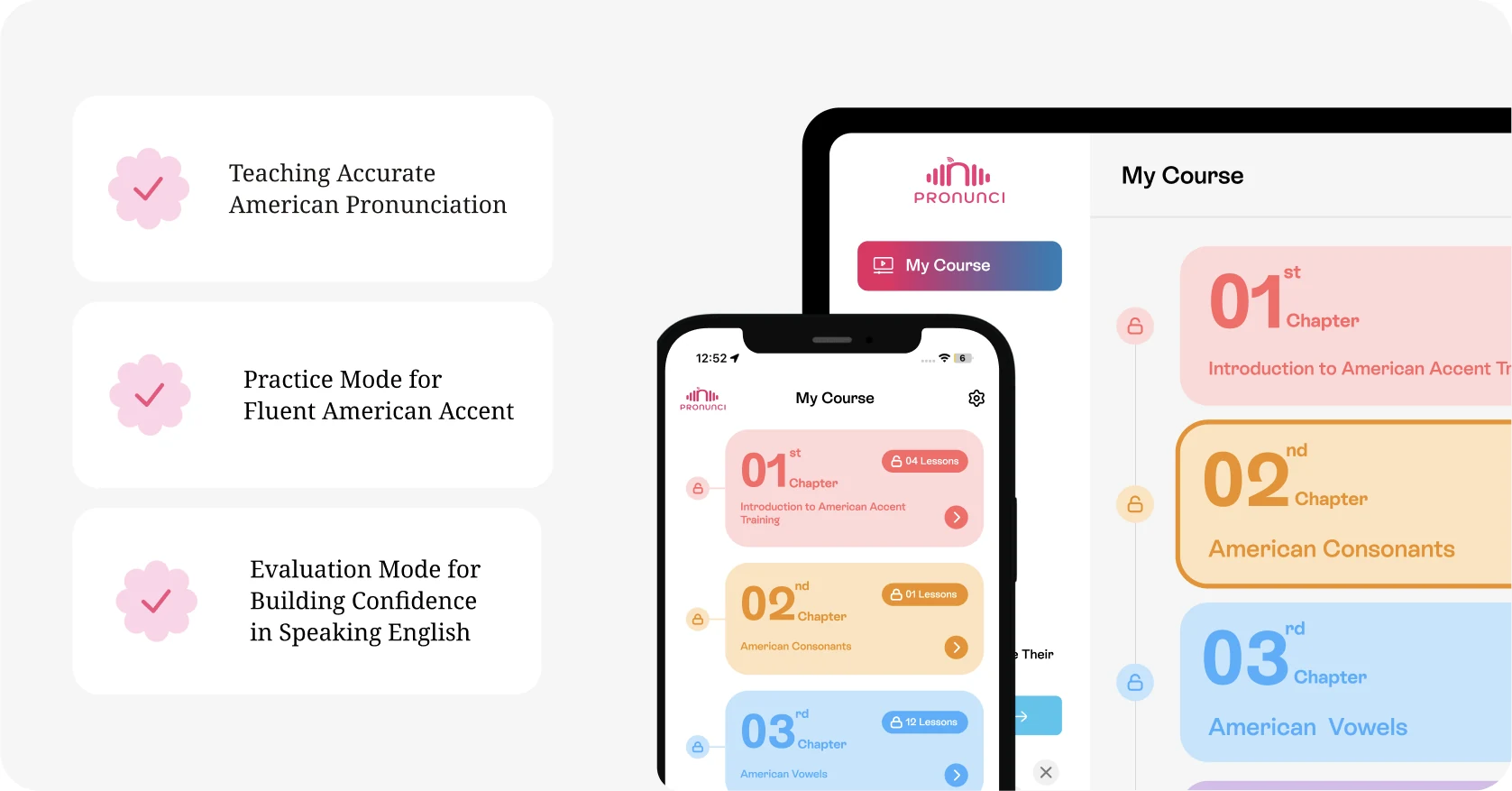
- Speech Organs EducationStudents learn how the speech organs work, along with the AI Accent Coach commands and feedback.
- American ConsonantsPractice and evaluate American consonants in phonetic exercises and practice sentences with the AI Accent Coach.
- American VowelsPractice and evaluate American vowels in phonetic exercises and practice sentences with the AI Accent Coach.
- IntonationLearn how intonation can change the meaning of what you say.
- CertificateBy the end of the course, students receive a certificate.
What Is Accent Reduction and How Does Structured Training Work?
Accent reduction describes a retraining process for pronunciation habits, not a single named method or product you buy off the shelf. When people ask what is accent reduction, they’re usually asking how someone can change deeply ingrained speech patterns borrowed from their first language into clearer American English sounds, stress, and rhythm.
What Does Accent Reduction Mean for American English Pronunciation?
It means retraining the physical habits of speech, not adopting a trick or a fixed curriculum with one official name. Every speaker’s tongue, lips, jaw, and airflow learned their resting positions and movement patterns from their native language, long before they ever studied English [3]. Those positions become automatic through years of repetition, which is exactly why they resist change when a learner just memorizes vocabulary and grammar rules.
Speech and language researchers call this interference: features of the first language carry over into the second, affecting individual sounds as well as stress and intonation patterns [2]. Structured accent training works by interrupting that automatic transfer. It isolates each American sound, trains a new speech-organ position deliberately, and repeats it until the new position becomes just as automatic as the old one.
What Are the Main Stages of Accent reduction Training?
A structured process moves through a logical sequence, each stage building on the one before it.
- Sound articulation. Train the tongue, lips, jaw, and airflow to produce each American vowel and consonant correctly in isolation.
- Phonetic exercises. Repeat those sounds in combinations, reductions, and assimilations until production is steady and no longer requires conscious effort.
- Sentence-level stress and intonation. Apply the trained sounds inside natural American rhythm, word stress, and melody.
- Paragraph-level delivery. Extend accurate pronunciation and intonation into longer, presentation-style speech for meetings, interviews, and everyday conversation.
InPronunci follows this exact sequence. Its Interactive Visual 2D Sound Simulators train the tongue, lips, jaw, teeth, and airflow for each American sound, while Pronunci Instructions from Prof. Alex, Ph.D. Accent Coach, Doctor of Education, and professional linguist, guide students through each step so they know precisely what to adjust.
The American R illustrates why sound-level training has to come first. It requires the tongue to pull back and curl slightly without touching the roof of the mouth, a position many languages simply don’t use. Skip that isolated training and jump straight to sentences, and the old tongue position resurfaces every time, no matter how much vocabulary a learner knows.
What’s the Difference Between Reducing and Eliminating an Accent?
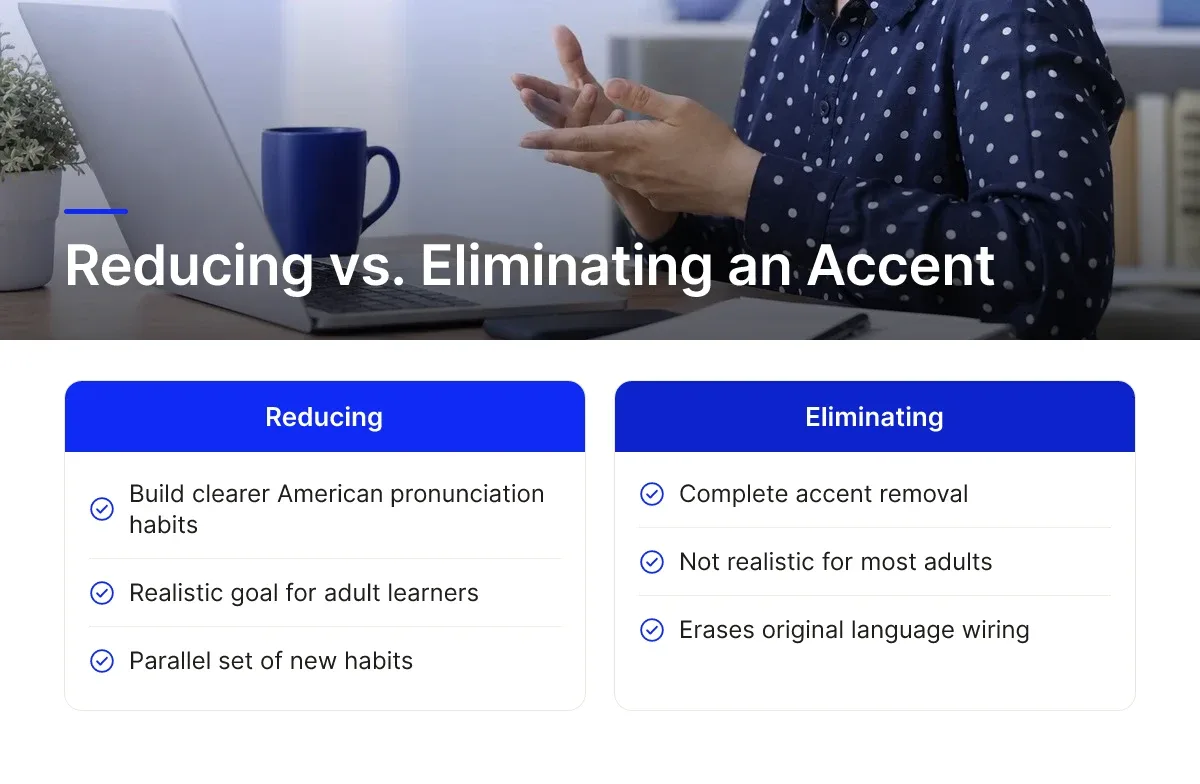
Reducing an accent means building clearer, more natural American pronunciation habits alongside your existing ones; eliminating an accent, as a complete goal, is not realistic for most adult learners.
Part of answering what is accent reduction means explaining what it changes and what it does not. An accent is not a flaw to fix. It is the result of years of neuromuscular habits: your tongue, lips, and jaw learned to produce the sounds of your first language long before you studied English, and those movement patterns are deeply automatic. Accent training does not erase that wiring. It builds a second, parallel set of habits for American sounds, stress, and intonation, so you can access either pattern depending on context. That is also why some trace of the original accent typically remains, even after months of focused work.
Why Is Reduction the Realistic Goal, Not Elimination?
The realistic goal is to sound clearer, more intelligible, and more natural in American English, not to sound identical to someone born and raised in the US. Research on pronunciation instruction supports this framing: explicit, targeted practice measurably improves comprehensibility and reduces the listening effort required from others, even when a detectable accent remains [3]. Clarity and nativelikeness are related but separate outcomes, and clarity is the one that actually affects whether people understand you the first time, whether in a meeting, a client call, or a classroom presentation.
Can You Keep Your Native Accent While Still Reducing It?
Yes. Wanting clearer pronunciation in professional or academic settings does not mean giving up your cultural or linguistic identity [1]. Respecting the accent you already have is part of the process, not an obstacle to it. Training adds tools, including better command of American vowels, consonants, and rhythm, that you choose to use when the setting calls for it.
Some learners do want to get as close as possible to native-level American English, often for specific professional reasons: leading presentations, closing client calls, or reducing the number of times they get asked to repeat themselves. That is a legitimate goal, but it still sits on a spectrum of clarity and naturalness rather than a binary switch between “accented” and “native.” InPronunci reflects that spectrum directly, offering an Intermediate evaluation level for speakers focused on confident, independent communication and an Advanced level, recommended with the Premium Plan, for those working toward native-like American pronunciation with Prof. Alex, Ph.D. Accent Coach, Doctor of Education, and professional linguist.
What Methods Actually Work for Accent Reduction?
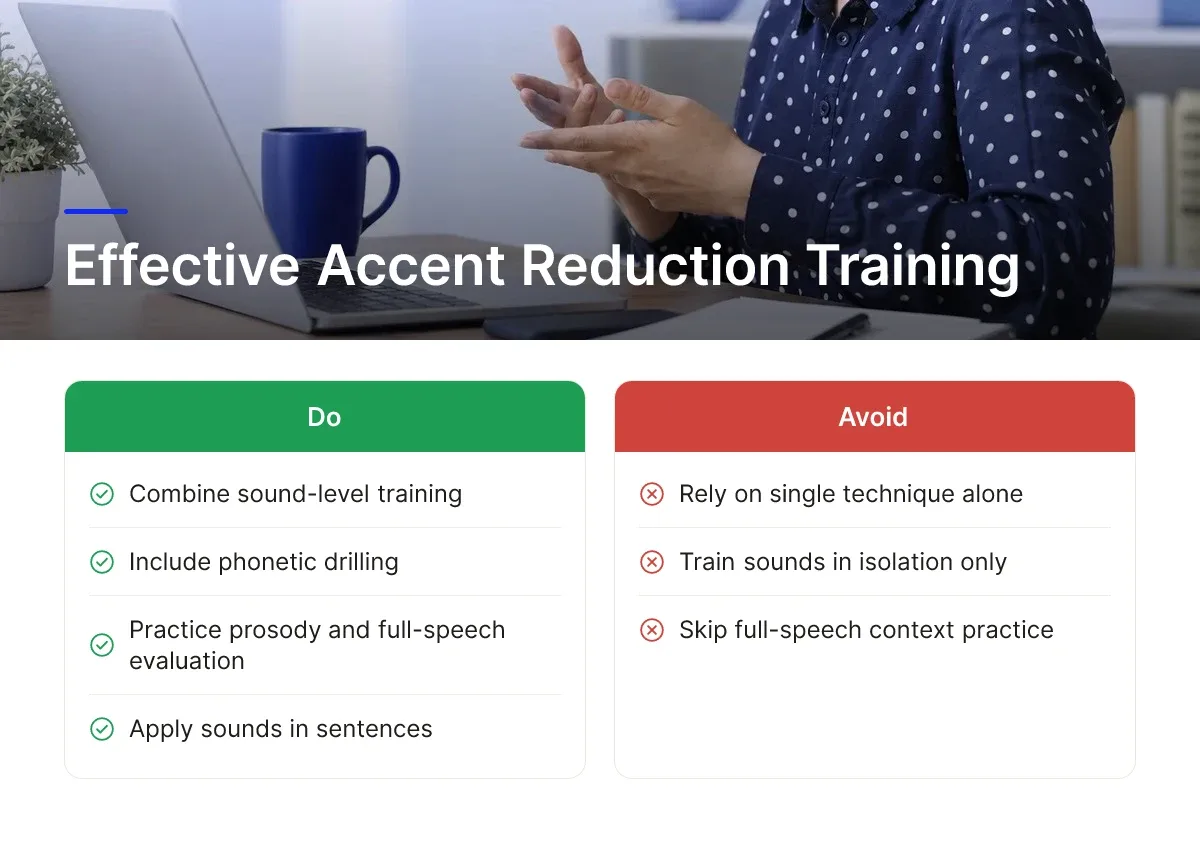
The methods that work combine sound-level training, phonetic drilling, prosody practice, and full-speech evaluation, no single layer gets a speaker to natural American English alone. Answering what is accent reduction in practice means looking at how these layers connect, not picking one technique and repeating it.
How Do Phonetic Exercises, Sound Articulation, and Intonation Work Together?
Training a sound in isolation does not mean a speaker will produce it correctly in a sentence. A Hindi speaker who masters the American flap T in the word “water” during a drill can still revert to a retroflex /t/ once that word sits inside a fast sentence with five other words competing for attention. This is why phonetic exercises exist as a separate, necessary step: they train sound combinations, reductions, and assimilations, the patterns that happen when sounds bump into each other in real speech, like “did you” becoming “didja.”
Prosody is a distinct layer again. American English is stress-timed, meaning stressed syllables fall at roughly even intervals and unstressed syllables compress, with vowels reducing to a schwa sound in between [3]. Spanish and Portuguese are syllable-timed, where each syllable gets closer to equal length and full vowel value. A Spanish speaker who has trained every American consonant and vowel correctly can still sound non-native if sentence rhythm and word stress follow syllable-timed patterns instead of the stress-timed pattern American listeners expect. Sound accuracy, phonetic fluency, and prosody are three separate skills, and training only one leaves gaps in the other two.
What Makes Some Approaches More Effective Than Others?
Full-speech evaluation catches errors that single-word or single-sound scoring misses entirely. An app that scores one word in isolation cannot tell a learner whether their intonation rises correctly on a yes/no question, whether they linked words naturally across a sentence, or whether their rhythm matched stress-timed English. Research on pronunciation instruction has found that explicit, structured teaching produces measurable gains in both production and perception compared to unguided exposure [5].
InPronunci: American Accent Training App is built around this layered principle rather than any single method. Its four connected stages move from American sound articulation training with the Interactive Visual 2D Sound Simulators, to phonetic exercises that make sounds automatic in combinations, to sentence practice with stress and intonation training, to paragraph practice with presentation-style delivery. The AI Accent Coach evaluates pronunciation, intonation, melody, rhythm, connected speech, and sentence flow together as a student speaks, not a single word at a time, and Feedback & Analysis then breaks that speech into sentences, words, and sounds so the learner knows exactly where to adjust.
First-language patterns shape which layer needs the most attention, though these are tendencies, not rules for every speaker. Hindi, Tamil, and Telugu speakers often work on the flap T and retroflex consonants. Spanish and Portuguese speakers often focus on final consonants and shifting from syllable-timed to stress-timed rhythm. A structured course that trains sounds, phonetic combinations, and prosody in sequence, and then evaluates full speech, addresses these patterns more directly than any one isolated technique. For more on how rhythm and linking shape natural speech, see our guide to connected speech.
How Long Does Accent Reduction Take to Show Results?
There is no fixed number of weeks: progress depends on how many sounds differ from your native language, how often you practice, and whether that practice is structured or random. Anyone asking what is accent reduction in practical terms needs to understand it as a skill built through repetition, not a one-time fix.
What Should You Expect in Terms of a Timeline?
Three variables drive your pace more than anything else. First, the distance between your native sound system and American English: a Spanish speaker working on the short-vowel distinction in “ship” versus “sheep” faces a different workload than a Mandarin speaker rebuilding final consonants. Second, practice frequency: a few minutes of focused drilling most days moves faster than occasional, unstructured attempts. Third, and often overlooked, is whether practice is explicit and sound-by-sound or just passive exposure to English media.
Thomson and Derwing’s 2015 review of pronunciation research found that explicit instruction, where learners are taught specific sounds and patterns directly rather than left to absorb them through listening alone, produces more consistent gains than exposure-based approaches [2]. This matches how InPronunci structures its training: name the sound, train the articulation with the Interactive Visual 2D Sound Simulators, then drill it into phonetic exercises and sentences until it becomes automatic. That sequence, not calendar time, is what predicts whether a sound sticks.
How Do You Measure Progress Along the Way?
Progress shows up in specifics, not a general feeling of improvement. Compare a recording of your own speech against a native-speaker model and listen for where they diverge. Track which particular sounds or intonation patterns still cause listeners to ask you to repeat yourself, and note whether that list is shrinking. Feedback on full sentences matters more than feedback on isolated words, since connected speech reveals whether a corrected sound holds up at natural speed.
InPronunci’s Your Coach vs. My Pronunci Pronunciation Comparison Tool lets you set your own recording next to the native-speaker model and notice the gap directly. The AI Accent Coach adds a second layer, evaluating pronunciation, intonation, rhythm, connected speech, and sentence flow as you speak, rather than scoring a single word in isolation. Used together over time, these give you a concrete record of which sounds have stabilized and which still need the sound-by-sound work that defines structured accent training.
Cognitive Accent Training
Compare Your Coach vs. Your Pronunci
In every practice sentence, students listen to Your Coach, record their own voice, and compare it with Your Pronunci, so they consciously notice and correct each sound.
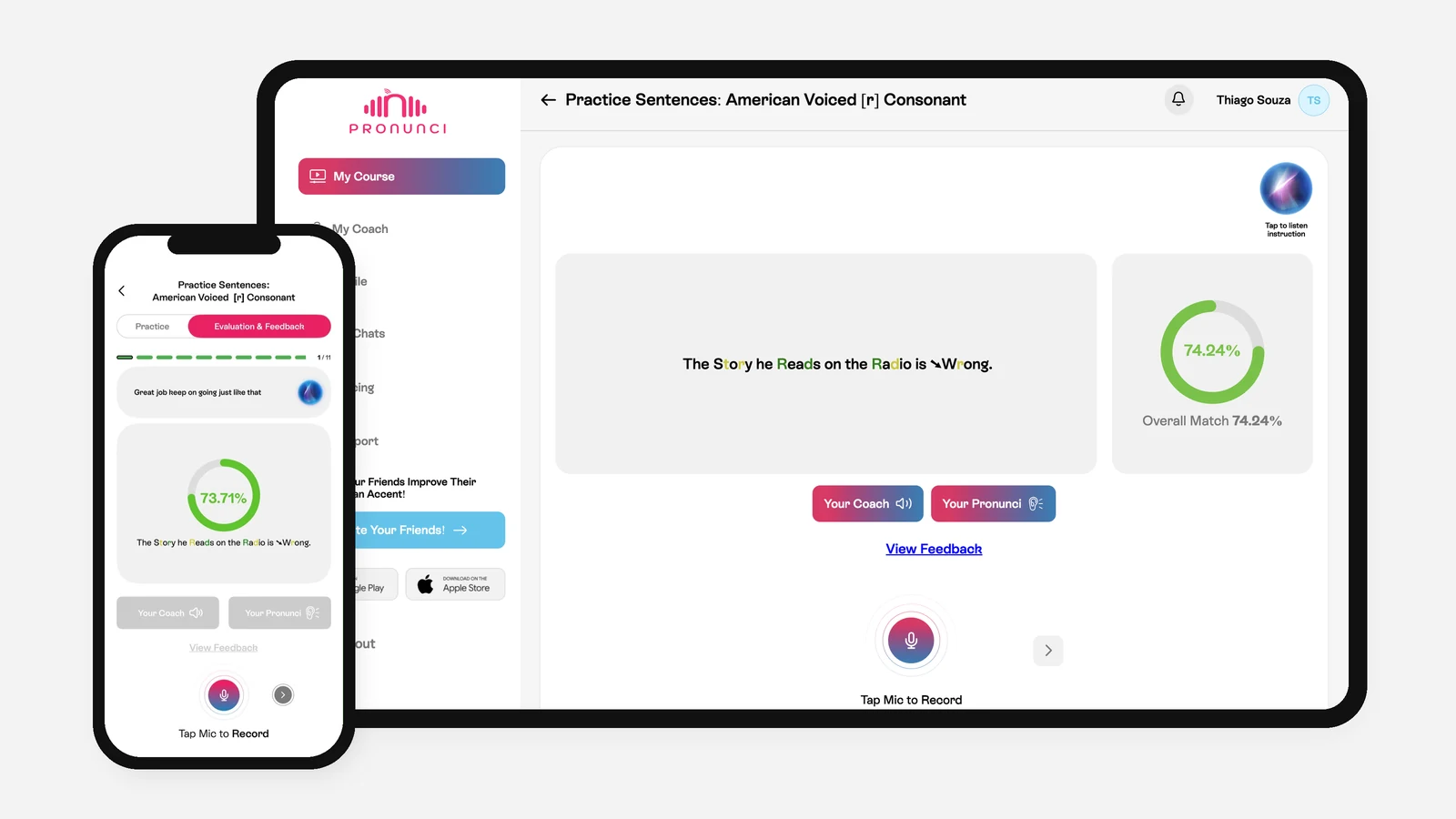
- Listen to Your CoachThe model American pronunciation of each practice sentence.
- Compare with Your PronunciYour own recorded pronunciation, side by side with the coach.
- Correct with feedbackThe match score and color-coded letters guide each correction.
Who Benefits Most From Accent Reduction Training?
Anyone whose accent gets in the way of being understood quickly, in situations where that matters, benefits most from structured training. This isn’t a narrow group: it spans client-facing professionals, healthcare staff, tech teams, exam candidates, and even native speakers who want sharper, more neutral delivery.
A software engineer leading a stand-up with a distributed team needs to be understood the first time, not after repeating a sentence twice. A nurse or physician explaining a treatment plan to a worried patient can’t afford a misheard word. A call center agent handling dozens of calls a day needs rhythm and clarity that build trust fast. IT professionals on global teams, consultants presenting to American clients, and managers delivering performance reviews all share the same pressure: speech has to land the first time. TOEFL and IELTS speaking candidates face a related but different challenge, a structured evaluation of pronunciation, intonation, and fluency, where clear articulation and natural stress patterns directly affect the score. Even native English speakers sometimes want this kind of training, trading a strong regional accent for one that colleagues and audiences find easier to follow nationwide.
Is Accent Reduction Worth the Time Investment?
The honest answer depends on how often unclear speech costs you something. If a thick accent means repeated requests to “say that again” in interviews, client meetings, or patient conversations, the time spent on structured practice pays off in fewer breakdowns and more confident delivery. If miscommunication rarely happens, the case for intensive training is weaker. This is a practical calculation, not a universal rule, which is part of answering what is accent reduction in realistic terms: it’s an investment weighed against the cost of being misunderstood in moments that matter.
How Much Improvement Can Realistic Training Deliver?
Structured practice, the kind built around sound articulation, phonetic drills, and intonation work rather than casual repetition, can produce clearer consonants and vowels, more natural sentence rhythm, and steadier confidence under pressure [3]. What it does not deliver is an overnight transformation. Pronunciation change is a gradual, skill-building process, closer to learning an instrument than flipping a switch [5].
For readers with an underlying speech or hearing difficulty, structured accent training like InPronunci’s is supportive practice, not therapy or diagnosis. A licensed speech-language pathologist is the right resource for disorder-level concerns [2]. For everyone else working toward clearer, more natural American English, InPronunci’s four-stage course, sound articulation, phonetic exercises, sentence intonation, and paragraph delivery, guided by Pronunci Instructions from Prof. Alex and evaluated by the AI Accent Coach, gives that gradual process real structure. See the full course overview for how the stages connect.

Real student result: before and after training
Vlad, a Russian speaker, trained in the InPronunci Premium Plan, which combines Interactive 1-on-1 American Accent Training with Prof. Alex and daily practice in InPronunci. Prof. Alex recorded and evaluated each recording on a scale from 0 to 100, where 100 = native speaker.
Premium Plan result

VladPower Engineer
Russian speaker
“It feels amazing when people say, ‘Your accent is so good. Where did you learn it?’ My answer is always, ‘Thanks to my great teacher, Alex.’”
Full evaluation of Vlad on MyAccentWay
5monthsof hard work and dedication
Listen to the starting point0:00
Listen to the result0:00
Questions & Answers
Frequently Asked Questions
01Is accent reduction the same as speech therapy?
No, they overlap but serve different purposes. Accent reduction is pronunciation training for clear communication in a second language, while speech therapy treats speech or language disorders and is delivered by a licensed speech-language pathologist [2]. If you suspect a disorder (stuttering, articulation disorder, voice problems), see a licensed clinician rather than an accent training app or course.
02Can adults still make real progress with accent reduction, or is it easier for children?
Adults can make measurable progress with targeted pronunciation instruction, though full native-like acquisition becomes harder after childhood. Explicit instruction, the kind that teaches tongue, lip, and jaw position directly, produces significant gains in adult learners [3]. Age affects how close learners get to native-like speech, not whether they can improve. Consistent, structured practice is what drives the change, at any age.
03Do you need to practice every day for accent reduction to work?
Regular, structured practice matters more than long sessions, but daily practice isn’t strictly required. Short, focused sessions, several times a week, that isolate specific sounds and build toward sentences and paragraphs tend to produce steadier progress than occasional long sessions. Consistency over time outperforms cramming.
04What’s the difference between an accent reduction app and working with a coach?
Apps give structured, repeatable practice anytime; a coach gives personalized correction and judgment calls an app can’t make alone. Many learners benefit from combining both: InPronunci pairs Pronunci Instructions from Prof. Alex, Ph.D. Accent Coach, Doctor of Education, and professional linguist, with AI Accent Coach feedback on full speech, and its Premium Plan adds a monthly 1-on-1 live session with Prof. Alex for personalized guidance between independent practice sessions.
Conclusion
Accent reduction works by retraining specific speech organs and patterns, not by erasing an accent or memorizing vocabulary lists. Progress depends on three things: training individual sounds with correct tongue, lip, and jaw position, making those sounds automatic through repeated phonetic practice, and applying them in the stress, rhythm, and intonation of real sentences [3]. Skipping straight to conversation practice without this foundation is why many learners plateau.
Start with the sounds that cause the most confusion in your own speech, not a random list. Try Free Chapter 1 of InPronunci on the web to see how sound-by-sound training with Pronunci Instructions works before committing to a full plan.
Sources & References
- What Is Accent Reduction? – Accent Advisor
- Accent Reduction – UCF Communication Disorders Clinic
- Accent reduction – Wikipedia
- Do Accent Reduction Classes Work? | ALTA Language Services
Recommended Articles
Why Do I Have an Accent and What Causes It in English?
You keep your native accent in English because your speech organs learned to produce sounds, rhythm, and intonation for your first language first, and those...
What Cognitive Accent Training Is and How It Rewires Speech
Cognitive accent training retrains your speech organs and listening habits together: you train the tongue, lips, jaw, and airflow to produce accurate...
Why Connected Speech in American English Matters for Fluency
How to practice connected speech in American English: linking, flap T, reductions and dropped sounds, one pattern at a time.
Plans
What InPronunci costs
InPronunci Basic
$35 per month
Chapter 1 is free after signup.
InPronunci Premium
$200 per month
Includes a coach: