


You develop an American accent by retraining the physical mechanics of speech, mouth shape, tongue placement, and rhythm, not by memorizing rules. The process moves through three stages: isolating individual sounds (especially vowels and the American R), building sentence-level rhythm and stress, then applying both in spontaneous conversation. Most learners need consistent daily practice over several months before the accent holds up outside of drills, with speed depending on native language background and how much feedback they get on their actual speech.

Identify How an American Accent Differs From Your Current Speech Patterns
An American accent differs from most other English varieties in four measurable ways: tongue position, vowel shape, rhythm timing, and pitch range on stressed syllables. Before you learn how to speak with American accent patterns, you need a clear map of what’s actually changing in your mouth and voice, not a vague sense of “sounding American.”
Start with the tongue. American English uses a flatter, more forward tongue position than British Received Pronunciation, and it’s rhotic, the “R” sound gets pronounced in nearly every position, including after vowels in words like “car” and “better.” Non-rhotic varieties, including standard British and Australian English, drop that R sound unless a vowel follows it. This single feature accounts for a large share of what listeners perceive as “American” in the first three seconds of speech.
Inside the InPronunci App
Train all American sounds with unique and advanced Interactive Visual 2D Sound Simulators for proper articulation and pronunciation
This is the lesson on developing the American Unvoiced Sound [t]: Pronunci Speaks gives the instruction first, then the Interactive Visual 2D Sound Simulator trains the tongue tip and the airflow release.
- EffectiveMost apps offer visual learning. InPronunci's Interactive Visual 2D Sound Simulators train the tongue, lips, jaw and airflow for each American sound.
- ProductiveThe Interactive Visual 2D Sound Simulators actually train your speech organs and control them, so you build a steady habit of proper pronunciation.
- ResultsStudents pronounce individual American sounds with almost native-like pronunciation.
How American Pronunciation Compares to British, Australian, and Other Varieties
American vowels tend to be more relaxed and drawn out, while British Received Pronunciation favors crisper, higher vowel placement with a smaller mouth opening. Say “dance” or “class” in each accent, the American version opens the jaw wider and holds the vowel longer, while RP keeps it short and tight. This isn’t stylistic; it’s a difference in how far the jaw drops and where the tongue sits in the mouth.
Rhythm separates American English even further from languages like Spanish, French, or Mandarin, which use syllable-timed rhythm, each syllable gets roughly equal length and weight. American English is stress-timed: stressed syllables land at fairly even intervals, and unstressed syllables compress or reduce almost to a mumble. Speakers coming from syllable-timed backgrounds often sound clipped or overly even to American ears, even when every word is pronounced correctly.
Intonation compounds the effect. American English carries wider pitch swings on stressed words, which is part of why flat, evenly-pitched delivery can read as hesitant or unconfident to a native listener, regardless of vocabulary or grammar.
The practical first step is diagnostic: record yourself reading a short paragraph aloud, then compare it against a native speaker saying the same lines. Listen specifically for R sounds you’re dropping, vowels that sound clipped instead of relaxed, and pitch that stays flat where a native speaker would swing up or down. That comparison, not general practice, tells you which mechanical feature to fix first.
How to Speak With an American Accent by Training Speech Mechanics and Muscle Memory
Learning how to speak with American accent requires retraining the tongue, jaw, and throat through isolated repetition before combining sounds into words and sentences.
Accent comes from more than individual vowels and consonants, it comes from the overall shape and tension of the vocal tract, which is why two people can hit the same phonetic target and still sound different [1]. Retraining that shape follows a specific order, moving from the smallest unit of sound to full connected speech.
Start With Isolated Sounds
- Identify the two or three sounds that cause the most trouble, commonly the American R, the TH sounds in “think” and “this,” and short vowels like the one in “bit” versus “beat.”
- Practice each sound alone, repeatedly, without attaching it to a word. Say the R sound by itself for several minutes before trying “red” or “car.”
- Move to minimal pairs once the isolated sound feels stable, “ship/sheep,” “bat/bet,” “this/these”, to sharpen the distinction between similar sounds.
- Only after the sound is consistent in pairs, place it inside full sentences where surrounding sounds compete for tongue and jaw position.
This sequence matters because muscle memory forms faster when the tongue and jaw repeat one specific motion without interference from neighboring sounds. Jumping straight to sentences forces the mouth to juggle several new motions at once, which slows down consolidation and reinforces old habits instead of replacing them.
Watch the Mouth, Not Just the Ear
Most learners cannot feel the difference between their own mouth position and a native speaker’s, even when they can hear that something is off. Practicing in front of a mirror, or recording short clips and comparing them side by side with a native reference, closes that gap by turning an unnoticed motion into a consciously controlled one. This is the same principle behind articulation training tools: learning tongue and lip placement removes the guesswork that pure listening leaves behind. InPronunci’s 2D Sound Motion simulators apply this directly, training learners to move their speech organs into the native pattern for each target sound rather than asking them to guess from audio alone.
Cognitive Accent Training
Compare Your Coach vs. Your Pronunci
In every practice sentence, students listen to Your Coach, record their own voice, and compare it with Your Pronunci, so they consciously notice and correct each sound.
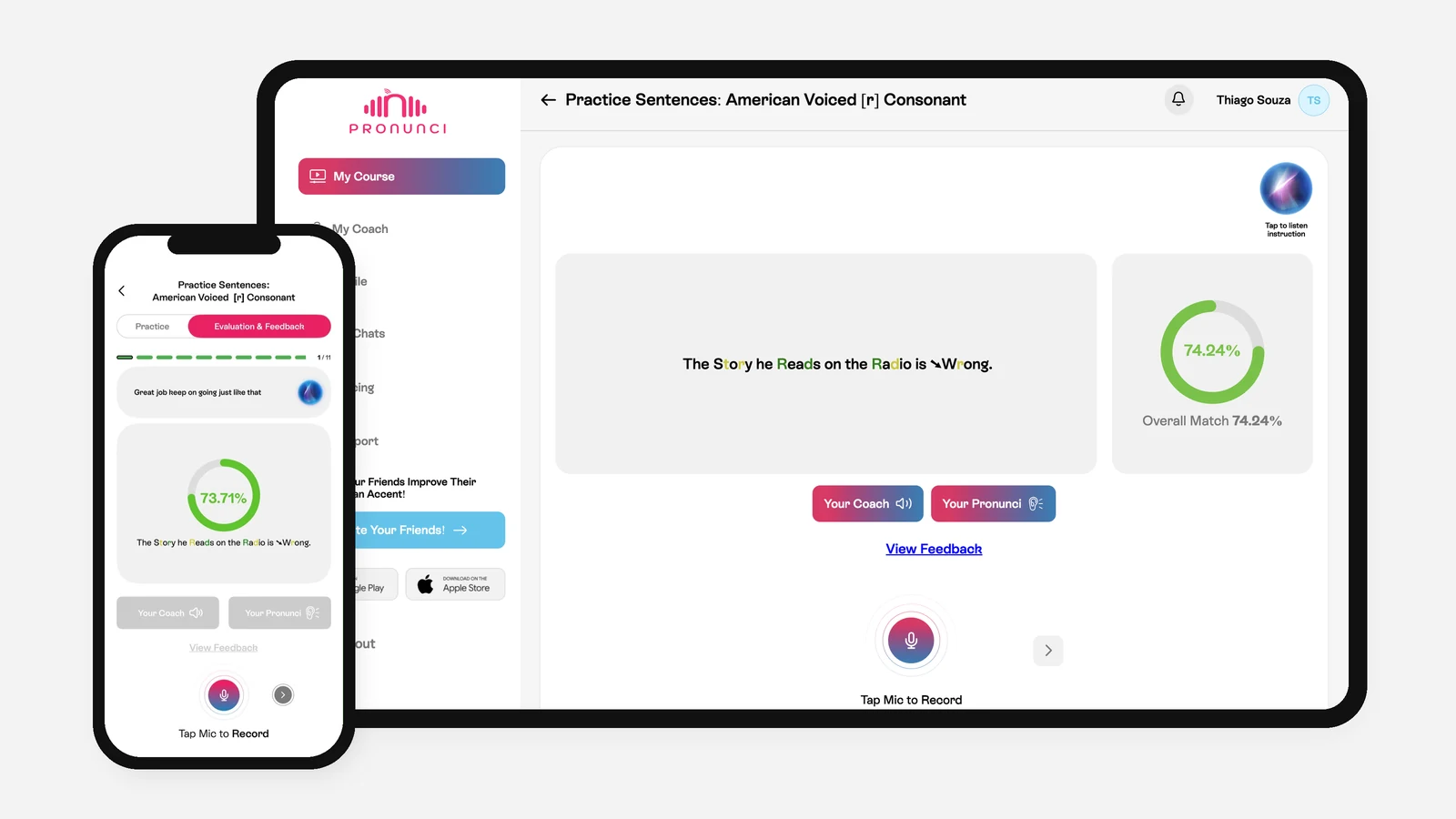
- Listen to Your CoachThe model American pronunciation of each practice sentence.
- Compare with Your PronunciYour own recorded pronunciation, side by side with the coach.
- Correct with feedbackThe match score and color-coded letters guide each correction.
Build Toward Connected Speech
Individual sounds are only half the picture. Native-sounding speech links words together, reduces unstressed vowels toward a neutral “uh,” and blends sounds across word boundaries, “want to” becomes “wanna,” “did you” becomes “didja” [2]. Without this layer, speech stays technically correct but sounds choppy and overly deliberate.
Practice Daily, Briefly
Short daily sessions build durable muscle memory more reliably than occasional long ones, because motor learning consolidates through repeated exposure spaced over time rather than volume in a single sitting. Ten focused minutes a day on isolated sounds, minimal pairs, and short connected-speech drills produces steadier progress than an hour once a week.
Choose Which American Accent Variation to Learn
Most learners should target General American, the neutral broadcast accent, rather than a strong regional variety like Southern or New York, because it carries the fewest markers that flag a speaker’s origin and is understood everywhere in the country.
Before picking a target, it helps to know what “American accent” actually covers. The United States has several distinct regional accents, each with its own vowel shifts, rhythm, and stress patterns. Learning how to speak with American accent that travels well across regions means starting with the version that has the least regional coloring, then adjusting later if you settle somewhere specific.
How Southern, Midwestern, New York, and California Accents Differ From Each Other
Southern accents stretch certain vowels into drawls, “yes” can become closer to a two-syllable sound, and shift stress differently on multi-syllable words compared to General American. Midwestern accents, sometimes called the Inland North accent, sit closest to General American in vowel quality and rhythm, which is part of why national news anchors are frequently trained on this base.
New York accents show a different pattern: dropped Rs at the end of syllables in some speakers, plus distinct vowel qualities in words like “coffee” or “talk.” California accents, especially among younger speakers, show specific vowel mergers, words like “cot” and “caught” often sound identical, and certain front vowels shift slightly forward or backward compared to General American. None of these variations is “wrong.” They’re just more regionally specific, which means listeners outside that region may need a beat longer to process them.
Which American Accent Variation Works Best for Professional Communication
General American is the practical default for professional and social contexts because it’s the accent used by most national broadcasters and carries the fewest regional markers, so it reads as neutral rather than tied to one city or state [1]. For a non-native speaker building credibility in meetings, client calls, or presentations, that neutrality removes one more variable that could distract a listener from the actual content.
The choice still depends on the goal. If the aim is professional communication, leading a call with colleagues in different states, presenting to a mixed audience, or simply sounding clear on video, General American is the safer target. If the goal is social integration in a specific place, say Atlanta or Boston, picking up a light, regional flavor can help with rapport, as long as the core sounds stay intelligible. InPronunci’s curriculum trains General American as the baseline, using phonetic exercises and 2D Sound Motion simulators to build the articulation patterns that carry across contexts before any regional nuance gets layered on top.
Set a Realistic Timeline and Track Your Progress
Most learners see measurable change in isolated sounds within weeks, but spontaneous conversational accuracy takes months of consistent work to shift permanently. Anyone researching how to speak with American accent training should expect a gradual curve, not a single breakthrough.
What Factors Affect How Quickly You Can Learn an American Accent
Progress speed depends on four variables, and they interact rather than operate independently.
- Native language distance from English phonetics: Speakers of languages with similar vowel systems or stress patterns to American English adjust faster than speakers whose native phonology differs sharply.
- Daily practice volume: Ten focused minutes a day produces faster gains than an hour once a week, because muscle memory for articulation builds through repetition, not duration.
- Prior exposure to spoken English: Learners who have spent years listening to American media or working with American colleagues already have a mental model of the target sounds, which shortens the adjustment period.
- Access to consistent feedback: Without a way to hear the gap between your production and the target sound, errors get reinforced instead of corrected. This is where structured tools matter, InPronunci’s AI Accent Coach gives real-time evaluation on each practice session, so learners catch drift before it becomes habit.
What to Expect at Each Stage of American Accent Training
Change doesn’t arrive evenly across skills. It moves from controlled to spontaneous speech in a predictable order.
- Early weeks: Isolated sounds improve first. You’ll notice better control over individual vowels and consonants during slow, deliberate drills.
- A few months in: Scripted or rehearsed speech, reading a paragraph aloud, delivering a prepared line, starts to sound noticeably more American, since you have time to apply what you’ve practiced.
- Longest to shift: Spontaneous conversation. Under the cognitive load of forming ideas in real time, speakers default to ingrained native-language patterns until the new articulation becomes automatic rather than effortful.
This lag is normal, not a sign of failure. It reflects how motor learning works: a skill only transfers to unscripted use once it no longer requires conscious attention.
How to Measure Improvement Objectively
Self-assessment works best when it’s specific and evidence-based rather than a vague sense of “sounding better.”
- Record yourself weekly and compare the same sentence against a native speaker sample, listening for one sound or feature at a time.
- Track individual sounds over time, the “th” sound this month, vowel reduction next month, instead of judging your accent as a whole.
- Use minimal-pair drills (ship/sheep, cot/caught) to confirm you can reliably produce and distinguish specific contrasts.
Your native language also determines which sounds need the most attention. Spanish speakers often need focused work on vowel reduction, since Spanish vowels stay full in unstressed syllables. Mandarin speakers more often need work on consonant clusters and word stress, since Mandarin syllable structure rarely allows the consonant sequences common in English.
Common Mistakes to Avoid When Practicing an American Accent
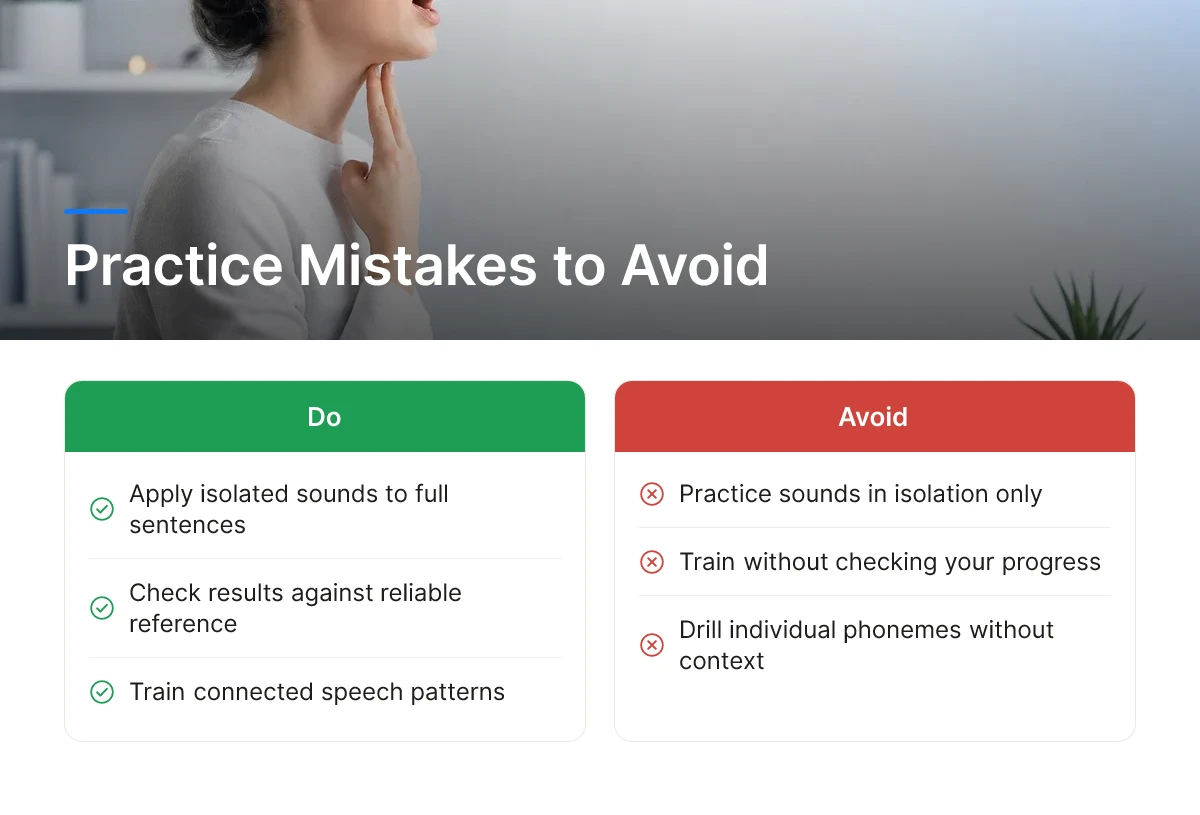
Most learners stall not because they lack effort, but because they train the wrong thing, inconsistently, without checking their results against a reliable reference.
- Practicing sounds in isolation and never applying them. Drilling the American “r” or the short “i” in a word list feels productive, but that skill has to transfer into full sentences and conversation to matter. Rachel’s English notes that an accent comes less from individual sounds than from the overall shape and tension of the throat and mouth as you speak connected speech [1]. If you only ever say a phoneme alone, you’re training a skill you’ll rarely use.
- Trusting your own ear over a reference or structured feedback. Your brain is used to how your voice sounds internally, which makes it a poor judge of how you actually sound to a listener. Recording yourself and comparing it against a native speaker, or getting outside feedback, catches gaps that self-assessment misses.
- Fixing sounds while ignoring rhythm and stress. A voice coach’s checklist for accent training points out that isolated sound accuracy is only one of several components in a convincing accent, word stress, sentence rhythm, and intonation carry just as much weight [2]. You can pronounce every consonant correctly and still sound foreign if stressed syllables aren’t longer and louder than unstressed ones.
- Practicing in occasional long sessions instead of daily short ones. Accent training is a motor skill, and motor skills build through repetition spaced over time, not cramming. A focused 10 to 15 minute daily session builds muscle memory more reliably than an occasional hour-long push, because the muscles involved in articulation need frequent, consistent signals to adapt.
How to Use AI and Speech Recognition Technology for Real-Time Feedback
AI-based speech feedback tools catch pronunciation and rhythm errors a learner physically cannot hear in their own voice, because they compare your speech against modeled native patterns rather than relying on your own perception.
This is where structured platforms differ from casual self-practice. InPronunci’s AI Accent Coach evaluates articulation, intonation, and connected speech as you speak, and its 2D Sound Motion simulators train exactly how your mouth and tongue should move for a given sound compared to how yours actually moved. Combined with sentence and paragraph drills that force sounds into real context, this closes the gap between knowing how to speak with American accent in theory and doing it consistently under pressure, in a meeting, a presentation, or a client call.
Questions & Answers
Frequently Asked Questions
01Can adults develop a convincing American accent, or is it too late after childhood?
Adults can develop a convincing American accent because pronunciation is a motor skill, not a fixed trait tied to age. It takes deliberate, repeated practice of throat, tongue, and mouth positioning rather than passive exposure. Progress is slower than for children, but consistent, targeted drilling over weeks produces measurable change in clarity and rhythm.
02Do I need to eliminate my native accent completely to sound American?
No, complete elimination isn’t the goal or a realistic benchmark for most learners. The aim is intelligibility and confidence in professional settings, which requires accurate vowel sounds, stress patterns, and connected speech rather than a total erasure of your original accent.
03What assessment methods let me objectively track my pronunciation and intonation improvements?
Recording your own speech regularly and comparing it against native benchmarks is the simplest objective method, alongside AI-based speech evaluation tools. Platforms like InPronunci use an AI Accent Coach to score articulation, intonation, and connected speech in real time, paired with 2D Sound Motion simulators that train exact tongue and mouth positioning. This combination gives you a repeatable baseline instead of relying on subjective self-judgment.
04How do accent training needs differ for Spanish, Mandarin, or French native speakers?
Each language group struggles with different sound contrasts, so training should target those specific gaps rather than follow one generic path. Mandarin speakers often need work on consonant clusters and final sounds; Spanish speakers typically focus on vowel distinctions like the short “i” versus long “e”; French speakers often need help with the American “r” and aspirated consonants. A structured, phoneme-first curriculum adapts to these differences more effectively than generic drills.
05Is it better to practice with scripted sentences or free conversation?
Both matter, but scripted practice should come first to build accurate muscle memory before free conversation tests retention. Sentence and paragraph drills isolate specific sounds and rhythm patterns, while spontaneous speech confirms whether those patterns hold up under real communication pressure.
Conclusion
Sounding American isn’t about mimicking a voice, it’s about retraining specific muscle movements in your throat, tongue, and mouth, then reinforcing them through structured repetition [1]. Start with individual phonemes, move to sentence rhythm, and only then test yourself in unscripted conversation. Track progress with recordings or objective feedback rather than guesswork, since self-perception of accent is notoriously unreliable.
If you want that structure without building it yourself, try a guided phonetics-to-spontaneous-speech curriculum, such as the one InPronunci offers with its 2D Sound Motion simulators, as your next practice session.
Sources & References
- Simple Exercises for a PERFECT American Accent
- How to Speak with an American Accent // Rebecca Gausnell [Voice Coach]
Plans
What InPronunci costs
InPronunci Basic
$35 per month
Chapter 1 is free after signup.
InPronunci Premium
$200 per month
Includes a coach: