

Why do your English sentences feel like a series of isolated blocks when native speakers seem to produce one continuous stream of sound? This disconnect often happens because traditional language learning emphasizes individual words rather than the fluid reality of connected speech, which is the linguistic process where sounds are joined, linked, or deleted between words. In a 2022 analysis of professional communication, researchers noted that mastering these transitions is more critical for listener comprehension than the perfect pronunciation of individual consonants. Over-enunciating every syllable might feel like the path to clarity, but it often makes your speech sound robotic and difficult to follow in fast-paced professional settings.
It’s common to feel that sounding “correct” requires a stiff, formal delivery, but this approach often creates a barrier to natural communication. We understand that your goal isn’t just to be heard, but to be understood with ease and confidence. This guide is designed to help you master the mechanics of linking and reduction, providing you with the tools to transition from word-by-word speaking to a more rhythmic flow. We’ll examine how 2D Sound Motion Technology and 2D Sound Simulators can support your practice by making the invisible patterns of native speech visible and repeatable.
Key Takeaways
- Understand why dictionary-style American speech training often differs from natural conversation and how to identify these shifts in real-time.
- Explore the core pillars of connected speech, such as catenation and intrusion, to help your English sound more fluid and less robotic.
- Discover how mastering rhythm and stress patterns can improve your communication clarity more effectively than focusing on isolated sounds alone.
- Learn a practical, step-by-step routine for marking texts and active listening to bridge the gap between study and spontaneous speaking.
- See how 2D Sound Motion Technology can provide the visual feedback needed to master complex vowel-to-vowel transitions and smooth links.
What is Connected Speech in American English?
Connected speech is the linguistic phenomenon where sounds in words change, disappear, or blend together when spoken in a continuous stream. It isn’t a sign of careless speaking; it’s a fundamental characteristic of how English functions in real time. This process, often referred to as What is Connected Speech, involves complex shifts like assimilation, elision, and linking. These adjustments allow the speaker to maintain a consistent, rhythmic flow that defines the American accent.
To better understand this concept, watch this helpful video:
Traditional language learning often focuses on “citation form,” which is how a word sounds when spoken in isolation. While this is helpful for building vocabulary, it fails to prepare learners for the “natural speech” used by native speakers. In a sentence, words don’t sit like separate blocks in a line. Instead, they act like water, flowing into one another. This “glue” is what creates the distinct American English rhythm. Without it, speech sounds robotic and can be harder for native speakers to process quickly.
The Difference Between Word-by-Word and Fluid Speech
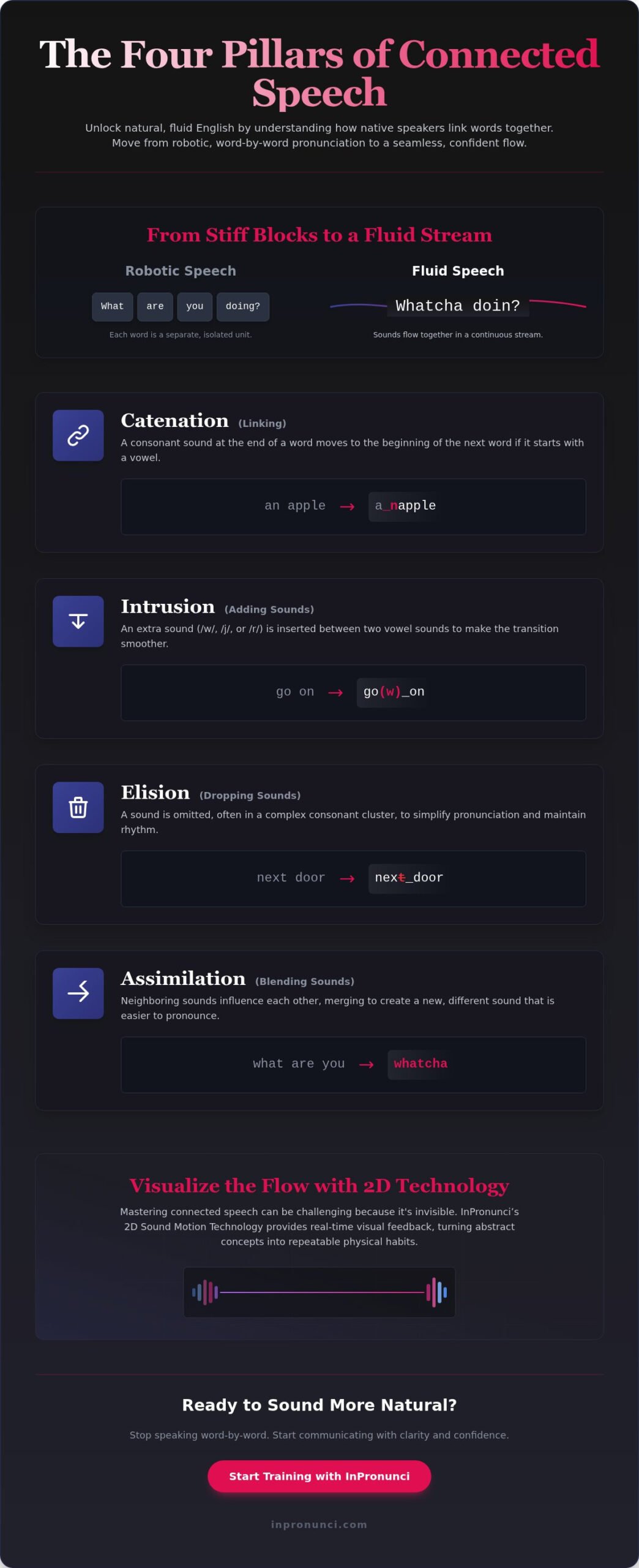
Consider the phrase “What are you doing?” In a classroom, you might hear four distinct, clearly articulated words. In natural conversation, it often sounds like “Whatcha doin?” Native speakers don’t hear these as errors or slang; they recognize them as standard markers of fluency. These shifts directly impact how American sounds function in professional contexts. Mastering these transitions helps you move away from a stilted delivery toward a more fluid, natural cadence that feels authentic to the listener.
Why Your Brain Struggles to Hear Connected Speech
Many learners struggle to understand fast speech because of phonological filtering. This is a mental process where your brain blocks out or misinterprets sound patterns that don’t match your internal map of the language. If your brain expects to hear “What” and “are” as separate units, it won’t recognize the blended “Whatcha” sound. This creates a gap between your vocabulary knowledge and your listening comprehension.
Research in linguistics suggests that mastering production directly improves your listening skills. When you learn to physically create these sound transitions, your brain begins to recognize them in others. Consistent practice can support better recognition of these patterns in daily life. InPronunci is an AI-powered American accent training app that uses 2D Sound Motion Technology, 2D Sound Simulators, and guided pronunciation practice to help learners improve American pronunciation. These tools help you visualize the physical movement required to bridge the gap between words, turning abstract concepts of connected speech into repeatable physical habits.
The Four Pillars of Connected Speech
Natural American English relies on a fluid transition between words rather than a staccato delivery of isolated sounds. This fluidity, known as connected speech, is governed by four primary linguistic mechanics. These processes allow the vocal tract to move efficiently from one position to the next, reducing the physical effort required for rapid communication. By understanding these pillars, learners can move away from robotic phrasing and toward a more rhythmic, predictable flow.
- Catenation: Consonants at the end of a word shift to the beginning of the following vowel-started word.
- Intrusion: An extra sound, usually a /j/ or /w/, is inserted to bridge two vowels.
- Elision: Specific sounds are omitted to simplify complex consonant clusters.
- Assimilation: Two neighboring sounds influence each other to create a third, distinct sound.
Mastering Catenation: Consonant to Vowel Linking
Catenation is perhaps the most visible element of a smooth American accent. When a word ends in a consonant and the next begins with a vowel, the consonant often “borrows” the vowel’s start. For example, “pick it up” doesn’t sound like three separate units; it sounds like /pɪ-kɪ-tʌp/. This transition is a core component of the American sound system, where the goal is to maintain a continuous stream of air. Many learners fall into the trap of pausing too long between words, which breaks the rhythm and makes speech sound disjointed. Consistent practice with these links helps the mouth muscles adapt to these rapid shifts without losing clarity.
Understanding Elision and Assimilation
Elision involves the disappearance of sounds that are physically difficult to pronounce in quick succession. In the phrase “next door,” the /t/ sound is often dropped, resulting in /neks-dɔːr/. Similarly, “sandwich” is frequently pronounced as /sænwɪtʃ/ because the /d/ requires a tongue position that slows down the transition to the /w/. These aren’t errors; they’re adjustments for physical ease. Assimilation takes this a step further by merging sounds. When you say “would you,” the /d/ and /j/ often combine to form a /dʒ/ sound, creating /wʊ-dʒu/. This happens because the tongue finds a middle ground between the two targets. These changes are driven by the economy of motion within the vocal tract. To help refine these transitions, using an AI American accent training app can provide the feedback necessary to recognize when to drop or merge sounds naturally.
Intrusion serves as the final pillar, acting as a phonetic lubricant between vowels. When one word ends in a vowel and the next begins with one, the vocal cords don’t simply stop. Instead, a small “y” or “w” sound appears. Phrases like “go on” become /ɡoʊ-w-ɒn/ and “see it” becomes /siː-j-ɪt/. Recognizing these small additions prevents the jerky pause that often marks a non-native rhythm. Mastering these four pillars isn’t about speed; it’s about developing the muscular coordination that supports a more natural connected speech pattern over time.
Why Connected Speech is Essential for Professional Clarity
Many learners believe that professional English requires pronouncing every single letter with equal intensity. This approach often stems from a fear of appearing “lazy” or “unprofessional” in the workplace. However, linguistic research shows that native English speakers rely on connected speech to create a predictable rhythm. This isn’t a sign of carelessness; it’s a structural requirement of a stress-timed language. Without these natural connections, speech sounds stilted and can actually increase the cognitive load for listeners during a complex 45-minute meeting.
The schwa sound /ə/ plays a vital role in this process. In unstressed syllables, vowels often shift to this neutral sound to maintain the overall pace. For instance, in the word “management,” the second ‘a’ isn’t a sharp vowel; it’s a schwa. When a speaker forces every vowel to be fully articulated, they disrupt the expected musicality of the sentence. Robotic speech can be harder for native speakers to process in high-stakes environments because it lacks the “peaks and valleys” that signal which information is most important.
Rhythm, Stress, and the Musicality of English
English isn’t spoken like a metronome where every beat is equal. Instead, we emphasize content words like nouns and verbs while reducing function words like “of,” “to,” or “and.” This allows the listener to focus on the core message without getting bogged down by grammatical filler. Strategic speakers use thought groups to manage this flow effectively. Thought groups are the natural pauses that give listeners time to process information.
- Content words: These carry the meaning and receive the most stress.
- Function words: These are often reduced or linked to the words around them.
- Flow: Proper linking prevents the “choppy” sound that distracts from technical expertise.
Building Confidence in Workplace Communication
Sounding more fluid in a professional setting supports a sense of belonging and helps you focus on your message rather than your mechanics. Many professionals fall into the over-articulation trap. They try so hard to be clear that they over-pronounce every syllable, which leads to vocal fatigue and a rigid delivery. This can be counterproductive in meetings where building rapport is just as important as sharing data.
Using consistent pronunciation practice can help bridge the gap between technical knowledge and vocal delivery. It allows you to move away from isolated sounds and toward the natural flow of connected speech. By mastering these patterns, your contributions feel more integrated and easier for colleagues to digest, ensuring your ideas aren’t lost behind a barrier of unnatural phrasing.
How to Practice Connected Speech: A Step-by-Step Routine
Developing a natural flow in American English requires a structured approach that moves beyond simple repetition. Mastery of connected speech is a physical skill that demands both auditory precision and muscular coordination. By following a deliberate routine, you can retrain your articulators to move with the efficiency required for professional communication. This process transforms abstract phonetic rules into reliable muscle memory.
- Step 1: Active Listening with Transcripts. Select a short audio clip and follow the text closely. Identify exactly where words blend or where final consonants disappear. Don’t just listen for meaning; listen for the seams between words.
- Step 2: Marking the Text. Use curved “link” symbols to connect words and slashes to mark elision. This creates a visual map for your tongue, turning an abstract sound into a clear physical instruction.
- Step 3: Slow Motion Shadowing. Reduce the playback speed to 0.75x. Mimic the transitions slowly to ensure every link is smooth before you attempt to increase the tempo. Precision at low speeds is the foundation of high-speed fluidity.
- Step 4: Visualizing Muscle Movement. Use 2D simulators to observe how the tongue and lips interact during complex transitions. Seeing the internal movement provides a blueprint for your own muscles, making the mechanics of speech visible.
- Step 5: Recording and Comparing. Record your speech and compare it to the original model. Use AI feedback to identify specific areas where the fluidity breaks down or sounds become choppy.
The Power of Shadowing for Fluidity
Shadowing is the practice of listening and repeating speech almost simultaneously. This technique forces you to focus on the melody of the sentence rather than individual words. When you mirror the speaker’s rhythm, you naturally adopt the patterns of connected speech. It’s often more effective to master the prosody first; the individual sounds usually fall into place once the rhythm is correct. Start with short 5-second clips of professional dialogue. This prevents cognitive overload and allows you to focus on the subtle nuances of every transition.
Using Visual Feedback to Correct Muscle Memory
Audio feedback is often insufficient for correcting deep-seated pronunciation habits. Your brain often filters out your own errors, making it difficult to hear where a transition fails. Seeing a 2D representation of the mouth helps place the sound correctly by showing the exact position of the articulators. This visual data bridges the gap between what you hear and what your muscles are doing.
InPronunci’s 2D Sound Motion Technology allows you to see these movements in real time. This makes the learning process more transparent and less reliant on guesswork. You can use an AI American accent training app for objective feedback that targets your specific needs. Understanding the physical mechanics behind a movement leads to faster, more sustainable results in your speech clarity.
Improving Speech Fluidity with InPronunci’s 2D Technology
InPronunci is an AI-powered American accent training app that uses 2D Sound Motion Technology, 2D Sound Simulators, and guided pronunciation practice to help learners improve American pronunciation. Mastering connected speech requires more than just knowing how to say individual words; it involves understanding the fluid transitions that occur when those words collide. This platform provides a visual map of these transitions, making it easier to identify where sounds are dropped or modified in natural conversation. By focusing on the mechanics of how sounds interact, the technology helps bridge the gap between choppy, word-by-word delivery and the smooth flow of a seasoned speaker.
Visualizing the “Invisible” Parts of Speech
The 2D Sound Simulators reveal the precise tongue positions required for complex linguistic phenomena like elision and assimilation. When two words meet, the tongue often takes a shortcut to maintain speed, a process that’s difficult to explain with text alone. By watching the simulator, you can see how the “t” in “get them” might soften or how vowels slide into one another. This visual approach is designed to help learners recognize the physical “sliding” motion necessary for natural flow. Phonetic research suggests that visual modeling can accelerate the acquisition of new speech patterns by providing an immediate, objective reference for correction, which can support faster progress in accent reduction.
Personalized Coaching and Structured Curriculum
While human coaches offer great insight, the AI feedback loop creates a low-pressure environment for the high-volume repetition needed for habit change. It’s common for learners to need dozens of attempts to master a specific vowel-to-vowel link, such as the subtle “w” sound inserted between “go out.” The app’s structured path ensures you don’t jump into complex sentences before mastering the foundational movements. This combination of AI precision and linguistic expertise helps bridge the gap between classroom knowledge and real-world application. Consistent practice with these tools can support a more rhythmic and predictable speech pattern without the anxiety often associated with live performance.
Achieving a natural American accent is a journey of refining small physical habits over time. By using an AI American accent training app, you gain access to the tools needed to visualize and practice these changes at your own pace. Explore the InPronunci platform to see how 2D Sound Motion Technology can transform your approach to connected speech and help you communicate with greater ease in professional settings.
Refining Your Path to Fluid Communication
Developing a natural rhythm in American English isn’t about rushing your words. It’s about understanding how sounds interact and flow together through connected speech. By focusing on the four pillars of linking, reduction, elision, and assimilation, you can move away from robotic, word-by-American speech training toward a more fluid style. Consistent practice with a focus on auditory and visual feedback helps bridge the gap between knowing the rules and applying them in real conversations.
InPronunci is an AI-powered American accent training app that uses 2D Sound Motion Technology, 2D Sound Simulators, and guided pronunciation practice to help learners improve American pronunciation. Founded by linguistics expert Dr. Alex Obskov, the platform provides real-time AI feedback on your specific speech patterns. This specialized approach allows you to see the movement of sounds, making the abstract concepts of linguistics more tangible and easier to master.
Start your journey to fluid American speech with the InPronunci App today. Developing these skills takes time, but with the right tools and steady practice, you’ll find your communication becoming more natural and effective.
Frequently Asked Questions
Is connected speech the same as slang?
Connected speech is not the same as slang; it is a natural phonetic process where sounds blend together in fluent conversation. While slang involves informal vocabulary choices, these phonetic transitions occur in every register of English to maintain rhythm and efficiency. For example, saying “don’t know” as “dunno” is a common reduction, but the mechanic of linking a consonant to a vowel remains a standard feature of even the most formal speech.
Will connected speech make me harder to understand?
Using connected speech correctly actually makes you easier to understand because it aligns your speech rhythm with the expectations of native listeners. If you pronounce every word in isolation, your speech sounds robotic and can be taxing for a listener to process. Research in applied linguistics suggests that mastering these transitions allows listeners to focus on your message rather than the mechanical effort of decoding individual sounds.
How long does it take to master connected speech?
Most learners see a measurable improvement in their flow within 3 to 6 months of consistent practice. Mastering these patterns requires retraining the muscles of the mouth to move fluidly between phonetic boundaries. Using tools like 2D Sound Simulators can support this process by providing visual feedback on tongue placement during complex transitions, helping you build muscle memory more effectively than through listening alone.
Can I learn connected speech without a teacher?
You can learn the mechanics of connected speech independently by utilizing high-quality audio resources and feedback technology. Many modern learners use an AI-powered American accent training app to identify specific areas where their linking or elision might be inconsistent. Consistent self-monitoring and recording your voice against native samples are effective ways to build these habits without a traditional classroom setting.
Why do native speakers use connected speech even in formal settings?
Native speakers use connected speech in formal settings because it is the fundamental architecture of English prosody. It is not a sign of laziness; it is a method of prioritizing stressed syllables to convey meaning effectively. In a 2023 analysis of professional presentations, speakers used linking and reduction to maintain a steady pace and keep the audience engaged with the core narrative rather than getting lost in choppy, disconnected syllables.
What is the most common type of linking in American English?
Consonant-to-vowel linking is the most frequent type of connection found in natural American English. This happens when a word ends in a consonant sound and the next word begins with a vowel, such as in the phrase “pick it up.” In this example, the “k” and “t” sounds migrate to the start of the following words, creating the seamless stream of sound that defines the primary keyword, connected speech.
Disclaimer – InPronunci Coaching & Training Content
All content provided within InPronunci, including but not limited to 2D Sound Motion Technology, phonetic exercises, coaching materials, audio instructions, visual simulations, lesson structures, and personalized feedback systems, is the intellectual property of InPronunci and its creators and is protected by applicable copyright and intellectual property laws.
The coaching exercises and training methodologies are designed exclusively for personal educational use within the InPronunci platform. Users are granted a limited, non-transferable license to access and use the materials for individual learning purposes only.
Any reproduction, distribution, modification, recording, sharing, or commercial use of InPronunci content without prior written permission is strictly prohibited. This includes, but is not limited to, copying coaching exercises, redistributing training materials, or replicating the methodology in other platforms or products.
InPronunci is a guided pronunciation training system intended to support language development. While the program is designed to improve pronunciation, fluency, and speech clarity, individual results may vary depending on practice, consistency, and learner background.
By using InPronunci, users agree to respect all intellectual property rights and comply with these terms of use.
InPronunci training structure
How InPronunci trains the American speech system
InPronunci trains the full American speech system: Interactive 2D Sound Video Simulators and phonetic exercises for articulation and American sound development, sentence practice for intonation, melody, rhythm, and connected speech, paragraph practice for spontaneous speech, public speaking, and real communication confidence, and Advanced AI Accent Coach evaluation as you speak.
InPronunci is a newer, advanced, and linguistically structured American accent training platform with more than 1,000 downloads and a growing learner base. It is designed for serious learners who want clearer American pronunciation, stronger intonation, more natural rhythm, better connected speech, and the ability to speak English more confidently in real communication. The program is especially useful for intermediate and advanced English speakers who want to become independent speakers of English with confident communication, stronger speaking control, long-term speech improvement, and great public speaking skills. It is also designed for advanced speakers whose goal is to speak like a native or closer to native-like American speech, including people who were raised in the United States but still have slight accent patterns from the native language they were born with.