


Mastering connected speech in American English matters for non-native speakers because it closes the gap between textbook pronunciation and how Americans actually talk, where words blend, shorten, and lean on each other in real time. Without this skill, learners sound choppy even when every individual sound is correct, and they struggle to follow native speakers who never pause between words the way classroom audio does. Connected speech training rebuilds listening comprehension and spoken fluency together, because the same sound changes you learn to produce are the ones you must learn to recognize in fast, casual speech.
How to practice connected speech in American English
Practice one pattern at a time: linking a final consonant to the next vowel (“turn it on”), the flap T (“water”, “a lot of”), reductions (“gonna”, “wanna”), and dropped sounds (“next day”). Say each phrase slowly, then at normal speed, then in a full sentence, and record yourself. In InPronunci: Accent Training, the AI Accent Coach evaluates connected speech along with pronunciation, rhythm, and intonation, and Pronunci Speaks gives instructions before every exercise.
What Is Connected Speech in American English and Why Does It Matter for Non-Native Speakers?
Connected speech in American English is the set of changes speakers make to link words together: sounds merge, shorten, or disappear so a sentence flows as one continuous stream instead of separate blocks.
Most learners first study English one word at a time, with every consonant and vowel pronounced clearly and a small gap between words. That approach works for reading aloud, but it is not how Americans talk to each other. In real conversation, “what are you doing” becomes something closer to “whatcha doin’,” and “did you” collapses into “didja.” These are not exceptions. They are the default pattern of fluent American speech.
How Is Connected Speech Different From Speaking Individual Words Slowly and Clearly?
Word-by-word pronunciation treats each word as an island, with a clear start and end. Connected speech treats a sentence as one unit, where the end of one word changes the beginning of the next. A learner who says “I will go” with three distinct words is understandable but sounds mechanical. A native speaker says “I’ll go” or lets the words lean into each other, dropping stress on function words like “will,” “to,” and “of” and saving clear articulation for the words that carry meaning.
Why Do Non-Native Speakers Struggle to Hear and Produce Connected Speech?
Many languages, including Spanish, Japanese, and Mandarin, are syllable-timed: each syllable gets roughly equal time and weight. American English is stress-timed, so stressed syllables fall at a steady beat while unstressed syllables and function words compress around them [2]. A learner whose ear is tuned to syllable-timing expects every syllable to sound roughly the same length, so compressed, blended speech sounds like noise rather than words. The same mismatch works in reverse: producing connected speech requires timing and reductions the speaker’s first language never trained the mouth or ear to expect.
This is not slang or careless talk. It is a normal, predictable feature of fluent pronunciation that shapes both how a speaker sounds and how well they understand others [3][5]. Skipping it leaves learners sounding overly formal and struggling to follow casual conversation, interviews, or meetings where no one pauses between words.
Connected speech also builds on top of accurate individual sounds, not instead of them. A stable American sound system has to come first, since linking, reduction, and assimilation all depend on producing the underlying consonants and vowels correctly before blending them. That is why InPronunci structures training to move from sound articulation to phonetic exercises before introducing sentence-level connected speech in American English, following the same sequence Prof. Alex, Ph.D. Accent Coach, Doctor of Education, and professional linguist, uses in 1-on-1 coaching.
What Sound Changes Happen When American English Words Flow Together?
Four patterns account for most of what makes connected speech in American English hard to catch: linking, reduction, assimilation, and flapping. Once you can name each one, you can start training your ear and your speech organs to produce them on purpose instead of guessing.
What Are the Most Common Types of Sound Changes in Connected Speech?
Linking happens when a final consonant sound slides into the vowel that starts the next word. “Turn it off” becomes something closer to “tur-ni-toff,” with the /n/ and /t/ sounds carrying forward instead of stopping and restarting for each word [4]. Native speakers do this automatically because stopping fully between every word takes extra muscular effort the speech system does not need.
Reduction shrinks function words, the small grammatical words like “to,” “him,” “and,” and “of,” because they carry little stress in a sentence. “Going to” becomes “gonna” in casual speech, and “ask him” often loses its /h/ entirely, landing closer to “ask-im” [2]. This happens because American English is stress-timed: content words get full value, while function words compress to keep the sentence’s rhythm even.
Assimilation occurs when one sound changes to match, or partly match, the sound next to it. “Did you” commonly becomes something closer to “didja,” as the /d/ and /y/ sounds merge into a single /dʒ/-like sound [5]. The same pattern shows up in “won’t you” and “could you.”
Flapping, or the flap T, turns a /t/ between two vowel sounds into a quick tap of the tongue against the ridge behind the upper teeth, closer to a /d/ sound than a true /t/. “Water,” “better,” and “not at all” all use this tap rather than a crisp, released /t/.
Can You Give Examples of Connected Speech in Real Sentences?
Real sentences rarely use just one pattern at a time; they stack several changes together. Take “What are you going to do about it?” In fluent American speech, this often sounds like “Whadaya gonna do aboutit,” combining flapping on “what,” reduction on “going to” and “about,” and linking across nearly every word boundary.
Or take “Did you get it?” which collapses into something close to “Didja getit,” with assimilation turning “did you” into “didja” and linking carrying the final /t/ of “get” into “it.” Readers who learn to isolate and reproduce these pieces, rather than memorizing whole phrases, can apply the same logic to sentences they have never heard before. That transfer is the real test of understanding connected speech in American English.
How Does Connected Speech Affect Your Listening Comprehension?
Connected speech in American English is the main reason fluent native speech sounds fast and blurry to learners, because the ear was trained on words that don’t connect that way. The gap isn’t vocabulary or grammar. It’s a mismatch between what the ear expects and what actually reaches it.
Why Do Native Speakers Sound So Fast and Unclear When You First Learn English?
Most learners build their listening skills on isolated words and slowed-down audio: textbook recordings, dictionary pronunciations, and apps that pause between words. That training creates an ear that expects clean boundaries between one word and the next.
Real conversation doesn’t work that way. Native speakers link, reduce, and change sounds across word boundaries constantly, so “what are you doing” becomes something closer to “whaddaya doin'” [3]. The learner isn’t missing a sound. They’re listening for a word shape that was never going to appear, because the version they studied doesn’t exist in natural speech at conversational speed [2].
This is why a learner can read a transcript of a sentence and understand it instantly, but mishear the same sentence spoken aloud. The problem sits in the ear’s trained expectations, not in comprehension of the language itself [5].
How Can You Train Your Ear to Recognize Connected Speech Patterns?
Ear training works best when it mirrors production practice: short phrases first, full conversations later. Start by listening for one pattern at a time rather than trying to catch everything in a fast podcast.
- Flap T: Listen for “water,” “better,” and “a lot of” until the quick tap between vowels sounds normal rather than mumbled.
- Linking: Listen for consonant-to-vowel connections like “turn it off,” where the words blend into one stream of sound.
- Reduction: Listen for function words like “to,” “for,” and “of” shrinking to a schwa inside a sentence instead of keeping their dictionary pronunciation.
Isolating one pattern per listening session builds recognition faster than general exposure, because the brain has a specific target to confirm instead of a wall of unfamiliar sound.
This is also where InPronunci: American Accent Training App connects listening to speaking rather than treating them as separate skills. Its sentence practice and intonation training stage has students produce reductions, linking, and flap T in context, while the AI Accent Coach evaluates how their sentence flow compares to natural American patterns. Training the mouth to produce a pattern sharpens the ear’s ability to catch it, which is why recognition and production improve together rather than on separate tracks. For a deeper look at how the pieces fit together, see our guide to natural American English connected speech.
What Mistakes Do Non-Native Speakers Make With Connected Speech?
The three most common mistakes are overcorrection, under-blending, and carrying over a first-language rhythm pattern, each of which pulls speech in a different direction away from natural American English.
Overcorrection happens when a learner discovers reductions like “gonna” or “wanna” and starts applying them everywhere, including in job interviews, presentations, or formal emails read aloud. Connected speech in American English is context-sensitive: native speakers slow down and articulate more clearly in a courtroom or a conference talk than in a conversation with a friend. A learner who reduces “I want to” to “I wanna” in a client pitch can sound underprepared rather than fluent, which works against the goal of confident professional communication.
Under-blending is the opposite problem. Learners who have never trained linking and reduction patterns keep every word fully separated, pronouncing “what are you doing” as four distinct units instead of letting the sounds connect. This tends to sound stiff or overly formal in casual settings, even when every individual sound is correct.
First-language rhythm is a third pattern worth naming. Speakers of syllable-timed languages, including Spanish and Vietnamese, often give each syllable roughly equal length and weight, a habit that works well in their native language but clashes with the stress-timed rhythm of American English, where some syllables compress and others stretch. InPronunci’s work with learners across different native-language backgrounds treats this as a common tendency tied to first-language rhythm, not a fixed rule that applies to every speaker of a given language.
How Do Mistakes in Connected Speech Affect How Native Speakers Perceive Your Accent?
Inconsistent or missing connected speech can make otherwise accurate pronunciation sound choppy, which shifts listener attention away from the message and toward the delivery. A listener does not consciously catalog which sounds were linked or reduced, but uneven rhythm registers as effort, and effort on the listener’s side reads as reduced fluency, even when grammar and vocabulary are strong.
None of these patterns are permanent. They are habits formed by a first language and years of practice in a different rhythm system, and habits can be retrained with the same deliberate attention that built them. The goal, consistent with how InPronunci frames accent work, is to reduce these tendencies through structured practice, not to erase a learner’s identity or chase an impossible standard of sounding identical to any one native speaker.
How Do You Practice Connected Speech in American English to Make It Automatic?
Practice one short sentence at a time: mark where sounds link or reduce, say it slowly, speed it up, then record yourself and compare against a native model. Repetition at increasing speed is what moves a pattern from conscious effort to automatic habit.
What Is the Best Way to Train Connected Speech in Sentences and Paragraphs?
Start with a sentence you actually use, such as “What are you going to do about it?” Mark the likely linking point between “what” and “are,” the reduction of “to” to “ta,” and the blending of “going to” into “gonna” in casual speech. Say the sentence slowly first, sound by sound, so each word stays clear. Then say it again at a natural conversational pace, letting the marked spots blend the way they would in real speech.
Record both versions and listen back. Compare your linking and reduction against a native-speaker recording of the same sentence, and note where your version still sounds word-by-word instead of connected. This routine works because connected speech in American English depends on timing and muscle habit, not just knowing the rule.
This step only works once the underlying sounds are stable. If a learner has not yet built accurate American vowels and consonants, forcing speed onto shaky articulation just produces mumbled speech instead of natural flow. That is why InPronunci sequences training in four stages: sound articulation first, then phonetic exercises that include linking, reductions, and assimilations, then sentence practice with stress and intonation, and finally paragraph-level delivery for presentations and real conversation.
How Does InPronunci Train Connected Speech Differently From Other Pronunciation Apps?
Each lesson in InPronunci comes with Pronunci Instructions, step-by-step guidance from Prof. Alex, Ph.D. Accent Coach, Doctor of Education, and professional linguist, telling students exactly which sounds to link, which words to reduce, and what to listen for in their own speech. Students then use the Your Coach vs. My Pronunci Pronunciation Comparison Tool to hear their own recording next to the native-speaker model, which makes the gap in linking and reduction audible rather than abstract.
Cognitive Accent Training
Compare Your Coach vs. Your Pronunci
In every practice sentence, students listen to Your Coach, record their own voice, and compare it with Your Pronunci, so they consciously notice and correct each sound.
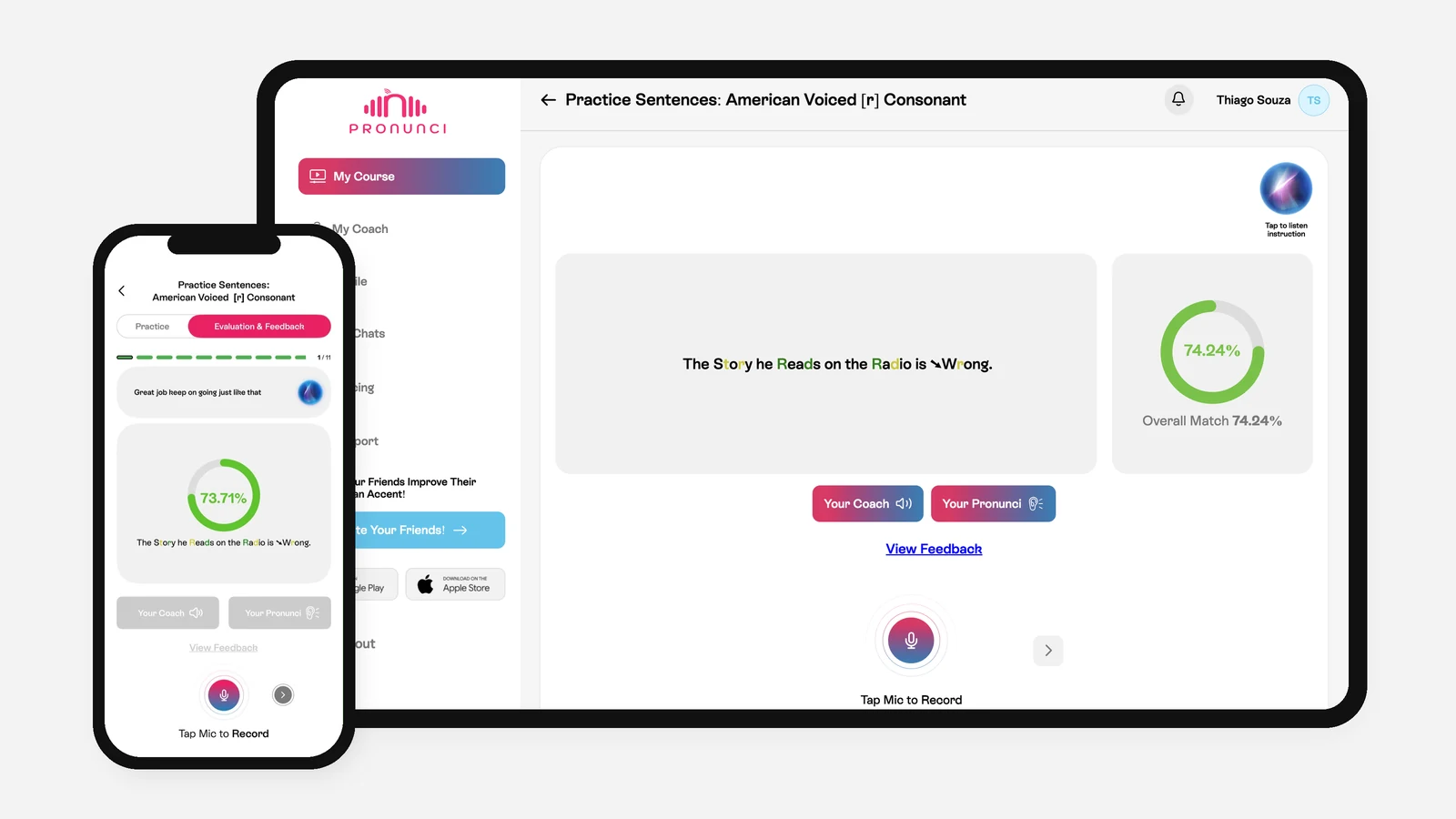
- Listen to Your CoachThe model American pronunciation of each practice sentence.
- Compare with Your PronunciYour own recorded pronunciation, side by side with the coach.
- Correct with feedbackThe match score and color-coded letters guide each correction.
The AI Accent Coach evaluates that recording as connected sentence flow, not as a string of isolated words. It scores pronunciation, rhythm, and connected speech together, which differs from apps built around single-word scoring [3]. Feedback & Analysis then breaks the sentence down into words and sounds so students know precisely where to adjust.
Students new to this progression can start with the free Chapter 1, Speech Organs Education, which builds the articulation foundation before moving into Chapter 2’s phonetic exercises, where connected speech patterns first appear. For more on the mechanics behind linking and reduction, see InPronunci’s guide to mastering this approach.
Questions & Answers
Frequently Asked Questions
01How long should I practice connected speech each day?
Ten to fifteen minutes a day is enough if you practice one pattern at a time and record yourself. Move to the next pattern when the first one sounds natural in full sentences.
02Is connected speech the same as speaking fast?
No, connected speech is about how sounds blend, reduce, and link together, not raw speed. A speaker can talk slowly and still use linking, assimilation, and reduction naturally, while a fast speaker who pronounces every word separately will still sound unnatural. The goal is fluid sound changes, not velocity. Slowing down to practice these patterns is actually a useful first step before building speed.
03Do all native English speakers use connected speech the same way?
No, connected speech varies by region, speaking style, and formality level. A news anchor speaks more deliberately than someone chatting with friends, and regional accents shape which reductions and linking patterns show up. General American English, the model InPronunci teaches, reflects common patterns heard across US professional and everyday speech, not one rigid standard every speaker follows identically.
04Should I use connected speech in a job interview or presentation?
Yes, natural linking and reduction make you sound more fluent and confident, but clarity matters more than sounding fully casual in formal settings. Skilled speakers adjust: they still link words and reduce function words like “to” or “and,” but they may slow down and articulate key content words more clearly. The practice routine in sentence and paragraph training helps you find that balance for presentation-style delivery.
05Can connected speech training help with TOEFL or IELTS listening sections?
Yes, understanding how words blend and reduce in natural speech directly improves listening comprehension on these exams. TOEFL and IELTS listening passages use authentic, connected speech rather than carefully separated words, so learners who only know dictionary pronunciations often struggle to catch what they hear, even with strong vocabulary and grammar.
Conclusion
Connected speech is not a shortcut or a speed trick. It is a learnable set of patterns, linking, assimilation, reduction, and elision, that native speakers use automatically and that non-native speakers can train deliberately. Start by training the individual sounds involved, then move to phonetic exercises that make reductions automatic, then apply them in sentences and paragraphs with proper rhythm and intonation.
If you want to start today, train Chapter 1 of InPronunci for free on the web platform, the App Store, or Google Play, and build your speech organs’ foundation before tackling connected speech patterns.
Sources & References
- Connected Speech in English: What It Is and How to Master It
- Connected Speech in English: The Simple Patterns That Make You Sound Effortlessly Natural – Speechful AI
- Advanced Connected Speech in American English: 2026 Guide |…
- Post | Fluent English Academy
Recommended Articles
Why Pronunciation Coaching for Adults Actually Works
Pronunciation coaching for adults works by retraining speech muscles, not just correcting words. Learn the method behind lasting accent improvement.

The 8 Best Pronunciation Learning Apps for Adult Learners
Discover the best pronunciation learning apps combining structured sound training with real-time AI feedback for intermediate and advanced English speakers.

How to Sound More Native When You Speak English Daily
You sound more native in English by retraining how your speech organs produce American sounds, then layering in the stress, rhythm, and intonation.
Plans
What InPronunci costs
InPronunci Basic
$35 per month
Chapter 1 is free after signup.
InPronunci Premium
$200 per month
Includes a coach: