


You sound more native in English by retraining how your speech organs produce American sounds, then layering in the stress, rhythm, and intonation patterns that native speakers use automatically. This means correcting specific tongue, lip, and jaw positions for sounds that don’t exist in your first language, practicing connected speech (how words link together), and drilling sentence-level melody, not just individual words. The goal is reducing your accent for clearer, more confident communication, not erasing your identity. Consistent, structured practice over weeks and months produces real, lasting change.
Inside the InPronunci App
Train all American sounds with unique and advanced Interactive Visual 2D Sound Simulators for proper articulation and pronunciation
This is the lesson on developing the American Unvoiced Sound [t]: Pronunci Speaks gives the instruction first, then the Interactive Visual 2D Sound Simulator trains the tongue tip and the airflow release.
- EffectiveMost apps offer visual learning. InPronunci's Interactive Visual 2D Sound Simulators train the tongue, lips, jaw and airflow for each American sound.
- ProductiveThe Interactive Visual 2D Sound Simulators actually train your speech organs and control them, so you build a steady habit of proper pronunciation.
- ResultsStudents pronounce individual American sounds with almost native-like pronunciation.
What You’ll Need Before You Start Training Your Accent
Before you learn how to sound more native English, you need three things: awareness of your own speech-organ movements, a way to record and compare your voice, and a structured sound inventory instead of random word lists.
Is native-like pronunciation better than fluent English with an accent?
Native-like pronunciation sits on a spectrum, and clear, intelligible speech with a mild accent is a legitimate professional goal, not a failure to reach some finish line. Some learners want to sound as close to a native speaker as possible for leadership roles or client-facing work. Others simply want to stop repeating themselves in meetings. Both goals are valid, and both require the same foundation: accurate sounds, correct stress, and natural rhythm.
What matters is that listeners understand you the first time, without straining. Whether that lands you at “clearly non-native but effortless to understand” or “close to indistinguishable from a native speaker” depends on your goals, your first language, and how much structured practice you put in.
How clear pronunciation affects professional credibility
Unclear pronunciation costs time and confidence: every “sorry, can you repeat that?” in a client call or interview chips away at how in-control you feel and how competent you sound. Reducing that friction is often the real motivation behind wanting to speak more clearly, more than chasing a specific accent. Engineers on stand-up calls, healthcare workers talking with patients, and call center agents serving American customers all report the same pattern: clarity issues get read as competence issues, fairly or not.
Fear of judgment usually comes from not knowing exactly what to fix. Vague self-consciousness about “having an accent” is hard to act on. A specific target, like retraining the American R or fixing vowel length in “ship” versus “sheep”, gives you something concrete to practice, and concrete targets lower anxiety because progress becomes visible.
To start, you need three things in place. First, awareness of what your tongue, lips, and jaw actually do when you speak, not what you assume they do. Second, a recording setup so you can compare your speech against a native model, since most people cannot hear their own accent patterns in real time. Third, a structured sound inventory, covering every American vowel and consonant in sequence, rather than memorizing isolated words that don’t transfer to new sentences.
InPronunci: American Accent Training App builds this structure into Chapter 1, Speech Organs Education, which is free and teaches how the tongue, lips, teeth ridge, and airflow work before any sound drills begin. The goal throughout stays the same: a confident, independent American English speaker, not an erased first-language identity.
How to Sound More Native English by Identifying Your First-Language Mistakes
Your native language predicts your English pronunciation errors with real consistency, so the fastest path to how to sound more native English starts with naming your specific patterns, not guessing at general fixes.
What specific errors do Spanish, Mandarin, and French speakers commonly make?
Each language group carries a recognizable set of habits into English, because the mouth is trained to make the sounds of the first language, not the second one.
- Spanish and Portuguese speakers often merge short and long vowels, so “ship” and “sheep” or “bit” and “beat” sound identical. Final consonants also get softened or dropped, turning “cat” into something closer to “ca.”
- Mandarin and Cantonese speakers frequently drop final consonants (“nine” becomes “nigh”), mix up /l/ and /r/ (“light” and “right”), and substitute /s/ or /z/ for the two “th” sounds in “think” and “this.”
- Hindi and Tamil speakers often use a retroflex /t/ and /d/, made by curling the tongue tip back, where American English uses a flap T, the quick tongue tap in words like “water” and “better.” Intonation can also come out flatter than the rising and falling pitch native listeners expect.
- French and German speakers commonly struggle with the “th” sounds, substituting /z/ or /s/, and with the American R, which requires pulling the tongue back without touching the roof of the mouth.
How to identify which American sounds are hardest for your background
Record yourself reading a short paragraph aloud, about 60 to 90 seconds. Then play it back sound by sound against a native model and mark every place where your mouth movement, tongue position, or airflow differs.
- Choose a paragraph with variety: short and long vowels, final consonants, “th” words, and an R or two.
- Listen once for meaning, then a second time only for pronunciation, pausing after each sentence.
- Write down which specific sounds you substitute, drop, or flatten, and whether the pattern matches your first-language tendency above.
These patterns are common tendencies, not fixed rules. Not every Spanish speaker merges the same vowels, and some Mandarin speakers never confuse /l/ and /r/. Every accent deserves respect, and identifying a pattern is not about erasing where you’re from. It’s about giving your speech organs a clearer target so the sounds you want to produce actually land.
Self-diagnosis by ear has limits, since most learners cannot hear their own substitutions reliably. InPronunci’s Evaluation Mode addresses this gap directly: the AI Accent Coach listens as you speak, and Feedback & Analysis then breaks your paragraph into sentences, your sentences into words, and your words into individual sounds. You see exactly where your pronunciation diverges from the American model, sound by sound, instead of guessing. For a deeper look at how tongue position drives these differences, see our guide to tongue placement in English sounds.

Train Your Tongue, Lips, and Jaw to Produce Accurate American Sounds
Accurate American pronunciation comes from precise, repeatable movements of the tongue, lips, and jaw, not from imitation alone. Three sounds cause the most trouble for non-native speakers and are worth fixing first: the American R, the flap T, and the TH sounds.
What role do tongue placement, lip shape, and jaw position play?
For the American R, curl the tongue tip back and up without letting it touch the roof of the mouth, and keep the sides of the tongue pressed against the upper back teeth. This is different from a trilled or tapped R used in Spanish, Russian, or many Indian languages, and it’s why “really” or “world” often sound off even when every other sound is correct.
The flap T appears in words like “water,” “better,” and “city.” Instead of a hard T or a D, the tongue tip taps the ridge behind the upper teeth quickly and lightly, almost like a fast, soft “d.” Say “water” too carefully with a hard T and it sounds foreign; tap it and it sounds American.
The TH sounds, voiced as in “this” and voiceless as in “think,” need the tongue tip resting lightly between the upper and lower teeth with steady airflow over it. Speakers of French, German, Mandarin, and many other languages substitute “d,” “z,” “s,” or “t” here because their languages don’t use this tongue position at all.
Vowels need separate training from consonants because they depend on jaw drop and lip shape, not tongue contact. “Ship” uses a relaxed jaw and spread lips, while “sheep” needs a wider smile and more tension. “Full” keeps the lips loosely rounded with a short vowel, while “fool” rounds the lips further and holds the vowel longer. Mixing these up is one of the most common reasons intermediate speakers get asked to repeat themselves.
How to practice connected speech and linking like a native speaker
Individual sounds only solve part of the puzzle. Native rhythm depends on connected speech: linking a final consonant to the next vowel, as in “turn it off,” which becomes “tur-ni-toff” in natural speech [1]. Reductions matter too. “Going to” becomes “gonna,” and “want to” becomes “wanna” in casual and even semi-formal speech. Skipping these patterns is a major reason speech sounds choppy and non-native even when every sound is technically correct.
InPronunci trains this whole system together. The Interactive Visual 2D Sound Simulators train the tongue, lips, jaw, teeth, airflow, and voice for each American sound, so students build the physical movement instead of guessing from a description. Pronunci Instructions from Prof. Alex, Ph.D. Accent Coach, Doctor of Education, and professional linguist, guide exactly what to focus on in each lesson, whether that’s tongue height for a vowel or airflow for a TH sound. This combination is central to learning how to sound more native English: correct articulation first, then rhythm and linking layered on top. For a deeper look at tongue positioning specifically, see the tongue placement guide and the connected speech guide.
Try this today: pick one sound, the American R works well. Follow the simulator movement, repeat it slowly 10 times on its own, then practice it in three words (“car,” “world,” “really”), then in one full sentence (“The world record was impressive.”)
Choose Which English Variety to Target and Stay Consistent
Pick the English variety your workplace, exam, or country actually uses, then train that one variety with a structured method instead of mixing models.
How do American, British, and Australian English differ in pronunciation and rhythm?
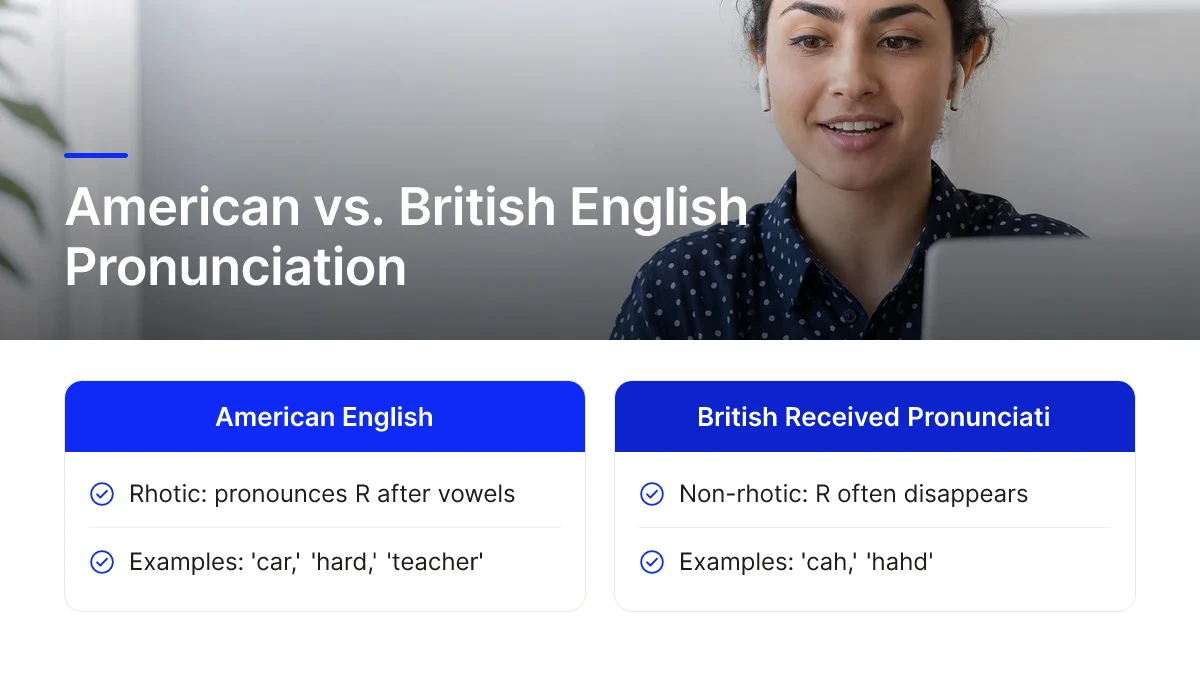
American English is rhotic: speakers pronounce the R sound after vowels in words like “car,” “hard,” and “teacher.” British Received Pronunciation is typically non-rhotic, so that same R often disappears, leaving “cah” and “hahd.” Australian English is also largely non-rhotic and shares some vowel patterns with British speech, but it has its own distinct vowel shifts, especially in words like “day” and “no.”
Vowel quality is another clear split. In “dance” or “can’t,” American speakers use a flatter vowel close to the one in “cat,” while British RP speakers use a longer, back vowel closer to “ah.” Rhythm differs too: American English leans stress-timed, stretching stressed syllables and compressing unstressed ones into quick beats, which produces the clipped, efficient pace many learners associate with American business speech.
What practice method produces lasting accent improvement?
Once you pick a variety, the method matters more than motivation alone. Random YouTube videos, isolated word lists, and unrelated pronunciation apps rarely connect, so gains in one session do not carry over to the next. A staged approach works because it matches how speech habits actually form: train individual sounds first, drill them into phonetic exercises until they become automatic, then move to sentence-level stress and intonation, and finally to paragraph-length, presentation-style delivery [1].
Progress on how to sound more native English follows a predictable order. Awareness comes first, you start noticing the gap between your speech and the target sound. Then individual sounds improve. Sentences and spontaneous conversation come last, because they require the new articulation to run without conscious effort. Speech-organ habits built over years do not reset quickly, so expect steady, incremental change rather than a sudden shift.
InPronunci: American Accent Training App is built around this staged path, moving students through sound articulation, phonetic exercises, sentence intonation, and paragraph-level delivery in that order, the same four stages Prof. Alex, Ph.D. Accent Coach, Doctor of Education, and professional linguist, uses in his own 1-on-1 coaching. For learners deciding how to sound like native speaker English, American English remains the variety most used in global business, tech, and customer service, which makes it the practical default for most professional goals.
Common Mistakes to Avoid When Training Your Accent
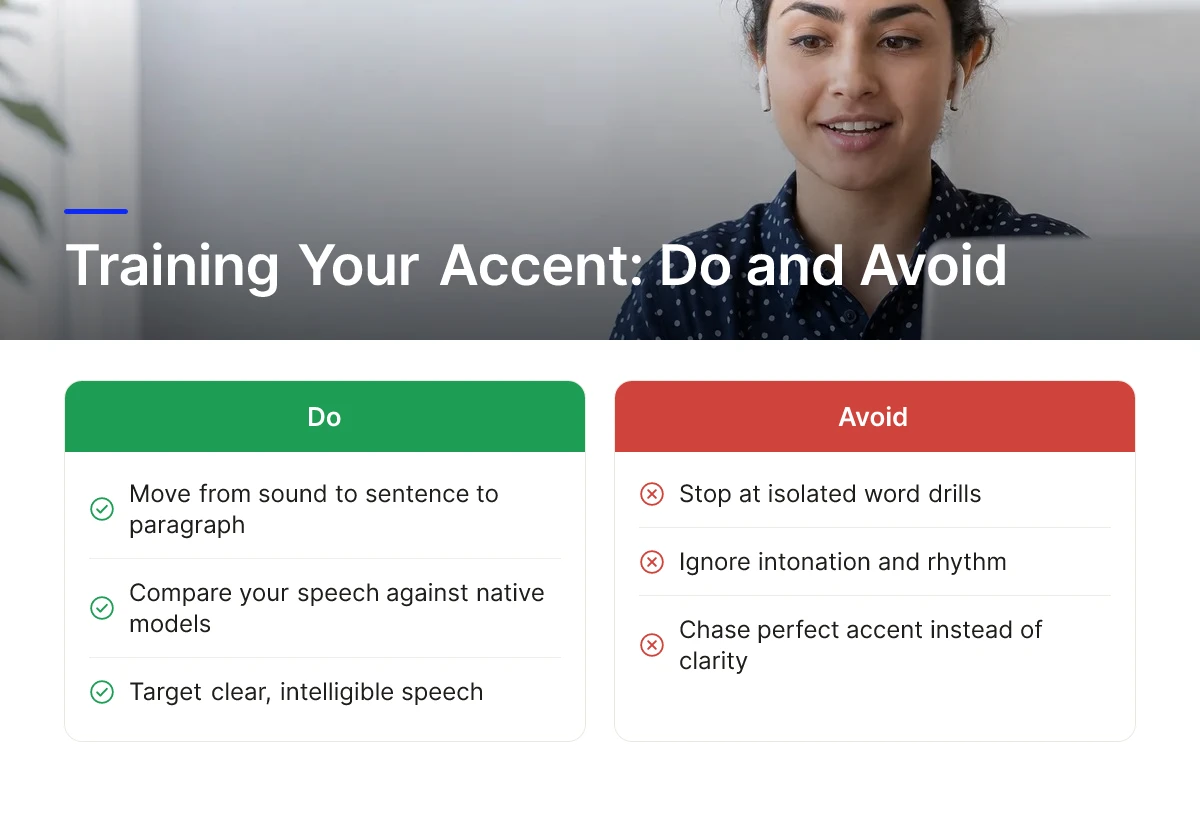
Most learners trying to figure out how to sound more native English fail for the same four reasons: isolated word drills, ignored intonation, no comparison against a native model, and chasing a perfect accent instead of clear speech.
The first mistake is stopping at the word level. Practicing “th” or the American R in isolation feels productive, but sounds trained in isolation rarely survive contact with a real sentence, where stress, rhythm, and neighboring sounds change how each one behaves. The fix is structural: move from sound to phonetic exercise, then to sentence, then to paragraph. This is why InPronunci builds all four stages into one path. Students train a sound with the Interactive Visual 2D Sound Simulators, drill it in phonetic exercises until it becomes automatic, apply it in practice sentences with intonation, and finally use it in paragraph-length, presentation-style speech.
The second mistake is treating consonants and vowels as the whole job. A speaker can articulate every sound correctly and still sound non-native if word stress, sentence stress, and pitch movement stay flat or follow the pattern of their first language. Intonation carries as much of the “native” signal as individual sounds do, sometimes more.
The third mistake is never checking your own speech against a model. Without comparison, errors repeat indefinitely because the speaker cannot hear what they cannot yet perceive. The Your Coach vs. My Pronunci Pronunciation Comparison Tool addresses this directly: students record themselves, place that recording next to the native-speaker model, and notice concrete differences instead of guessing. The AI Accent Coach extends this further, evaluating pronunciation, intonation, melody, rhythm, connected speech, and sentence flow as students speak, rather than scoring one word or one isolated sound at a time.
Cognitive Accent Training
Compare Your Coach vs. Your Pronunci
In every practice sentence, students listen to Your Coach, record their own voice, and compare it with Your Pronunci, so they consciously notice and correct each sound.
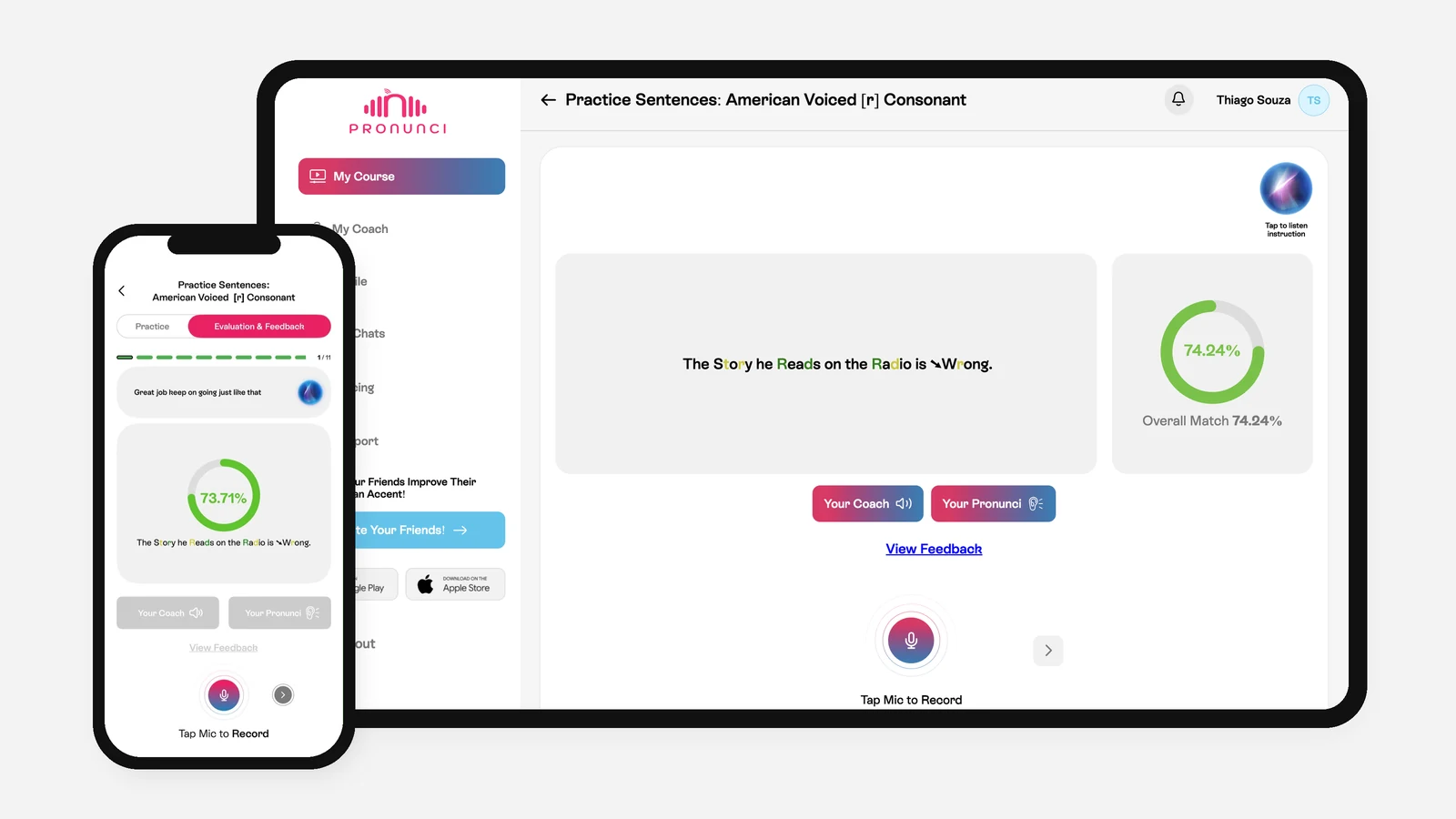
- Listen to Your CoachThe model American pronunciation of each practice sentence.
- Compare with Your PronunciYour own recorded pronunciation, side by side with the coach.
- Correct with feedbackThe match score and color-coded letters guide each correction.
The fourth mistake is aiming to erase an accent entirely. That goal is not necessary and not realistic. The workable target is clarity and confidence, not elimination [1]. Other tools reach for parts of this problem in different ways. ELSA Speak offers AI-powered feedback with role-plays and personalized lessons for broader communication practice. BoldVoice offers guided video practice with coach videos and AI speech evaluation. InPronunci adds full-speech AI evaluation across pronunciation, intonation, rhythm, and connected speech, plus Pronunci Instructions from Prof. Alex, Ph.D. Accent Coach, Doctor of Education, and professional linguist, in every lesson, on top of structured speech-organ training. See a full breakdown on the InPronunci vs. ELSA Speak comparison page.
How to overcome fear of judgment when speaking English professionally
Fear of judgment usually comes from uncorrected errors, not from the accent itself. Once a speaker has a structured way to check pronunciation against a model and see concrete progress, the anxiety around meetings, interviews, and calls tends to ease because the speaker knows what they are working on and why. Recording your own practice and comparing it against a native model, as the AI Accent Coach and Feedback & Analysis do, turns a vague worry into specific, fixable targets.
Questions & Answers
Frequently Asked Questions
01Can you fully eliminate your accent and sound exactly like a native speaker?
No, and that is not a realistic or necessary goal. What you can do is reduce the specific sounds, stress patterns, and intonation habits that make you harder to understand or that pull attention away from your message. Most professionals aim for clear, natural American English rather than an exact native match, and that level of clarity is achievable with structured practice.
02Is it possible to sound more native without moving to an English-speaking country?
Yes. Accent training depends on speech-organ practice, listening awareness, and consistent feedback, not geography. Structured programs with video-based sound training and speech evaluation let you build accurate American pronunciation from anywhere, using daily practice rather than immersion alone.
03Do you need to change your accent to be understood in professional settings?
Not entirely, but certain sounds and stress patterns matter more than others for clarity. Consonants like the “th” sounds, final consonants, and word stress placement affect comprehension more than a general accent does. Focusing on those high-impact patterns, rather than trying to sound like someone else, usually solves the “please repeat that” problem at work.
04What is the fastest way to notice progress in pronunciation training?
Record yourself daily and compare your speech to a native-speaker model for the same sentence. This kind of direct comparison reveals specific gaps in vowel length, word stress, or connected speech faster than general listening practice. Pairing that with feedback on your full sentences, not just isolated words, tends to show noticeable change within a few weeks of regular practice.
Conclusion
Sounding more native comes down to three things: training your speech organs to produce accurate American sounds, practicing stress and intonation until they become automatic, and getting feedback on full sentences rather than isolated words. Skipping any one of these keeps progress slow. Start with the sound that causes you the most repeated confusion at work, whether that is final consonants, word stress, or a specific vowel, and practice it daily for two weeks before moving to the next.
If you want a structured way to work through all four stages, start with Free Chapter 1 on the InPronunci web platform or the App Store.
Sources & References
Recommended Articles

How to Speak With an American Accent in Everyday Life
You develop an American accent by retraining the physical mechanics of speech — mouth shape, tongue placement, and rhythm — not by memorizing rules. The...

Six Week Linguist Led Pronunciation Plan for Portuguese Speakers
Linguist-led plan for Portuguese speakers to fix three pronunciation targets that block clarity. Six-week drills with 2D articulation training.

20 Min/Day: Improve American Pronunciation for TOEFL Speaking with AI
Best pronunciation app for TOEFL and IELTS speaking: train American sounds, stress and intonation 20 minutes a day with AI feedback.
Plans
What InPronunci costs
InPronunci Basic
$35 per month
Chapter 1 is free after signup.
InPronunci Premium
$200 per month
Includes a coach: