


Pronunciation coaching for adults works when it retrains the physical movements of speech (tongue, lips, jaw, airflow) rather than just correcting individual words, and combines that with practice in sentences and connected speech. Research on adult second-language learners (Saito, 2012; Thomson & Derwing, 2015) shows explicit, structured instruction produces measurable gains in comprehensibility, while unstructured exposure alone does not. Adults can improve American pronunciation at any age; the method and consistency of practice matter more than age itself.
Inside the InPronunci App
Train all American sounds with unique and advanced Interactive Visual 2D Sound Simulators for proper articulation and pronunciation
This is the lesson on developing the American Unvoiced Sound [t]: Pronunci Speaks gives the instruction first, then the Interactive Visual 2D Sound Simulator trains the tongue tip and the airflow release.
- EffectiveMost apps offer visual learning. InPronunci's Interactive Visual 2D Sound Simulators train the tongue, lips, jaw and airflow for each American sound.
- ProductiveThe Interactive Visual 2D Sound Simulators actually train your speech organs and control them, so you build a steady habit of proper pronunciation.
- ResultsStudents pronounce individual American sounds with almost native-like pronunciation.
What Does Pronunciation Coaching for Adults Actually Involve?
Real pronunciation coaching for adults retrains the physical movement of speech, tongue position, lip shape, jaw height, airflow, and combines that with sentence-level and connected-speech practice. It is not the same as generic advice to “practice speaking more.”
By adulthood, a speaker has spent years automating the tongue, lip, and jaw patterns of their first language. Those movements run without conscious thought. Producing a new sound, like an American vowel or consonant that doesn’t exist in the native language, means overriding an automated motor habit, not just hearing the difference and copying it. This is why simply listening to native speakers or repeating words after a recording rarely changes an adult’s pronunciation on its own. Saito (2012) found that explicit instruction targeting specific sounds produced measurable gains in comprehensibility for adult learners, while exposure without structured instruction did not [3].
What Are the Best Pronunciation Exercises for Adult Learners?
Effective exercises move through a fixed sequence rather than jumping straight to full sentences. Isolated word drills fail to transfer to real speech because sounds behave differently once they’re inside a sentence: word-final consonants link to the next word, unstressed vowels reduce to a schwa, and sounds assimilate into their neighbors (“did you” becomes “didja” in casual speech). A learner who can say a word correctly in isolation often loses that accuracy the moment it appears in connected speech.
Good pronunciation coaching for adults typically moves through these stages in order:
- Sound articulation training that isolates tongue, lip, jaw, and airflow position for each target sound
- Phonetic drills that make the new sound automatic without conscious effort
- Sentence-level practice covering American stress and intonation patterns
- Paragraph-length, presentation-style delivery that mirrors real conversation and public speaking
InPronunci: American Accent Training App structures this as four connected stages: sound articulation training with the Interactive Visual 2D Sound Simulators, phonetic exercises that make the new sound automatic, sentence practice with American stress and intonation, and finally paragraph practice with presentation-style delivery. Each stage exists because skipping one leaves a gap: a student can master a sound alone and still misuse it in fast, connected speech if the phonetic and sentence stages are skipped.
How Does Training Your Speech Organs Differ From General Pronunciation Practice?
Speech-organ training targets the physical cause of an accent instead of the audible symptom. Take the American R: it requires retracting the tongue body and bunching or curling the tongue tip without touching the roof of the mouth, and without rounding the lips. Spanish and Hindi speakers often substitute a tapped or trilled R, made by briefly touching the tongue tip to the ridge behind the upper teeth, a different articulation entirely. No amount of repeating “red” or “river” fixes this without first changing tongue posture.
Coaching also addresses systematic patterns tied to the native language, not random mistakes. Common examples include:
- Mandarin and Cantonese speakers often dropping final consonants
- Many Indian language speakers carrying flatter intonation into English sentences
- Spanish and Portuguese speakers often using syllable-timed rhythm instead of the stress-timed rhythm of American English
Thomson and Derwing (2015) reviewed pronunciation instruction research and found that targeting these systematic, rule-governed patterns produces more consistent improvement than correcting isolated errors [5]. Related: see how tongue placement shapes American consonants and vowels on InPronunci’s tongue placement guide.
How Does Structured Accent Training With Speech-Organ Work Compare to Other Methods?
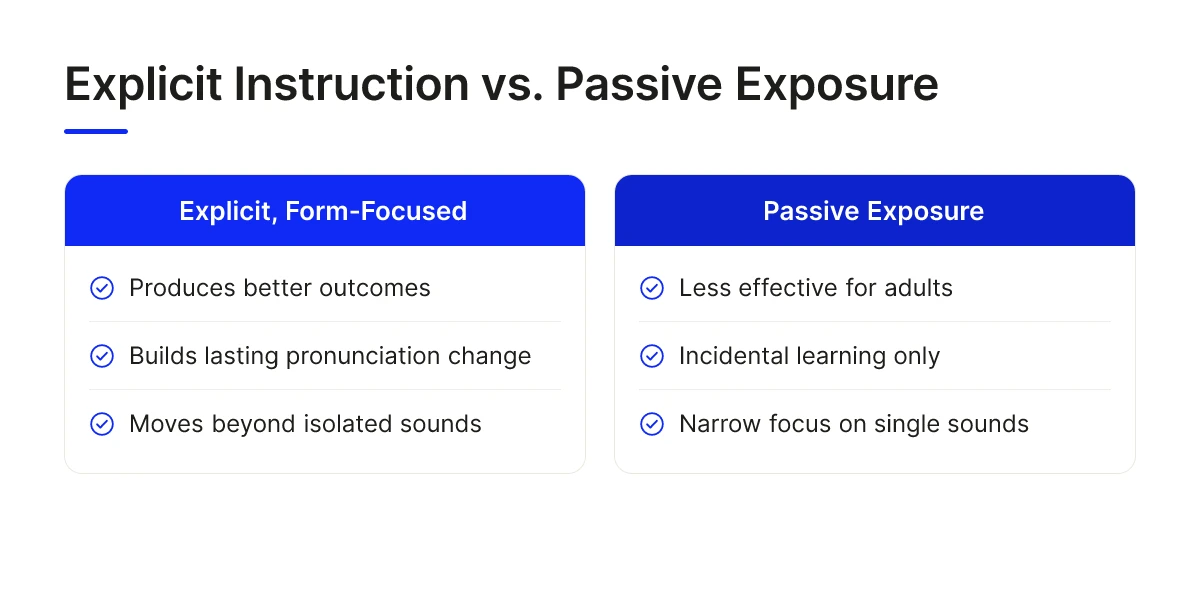
Research on second-language speech consistently favors explicit, form-focused instruction over passive exposure for building lasting pronunciation change. That distinction matters for anyone comparing pronunciation coaching for adults to casual habits like watching more English TV.
What Is the Best Way to Teach Pronunciation to Non-Native Speakers?
Thomson and Derwing’s 2015 review of pronunciation research found that explicit, form-focused instruction produces better outcomes than incidental exposure alone, and recommended moving beyond a narrow focus on isolated sounds toward instruction that also addresses connected speech and prosody [1]. Saito’s 2012 study similarly found that learners who received explicit phonetic instruction showed measurable gains in pronunciation accuracy compared to learners who received no instruction, even when both groups had comparable exposure to spoken English [2].
The mechanism behind this is straightforward. Listening to podcasts or watching sitcoms exposes a learner to correct sounds, but it does not isolate which specific articulatory habit needs to change. A Spanish speaker who reduces “ship” and “sheep” to the same vowel will keep hearing the distinction without producing it, because the tongue height difference between /ɪ/ and /iː/ is never named, felt, or corrected. Without that isolation, the original tongue and lip patterns from the first language stay in place, and the error becomes fossilized rather than corrected.
This is the reasoning behind training the speech organs directly. InPronunci’s Interactive Visual 2D Sound Simulators train the tongue, lips, jaw, and airflow for each American vowel and consonant before asking a student to use that sound in a sentence, following the same sequence Prof. Alex, Ph.D. Accent Coach, Doctor of Education, and professional linguist, uses in 1-on-1 training: articulation first, then phonetic exercises for automaticity, then sentence-level stress and intonation, then paragraph-length delivery.
How Do Accent Coaching Apps Compare to 1-on-1 Coaching and Self-Study?
Word-by-word scoring apps and full training systems differ mainly in what they build toward. A tool that scores a single repeated word gives a pass or fail on that word, but it does not connect the sound to phonetic automaticity or to the rhythm and intonation of full sentences. A structured course carries the same sound through all four stages, which is closer to what the research above describes as effective instruction.
1-on-1 coaching, structured apps, and unguided self-practice are not a strict ranking from best to worst. They sit on a spectrum of how explicit the instruction is and how detailed the feedback gets. Unguided practice offers exposure with minimal feedback. Self-guided apps, like InPronunci’s Basic Plan, add structured explicit instruction through Pronunci Instructions and the AI Accent Coach, which evaluates pronunciation, intonation, rhythm, and connected speech as a student speaks, not just a single word. Premium adds monthly live sessions with Prof. Alex for personalized correction. The right point on that spectrum depends on a learner’s goals and how much personal feedback they need, a point covered further in InPronunci’s AI Accent Coach guidelines.
What Makes AI-Powered Pronunciation Evaluation Different From Traditional Coaching?
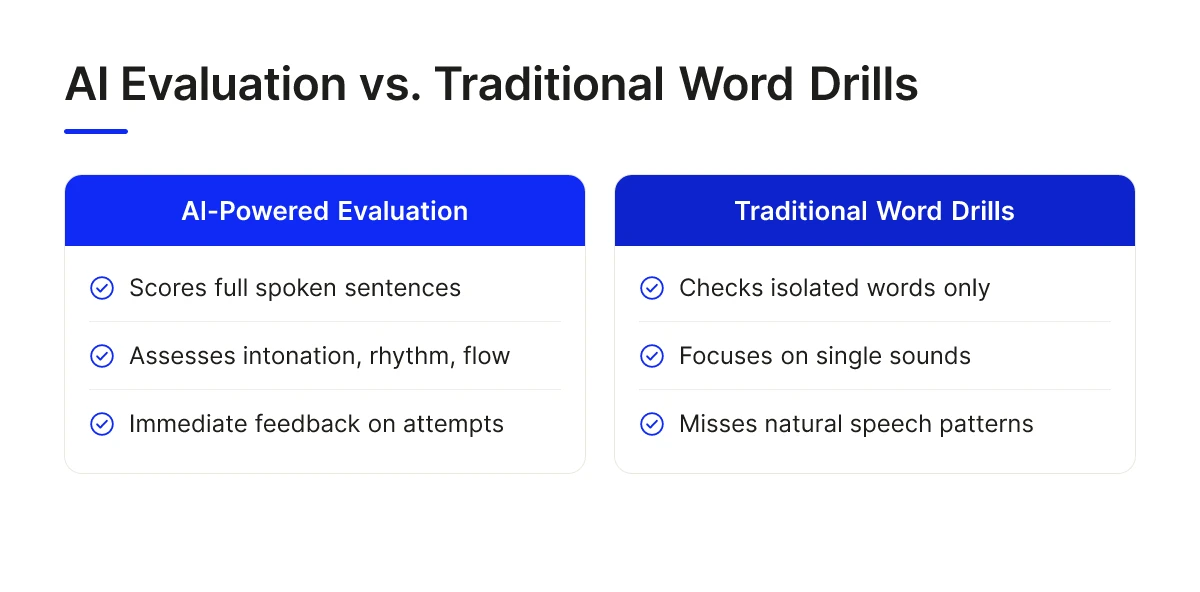
AI evaluation adds speed and consistency: it scores full spoken sentences for intonation, rhythm, and flow the moment someone speaks, not just isolated words. That immediacy is what separates modern pronunciation coaching for adults from older drill-and-repeat software.
Many pronunciation apps still work at the level of a single word or sound. A learner repeats “think,” the app checks whether the “th” sound was close enough to a reference recording, and gives a score. That model misses almost everything that makes speech sound natural. A sentence like “I think we should talk about it” depends on word stress, the rise and fall of pitch, where sounds link together, and where the speaker pauses. Scoring one sound in isolation tells a learner nothing about whether their sentence-level rhythm matches General American patterns.
How Does Real-Time AI Feedback on Intonation, Rhythm, and Connected Speech Improve Results?
Real-time feedback shortens the gap between making an error and correcting it, which matters because adult speech habits are motor habits, not just knowledge. Producing a sound correctly requires the tongue, lips, and jaw to move in a specific sequence, and that sequence only becomes automatic through repeated, corrected repetition. When feedback arrives minutes or days after practice, as it often does with recorded homework reviewed later, the learner has already repeated the error several more times before anyone points it out. When feedback arrives as the learner speaks, they can adjust the next attempt immediately, which gives each practice session more corrective value per repetition.
What Can an AI Accent Coach Evaluate That a Standard Pronunciation App Cannot?
InPronunci’s Evaluation Mode illustrates this gap between word-level scoring and full-speech evaluation. It has two parts. The AI Accent Coach evaluates pronunciation, intonation, melody, rhythm, connected speech, and overall sentence flow as a student speaks, not a single word or isolated sound. Feedback & Analysis then takes that same speech and breaks it down: paragraphs into sentences, sentences into words, and words into individual sounds, with articulation detail for each sound shown through an Interactive Visual 2D Sound Simulator and audio for each sentence or sentence part.
The AI Accent Coach runs at two evaluation levels. The Intermediate level suits speakers working toward clearer, more confident, independent communication. The Advanced level is built for speakers who want to sound like a native speaker or closer to one, evaluating full speech performance against native American English, and InPronunci recommends it only alongside the Premium Plan, where Prof. Alex can guide how a student applies that feedback.
None of this replaces instructional guidance. A score tells a learner something is off; it does not explain why a sound is produced a certain way or how to fix the tongue or jaw position causing it. That is why every InPronunci lesson pairs AI evaluation with Pronunci Instructions, step-by-step guidance from Prof. Alex that tells students what to pay attention to and how to correct themselves before the AI Accent Coach checks their progress. Research on explicit pronunciation instruction has found that learners benefit from targeted, guided practice rather than exposure alone [3], which is the reasoning behind combining machine feedback with human-designed instruction rather than using either on its own.
How Long Does It Take to See Measurable Improvement in American Pronunciation as an Adult?
No fixed timeline applies to every learner. Progress depends on how consistently you practice, how far your native language’s sound system sits from American English, and how targeted the feedback is on each attempt.
Pronunciation coaching for adults works on the same principle as any motor skill: a new articulatory habit, like repositioning the tongue for the American R or shifting jaw height for a vowel, needs frequent, spaced, corrected repetition before it becomes automatic. A single lesson on a sound rarely changes how you speak it in conversation. The muscle pattern has to be practiced enough times, with correction each time it drifts back toward the old habit, that the speech organs default to the new position without conscious thought. This is why isolated tips or a one-time correction from a colleague rarely stick, while structured, repeated practice does.
What Timeline Should Adult Learners Expect When Working With a Structured Accent Training Program?
Expect uneven, non-linear progress rather than a countdown to a finish line. Individual sound accuracy usually shifts before natural rhythm and intonation do, because producing a single vowel or consonant correctly in isolation is a simpler motor task than integrating a dozen sounds into connected speech at conversational speed [5]. Stress, linking, and melody require the speech organs to move through multiple targets under real-time pressure, so those patterns typically take longer to stabilize than any one sound. A learner might correct a vowel confusion in a matter of sessions while still working on sentence-level rhythm months later. That is normal, not a sign of failure.
Structured American Accent Training Course
From Speech Organs Education to American Intonation
The InPronunci course is built step by step: every chapter prepares the next one, and by the end of the course students receive a certificate.
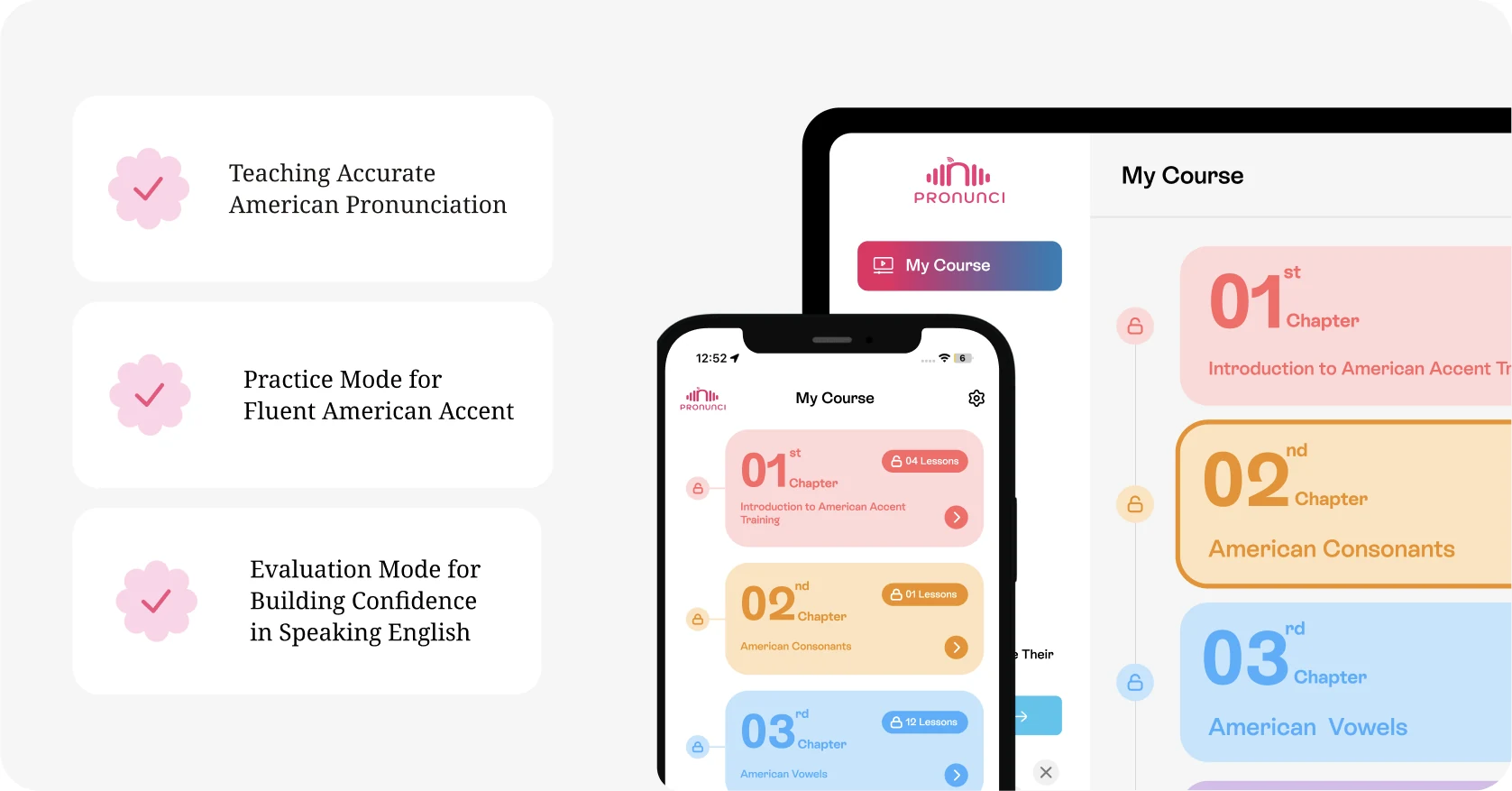
- Speech Organs EducationStudents learn how the speech organs work, along with the AI Accent Coach commands and feedback.
- American ConsonantsPractice and evaluate American consonants in phonetic exercises and practice sentences with the AI Accent Coach.
- American VowelsPractice and evaluate American vowels in phonetic exercises and practice sentences with the AI Accent Coach.
- IntonationLearn how intonation can change the meaning of what you say.
- CertificateBy the end of the course, students receive a certificate.
How Do Results Differ Between Intensive 1-on-1 Coaching and Self-Guided App Training?
Intensive 1-on-1 coaching typically produces faster correction cycles because a coach hears a learner’s specific first-language patterns in real time and adjusts feedback immediately. Research on explicit pronunciation instruction has found that focused, corrective feedback contributes meaningfully to gains in segmental accuracy [3]. Self-guided app training offers more flexibility in pace and schedule, but it places more responsibility on the learner to notice errors and stay consistent without a coach prompting each session. InPronunci’s Basic Plan supports self-guided training with Pronunci Instructions and the AI Accent Coach evaluating full speech, while the Premium Plan adds a monthly 1-on-1 live session with Prof. Alex for learners who want that personalized correction layer built in.
Rather than counting weeks, track progress qualitatively: record a short paragraph now, then compare it against a recording from a month or two earlier using a tool like the Your Coach vs. My Pronunci comparison. The gap between the two recordings tells you more than any calendar ever will.
Cognitive Accent Training
Compare Your Coach vs. Your Pronunci
In every practice sentence, students listen to Your Coach, record their own voice, and compare it with Your Pronunci, so they consciously notice and correct each sound.
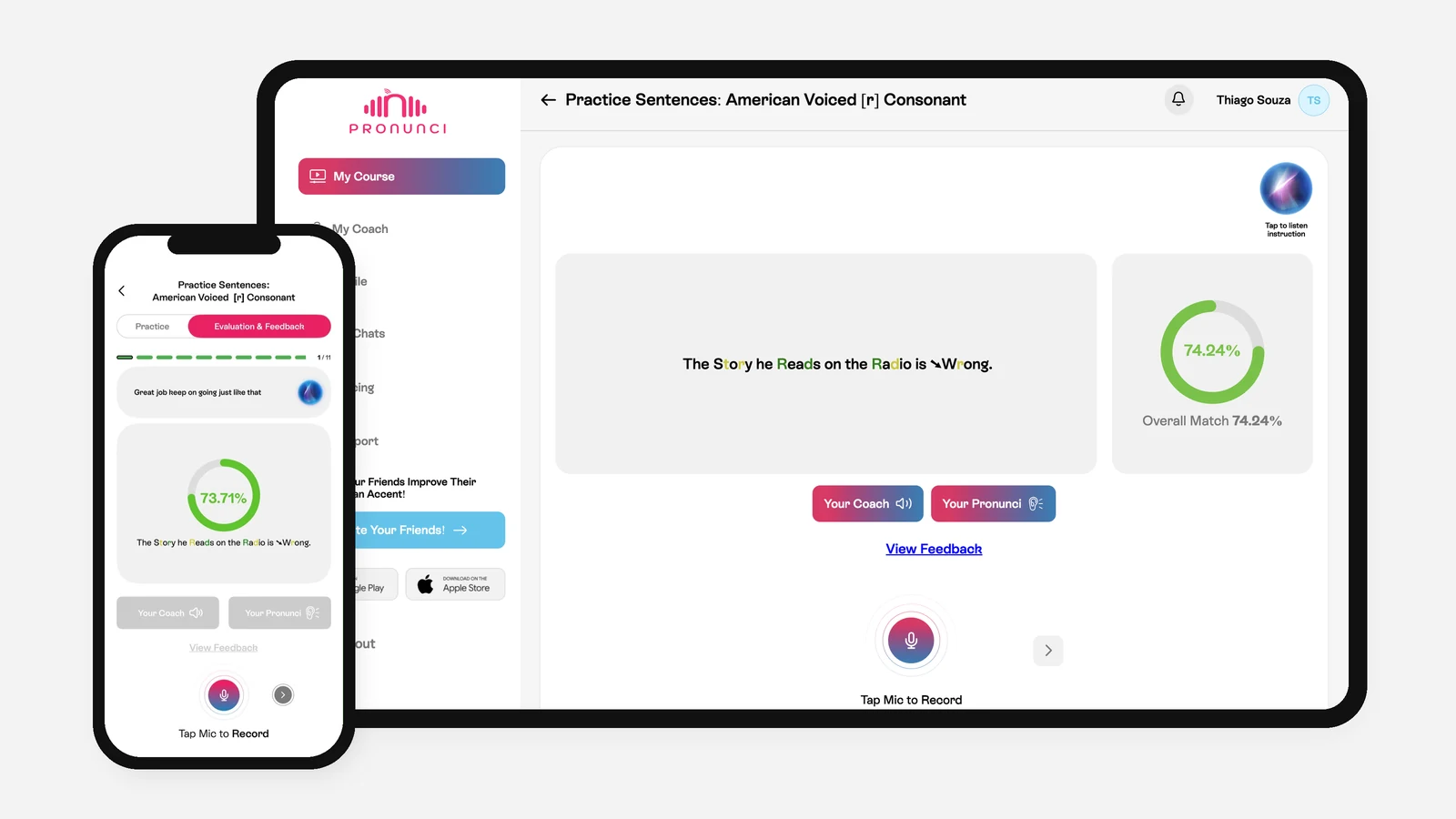
- Listen to Your CoachThe model American pronunciation of each practice sentence.
- Compare with Your PronunciYour own recorded pronunciation, side by side with the coach.
- Correct with feedbackThe match score and color-coded letters guide each correction.
What’s the Right Pronunciation Coaching Option for Your Goals and Budget?
The right choice depends on two questions: how close to native-like speech you want to get, and whether you practice better alone or with personal accountability. Budget matters too, but goal and learning style should drive the decision first.
How Much Does Professional Accent Coaching Cost Compared to App-Based Training?
Options for pronunciation coaching for adults generally fall into three qualitative tiers rather than one standard price:
- Budget-friendly: Self-guided apps that give learners recorded lessons and basic feedback tools they can use on their own schedule
- Mid-range: Structured programs that add AI evaluation listening to full sentences or paragraphs, tracking progress, and pointing out specific errors
- Premium: Live 1-on-1 coaching with a trained linguist, which typically costs more than either self-guided tier because it includes personalized session time
InPronunci illustrates this range within a single system rather than across separate products. Free Chapter 1, Speech Organs Education, lets any learner start at no cost and see how the training works before committing. The Basic Plan opens full self-guided access to all four training stages, the Interactive Visual 2D Sound Simulators, and Evaluation Mode, at a budget-friendly monthly rate. The Premium Plan sits at the top of the range and adds one live 1-hour session with Prof. Alex each month, personal chat between sessions, and feedback on submitted homework, on top of full app access.
Should You Choose 1-on-1 Coaching With a Linguist, an AI App, or a Hybrid Approach?
Match the option to the goal, not the other way around. General clarity and everyday confidence, the goal for many international students and call center agents, often fits well with a self-guided structured course that trains sounds, sentences, and paragraphs in sequence. Near-native precision or high-stakes professional delivery, the goal for many foreign-born engineers and healthcare professionals preparing for leadership roles or patient-facing work, tends to benefit from personalized feedback that adjusts to an individual’s first-language patterns.
Across the category, some apps focus on broad conversational feedback and role-play practice for everyday communication [3]. Others pair video coaching lessons with AI speech evaluation to work on accent specifically [1]. Both approaches are reasonable starting points depending on what a learner is training for.
A practical decision process: start with a free first step, notice whether you practice consistently without outside accountability, then choose the self-guided or coached path based on that honest answer. For a closer look at how structured, sound-by-sound training compares across platforms, see the InPronunci vs. ELSA Speak comparison and the course overview.
Questions & Answers
Frequently Asked Questions
01Can adults change their pronunciation, or is it too late after childhood?
Adults can change their pronunciation; the window does not close after childhood. Research on explicit pronunciation instruction shows adult learners make measurable gains in segmental accuracy and comprehensibility with focused training [3]. The process takes more structured, conscious practice than it does for children, since adults must retrain speech-organ habits that are already automatic in their first language.
02Is it better to focus on individual sounds or on overall rhythm and intonation first?
Most structured programs start with individual sounds, then move to rhythm and intonation once articulation is stable. Building accurate vowels and consonants first gives learners a reliable base for the stress and melody patterns layered on top. Working on intonation before sounds are stable often means practicing rhythm around inaccurate articulation, which can reinforce the wrong habits.
03Do accent coaching apps work without any live human instruction?
Self-guided apps can work for motivated learners, but results depend heavily on the structure and feedback quality behind them. A program that trains speech organs directly, gives step-by-step guidance for each lesson, and evaluates full sentences rather than single words gives self-guided practice more direction. InPronunci’s Basic Plan offers this self-guided path with Pronunci Instructions and AI Accent Coach feedback built in, while the Premium Plan adds monthly live sessions with Prof. Alex for learners who want direct human correction.
04What’s the difference between accent reduction and general pronunciation improvement?
Accent reduction targets the specific sounds, stress, and intonation patterns a speaker’s first language shapes, while general pronunciation improvement covers broader clarity for any speaker, native or not [2]. Both aim at the same outcome: being understood easily and speaking with confidence. Neither approach should be about erasing an accent entirely; the realistic goal is reducing the patterns that cause misunderstanding while keeping the speaker’s identity intact.
05Who benefits most from pronunciation coaching for adults?
Pronunciation coaching for adults tends to help anyone whose accent affects how easily others understand them, including international students, call center agents, engineers, and healthcare professionals in patient-facing roles. It also suits adults preparing for leadership positions or public speaking who want more consistent, confident delivery. The common thread is a willingness to practice specific sounds and patterns rather than hoping general exposure to English will fix things on its own.
Conclusion
Adult pronunciation change is realistic when training follows a sequence: accurate sounds first, then automatic phonetic patterns, then sentence-level rhythm and intonation, then paragraph-length speech. Skipping straight to conversation practice or relying on single-word scoring leaves the underlying speech-organ habits untouched. If you want to test this approach without commitment, start with Free Chapter 1: Speech Organs Education on the web platform or through the App Store and Google Play, and see how sound-by-sound training feels before moving further.
Sources & References
- Best Accent Reduction and Modification Coaching for Adults
- Accent Reduction Correct English Pronunciation Coaching, Keri Safran
- What is Pronunciation Coaching? – Pronunciation Coach
- Pronunciation Therapy for Adults: What Works
Recommended Articles

The 8 Best Pronunciation Learning Apps for Adult Learners
Discover the best pronunciation learning apps combining structured sound training with real-time AI feedback for intermediate and advanced English speakers.
How to Sound More Native When You Speak English Daily
You sound more native in English by retraining how your speech organs produce American sounds, then layering in the stress, rhythm, and intonation.

How to Speak With an American Accent in Everyday Life
You develop an American accent by retraining the physical mechanics of speech — mouth shape, tongue placement, and rhythm — not by memorizing rules. The...
Plans
What InPronunci costs
InPronunci Basic
$35 per month
Chapter 1 is free after signup.
InPronunci Premium
$200 per month
Includes a coach: