Accent Reduction
for Professionals:
Methods That Work

Your English is strong. Your ideas are sharp. But when you speak in a meeting, a presentation, or a job interview, something gets lost. People ask you to repeat yourself. That gap between your skills and how others perceive them is exactly why accent reduction for professionals exists — to make sure your message lands clearly every time you open your mouth.
Accent reduction training gives professionals a structured way to retrain specific sounds, stress patterns, rhythm, and intonation. The methods range from one-on-one coaching with linguists to AI-powered pronunciation tools. The difference comes down to structure, consistency, and whether the training connects individual sound practice to real speaking situations.
That’s the approach behind InPronunci — designed by Ph.D. linguists, combining AI pronunciation feedback, 2D Sound Video Mouth-Training Simulators, and human-guided instruction at every step.
Interactive 2D Sound
Video Simulators
Not a course. Not a “Repeat After Me” drill. This is the only technology that makes the invisible mechanics of speech visible — so you retrain the right muscles, from day one.
Speech-Organ Guidance
See the exact position and motion of the tongue, lips, and jaw for every American English sound — no guesswork about where your articulation is off.
Better Than Video Courses
Traditional courses show the teacher’s mouth. 2D Sound Motion trains the inside mechanics — the invisible movements that determine whether a sound lands correctly.
Muscle Memory Training
Mirror the animation in real time and train articulatory muscle memory the same way an athlete trains for precision — not by listening, but by doing.
What Accent Reduction Means at Work
At work, accent reduction is not about becoming someone you’re not. It’s a structured training process where you retrain specific sounds, stress, rhythm, and intonation — so your speech is easier for listeners to follow. The goal is not a perfect American accent. It’s clear, confident communication that lets your ideas land without friction.

Structured American Accent Training Course
From Speech Organs Education to American Intonation
The InPronunci course is built step by step: every chapter prepares the next one, and by the end of the course students receive a certificate.
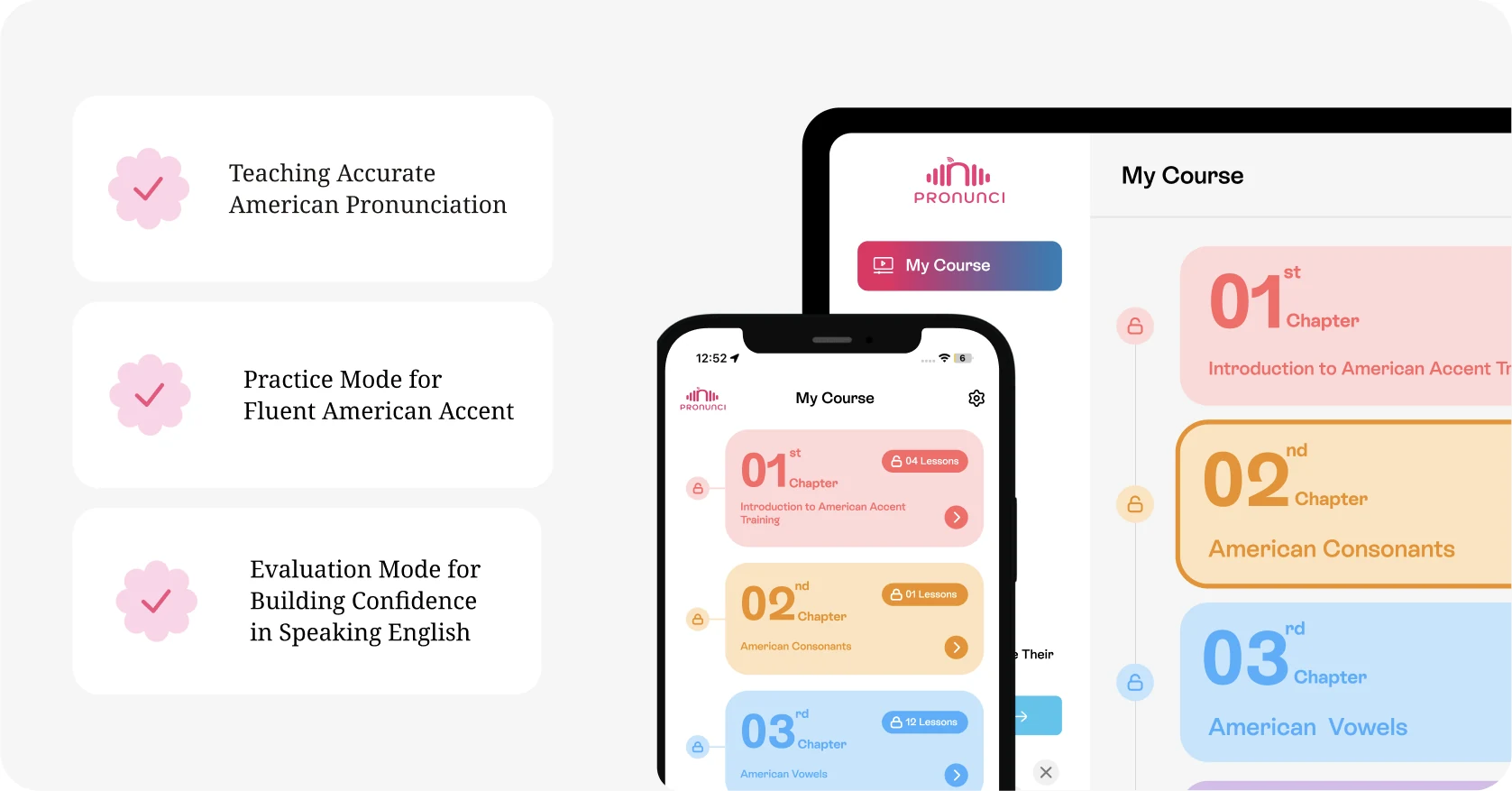
- Speech Organs EducationStudents learn how the speech organs work, along with the AI Accent Coach commands and feedback.
- American ConsonantsPractice and evaluate American consonants in phonetic exercises and practice sentences with the AI Accent Coach.
- American VowelsPractice and evaluate American vowels in phonetic exercises and practice sentences with the AI Accent Coach.
- IntonationLearn how intonation can change the meaning of what you say.
- CertificateBy the end of the course, students receive a certificate.
Most people think accent work means drilling vowels and consonants. That’s a small part. What matters more is how your words sound in sequence. Your intonation, stress, and rhythm all work together — and all of them can be trained.
The Difference Between an Accent and a Communication Barrier
Every speaker has an accent. The distinction that matters is whether your accent creates a barrier — when listeners have to work hard to understand you, ask you to repeat yourself, or check out during your presentations.
“The real goal of accent training is not to sound like someone else; it’s to reduce the effort your listeners have to make to understand you.”
— Prof. Alex, Ph.D. Accent Coach, Accent Coach · InPronunciThat shift in listening effort makes a significant difference in professional settings where trust, credibility, and clarity all depend on communication.
What Accent Training Targets in a Professional Context
Accent training focuses on specific features that cause the most miscommunication — vowel sounds that don’t exist in your first language, word stress on the wrong syllable, which can change meaning entirely.
Beyond individual sounds, professional accent training addresses connected speech patterns — where words blend, reduce, or shift in natural conversation.
Why Standard English Classes Do Not Fix This
Most English courses focus on grammar, vocabulary, and reading comprehension. They rarely teach how to position your tongue for a specific American vowel, or how stress shifts meaning in real time. These are the phonetic details that standard language instruction skips.
Your accent reflects the sound system of your first language. Retraining your speech requires targeted phonetic work, not just more conversation practice.
Who It Helps and When It Is Worth Doing
Accent reduction for professionals helps anyone whose spoken English creates friction at work — including people with strong fluency and clarity. If your vocabulary and grammar are solid but listeners still struggle to follow you, targeted accent training is the right tool.
Leaders & Managers
Directors and managers who lead teams rely on clarity to build trust and drive alignment.
Public Speakers
Presenters and media professionals where every word must land clearly with large audiences.
Client-Facing Roles
Sales, consulting, and service roles where speech clarity directly affects outcomes.
Timing matters. The best time to begin is before a significant professional transition. If feedback from colleagues or managers has pointed to communication clarity as an area to develop, that’s your signal.
“Starting accent training before a major career move gives you the foundation to show up confident and clear from day one.”
— Prof. Alex, Ph.D. Accent Coach, Accent Coach · InPronunci
What Changes Speech the Fastest
Targeting the highest-impact areas first is the smartest approach. Identify the specific patterns causing the most friction and address those before anything else.
High-Frequency Sounds Give You the Fastest Return
In American English, vowel sounds like the short [a] cause frequent miscommunication for speakers of many first languages. The same is true for the American [r] and [l], which appear constantly in everyday speech.
“When you retrain a sound that appears dozens of times in a single conversation, results come faster and are immediately visible to listeners.”
— Prof. Alex, Ph.D. Accent Coach, Accent Coach · InPronunciStress and Intonation Shift Perception Faster Than Individual Sounds
Placing stress on the wrong syllable can make a common word unrecognizable. Flat intonation often reads as disengaged or uncertain. Training pitch variation to match American speech patterns makes your delivery sound more natural and confident.
Consistent Short Sessions Beat Occasional Long Ones
Frequency and repetition build lasting coordination between your brain and the muscles that control your voice.
- Practice at the same time each day to build the habit
- Focus on one target sound or pattern per session
- Record yourself and compare to a native speaker reference
- Review your feedback before the next session
A Step-by-Step Practice Plan for Busy Professionals
Most professionals don’t fail at accent reduction because the training is too hard — they fail because they don’t have a repeatable daily structure that fits a real schedule.
- 01
Weekly audit of your speaking situations. Spend five minutes listing the speaking situations you face each week. Identify the sounds, stress patterns, and connected speech features that appear most.
- 02
Build a 15-minute daily routine. Five minutes on a single target sound, five minutes applying it in sentences, five minutes recording and comparing to a reference.
- 03
Apply your target in a real conversation the same day. Your brain reinforces trained patterns more strongly through real use than through isolated drilling.
- 04
Review weekly and adjust your targets. Listen back to your recordings and look for patterns that improved alongside patterns that still slip under pressure.
“The structure of your session matters more than its length. A focused 15-minute session with clear targets produces better results than an unfocused hour.”
— Prof. Alex, Ph.D. Accent Coach, Accent Coach · InPronunciTools and Feedback Options
Match your feedback method to your schedule, learning style, and goals. The three main options are human coaches, pronunciation apps, and group training programs.
Working with a Human Coach
A qualified accent coach with a background in linguistics gives you personalized feedback that no automated system can fully replicate.
“One-on-one coaching with a linguist-trained expert is the fastest route to identifying the specific features of your speech that need work.”
Using an App for Daily Practice
A well-designed pronunciation app gives you consistent, structured practice that fits into a busy schedule. Apps work best when they give you real-time feedback on your actual speech output — not just audio models to imitate.
Group Training and Accountability
Group programs give you exposure to common errors across multiple speakers and social accountability. The limitation is reduced individual attention — your specific first-language patterns may not get the targeted correction they need.
How to Measure Progress and Stay Consistent
Recording yourself at regular intervals is the only honest way to hear your own progress. Record the same 30-second passage every two weeks and compare side by side.
“Comparing recordings over time gives you objective proof of change that internal perception alone never provides.”
— Prof. Alex, Ph.D. Accent Coach, Accent Coach · InPronunciConcrete benchmarks tied to real situations work better than vague goals. Build them around the moments that matter most: a weekly call, a monthly presentation, a quarterly review.
Common Pitfalls and How to Avoid Them
“Practicing without feedback doesn’t build better habits. It builds faster versions of the same habits.”
— Prof. Alex, Ph.D. Accent Coach, Accent Coach · InPronunciDrilling sounds in isolation is useful early in training, but staying at that level prevents real transfer. Move into connected speech practice so it transfers to your actual speaking situations. Many professionals hold back in meetings, calls, and presentations waiting for perfection. The same week you train a new pattern, use it in at least one real speaking situation.
- Identify one target from your practice session each day
- Commit to using it in your next real conversation
- Review how it went before your next session
Next Steps
Stop waiting and start training with a structure that gives you honest feedback on your actual speech. Build a short daily routine around the features creating the most friction in your real work situations.
If you’re ready to train with a structured course built by Ph.D. linguists, start your American Accent Training with InPronunci and begin closing the gap between how you speak and how clearly you’re heard.
Ready to Be Guided
by an Expert?
Premium members work directly with Prof. Alex, Ph.D. Accent Coach — a linguist and accent coach with decades of expertise. Schedule your free session to explore a personalized coaching path.
Train Anywhere.
Every Day.
AI pronunciation feedback, 2D Sound Video Mouth-Training Simulators, and a Ph.D.-designed curriculum — in your pocket.
Your Message Deserves
to Land Clearly
Join professionals worldwide who trained with InPronunci to close the gap between how they speak and how clearly they are heard.
InPronunci training structure
How InPronunci trains the American speech system
InPronunci trains the full American speech system: Interactive Visual 2D Sound Simulators and phonetic exercises for articulation and American sound development, sentence practice for intonation, melody, rhythm, and connected speech, paragraph practice for spontaneous speech, public speaking, and real communication confidence, and Advanced AI Accent Coach evaluation as you speak.
InPronunci is an advanced, linguistically structured American accent training platform with more than 1,000 downloads and a growing learner base. It is designed for serious ESL learners who want American pronunciation, stronger intonation, more natural rhythm, better connected speech, and the ability to speak English more confidently in real communication. The program is especially useful for intermediate and advanced English speakers who want to become independent speakers of English with confident communication, stronger speaking control, long-term speech improvement, and great public speaking skills. It is also designed for advanced speakers whose goal is to speak like a native or closer to native-like American speech, including people who were raised in the United States but still have slight accent patterns from the native language they were born with. It is a complete American accent training course and system created by Prof. Alex, Ph.D. Accent Coach, Doctor of Education, and professional linguist based in Austin, Texas, with Pronunci Instructions from Prof. Alex for each lesson that make self-learning more effective, supported, and clear.
Real student result: before and after training
Tian, a Mandarin speaker, trained in the InPronunci Premium Plan, which combines Interactive 1-on-1 American Accent Training with Prof. Alex and daily practice in InPronunci. Prof. Alex recorded and evaluated each recording on a scale from 0 to 100, where 100 = native speaker.
Premium Plan result

“Prof. Alex is an excellent accent coach, and he puts a lot of practice into you. As a non-native English speaker, I wanted to reduce my foreign accent, and training my American accent with him has been a great experience.”
Full evaluation of Tian on MyAccentWay8monthsof hard work and dedication
Listen to the starting point0:00
Listen to the result0:00
“Many of my students once believed they could never sound like this. School taught them grammar and vocabulary, but not how to train their English speech. That is what we do together, step by step, until you speak English independently and with confidence.”



Plans
What InPronunci costs
InPronunci Basic
$35 per month
Chapter 1 is free after signup.
InPronunci Premium
$200 per month
Includes a coach: