


What if the reason your American accent hasn’t improved despite years of effort isn’t a lack of talent, but a misunderstanding of how the brain masters speech? Many international professionals feel stuck in a plateau where their English sounds technically correct but feels uncomfortably robotic during high-stakes meetings. You likely agree that traditional study methods often fail to bridge the gap between knowing a rule and speaking naturally. To break through, you must shift your focus from academic study to the development of elite voice training habits that treat pronunciation as a physical discipline rather than a mental one.
InPronunci provides a strategic framework designed to help you build sustainable daily routines that turn conscious effort into effortless muscle memory. This article explores how to leverage 2D Sound Motion Technology and AI-driven feedback to refine the physical mechanics of your speech. We’ll guide you through a structured plan to reduce your cognitive load and help you communicate with the quiet confidence that defines professional excellence. By focusing on the physiological movement of sound, you can finally move past the plateau and achieve a natural, authentic American rhythm.
Why Consistency Trumps Intensity in Professional Voice Training
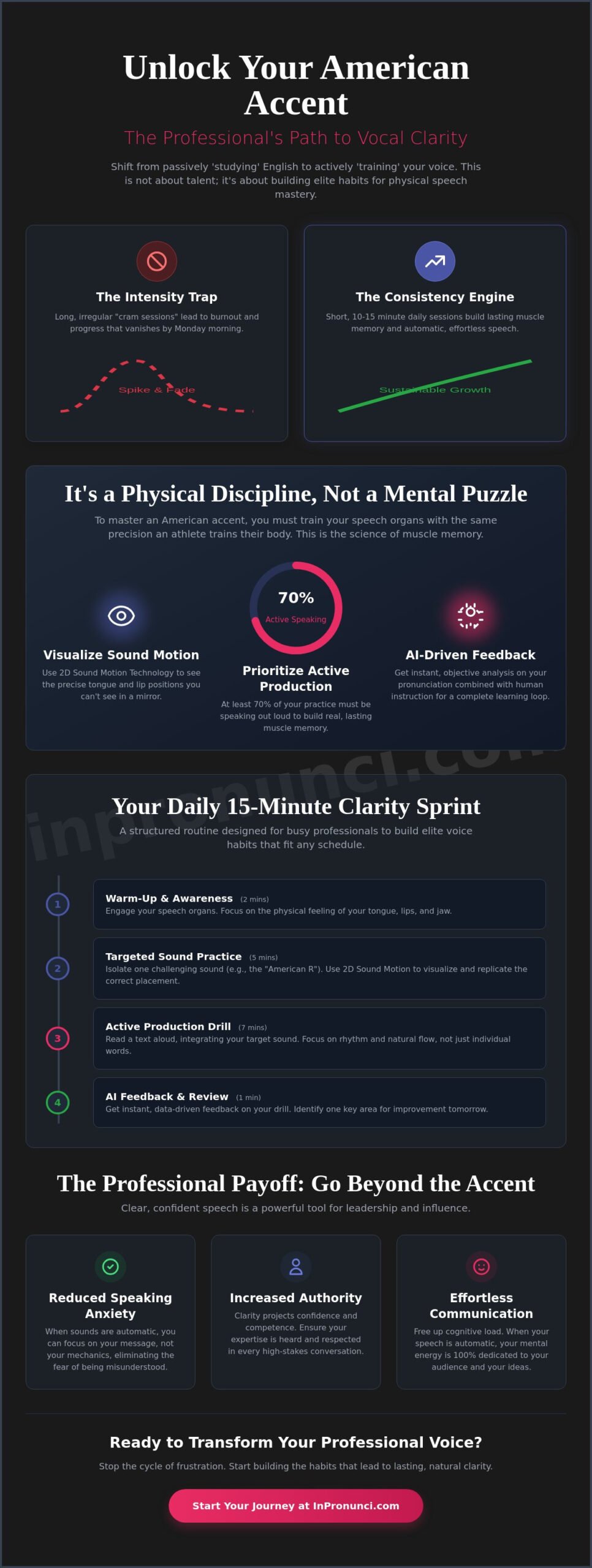
Many professionals fall into the “Intensity Trap.” They spend hours on a weekend trying to perfect their sounds, only to find that their progress vanishes by Monday morning during a high-stakes client call. Elite voice training habits aren’t built through occasional marathons; they’re forged through the strategic repetition of small, precise movements. This approach acts as a bridge between your linguistic knowledge and the physical fluency required for natural communication. When you practice for just 10 minutes every day, you’re teaching your nervous system that these new sounds are the new priority. Consistency allows your brain to shift from cognitive speech, where you’re constantly thinking about where to put your tongue, to automatic speech, where the sounds happen without effort.
Viewing American accent training as a strategic professional asset changes your trajectory. It isn’t just an ESL skill; it’s a tool for leadership and clarity that reduces the mental energy you spend on “fixing” your speech mid-sentence. By focusing on the official InPronunci website, you can see how a structured methodology supports this transition. This shift allows you to focus entirely on your message and your audience, rather than your mechanics.
The Neurological Path to Fluency
The adult brain processes speech differently than a child’s brain does. While children absorb sounds through immersion, adults often face the “Critical Period” challenge, where existing phonetic patterns are deeply ingrained. To override these old pathways, you need a systematic approach for learning that targets the neurological roots of speech. Every time you perform a targeted exercise, you’re strengthening the neural connections between your brain and your speech organs. Professional advancement requires more than just a rich vocabulary. It demands vocal clarity that ensures your ideas are heard exactly as you intended them to be.
Overcoming the Professional Plateau
You might talk for eight hours a day at work and still feel like your pronunciation isn’t improving. This happens because “just talking” is usually passive repetition of old habits rather than deliberate practice. To break a plateau, you must distinguish between passive exposure and active articulatory phonetics training. Voice training habits that include active production ensure you’re actually building muscle memory rather than just recognizing sounds. This deliberate focus leads to several key benefits:
- Reduced Speaking Anxiety: When sounds are automatic, you don’t fear being misunderstood.
- Increased Authority: Clearer speech patterns often correlate with perceived professional competence.
- Sustainable Progress: Small daily wins prevent the burnout associated with intense, irregular study.
True transformation happens when you stop treating your accent as a problem to solve and start treating your voice as an instrument to tune. This long-term perspective ensures that your results are not only professional but entirely sustainable.
The Science of Speech Muscle Memory and Sound Motion
Mastering a new accent is less about academic study and more about physical conditioning. You should think of your vocal tract as a sophisticated instrument that requires precise, daily tuning. While traditional methods rely on simple mimicry, elite voice training habits focus on the underlying mechanics of sound production. It’s often difficult for non-native speakers to understand what the tongue is doing inside the mouth just by watching a teacher’s lips. This is why 2D Sound Motion Technology is a game changer; it trains speech organ positioning with full articulation details that hand gestures and traditional methods cannot train.
Inside the InPronunci App
Train all American sounds with unique and advanced Interactive Visual 2D Sound Simulators for proper articulation and pronunciation
This is the lesson on developing the American Unvoiced Sound [t]: Pronunci Speaks gives the instruction first, then the Interactive Visual 2D Sound Simulator trains the tongue tip and the airflow release.
- EffectiveMost apps offer visual learning. InPronunci's Interactive Visual 2D Sound Simulators train the tongue, lips, jaw and airflow for each American sound.
- ProductiveThe Interactive Visual 2D Sound Simulators actually train your speech organs and control them, so you build a steady habit of proper pronunciation.
- ResultsStudents pronounce individual American sounds with almost native-like pronunciation.
Beyond seeing the movement, you must develop “Internal Feedback.” This is the ability to feel the vibration and placement of specific American sounds within your own body. Without this physical awareness, you’re essentially flying blind. Using a modern tool that trains these internal movements helps you build a reliable mental model of how each sound is constructed. This deep physical connection is what eventually allows you to speak without thinking about your mechanics.
Training Articulatory Phonetics
Understanding where a sound lives is the first step toward producing it consistently. Consider the “American R,” a sound that often feels impossible to master because the tongue position is hidden behind the teeth. By using 2D Sound Motion, you train exactly how the tongue curls or bunches to create that specific resonance. This speech-organ training, combined with immediate AI pronunciation feedback, creates an objective correction loop. You stop guessing if you’re right and start getting the proof. This approach aligns with the Daily Voice Training Template provided by the University of Washington, which emphasizes the muscular nature of speech.
Building Speech Muscle Memory
Muscle memory is the brain’s ability to perform a complex task without conscious thought. In the context of your soft palate, tongue, and lips, this requires thousands of precise repetitions. However, repetition without precision is dangerous. If you practice a sound incorrectly, you’re merely reinforcing a bad habit. InPronunci addresses this by coordinating Practice Mode and AI feedback with AI support. While human guidance handles the nuance of rhythm, the AI provides the consistent, daily feedback needed to ensure every repetition is accurate. This synergy helps you build voice training habits that lead to lasting change.
- Precision: Ensuring the tongue hits the exact spot every time to create the right resonance.
- Consistency: Practicing daily to keep the neural pathways active and strong.
- Feedback: Using technology to correct deviations before they become permanent.
To see this technology in action, you can explore the official InPronunci website and discover how visual feedback accelerates your progress toward natural American speech.
Strategic Listening vs. Active Production: Balancing Your Daily Habits
Many learners believe that simply immersing themselves in English media will eventually lead to a natural American accent. However, passive consumption often leads to a false sense of progress. Strategic auditory analysis is the actual skill required; it’s the process of deconstructing native speech to understand its rhythmic and phonetic components. To see real results, your voice training habits must be weighted heavily toward active production. Practical experience shows that speaking out loud should account for at least 70% of your training time. This imbalance is necessary because the brain needs to bridge the gap between understanding a sound and physically executing it under pressure.
Developing the “Ear-Voice Connection” means learning to hear the nuance before you can produce it. You cannot accurately replicate a sound that your brain hasn’t yet categorized as distinct. By using native speech as a benchmark rather than a target for blind imitation, you begin to understand the “why” behind the movement. This analytical approach ensures that you aren’t just making noise, but are instead building a precise physical map of the American sound system.
The Active Production Framework
Shadowing is a cornerstone of effective practice, but it’s most powerful when focused on mastering American English intonation and rhythm. If a specific phonetic transition feels difficult, you should adopt the “Slow-Motion” habit. By practicing these transitions at half-speed, you give your muscles the time to find the correct placement without the rush of natural conversation. Using the InPronunci app allows you to record these sessions and compare your production against native models. This immediate comparison provides the objective data needed to adjust your technique in real-time, ensuring that every minute of practice is high-value.
Cognitive Accent Training
Compare Your Coach vs. Your Pronunci
In every practice sentence, students listen to Your Coach, record their own voice, and compare it with Your Pronunci, so they consciously notice and correct each sound.
![InPronunci Cognitive Accent Training on web and mobile: practice sentence for the American voiced [r] consonant with Your Coach and Your Pronunci buttons and an overall match score](https://inpronunci.com/wp-content/uploads/2026/10/inpronunci-cognitive-accent-training-screens.webp)
- Listen to Your CoachThe model American pronunciation of each practice sentence.
- Compare with Your PronunciYour own recorded pronunciation, side by side with the coach.
- Correct with feedbackThe match score and color-coded letters guide each correction.
Auditory Analysis for Professionals
For the international professional, every meeting is a data set. Instead of just focusing on the content of a presentation, you can listen for where a speaker places word stress. American English is a stress-timed language, meaning the rhythm is defined by which syllables are elongated and which are reduced. Identifying these patterns in high-stakes environments turns every conversation into a low-stakes opportunity for strategic observation. When you begin to recognize the “American Sound System” patterns in your colleagues, you gain the insights necessary to refine your own delivery.
- Word Stress: Notice which part of a word is held longer and higher in pitch.
- Sentence Rhythm: Observe how native speakers “link” words together to create a smooth flow.
- Strategic Observation: Use daily interactions to validate the phonetic rules you’ve learned in your training.
Building these voice training habits ensures that your growth is continuous. By balancing the way you listen with the way you speak, you create a sustainable path toward professional vocal clarity.
A Daily Voice Training Template for Busy Professionals
Establishing elite voice training habits requires a shift from vague intentions to a structured, plug-and-play routine. For the international professional, time is the most valuable resource, meaning every minute of practice must yield a high return on investment. A predictable template removes the decision fatigue of wondering what to practice, allowing you to focus entirely on execution. By integrating these exercises into your existing workflow, you ensure that your American pronunciation improves steadily without overwhelming your daily schedule.
This framework isn’t about finding extra time; it’s about optimizing the time you already have. Whether you’re preparing for a keynote or simply navigating a morning commute, these micro-habits keep your speech organs primed and your muscle memory sharp. Consistency in these small moments is what eventually leads to the automaticity required for high-stakes communication.
The 15-Minute Morning Routine
The “15-Minute Clarity Sprint” is designed to wake up your vocal tract and set a standard for the day. You can easily complete this before your first cup of coffee or while reviewing your inbox.
- Minutes 1 to 3: Physical Reset. Perform jaw and tongue relaxation exercises. Reducing physical tension is essential for the fluid, open vowel sounds characteristic of the American accent.
- Minutes 4 to 10: Targeted Phonetics. Log in to your InPronunci student account to work on specific sounds identified by your AI coach. This is where you use 2D Sound Motion Technology to train and correct your tongue placement.
- Minutes 11 to 15: Professional Application. Repeat high-frequency phrases you’ll actually use today. Practice your project updates or meeting introductions to ensure your clarity remains high when the pressure is on.
Intermittent Habits for High-Performance Days
Beyond the morning routine, you can maintain your progress through “Pre-Meeting Primes.” Spend 60 seconds before a call practicing a single challenging sound, such as the “TH” or the “American R.” This short burst of focus centers your awareness and prevents you from slipping back into old patterns. During the day, you can also use the “Silent Articulation” method; move your speech organs through the motions of difficult words without making a sound. This keeps the muscles active even when you can’t speak out loud.
To track your long-term trends, record one 30-second voice memo every evening. Use the American accent training app to benchmark this recording against native models. Seeing your daily progress through objective AI pronunciation feedback provides the motivation needed to sustain these voice training habits over months and years. This data-driven approach ensures you’re always moving toward your goal of professional vocal mastery.
Scaling Your Progress with InPronunci Technology
Maintaining a daily routine requires more than willpower; it requires a system that evolves alongside your skills. The InPronunci App provides the architectural support needed to sustain elite voice training habits over the long term. While the initial phases of training focus on the mechanics of individual sounds, scaling your progress involves integrating these sounds into the complex, high-stakes communication required for professional advancement. By shifting from conscious effort to unconscious competence, you ensure that your pronunciation remains clear even during intense negotiations or rapid-fire technical discussions.
This growth is fueled by a unique synergy between AI-driven feedback and personalized human coaching. While AI provides the high-frequency, objective data points needed for daily refinement, human-based instruction handles the subtle nuances of professional rhythm and emotional resonance. This dual approach ensures that your training is both scientifically precise and socially effective. It’s about moving beyond simple repetition and toward a sophisticated mastery of the American sound system.
The Role of AI in Habit Maintenance
One of the greatest challenges in solo practice is “habit decay,” where a lack of objective feedback leads to a gradual return to old speech patterns. An AI coach prevents this by providing consistent, real-time AI pronunciation feedback every time you practice. By analyzing your performance data, the app identifies your specific “problem sounds,” allowing you to focus your voice training habits on the areas that yield the highest impact. The InPronunci curriculum removes the guesswork by providing a strategic path that moves from foundational phonetics to advanced professional phrasing, ensuring you don’t waste time on exercises you’ve already mastered.
Your Next Strategic Step
Professional clarity is a journey of continuous refinement rather than a one-time fix. You should view your American accent training as a form of “professional fitness,” a skill that requires regular maintenance to stay sharp and effective. As you move through the curriculum, the cognitive load of speaking English decreases, freeing your mind to focus on strategy, leadership, and genuine connection with your audience. This transition is where your investment in daily habits pays its greatest dividends, allowing your natural personality to shine through without the barrier of a heavy accent.
- Consistency: Use the app daily to maintain the strength of your neural pathways.
- Precision: Leverage 2D Sound Motion Technology to ensure every sound is physically accurate.
- Integration: Apply your training directly to your professional meetings to build real-world confidence.
Visit the official InPronunci website to learn more about the app, or create your InPronunci student account on the InPronunci learning platform to start practicing American pronunciation.
Achieving Professional Vocal Excellence
You’ve explored how small, consistent actions outperform occasional bursts of intensity. Mastering the American accent isn’t about removing your identity; it’s about refining your physical mechanics for greater clarity and professional impact. By integrating 2D Sound Motion Technology and real-time AI feedback into your daily schedule, you transform pronunciation from a conscious task into a natural reflex. These elite voice training habits act as a strategic investment in your career, reducing the cognitive load of every presentation and negotiation. This structural approach bridges the gap between technical knowledge and fluid, everyday speaking.
Our structured curriculum for professionals ensures that your progress is both measurable and sustainable. Visit the official InPronunci website to learn more about the app, or create your student account on the InPronunci learning platform to start practicing American pronunciation. Your journey toward clear, confident communication is a marathon of small steps. With the right technology and human-based guidance, you’ll find that speaking with an American rhythm becomes as natural as the ideas you share. Professional clarity is a powerful tool, and it’s well within your reach.
Questions & Answers
Frequently Asked Questions
01How long does it take to see results from daily voice training habits?
You can expect to notice heightened phonetic awareness within the first few weeks of consistent voice training habits. While significant muscle memory shifts often take several months of daily practice, the initial clarity comes from simply understanding where your tongue and lips should be. By utilizing the InPronunci App daily, you ensure that these micro-improvements accumulate into a sustainable and natural sound.
02Can I improve my American accent without a human coach?
You can make significant progress by using modern tools like an AI pronunciation coach and 2D Sound Motion Technology. These systems provide the objective feedback needed to correct your physical positioning without a human present. However, we recommend a hybrid approach where AI handles daily consistency while human-based instruction focuses on complex elements like rhythm and emotional resonance.
03What are the best voice training habits for non-native speakers in tech?
For tech professionals, the best voice training habits involve practicing technical terminology and using the “Pre-Meeting Prime” method. Spend 60 seconds before a call focusing on a specific sound that occurs frequently in your stack, such as the “TH” in “algorithm” or “theory.” This targeted focus ensures that your most common professional vocabulary is delivered with clarity and authority.
04Is 10 minutes of practice a day enough to change my pronunciation?
Ten minutes of daily practice is sufficient to create lasting neurological changes because the brain prioritizes frequent, short sessions over long, irregular ones. This consistency keeps your neural pathways active and prevents the decay of new phonetic patterns. When you commit to a short daily sprint, you’re building a foundation for automaticity that eventually requires no conscious effort during high-stakes conversations.
05How do I stop feeling ‘fake’ when practicing an American accent?
Feeling “fake” usually stems from a focus on imitation rather than the physical mechanics of sound production. To overcome this, shift your perspective and view your training as a form of physical conditioning for your speech organs. Once you understand how 2D Sound Motion Technology trains the speech organs through the movement of sound, the accent becomes a natural result of proper positioning rather than a performance.
06What is the difference between accent reduction and general English lessons?
Accent reduction focuses exclusively on the physiological mechanics of speech, whereas general English lessons prioritize grammar and vocabulary. While a grammar course helps you construct sentences, pronunciation training teaches you how to physically produce the sounds of those sentences. This distinction is vital for professionals who already have a high linguistic level but struggle with being understood clearly by their colleagues.
InPronunci training structure
How InPronunci trains the American speech system
InPronunci trains the full American speech system: Interactive Visual 2D Sound Simulators and phonetic exercises for articulation and American sound development, sentence practice for intonation, melody, rhythm, and connected speech, paragraph practice for spontaneous speech, public speaking, and real communication confidence, and Advanced AI Accent Coach evaluation as you speak.
InPronunci is an advanced, linguistically structured American accent training platform with more than 1,000 downloads and a growing learner base. It is designed for serious ESL learners who want American pronunciation, stronger intonation, more natural rhythm, better connected speech, and the ability to speak English more confidently in real communication. The program is especially useful for intermediate and advanced English speakers who want to become independent speakers of English with confident communication, stronger speaking control, long-term speech improvement, and great public speaking skills. It is also designed for advanced speakers whose goal is to speak like a native or closer to native-like American speech, including people who were raised in the United States but still have slight accent patterns from the native language they were born with. It is a complete American accent training course and system created by Prof. Alex, Ph.D. Accent Coach, Doctor of Education, and professional linguist based in Austin, Texas, with Pronunci Instructions from Prof. Alex for each lesson that make self-learning more effective, supported, and clear.
Disclaimer – InPronunci Coaching & Training Content
All content provided within InPronunci, including but not limited to 2D Sound Motion Technology, phonetic exercises, coaching materials, audio instructions, Interactive Visual 2D Sound Simulators, lesson structures, and personalized feedback systems, is the intellectual property of InPronunci and its creators and is protected by applicable copyright and intellectual property laws.
The coaching exercises and training methodologies are designed exclusively for personal educational use within the InPronunci platform. Users are granted a limited, non-transferable license to access and use the materials for individual learning purposes only.
Any reproduction, distribution, modification, recording, sharing, or commercial use of InPronunci content without prior written permission is strictly prohibited. This includes, but is not limited to, copying coaching exercises, redistributing training materials, or replicating the methodology in other platforms or products.
InPronunci is a guided pronunciation training system intended to support language development. While the program is designed to improve pronunciation, fluency, and speech clarity, individual results may vary depending on practice, consistency, and learner background.
By using InPronunci, users agree to respect all intellectual property rights and comply with these terms of use.
Plans
What InPronunci costs
InPronunci Basic
$35 per month
Chapter 1 is free after signup.
InPronunci Premium
$200 per month
Includes a coach: