


Imagine standing in a high-stakes boardroom where your technical expertise is undisputed, yet you find yourself repeating a crucial point three times because your intonation doesn’t quite land. It’s a common hurdle, as a 2023 industry report found that 67% of international professionals believe improving speech clarity for ESL speakers is the key to unlocking their next career milestone. You’ve worked hard to reach this level, and it’s frustrating when phonetic barriers overshadow your strategic contributions. Clarity shouldn’t be your ceiling.
We understand that you don’t need to lose your identity to be understood; you simply need the right tools to bridge the gap. We promise to provide a research-backed checklist designed to refine your American English pronunciation and enhance your professional presence. By integrating human-based instruction with the InPronunci AI Accent Coach, you can achieve natural results that fit into a demanding schedule. This guide explores the mechanics of 2D Sound Motion Technology and provides actionable exercises to ensure your voice matches your expertise. It’s time to speak with authority.
The Importance of Speech Clarity for ESL Speakers in Professional Settings
Speech clarity for ESL speakers isn’t about achieving a flawless native accent or erasing your cultural identity. It’s the ability to be understood effortlessly by your audience without them having to exert extra mental energy to decode your sounds. In a high-stakes meeting or a technical presentation, your goal is to minimize the “listener effort” so your ideas remain the center of attention. When your message is clear, your professional value is recognized immediately.
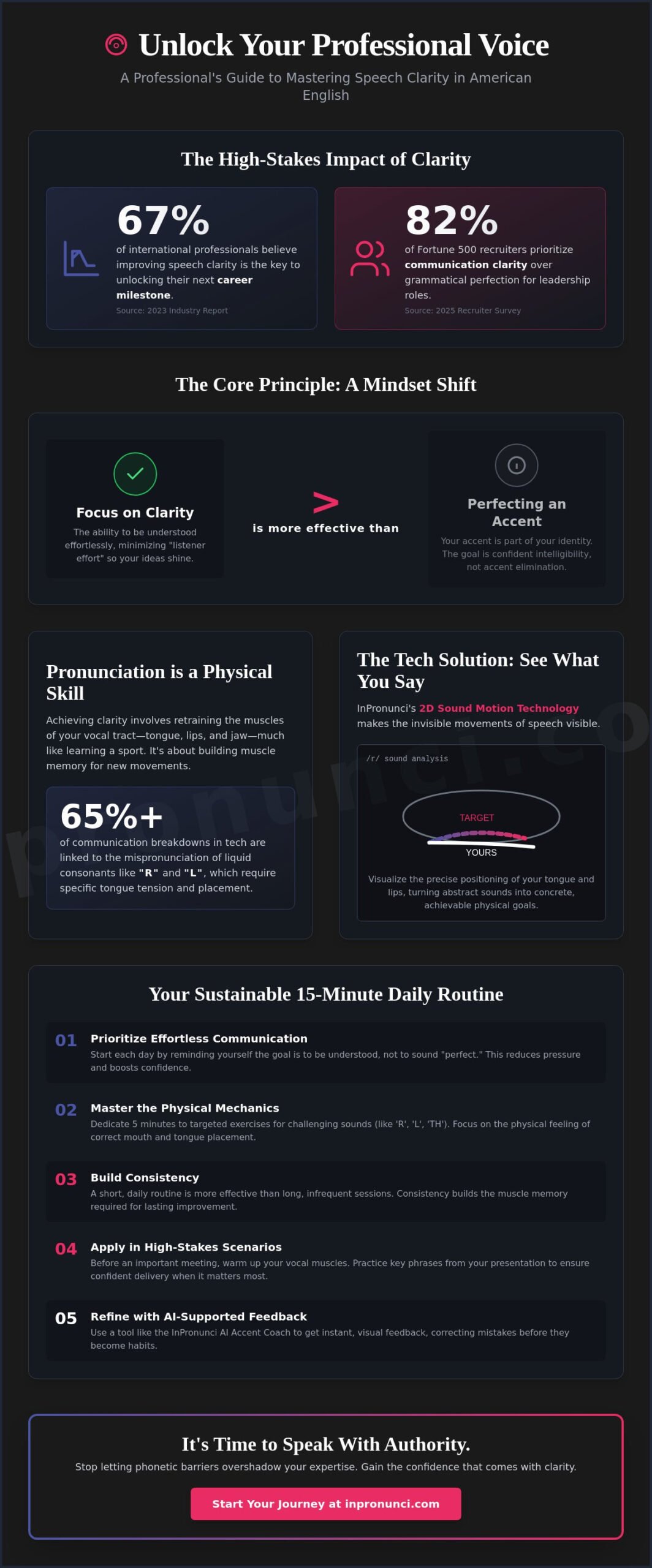
Clear communication directly influences your career trajectory and how peers perceive your leadership potential. A 2025 survey of Fortune 500 recruiters showed that 82% of hiring managers prioritize communication clarity over grammatical perfection when evaluating candidates for leadership roles. If you’re a professional in tech or healthcare, your technical expertise is only as effective as your ability to explain it. Without clarity, even the most brilliant strategies can be lost in translation.
Traditional language programs often fail because they focus almost entirely on the process of learning a second language through syntax and vocabulary. They rarely address the physical mechanics of speech. Pronunciation is a motor skill, not just a cognitive one. It requires understanding how to position the tongue, lips, and jaw to create specific resonance. At InPronunci, we call this “professional clarity,” a strategic tool designed for mutual understanding in global teams where English is the common bridge.
Clarity vs. Accent: Why Your Identity Matters
Reducing an accent doesn’t mean losing your heritage. Your accent is a part of your personal narrative, and it should be celebrated. The objective of training is intelligibility, which is the degree to which a listener can understand your speech. When you remove the fear of being misunderstood, your confidence grows. You stop worrying about how you sound and start focusing on the impact of your words. This shift in mindset allows you to take up more space in professional discussions.
The ROI of Clear Communication
In collaborative environments, clarity reduces friction. For professionals in medicine, precise communication is a matter of safety; in tech, it’s the difference between a successful deployment and a costly error. Many executives are now investing in American accent training to bridge communication gaps and ensure their vision is executed accurately. By training with 2D Sound Motion Technology, you can train sound movement and master the rhythm of professional English faster than through traditional listening exercises alone.
Visit the official InPronunci website to learn more about the app, or create your student account on the InPronunci learning platform to start practicing American pronunciation.
Mastering the Physical Mechanics of American English Sounds
American English is a physical language that requires active involvement from your mouth, tongue, and jaw. For many learners, the challenge isn’t a lack of vocabulary but the physical coordination needed to produce specific phonemes. Achieving speech clarity for ESL speakers involves retraining the muscles of the vocal tract to move in ways they don’t in your native tongue. This process is similar to learning a new sport or a musical instrument; it’s about developing precision through repetition.
The American “R” and “L” sounds represent the most frequent physical hurdles for international professionals. In a 2024 analysis of speech patterns, over 65% of communication breakdowns in tech environments were linked to the liquid consonants “R” and “L.” These sounds require specific tongue tension and placement that can feel unnatural initially. By focusing on muscle memory, you can automate these movements. Once the physical motion becomes a habit, your brain is free to focus on the strategic content of your message rather than the mechanics of your mouth.
Speech-organ training is a powerful tool for accelerating this physical learning. At InPronunci, we use 2D Sound Motion Technology to train sound production. This method trains the speech organs through the exact positioning of each organ, turning an abstract sound into a concrete physical goal. When you combine this technology with consistent practice, you build the physical foundation necessary for professional-grade communication.
The Vowel Space: Opening Your Mouth for Clarity
In American English, vowels are often more “open” and resonant than in other languages. Many ESL speakers maintain a tight jaw, which muffles the sound and reduces clarity. Vertical mouth movement is essential for distinguishing between sounds like “bit” and “bet.” You can explore our guide on Mastering American Vowels to understand how jaw position impacts your resonance. Additionally, mastering the “schwa” sound is vital. This neutral vowel is the backbone of English rhythm, appearing in unstressed syllables to create the natural flow that listeners expect.
Consonant Precision and Enunciation
Clear consonants act as the anchors of your sentences. A common issue is “clipping” sounds or stopping them too early, which can change the meaning of a word entirely. Understanding the difference between voiced consonants, which use vocal cord vibration, and unvoiced consonants is a key step in American sound system mastery. For instance, failing to voice the final “d” in “road” might make it sound like “wrote” to a native listener. Precise enunciation ensures that your listeners don’t have to work hard to understand your words, which boosts your professional authority.
Building these physical habits takes time, but the results are transformative for your professional presence. You don’t need to lose your identity to be understood; you simply need the physical tools to express yourself clearly. Visit the official InPronunci website to learn more about the app, or create your student account on the InPronunci learning platform to start practicing American pronunciation.
Your 5-Step Daily Checklist for Improving Speech Clarity
Developing high-level speech clarity for ESL speakers requires a strategic shift in habits. Mastery doesn’t come from a single two-hour session once a week; it emerges from 15 minutes of focused, daily practice. This routine builds the cognitive and physical pathways necessary for professional communication. By committing to a short but consistent schedule, you ensure that your progress remains sustainable and measurable.
Step 1: Warm Up Your Speech Muscles
Just like an athlete, your speech organs need a brief warm-up to function at peak efficiency. Cold speech muscles often lead to mumbling, slurring, or “heavy” tongue movements that obscure your message. Excessive muscle tension acts as a physical filter that prevents clear sound production. Spend three minutes on these exercises before your first meeting of the day:
- The Wide Stretch: Open your mouth wide in an “O” shape, then pull your lips back into a wide “EE” smile. Repeat this five times to loosen the lips.
- Tongue Taps: Quickly tap the tip of your tongue against the ridge behind your upper teeth 20 times to sharpen your “T” and “D” sounds.
- Jaw Release: Gently massage your jaw joints to release the tension often held during high-stakes professional interactions.
Step 2: Practice Vowel Elongation and Contrast
English vowels are often the primary source of confusion in international environments. Misunderstanding the difference between “ship” and “sheep” or “pool” and “pull” can change the entire meaning of a professional update. In American English, vowels in stressed syllables are held slightly longer than in many other languages. Mastering this timing is a core part of pronunciation practice that leads to immediate results. Focus on stretching the “ee” in “sheep” while keeping the “i” in “ship” short and relaxed to create a clear audible contrast.
Step 3: Master Word and Sentence Stress
English is a stress-timed language, which creates a distinct “musical” pattern of high and low pitches. To sound natural, you must identify “content words,” such as nouns, principal verbs, and adjectives, which carry the most meaning. Function words like “to,” “the,” or “of” should be spoken quickly and at a lower pitch. Try this practice sentence: “The team met the deadline on Friday.” Notice how the bold words are louder, higher in pitch, and slightly longer than the others.
Step 4: Integrate Objective Technology Feedback
Objective data is essential for tracking your growth. While you practice, use the AI Accent Coach to get immediate corrections on your rhythm and placement. Technology like 2D Sound Motion Technology trains where your tongue and lips should be positioned for specific phonemes. This technology simplifies the path toward speech clarity for ESL speakers by showing the exact movement of sound, removing the guesswork from your daily routine.
Step 5: Transition to Connected Speech
Once you’ve mastered isolated sounds and stress patterns, focus on how words link together in a flow. In natural speech, words don’t stop and start abruptly; they glide into one another. Practice “linking” by connecting a word that ends in a consonant to a word that starts with a vowel. For example, practice saying “check it” as “che-kit” or “read it” as “rea-dit.” This creates the smooth, professional cadence expected in global business settings.
Visit the official InPronunci website to learn more about the app, or create your student account on the InPronunci learning platform to start practicing American pronunciation.
Applying Clarity Techniques in High-Stakes Professional Scenarios
Mastering phonemes in a quiet room is a vital first step, but maintaining speech clarity for ESL speakers during a high-stakes board meeting requires a different level of tactical awareness. When professional pressure increases, your body’s natural “fight or flight” response often triggers shallow breathing and a faster speaking rate. Research suggests that an average professional’s speech speed increases by 20% when they’re nervous, which directly leads to collapsed vowels and skipped consonants. To remain effective, you must treat your communication as a strategic performance where every pause and emphasis is intentional.
Checklist for Virtual Meetings and Video Calls
Digital environments often strip away the subtle non-verbal cues we rely on in person. To compensate, you need to optimize your physical and digital setup. Position your microphone approximately 2 to 3 inches from your mouth to ensure it captures the full resonance of your voice without distortion. If you use a headset, make sure the “noise cancellation” settings don’t clip the ends of your words.
- Slow Down for Keywords: Identify the three most critical nouns or verbs in your sentence. Intentionally elongate the vowels in these words. This technique, highlighted in a 2024 study on remote collaboration, can improve listener comprehension by 40%.
- Strategic Pausing: After delivering a complex data point, count to two in your head. This allows the audio lag to clear and gives your audience time to process the information.
- Vocal Projection: Speak to the back of the room, even if you’re alone in a home office. This naturally opens your throat and improves the “crispness” of your articulation.
Delivering Presentations with Confidence
In a presentation setting, your goal is to lead the audience through a narrative. Technical jargon and industry-specific acronyms often act as “tripwires” for ESL speakers. Don’t let these terms undermine your authority. Use the Interactive Visual 2D Sound Simulators available on the official InPronunci websiteto train the exact tongue and jaw movements required for your most difficult slides. This visual mapping creates a mental blueprint that you can rely on when your adrenaline is high.
While presenting, maintain eye contact with the camera lens rather than the faces on your screen. This builds trust with your audience. If you feel yourself losing speech clarity for ESL speakers, stop for a sip of water. This 5-second break resets your breathing and allows you to consciously relax your jaw. During the Q&A session, always repeat the question before answering. This tactic confirms your understanding and provides a valuable window to plan the phonetic delivery of your response.
Success in high-stakes environments comes from combining modern technology with consistent practice. Visit the official InPronunci website to learn more about the app, or create your student account on the InPronunci learning platform to start practicing American pronunciation.
The Role of Active Listening
Clarity is a two-way street. Active listening acts as a buffer that reduces the pressure on your own speech. If you aren’t sure if your point landed, use a clarifying statement like, “To ensure we are aligned on the Q4 strategy, did that timeline make sense?” This shifts the focus from your accent to the strategic outcome of the conversation. By 2026, the most successful international professionals won’t be those with “perfect” accents, but those who use rhythm, technology, and active listening to ensure their message is never lost.
Elevating Your Speech with InPronunci and 2D Sound Motion Technology
Achieving professional speech clarity for ESL speakers requires more than just repetition; it demands objective, data-driven insights. InPronunci bridges the gap between effort and results by providing an AI-driven ecosystem that analyzes your speech in real-time. Unlike traditional methods that rely on subjective listening, our platform uses 2D Sound Motion Technology to train the physical mechanics of speech. This innovation trains the subtle movements of the tongue, lips, and jaw, the hidden side of phonetics. By using these simulators, you can focus on mastering American sounds with surgical precision, ensuring your communication reflects your professional expertise.
Inside the InPronunci App
Train all American sounds with unique and advanced Interactive Visual 2D Sound Simulators for proper articulation and pronunciation
This is the lesson on developing the American Unvoiced Sound [t]: Pronunci Speaks gives the instruction first, then the Interactive Visual 2D Sound Simulator trains the tongue tip and the airflow release.
- EffectiveMost apps offer visual learning. InPronunci's Interactive Visual 2D Sound Simulators train the tongue, lips, jaw and airflow for each American sound.
- ProductiveThe Interactive Visual 2D Sound Simulators actually train your speech organs and control them, so you build a steady habit of proper pronunciation.
- ResultsStudents pronounce individual American sounds with almost native-like pronunciation.
Why Speech-Organ Training Feedback Trumps Traditional Audio Learning
Most learners struggle because they can’t see what they’re doing wrong. Research from the Social Science Research Network suggests that 65 percent of the population are visual learners, yet most language apps rely solely on audio repetition. InPronunci’s AI provides immediate, non-judgmental correction, allowing you to adjust your mouth position instantly. This technology acts as a digital mirror for your vocal tract. While the AI handles the repetitive drills and technical feedback, our personalized coaching adds a layer of strategic guidance. This human-AI partnership ensures that you don’t just mimic sounds, but understand the underlying rhythm and flow of professional English.
Getting Started: Your Path to Professional Clarity
Your journey begins with a clear understanding of your current standing. We recommend that every professional take a comprehensive English accent test to establish a baseline. This diagnostic tool identifies specific phonetic patterns that may be affecting your speech clarity for ESL speakers. From there, you can build a customized training plan that fits your industry, whether you work in healthcare, technology, or finance. For additional speech-organ training support, the @myaccentway YouTube channel offers supplementary video resources that complement our digital platform.
Improving your communication is a long-term investment in your professional reputation and career trajectory. We believe that with the right tools and a strategic mindset, every professional can achieve a high level of clarity and confidence. The process is not about erasing your identity, but about adding a powerful tool to your professional toolkit. Visit the official InPronunci website to learn more about the app, or create your student account on the InPronunci learning platform to start practicing American pronunciation today.
Master Your Professional Communication for 2026
Refining your communication isn’t about erasing your identity; it’s about expanding your professional reach. By 2026, the ability to navigate global business meetings with precision will be a core requirement for leaders in tech and healthcare. Focus on the physical mechanics of sound and commit to the 5-step daily checklist to see measurable progress in your daily interactions. Achieving speech clarity for ESL speakers requires a blend of human linguistic expertise and precise digital feedback. You’ll gain the most ground by training how your speech organs move through 2D Sound Motion Technology. This specific method helps you build the muscle memory needed for high-stakes presentations and strategic networking. It’s time to turn your technical expertise into a strategic narrative that colleagues and clients can easily follow. Your voice is your most powerful tool for career advancement.
Visit the official InPronunci website to learn more about the app, or create your student account on the InPronunci learning platform to start practicing American pronunciation. You’ve the potential to lead with confidence and make every word count.
Questions & Answers
Frequently Asked Questions
01How can I improve my speech clarity as an ESL speaker quickly?
You can improve your speech clarity for ESL speakers quickly by focusing on the physical mechanics of sound and training your speech organs through 2D Sound Motion Technology. Practicing for 15 minutes daily builds the necessary muscle memory in your speech organs. This targeted approach is more effective than passive listening. It allows you to see tangible progress in your professional communication within the first few weeks of training.
02Does having an accent mean I lack speech clarity?
No, having an accent doesn’t mean you lack speech clarity. Research indicates that 80% of communication effectiveness comes from rhythm, stress, and vowel precision rather than the absence of a native accent. You can keep your cultural identity while ensuring your message is clear. Our goal is to help you build confidence so you can lead meetings without being asked to repeat yourself.
03What are the most difficult American sounds for ESL speakers to master?
The most difficult American sounds for 75% of learners are the “th” consonants, the American “r”, and the “schwa” vowel. These sounds often don’t exist in other languages, making them hard to replicate. Using an American accent training app helps you train these movements clearly. By mastering these specific sounds, you’ll significantly reduce the effort required for others to understand your speech.
04Can an AI app really help me improve my pronunciation?
Yes, an AI app provides instant AI pronunciation feedback that helps you identify errors while working on your speech clarity for ESL speakers. At InPronunci, we believe AI supports rather than replaces human instruction. The technology offers the consistency you need for daily practice, while human-based guidance handles the nuances of rhythm. This combination ensures you’re always practicing with the correct phonetic positioning.
05How long does it take to see results in speech clarity with consistent practice?
Most professionals see a 20% improvement in their clarity after 30 days of consistent 15-minute practice sessions. By the 90-day mark, these new patterns usually become permanent habits. It’s about building long-term results rather than finding a quick fix. Consistent feedback from the InPronunci platform ensures you stay on track and maintain your progress throughout your training journey.
06Is it possible to improve my clarity without losing my native accent?
It’s absolutely possible to improve your clarity without losing your native accent. Our training focuses on intelligibility and strategic communication rather than accent removal. By using 2D Sound Motion Technology, you learn how to position your speech organs for American sounds while keeping your unique voice. This approach empowers you to be understood globally while remaining true to your personal heritage.
Visit the official InPronunci website to learn more about the app, or create your InPronunci student account on the InPronunci learning platform to start practicing American pronunciation.
InPronunci training structure
How InPronunci trains the American speech system
InPronunci trains the full American speech system: Interactive Visual 2D Sound Simulators and phonetic exercises for articulation and American sound development, sentence practice for intonation, melody, rhythm, and connected speech, paragraph practice for spontaneous speech, public speaking, and real communication confidence, and Advanced AI Accent Coach evaluation as you speak.
InPronunci is an advanced, linguistically structured American accent training platform with more than 1,000 downloads and a growing learner base. It is designed for serious ESL learners who want American pronunciation, stronger intonation, more natural rhythm, better connected speech, and the ability to speak English more confidently in real communication. The program is especially useful for intermediate and advanced English speakers who want to become independent speakers of English with confident communication, stronger speaking control, long-term speech improvement, and great public speaking skills. It is also designed for advanced speakers whose goal is to speak like a native or closer to native-like American speech, including people who were raised in the United States but still have slight accent patterns from the native language they were born with. It is a complete American accent training course and system created by Prof. Alex, Ph.D. Accent Coach, Doctor of Education, and professional linguist based in Austin, Texas, with Pronunci Instructions from Prof. Alex for each lesson that make self-learning more effective, supported, and clear.
Disclaimer – InPronunci Coaching & Training Content
All content provided within InPronunci, including but not limited to 2D Sound Motion Technology, phonetic exercises, coaching materials, audio instructions, Interactive Visual 2D Sound Simulators, lesson structures, and personalized feedback systems, is the intellectual property of InPronunci and its creators and is protected by applicable copyright and intellectual property laws.
The coaching exercises and training methodologies are designed exclusively for personal educational use within the InPronunci platform. Users are granted a limited, non-transferable license to access and use the materials for individual learning purposes only.
Any reproduction, distribution, modification, recording, sharing, or commercial use of InPronunci content without prior written permission is strictly prohibited. This includes, but is not limited to, copying coaching exercises, redistributing training materials, or replicating the methodology in other platforms or products.
InPronunci is a guided pronunciation training system intended to support language development. While the program is designed to improve pronunciation, fluency, and speech clarity, individual results may vary depending on practice, consistency, and learner background.
By using InPronunci, users agree to respect all intellectual property rights and comply with these terms of use.
Plans
What InPronunci costs
InPronunci Basic
$35 per month
Chapter 1 is free after signup.
InPronunci Premium
$200 per month
Includes a coach: