


What if the primary barrier to your professional advancement isn’t your vocabulary, but the inability to quantify your phonetic progress? Many high-level professionals experience the persistent exhaustion of repeating themselves in meetings, yet they struggle to identify exactly where their pronunciation falters. You’ve likely realized that measuring improvement in speech clarity requires more than just listening to recordings or asking a colleague for feedback. It demands a shift toward objective data.
We recognize that “feeling” clearer isn’t enough to build lasting confidence in a high-stakes boardroom. Relying on intuition often leads to a plateau where progress feels stagnant or entirely invisible. This article provides a strategic framework to move beyond subjective self-assessment by utilizing AI-driven metrics and 2D Sound Motion Technology to track your phonetic evolution. We’ll outline a structured roadmap that replaces uncertainty with objective scores, giving you the professional validation necessary to master the American accent. Precision creates confidence.
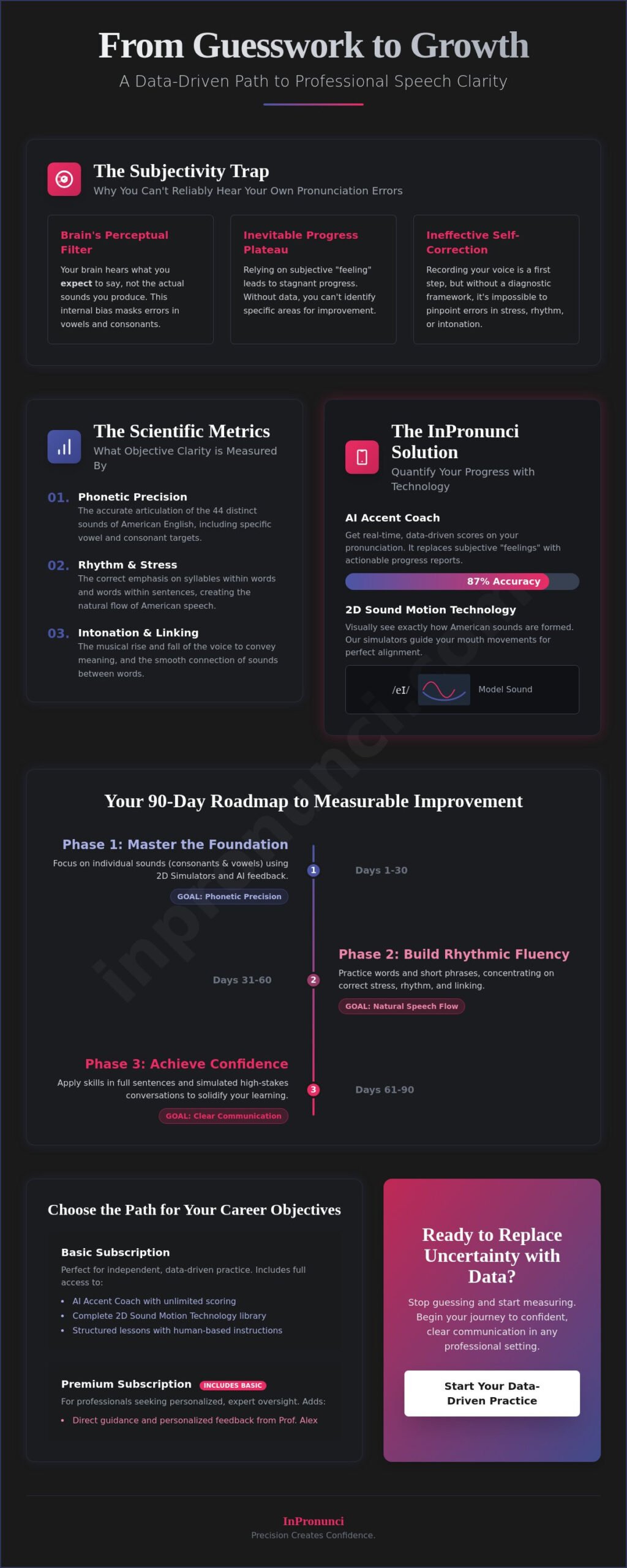
The Subjectivity Trap: Why You Can’t Always Hear Your Own Progress
The human brain is remarkably efficient at filtering out noise to find meaning. However, this same efficiency creates a significant hurdle when you’re trying to refine your American accent. This phenomenon, often called the “Perceptual Filter,” means your brain hears what it expects to say rather than the actual sounds leaving your mouth. Because you know your intended message, your internal ear compensates for dropped consonants or flattened vowels. This internal bias makes measuring improvement in speech clarity nearly impossible through self-perception alone. You can’t fix what you can’t objectively hear.
In a professional context, clarity isn’t about achieving a “perfect” accent or erasing your identity. It’s an objective measure of how comprehensible speech is to your audience. When a listener has to work hard to decode your message, their cognitive energy shifts from your ideas to your phonetics. High-level communication requires a seamless exchange where your voice acts as a clear conduit for your expertise. Relying on “feeling” clearer is a strategy that inevitably leads to a plateau.
The Limitations of Self-Assessment
Many professionals attempt to bridge this gap by recording their own voice. While this is a helpful initial step, it often leads to confusing results because the learner lacks the diagnostic framework to identify specific errors. You might notice that something sounds “off,” but without data, you can’t tell if the issue is a misplaced word stress, a tense vowel, or a lack of aspiration. This ambiguity makes it difficult to know if your practice is actually working.
This difficulty intensifies under high cognitive load. During a high-stakes presentation, your mental resources are focused on data and strategy, leaving little room for conscious speech monitoring. This is why many find that their clarity drops in meetings despite hours of isolated practice. Speech clarity is the intersection of phonetic precision and rhythmic consistency. Without an external, objective tool like the AI Accent Coach, you’re essentially flying blind in your development.
The Professional Cost of Unclear Communication
The stakes for speech mastery are high in a globalized economy. Every time you’re asked to “repeat that” in a boardroom, your authority takes a subtle hit. It interrupts the flow of your argument and can make you appear less prepared than your peers. Over time, this creates a cycle of speaking anxiety. When you’re nervous, your vocal muscles tighten, which physically restricts the movement required for clear American sounds.
Viewing professional clarity as a strategic career asset allows you to approach training with the same rigor as any other business skill. It’s not a vague talent; it’s a measurable output that can be optimized through structured data and deliberate practice. Breaking through the subjectivity trap requires moving away from guesswork and toward a system that provides consistent, quantifiable feedback.
Scientific Metrics of Clarity: Phonetics, Rhythm, and Intonation
While architectural standards measure clarity through decibels and sound reflections, professional speech mastery relies on the precision of human articulation. The American Sound System functions as a strategic framework composed of specific phonetic units: consonants, vowels, and the rhythmic stress patterns that bind them together. Measuring improvement in speech clarity involves analyzing how closely your production aligns with these established acoustic targets. It’s a transition from being merely understood to being effortlessly heard.
In the corporate world, intelligibility is the functional floor. It’s the bare minimum required for a listener to decode your message. Clarity, however, is the professional ceiling. It’s the ease with which your expertise is received. This distinction often hinges on word-final consonants and vowel neutralization. When you drop the final “t” in “project” or fail to neutralize unstressed vowels into the “schwa” sound, you increase the listener’s cognitive load. High-level communication requires reducing this friction so your ideas can take center stage.
Phonetic Precision vs. General Fluency
Fluency is often mistaken for speed, but true professional clarity is rooted in phonetic precision. You may know the correct vocabulary for a board report, but if your articulatory habits are stuck in your native phonetic system, your message will lose its impact. This is particularly evident in the production of American vowels, which require specific tongue positions and jaw movements that differ significantly from other languages. Mastering these physical movements is the foundation of measurable change.
Articulatory habits are essentially muscle memory. To change them, you must move beyond passive listening and engage in active, repetitive drills that re-educate your vocal tract. If you’re ready to begin this structured process, you can create your profile to start tracking your phonetic accuracy today. Precision is the result of deliberate practice, not accidental exposure.
Rhythm and Intonation: The Hidden Metrics
Native speakers navigate meaning through a melody of sentence stress and pitch changes. If your speech is monotone or follows the rhythm of a syllable-timed language, American listeners will find it difficult to identify your key points. Speaking too fast is frequently a symptom of poor rhythm. By rushing, you bypass the essential “Held T” sounds and glottal stops that provide the necessary punctuation in American English. These subtle mechanics are the hallmarks of advanced mastery.
Intonation also serves as a tool for professional authority. A slight pitch drop at the end of a declarative sentence signals confidence and finality. Conversely, an upward inflection at the end of a statement can make you sound uncertain, regardless of your actual expertise. By quantifying these pitch shifts and rhythmic intervals, you turn the “feeling” of a good accent into a set of actionable data points. Mastery is found in the details of the melody.
How AI and 2D Sound Motion Quantify Improvement
Transitioning from phonetic theory to practical mastery requires a reliable, tireless observer. While human feedback is valuable, it’s often inconsistent or limited by social politeness. The AI Accent Coach functions as a 24/7 objective listener, providing a data-driven baseline for every sound, word, and sentence you produce. This technology eliminates the ambiguity of self-assessment, turning the vague goal of “sounding better” into a series of quantifiable benchmarks. Measuring improvement in speech clarity becomes a transparent process when every utterance is compared against a precise American phonetic model.
Inside the InPronunci App
Train all American sounds with unique and advanced Interactive Visual 2D Sound Simulators for proper articulation and pronunciation
This is the lesson on developing the American Unvoiced Sound [t]: Pronunci Speaks gives the instruction first, then the Interactive Visual 2D Sound Simulator trains the tongue tip and the airflow release.
- EffectiveMost apps offer visual learning. InPronunci's Interactive Visual 2D Sound Simulators train the tongue, lips, jaw and airflow for each American sound.
- ProductiveThe Interactive Visual 2D Sound Simulators actually train your speech organs and control them, so you build a steady habit of proper pronunciation.
- ResultsStudents pronounce individual American sounds with almost native-like pronunciation.
This data-driven approach relies on a rigorous feedback loop: Practice, Record, AI Analysis, and Correction. When you record your speech, the AI doesn’t just listen for general errors; it analyzes the acoustic properties of your voice to identify exactly where a sound deviates from the target. This immediate diagnostic capability allows you to address specific phonetic missteps before they become deeply ingrained habits. Understanding how to use AI pronunciation feedback strategically ensures that every minute of practice contributes to a measurable increase in clarity rather than simply chasing a higher score.
The Role of 2D Sound Video Mouth Training Simulators
One of the greatest challenges in accent training is the “hidden” nature of speech. You can’t easily see how your tongue moves or how your vocal tract shapes a specific vowel. This often leads to a guessing game that stalls progress. 2D Sound Motion Technology solves this by training speech patterns. By using 2D Sound Video Mouth Training Simulators, you can train the precise movement of the mouth and speech organs in real time. Training the mechanics of a sound while you hear it helps re-educate the brain and strengthens the connection between auditory input and physical execution.
Training cues significantly reduce the cognitive load of learning complex American sounds. Instead of struggling to interpret abstract instructions, you follow a clear training path for the articulatory process. This “seeing is believing” factor accelerates the transition from conscious effort to automatic muscle memory. It’s a modern solution for a complex biological challenge.
Interpreting AI Pronunciation Scores
A score in the InPronunci ecosystem isn’t just a grade; it represents the mathematical alignment between your production and the target American phonetic model. High scores indicate that your tongue position, lip shape, and air release are synchronized with the standard American sound system. By using these real-time scores, you can make micro-adjustments during your practice sessions. If a specific vowel score is low, you know exactly where to focus your attention.
It’s important to distinguish between “passing” a single word and mastering paragraph-level flow. While scoring a 95% on an isolated word is an excellent start, true professional clarity is measured by your ability to maintain that precision across complex sentences. The AI tracks this evolution, showing you how your clarity holds up as the linguistic difficulty increases. Data provides the roadmap; your practice provides the results.
Case Study: A 90-Day Roadmap to Measurable Clarity
Achieving professional fluency is a strategic progression rather than a series of random exercises. By following a structured 90-day roadmap, measuring improvement in speech clarity becomes a predictable outcome based on phonetic data and consistent practice. This timeframe allows for the physical re-education of the speech organs while providing enough duration to track significant acoustic changes. It moves the user from a state of phonetic uncertainty to a position of communicative authority.
The Diagnostic Phase: Identifying High-Impact Errors
Every successful intervention begins with an accurate assessment. During the first 30 days, the focus is on establishing a baseline and mastering individual phonemes. Using a strategic English accent test allows you to identify the 20% of phonetic errors that cause 80% of your clarity issues. This diagnostic approach ensures you don’t waste time on sounds you already produce correctly, focusing instead on high-impact vowels and consonants.
Setting SMART goals is essential during this phase. Instead of aiming to “sound better,” you might set a goal of mastering the American “R” or the “TH” sound within three weeks. It’s also vital to record a “Before” sample using the app’s microphone practice feature. This recording serves as a raw data point that you can compare against future AI scores to validate your effort. Without a clear starting point, progress remains an abstract concept.
The Mastery Phase: From Drills to Real-World Application
Once the foundation is set, the second phase (Days 31-60) transitions to word-linking and sentence-level rhythm. This is where you begin to see how individual sounds behave in a flow. Phonetic drills translate into clearer boardroom presentations when you understand how to navigate sentence stress and glottal stops. The AI Accent Coach provides real-time feedback on these transitions, ensuring your rhythm matches the expected American melody. Measuring improvement in speech clarity at this stage involves tracking your ability to maintain precision during longer, more complex utterances.
The final phase (Days 61-90) focuses on paragraph-level fluency and professional confidence. This is where you build the stamina required for 30-minute meetings or keynote speeches. The transition from conscious effort to unconscious muscle memory occurs when the articulatory system no longer requires active monitoring during spontaneous speech. For those seeking the highest level of refinement, human-based guidance in our Premium Subscription provides the nuanced correction that AI alone might miss. This combination of data and expert oversight ensures your progress is both measurable and sustainable.
Precision in speech is a career asset that pays dividends in every meeting. If you’re ready to start your 90-day progression with a data-driven baseline, you can sign up and take your initial assessment today. Data-driven results are the only way to ensure your efforts lead to genuine mastery.
Implementing a Data-Driven Practice with InPronunci
The InPronunci ecosystem represents a strategic shift from passive listening to active, data-driven mastery. By prioritizing measuring improvement in speech clarity, you move away from the frustration of invisible progress and toward a structured environment where every phonetic drill yields a quantifiable result. This approach treats American pronunciation not as an innate talent, but as a sophisticated skill that can be engineered through precise feedback and deliberate repetition. It’s about building a reliable sound system that serves your professional objectives without fail.
Integrating high-level training into a demanding career doesn’t require hours of daily study. Consistency outpaces intensity in the re-education of speech muscles. Dedicating just 15 minutes of focused pronunciation practice each day allows the brain to solidify new articulatory habits without overwhelming your schedule. This micro-learning strategy ensures that your phonetic precision remains sharp, making measuring improvement in speech clarity a daily reality rather than a distant aspiration.
Choosing Your Subscription Level
Your choice of subscription should align with your specific professional needs and the depth of feedback you require. The Basic Subscription provides the essential tools for daily maintenance, including the AI Accent Coach, 2D simulators, and Practice Mode and AI feedback. It’s an ideal solution for professionals who need a tireless, objective listener to provide real-time scoring and correction guidance. Think of the app as a “Gym for your Speech Muscles,” where regular use builds the phonetic strength and flexibility required for clear communication.
For high-level executives and public speakers who operate in high-stakes environments, the Premium Subscription offers an added layer of strategic depth. This plan includes everything in the Basic tier plus direct, personalized guidance from Prof. Alex. This human-based oversight provides the nuanced analysis of rhythm and intonation that helps you achieve a truly authoritative presence. Whether you choose the AI-driven path or the expert-guided route, the goal remains the same: sustainable, measurable clarity.
Next Steps: Your First Measurable Improvement
The path to mastery begins with a single data point. We invite you to adopt a test-and-learn mindset for your first 30 days of practice. By downloading the InPronunci app from the App Store, you gain immediate access to the diagnostic tools necessary to map your current phonetic landscape. Your first recording serves as a baseline, allowing the AI to identify exactly which sounds require your attention.
Don’t wait for a “perfect” time to start. Record your first diagnostic today and let the data guide your progression. As your scores rise and your speech organs match the 2D Sound Motion target models, you’ll gain the quiet confidence that comes from knowing you are being heard. Excellence in speech is a choice. Practice your American pronunciation using the app, try the AI Accent Coach, and begin the process of mastering your professional voice through guided, objective practice.
Mastering the Mechanics of Professional Voice
Moving from phonetic uncertainty to communicative authority requires a fundamental shift in perspective. You’ve seen how the brain’s internal filters can distort self-assessment and why data-driven metrics are essential to break through a persistent progress plateau. By focusing on the specific mechanics of the American sound system, you turn a vague professional goal into a series of achievable, quantifiable benchmarks. Measuring improvement in speech clarity isn’t just about achieving high scores; it’s about the psychological freedom that comes from knowing your message is landing exactly as intended.
Whether you’re using 2D Sound Motion Technology to train articulatory movements or relying on real-time AI scoring for daily drills, you’re building a foundation of muscle memory that supports your long-term career objectives. Human-based guidance ensures that even the most subtle nuances of professional rhythm and intonation are mastered with precision. Start measuring your progress today with the InPronunci AI Accent Coach and replace guesswork with strategic growth. Clarity is a skill that can be engineered. With the right tools and a structured approach, your voice becomes your strongest professional asset.
Questions & Answers
Frequently Asked Questions
01How long does it take to see a measurable improvement in speech clarity?
Measurable improvement typically begins to manifest within the first 30 days of consistent, daily practice. While initial phonetic adjustments are visible in your AI scores within the first few weeks, achieving sustainable paragraph-level fluency usually requires a structured 90-day progression to solidify new muscle memory.
02Can AI really accurately score a non-native accent?
Yes, the AI Accent Coach utilizes advanced phonetic models to provide an objective mathematical alignment between your speech and the target American sound system. Unlike human listeners who may be influenced by social context or personal bias, the AI provides a neutral, data-driven baseline for every sound you produce.
03What is the difference between intelligibility and clarity in English?
Intelligibility is the functional minimum required for a listener to decode your words; clarity is the professional ceiling that determines the ease of that decoding. High clarity reduces the listener’s cognitive load, allowing them to focus entirely on your expertise rather than your phonetic delivery.
04How often should I practice with the AI Accent Coach for the best results?
Consistency is more effective than intensity when re-educating your speech organs. Dedicating 15 minutes to focused practice each day is the most efficient strategy for measuring improvement in speech clarity and building long-term articulatory habits without overwhelming your professional schedule.
05Do I need to lose my original accent to be clear in American English?
No, professional clarity does not require the erasure of your linguistic identity or heritage. The objective is to master the specific mechanics of American vowels, consonants, and rhythm so that your message is delivered with precision and authority, regardless of your original accent.
06Why is speech-organ training feedback more effective than just listening to audio samples?
Speech-organ training through 2D Sound Motion Technology trains the movement of speech organs that are usually hidden. This removes the guesswork from pronunciation by providing a clear training path for how your tongue, lips, and jaw should move to produce specific American sounds.
07What are the most common sounds that affect professional speech clarity?
Professional clarity is most frequently impacted by American vowel precision, word-final consonants, and sentence-level stress patterns. Mastering these elements provides the “melody” that native speakers use to navigate meaning, ensuring your key points are emphasized correctly during high-stakes communication.
08Can I measure my progress without a human coach?
Yes, the InPronunci app is designed to facilitate measuring improvement in speech clarity through objective AI scoring and real-time feedback. While human-based guidance in the Premium Subscription provides nuanced strategic refinement, the AI Accent Coach offers a reliable, independent way to track and validate your phonetic growth.
InPronunci training structure
How InPronunci trains the American speech system
InPronunci trains the full American speech system: Interactive Visual 2D Sound Simulators and phonetic exercises for articulation and American sound development, sentence practice for intonation, melody, rhythm, and connected speech, paragraph practice for spontaneous speech, public speaking, and real communication confidence, and Advanced AI Accent Coach evaluation as you speak.
InPronunci is an advanced, linguistically structured American accent training platform with more than 1,000 downloads and a growing learner base. It is designed for serious ESL learners who want American pronunciation, stronger intonation, more natural rhythm, better connected speech, and the ability to speak English more confidently in real communication. The program is especially useful for intermediate and advanced English speakers who want to become independent speakers of English with confident communication, stronger speaking control, long-term speech improvement, and great public speaking skills. It is also designed for advanced speakers whose goal is to speak like a native or closer to native-like American speech, including people who were raised in the United States but still have slight accent patterns from the native language they were born with. It is a complete American accent training course and system created by Prof. Alex, Ph.D. Accent Coach, Doctor of Education, and professional linguist based in Austin, Texas, with Pronunci Instructions from Prof. Alex for each lesson that make self-learning more effective, supported, and clear.
Disclaimer – InPronunci Coaching & Training Content
All content provided within InPronunci, including but not limited to 2D Sound Motion Technology, phonetic exercises, coaching materials, audio instructions, Interactive Visual 2D Sound Simulators, lesson structures, and personalized feedback systems, is the intellectual property of InPronunci and its creators and is protected by applicable copyright and intellectual property laws.
The coaching exercises and training methodologies are designed exclusively for personal educational use within the InPronunci platform. Users are granted a limited, non-transferable license to access and use the materials for individual learning purposes only.
Any reproduction, distribution, modification, recording, sharing, or commercial use of InPronunci content without prior written permission is strictly prohibited. This includes, but is not limited to, copying coaching exercises, redistributing training materials, or replicating the methodology in other platforms or products.
InPronunci is a guided pronunciation training system intended to support language development. While the program is designed to improve pronunciation, fluency, and speech clarity, individual results may vary depending on practice, consistency, and learner background.
By using InPronunci, users agree to respect all intellectual property rights and comply with these terms of use.
Plans
What InPronunci costs
InPronunci Basic
$35 per month
Chapter 1 is free after signup.
InPronunci Premium
$200 per month
Includes a coach: