


Last Tuesday, a senior software architect stood before his board of directors, but instead of discussing his innovative project, he spent ten minutes repeating himself because of a few misunderstood vowels. This common scenario highlights the need for strategic accent reduction, a skill that prevents talented professionals from being overlooked for leadership roles. It’s exhausting to manage complex technical data while simultaneously worrying if your listeners can follow your pronunciation. Your ideas deserve to be heard the first time you speak them.
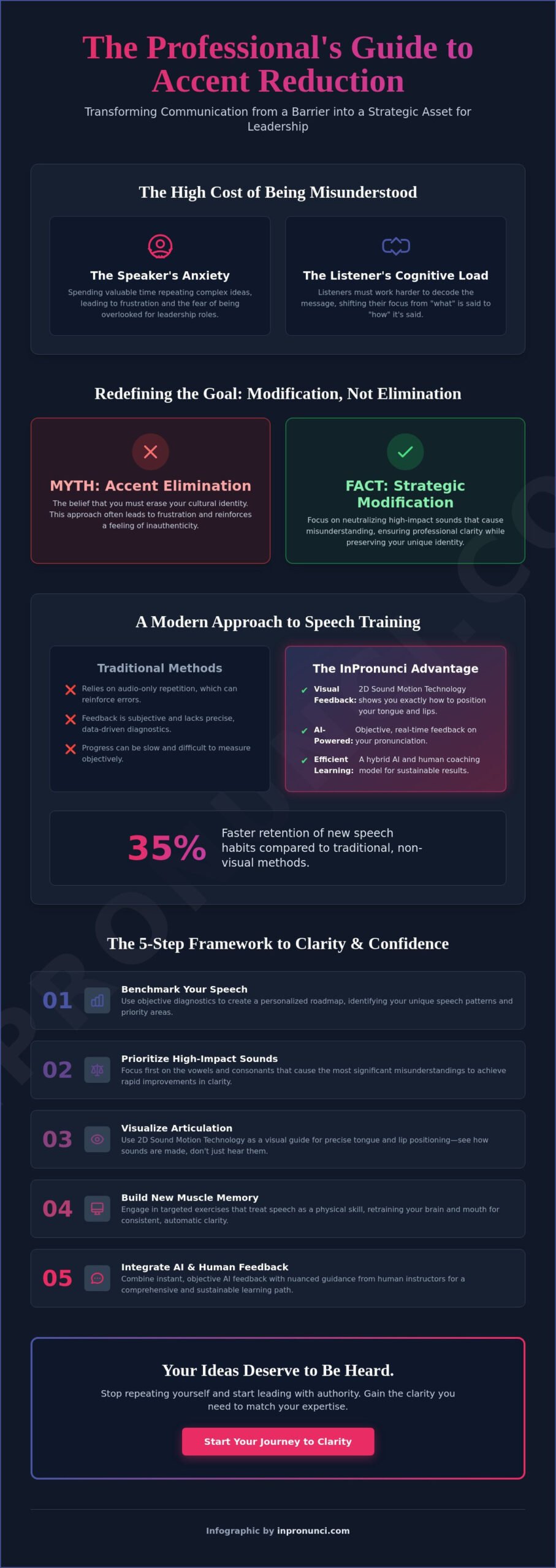
We believe that clear communication is the most important tool for achieving business success and professional visibility. In this guide, you’ll learn a systematic approach to neutralizing speech barriers and building professional confidence through modern phonetic training. We’ll explore how InPronunci uses 2D Sound Motion Technology to help learners achieve 35% faster retention compared to traditional methods. This journey isn’t about losing your identity; it’s about gaining the clarity needed to lead with authority and poise.
What is Accent Reduction and Why Does it Matter for Professionals?
Communication is a strategic asset, not just a basic skill. For many international experts, accent reduction is the final step in aligning their deep technical knowledge with their professional visibility. It’s a strategic modification of speech patterns designed to ensure your message is received without friction. According to Wikipedia, What is Accent Reduction involves a systematic approach to adopting new pronunciation habits. It’s not about erasing your past; it’s about optimizing your future. When you reduce speech barriers, you lower the cognitive load for your listeners, allowing them to focus entirely on your expertise rather than your phonetics.
The emotional shift is just as significant as the technical one. Moving from the anxiety of being misunderstood to the calm of authoritative communication changes how you show up in boardrooms and on stages. Clear speech builds a strategic narrative of competence. It signals that you value your audience’s time by making your insights easy to consume. This transition from “repeating yourself” to “being heard” is the foundation of modern leadership in global industries like tech and healthcare. For ESL professionals looking to bridge this gap, mastering professional advancement communication is a critical step toward earning the leadership visibility your expertise deserves.
The Difference Between Accent Modification and Elimination
Eliminating an accent is a myth that often leads to frustration. Your unique cultural identity is a professional asset that adds depth to your brand. Strategic modification focuses on neutralization rather than erasure. We target “high-frequency” sounds; the specific vowels and consonants that, when mispronounced, change the meaning of a word or cause a listener to pause. The goal is to make communication effortless. By focusing on these critical barriers, you maintain your cultural essence while ensuring your professional clarity is never in question. It’s a pragmatic balance between authenticity and precision.
Why Grammar Isn’t Enough for Professional Clarity
Many professionals fall into the “fluency gap.” This is where a speaker possesses perfect grammar and a rich vocabulary, yet struggles to lead meetings because of their delivery. Achieving the goal of speaking english fluently requires a deep understanding of American intonation and rhythm. In English, the “music” of the sentence often carries more weight than the individual words. Research indicates that professionals who master american sounds and stress patterns experience faster career growth. They don’t just speak correctly; they speak with a rhythm that commands attention and projects confidence in every interaction.
The Science of Speech: Articulatory Phonetics and Muscle Memory
Most professionals view language as a collection of grammar rules and vocabulary lists. However, speaking is fundamentally a physical performance that requires the precise coordination of multiple muscle groups. To achieve effective accent reduction, you must first understand the mechanics of your speech organs. This physical system includes the tongue, lips, jaw, and soft palate. Articulatory phonetics is the study of how speech sounds are physically produced by the human body. When you speak, you’re essentially performing a complex athletic feat with your mouth.
The challenge for adult learners is often rooted in the brain’s hardware. The Science of Speech research indicates that the adult brain begins to filter out sounds that don’t exist in its native phonology. This means you might struggle to “hear” the difference between two American vowels because your brain has been trained to ignore that specific distinction for decades. Training isn’t just about listening harder; it’s about retraining your physical anatomy to create sounds your brain has previously dismissed. You’re building a new physical map for your mouth.
Developing Speech Muscle Memory for Native-Like Clarity
Repetition alone often fails because it reinforces existing habits rather than creating new ones. If your tongue is in the wrong position, repeating a word a thousand times only cements the error. True progress comes from proprioception, which is the ability to feel the exact location of your tongue and jaw during speech. This is why pronunciation practice must focus on physical drills. By using 2D Sound Motion Technology on the official InPronunci website, you can train these movements, making the invisible physical process visible and manageable.
Reducing Cognitive Load in High-Stakes Conversations
There’s a hidden mental tax on non-native speakers during high-stakes negotiations. When you have to monitor your pronunciation while simultaneously managing complex technical data, your cognitive load increases significantly. This mental drain often leads to communication fatigue and a perceived loss of authority. For many international professionals, this pressure compounds into speaking anxiety in English that can mask expertise and hinder career advancement. The goal of accent reduction is to move from conscious effort to unconscious competence. By automating the physical movements of speech through consistent training, you free up mental energy. This allows you to focus entirely on your professional narrative and the strategic impact of your message.
Comparing Methods: Traditional Coaching vs. AI-Assisted Training
Choosing the right path for accent reduction is a strategic decision that impacts both your schedule and your career trajectory. Historically, professionals relied solely on private coaching, which as of May 2026 often costs between $100 and $250 per hour. While these sessions provide deep, personalized insights, their low frequency often hinders the development of muscle memory. Modern professionals now turn to a hybrid model that integrates the precision of a pronounce app with the nuanced guidance of human specialists. This approach ensures that you aren’t just learning once a week, but refining your speech every single day.
The accent reduction journey is most effective when AI handles the repetitive, phonetic heavy lifting. According to the American Speech-Language-Hearing Association, modification is a personal choice that should focus on the speaker’s specific goals. AI provides the 24/7 consistency needed to meet those goals without the burnout of high-cost sessions. It doesn’t replace the human coach; it empowers them by ensuring the student arrives at each session with a stronger phonetic foundation. This synergy allows for a higher return on investment for the learner.
The Role of Real-Time AI Pronunciation Feedback
Precision is the hallmark of modern digital training. AI pronunciation feedback identifies micro-errors in vowel length or consonant aspiration that even a trained human ear might overlook during a fast-paced conversation. Before stepping into a high-stakes meeting, you can use an english accent test to benchmark your progress and identify lingering barriers. This “safe-to-fail” environment allows you to experiment with new sounds without the pressure of a live audience. By the time you speak in public, your patterns are already polished through thousands of low-stakes repetitions. Professionals seeking a deeper understanding of how these systems work can explore AI accent coach technology to see how modern acoustic modeling delivers more nuanced and precise pronunciation guidance.
When to Seek Human-Based Phonetic Guidance
While AI excels at objective phonetic accuracy, human specialists remain essential for mastering the emotional architecture of speech. Complex rhythm, persuasive intonation, and the subtle “music” of American English often require a human perspective on context and intent. A coach is invaluable when preparing for specific scenarios like a keynote address or a critical job interview where the goal isn’t just clarity, but influence. By combining digital precision with human expertise, you create a communication strategy that is both technically perfect and emotionally resonant. Visit the official InPronunci website to see how this synergy works in practice.
5 Strategic Steps to Efficiently Reduce Your Accent Barriers
Successful accent reduction isn’t the result of random imitation; it’s the outcome of a deliberate, five-stage framework that treats speech as a physical discipline. While many learners attempt to “shadow” movies or podcasts, this lacks the scientific progression required for professional-grade clarity. To move beyond surface-level improvement, you need a structured approach that addresses both the mechanics of sound and the musicality of the language.
- Step 1: Benchmark your current speech patterns. You can’t fix what you haven’t identified. Start with an objective diagnostic to pinpoint exactly which sounds are creating barriers for your listeners.
- Step 2: Prioritize high-impact sounds. Focus on the vowels and consonants that change the meaning of words. Mispronouncing a “high-impact” sound can lead to immediate confusion in a technical briefing.
- Step 3: Internalize American rhythm and stress. English is a stress-timed language. Mastering the “stair-step” intonation patterns is often more important for being understood than perfect phonetics.
- Step 4: Employ speech-organ training feedback. Research from 2024 suggests that learners using speech-organ training feedback tools achieve 35% faster retention. Training the movement of the tongue and lips with 2D Sound Motion Technology clarifies what the ear might miss.
- Step 5: Audit your professional output. Record your meetings or presentations and review them with a critical ear. This creates a feedback loop that translates training into real-world competence.
Mastering the American Sound System
The foundation of American clarity lies in the Schwa—the neutral, “lazy” vowel sound that appears in almost every multi-syllable word. It’s the most common sound in the language, yet many professionals over-pronounce every vowel, leading to a stilted, unnatural rhythm. You must also distinguish between voiced and unvoiced consonants, such as the difference between “s” and “z”. Failing to vibrate your vocal cords on voiced sounds can change the word “eyes” into “ice.” You can find comprehensive phonetic exercise lists on the official InPronunci website to help you drill these specific distinctions.
The Power of Intonation and Word Stress
Stressing the wrong syllable often causes more confusion than a slightly “off” vowel sound. In American English, we emphasize specific words to signal importance and use pitch changes to indicate the end of a thought. This musicality isn’t just aesthetic; it’s a strategic tool for authority. By mastering the stair-step intonation pattern—where the voice moves up and down in pitch—you guide your listener through your logic. A deeper understanding of American English intonation reveals how the melody of your voice directly shapes how your confidence and expertise are perceived in professional settings. Strategic pausing is equally vital. It gives your audience time to process complex data and positions you as a calm, confident leader who isn’t rushing to finish. For a more personalized experience, start practicing American pronunciation with tools designed for high-stakes professional clarity.
Mastering the American Accent with InPronunci Technology
InPronunci represents the convergence of linguistic expertise and modern engineering. While we’ve discussed the importance of muscle memory and physical positioning, InPronunci provides the specific tools to master these elements with precision. It’s a comprehensive ecosystem designed for the modern professional who requires efficiency and measurable results. By utilizing an American accent training app, you gain access to consistent feedback that bridges the gap between weekly coaching sessions and daily practice. This platform ensures that your accent reduction efforts are grounded in scientific precision rather than vague imitation.
The platform functions as a strategic partner in your career growth. It combines AI pronunciation feedback with a human-led curriculum to handle the heavy lifting of phonetic drills. This allows you to focus your mental energy on the strategic narrative of your professional life. Whether you’re a software engineer in Silicon Valley or a surgeon in London, the goal remains the same: to speak with a level of clarity that matches your intellectual depth. It’s about ensuring your communication style never overshadows your professional value. A deeper understanding of professional advancement communication strategies for ESL professionals can help you align your phonetic training with the specific demands of executive-level career growth.
Training Speech Organs with 2D Sound Motion
Many learners struggle because they can’t sense what’s happening inside their own mouths during speech. Listening to a sound and trying to replicate it is often insufficient for adults whose brains have already formed rigid phonetic filters. This is where 2D Sound Motion Technology changes the learning curve. By training tongue and lip movements in real time, it allows you to correct your muscle positioning much faster than traditional auditory-only methods. 2D Sound Motion Technology trains the speech organs for precise sound production. This speech-organ approach is particularly effective for technical professionals who prefer logical, data-driven frameworks over abstract instructions.
Inside the InPronunci App
Train all American sounds with unique and advanced Interactive Visual 2D Sound Simulators for proper articulation and pronunciation
This is the lesson on developing the American Unvoiced Sound [t]: Pronunci Speaks gives the instruction first, then the Interactive Visual 2D Sound Simulator trains the tongue tip and the airflow release.
- EffectiveMost apps offer visual learning. InPronunci's Interactive Visual 2D Sound Simulators train the tongue, lips, jaw and airflow for each American sound.
- ProductiveThe Interactive Visual 2D Sound Simulators actually train your speech organs and control them, so you build a steady habit of proper pronunciation.
- ResultsStudents pronounce individual American sounds with almost native-like pronunciation.
Starting Your Journey to Professional Clarity
The InPronunci curriculum is built on a foundation of logical progression. You don’t start with complex public speaking; you start with the fundamental building blocks of the American sound system. As you master individual phonemes and word stress, the system guides you toward more complex professional scenarios. Because it’s a digital platform, you can practice anywhere, ensuring that your training fits into a busy executive schedule. Successful accent reduction is a long-term investment in your professional visibility and global impact. It’s the key to moving from the background of a meeting to the center of the conversation.
Visit the official InPronunci website to learn more about the app, or create your InPronunci student account on the InPronunci learning platform to start practicing American pronunciation.
Elevate Your Professional Narrative Through Strategic Communication
Mastering accent reduction is no longer a matter of endless repetition or losing your cultural identity. It’s a precise, physical recalibration that aligns your spoken delivery with your deep professional expertise. By understanding the mechanics of speech and leveraging modern speech-organ training feedback tools, you move from the background of a conversation to a position of authoritative influence. Your communication style becomes a strategic asset rather than a barrier to your visibility in high-stakes environments.
The curriculum designed by Prof. Alex, Ph.D. Accent Coach bridges the gap between articulatory theory and daily practice. With AI-driven real-time speech analysis and 2D Sound Motion Technology, you train the tongue, lips, jaw, teeth, airflow, and voice to produce sounds with precision. This systematic approach ensures that your message is heard clearly in every boardroom and technical presentation. Clarity is not a gift; it’s a skill you can build through deliberate and guided practice. Give your ideas the platform they deserve.
Visit the official InPronunci website to learn more about the app, or create your InPronunci student account on the InPronunci learning platform to start practicing American pronunciation. Lead with the confidence that comes from true phonetic mastery.
Questions & Answers
Frequently Asked Questions
01Can I really achieve accent reduction as an adult?
You can definitely achieve meaningful accent reduction as an adult by focusing on articulatory phonetics rather than just passive listening. While children learn through immersion, adults benefit from a strategic understanding of where to place the tongue and lips. By using tools like 2D Sound Motion Technology, you bypass the brain’s natural filters and build new physical habits. It’s a matter of consistent training rather than age.
02How long does it take to see results in my pronunciation?
Most professionals notice improved clarity within 30 to 90 days of consistent daily practice. Research from 2024 indicates that learners using speech-organ training feedback tools achieve 35% faster retention than those using traditional audio methods. If you practice for 15 minutes a day, the cumulative effect on your muscle memory becomes noticeable in high-stakes meetings quite quickly. Real change is a gradual but steady process of refinement.
03Is it necessary to sound like a native speaker to be successful?
Sounding exactly like a native speaker isn’t necessary for professional success or leadership roles in global industries. The strategic goal of accent reduction is to remove communication barriers so that your audience focuses on your expertise instead of your delivery. Leadership requires clarity and confidence, not the erasure of your cultural identity. InPronunci focuses on neutralizing sounds that cause misunderstanding, ensuring you’re heard the first time.
04What is the most difficult part of American accent training?
The most challenging aspect is often breaking long-standing muscle habits and mastering American rhythm. Many speakers focus on individual letters but miss the stair-step intonation that defines American English. It takes conscious effort to stop over-pronouncing every vowel and start using the Schwa correctly. Using an American accent training app helps you identify these subtle rhythm errors that the human ear might miss during a busy workday.
05How does the InPronunci app differ from other language apps like Duolingo?
InPronunci is a specialized articulatory training tool rather than a general language learning app. While traditional apps like Duolingo focus on grammar and vocabulary, InPronunci uses 2D Sound Motion Technology to train exactly how to move your speech organs. It provides real-time AI pronunciation feedback specifically for American sounds. It’s designed for professionals who already know the language but need to improve their physical clarity and professional visibility.
06What happens if I stop practicing my accent reduction exercises?
If you stop practicing before your new patterns reach unconscious competence, you might find yourself slipping back into old habits during stressful situations. Like any physical skill, speech requires maintenance until the movements are fully automated. However, once you’ve built the foundational muscle memory, a quick 5-minute refresher before a presentation is often enough to regain your clarity. Consistency is the key to making these changes permanent.
InPronunci training structure
How InPronunci trains the American speech system
InPronunci trains the full American speech system: Interactive Visual 2D Sound Simulators and phonetic exercises for articulation and American sound development, sentence practice for intonation, melody, rhythm, and connected speech, paragraph practice for spontaneous speech, public speaking, and real communication confidence, and Advanced AI Accent Coach evaluation as you speak.
InPronunci is an advanced, linguistically structured American accent training platform with more than 1,000 downloads and a growing learner base. It is designed for serious ESL learners who want American pronunciation, stronger intonation, more natural rhythm, better connected speech, and the ability to speak English more confidently in real communication. The program is especially useful for intermediate and advanced English speakers who want to become independent speakers of English with confident communication, stronger speaking control, long-term speech improvement, and great public speaking skills. It is also designed for advanced speakers whose goal is to speak like a native or closer to native-like American speech, including people who were raised in the United States but still have slight accent patterns from the native language they were born with. It is a complete American accent training course and system created by Prof. Alex, Ph.D. Accent Coach, Doctor of Education, and professional linguist based in Austin, Texas, with Pronunci Instructions from Prof. Alex for each lesson that make self-learning more effective, supported, and clear.
Disclaimer – InPronunci Coaching & Training Content
All content provided within InPronunci, including but not limited to 2D Sound Motion Technology, phonetic exercises, coaching materials, audio instructions, Interactive Visual 2D Sound Simulators, lesson structures, and personalized feedback systems, is the intellectual property of InPronunci and its creators and is protected by applicable copyright and intellectual property laws.
The coaching exercises and training methodologies are designed exclusively for personal educational use within the InPronunci platform. Users are granted a limited, non-transferable license to access and use the materials for individual learning purposes only.
Any reproduction, distribution, modification, recording, sharing, or commercial use of InPronunci content without prior written permission is strictly prohibited. This includes, but is not limited to, copying coaching exercises, redistributing training materials, or replicating the methodology in other platforms or products.
InPronunci is a guided pronunciation training system intended to support language development. While the program is designed to improve pronunciation, fluency, and speech clarity, individual results may vary depending on practice, consistency, and learner background.
By using InPronunci, users agree to respect all intellectual property rights and comply with these terms of use.