


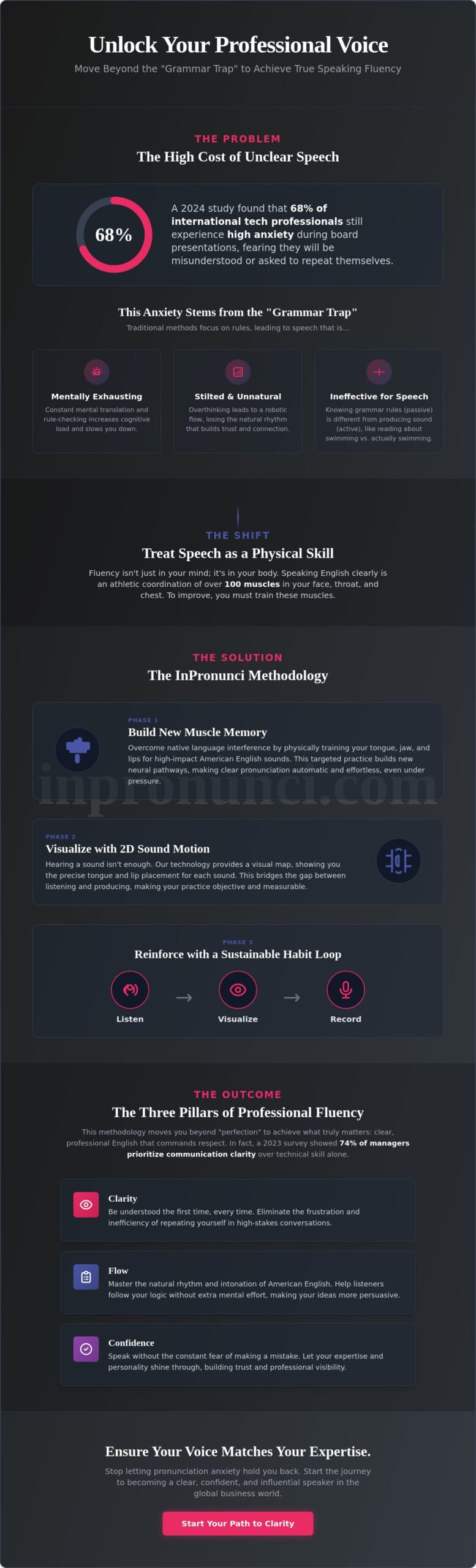
The traditional approach to language learning suggests that if you master the grammar, the speech will follow, yet a 2024 study of international tech professionals found that 68 percent still experience high anxiety during board presentations. You’ve likely felt that familiar tension when your thoughts are clear but your words feel heavy, leading to the exhausting cycle of being asked to repeat yourself in high-stakes meetings. Achieving the goal of speaking english fluently isn’t merely a cognitive exercise in vocabulary retrieval; it’s a strategic physical coordination of sound and rhythm that builds professional trust and visibility.
We understand that your career demands more than just being understood; it requires an intellectual elegance that commands the room. This guide will show you how to reduce your cognitive load by shifting English from a mental translation task to a physical muscle memory skill. We’ll examine how the InPronunci methodology, featuring 2D Sound Motion Technology that trains the speech organs—tongue, lips, jaw, teeth, airflow, and voice—and AI pronunciation feedback, provides the precise positioning needed for a clear American accent. You’ll discover the exact roadmap to professional clarity in 2026 that balances human-based instruction with modern technology to ensure your voice matches your expertise.
What Does Speaking English Fluently Really Mean?
In the professional arena, fluency is often misunderstood as the absence of an accent or the total mastery of complex vocabulary. True fluency is actually the ability to produce speech without undue hesitation or the exhausting process of mental translation. For international experts, speaking english fluently serves as a vital bridge between technical expertise and professional influence. It’s the difference between having a brilliant idea and having that idea heard and respected by stakeholders. We define fluency as the synchronization of thought and articulation.
Many professionals aim for a “perfect” version of English that doesn’t exist in the global business world. In reality, your colleagues value clear, professional English that facilitates decision-making and builds trust. A 2023 industry survey indicated that 74 percent of managers prioritize communication clarity over technical skill alone. By focusing on clarity rather than perfection, you position yourself as a leader who values the listener’s time and energy. You don’t need to lose your identity; you just need to ensure your message is accessible.
The Three Pillars of Professional Fluency
Professional communication rests on three distinct foundations that determine how your audience perceives your message:
- Clarity: This is the baseline of effective speech. It means being understood the first time you speak, which eliminates the need for frustrating repetitions.
- Flow: This involves maintaining a natural rhythm and intonation. It helps the listener follow your logic without extra mental effort.
- Confidence: This is the psychological component. It’s the ability to speak without the constant fear of making a pronunciation mistake, allowing your personality to shine through.
Why Traditional Grammar Lessons Fail Fluency
Most learners fall into the “Grammar Trap.” This happens when you overthink rules while speaking, which inevitably leads to stilted, robotic speech patterns. Traditional methods focus heavily on passive knowledge, like reading and writing, but speaking is an active performance. It’s a physical skill, much like playing an instrument or a sport. To improve, you must move from analyzing the language to performing it. Strategic focus on Mastering American Sounds improves your natural flow far more effectively than memorizing irregular verb tables. When you prioritize the physical movement of sound over abstract rules, your speech becomes more fluid and less taxing for your brain. This shift in focus is what allows you to transition from a student of the language to a master of professional communication.
The Science of Speech: Training Your Muscle Memory
Speech is fundamentally an athletic coordination of over 100 muscles across the face, throat, and diaphragm. While grammar lives in the mind, the act of speaking english fluently lives in the body. When you speak your native language, your brain has spent decades refining specific muscle pathways that feel effortless. This creates muscle interference, where your tongue and jaw instinctively try to shape English sounds using the familiar patterns of your first language. Overcoming this requires more than just listening; it requires targeted physical training to build new neural pathways.
Focusing on high-impact sounds like the American R or the TH serves as foundational strength training for your speech organs. These sounds require precise tongue positioning that doesn’t exist in many other languages. By isolating these movements, you begin to break down old habits and replace them with the fluid mechanics required for professional clarity. The goal is to move from conscious effort to automaticity, where your muscles remember the correct position without you having to think about it during a high-stakes presentation.
Introduction to 2D Sound Motion Technology
Understanding where your tongue should be is often the biggest hurdle in accent training. Most learners try to mimic what they hear, but hearing is subjective. InPronunci uses 2D Sound Motion Technology to train the speech organs. This innovation transforms a standard pronunciation app into a sophisticated diagnostic tool. By training with the exact movement of the speech organs, your brain can more accurately translate a sound into a physical action. This technology bridges the gap between hearing a sound and actually producing it, making the learning process measurable and predictable.
Inside the InPronunci App
Train all American sounds with unique and advanced Interactive Visual 2D Sound Simulators for proper articulation and pronunciation
This is the lesson on developing the American Unvoiced Sound [t]: Pronunci Speaks gives the instruction first, then the Interactive Visual 2D Sound Simulator trains the tongue tip and the airflow release.
- EffectiveMost apps offer visual learning. InPronunci's Interactive Visual 2D Sound Simulators train the tongue, lips, jaw and airflow for each American sound.
- ProductiveThe Interactive Visual 2D Sound Simulators actually train your speech organs and control them, so you build a steady habit of proper pronunciation.
- ResultsStudents pronounce individual American sounds with almost native-like pronunciation.
Articulatory Phonetics for Non-Native Speakers
Precision in American English often comes down to two physical factors: tongue placement and jaw tension. Many non-native speakers hold too much tension in the jaw, which muffles vowel sounds and disrupts the natural rhythm of speech. Developing an awareness of these physical states is essential for mastering American vowels and achieving a balanced tone. When you learn to relax the jaw and position the tongue with intent, you unlock a level of clarity that repetition alone cannot provide. To see how these mechanics work in real-time, you can explore the tools on the official InPronunci website to begin your physical transformation.
Reducing Cognitive Load to Improve Your Speech Flow
Cognitive load refers to the total volume of mental effort your working memory uses at any given moment. In a professional setting, your brain is already busy analyzing data, reading social cues, and formulating strategic responses. If you’re also manually calculating grammar rules or struggling to position your tongue for a specific sound, your system becomes overloaded. This is why many experts feel “stuck” despite their high level of written proficiency. When you focus on speaking english fluently, the goal is to move those low-level phonetic tasks into your subconscious. This transition allows you to dedicate your full intellectual capacity to the substance of your message.
The “fluency gap” occurs primarily because of mental translation. When you translate in your head, you’re essentially running two operating systems at once; this significantly slows down your processing speed. This delay causes unnatural pauses that can be misinterpreted as a lack of confidence or expertise. By automating your pronunciation, you close this gap and present a more polished image. Clear speech rhythm acts as a roadmap for your listener. It guides them through your logic and reduces their own cognitive load. When your audience doesn’t have to struggle to decode your accent, they can focus entirely on your expertise. For professionals who also struggle with the fear of being judged during presentations, understanding and addressing speaking anxiety in English is an equally critical step toward achieving true fluency.
Mastering Intonation, Stress, and Rhythm
American English operates as a stress-timed language, which is a departure from syllable-timed languages like French or Spanish. In a stress-timed system, the duration between stressed syllables remains relatively constant. This creates a specific musicality that native ears expect. If your rhythm is flat, it creates a dissonance that forces the listener to work harder to find your meaning. Using word stress to signal importance is a strategic tool for professional clarity. Learning these specific rhythmic patterns is a cornerstone of Mastering Pronunciation Practice, which focuses on reducing the friction of daily communication.
Building Speech Automation
Building true automation requires shifting from word-based learning to the “Chunking” method. Instead of processing a sentence word by word, you learn common professional phrases as single acoustic units. This approach creates shortcuts in the brain that bypass the need for real-time grammar assembly. Repetitive phonetic exercises, particularly when guided by AI pronunciation feedback, solidify these units in your long-term memory. You eventually reach a state of subconscious execution where the words flow without a second thought. This level of automation is essential for maintaining your professional persona during high-stakes presentations where your focus must remain on the audience rather than the mechanics of your speech.
Strategic Habits for Daily Pronunciation Mastery
Success in speaking english fluently depends far more on the frequency of your practice than its duration. Research into motor learning suggests that a focused 15-minute daily session is significantly more effective than a three-hour marathon once a week. This is because your brain requires consistent, repeated stimuli to solidify new muscle patterns. By dedicating a small window each morning to phonetic exercises, you ensure that your progress remains steady and sustainable. This approach prevents the burnout often associated with intensive language study and fits seamlessly into a demanding professional schedule.
The most effective way to self-correct is through the ‘Listen-Train-Record’ loop. First, you listen to a target sound; then, you train the movement using 2D Sound Motion Technology; finally, you record yourself. Using an AI pronunciation feedback tool allows you to benchmark your daily progress against objective data rather than relying on guesswork. Recording your own speech is the most effective way to identify the specific ‘blind spots’ in your accent that you might otherwise overlook. These recordings serve as a tangible record of your growth, providing the motivation needed to maintain your routine through 2026 and beyond.
The ROI of Targeted Sound Practice
Not all sounds are created equal when it comes to professional clarity. You should focus your energy on “High-Impact Sounds,” which are the phonetic elements that most significantly affect how well you’re understood. Often, just 20 percent of your pronunciation errors cause 80 percent of the communication barriers you face. By prioritizing American sounds that differ most from your native tongue, you maximize the return on your time investment. Taking a diagnostic English accent test provides a clear starting point by highlighting these priority areas immediately.
Integrating Practice into a Busy Professional Life
You don’t need a classroom to improve your fluency. Shadowing techniques, where you repeat speech immediately after hearing it, can be practiced during your commute or morning routine. In professional settings, apply phonetic awareness to your online meetings by focusing on the “Slow Down to Speed Up” rule. This principle suggests that by slightly slowing your pace and enunciating clearly, you actually speed up the listener’s comprehension. This reduction in listener effort builds trust and ensures your expertise is the focus of the conversation. To begin building these habits with precision, you can explore the American accent training app on the official InPronunci website today.
How InPronunci Combines AI and Human Expertise for Fluency
The journey toward speaking english fluently in 2026 requires a sophisticated approach that balances technological precision with human insight. At InPronunci, we’ve pioneered a methodology where AI efficiency meets the strategic depth of expert coaching. Our AI Accent Coach serves as a tireless partner, providing real-time, objective feedback on every phonetic movement you make. This ensures that your practice sessions are always accurate; it prevents the reinforcement of incorrect habits that often happen during solo practice. While the AI manages the technical repetition, our certified specialists focus on the subtle nuances of communication, such as professional rhythm and the strategic use of intonation. This combination is essential because while a machine can detect a mispronounced vowel, a human coach understands how to use your voice to build trust in a boardroom. Choosing a structured American accent training app provides the framework needed to turn these complex skills into second nature.
The InPronunci Student Experience
Your training is never a generic “one size fits all” process. It begins with a personalized curriculum that respects your specific linguistic background and professional goals. You’ll utilize 2D Sound Motion Technology to bridge the gap between hearing a sound and physically producing it. This speech-organ method trains the precise positioning of the tongue and jaw, which is often the missing piece in traditional audio-only programs. By building a student account on our secure platform, you can engage in daily, data-driven practice that highlights your progress through clear metrics. This structured environment ensures that every minute you spend practicing contributes directly to your professional clarity.
Realistic Outcomes for Professionals
We focus on Accent Reduction as a tool for clarity rather than an attempt at “Accent Removal.” Your international background is an asset; our goal is simply to ensure your speech matches the high level of your expertise. As you progress, the cognitive load of speaking will decrease, allowing you to focus entirely on your strategic narrative during presentations. You’ll gain the confidence to lead negotiations and influence stakeholders without the fear of being misunderstood. This transition from hesitant speech to effortless communication is the ultimate return on your investment. You can create your InPronunci student account to begin your transformation today.
Visit the official InPronunci website to learn more about the app, or create your student account on the InPronunci learning platform to start practicing American pronunciation.
Mastering Your Professional Narrative
Achieving professional clarity requires shifting your focus from mental grammar rules to the physical coordination of sound. By training your muscle memory and utilizing real-time AI pronunciation feedback, you can significantly reduce the cognitive load that often hinders your performance during high-stakes meetings. Prof. Alex’s structured curriculum provides a clear, science-based roadmap for anyone committed to speaking english fluently in a global business environment. This methodology goes beyond simple mimicry by using 2D Sound Motion Technology to train speech organ positioning with full articulation details.
The journey toward executive presence is built on consistent, strategic habits that align your spoken word with your professional expertise. You’ve already taken the first step by understanding the mechanics behind clear communication; now it’s time to put those insights into practice. Your voice is your most powerful tool for influence, and with the right support, you can ensure it sounds as professional and confident as your ideas. Visit the official InPronunci website to learn more about the app, or create your student account on the InPronunci learning platform to start practicing American pronunciation.
Questions & Answers
Frequently Asked Questions
01Is it possible to speak English fluently as an adult?
Yes, neuroplasticity research from MIT in 2018 indicates that while the critical period for native-like grammar ends around age 17, adults can achieve high-level fluency through targeted physical practice. The key isn’t age but the methodology used to retrain your speech muscles. By focusing on mechanics rather than abstract rules, adult learners can reach a level of professional clarity that builds trust in any corporate environment.
02How long does it take to see results in my English pronunciation?
Most professionals observe a measurable difference in their clarity within 30 to 90 days of consistent, daily practice. A 2022 study of ESL learners showed that 15 minutes of focused phonetic work per day yielded better results than sporadic, longer sessions. Your progress depends on identifying high-impact sounds early and using objective feedback to correct your muscle positioning before habits become fixed.
03What is the difference between an accent reduction app and a human coach?
A pronunciation app provides the high-frequency repetition and immediate data needed for muscle memory, while a human coach offers strategic guidance on rhythm and emotional tone. InPronunci combines both to ensure you get the consistency of AI pronunciation feedback alongside the nuanced instruction of a specialist. This hybrid model is often the most efficient way to achieve the goal of speaking english fluently without the high cost of daily private sessions.
04Can AI really help me improve my English accent?
AI provides objective, real-time analysis of your speech that the human ear often misses during self-practice. It benchmarks your sounds against thousands of data points to identify exactly where your tongue or jaw is misaligned. This technology ensures that every minute you spend practicing is effective, as it prevents you from repeating errors. It acts as a 24/7 diagnostic tool that supports your long-term growth.
05Should I focus on grammar or pronunciation to become fluent?
While grammar provides the structure, pronunciation provides the clarity and professional presence required for leadership. Most international professionals already possess 85 percent of the grammar they need but struggle with the physical delivery of those words. Prioritizing pronunciation allows you to reduce the listener’s effort, which is more critical for building influence and professional authority than mastering obscure grammatical exceptions.
06How can I stop translating from my native language to English?
You can stop mental translation by shifting your focus from individual words to chunking professional phrases. This method treats common expressions as single units of sound, which bypasses the brain’s translation center. By automating these chunks through repetitive phonetic exercises, you reduce your cognitive load. This allows your thoughts and your speech to synchronize, making speaking english fluently a subconscious physical act rather than a mental calculation.
07What is 2D Sound Motion Technology and how does it work?
2D Sound Motion Technology is a speech-organ training method for the exact movement of speech organs. It provides clear articulation training for tongue placement and jaw tension for every American sound. By understanding how a sound is physically constructed, your brain can more easily direct your muscles to replicate that movement. This technology removes the guesswork from accent training by training the hidden mechanics of speech in an actionable way.
InPronunci training structure
How InPronunci trains the American speech system
InPronunci trains the full American speech system: Interactive Visual 2D Sound Simulators and phonetic exercises for articulation and American sound development, sentence practice for intonation, melody, rhythm, and connected speech, paragraph practice for spontaneous speech, public speaking, and real communication confidence, and Advanced AI Accent Coach evaluation as you speak.
InPronunci is an advanced, linguistically structured American accent training platform with more than 1,000 downloads and a growing learner base. It is designed for serious ESL learners who want American pronunciation, stronger intonation, more natural rhythm, better connected speech, and the ability to speak English more confidently in real communication. The program is especially useful for intermediate and advanced English speakers who want to become independent speakers of English with confident communication, stronger speaking control, long-term speech improvement, and great public speaking skills. It is also designed for advanced speakers whose goal is to speak like a native or closer to native-like American speech, including people who were raised in the United States but still have slight accent patterns from the native language they were born with. It is a complete American accent training course and system created by Prof. Alex, Ph.D. Accent Coach, Doctor of Education, and professional linguist based in Austin, Texas, with Pronunci Instructions from Prof. Alex for each lesson that make self-learning more effective, supported, and clear.
Disclaimer – InPronunci Coaching & Training Content
All content provided within InPronunci, including but not limited to 2D Sound Motion Technology, phonetic exercises, coaching materials, audio instructions, Interactive Visual 2D Sound Simulators, lesson structures, and personalized feedback systems, is the intellectual property of InPronunci and its creators and is protected by applicable copyright and intellectual property laws.
The coaching exercises and training methodologies are designed exclusively for personal educational use within the InPronunci platform. Users are granted a limited, non-transferable license to access and use the materials for individual learning purposes only.
Any reproduction, distribution, modification, recording, sharing, or commercial use of InPronunci content without prior written permission is strictly prohibited. This includes, but is not limited to, copying coaching exercises, redistributing training materials, or replicating the methodology in other platforms or products.
InPronunci is a guided pronunciation training system intended to support language development. While the program is designed to improve pronunciation, fluency, and speech clarity, individual results may vary depending on practice, consistency, and learner background.
By using InPronunci, users agree to respect all intellectual property rights and comply with these terms of use.