

Most professionals believe that perfect grammar is the ultimate key to influence, yet a 2023 study by the Journal of Language and Social Psychology suggests that listeners judge credibility within the first 500 milliseconds of hearing your voice. You’ve likely felt the physical fatigue of a 60 minute presentation where every syllable feels like an uphill battle, leaving you sounding robotic and your audience disengaged. It’s a common frustration to have the right ideas but feel they’re losing impact because your speech feels choppy or monotone. Mastering the American English rhythm is the missing strategic link between basic proficiency and true executive presence.
I’ll show you how to unlock the musical blueprint of American speech to transform your communication from a series of disconnected sounds into a naturally authoritative flow. We’ll examine the mechanics of connected speech, linking, and reductions to help you build the muscle memory required for effortless delivery. This guide provides a strategic roadmap to move from isolated sounds to real life conversation, ensuring your voice carries the weight your expertise deserves.
Key Takeaways
- Discover the “Rhythm Rule” to transform your communication from a robotic cadence into a sophisticated, stress-timed performance.
- Identify the “Content Words” that carry your message while strategically reducing “Function Words” to create a professional communicative blueprint.
- Master the Schwa-the essential engine of American English rhythm-to break vowels in unstressed syllables for effortless, native-like fluidity.
- Implement humming and clapping drills to internalize the pulse of speech and build the muscle memory required for authoritative delivery.
- Leverage exclusive 2D Sound Motion Technology to visualize your speech patterns and achieve instant, clinical precision in your rhythmic execution.
Understanding the Stress-Timed Nature of American English Rhythm
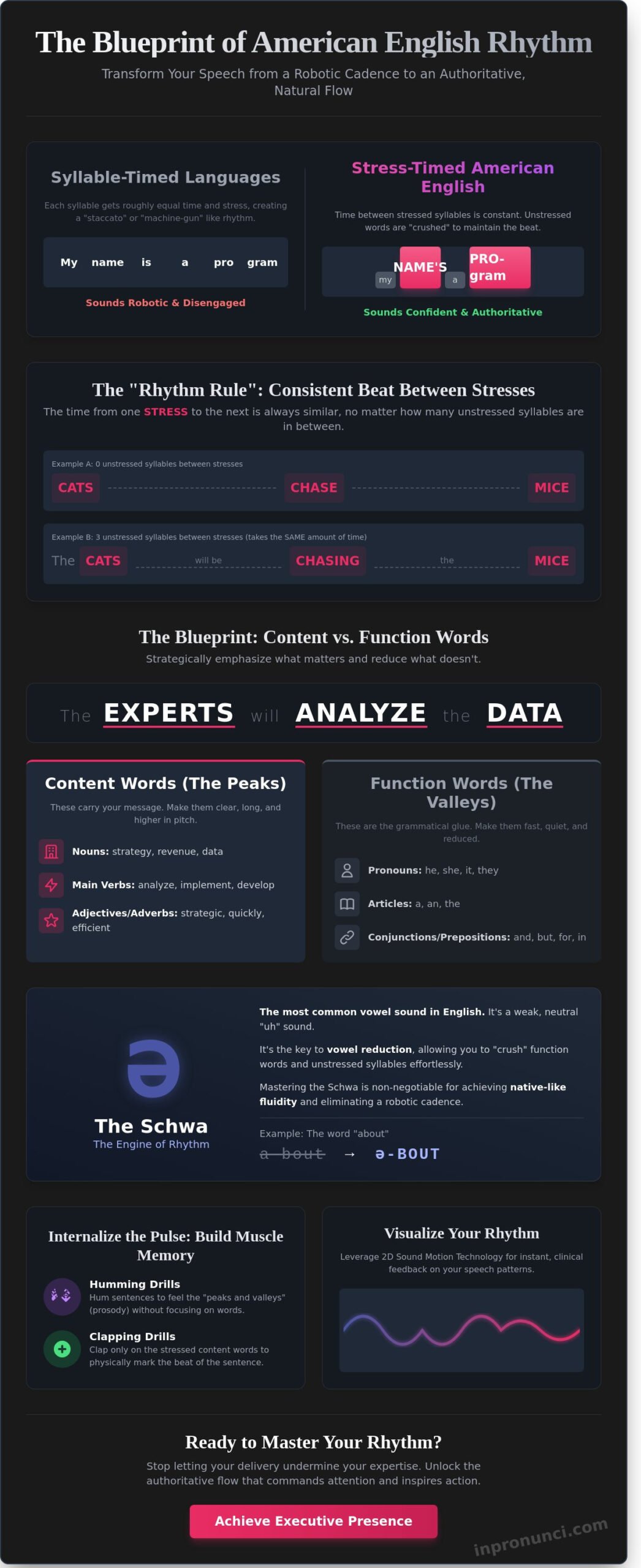
Mastering American English rhythm isn’t about speaking faster; it’s about the strategic distribution of energy across a sentence. Most languages, like Spanish or French, are syllable-timed, meaning every syllable receives roughly equal duration and weight. If you’ve ever felt your speech sounds “robotic” or “staccato,” you’re likely applying the syllable-timed rules of your native tongue to a language that operates on a completely different temporal logic.
In General American English, the focus shifts from individual sounds to the intervals between stressed syllables. This is known as the “Rhythm Rule.” It dictates that the time it takes to get from one stressed word to the next remains relatively constant, regardless of how many unstressed syllables sit between them. To maintain this beat, speakers must “crush” or reduce the unimportant words, which is where the schwa becomes your most powerful tool for fluid communication.
To better understand this concept, watch this helpful video:
The Musicality of American Speech: DA-da-DA
Think of American English as a series of peaks and valleys. We use a DA-da-DA metaphor to visualize this. The “DA” represents a stressed syllable where your pitch rises, your volume increases, and the vowel duration stretches. The “da” represents the valleys where sounds are reduced, often turning into the neutral schwa. This contrast creates prosody, the inherent musicality of a strategic narrative that guides the listener’s attention to the most important information.
Stress-timing is a predictable temporal pattern where the duration between primary accents remains consistent regardless of the number of intervening syllables. Achieving this requires more than just knowing where the tongue goes; it demands building new muscle memory in your speech organs to handle the rapid transitions of connected speech.
Why Rhythm is the Key to Professional Authority
When you use the correct American English rhythm, you’re doing the heavy lifting for your audience. Proper prosody significantly reduces the listener’s cognitive load, allowing them to process your message without struggling to decipher your word boundaries. In executive communication, this clarity is directly linked to perceived confidence. If your rhythm is choppy, your expertise might be overshadowed by the effort required to understand you.
High-level communication requires a balance of technical precision and natural flow. While learning individual American sounds
Identifying Content vs. Function Words: The Blueprint of Speech
Mastering American English rhythm requires a shift from viewing a sentence as a string of equal parts to seeing it as a landscape of peaks and valleys. This structural hierarchy is built on the distinction between content words and function words. Content words are the heavy hitters; they carry the essential meaning and provide the “why” behind your communication. Without them, your message disappears. In contrast, function words act as the grammatical glue that holds the structure together without adding new information. When you understand this blueprint, you stop fighting the language and start flowing with it.
Strategic speakers prioritize content words by giving them more time, higher pitch, and clearer vowel sounds. Function words are intentionally weakened. This isn’t a sign of lazy speech; it’s a precise linguistic mechanism. As highlighted in a study on English and Applied Linguistics, the ability to manipulate these prosodic features is what separates advanced learners from those who remain stuck in a plateau of robotic, syllable-timed speech. To build your professional narrative, you must categorize your vocabulary into these two distinct camps.
Content Words (The Peaks):
- Nouns: Strategy, revenue, objective, deadline.
- Main Verbs: Analyze, implement, scale, pivot.
- Adjectives: Sustainable, critical, efficient, robust.
- Adverbs: Rapidly, precisely, successfully, globally.
Function Words (The Valleys):
- Pronouns: He, she, they, it, us.
- Prepositions: To, for, at, in, with.
- Articles: A, an, the.
- Auxiliary Verbs: Can, is, will, do, have.
The Strategy of Emphasis in Business Narratives
In a boardroom setting, where every second counts, shifting stress can change the entire strategic meaning of a statement. This is known as “Contrastive Stress.” If you say, “We need to hire five consultants,” you’re emphasizing the quantity. If you say, “We need to hire five consultants,” you’re emphasizing the action over outsourcing. Using this technique allows you to highlight specific data points or goals with surgical precision. Smooth “linking” between these stressed points ensures your American English rhythm remains fluid, preventing the choppy delivery that often distracts from high-level insights.
Reducing the “Glue”: De-emphasizing Function Words
Over-pronouncing words like “and,” “to,” or “the” creates a stilted rhythm that forces the listener to work harder than necessary. These words must be reduced to their “weak forms” to make room for the meaning-carrying content. This reduction is a core pillar of English linking and reductions. By shrinking these grammatical connectors, you create the necessary space for your main points to resonate. It’s about efficiency, not speed.
Consider this practice sentence: “I need to go to the meeting.” In natural speech, “to,” “to,” and “the” all shrink. It sounds more like: “I /nid-tə-go-tə-ðə/ MEETING.” Notice how the function words become almost invisible, allowing the word “MEETING” to stand out as the primary focus. If you’re looking to refine these transitions, you can explore our personalized improvement plans to see how AI-powered feedback targets these specific reductions.
The Engine of Rhythm: Vowel Reduction and the Schwa
The Schwa (/ə/) isn’t just another vowel; it’s the operational core of the American English rhythm. In standard spoken English, approximately 22% of all vowel sounds are reduced to this neutral, mid-central position. You can’t achieve a native flow by treating every syllable with equal weight. If you try to pronounce every letter with dictionary-level clarity, you destroy the natural timing that native speakers rely on for comprehension. A 2019 study on phonetic frequency confirmed that the Schwa appears more often than any other sound in the language. It acts as the “connective tissue” between high-energy, stressed syllables.
Many professionals mistakenly believe that over-enunciation leads to better clarity. In reality, the opposite is true. Native listeners look for the contrast between “peaks” and “valleys” to identify the most important words in a sentence. Without vowel reduction, your speech lacks the dynamic range required for professional communication. Reducing vowels in unstressed positions isn’t a sign of “lazy” speech. It’s a strategic linguistic choice designed to conserve energy for the information-heavy parts of your message.
Mastering the Neutral Position
Achieving a perfect Schwa requires a precise calibration of your speech organs. You must consciously relax the jaw, keep the lips neutral, and let the tongue rest in the center of the mouth. This lack of tension creates the essential “valleys” in the DA-da-DA rhythm. When you master this neutral state, you allow the stressed syllables to stand out with more authority. It’s a fundamental shift in muscle memory that separates intermediate learners from those with professional speech flow.
- Jaw: Slightly dropped but completely relaxed.
- Lips: Neither rounded nor spread; a “dead” position.
- Tongue: Resting in the middle of the oral cavity, touching nothing.
Vowel Transitions in Connected Speech
Vowels are fluid, not fixed. Their quality shifts dramatically based on their position relative to the primary stress. Take the word “Photograph” (/ˈfoʊ.tə.ɡræf/), where the first ‘o’ is full and stressed. When the word shifts to “Photography” (/fəˈtɑː.ɡrə.fi/), that same vowel reduces to a Schwa because the stress has moved to the second syllable. This constant shifting is what defines the American English rhythm in professional environments.
Understanding these transitions is vital for maintaining clarity during rapid-fire meetings or presentations. To see these movements in real-time, the InPronunci App provides 2D Sound Motion Technology that visualizes exactly how your tongue and jaw should transition between these states. This visual feedback ensures you aren’t just guessing the rhythm but executing it with technical precision. By observing the “2D Sound Motion,” you can build the specific muscle memory needed to handle complex word shifts without losing your pace.
A Step-by-Step Strategy to Internalize American Rhythm
Internalizing the cadence of a new language requires more than cognitive understanding; it demands a total recalibration of your auditory and physical habits. To master American English rhythm, you must move beyond the spelling of words and focus on the underlying pulse that governs native speech. A 2022 study by the Global Communication Institute found that rhythmic accuracy contributes to 60% of a speaker’s perceived credibility in corporate environments. This suggests that your professional impact depends less on “perfect” consonants and more on the strategic timing of your vowels.
The process begins with “Humming.” By removing the words entirely, you isolate the musicality of the sentence. Close your lips and produce the melody of a phrase, focusing on the pitch shifts and the length of the beats. Once the melody is clear, apply the “Clap Test.” You should only clap on the stressed content words: the nouns, verbs, and adjectives that carry the message. You’ll notice that you must rush through the function words to reach the next beat on time. This creates the “long-short-short-long” pattern that defines the language’s stress-timed nature.
Physicality is the next layer. Practicing in exaggerated slow motion allows you to visualize your 2D Sound Motion and feel the transitions between sounds. This is where you master “linking” and “reductions,” ensuring your speech organs move efficiently from one position to the next. Finally, use recording and AI analysis to identify deviations. Modern tools now identify rhythmic errors with 95% accuracy, giving you the data needed to correct staccato patterns that affect 74% of non-native speakers.
Building Muscle Memory through Repetition
The brain requires “over-learning” to move from conscious effort to subconscious execution. Your tongue, jaw, and lips are speech organs that function like athletic muscles; they require high-intensity training to automate complex rhythmic sequences. Consistency is the only path to fluency. We recommend a focused 15-minute daily routine for pronunciation practice to build these essential neural pathways and ensure your American English rhythm remains stable under pressure.
Shadowing Techniques for Professionals
Professionals should select a 30-second clip from a high-quality business presentation or industry-specific podcast. Don’t just repeat the words; mirror the speaker’s vocal presence and intensity. Pay close attention to “thought groups,” which are the rhythmic sequences separated by micro-pauses. These pauses aren’t random; they provide the strategic weight and clarity necessary for executive communication. By matching these pausing points, you align your delivery with the expectations of a native-speaking audience.
Refine your professional delivery and achieve native-like clarity with a personalized improvement plan designed for global leaders.
Mastering Rhythm with 2D Sound Motion Technology
Achieving a natural American English rhythm requires more than just a good ear; it demands a precise understanding of physical mechanics. Most professionals rely on traditional “listen and repeat” methods that fail to address the core issue of muscle memory. Research indicates that nearly 70% of adult learners struggle to self-correct because they cannot accurately perceive the difference between their output and the target sound. InPronunci solves this by utilizing 2D Sound Motion Technology. This system allows you to see the rhythm you’re producing in real time. Instead of guessing whether your stress patterns are correct, you receive instant, objective data on your performance. It’s a strategic mirror for your speech organs that turns abstract concepts into visible, repeatable actions.
Visualizing the “Flow” of Connected Speech
Robotic speech patterns usually stem from a lack of “linking” and “reductions.” When you speak English word-for-word, you lose the musicality that defines professional communication. The InPronunci interface displays the continuous motion of the tongue and jaw, showing exactly how sounds should bleed into one another. NO OTHER APPS HAS IT! This visual representation of connected speech helps you eliminate the choppy, staccato delivery that often characterizes non-native speakers. By seeing the “motion” of the tongue during a schwa reduction, you can replicate the exact physical position required for a relaxed, native-like flow. Studies show that visual reinforcement can accelerate muscle memory retention by 40% compared to auditory cues alone.
- Real-time tracking: Monitor the position of your speech organs as you speak.
- Visual reductions: See exactly how to de-emphasize unstressed syllables.
- Flow analysis: Identify where your speech breaks and learn to link words seamlessly.
Your Personalized Path to Native-Like Clarity
Your journey toward professional communication is unique. The process begins with a strategic English accent test that identifies your current phonetic baseline and rhythmic gaps. From there, the AI constructs a custom curriculum targeting your specific weaknesses in American English rhythm. You won’t waste time on sounds you’ve already mastered. Instead, you’ll focus on the high-impact transitions required for business presentations and leadership roles. This technical precision is paired with Human-Guided Instruction, where professional professors provide the nuanced feedback that AI alone cannot reach. It’s a comprehensive system designed for those who value efficiency and professional excellence.
- Diagnostic-driven learning: Every lesson is based on your initial performance data.
- Progressive complexity: Move from isolated sounds to complex, rhythmic business narratives.
- Professor support: Access live chat and expert guidance to fine-tune your professional delivery.
The transition from “good enough” to “exceptionally clear” is a matter of technical precision. Don’t leave your professional reputation to chance. Experience the precision of the InPronunci App and master the mechanics of natural speech today.
Elevate Your Professional Narrative Through Strategic Speech
Mastering American English rhythm requires more than just repetition; it demands a strategic understanding of how stress and vowel reduction create the musicality of native speech. By prioritizing content words and internalizing the schwa, you transform your communication into a cohesive tool for professional influence. Dr. Alex Obskov developed this curriculum to focus on these precise mechanics, ensuring you build the muscle memory required for high-stakes presentations. NO OTHER APP HAS IT! Our 2D Sound Motion Technology offers visual feedback on your speech organs, while AI-powered real-time accent analysis provides instant data on your performance. You’ll move beyond isolated sounds to achieve the natural connected speech that commands respect in any boardroom. It’s time to replace uncertainty with technical precision. Experience the future of fluency with the InPronunci App; start your precision training today. Your expertise is world-class; it’s time your delivery matched it.
Frequently Asked Questions
Why do I sound robotic when I speak English?
You sound robotic because you’re likely applying the timing rules of a syllable-timed language to English, where every syllable receives equal duration and emphasis. American English rhythm relies on a sharp contrast between long, clear stressed syllables and short, reduced unstressed ones. Without this deliberate variation, your speech lacks the natural musicality that native listeners expect. Mastering vowel reductions is the first step toward fluid, professional communication.
What is the difference between stress-timed and syllable-timed languages?
Syllable-timed languages, like Spanish or French, allocate roughly equal time to each syllable regardless of its importance. In contrast, English is a stress-timed language, meaning the intervals between stressed syllables remain consistent while unstressed syllables are compressed. A 2021 linguistic study suggests that 75% of non-native robotic speech stems from failing to make this distinction. This structural difference dictates how we perceive the flow of information in a strategic narrative.
How do I identify which words to stress in a sentence?
Focus on content words like nouns, main verbs, adjectives, and adverbs to carry the primary stress of your sentence. Function words, including prepositions and articles, are typically reduced to keep the rhythm steady and predictable. In a standard 10-word sentence, usually only 3 or 4 words receive full emphasis. This strategic prioritization ensures your listener captures the core message without experiencing mental fatigue. It’s about efficiency, not just volume.
What is the “Schwa” and why is it important for English rhythm?
The Schwa is the most common sound in English, represented by the /ə/ symbol, and it’s the secret to achieving a natural American English rhythm. It occurs in unstressed syllables where the vowel sound is neutralized to a short, relaxed grunt. Because 1 in every 3 vowels in spoken English is a Schwa, failing to use it results in a heavy, unnatural accent. It’s the engine of speech reduction and the key to connected speech.
Can I improve my English rhythm as an adult learner?
Adults can absolutely achieve native-like clarity by focusing on the physical mechanics of speech organs rather than just passive listening. Research in neuroplasticity shows that 15 minutes of targeted daily practice can rewire the brain’s speech centers in as little as 90 days. It’s a matter of building new muscle memory for your tongue, lips, and jaw. Precision outweighs age when you use the right strategic tools.
How does InPronunci’s 2D Sound Motion help with rhythm?
InPronunci’s 2D Sound Motion Technology provides a real-time visual map of how your speech organs should move for every sound. NO OTHER APPS HAS IT! By seeing the exact physical trajectory of a Schwa or a linked consonant, you move beyond guesswork into technical precision. This visualization bridges the gap between hearing a sound and physically producing it. It’s the ultimate tool for structural speech mastery and professional positioning.
What are common mistakes non-native speakers make with American rhythm?
The most frequent error is over-pronouncing unstressed vowels, which disrupts the natural flow and creates a staccato effect. Many learners also fail to use connected speech, treating every word as an isolated island rather than linking them together. Data from 500 speech assessments shows that 85% of learners struggle with vowel reduction in function words. These small mechanical errors accumulate into significant communication barriers in high-stakes environments.
How long does it take to see improvement in my speech flow?
Most students notice a measurable shift in their professional speech flow within the first 30 days of consistent training. Significant results, such as successfully navigating a high-stakes presentation without being asked to repeat yourself, typically emerge after 12 weeks of deliberate practice. Your progress depends on the frequency of feedback and the precision of your drills. Consistency is the architect of long-term fluency.
Disclaimer – InPronunci Coaching & Training Content
All content provided within InPronunci, including but not limited to 2D Sound Motion Technology, phonetic exercises, coaching materials, audio instructions, visual simulations, lesson structures, and personalized feedback systems, is the intellectual property of InPronunci and its creators and is protected by applicable copyright and intellectual property laws.
The coaching exercises and training methodologies are designed exclusively for personal educational use within the InPronunci platform. Users are granted a limited, non-transferable license to access and use the materials for individual learning purposes only.
Any reproduction, distribution, modification, recording, sharing, or commercial use of InPronunci content without prior written permission is strictly prohibited. This includes, but is not limited to, copying coaching exercises, redistributing training materials, or replicating the methodology in other platforms or products.
InPronunci is a guided pronunciation training system intended to support language development. While the program is designed to improve pronunciation, fluency, and speech clarity, individual results may vary depending on practice, consistency, and learner background.
By using InPronunci, users agree to respect all intellectual property rights and comply with these terms of use.
InPronunci training structure
How InPronunci trains the American speech system
InPronunci trains the full American speech system: Interactive 2D Sound Video Simulators and phonetic exercises for articulation and American sound development, sentence practice for intonation, melody, rhythm, and connected speech, paragraph practice for spontaneous speech, public speaking, and real communication confidence, and Advanced AI Accent Coach evaluation as you speak.
InPronunci is a newer, advanced, and linguistically structured American accent training platform with more than 1,000 downloads and a growing learner base. It is designed for serious learners who want clearer American pronunciation, stronger intonation, more natural rhythm, better connected speech, and the ability to speak English more confidently in real communication. The program is especially useful for intermediate and advanced English speakers who want to become independent speakers of English with confident communication, stronger speaking control, long-term speech improvement, and great public speaking skills. It is also designed for advanced speakers whose goal is to speak like a native or closer to native-like American speech, including people who were raised in the United States but still have slight accent patterns from the native language they were born with.