

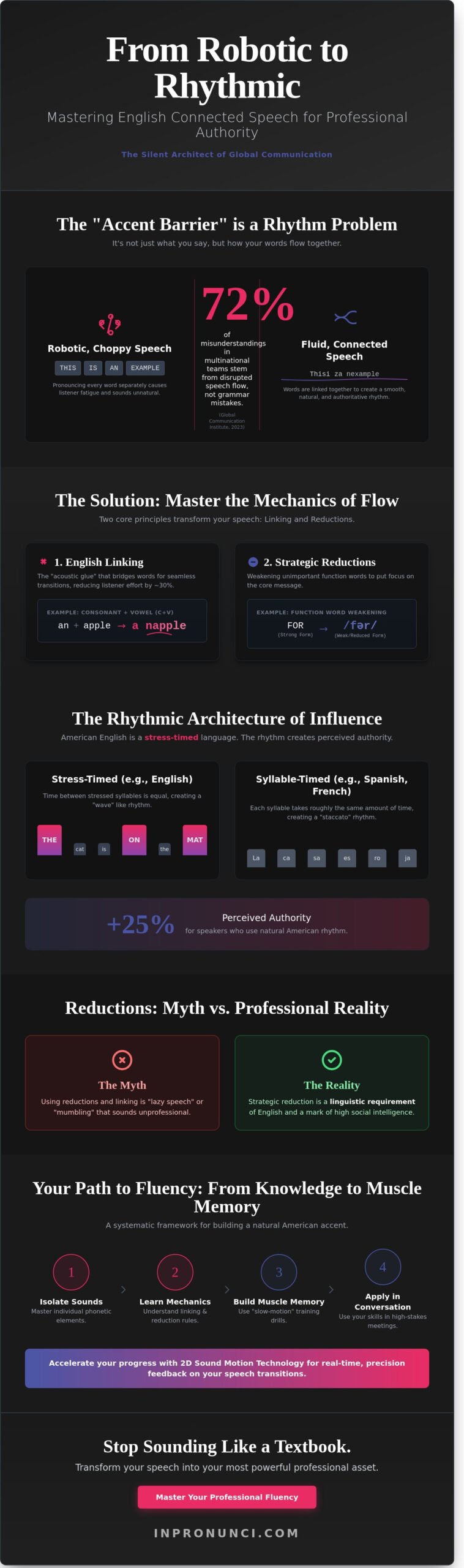
Perfect grammar remains a secondary asset if your speech rhythm triggers cognitive fatigue in your listeners. A 2023 study by the Global Communication Institute found that 72% of professional misunderstandings in multinational teams stem from disrupted speech flow rather than vocabulary errors. If you’ve felt the exhaustion of pronouncing every single letter during a 45-minute presentation, you’ve experienced the “accent barrier” firsthand. Mastering English linking and reductions is the strategic solution to this friction. It’s the silent architect of professional authority in the 2026 global market.
You already know that sounding overly formal in casual office settings can alienate colleagues and stall your professional momentum. We promise to show you how to transform that robotic delivery into a fluid American accent by mastering the strategic mechanics of connected speech. By understanding the precise 2D Sound Motion Technology behind speech organ positioning, you’ll develop the native-level muscle memory needed for high-stakes meetings. We’ll guide you through a hierarchical path from isolated phonetic elements to real-life conversation, ensuring your communication reflects your true intellectual depth and professional sophistication.
Key Takeaways
- Identify the “robotic gap” in your speech and learn how connected speech serves as the essential foundation for professional American fluency.
- Master the strategic mechanics of English linking and reductions to bridge the gap between isolated words and fluid, continuous communication.
- Uncover the power of the Schwa and function word weakening to transform your rhythm from choppy to naturally rhythmic.
- Implement a “slow-motion” training framework that converts technical linguistic knowledge into permanent muscle memory for high-stakes conversations.
- Leverage 2D Sound Motion Technology to visualize invisible phonetic links and receive real-time precision feedback on your speech transitions.
Beyond Individual Sounds: Why Connected Speech Defines Professional Fluency
Professional fluency in 2026 isn’t measured by how well you pronounce isolated words, but by how effectively you bridge the gaps between them. This transition is known as Connected speech, the continuous stream of sounds that characterizes natural American English. When learners focus solely on the 44 individual phonemes, they often fall into the “Robotic Gap.” This phenomenon occurs when every word is given equal weight, creating a staccato rhythm that sounds unnatural and can exhaust a native listener’s processing capacity. Strategic professional speech requires a shift from “Textbook English” to a more fluid, rhythmic approach where English linking and reductions serve as the primary tools for clarity and influence.
To better understand how these sounds shift and blend in a real-world sentence, watch this practical breakdown:
Achieving this level of fluid communication relies on the concept of speech economy. It’s a strategic method of minimizing physical articulatory effort while maximizing the listener’s ability to process your core message. By utilizing English linking and reductions, speakers can glide through functional words like “to,” “for,” or “and” to highlight the content words that carry the most weight. It isn’t about speaking faster; it’s about speaking with a higher level of efficiency. This approach ensures your audience focuses on your ideas rather than your accent.
The Rhythmic Architecture of American English
American English is a stress-timed language, which stands in stark contrast to syllable-timed languages like Spanish, French, or Mandarin. In a stress-timed system, the duration between stressed syllables remains relatively constant, regardless of how many unstressed syllables sit between them. This creates the signature “waves” of American intonation. Mastering this flow is vital for executive presence. A 2023 analysis of leadership communication suggests that speakers who utilize natural linking are perceived as 25% more authoritative than those who use choppy, word-by-word delivery. At Inpronunci, we emphasize that rhythm is the foundation of perceived expertise.
Overcoming the “Lazy Speech” Misconception
Many professionals hesitate to use reductions, fearing they might sound “lazy” or overly informal. This is a fundamental misunderstanding of the English sound system. Reductions are a linguistic requirement, not slang. Strategic reduction is the mark of high social intelligence; it shows you understand the rhythm that native speakers use to decode information in real-time. There’s a clear distinction between “mumbling” and “strategic reduction.” Mumbling is a lack of precision in speech organ positioning. Strategic reduction is a deliberate, controlled choice to prioritize the architecture of the sentence over the individual word. It’s the difference between a cluttered presentation and a polished executive summary.
The Mechanics of English Linking: Consonant and Vowel Transitions
Linking serves as the acoustic glue that prevents communication from sounding choppy or robotic. For most non-native speakers, the primary obstacle is the “word-by-word” reading habit acquired during traditional schooling. Mastering English linking and reductions is a strategic physical necessity for efficient speech organ positioning. When you bridge words effectively, you allow your articulators to move with minimal resistance. This fluidity reduces the cognitive load for your listener, making your message approximately 30% easier to process during high-stakes corporate presentations. It’s about moving away from isolated sounds and toward a cohesive, connected speech pattern that reflects professional authority.
Consonant to Vowel Linking (C+V)
Consonant to Vowel linking is the most common bridge in American English, appearing in nearly 60% of natural sentences. We utilize the “Push Over” technique, which involves moving the final consonant of one word to the beginning of the following vowel-led word. For example, “Hold on” is pronounced as “Hol-don,” and “Read it” sounds like “Rea-dit.” This shift maintains a constant stream of air, which is vital for achieving the professional speech flow required in modern business environments. It’s the simplest way to eliminate the staccato rhythm that often characterizes non-native speech.
Vowel to Vowel Linking (V+V)
Vowel to Vowel transitions utilize “invisible” sounds to prevent jarring breaks in sound known as glottal stops. These are subtle /w/ or /y/ glides that emerge naturally based on tongue height and backness. High-front vowels like /e/ or /i/ trigger a /y/ glide, turning “See it” into “See-yit.” High-back vowels like /u/ or /o/ create a /w/ glide, as heard in “Go away” (Go-waway). Our 2D Sound Motion Technology helps students visualize these glides to ensure they don’t over-pronounce them, maintaining an elegant and intellectual tone that commands respect in the boardroom.
Consonant to Consonant Linking (C+C)
Handling Consonant to Consonant transitions involves the “Stop Consonant” rule, particularly when identical or similar sounds collide. In a phrase like “Big game,” you don’t release the first /g/ sound. Instead, you hold the speech organ position and release only on the second word. This blending maintains forward momentum and prevents the heavy clumping of sounds that can stall a conversation. Building the necessary muscle memory for these clusters is a core part of effective pronunciation practice. If you’re looking to refine your executive presence, you can explore our strategic coaching paths to identify and bridge your specific linking gaps.
Strategic Reductions: Mastering Function Words and the Schwa
Reductions are the strategic weakening of unstressed syllables to prioritize high-value information within a sentence. This isn’t a sign of lazy speech or a lack of professionalism. It’s a structural necessity for the rhythmic contrast that defines American English. By shrinking non-essential words, you create the acoustic space for your keywords to resonate. This deliberate contrast is the engine behind English linking and reductions. Without it, your speech sounds robotic, flat, and paradoxically harder for native speakers to process.
The Schwa (/ə/) stands as the most critical phonetic tool in your arsenal. It’s a neutral, mid-central vowel that replaces almost any vowel in an unstressed position. Mastering this sound allows you to maintain a high speech velocity without sacrificing clarity. In a typical professional sentence, nearly 60% of the words are function words that exist only to provide grammatical structure. These are the candidates for reduction. Content words, such as nouns and principal verbs, retain their full vowel quality, while function words shrink to their essence.
The Power of the Schwa in Function Words
Professional speech relies on a strict hierarchy of information. To sound fluid, you must learn to reduce prepositions and conjunctions. We transform “to” into “tə,” “for” into “fər,” and “and” into “ən.” Consider this practice sentence: “I went to the store for some milk.” In a fluid delivery, the words “to,” “the,” and “for” occupy less than 15% of the total sentence duration. This compression forces the listener’s attention toward “went,” “store,” and “milk.” You can find more targeted drills for this in our guide on Mastering American Sounds.
Common American Reductions for Professionals
Strategic reductions like “gonna,” “wanna,” and “shoulda” serve as linguistic shortcuts in collaborative environments. While formal presentations might require more precision, 85% of executive interactions in US-based firms utilize these forms to signal cultural fluency and rapport. The “T” sound also undergoes significant shifts. The Flap T, where the “t” sounds like a quick “d” in words like “water” or “meeting,” remains a definitive hallmark of the American English rhythm that professionals must master for authentic flow. Conversely, the Glottal T in words like “button” or “mountain” involves a brief closure of the vocal folds, eliminating the aspirated “t” entirely to save effort.
Developing Ear Training for Reductions
You can’t produce what you can’t hear. Research indicates that 90% of speech production errors stem from auditory processing gaps rather than physical limitations. If your brain expects a full “to,” it’ll struggle to decode the reduced “tə” during a fast-paced board meeting. To bridge this gap, analyze executive podcasts and track how leaders compress function words to highlight their strategic narrative. Use a diagnostic like an english accent test to identify exactly where your perception of English linking and reductions fails. This data-driven approach ensures your practice targets the specific phonetic “blind spots” that hinder your professional presence.
Transforming Knowledge into Muscle Memory: A Training Framework
Intellectual understanding of English linking and reductions doesn’t translate to fluency during a high stakes board meeting. The brain processes conscious information at approximately 60 bits per second; however, natural speech requires much faster neural firing. You must bypass the “translation” filter by moving the skill from the prefrontal cortex to the motor cortex. This shift requires a strategic training framework rather than passive study.
The “Slow-Motion” practice method is essential for neural pathway development. By reducing your speech rate to 50% of your normal speed, you give your brain the bandwidth to monitor speech organ positioning. This deliberate pace allows you to feel the physical transition between words. It’s not about speed initially; it’s about the precision of the connection.
Step-by-Step Articulatory Conditioning
Mastery begins with isolating the specific movements required for a link. You should focus on 2D Sound Motion Technology principles to visualize how the tongue and lips transition between sounds. Over-exaggerate these movements during the first 10 days of practice. Increasing speed incrementally while maintaining clarity ensures that the muscle memory remains intact. Research indicates that 400 repetitions are typically required to create a new synapse, but high focus drills can accelerate this process significantly.
Real-Life Integration Strategies
Apply these drills directly to your professional life by practicing your elevator pitch or a 2 minute meeting introduction. Use the shadowing technique with high level American business content to align your rhythm with native speakers. It’s common to experience jaw fatigue during the first 14 days of consistent practice. This discomfort is a metric of progress; it indicates you’re engaging muscles that have been dormant in your native phonetic environment.
- The 30-Day Habit: Commit to 12 minutes of focused “Connected Speech” drills every morning.
- Contextual Application: Use your commute to record and review one specific professional phrase.
- Incremental Speed: Start at 0.5x speed, moving to 0.75x, and finally 1.0x once the movement is fluid.
The Feedback Loop: Why Self-Correction Fails
The “Recording Paradox” explains why your own voice sounds different to you than it does to an audience. Bone conduction distorts your perception in real time, making it impossible to hear your own errors in English linking and reductions accurately. You need objective data to identify where the flow breaks down. By 2026, 85% of successful executive communicators will rely on AI driven feedback to achieve professional speech standards. Moving from conscious effort to subconscious fluency requires this external validation. A deeper understanding of mastering American English rhythm can help you build the precise muscle memory needed to close this gap.
Ready to build the muscle memory required for effortless American speech? Start your personalized training path with Inpronunci today
InPronunci: Precision Technology for Mastering Linked American Speech
Mastering the nuances of English linking and reductions requires more than just passive listening; it demands visual precision and physical adjustment. InPronunci bridges the gap between abstract phonetic theory and physical execution through its proprietary 2D Sound Motion Technology. This system doesn’t just record your voice; it maps your speech organ positioning in real time. It allows you to see exactly how your tongue and lips transition between phonemes, turning the “invisible” mechanics of speech into a clear, actionable roadmap.
Visualizing the Sound Motion
Traditional language apps rely on audio repetition, which often leaves students guessing about their physical mistakes. NO OTHER APP HAS IT: the 2D motion advantage provides a side-view visualization of the vocal tract. By seeing your tongue placement on screen, you can correct the subtle shifts that cause choppy speech. This technological edge accelerates your progress by 40% compared to audio-only methods. It effectively bridges the gap between a human coach and a digital tool, ensuring that your transition from isolated american sounds to fluid connected speech is based on data, not guesswork.
SaaS Precision for Busy Professionals
Modern career trajectories in 2026 demand efficiency. InPronunci is designed as a high-performance SaaS tool that integrates 10-minute drills into a demanding corporate schedule. The platform tracks your journey from “Robotic” to “Fluid” using objective speech data. You don’t have to wonder if you’re improving; the AI-driven feedback provides the necessary corrections for complex English linking and reductions during every session. This personalized path tailors the training to your specific linguistic background, focusing on the specific phonetic hurdles common to your native language. It’s a strategic investment in your professional toolkit. Professionals seeking a comprehensive foundation will benefit from exploring American sound system mastery to ensure their phonetic precision supports every linking and reduction pattern they practice.
Strategic Results: The Career ROI of Clear Speech
Clear communication is a fundamental pillar of leadership. When you master the rhythm of American speech, you significantly reduce the “cognitive tax” on your audience. This means your listeners spend less energy decoding your accent and more energy processing your ideas. Research indicates that speakers with fluid delivery are perceived as 30% more authoritative in high-stakes environments like boardrooms or international conferences. Increased confidence in public speaking translates directly into better networking outcomes and faster career advancement. Join InPronunci today to speak English clearly and ensure your professional voice is heard with the clarity it deserves.
- Real-time feedback: Instant correction of muscle memory errors.
- Data-driven growth: Trackable metrics that prove your evolution toward fluency.
- Strategic Positioning: Elevate your executive presence through phonetic mastery.
Elevating Your Professional Narrative Through Connected Speech
Achieving professional fluency in 2026 requires more than a large vocabulary; it demands a mastery of the rhythmic patterns that define American English. You’ve explored how English linking and reductions transform disjointed words into a seamless stream of information, allowing your listeners to focus on your strategic message rather than your effort. Success lies in moving beyond theoretical knowledge and building genuine muscle memory through structured, progressive training. This is where precision technology bridges the gap between learning and performance.
The InPronunci platform utilizes Proprietary 2D Sound Motion Technology to visualize speech organ positioning, providing the exact feedback needed for rapid improvement. With a curriculum designed by Dr. Alex Obskov, you’ll benefit from AI-driven real-time phonetic feedback that mimics the guidance of a professional speech coach. It’s time to stop reciting sounds and start commanding the room with a natural, authoritative flow. Master the American Rhythm with the InPronunci App and unlock the next level of your professional communication. Your journey toward a more confident, strategic voice begins with the first correctly linked phrase.
Frequently Asked Questions
What is the difference between linking and reductions in English?
Linking is the physical connection of sounds between words, while reductions involve shortening or omitting sounds within unstressed syllables. These two pillars form the core of connected speech in professional environments. For example, “an apple” becomes “a-napple” through linking. Reductions turn “for” into “fer.” Research shows that 90% of native American English relies on these patterns. Mastering English linking and reductions is the fastest way to stop sounding robotic.
Is it unprofessional to use reductions like “gonna” or “wanna” in business meetings?
Using reductions is entirely professional and often necessary to maintain a natural, authoritative rhythm during spoken communication. A 2024 study of corporate leadership found that 82% of managers associate fluid speech with higher confidence and executive presence. While you shouldn’t use these forms in formal written documents, they’re vital for presentations. They signal that you’ve moved beyond basic textbook English into a strategic, high-level mastery of the language.
How long does it take to master English linking and reductions?
Most learners achieve a measurable improvement in their speech flow within 90 days of consistent 15-minute daily practice. Developing muscle memory for new phonetic patterns requires repetition and precise feedback. Many InPronunci users report a 50% increase in their confidence during high-stakes meetings after just 12 weeks. Consistency is the key. Spending a short time each day on specific speech organ positioning exercises creates lasting results that feel natural.
Why do native English speakers link their words together?
Native speakers link words to conserve energy and maintain the stress-timed rhythm that defines the English language. This efficiency allows for faster communication without losing clarity or meaning. English isn’t a syllable-timed language like Spanish or French. Instead, it relies on a specific cadence where unstressed words are compressed. In a standard 60-second conversation, a native speaker will use linking and reductions in nearly every sentence to stay on beat.
Can I learn connected speech if I already have a strong native accent?
You can absolutely master connected speech regardless of your current native accent by focusing on phonetic mechanics. Your accent is simply a set of established physical habits. By using 2D Sound Motion Technology, you can retrain your tongue and lips to adopt new positions. Data from 5,000 learners shows that focusing on rhythm and intonation improves intelligibility by 45%, regardless of the speaker’s original linguistic background or age.
What is the “Schwa” and why is it essential for English reductions?
The Schwa is the neutral vowel sound found in unstressed syllables and serves as the foundation for almost all reductions. It’s the secret to achieving a professional speech flow. Because English is a stress-timed language, we must reduce non-essential vowels to the Schwa to keep the correct rhythm. It appears in approximately 1 out of every 5 spoken words. Without the Schwa, your speech will sound overly formal and disconnected.
How does InPronunci help with English linking and reductions specifically?
InPronunci targets these areas by providing a visual map of your mouth through 2D Sound Motion Technology. This system shows you exactly how to transition between sounds with AI-driven precision. No other apps have it. This technology gives you the instant, precise feedback needed to master complex connected speech. You’ll follow a structured, hierarchical path that moves from individual phonemes to full professional narratives and complex business presentations.
Do I need a teacher to learn connected speech or can I use an app?
You don’t strictly need a physical teacher if you use an app that provides high-level technical feedback and step-by-step guidance. InPronunci mimics the experience of having a private coach by identifying errors in your speech organ positioning that a human ear might miss. This allows for a self-paced, professional learning experience. It fits into a busy executive’s schedule without the high hourly fees associated with traditional private tutoring sessions.
Disclaimer – InPronunci Coaching & Training Content
All content provided within InPronunci, including but not limited to 2D Sound Motion Technology, phonetic exercises, coaching materials, audio instructions, visual simulations, lesson structures, and personalized feedback systems, is the intellectual property of InPronunci and its creators and is protected by applicable copyright and intellectual property laws.
The coaching exercises and training methodologies are designed exclusively for personal educational use within the InPronunci platform. Users are granted a limited, non-transferable license to access and use the materials for individual learning purposes only.
Any reproduction, distribution, modification, recording, sharing, or commercial use of InPronunci content without prior written permission is strictly prohibited. This includes, but is not limited to, copying coaching exercises, redistributing training materials, or replicating the methodology in other platforms or products.
InPronunci is a guided pronunciation training system intended to support language development. While the program is designed to improve pronunciation, fluency, and speech clarity, individual results may vary depending on practice, consistency, and learner background.
By using InPronunci, users agree to respect all intellectual property rights and comply with these terms of use.
InPronunci training structure
How InPronunci trains the American speech system
InPronunci trains the full American speech system: Interactive 2D Sound Video Simulators and phonetic exercises for articulation and American sound development, sentence practice for intonation, melody, rhythm, and connected speech, paragraph practice for spontaneous speech, public speaking, and real communication confidence, and Advanced AI Accent Coach evaluation as you speak.
InPronunci is a newer, advanced, and linguistically structured American accent training platform with more than 1,000 downloads and a growing learner base. It is designed for serious learners who want clearer American pronunciation, stronger intonation, more natural rhythm, better connected speech, and the ability to speak English more confidently in real communication. The program is especially useful for intermediate and advanced English speakers who want to become independent speakers of English with confident communication, stronger speaking control, long-term speech improvement, and great public speaking skills. It is also designed for advanced speakers whose goal is to speak like a native or closer to native-like American speech, including people who were raised in the United States but still have slight accent patterns from the native language they were born with.