


Speech organ training means practicing the exact tongue, lip, jaw, and airflow positions that produce accurate American English sounds, then repeating those movements until they become automatic. It works because a foreign accent is largely a set of borrowed speech-organ habits from your first language, not a hearing or vocabulary problem. Training the organs directly, sound by sound, changes pronunciation at its physical source instead of only correcting isolated words you happen to practice. From there, the new articulation carries into phonetic exercises, sentences with natural stress and intonation, and full paragraphs, which is what makes the change lasting rather than a one-word trick.
Inside the InPronunci App
Train American Sounds with Interactive Visual 2D Sound Simulators
Learning American pronunciation involves more than listening to sounds and repeating them.
InPronunci’s Interactive Visual 2D Sound Simulators, developed by Prof. Alex using 2D Sound Motion Technology, guide students through the tongue, lip, and jaw movements involved in producing American consonants and vowels.
Students actively coordinate their speech movements with the simulator, practice each sound aloud, and develop greater awareness of how American sounds are produced.
You don’t just listen to an American sound. You actively train how to produce it.
This lesson demonstrates active training of the American voiceless consonant /t/. Prof. Alex’s Pronunci Instructions guide students before they practice the tongue-tip and airflow-release movements using the Interactive Visual 2D Sound Simulator.
Three Benefits of InPronunci’s Interactive Visual 2D Sound Simulators
- Active ArticulationTrain tongue, lip, and jaw movements while producing American sounds aloud.
- Guided Sound TrainingFollow Prof. Alex’s Pronunci Instructions to understand what to focus on and how to practice.
- Greater Sound ControlDevelop awareness and coordination for clearer, more consistent American pronunciation.
What Are Speech Organs and Why Does Speech Organ Training Matter for American English?
Speech organs are the tongue, lips, jaw, teeth, alveolar ridge, soft palate, hard palate, vocal cords, and airflow, and American English pronunciation depends on how precisely they move together.
Every sound you make in English is the result of these parts working in coordination. The tongue alone has three functional zones that matter for pronunciation: the tip, the blade, and the back. Each one shapes a different set of sounds depending on where it touches or approaches the roof of the mouth, the teeth, or the alveolar ridge just behind your upper front teeth.
Which Speech Organs Control English Consonants and Vowels?
Consonants and vowels are built differently, and knowing the difference helps you know what to fix. Consonants form when the tongue or lips obstruct or narrow the airflow at a specific point. The TH sound in “think” requires the tongue tip to rest between the upper and lower teeth, letting air slip through in a narrow channel. The American R pulls the tongue back and curls it slightly without touching the roof of the mouth at all.
Vowels work on a different principle: tongue height, tongue position (front, central, back), and lip rounding. The difference between “ship” and “sheep” comes down to tongue height and tension. “Ship” uses a lower, more relaxed tongue position, while “sheep” raises the tongue higher and tenses it. Neither sound involves blocking airflow. The vowel quality comes entirely from the shape of the resonating space inside the mouth.
Why Do Non-Native Speakers Struggle With Speech Organ Control?
Your speech organs already know how to move. The problem is they learned fixed patterns for your first language, not for English. From early childhood, the tongue, lips, and jaw build habitual coordination for the sounds and vowel contrasts that exist in your native language, and those patterns become close to automatic. When English asks for a sound your first language never used, like the American R, the flap T in “water,” or the TH in “this,” your speech organs have no existing movement pattern to draw on. They have to learn new coordination, often while unlearning a habit that feels equally automatic.
This is why accent is largely a physical habit carried over from your first language, not a hearing problem or a vocabulary gap. Vocabulary and listening practice do not retrain the tongue or lips. Speech organ training addresses the issue at its physical source, rather than only correcting the handful of words you happen to drill. For a full breakdown of tongue placement across individual American sounds, see our guide to tongue placement in English sounds.
How Do You Train Your Speech Organs to Produce Accurate American Sounds?
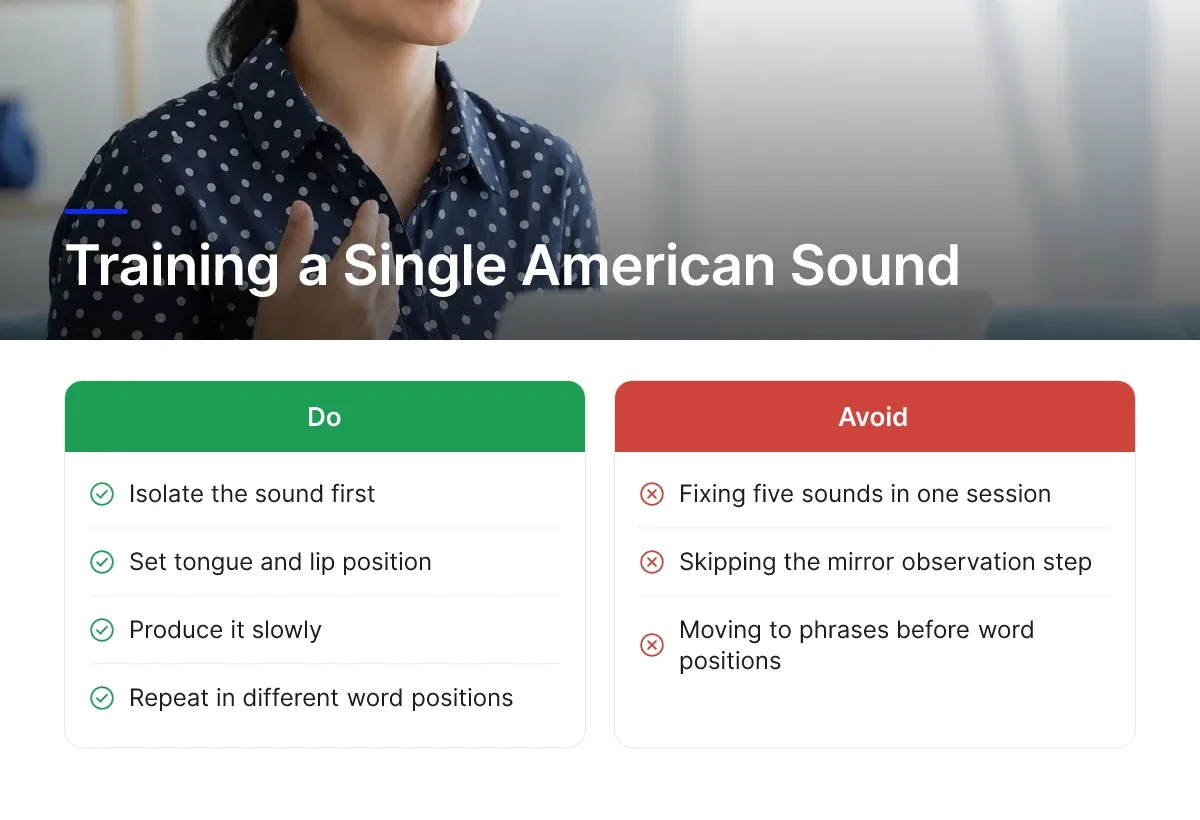
Speech organ training for a single sound follows five repeatable steps: isolate the sound, set the tongue and lip position, produce it slowly, repeat it in different word positions, then move into phrases.
What Is the Step-by-Step Process for Training a Single American Sound?
Take the American R in words like “red” and “car.” Many non-native speakers tap the tongue against the roof of the mouth, producing a sound closer to a D or a flap, a pattern common among Spanish, Portuguese, and Japanese speakers. The American R requires the opposite: the tongue pulls back and curls slightly without touching the roof of the mouth at all, while the lips round slightly, almost like preparing to say “oo.”
The training sequence looks like this. First, isolate the sound alone, away from any word, just the “er” position held for two or three seconds. Second, set the speech-organ position deliberately: tongue back, no contact with the palate, lips rounded. Third, produce the sound slowly and stretched out, checking that no tap or click occurs. Fourth, repeat it in word-initial position (“red,” “run,” “right”) and word-final position (“car,” “far,” “door”), since the tongue often behaves differently depending on where the sound falls in a word. Fifth, once the isolated sound is stable, move into short phrases: “red car,” “far right,” “turn right here.” This progression from isolated articulation to connected phrases is what separates real speech organ training from simple sound imitation.
How Do You Know If You’re Moving Your Tongue, Lips, and Jaw Correctly?
Record yourself saying the target words, then play the recording back next to a native-speaker model of the same words. Listen specifically for the acoustic signature of the common mistake, not just a general sense of “right” or “wrong.” For the American R, a tapped tongue produces a short, hard sound that resembles a D, so “very” might come out closer to “veddy.” That specific comparison point tells you exactly what to fix, rather than leaving you to guess.
This is where InPronunci’s Interactive Visual 2D Sound Simulators come in. The simulators train the tongue, lips, jaw, and airflow for the American R directly, showing the student the exact position to hold before producing the sound. Pronunci Instructions from Prof. Alex, Ph.D. Accent Coach, Doctor of Education, and professional linguist, follow immediately after, telling the student precisely what to adjust: how far back the tongue pulls, how rounded the lips should be, and what to listen for if the sound still slips into a tap. Research on explicit pronunciation instruction with corrective feedback has found measurable gains in L2 segmental accuracy over time [3].
Isolated repetition alone rarely makes a new sound stick. What builds lasting change is carrying that same tongue and lip position into phonetic exercises, then sentences, so the correct articulation survives contact with normal speaking speed. For more on how tongue position shapes individual sounds, see our guide on tongue placement in English sounds.
How Does Speech Organ Training Compare to Other Accent Reduction Methods?
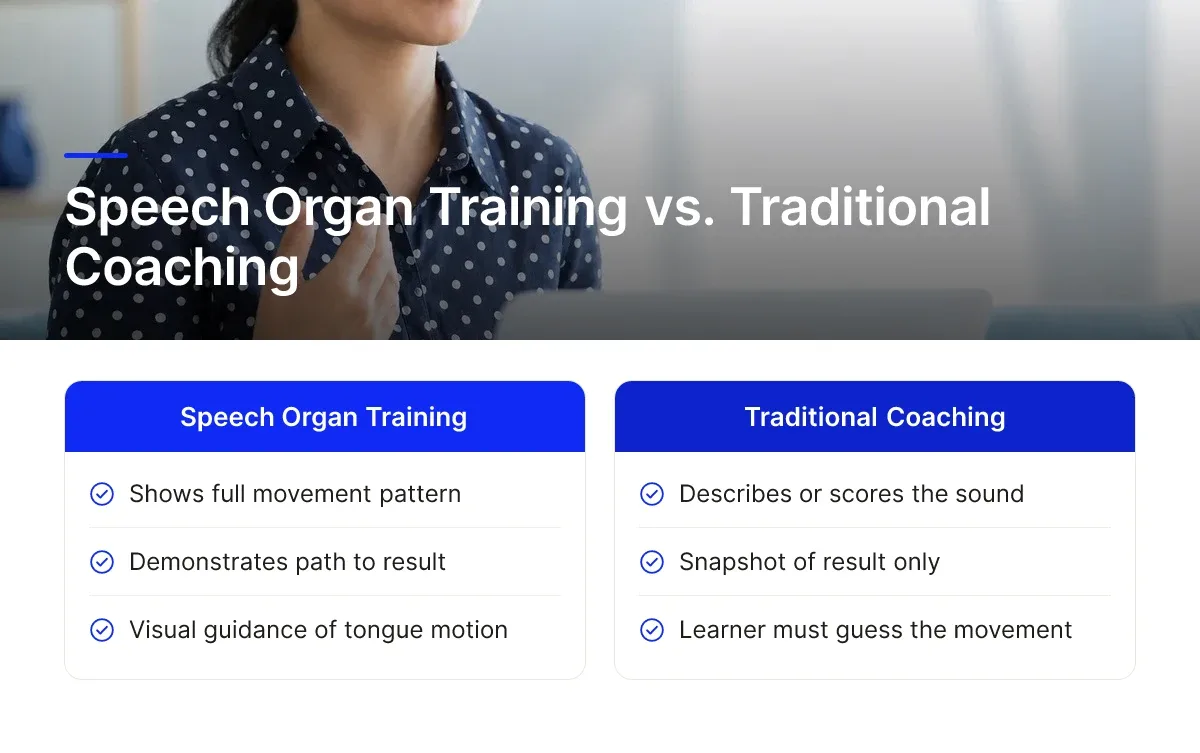
Speech organ training differs from verbal coaching and speech-repetition apps by showing the full movement pattern of a sound, not just describing or scoring it. Traditional accent reduction covers a range of methods, and each one treats the first step differently.
How Does Speech Organ Training Compare to Traditional Accent Coaching or Speech Therapy?
A coach can tell a student to “curl the tongue tip back slightly” for the American R, or point at their own mouth and gesture. That description is a snapshot of a result, not the path to get there. A learner has to guess how the tongue moved from its resting position to that final shape, then reverse-engineer the muscle coordination on their own.
Training that shows the full movement, start to finish, gives the learner something concrete to copy rather than something abstract to interpret. This is the reasoning behind InPronunci’s Interactive Visual 2D Sound Simulators: they train the tongue, lips, jaw, and airflow through the entire motion of each American sound, so students follow a movement pattern instead of reconstructing one from a verbal cue.
Speech-language pathology serves a different purpose entirely. It diagnoses and treats speech and language disorders, such as apraxia, dysarthria, or developmental articulation disorders [3]. Accent-focused speech organ training is supportive pronunciation practice for people with typical, healthy speech who want to adjust sounds borrowed from their first language. Anyone with a diagnosed or suspected speech or hearing difficulty should consult a licensed speech-language pathologist rather than rely on accent training alone [3].
General speaking-practice apps sit somewhere else on this spectrum. Many focus on vocabulary building, conversation practice, or word repetition without first correcting the articulation underneath. A learner can repeat a word dozens of times and reinforce the same inaccurate vowel or consonant each time, because nothing in the exercise addresses tongue, lip, or jaw position before the repetition begins.
Why Is Speech Organ Training the Foundation Before Sentences and Paragraphs?
Stress, rhythm, and intonation are patterns applied on top of sounds. If the underlying sound is inconsistent, every layer built on it inherits that inconsistency. This is why InPronunci sequences its four training stages in a fixed order: sound articulation first, then phonetic exercises that make the corrected sound automatic, then sentence practice with stress and intonation, then paragraph practice with presentation-style delivery.
Different apps and coaches take different approaches to this first stage, and the right fit depends on a learner’s goals and budget. Readers who want a feature-by-feature look at one alternative can read the InPronunci vs. ELSA Speak comparison.
How Long Does It Take to See Results From Speech Organ Training?
No coach or app can honestly promise a fixed timeline or guarantee a native-like accent, because results depend on how regularly a learner practices each sound and uses it in real conversation. Speech organ training works gradually, and progress varies by first language, which sounds are targeted, and how often the new pattern gets used outside of practice sessions. Anyone who promises a set number of weeks to a native accent is overselling what pronunciation training can deliver.
What Milestones Should You Expect in Your First Stages of Speech Organ Training?
Progress in speech organ training tends to follow a recognizable order, even without a fixed schedule attached to it. The first milestone is producing the sound correctly in isolation on demand, meaning the tongue, lips, or jaw move to the right position when a learner is focused entirely on that one sound. The second milestone is saying the sound correctly inside full words, where it has to coexist with the sounds around it rather than standing alone.
The third and more demanding milestone is carrying the sound into full sentences without reverting to the old pattern, even when speaking at a natural pace. This last step is where most learners spend the most time, because sentence-level speech adds pressure that isolated practice does not.
How Do You Track Progress Beyond Just Feeling Like Your Mouth Is Moving Differently?
A sound that feels correct when a learner is thinking carefully about it often slips back to the old pattern once conversation speeds up. This is a normal plateau, not a failure. It happens because conscious articulation and automatic, rapid-fire speech draw on different levels of control, which is exactly why phonetic exercises and sentence and paragraph practice matter more than isolated sound drills alone.
The most reliable way to track progress is a recorded comparison: record the same word or sentence at different points in training and compare it against a native-speaker model to notice concrete, specific differences rather than relying on a subjective sense of improvement. InPronunci’s Your Coach vs. My Pronunci Pronunciation Comparison Tool is built for exactly this kind of side-by-side check, and the AI Accent Coach extends it further by evaluating pronunciation, intonation, rhythm, and connected speech as students speak full sentences, not just isolated words. Research on explicit pronunciation instruction supports this structured approach: Saito (2012) found that explicit, targeted instruction produces measurable gains in second-language pronunciation development, more than passive listening or incidental exposure alone [source]. Structured, trackable practice, not guesswork, is what moves speech organ training forward.
What Tools and Exercises Can You Use to Train Your Speech Organs at Home?
A short mirror drill, a handful of practice words, and a recording you compare against a model cover the basics of speech organ training without special equipment.
What Are the Most Effective Drills for Beginners Learning Speech Organ Control?
Start with one sound at a time. Trying to fix five sounds in one session usually fixes none of them.
- Pick one troublesome sound. Choose the sound that causes the most confusion in conversation, such as the American R or the TH sound.
- Set the position slowly in a mirror. Watch where your tongue, lips, and jaw land before you add voice or airflow.
- Produce it in five isolated words. Say each word slowly, then at normal speed, checking the organ position each time.
- Produce it in three short sentences. Moving from isolated words to sentences tests whether the sound holds up in connected speech.
- Record and compare against a model. Play your recording next to a native-speaker sample and listen for where they diverge.
Watch for patterns tied to your first language, treated as tendencies rather than fixed rules. Spanish and Portuguese speakers often flatten the short-versus-long vowel contrast, so “ship” and “sheep” sound alike. Hindi, Tamil, and Telugu speakers sometimes substitute a tapped sound for the American R or the flap T in words like “water” and “better.” Mandarin and Cantonese speakers often drop final consonants, turning “cat” into something closer to “ca.” None of these are flaws in the language itself; they are habits worth noticing during practice.
How Can You Troubleshoot Common Mistakes When Training Your Speech Organs?
If a sound still sounds off after isolated repetition, the problem is often jaw tension or lip rounding rather than tongue position. Tongue placement gets most of the attention in self-study guides, but a jaw held too tight or lips rounded out of habit can distort a sound even when the tongue is correctly placed. Isolate each organ one at a time: hold the jaw loose and check lip shape separately from tongue position before combining them again. This is consistent with how accent modification programs describe training as changing sound production habits along with rhythm and stress, not just one articulator in isolation [3].
This kind of isolation is also where structured speech organ training tools help, because a mirror alone cannot show you the inside of the mouth. InPronunci: American Accent Training App builds this same five-step logic into a connected system. The Interactive Visual 2D Sound Simulators train the sound by guiding the tongue, lips, jaw, and airflow through the movement for each American vowel and consonant. Practice Mode then drills that sound through phonetic exercises and sentences until it becomes automatic. The Your Coach vs. My Pronunci Pronunciation Comparison Tool lets you record yourself and compare it directly against the native-speaker model, the same comparison step recommended above. Evaluation Mode, through the AI Accent Coach and Feedback & Analysis, gives sound-by-sound feedback on full speech rather than a single repeated word.
Cognitive Accent Training
Cognitive Accent Training: Learn to Recognize and Correct Your Own Pronunciation
Have you ever listened to yourself speaking English and noticed that your pronunciation sounds different from an American speaker’s, but weren’t sure why?
InPronunci incorporates Cognitive Accent Training to help students recognize their existing pronunciation habits and become more aware of how they speak.
Through Your Coach vs. My Pronunci, students listen to their own recordings, compare them with an American pronunciation model, and actively identify differences in sounds, stress, rhythm, and intonation.
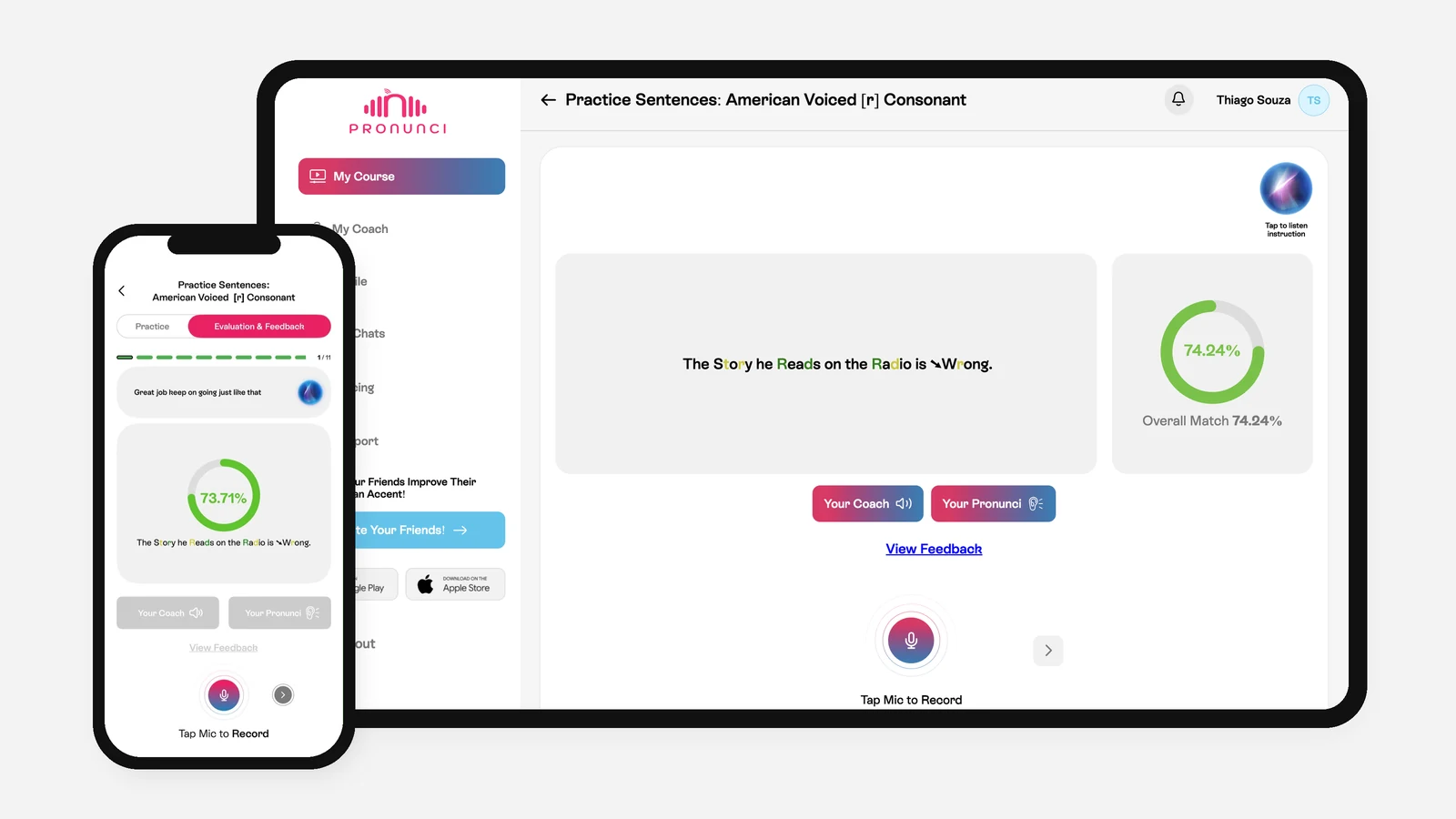
Prof. Alex’s Pronunci Instructions then guide students in understanding how to approach those corrections, while Interactive Visual 2D Sound Simulators support active articulation practice.
The process is simple:
Listen → Compare → Recognize → Understand → Practice → Correct → Recheck
Instead of relying entirely on an AI pronunciation score, students learn to participate actively in evaluating and improving their own speech.
The goal is to help students become increasingly capable of recognizing their pronunciation differences and correcting them independently.
- Hear the American ModelThe model American pronunciation of each practice sentence.
- Recognize Your DifferencesCompare your recorded speech with the American pronunciation model to identify differences in sounds, stress, rhythm, and intonation.
- Practice Your CorrectionsUse Pronunci Instructions and AI feedback to understand which pronunciation differences need attention, practice corrections, and compare your speech again.
New students can start with Free Chapter 1, Speech Organs Education, to learn how the tongue, lips, and airflow work before attempting any sound. From there, the Basic Plan supports daily self-guided practice using the same structure. For a deeper look at how tongue position shapes individual sounds, see our guide on the role of tongue placement in English sounds.
Questions & Answers
Frequently Asked Questions
01Can adults retrain their speech organs for a new accent?
Yes, adults can retrain the tongue, lips, and jaw to produce new sounds, though it takes deliberate, repeated practice rather than passive exposure. Prof. Alex’s doctoral research found that interactive, student-centered pronunciation instruction produced more stable gains than traditional, teacher-centered methods. Consistency matters more than age, and results depend on regular practice carried into daily conversation.
02Does speech organ training replace listening practice?
No, this approach works alongside listening practice, not instead of it. Learners need to hear the target sound accurately before they can train their tongue, lips, and jaw to produce it, which is why comparing your speech against a native-speaker model remains part of a structured routine.
03Is speech organ training useful for people without a foreign accent?
Yes, native English speakers can use it too, especially to sharpen articulation or soften a regional accent toward General American. Clear tongue, lip, and jaw control helps anyone speak more distinctly in presentations, interviews, or recorded audio, regardless of their first language.
04Do I need special equipment to train my speech organs at home?
No special equipment is required, just a mirror, a quiet space, and a way to record your voice for playback. Structured guidance, such as the Interactive Visual 2D Sound Simulators and step-by-step Pronunci Instructions, replaces the need for in-person tools.
Conclusion
Training your speech organs is where accent change actually starts: the tongue, lips, jaw, and airflow have to learn new positions before rhythm and intonation can follow. Treat each sound as a skill to build, not a word to repeat, and practice it until it becomes automatic in sentences and paragraphs, not just isolated drills.
If you want a structured starting point, train Chapter 1: Speech Organs Education free with InPronunci on the App Store, Google Play, or the web, then move into guided sound-by-sound practice with Pronunci Instructions.
Sources & References
Recommended Articles

A Handy Guide to English Pronunciation Exercises That Work
Learn how English pronunciation exercises train speech organs, build automatic sounds, and improve stress, rhythm, and intonation for natural speech.

accent reduction app for arabic speakers
The most effective accent reduction app for Arabic speakers is one that trains the specific sounds Arabic does not share with English, such as /p/-/b/...

Guide to Learning an American Accent for Spanish Speakers
Learn how to master an american accent for spanish speakers through structured phonetic exercises and practice with speech patterns.