


Understanding why is English pronunciation difficult is essential. English pronunciation is difficult for intermediate and advanced non-native speakers mainly because it demands precise, unfamiliar tongue, lip, and jaw coordination for sounds that don’t exist in many native languages, plus stress-timed rhythm and connected speech patterns that differ from syllable-timed languages. The difficulty is physical and automatic, not just about knowing the rules. Structured sound training that isolates each speech-organ movement, then builds it into phonetic exercises, sentences, and paragraphs, retrains these patterns more effectively than general speaking practice or spelling-based study alone.
Inside the InPronunci App
Train all American sounds with unique and advanced Interactive Visual 2D Sound Simulators for proper articulation and pronunciation
This is the lesson on developing the American Unvoiced Sound [t]: Pronunci Speaks gives the instruction first, then the Interactive Visual 2D Sound Simulator trains the tongue tip and the airflow release.
- EffectiveMost apps offer visual learning. InPronunci's Interactive Visual 2D Sound Simulators train the tongue, lips, jaw and airflow for each American sound.
- ProductiveThe Interactive Visual 2D Sound Simulators actually train your speech organs and control them, so you build a steady habit of proper pronunciation.
- ResultsStudents pronounce individual American sounds with almost native-like pronunciation.
Why Is English Pronunciation Difficult for Non-Native Speakers to Master?
A short list of consonants, vowel pairs, and rhythm patterns accounts for most of the friction, and each one is a speech-organ coordination problem, not a vocabulary gap.
Intermediate and advanced speakers already know the grammar and the words. What trips them up is getting the tongue, lips, and jaw into positions their native language never required, at a speed that leaves no time to think about it. This is the core of why is English pronunciation difficult for people who are otherwise fluent: the issue sits in motor habits, not in knowledge.
Which American Consonants and Vowels Cause the Most Trouble for Intermediate Learners?
Four consonant patterns generate most of the repeated-myself moments: the two TH sounds, the American R, the L versus dark L distinction, and the V/W contrast. The voiceless TH in “think” and the voiced TH in “this” require the tongue tip between the teeth, a position many languages substitute with /s/, /z/, /t/, or /d/ [2]. The American R in “red” needs the tongue pulled back without touching the roof of the mouth, while a clear L (as in “light”) and a dark L (as in “little” or “feel”) use different tongue-back positions that many speakers flatten into one sound. V and W get merged by speakers whose native language treats them as a single sound, so “van” and “wet” can sound identical to a listener expecting the American distinction [2].
Vowels cause a parallel problem. Short-long pairs like “ship” and “sheep,” or “full” and “fool,” rely on vowel length and tongue height differences that many languages simply don’t mark as separate phonemes [2]. When a learner’s native sound system has one vowel where English has two, the ear often can’t catch the difference before the mouth can produce it.
Why Is Connected Speech and Reduction So Much Harder Than Individual Word Pronunciation?
Isolated words are the easy case; real English compresses, links, and drops sounds the moment they appear in a sentence. “Going to” becomes “gonna,” “want to” becomes “wanna,” and word-final consonants slide into the next word’s first sound through assimilation and linking [2][3]. A learner who can pronounce every word correctly in isolation still struggles here, because connected speech is a different articulatory task entirely.
Rhythm compounds this. English is stress-timed: stressed syllables land at roughly even intervals, and everything between them gets compressed, with unstressed vowels collapsing into the neutral schwa sound [2]. Speakers of syllable-timed languages, where each syllable gets roughly equal weight, find this compression counterintuitive, since no syllable in their native rhythm disappears the way unstressed English syllables do.
This mechanical difficulty is distinct from English spelling’s irregularity, which creates a separate, knowledge-based challenge covered next.
How Does Your Native Language Affect Which English Sounds Are Hardest to Learn?
Your first language built the sound filter you hear English through, so sounds that don’t exist in that filter are the ones you mishear and mispronounce. This is one of the clearest reasons why is English pronunciation difficult for learners who already read, write, and understand English well.
Speech perception research backs this up: listeners categorize new sounds using the closest category their native language already has, even when that category is a poor match [2]. If your native language has one vowel where English has two, your brain tends to hear both as the same sound, which makes the two English sounds hard to tell apart and harder to produce distinctly.
What Pronunciation Mistakes Do Speakers of Mandarin, Spanish, French, or German Typically Make in English?
Mandarin speakers often find /l/ and /r/ hard to keep separate, and tend to drop consonants at the ends of words because Mandarin syllables rarely end that way. Spanish speakers often merge vowel pairs like the short i in “ship” and the long ee in “sheep,” since Spanish has five clear vowels instead of English’s roughly fifteen, and may also drop or soften final consonants. Hindi speakers commonly mix up /v/ and /w/ and substitute a retroflex consonant for the American flap T in words like “water” and “better.” Japanese speakers often struggle with /r/ versus /l/ and tend to insert extra vowels after consonants, turning “strike” into something closer to “sutoraiku.” French and German speakers frequently substitute /t/ or /d/ for the “th” sounds in “think” and “this” [3]. These are general tendencies, not fixed rules, and plenty of speakers from each group overcome them with targeted practice.
Why Do Some Native Languages Make English Rhythm and Stress Patterns Harder to Master?
Sound transfer and rhythm transfer are separate problems, and both need separate attention. Spanish, French, and Mandarin are syllable-timed languages, meaning each syllable gets roughly equal length and weight. English is stress-timed: stressed syllables fall at a steady beat while unstressed syllables and vowels compress and reduce. Speakers of syllable-timed languages often carry that even timing into English, producing speech that sounds flat or mechanical even when every individual sound is accurate [2]. This is why fixing isolated sounds alone rarely solves clarity problems. A learner can nail every consonant and vowel and still be hard to follow if sentence stress, linking, and intonation don’t match American patterns.
None of these tendencies make an accent wrong, and every accent deserves respect. The goal is intelligibility and confidence, not erasing where you come from. InPronunci’s structured course builds from individual sounds through phonetic exercises into sentence-level rhythm and intonation, so both sound transfer and rhythm transfer get addressed in sequence rather than left to guesswork.
Structured American Accent Training Course
From Speech Organs Education to American Intonation
The InPronunci course is built step by step: every chapter prepares the next one, and by the end of the course students receive a certificate.
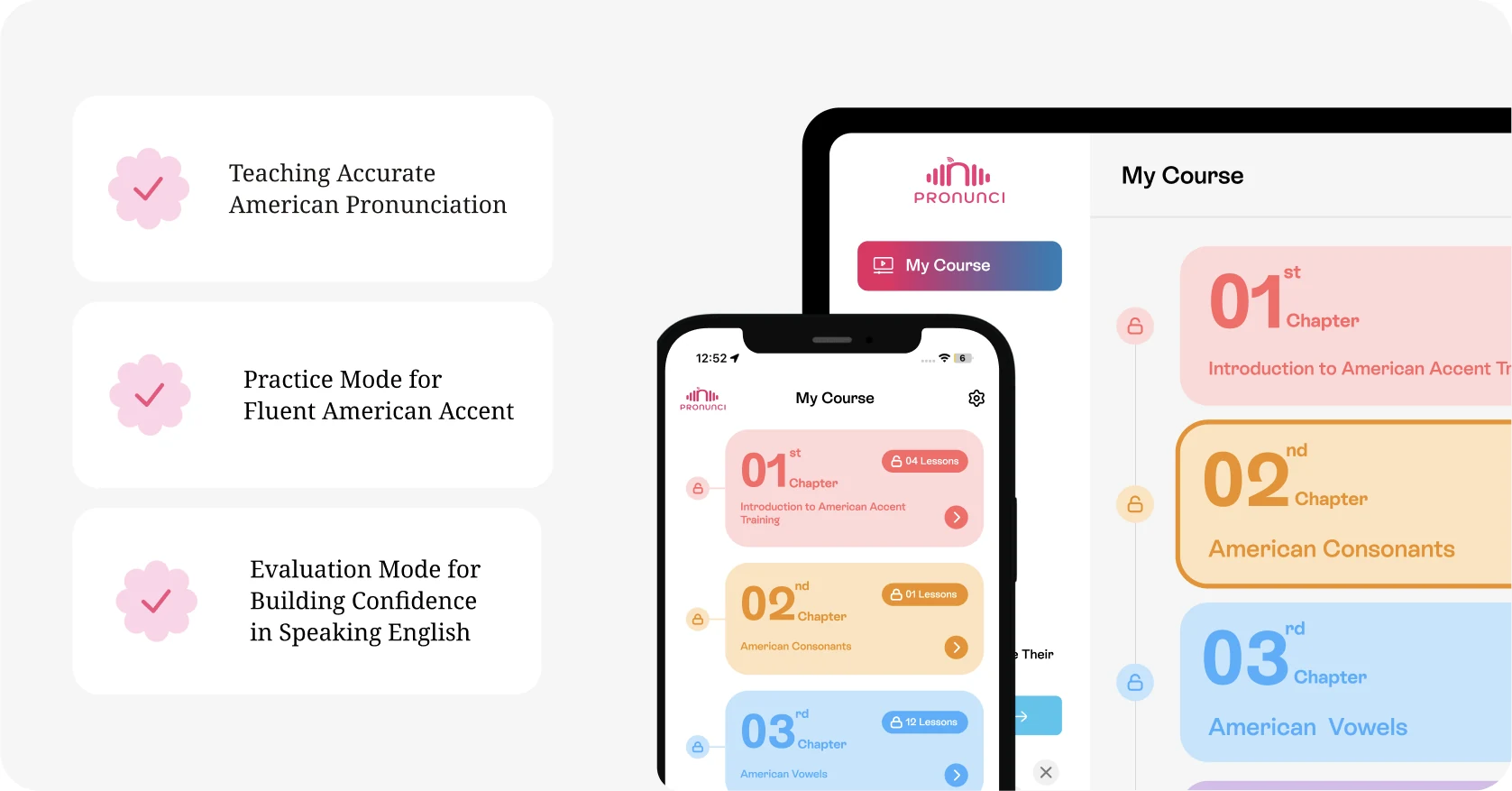
- Speech Organs EducationStudents learn how the speech organs work, along with the AI Accent Coach commands and feedback.
- American ConsonantsPractice and evaluate American consonants in phonetic exercises and practice sentences with the AI Accent Coach.
- American VowelsPractice and evaluate American vowels in phonetic exercises and practice sentences with the AI Accent Coach.
- IntonationLearn how intonation can change the meaning of what you say.
- CertificateBy the end of the course, students receive a certificate.

Is English Pronunciation Difficulty the Same Thing as Irregular Spelling?
No. Irregular spelling and articulatory difficulty are two separate problems, and confusing them is a common reason why is English pronunciation difficult remains hard to pin down for learners and teachers alike.
Spelling irregularity is a reading problem. It makes it hard to guess how a word sounds just by looking at the letters. Articulatory difficulty is a production problem. It affects whether your tongue, lips, and jaw can actually make the target sound, even when you already know exactly how the word is supposed to sound.
Why Do English Spelling and Pronunciation Not Always Match?
‘Though’, ‘through’, and ‘tough’ share the same four letters in the middle but represent three different vowel-consonant combinations entirely [4]. A learner who has memorized all three pronunciations perfectly can still mispronounce the TH sound in each word, or substitute an /f/ for the final sound in ‘tough’, because the spelling was never the obstacle. The obstacle is tongue placement. This is the gap this article focuses on: not decoding text, but training the speech organs to produce sounds the reader already knows are correct.
How Do Historical Sound Changes in English Create Pronunciation Challenges Today?
English spelling froze centuries ago while pronunciation kept shifting, and the language also absorbed vocabulary from French, Latin, and Old Norse, each with its own spelling conventions [4]. That history explains why letters like ‘ough’ can represent half a dozen different sounds. It does not explain why a learner who understands all of that history still can’t produce the American R or the short vowel in ‘ship’ correctly. Historical spelling quirks are a useful footnote, not a cause of articulatory error.
Knowing a word’s correct pronunciation and producing it are different skills, and closing the first gap does nothing for the second [2]. A learner can read English fluently, pass a spelling test, and still struggle with sounds that don’t exist in their first language, which is exactly the terrain InPronunci: American Accent Training App works on. Its Interactive Visual 2D Sound Simulators train the tongue, lips, jaw, teeth, airflow, and voice for each American sound directly, independent of how the word is spelled. That distinction is also why structured, sound-by-sound work matters more than spelling drills for anyone asking why English pronunciation is difficult to master at an advanced level.
How Can Structured Sound Training and Speech-Organ Exercises Fix These Challenges?
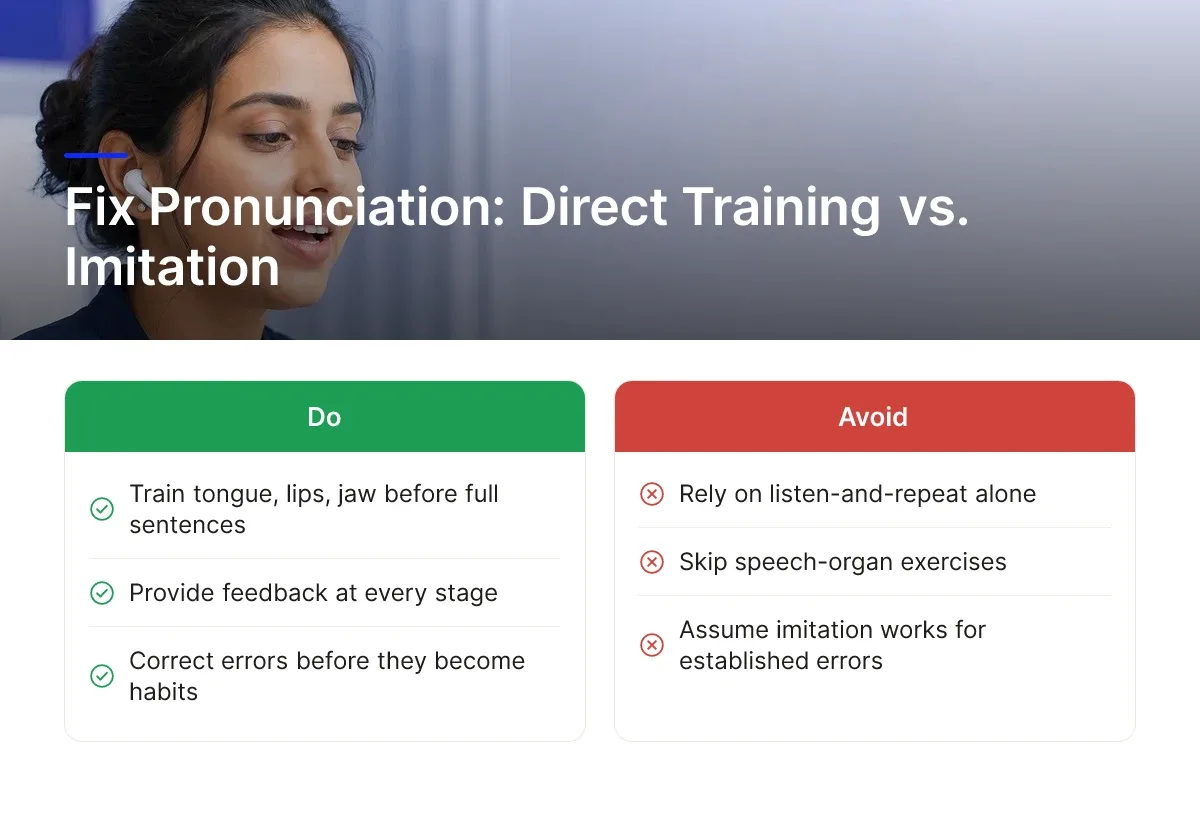
The fix is direct: train the tongue, lips, jaw, and airflow for each sound before trying to fix it in full sentences, rather than relying on listen-and-repeat alone.
Part of why is English pronunciation difficult for intermediate and advanced speakers is that imitation stops working once an error is established. Listening and repeating can take a beginner fairly far, but it gives no information about what the tongue or lips are actually doing inside the mouth. A learner can hear the difference between “think” and “sink” perfectly well and still produce the wrong sound, because the problem is not perception. It is motor control: the tongue is not reaching the teeth, or the lips are rounding too early. Without a way to see and correct that specific movement, the error repeats until it becomes automatic, or fossilized, and automatic errors are far harder to unlearn than new ones are to learn [2].
What Does Training Your Tongue, Lips, and Jaw Position Actually Accomplish?
It isolates one small, controllable movement, builds that movement into a physical habit, and only then layers the sound into words and sentences. Targeting tongue placement, lip rounding, jaw drop, and airflow separately, before combining them with the speed and rhythm of real speech, gives the speech organs a chance to learn the new position without the extra cognitive load of meaning, grammar, and vocabulary happening at the same time.
This is the mechanism behind InPronunci’s Interactive Visual 2D Sound Simulators, part of its 2D Sound Motion Technology. Each simulator trains the tongue, lips, jaw, teeth, and airflow for a specific American vowel or consonant, and the student follows the movement and repeats it with voice-over instruction on the exact articulation details. Every session also includes Pronunci Instructions, step-by-step guidance from Prof. Alex, Ph.D. Accent Coach, Doctor of Education, and professional linguist, so the student always knows what to pay attention to rather than guessing from an audio model alone.
How Do Phonetic Exercises Build Automatic, Fluent Pronunciation Instead of Conscious Effort?
Phonetic exercises take a sound the student can now produce correctly in isolation and drill it across sound combinations, reductions, and assimilations until it holds up at normal speaking speed. A sound practiced once in a single word is not yet a habit. It has to survive contact with neighboring sounds, weak forms, and the quick pace of connected speech before it becomes something the speaker does without thinking.
Research on explicit pronunciation instruction supports this sequence. Saito 2012 found that explicit, form-focused instruction produced measurable gains in second-language pronunciation that unstructured exposure did not reliably produce [3]. Thomson and Derwing’s 2015 review of pronunciation teaching research reached a similar conclusion: evidence-based, structured instruction outperforms incidental exposure for adult learners working on second-language pronunciation [2].
This is why InPronunci sequences training rather than mixing it: sound articulation first, then phonetic exercises, then sentence practice with stress and intonation, then paragraph practice for presentations and real conversations. Each stage depends on the one before it. For a closer look at how tongue position drives individual sounds, see the guide on tongue placement in English sounds.
What Is the Fastest Way to Build Automatic American Pronunciation?
The fastest path moves in a fixed order: one sound, then that sound in sentences, then that sound in connected paragraph speech, with feedback at every stage so errors get corrected before they turn into habits.
Should You Focus on Individual Sounds First, or Jump Straight to Sentences and Connected Speech?
Sound-first training works because sentence-level drilling cannot fix what the mouth is doing wrong at the articulation level. This is a central reason why is English pronunciation difficult for intermediate speakers who already study stress and intonation: they practice rhythm and melody on top of a sound that was never accurate to begin with. If a Spanish speaker produces a short, tense vowel in “ship” that actually sounds like “sheep,” adding sentence stress on top of that vowel does not fix the vowel. It just repeats the same substitution with more confidence and at higher volume.
This is why isolating the sound matters before moving on. Once the tongue height, lip shape, and jaw position for a sound are stable, stress and intonation training reinforces something correct instead of something broken.
A short daily routine applies this directly:
- Spend three to five minutes on one difficult sound, using slow, exaggerated articulation. Overemphasize tongue or lip position so the muscle memory is unmistakable, even if it feels unnatural at first.
- Read five to ten practice sentences that contain that sound in different positions (beginning, middle, end of words).
- Record the reading and compare it against a native-speaker model, listening specifically for the one sound you isolated, not the whole sentence at once.
Repeating this daily, with one sound at a time, builds the kind of stable articulation that later rhythm and intonation work can actually build on. InPronunci’s four connected stages, sound articulation, phonetic exercises, sentence and intonation practice, and paragraph practice with presentation-style delivery, follow exactly this order for the same reason.
How Do AI Evaluation and Real-Time Feedback Accelerate Progress Compared to Self-Practice Alone?
Real-time feedback shortens the correction loop by catching an error on the first or second repetition instead of the fiftieth. Unsupervised practice has a quiet risk: a learner can repeat the same tongue or lip error dozens of times without noticing, because the ear adapts to its own speech faster than it detects small articulation mistakes [2]. Minimal-pair practice and mouth-position modeling help precisely because they interrupt that drift early [2].
This is where evaluation tools change the pace of progress. InPronunci’s Evaluation Mode, built from the AI Accent Coach and Feedback & Analysis, listens to full sentence flow, intonation, rhythm, and connected speech as students speak, not just an isolated word. Feedback & Analysis then breaks that speech into sentences, words, and sounds, so a learner sees exactly which sound in which word needs correction. The Your Coach vs. My Pronunci Pronunciation Comparison Tool adds a direct side-by-side: students hear their own recording against a native-speaker model and notice the gap themselves, which builds the kind of conscious self-correction that lasts after the session ends.
Cognitive Accent Training
Compare Your Coach vs. Your Pronunci
In every practice sentence, students listen to Your Coach, record their own voice, and compare it with Your Pronunci, so they consciously notice and correct each sound.
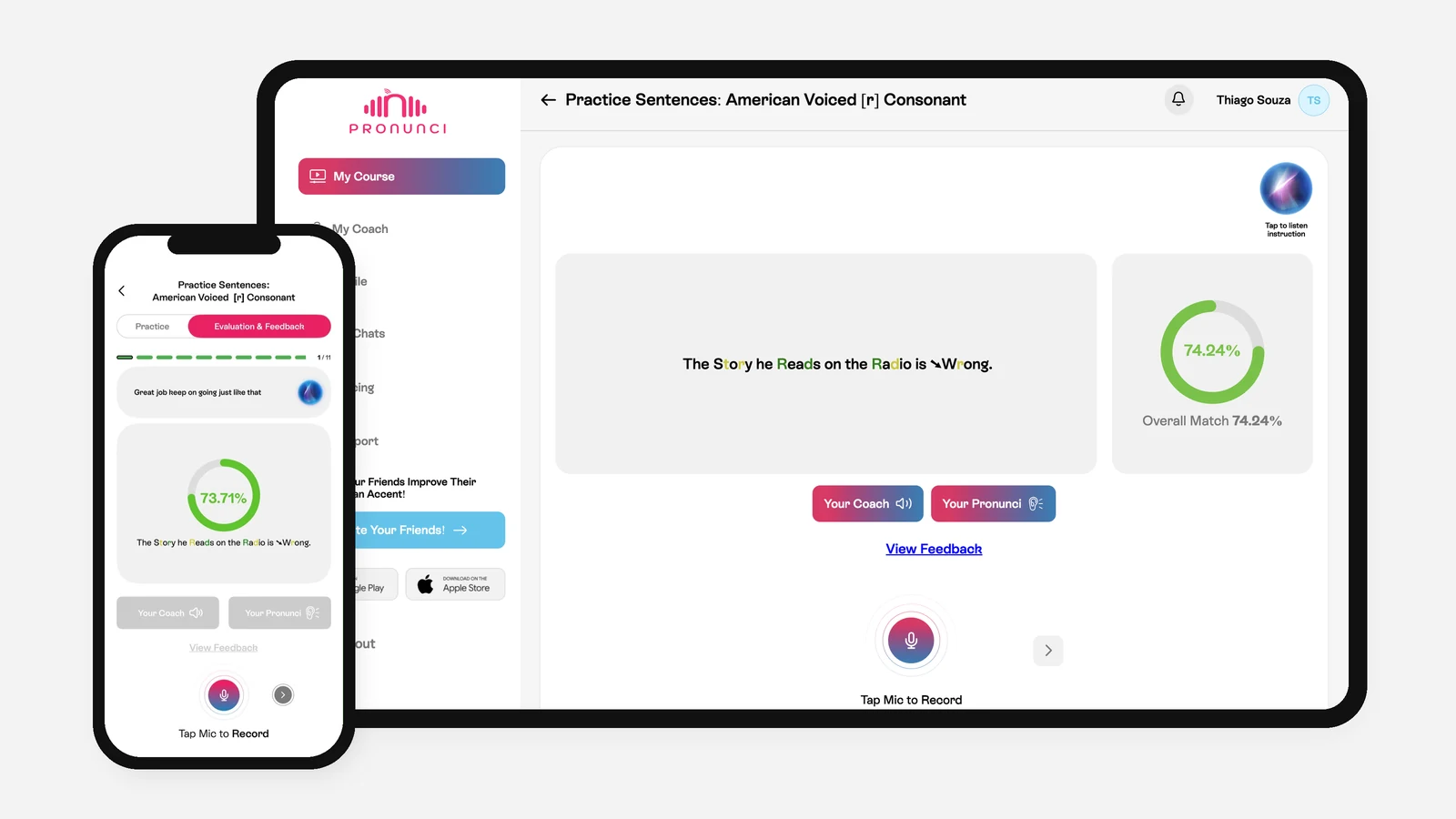
- Listen to Your CoachThe model American pronunciation of each practice sentence.
- Compare with Your PronunciYour own recorded pronunciation, side by side with the coach.
- Correct with feedbackThe match score and color-coded letters guide each correction.

Questions & Answers
Frequently Asked Questions
01Can adults change pronunciation habits that feel permanent?
Yes, adults can retrain pronunciation habits, though it takes deliberate, structured practice rather than passive exposure. Explicit pronunciation instruction has been shown to produce measurable gains in adult learners’ speech [3]. The speech organs are muscles, and like any muscle pattern, they respond to repeated, targeted movement. Progress depends on practicing specific sounds correctly, not just speaking more.
02Why do some non-native speakers sound clearer than others with similar English experience?
Clarity usually comes down to how someone practiced, not how long. Years of speaking English without correcting a mispronounced sound just reinforces the error, while focused, sound-specific practice changes the pattern. Instruction type and quality matter more than raw exposure time [3].
03Does watching movies and listening to podcasts improve pronunciation on its own?
Listening alone rarely fixes pronunciation because it builds recognition, not the motor control needed to produce sounds. You can hear the difference between “ship” and “sheep” long before your tongue and jaw can reliably produce it. Passive input helps train your ear and builds vocabulary, but speech organs improve through active, guided repetition of specific mouth and tongue movements, not through listening alone.
04Is American English pronunciation harder to learn than British English?
Neither variety is inherently harder; both present distinct patterns a learner’s native language may not include. American English relies heavily on the flap T, R-coloring, and specific vowel reductions, while British English has its own set of challenges. Difficulty depends more on how different your native sound system is from the target variety than on which variety you choose.
Conclusion
English pronunciation feels difficult because it asks your speech organs to produce sounds, stress patterns, and rhythms your native language never trained them to make. Progress starts with identifying which specific sounds or patterns your first language interferes with, then retraining the tongue, lips, and jaw deliberately rather than hoping exposure alone will fix them. Sentence-level rhythm and intonation matter as much as individual sounds once the basics are in place.
A practical next step: work through a structured training path that starts with speech-organ articulation, or try Free Chapter 1 on the InPronunci web platform to see how sound-by-sound training feels before committing to a plan.
Sources & References
- What are the biggest challenges adult learners face when mastering English pronunciation, and how can they overcome them? | Wyzant Ask An Expert
- Barriers and Solutions to English Pronunciation | American TESOL Institute’s Lexical Press Blog
- What Makes English Such A Difficult Language To Learn? – Propio
Recommended Articles

How an Accent Training App Can Help You Sound More Natural
An accent training app works best when it trains speech organs sound by sound, then builds phonetic drills, sentence stress, and paragraph-level speech.
7 English Articulation Exercises for Crisper Speech
English articulation exercises train the tongue, lips, jaw, and airflow to produce accurate American vowel and consonant sounds, building the foundation...

What Interactive Pronunciation Teaching Is and Why It Works
Interactive pronunciation teaching works better than static apps because it trains the speech organs directly and evaluates full speech as you talk, not just...
Plans
What InPronunci costs
InPronunci Basic
$35 per month
Chapter 1 is free after signup.
InPronunci Premium
$200 per month
Includes a coach: