


An accent training app works best when it trains your speech organs sound by sound, then locks that control into phonetic drills, sentence-level stress and intonation, and finally paragraph-length speech, rather than only scoring isolated words. Look for structured sound articulation training, guided instructions in every lesson, and AI feedback that evaluates full speech, not single words. Apps that skip straight to word repetition or conversation practice leave pronunciation habits unchanged, because the tongue, lips, and jaw never get retrained. The strongest programs combine speech-organ training, phonetic automation, and intonation practice in one connected system.
Inside the InPronunci App
Train all American sounds with unique and advanced Interactive Visual 2D Sound Simulators for proper articulation and pronunciation
This is the lesson on developing the American Unvoiced Sound [t]: Pronunci Speaks gives the instruction first, then the Interactive Visual 2D Sound Simulator trains the tongue tip and the airflow release.
- EffectiveMost apps offer visual learning. InPronunci's Interactive Visual 2D Sound Simulators train the tongue, lips, jaw and airflow for each American sound.
- ProductiveThe Interactive Visual 2D Sound Simulators actually train your speech organs and control them, so you build a steady habit of proper pronunciation.
- ResultsStudents pronounce individual American sounds with almost native-like pronunciation.
Structured American Accent Training Course
From Speech Organs Education to American Intonation
The InPronunci course is built step by step: every chapter prepares the next one, and by the end of the course students receive a certificate.
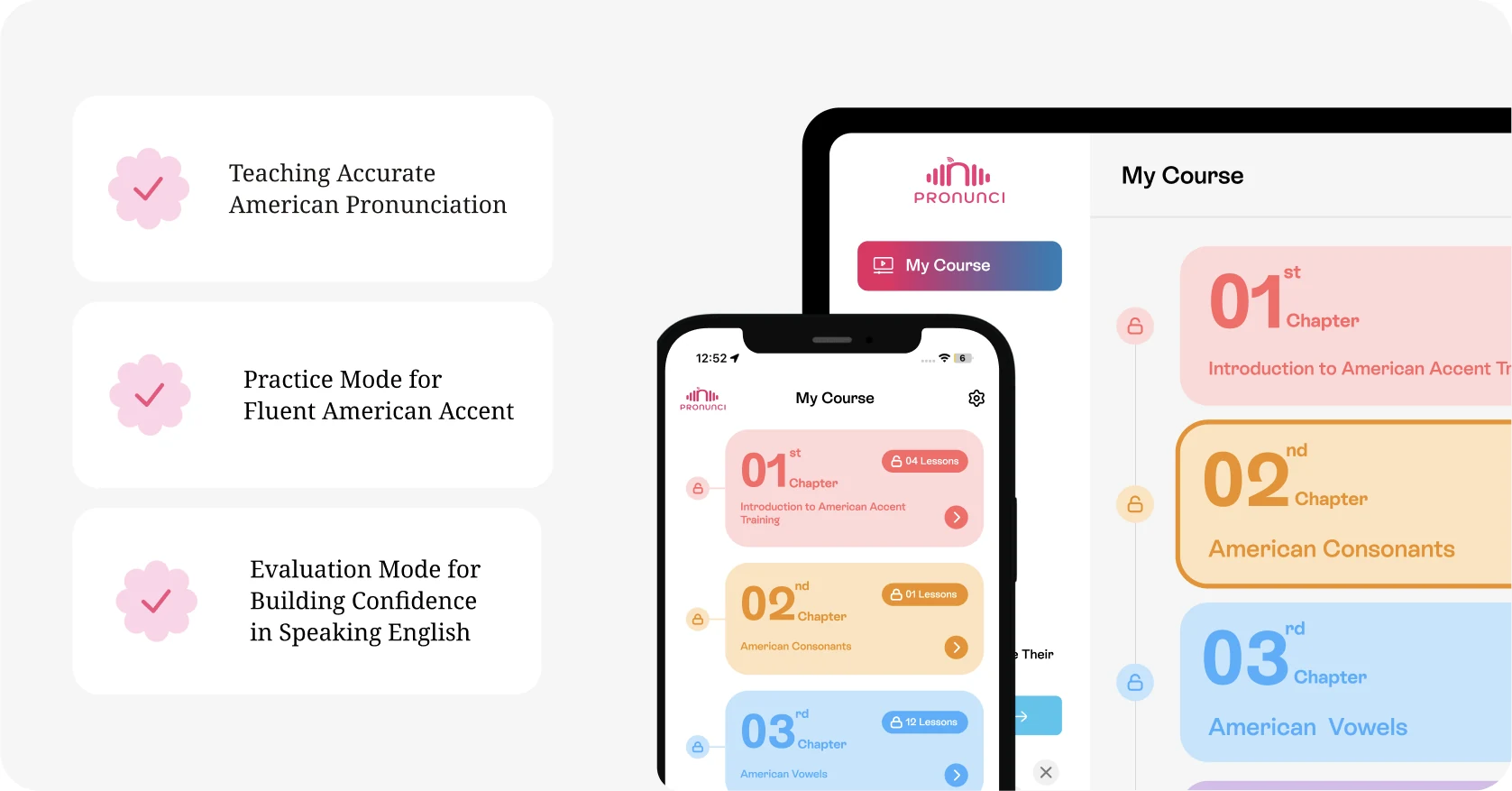
- Speech Organs EducationStudents learn how the speech organs work, along with the AI Accent Coach commands and feedback.
- American ConsonantsPractice and evaluate American consonants in phonetic exercises and practice sentences with the AI Accent Coach.
- American VowelsPractice and evaluate American vowels in phonetic exercises and practice sentences with the AI Accent Coach.
- IntonationLearn how intonation can change the meaning of what you say.
- CertificateBy the end of the course, students receive a certificate.
What Does This Kind of App Actually Do?
A general English app builds vocabulary and grammar; an accent training app retrains the physical act of speaking, the tongue, lips, jaw, and breath that shape each sound.
General English apps, and even broad speaking-practice apps, are built around words, sentence structure, and conversation topics. They ask whether you know the right word for a situation or whether your grammar holds up in a role-play. A tool focused on pronunciation asks a different question: is your tongue in the right place for the American “R”? Are your lips rounding correctly for the vowel in “book”? Are you releasing enough air for a clear “p” at the start of a word? These are motor skills, not vocabulary gaps, and they need a different kind of practice.
Is There an App to Test Your Accent, or Do Accent Apps Only Teach?
Testing and training are two separate functions, and conflating them is a common source of frustration for learners. An accent test or evaluation tool measures where a learner’s pronunciation diverges from a target accent at a given moment. It is useful for a baseline, but it does not change anything on its own. Training is the retraining process: structured stages that rebuild how the speech organs move, sound by sound, until the new patterns replace the old ones. Some apps on the market, including tools reviewed in general app roundups, lean heavily on scoring and real-time pitch visualization [3], which can tell a learner that something is off without showing them how to fix the underlying articulation.
What Features Separate a Serious Accent Training App From a Pronunciation Scoring App?
A handful of features tend to mark the difference between a structured course and a simple scoring tool:
- Sound-by-sound progression rather than a random word list
- Explicit guidance on speech-organ position for each sound
- Phonetic exercises that drill a sound until it becomes automatic
- Feedback that covers connected speech, not just isolated words repeated in sequence
InPronunci organizes this work as four connected training stages: sound articulation training with the Interactive Visual 2D Sound Simulators, phonetic exercises that build automaticity, sentence practice with American stress and intonation, and paragraph-level practice for presentation-style delivery. Each lesson includes Pronunci Instructions from Prof. Alex, Ph.D. Accent Coach, Doctor of Education, and professional linguist, so learners know what to adjust at each stage rather than guessing from a score alone.
Learners with speech or hearing difficulties should treat any accent app, including InPronunci, as supportive practice and consult a licensed speech-language pathologist for diagnosis or therapy. For a closer look at how structured sound training compares to word-repetition apps, see the course overview.

How Accent Training Apps Change Your Pronunciation
A working accent training app changes pronunciation by retraining speech-organ movement first, then automating the new pattern through repetition, then layering stress and intonation on top. Each stage depends on the one before it.
Your native language already set habitual positions for your tongue, lips, and jaw years ago. Spanish speakers learned to produce a tap instead of the American R. Mandarin speakers learned syllable-timed rhythm instead of English’s stress-timed pattern. These habits run automatically, which is why listening to native speakers alone rarely fixes them. Passive exposure trains your ear, but your speech organs keep doing what they already know. Change requires deliberate, guided movement practice, not just more listening.
How Do These Apps Train Your Speech Organs to Produce American Sounds?
InPronunci addresses this directly with 2D Sound Motion Technology, the system behind its Interactive Visual 2D Sound Simulators. For each American vowel and consonant, the student follows a simulator that trains tongue, lip, jaw, teeth, and airflow positions, then repeats the movement pattern until it becomes a new habit. This is articulation training, not a sound demonstration the student watches once and moves past.
The research backs this approach. Saito (2012) found that explicit pronunciation instruction, where learners receive direct guidance on how to produce a sound, led to measurable improvement in L2 sound development compared to instruction without that explicit focus [3]. Thomson and Derwing (2015) reviewed pronunciation teaching research and found that targeted instruction outperforms incidental exposure, meaning simply hearing more English does not substitute for focused practice on specific sounds [2]. This is consistent with why InPronunci structures training around the speech organs before moving to phonetic exercises, sentences, and paragraphs.
What Role Does AI Feedback Play in This Type of Training?
Once a sound is trained, the next problem is knowing whether you’re producing it correctly in real speech, not just in isolation. This is where the AI Accent Coach fits into InPronunci’s system. It evaluates pronunciation, intonation, melody, rhythm, connected speech, and sentence flow as the student speaks a full sentence or paragraph, not just one isolated word.
That distinction matters. Many pronunciation apps score single-word repetition: you say “water,” the app checks the word, and that’s the full evaluation. But rhythm errors, dropped word stress, and broken connected speech only show up across a phrase or sentence. A tool that never asks you to speak more than one word at a time cannot detect them, no matter how accurate its single-sound scoring is.

Choosing the Best Accent Training App for American English
The right accent training app depends on four questions: does it train your speech organs directly, does it guide each lesson step by step, does it evaluate full speech or single words, and does it lead from sounds to paragraphs.
Most marketing pages describe apps as “AI-powered” or “personalized,” but those terms do not tell you how the training actually works. A useful comparison looks at structure first:
- Does the app teach you where to place your tongue and how to shape your lips for a specific sound, or does it mainly ask you to repeat words and score your accuracy?
- Does a lesson tell you what to pay attention to before you practice, or do you guess?
- When you finish speaking, does the feedback cover your rhythm, intonation, and connected speech, or just whether individual words sounded “correct”?
How Do InPronunci, ELSA Speak, BoldVoice, and Other Top Apps Compare?
ELSA Speak offers AI-powered English speaking practice with instant personalized feedback, role-plays, and broad communication practice [1]. It is built for general English speaking confidence across many conversation types.
BoldVoice centers on guided video practice, with coach videos and AI speech evaluation [1][2]. Lessons are organized around watching a coach demonstrate a sound or phrase, then recording your own attempt for feedback.
InPronunci: American Accent Training App takes a different starting point. Its two major differentiators are Pronunci Instructions, step-by-step guidance from Prof. Alex, Ph.D. Accent Coach, Doctor of Education, and professional linguist, in every lesson, and AI Accent Coach evaluation of full speech, including pronunciation, intonation, melody, rhythm, connected speech, and sentence flow, not just one word or sound. Both are built on 2D Sound Motion Technology: the Interactive Visual 2D Sound Simulators train the tongue, lips, jaw, teeth, airflow, and voice for every American vowel and consonant, before students move into phonetic exercises, sentences with intonation, and paragraph practice. This four-stage structure mirrors the same path Prof. Alex uses in 1-on-1 training. For a detailed, fact-based comparison, see our InPronunci vs. ELSA Speak page.
What Should You Look for When Choosing a Pronunciation Tool for Your Goals?
Match the tool to the goal, not the other way around. If you want general conversation confidence across everyday topics, an app built around broad communication practice and role-plays may fit [1]. If your goal is systematic, sound-by-sound retraining toward natural American pronunciation, intonation, and connected speech, you need a program that trains speech organs directly and evaluates full speech, not isolated words.
Professionals preparing for client calls, interviews, or presentations usually benefit most from a structured path: sounds, then phonetic exercises, then sentences, then paragraphs. Learn more about this approach on our course overview and the AI Accent Coach guidelines.
Accent Training App Costs: What to Expect
Most options in this category follow a similar pattern: a free or limited entry point, a budget-friendly subscription for self-guided practice, and a premium tier that adds live human coaching. Where each app draws those lines, and what it includes at each level, varies by provider.
What’s Included in Free Tiers and Basic Plans Across Leading Apps?
Free tiers typically enable a small sample of lessons, while paid subscriptions open the full curriculum and ongoing feedback tools. BoldVoice, for example, offers in-app purchases on top of a free download, with features including video tutorials, AI-powered pronunciation feedback, and native-speaker comparison tools [1][2]. ELSA Speak follows a comparable structure, with a free tier and paid plans enabling broader practice [4].
InPronunci uses the same three-tier logic. Free Chapter 1 covers Speech Organs Education, the foundation lesson where students learn how the tongue, lips, teeth ridge, and airflow work together before training individual sounds. The Basic Plan gives self-guided learners full access to all four chapters, all 400 lessons, and the student group chat, at a budget-friendly subscription level. The Premium Plan adds 1-on-1 training with Prof. Alex, Ph.D. Accent Coach, Doctor of Education, and professional linguist, at a premium tier: one 1-hour live session each month, a personal chat channel between sessions, and feedback on submitted phonetic exercises, sentences, and paragraphs.
When Is It Worth Paying for a Premium Plan With a Live Coach?
Premium coaching costs more because it requires a trained professional’s time, not just computing power. Correcting first-language influence on rhythm, intonation, and specific sounds means a coach has to listen to how a student’s native language shapes their English, then give feedback targeted to that pattern, something automated scoring alone cannot fully replicate.
That extra cost tends to pay off for professionals preparing for high-stakes communication: a client call, a job interview, a conference presentation, or a leadership meeting where clarity carries real weight. Self-motivated learners working on general clarity, without a specific deadline or stakes, often do well with structured self-guided practice and the AI Accent Coach’s full-speech feedback alone.
Students weighing the Premium Plan book a consultation with Prof. Alex first. That conversation covers their goals and speaking background, so they start at the Intermediate or Advanced evaluation level that actually matches where they are, rather than guessing. For a closer look at how the four stages fit together, see the course overview.
Building a Daily Accent Training Routine With an App
A realistic daily routine runs 15 to 25 minutes and moves through four steps: one target sound, phonetic drills on that sound, a few sentences, then a recorded paragraph. The order matters more than the total time.
What’s a Realistic Practice Schedule for This Kind of Training?
Start with a few minutes training one target sound with a sound simulator and step-by-step guided instructions. In InPronunci, this means working with the Interactive Visual 2D Sound Simulator and Pronunci Instructions, which train the tongue, lips, jaw, and airflow to produce the sound correctly before moving on.
A typical session can look like this:
- A few minutes on one target sound with a sound simulator and guided instructions
- Five to seven minutes of phonetic exercises on that same sound, including combinations, reductions, and assimilations
- Two or three sentences that put the sound under normal stress and rhythm
- A short recorded paragraph for self-review against a native-speaker model
This is also where a comparison tool earns its place in the routine. InPronunci’s Your Coach vs. My Pronunci Pronunciation Comparison Tool lets a student play back their own recording next to a native-speaker model and notice specific differences: a vowel that’s too short, a consonant dropped at the end of a word, a flat pitch where English needs a rise. Noticing consciously, sentence by sentence, is what turns a vague sense of “something’s off” into a fixable detail.
Cognitive Accent Training
Compare Your Coach vs. Your Pronunci
In every practice sentence, students listen to Your Coach, record their own voice, and compare it with Your Pronunci, so they consciously notice and correct each sound.
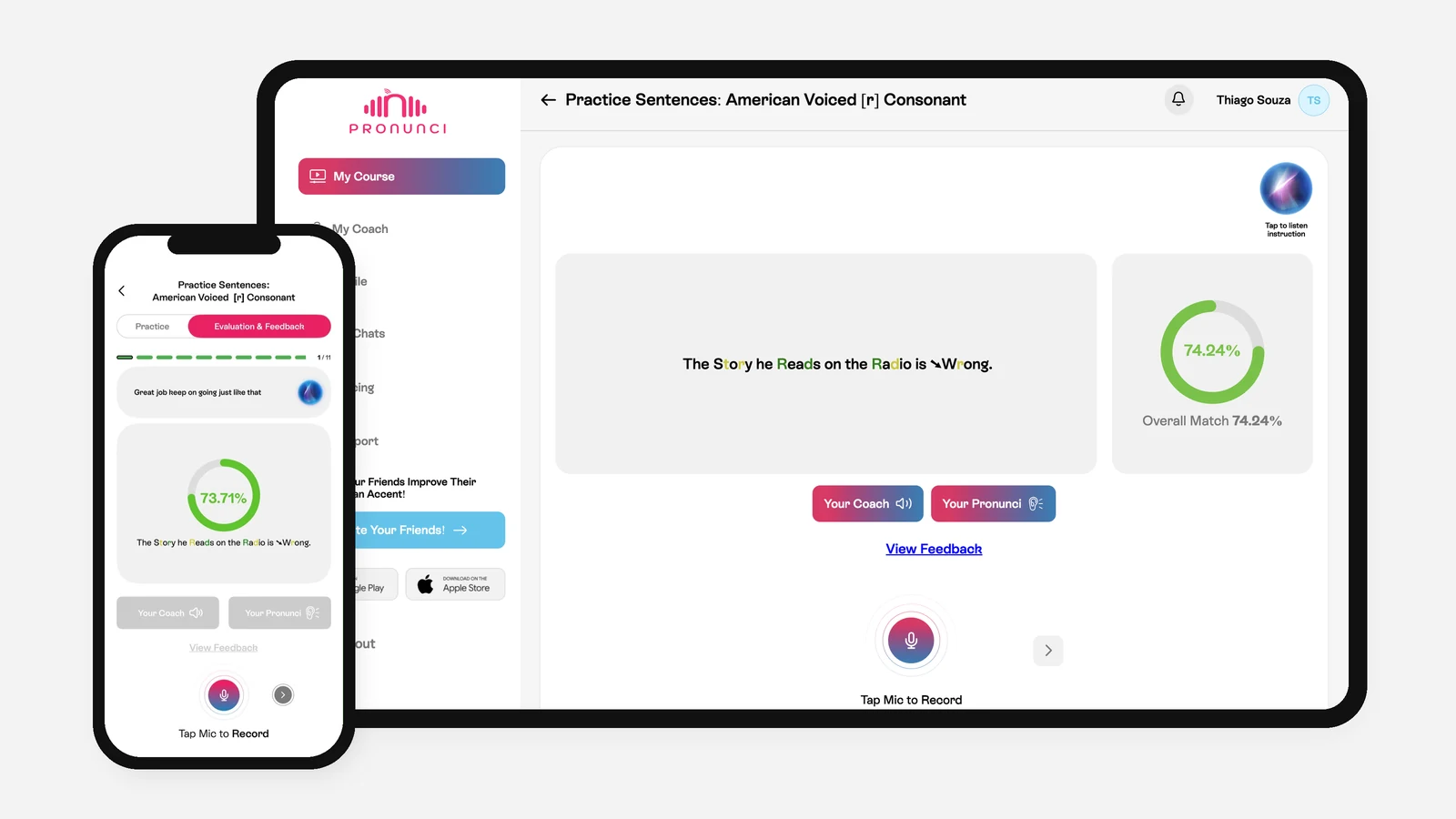
- Listen to Your CoachThe model American pronunciation of each practice sentence.
- Compare with Your PronunciYour own recorded pronunciation, side by side with the coach.
- Correct with feedbackThe match score and color-coded letters guide each correction.
How Do You Move From Sound Drills to Natural Speech Practice?
A sound drilled in isolation doesn’t automatically survive in a sentence. Once a sound is stable in phonetic exercises, the next step is applying it in sentences with ordinary stress and intonation, then in paragraph-length, presentation-style delivery, which is closer to how the sound behaves in a meeting or an interview.
Pick one or two target sounds per session, not five. A Spanish speaker working on short versus long vowels, or a Hindi speaker working on the flap T in words like “water” and “better,” makes steadier progress drilling one pattern until it’s automatic than spreading attention across many sounds at once. Research on explicit pronunciation instruction supports focused, structured practice over scattered exposure as the mechanism for lasting change [3].
No tool in this category can promise a fixed timeline for results, and claims that suggest otherwise are worth treating with skepticism. What drives change is consistent, structured repetition across sound, exercise, sentence, and paragraph levels, the same four-stage path InPronunci’s course and Prof. Alex’s 1-on-1 training both follow.

Questions & Answers
Frequently Asked Questions
01Can adults learn to sound more like a native English speaker with an app?
Yes. Adult learners can retrain pronunciation habits with structured, explicit instruction, though the process takes sustained practice rather than passive exposure. Research on explicit pronunciation instruction shows it produces measurable gains in L2 pronunciation accuracy [3], which is why sound-by-sound training with speech-organ awareness works better than casual listening or repeat-after-me drills. An app like InPronunci builds this through Interactive Visual 2D Sound Simulators, phonetic exercises, and sentence-level practice rather than isolated word repetition.
02Do accent training apps work for IELTS or TOEFL speaking preparation?
Yes, clearer pronunciation and natural intonation directly support IELTS Speaking and TOEFL Speaking scores, which both assess intelligibility and delivery. Training that moves from individual sounds to sentence stress and connected speech, as InPronunci’s four-stage structure does, builds the rhythm and clarity examiners listen for, not just accurate vocabulary.
03Is an accent training app enough, or do I need a live coach?
A structured app is enough for many self-motivated learners, but some professionals benefit from adding live coaching. InPronunci’s Basic Plan gives self-guided learners full access to all four training stages and the AI Accent Coach, while the Premium Plan adds a monthly 1-on-1 session with Prof. Alex for personalized feedback on first-language influence, rhythm, and intonation. The right choice depends on your goals and how much individualized correction you want.
04How is connected speech practiced inside an accent training app?
Connected speech is practiced through sentence and paragraph drills that train linking, reductions, and assimilations, not isolated words. InPronunci’s phonetic exercises introduce these patterns first, then sentence practice adds stress and intonation, and paragraph practice applies them in presentation-style speech. See our connected speech guide for sound examples.
05How long does it typically take to notice a change in pronunciation?
Timelines vary by learner, native language, and how consistently someone practices, so no app can honestly promise a fixed number of weeks. What tends to matter more than elapsed time is whether practice moves through all four stages, sound, phonetic drill, sentence, and paragraph, on a regular schedule. Learners who skip straight to conversation practice without this foundation typically see slower, less stable improvement.
Conclusion
Choosing an accent training app comes down to structure: does it train your speech organs for each sound, build that sound into automatic phonetic patterns, and then apply it to sentences and paragraphs with real feedback on your full speech? Word-repetition scoring alone won’t get you there. Start with the sounds that matter most for your first language, practice daily with instructions you can actually follow, and track progress against a native-speaker model rather than a single score.
A practical next step: download InPronunci and start with Free Chapter 1 on the App Store, Google Play, or the web, and see how Pronunci Instructions and the AI Accent Coach guide your first session.
Sources & References
- BoldVoice: Accent Training App – App Store
- BoldVoice – Accent Training – Apps on Google Play
- Accent Training App – App Store
- Best App to Learn American Accent in 2026 [Reviewed] | Practice Me
Recommended Articles
7 English Articulation Exercises for Crisper Speech
English articulation exercises train the tongue, lips, jaw, and airflow to produce accurate American vowel and consonant sounds, building the foundation...
What Interactive Pronunciation Teaching Is and Why It Works
Interactive pronunciation teaching works better than static apps because it trains the speech organs directly and evaluates full speech as you talk, not just...
How an AI Pronunciation Trainer Gives Instant Feedback
An AI pronunciation trainer gives instant feedback by listening to your full spoken sentence or paragraph, not just a single word, and scoring pronunciation...
Plans
What InPronunci costs
InPronunci Basic
$35 per month
Chapter 1 is free after signup.
InPronunci Premium
$200 per month
Includes a coach: