


Understanding american accent for spanish speakers is essential. Spanish speakers develop an American accent by retraining the speech organs for sounds that don’t exist in Spanish, then automating those sounds through phonetic exercises, sentence-level intonation practice, and paragraph-level delivery. The main gaps come from Spanish having five pure vowels instead of American English’s vowel set, no /ɪ/-/i/ distinction, no th sounds, a tapped r instead of the American r, and syllable-timed rhythm instead of English’s stress-timed rhythm. Progress depends on structured, sound-by-sound practice rather than isolated tips, and results vary by how consistently someone practices.
How Spanish Speech Patterns Shape an American Accent for Spanish Speakers
Spanish and American English organize vowels, consonants, and rhythm differently. Those mismatches, not any lack of skill, produce an American accent for Spanish speakers.
Spanish uses five pure vowel sounds: /a/, /e/, /i/, /o/, /u/. American English uses roughly 11 to 15 vowel sounds, depending on how a dialect counts diphthongs [1]. With no equivalent category in their native sound system, Spanish speakers tend to map several English vowels onto the single closest Spanish vowel. The classic case is ship and sheep: English distinguishes /ɪ/ from /i/, but Spanish has only /i/, so both words can come out sounding like “sheep.” The same collapsing happens with /ʊ/ and /u/ in full and fool, and with /æ/ and /ɛ/ in bat and bet.
Which Spanish Sounds Don’t Exist in American Accent for Spanish Speakers
Spanish has no /ð/ or /θ/ (the two “th” sounds in this and think), no /ɪ/-/i/ contrast, and no American /r/. Spanish /r/ is tapped or trilled with the tongue tip touching the alveolar ridge, while the American /r/ is produced with the tongue pulled back and the tip curled, touching nothing. Without a matching sound to borrow from, the speech organs default to the nearest Spanish sound, which is exactly what structured articulation training is built to retrain.
Inside the InPronunci App
Train American Sounds with Interactive Visual 2D Sound Simulators
Learning American pronunciation involves more than listening to sounds and repeating them.
InPronunci’s Interactive Visual 2D Sound Simulators, developed by Prof. Alex using 2D Sound Motion Technology, guide students through the tongue, lip, and jaw movements involved in producing American consonants and vowels.
Students actively coordinate their speech movements with the simulator, practice each sound aloud, and develop greater awareness of how American sounds are produced.
You don’t just listen to an American sound. You actively train how to produce it.
This lesson demonstrates active training of the American voiceless consonant /t/. Prof. Alex’s Pronunci Instructions guide students before they practice the tongue-tip and airflow-release movements using the Interactive Visual 2D Sound Simulator.
Three Benefits of InPronunci’s Interactive Visual 2D Sound Simulators
- Active ArticulationTrain tongue, lip, and jaw movements while producing American sounds aloud.
- Guided Sound TrainingFollow Prof. Alex’s Pronunci Instructions to understand what to focus on and how to practice.
- Greater Sound ControlDevelop awareness and coordination for clearer, more consistent American pronunciation.
Why Spanish Speakers Add or Drop Vowels in American Accent for Spanish Speakers
Spanish syllables don’t start with consonant clusters like /st, /sp, or /sk. A word must begin with a vowel or a single consonant. Spanish speakers often insert a short vowel before words like student or Spain. This produces “estudent” and “eSpain.” The same gap in syllable structure affects word endings. Spanish syllables typically close with a vowel or a small set of consonants (n, s, r, l, d). English word-final sounds like d, t, and s in words like worked or cats often get softened or dropped entirely.
Rhythm compounds all of this. Spanish is syllable-timed, meaning each syllable takes roughly the same amount of time to say. American English is stress-timed: stressed syllables set the pace, and unstressed syllables and function words compress between them [1]. Applying syllable-timed rhythm to English produces speech that sounds evenly paced rather than naturally stressed, which listeners often perceive as flat or mechanical even when every sound is pronounced correctly.
None of this is permanent. These are tendencies carried over from a first language. They respond to targeted retraining of the speech organs, sound by sound. This article walks through the path of this retraining. These accent patterns are discussed widely outside linguistics textbooks. They appear in regional reporting on how accents shape everyday life, such as this WLRN report on accent and identity in South Florida.
The Hardest American Sounds for Spanish Speakers to Produce
Five sound patterns cause most of the trouble: the /ɪ/-/i/ vowel pair, the two “th” sounds, the American R, the B/V distinction, and final consonant clusters.
- The /ɪ/-/i/ vowel pair: collapses words like “ship” and “sheep” into the same sound.
- The two “th” sounds: /θ/ and /ð/ don’t exist in Spanish and get replaced with /t/, /d/, or /s/.
- The American R: a retroflex sound with no Spanish equivalent, often replaced with a tap or trill.
- The B/V distinction: merged into one sound in many Spanish dialects.
- Final consonant clusters: often softened or dropped due to Spanish syllable structure.
Spanish has five vowel sounds, while English has around fourteen vowel and diphthong sounds. A significant part of training an American accent for Spanish speakers is learning to hear and produce distinctions that Spanish simply doesn’t make [1]. The same applies to a handful of consonants that exist in English but not in Spanish. Some consonants exist in both languages but have different tongue or lip positions. None of this means starting from scratch. It means retraining specific speech organs for specific sounds.
Why the /ɪ/-/i/ Distinction and th Sounds Are So Hard
Spanish has one “i” sound, so words like “ship” and “sheep” can sound identical when a Spanish speaker maps both onto that single vowel [1]. In American English, /i/ (as in “sheep”) is made with the tongue high and front, the jaw nearly closed, and the lips slightly spread, held longer than its short counterpart. /ɪ/ (as in “ship”) drops the jaw slightly more, relaxes the tongue a bit lower and back from the front wall, and is shorter and more clipped. The difference is small in space but large in meaning: “live” versus “leave,” “bit” versus “beat,” “chip” versus “cheap.”
A simple minimal pair drill works well here: say “bit, beat, bit, beat” slowly, feeling the jaw open slightly more for “bit” and the tongue relax. Then do the same with “live/leave” and “slip/sleep,” exaggerating the jaw movement before bringing it back to natural speed.
The “th” sounds, /θ/ as in “think” and /ð/ as in “this,” don’t exist in Spanish at all. Spanish speakers typically substitute /t/, /d/, or /s/, so “think” becomes “tink” or “sink,” and “this” becomes “dis.” Both American “th” sounds require placing the tongue tip lightly between the upper and lower front teeth and pushing air through for the voiceless /θ/, or voicing it for /ð/. Practice with “three,” “mouth,” “this,” and “that,” watching that the tongue actually makes contact with the teeth rather than staying behind them.
How to Fix the American R and B/V Confusion
The American R (/ɹ/) is produced with the tongue curling back and up without touching the roof of the mouth, while the Spanish R is a quick tap or trill where the tongue tip strikes or vibrates against the ridge behind the upper teeth. This is one of the most frequent substitutions in an american accent for Spanish speakers, showing up in words like “really,” “car,” and “world.” The fix starts with holding the tongue in a tense, retracted position and checking that no tap occurs at all.
Spanish also merges /b/ and /v/ into a single sound in many dialects. Thus, “berry” and “very” or “boat” and “vote” can sound the same. American /b/ closes the lips completely before releasing a burst of air. In contrast, /v/ requires the top teeth to rest lightly on the bottom lip, letting air hum through the gap. Final consonant clusters, like “fifths” and “asked,” and word-final consonants in general are secondary trouble spots. These areas are worth separate practice once the core sounds feel stable.
Training Your Speech Organs for Accurate American Accent for Spanish Speakers
Retraining the tongue, lips, and jaw for an american accent for Spanish speakers follows a fixed sequence: isolate the sound, set the articulation position, then build outward from sound to syllable to word.
Spanish uses a smaller set of vowel and consonant targets than American English. The speech organs never learned several positions they need now. This is not a lack of effort. It is a gap in motor training that a structured sequence can close, one sound at a time.
A Step-by-Step Process for Retraining Your American Accent for Spanish Speakers
- Start with the sound alone, outside any word. For the American R, pull the tongue tip back and up without touching the roof of the mouth, round the lips slightly, and sustain the sound for two or three seconds.
- Check in a mirror: lips should be rounded, tongue tip curled back, no contact anywhere in the mouth.
- Once the isolated sound is stable, move to syllables: “ra,” “ro,” “ar,” “or.”
- Progress to full words: “red,” “right,” “car,” “door.”
Each step adds complexity. The tongue and jaw hold the position learned in the previous step. Skipping from an isolated sound straight to full sentences explains why many learners can produce a sound correctly alone. However, they lose it the moment they speak at normal speed.
How Phonetic Exercises Improve American Accent for Spanish Speakers
Isolated sound drills build the position. However, real speech never uses sounds in isolation. English speakers constantly combine, reduce, and blend sounds across word boundaries. For example, “want to” becomes “wanna” and “did you” becomes “didja.” Final consonants shift depending on what follows. A Spanish speaker who has mastered the American R in single words still needs practice with that R inside phrases. For instance, “for a reason” or “far away” connects the sound to surrounding vowels.
This is why phonetic exercises come after, not instead of, isolated sound work. Phonetic exercises train the sound combinations, reductions, and assimilations that make pronunciation automatic in connected speech. They help learners go beyond careful, word-by-word practice.
Training Structure and Methodology
InPronunci: American Accent Training App structures this exact progression. Interactive Visual 2D Sound Simulators, part of 2D Sound Motion Technology, train the tongue, lips, jaw, and airflow to produce each American vowel and consonant, paired with Pronunci Instructions from Prof. Alex, Ph.D. Accent Coach, Doctor of Education, and professional linguist, in every lesson. Students then move into phonetic exercises before applying the sound in sentences and paragraphs, the same four-stage path Prof. Alex uses in 1-on-1 training.
Try this five-minute routine today, in front of a mirror. Spend one minute alternating “ship/sheep,” “bit/beat,” and “sit/seat” to separate /ɪ/ from /i/. Spend two minutes on “th” words: “think,” “this,” “breathe,” tongue tip lightly between the teeth. Finish with two minutes on American R words: “red,” “car,” “better,” “world.” Say each pair slowly first, then at normal speaking speed.
Recording this practice and comparing it against a native-speaker model helps learners. The Your Coach vs. My Pronunci Pronunciation Comparison Tool helps them hear the gap between what they intend and what they actually produce. This process allows them to adjust consciously rather than by guesswork. For more on how tongue position shapes individual sounds, see the guide to tongue placement in English sounds.
Cognitive Accent Training
Cognitive Accent Training: Learn to Recognize and Correct Your Own Pronunciation
Have you ever listened to yourself speaking English and noticed that your pronunciation sounds different from an American speaker’s, but weren’t sure why?
InPronunci incorporates Cognitive Accent Training to help students recognize their existing pronunciation habits and become more aware of how they speak.
Through Your Coach vs. My Pronunci, students listen to their own recordings, compare them with an American pronunciation model, and actively identify differences in sounds, stress, rhythm, and intonation.
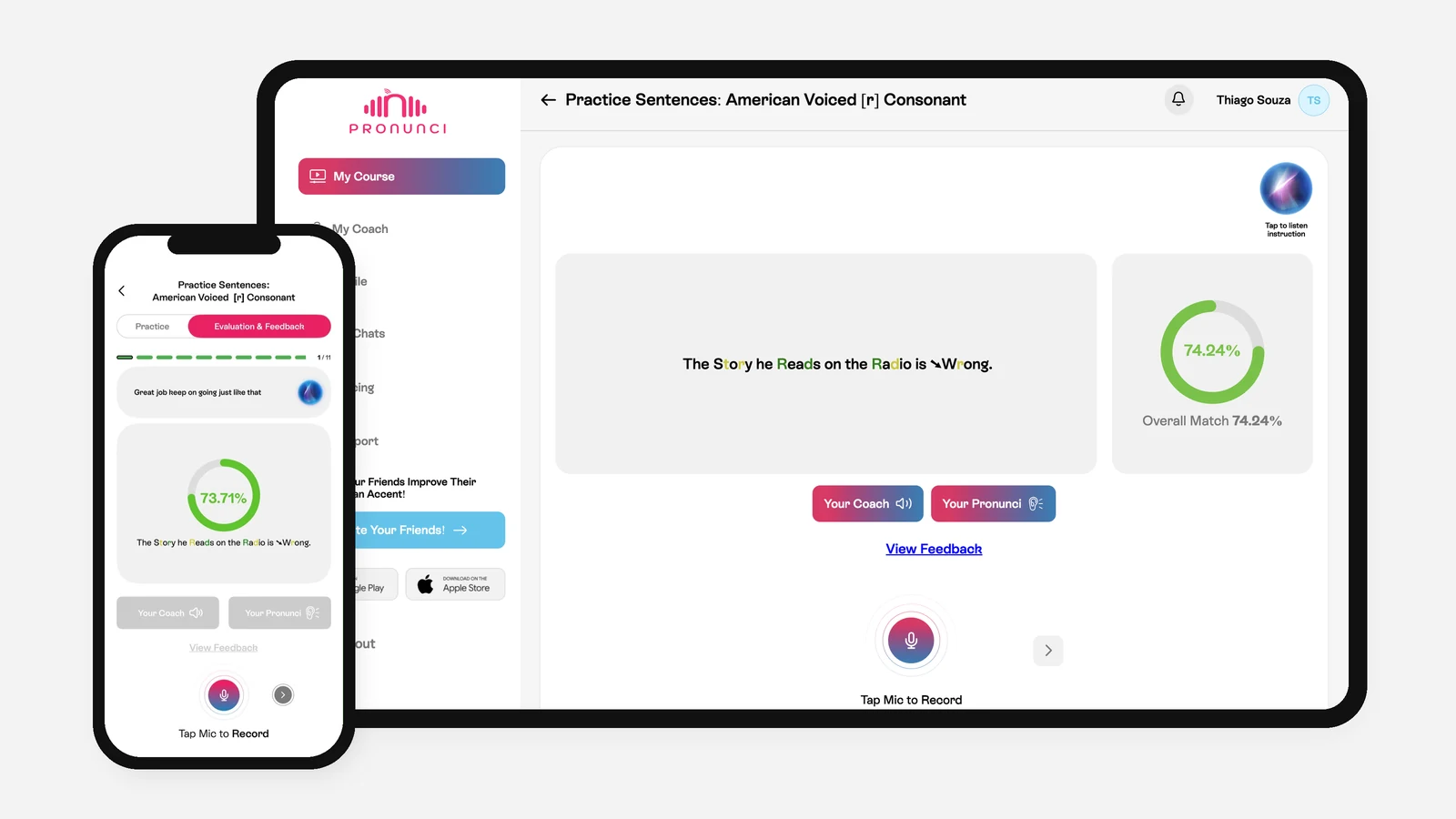
Prof. Alex’s Pronunci Instructions then guide students in understanding how to approach those corrections, while Interactive Visual 2D Sound Simulators support active articulation practice.
The process is simple:
Listen → Compare → Recognize → Understand → Practice → Correct → Recheck
Instead of relying entirely on an AI pronunciation score, students learn to participate actively in evaluating and improving their own speech.
The goal is to help students become increasingly capable of recognizing their pronunciation differences and correcting them independently.
- Hear the American ModelThe model American pronunciation of each practice sentence.
- Recognize Your DifferencesCompare your recorded speech with the American pronunciation model to identify differences in sounds, stress, rhythm, and intonation.
- Practice Your CorrectionsUse Pronunci Instructions and AI feedback to understand which pronunciation differences need attention, practice corrections, and compare your speech again.
From Accent Mechanics to Natural American Speech
Accurate individual sounds are necessary but not sufficient, natural speech also requires correct stress, rhythm, and linking across full sentences and paragraphs.
Why Sound Accuracy Alone Doesn’t Create Natural Speech
A Spanish speaker can train the /ɪ/-/i/ contrast or the American R in isolation. They can still sound unnatural in conversation. This is because connected speech changes how sounds behave when they sit next to other words. Sounds link across word boundaries (for example, “turn it off” becomes “turn-it-off” with no pause). Unstressed vowels reduce to schwa, and consonants shift or disappear depending on stress. Practicing “ship” and “sheep” as flashcards doesn’t train the ear or mouth for mid-sentence occurrences, surrounded by faster, less careful speech.
This is one reason American accent for Spanish speakers training has to go beyond sound drills. Spanish is a syllable-timed language, where most syllables get roughly equal length and weight. English is stress-timed: content words (nouns, verbs, adjectives) get full vowels and clear stress, while function words (articles, prepositions, auxiliary verbs) shrink. Spanish speakers often pronounce “to,” “for,” and “a” with their full vowel sound, when native speech reduces them to a quick schwa, “I’m going to the store” becomes “I’m goin’ tuh the store.” Skipping this pattern makes speech sound overly precise and word-by-word rather than connected.
How Sentence Stress and Paragraph Practice Complete the Path
Once a sound is stable, the next step is practicing it inside stressed and unstressed syllables, not just in a single rehearsed word. The same /ɪ/-/i/ distinction or American R gets tested in sentence rhythm, where stress patterns determine which syllables get full value and which compress. This is exactly where sentence practice and intonation training build on the articulation stage: students take sounds they already produce correctly and apply them under the pressure of real sentence melody, emphasis, and pacing.
Paragraph practice with presentation-style delivery is the last stage, where rhythm, pausing, and intonation combine across a full passage instead of one sentence at a time. This mirrors how people actually speak in meetings, interviews, and presentations, longer stretches of speech where pauses signal meaning and stress patterns carry emphasis across multiple clauses. Saito 2012 found that explicit, structured pronunciation instruction supports more durable long-term improvement than exposure alone [1], which is the reasoning behind moving deliberately through sounds, then sentences, then paragraphs, rather than hoping exposure alone will fix connected speech. InPronunci: American Accent Training App follows this same order, sound training, phonetic exercises, sentence intonation, then paragraph delivery, so students build toward natural speech, not just accurate isolated sounds. For more on how reductions and linking work, see the guide to connected speech.
What Affects How Fast a Spanish Speaker Develops a Natural American Accent
Pace depends on four concrete factors: how much and how consistently you practice, your starting level of English, how much you hear spoken American English day to day, and whether your practice targets specific sounds or stays general. No two learners move at the same rate, so treating progress as a fixed timeline usually sets up disappointment rather than clarity.
Consistent, focused practice tends to outperform occasional, unfocused exposure. Someone who listens to American podcasts for an hour a day but never isolates individual sounds often plateaus on the same errors for a long time. In contrast, someone who practices fewer minutes but directly works on the short i versus long e contrast (ship/sheep) or sentence stress patterns tends to notice change sooner. This happens because their practice targets a specific gap rather than general comprehension.
Starting level matters too. A learner who can already distinguish most American vowel sounds only needs work on rhythm and intonation. This situation contrasts with someone still tackling consonant clusters and final sounds common in Spanish-influenced speech. Both are valid starting points for building an American accent for Spanish speakers, but the path length differs.
What Progress Looks Like at Intermediate vs. Advanced Levels
At the intermediate level, progress usually appears as clearer individual sounds. Fewer words get misheard or require repetition. A listener no longer confuses “very” with “berry,” or “think” with “sink.” The contrasts between /v/ and /b/ and /θ/ become more reliable. This is often the first visible payoff of structured practice.
At the advanced level, progress looks different: it shows up in longer stretches of speech, not isolated words. Rhythm, stress placement, and intonation start to carry the natural rise and fall of American English, and speech sounds closer to native across full sentences and paragraphs, not just in test words.
Research on second-language pronunciation supports this distinction. Thomson and Derwing’s 2015 review found that focused, high-variability pronunciation training produces more measurable improvement than general listening exposure alone [2]. This finding explains why practice aimed at specific sounds and patterns tends to move the needle faster than passive exposure.
InPronunci’s Evaluation Mode reflects this same progression. The Intermediate AI Accent Coach level evaluates pronunciation, intonation, melody, rhythm, connected speech, and sentence flow. It helps learners working toward clearer, more confident speech. The Advanced level evaluates full speech performance for learners aiming to sound closer to a native speaker. Neither level promises a fixed outcome. Both provide ongoing feedback to help learners see where they stand and what to work on next.

Questions & Answers
Frequently Asked Questions
01Why do Spanish speakers often add an extra vowel sound before words like ‘school’ or ‘Spain’?
Spanish syllable structure does not allow words to start with “s” plus another consonant. As a result, speakers insert a short “eh” sound before it. This insertion happens because Spanish phonology requires a vowel before an “s-consonant” cluster. Thus, they produce forms like “eschool” or “eSpain.” Fixing it means training the tongue and lips to start the airflow directly on the “s” sound, without the vowel buildup.
02Is the Spanish r the same as the American r?
No, the two sounds are produced completely differently. They use different parts of the mouth. Spanish “r” is a tap or trill made with the tongue tip touching the roof of the mouth. In contrast, the American R is a retroflex or bunched sound where the tongue curls back without touching anything. Spanish speakers often substitute their native tap, making American R sound shortened or unclear.
03Can an adult Spanish speaker still fully retrain their pronunciation?
Yes, adults can reduce a Spanish accent and build natural American pronunciation habits. This happens through structured, sound-by-sound practice. Saito 2012 found that explicit pronunciation instruction improves adult learners’ accuracy [3]. Moreover, Lee, Jang, and Plonsky’s 2015 meta-analysis confirmed pronunciation instruction produces measurable gains [1]. Progress depends on consistent practice, not age alone, and no app or coach can guarantee a fully native-like result.
04Should Spanish speakers focus on individual sounds or on rhythm and intonation first?
Start with individual sounds, then move to rhythm and intonation once articulation is stable. Building accurate vowels and consonants first gives the speech organs a reliable foundation, so later work on American stress-timed rhythm and sentence melody has something consistent to attach to. Skipping straight to rhythm without fixing sounds usually leaves both issues unresolved.
05Does accent training mean erasing a Spanish accent completely?
No, the goal is clearer, more natural American pronunciation, not erasing a Spanish accent or anyone’s identity. Training focuses on reducing patterns that cause misunderstandings, like vowel length confusion or missing final consonants, while respecting the accent as part of the speaker’s background. The aim is confident, independent communication, not sounding identical to someone else.
Conclusion
Spanish speakers reduce their accent by retraining specific habits: distinguishing short and long vowels, producing the American R without a tap, pronouncing final consonants, and shifting from syllable-timed to stress-timed rhythm. Each change starts in the speech organs before it becomes automatic in sentences and conversation.
The practical next step is structured, not random. Start with Free Chapter 1 of InPronunci: American Accent Training App on the web, App Store, or Google Play, and train the sounds that matter most for Spanish speakers before moving into sentence and paragraph practice.
Sources & References
- A Linguist’s Guide to American English Pronunciation for Spanish…
- Prof. Alex, Ph.d. American Accent Coach | Austin, TX
- BBC English, Expert Accent Reduction & Public Speaking Tips for Clear Speech, Get Rid of Your Accent | Books, Apps & Courses | BATCS Global
Recommended Articles

speak english like a native
Speaking English like a native speaker means retraining your speech organs, not just learning tips, so your tongue, lips, jaw, and airflow produce American...

How to Structure American Accent Practice the Right Way
Learn how to structure American accent practice step by step, from sound training to rhythm, intonation, and feedback, for faster, lasting results.

How to Choose the Right Phonetics App for Accent Training
Discover what a true phonetics app should do: train your speech organs, not just score words, with structured sound-by-sound coaching for accent training.