


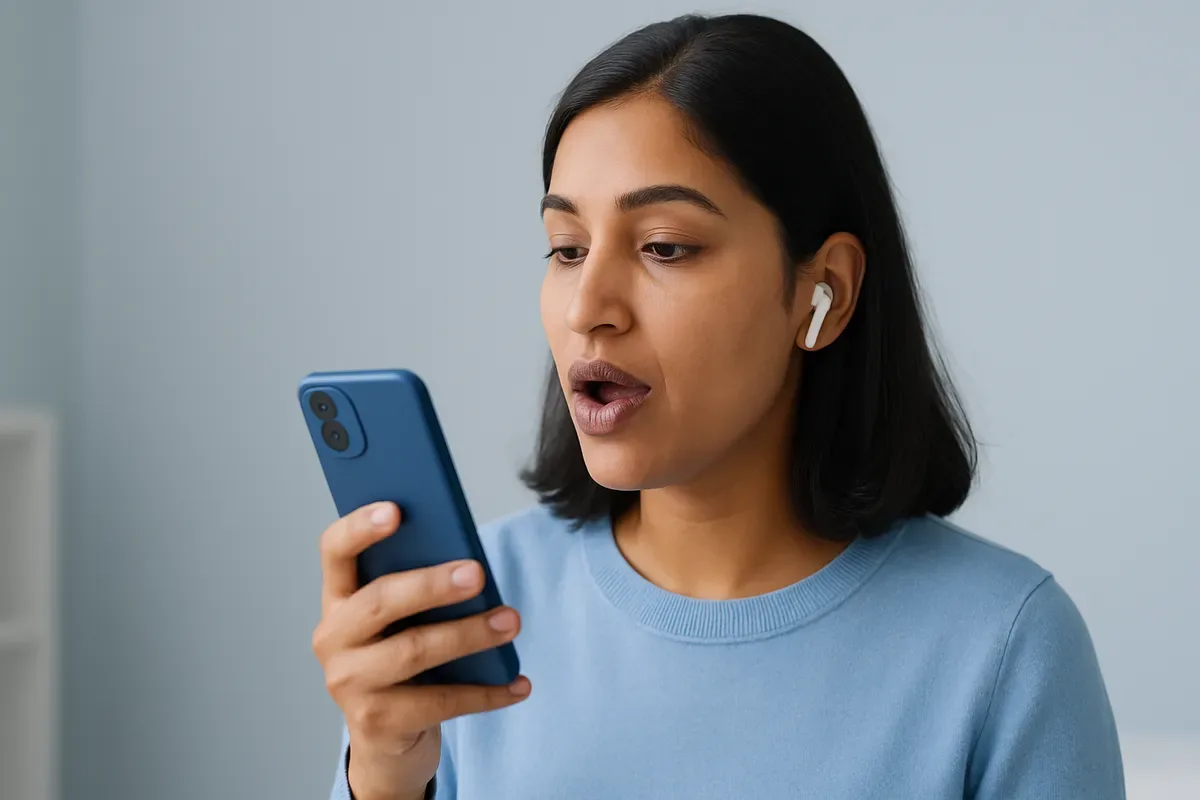
A phonetics app built for American accent training should do more than teach IPA symbols or score single words: it needs to train your tongue, lips, jaw, and airflow to physically produce each American sound, then carry that sound into exercises, sentences, and paragraphs. Apps that stop at transcription or a pronunciation score can tell you a sound is wrong, but they rarely show your speech organs how to fix it. Look for structured, sound-by-sound training with step-by-step coaching, not just symbol drills or a numeric score.

What to Look for in a Phonetics App for American Accent Training
A phonetics app worth your time trains sound-by-sound articulation, gives spoken step-by-step coaching, moves from sounds into sentences and paragraphs, and evaluates full speech rather than single words.
Most apps marketed for pronunciation fall into one of two categories. The first teaches IPA symbols and transcription, useful for linguistics students but not built to change how your tongue, lips, and jaw move. The second scores individual words or sounds, telling you something is “wrong” without showing your speech organs what “right” looks like. A phonetics app built for accent training needs to do both more and differently: train articulation, then carry that sound through phonetic exercises, sentences with stress and intonation, and paragraph-length speech.
Before committing to any course, check for four things: whether it trains the physical production of each sound, whether guidance is explained step by step rather than left to guesswork, whether the app progresses structurally from isolated sounds to connected speech, and whether evaluation covers your sentence flow and rhythm instead of scoring one word at a time.
Should You Choose a Free Phonetics App or Pay for a Structured Course?
Free tiers are genuinely useful for testing whether an app’s teaching style fits you, but building automatic American speech habits requires the full structured progression a paid course provides. A single free lesson can show you how instructions are delivered, whether speech-organ training feels concrete, and whether the pacing suits your level. That is enough to judge fit. It is not enough to retrain rhythm, vowel length, or consonant production across hundreds of words and real conversation patterns, which takes the complete path from sound training through phonetic exercises to sentence and paragraph practice.
InPronunci offers Free Chapter 1, Speech Organs Education, as a way to test this before moving to the Basic Plan or Premium Plan. It covers how the tongue, lips, teeth ridge, and airflow work together, the foundation for following any sound-specific training that comes after.
What Features Help You Move from Single Sounds to Natural Sentence-Level Speech?
Generic phonetics apps often stop short of what non-native speakers actually need, because first-language patterns affect more than individual sounds. Spanish and Portuguese speakers bring syllable-timed rhythm into English, which needs stress-timed rhythm instead. Hindi and Tamil speakers often substitute retroflex consonants for American /t/ and /d/. Many learners confuse short and long vowels, such as the difference between “ship” and “sheep.” An app that only drills symbols or scores isolated words cannot address rhythm or vowel length across a sentence. Look for a progression that trains the sound, then locks it in with phonetic exercises, then applies it in sentences and paragraphs with an AI Accent Coach evaluating the full result.
How Phonetics Apps Train Your Speech Organs to Produce American Sounds
A phonetics app built for accent training works by directing the tongue, lips, jaw, and airflow through each sound, not by showing you a symbol and asking you to copy it from memory. The mechanism is movement training, not recognition training.
How Do Interactive Visual 2D Sound Simulators Teach Tongue, Lips, and Jaw Placement?
InPronunci’s Interactive Visual 2D Sound Simulators train the speech organs, tongue, lips, jaw, teeth, vocal cords, airflow, and voice, for every American vowel and consonant. Most apps offer visual learning. InPronunci goes further: its Interactive Visual 2D Sound Simulators train the speech organs (tongue, lips, jaw and airflow) to produce each American sound correctly. Students follow the simulator and repeat the movement until the position becomes familiar, not just understood.
Inside the InPronunci App
Train American Sounds with Interactive Visual 2D Sound Simulators
Learning American pronunciation involves more than listening to sounds and repeating them.
InPronunci’s Interactive Visual 2D Sound Simulators, developed by Prof. Alex using 2D Sound Motion Technology, guide students through the tongue, lip, and jaw movements involved in producing American consonants and vowels.
Students actively coordinate their speech movements with the simulator, practice each sound aloud, and develop greater awareness of how American sounds are produced.
You don’t just listen to an American sound. You actively train how to produce it.
This lesson demonstrates active training of the American voiceless consonant /t/. Prof. Alex’s Pronunci Instructions guide students before they practice the tongue-tip and airflow-release movements using the Interactive Visual 2D Sound Simulator.
Three Benefits of InPronunci’s Interactive Visual 2D Sound Simulators
- Active ArticulationTrain tongue, lip, and jaw movements while producing American sounds aloud.
- Guided Sound TrainingFollow Prof. Alex’s Pronunci Instructions to understand what to focus on and how to practice.
- Greater Sound ControlDevelop awareness and coordination for clearer, more consistent American pronunciation.
Take the American R, one of the sounds that trips up speakers of Spanish, Hindi, Japanese, and many other languages. In most of those languages, the R is tapped against the roof of the mouth or trilled with the tongue tip. The American R works differently: the tongue body pulls back in the mouth, the tip curls up slightly or bunches, and critically, nothing touches the roof of the mouth. A phonetics app that only shows a static diagram of this position leaves the student guessing how to get there. A simulator that trains the movement step by step gives the tongue somewhere to go.
What Role Does Step-by-Step Instruction from a Professional Linguist Play in Sound Training?
Pronunci Instructions supply the spoken, step-by-step guidance that tells a student exactly what to adjust, sound by sound, lesson by lesson. Prof. Alex, Ph.D. Accent Coach, Doctor of Education, and professional linguist, built these instructions into every lesson so students are never left to interpret a simulator on their own. The instructions function like a coach standing beside the learner: pull the tongue back a little more, relax the jaw, narrow the airflow here.
This is where a phonetics app built around articulation differs from an IPA chart or a mouth diagram in a textbook. A chart shows a symbol. A diagram shows one frozen position. Neither trains the transition from rest position into the sound, which is where most of the real difficulty sits. For a deeper breakdown of how tongue placement shapes individual American sounds, see InPronunci’s guide on the role of tongue placement in English sounds.
Phonetics App vs. Pronunciation Scoring App: What Actually Differs
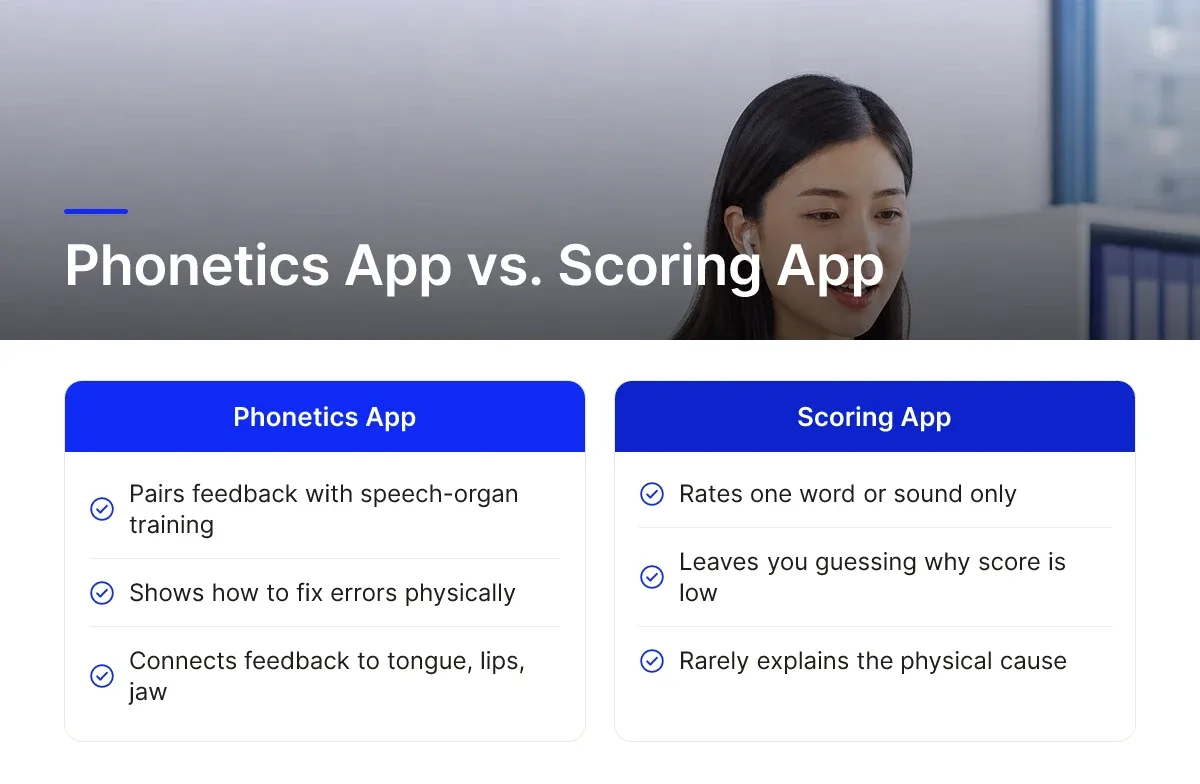
A pronunciation scoring app rates one word or sound and stops there, while a structured phonetics app pairs that feedback with speech-organ training that shows how to fix it.
Most pronunciation scoring tools work the same way: you say a word, the app compares it to a reference recording, and you get a number or a color code. If the score is low, you are left guessing why. Was it the vowel? The final consonant? Your stress placement? A scoring app rarely says. A phonetics app built around structured training closes that gap by connecting the feedback to the physical cause: tongue position, lip rounding, jaw opening, or airflow.
InPronunci’s AI Accent Coach works this way by design. Instead of scoring an isolated word, it evaluates full speech in context: sound accuracy, intonation, melody, rhythm, connected speech, and sentence flow. A learner practicing a sentence like “What are you going to do about it?” gets feedback on the whole utterance, including whether “going to” reduced naturally to something close to “gonna” and whether sentence stress landed on the right words.
Why Does Real-Time Evaluation of Intonation, Rhythm, and Connected Speech Matter More Than Single-Word Scores?
Single-word scores miss the patterns that make American English sound natural in running speech: linking, reduction, and rhythm across word boundaries. Native speakers routinely drop or blend sounds between words, so “did you” becomes closer to “didja” and “want to” becomes “wanna.” A learner who nails every word in isolation can still sound stilted or hard to follow in conversation if these patterns are missing. Evaluating full sentences and paragraphs, not single words, is the only way to catch that gap, which is why InPronunci’s sentence practice and paragraph practice stages exist alongside sound-level training. For more on how these patterns work, see our guide on connected speech in American English.
How Does a Phonetics App Designed by a Linguist Differ from Apps Focused on IPA Symbols and Transcription?
Some apps center on IPA transcription drills and symbol recognition, which build awareness of sounds but do not train the speech organs to produce them. InPronunci’s Feedback & Analysis, part of Evaluation Mode, takes a different approach: it breaks a paragraph into sentences, sentences into words, and words into individual sounds, giving articulation detail for each sound through an Interactive Visual 2D Sound Simulator. Every score in the system uses a 100 = native speaker scale. No app, including InPronunci, can honestly guarantee a native-like accent; progress depends on consistent practice and applying the training in daily conversation.
How to Practice Phonetics Exercises to Make American Sounds Automatic
Practice an isolated sound for a minute, drill it in a phonetic exercise, then speak it inside full sentences with normal stress and rhythm. A phonetics app that stops at the first step leaves the sound disconnected from real speech.
What Is the Progression from Articulation Training Through Phonetic Exercises to Paragraph-Level Practice?
American accent training works in four connected stages, not one isolated drill. First, sound articulation training positions the tongue, lips, jaw, and airflow correctly for a target sound. Second, phonetic exercises repeat that sound inside combinations until it stops requiring conscious effort. Third, sentence practice adds stress, rhythm, and intonation, so the sound survives contact with a full American English sentence. Fourth, paragraph practice with presentation-style delivery tests the sound in longer, spontaneous speech, the kind used in meetings, interviews, and presentations.
This is the structure behind InPronunci: American Accent Training App, which organizes all four stages into one sequence rather than separate, disconnected tools. A new sound starts with the Interactive Visual 2D Sound Simulator and Pronunci Instructions, moves into phonetic exercises, then into practice sentences and paragraphs. Each stage depends on the one before it. Skipping ahead to sentences before the sound is stable in isolation usually means the old, native-language sound pattern resurfaces under pressure.
How Do Phonetics Exercises with Sound Combinations and Reductions Build Fluent, Natural American Speech?
Phonetics exercises train how a sound behaves next to other sounds, not how it sounds alone. American English merges, reduces, and links sounds constantly: “want to” becomes “wanna,” “did you” becomes “didja,” and final consonants often link into the next word’s vowel. A phonetics app built around single-word repetition rarely covers these combinations, reductions, and assimilations, which is exactly where fast natural speech lives.
Research on explicit pronunciation instruction supports this approach. Saito (2012) found that focused, explicit instruction on specific sounds produced measurable gains in L2 pronunciation compared to instruction without that explicit focus [1]. The gains come from targeted, structured practice, not from vague exposure to how a language sounds.
A short routine to start today:
- Spend two to three minutes on one target sound with the Interactive Visual 2D Sound Simulator and Pronunci Instructions, focusing on tongue and lip position.
- Repeat that sound in a short phonetic exercise that combines it with surrounding sounds, not in isolation.
- Say two practice sentences containing the sound at normal speaking speed, paying attention to sentence stress and rhythm.
The common mistake is stopping at the first step. A learner can produce a perfect isolated American R or TH sound and still drop it the moment sentence-level stress and rhythm take over, because the sound was never practiced under those conditions. Carrying a sound from articulation through sentences is what makes it automatic rather than something to mentally reach for mid-conversation.
Choosing a Phonetics App That Combines Speech-Organ Training with Real Coaching
The right phonetics app trains your speech organs for each American sound, gives you feedback on full sentences, and connects you with real coaching when you need it. Many apps cover one or two of these pieces. Few connect all three into a single path.
InPronunci works as one connected system rather than a set of separate tools. 2D Sound Motion Technology trains your tongue, lips, jaw, and airflow for each American vowel and consonant through the Interactive Visual 2D Sound Simulators. Pronunci Instructions from Prof. Alex, Ph.D. Accent Coach, Doctor of Education, and professional linguist, guide every lesson step by step. Practice Mode turns that guidance into repeatable drills, the Your Coach vs. My Pronunci Pronunciation Comparison Tool lets you compare your speech against a native-speaker model, and Evaluation Mode closes the loop with AI Accent Coach feedback and sound-by-sound Feedback & Analysis.
Cognitive Accent Training
Cognitive Accent Training: Learn to Recognize and Correct Your Own Pronunciation
Have you ever listened to yourself speaking English and noticed that your pronunciation sounds different from an American speaker’s, but weren’t sure why?
InPronunci incorporates Cognitive Accent Training to help students recognize their existing pronunciation habits and become more aware of how they speak.
Through Your Coach vs. My Pronunci, students listen to their own recordings, compare them with an American pronunciation model, and actively identify differences in sounds, stress, rhythm, and intonation.
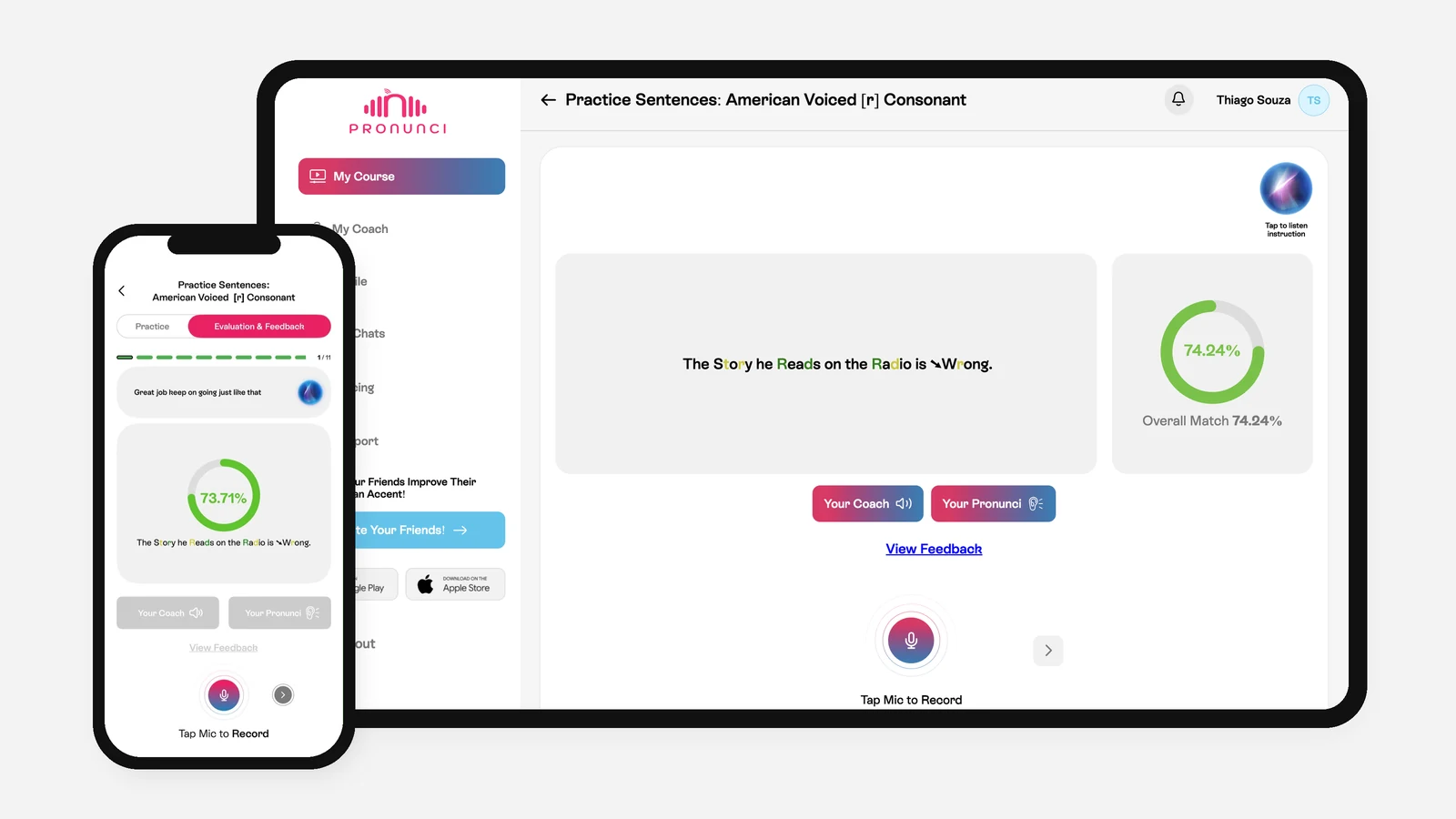
Prof. Alex’s Pronunci Instructions then guide students in understanding how to approach those corrections, while Interactive Visual 2D Sound Simulators support active articulation practice.
The process is simple:
Listen → Compare → Recognize → Understand → Practice → Correct → Recheck
Instead of relying entirely on an AI pronunciation score, students learn to participate actively in evaluating and improving their own speech.
The goal is to help students become increasingly capable of recognizing their pronunciation differences and correcting them independently.
- Hear the American ModelThe model American pronunciation of each practice sentence.
- Recognize Your DifferencesCompare your recorded speech with the American pronunciation model to identify differences in sounds, stress, rhythm, and intonation.
- Practice Your CorrectionsUse Pronunci Instructions and AI feedback to understand which pronunciation differences need attention, practice corrections, and compare your speech again.
Other accent and pronunciation apps on the market take different approaches. Some are AI-feedback apps that score individual words or sounds. Others are video-coaching apps that walk you through lessons recorded by a coach without evaluating your full speech as you produce it. Both approaches have value, but a phonetics app built around isolated word scoring, or one built mainly around watching video lessons, leaves gaps that a structured, speech-organ-first system is designed to close.
Can a Phonetics App Include Live 1-on-1 Sessions with a Professional Accent Coach?
Yes, the Premium Plan adds a monthly 1-hour live 1-on-1 session with Prof. Alex plus a personal chat between sessions, making it a budget-friendly way to train directly with him inside the app. Premium also includes feedback on submitted phonetic exercises, sentences, and paragraphs, along with homework tailored to your first-language influence, rhythm, and intonation patterns. This is not the same level as Prof. Alex’s weekly 1-on-1 training on MyAccentWay, but it gives app users a direct line to human coaching without leaving the structured course.
How Does Access to Personal Feedback from a Linguist-Trained AI Coach Improve Your Results?
Two things set InPronunci apart from a typical phonetics app: the AI Accent Coach evaluates pronunciation, intonation, melody, rhythm, connected speech, and sentence flow as you speak full sentences, not just one isolated word or sound. And Pronunci Instructions appear in every lesson, so you always know what to listen for and how to correct it, the way a coach would in a live class.
Start with Free Chapter 1 to learn the speech organs behind every American sound. Move to the Basic Plan for self-guided access to the full four-stage course. Choose the Premium Plan with Advanced evaluation if your goal is American English that sounds native or close to it, paired with personal coaching from Prof. Alex.

Questions & Answers
Frequently Asked Questions
01Is a phonetics app enough to reduce my accent on its own?
A structured app can take you far, but regular practice and real conversation use matter as much as the app itself. Apps that train sound articulation, phonetic exercises, sentences, and paragraphs give you a complete path, while apps limited to single-word scoring leave gaps in rhythm and intonation. Progress depends on consistent, deliberate practice, not the app alone.
02Do I need to learn IPA symbols to use a phonetics app effectively?
No, IPA symbols are not required to train pronunciation effectively. What matters more is understanding tongue, lip, and jaw positions for each sound. InPronunci’s Pronunci Instructions explain articulation in plain language, with IPA used only when it clarifies a specific sound.
03How is connected speech different from individual sound practice?
Connected speech is how sounds link, reduce, and blend together in real sentences, while individual sound practice isolates one vowel or consonant at a time. Native speakers reduce “going to” to “gonna” and link “not at all” into one flowing phrase. Training sounds alone will not prepare you for this. A structured path moves from isolated sounds to phonetic exercises and then full sentences, where these patterns appear naturally.
04Can native English speakers use a phonetics app too?
Yes, native speakers use phonetics apps to refine articulation or move toward a more neutral General American accent. This applies to speakers of regional or international English varieties, such as British or Australian English, who want clearer, more neutral pronunciation. InPronunci’s structured training works for this goal as well as for non-native learners.
05How long does it typically take to notice results from using a phonetics app?
Timelines vary by learner, but most people notice small, concrete changes, such as clearer production of a single troublesome sound, within a few weeks of consistent daily practice. Larger shifts in rhythm, intonation, and overall accent take longer and depend on how often you move beyond isolated sounds into sentence and paragraph practice. Consistency across all four training stages matters more than the total amount of time spent.
Conclusion
A phonetics app earns its place in your routine when it trains speech organs, not just scores isolated words. Look for a structured path that moves from sound articulation to phonetic exercises, then sentences with intonation, then paragraph-level speech, with feedback on your full delivery rather than single sounds. InPronunci builds this path through 2D Sound Motion Technology, Pronunci Instructions from Prof. Alex, and AI Accent Coach evaluation of pronunciation, rhythm, and connected speech. Start with Free Chapter 1 on the App Store, Google Play, or the web, and judge the fit for yourself before committing to a plan.
Sources & References
Recommended Articles

A Guide to Mastering American English Pronunciation
Learn how to train your speech organs for accurate American English pronunciation with a structured, four-stage practice method that builds lasting results.
How InPronunci’s Accent Coach App Trains Natural US Speech
Discover how the InPronunci accent coach app trains speech organs, builds sounds into sentences, and gives full-speech AI feedback for natural American English.

Guide to Choosing the Right Online Accent Reduction Course
Learn what makes an online accent reduction course effective, from speech-organ training to AI feedback, and how to choose the right fit for your goals.