


An online accent reduction course works best when it trains the speech organs for each American sound first, then drills those sounds into automatic habits through phonetic exercises, sentences, and paragraphs, with feedback on full speech rather than isolated words. This structured, four-stage progression (sound articulation, phonetic drills, sentence-level intonation, paragraph delivery) separates a real course from a tips list or a single-word pronunciation scorer. Look for a course built by a linguist or accent coach, with AI evaluation that covers rhythm, connected speech, and melody, not just whether one word was said correctly.
Inside the InPronunci App
Train American Sounds with Interactive Visual 2D Sound Simulators
Learning American pronunciation involves more than listening to sounds and repeating them.
InPronunci’s Interactive Visual 2D Sound Simulators, developed by Prof. Alex using 2D Sound Motion Technology, guide students through the tongue, lip, and jaw movements involved in producing American consonants and vowels.
Students actively coordinate their speech movements with the simulator, practice each sound aloud, and develop greater awareness of how American sounds are produced.
You don’t just listen to an American sound. You actively train how to produce it.
This lesson demonstrates active training of the American voiceless consonant /t/. Prof. Alex’s Pronunci Instructions guide students before they practice the tongue-tip and airflow-release movements using the Interactive Visual 2D Sound Simulator.
Three Benefits of InPronunci’s Interactive Visual 2D Sound Simulators
- Active ArticulationTrain tongue, lip, and jaw movements while producing American sounds aloud.
- Guided Sound TrainingFollow Prof. Alex’s Pronunci Instructions to understand what to focus on and how to practice.
- Greater Sound ControlDevelop awareness and coordination for clearer, more consistent American pronunciation.
What Makes an Online Accent Reduction Course Different From a Pronunciation App
A course sequences training from sound to sentence; a pronunciation app usually just scores one word at a time and stops there.
That distinction matters more than it sounds. An online accent reduction course is built around a progression: a learner trains a sound, practices it until it’s automatic, then applies it in sentences and finally in longer speech. A scoring app skips most of that path. It gives a number, maybe a red or green checkmark, and moves to the next word. Neither step builds on the one before it.
Why Do Most Apps Only Score Individual Words Instead of Full Sentences?
Scoring a single word is technically simpler than evaluating a full sentence, which is why many apps default to it. Rhythm, stress, intonation, and connected speech only appear across multiple words strung together, so a tool built around short-phrase scoring misses the patterns that actually make speech sound natural or foreign. Even apps that offer broader conversation practice and instant feedback, such as ELSA Speak, are built primarily around that kind of word- and phrase-level evaluation rather than a sequenced curriculum. BoldVoice takes a different route, pairing guided video lessons from accent coaches with AI speech evaluation [1], which moves closer to structured practice but still centers on short daily sessions rather than a staged curriculum.
How Does a Linguist-Designed Course Structure Differ From a General English App?
A linguist-designed course targets the speech organs, tongue, lips, jaw, and airflow, for each American sound, instead of offering random vocabulary drills or topic-based chat practice. The difference shows in the sequencing: sounds first, then phonetic exercises that make those sounds habitual, then sentences with stress and intonation, then paragraphs delivered at a natural pace. InPronunci: American Accent Training App follows exactly this structure, with four connected training stages, sound articulation training, phonetic exercises, sentence practice and intonation training, and paragraph practice with presentation-style delivery, built by Prof. Alex, Ph.D. Accent Coach, Doctor of Education, and professional linguist, the same stages he uses in his own 1-on-1 coaching.
A list of pronunciation tips cannot substitute for this. New speech habits require repeated, structured practice before they become automatic; reading a tip once does not retrain a tongue or jaw position. That’s the real gap between a course and a collection of advice.
How Structured Speech-Organ Training Helps You Reduce an Accent
Accent reduction works by retraining where your tongue, lips, and jaw sit for each sound, then repeating that position until it becomes automatic. An effective online accent reduction course teaches this sound by sound instead of asking you to imitate a native speaker by ear.
What Role Do Tongue Placement, Jaw Position, and Airflow Play in Accurate American Sounds?
Every American sound depends on a specific combination of tongue position, lip shape, jaw height, and airflow. Change one of those, and the sound changes with it.
Take the American R. The tongue pulls back and curls slightly without touching the roof of the mouth, while the lips round a little and the jaw stays relatively still. Many Spanish speakers transfer a tapped or trilled R from their first language, where the tongue tip briefly touches or bounces off the ridge behind the upper teeth. Many Japanese speakers tend to blend the English R and L into a single intermediate sound, since Japanese has one liquid consonant that falls between the two. Neither pattern is wrong in the speaker’s native language. It simply does not match the tongue position English requires.
The TH sounds work differently. For “think” or “this,” the tongue tip sits between or just behind the upper and lower front teeth, with steady, continuous airflow over the tongue, not a burst of air. Speakers of Russian, German, and many other languages often substitute /s/, /z/, /t/, or /d/, because their native sound systems don’t include an interdental fricative. Once a learner sees and trains the exact tongue position, the sound usually becomes physically reachable, often for the first time.
How Do Phonetic Exercises Turn New Sounds Into Automatic Speech Habits?
Producing a sound correctly in isolation is not the same as using it automatically in conversation. Phonetic exercises close that gap by training the sound inside combinations, reductions, and assimilations: the contractions and blends that happen naturally in fast American speech, such as “want to” becoming “wanna” or the flap T in “better.” Repeating these patterns moves the new articulation from a conscious effort into a habit the speech organs produce without thinking.
Research on explicit pronunciation instruction supports this approach. Saito 2012 found that teaching the American English /r/ explicitly, with attention to articulation, led to measurable gains in learners’ production compared to instruction without that explicit focus [2]. Targeted, structured training on specific sounds produces change that general listening and repeating often does not.
InPronunci’s Interactive Visual 2D Sound Simulators train the tongue, lips, jaw, and airflow for each American sound before a student moves into sentence-level practice. Students follow the simulator, repeat the movement, and build the articulation pattern the phonetic exercises later make automatic. This sequence, sound first, then phonetic exercises, then sentences and paragraphs, reflects the structured path described in InPronunci’s course overview and in the guide to tongue placement in English sounds.

What to Look for in an Accent Training Course: Instructor, Method, and AI Evaluation
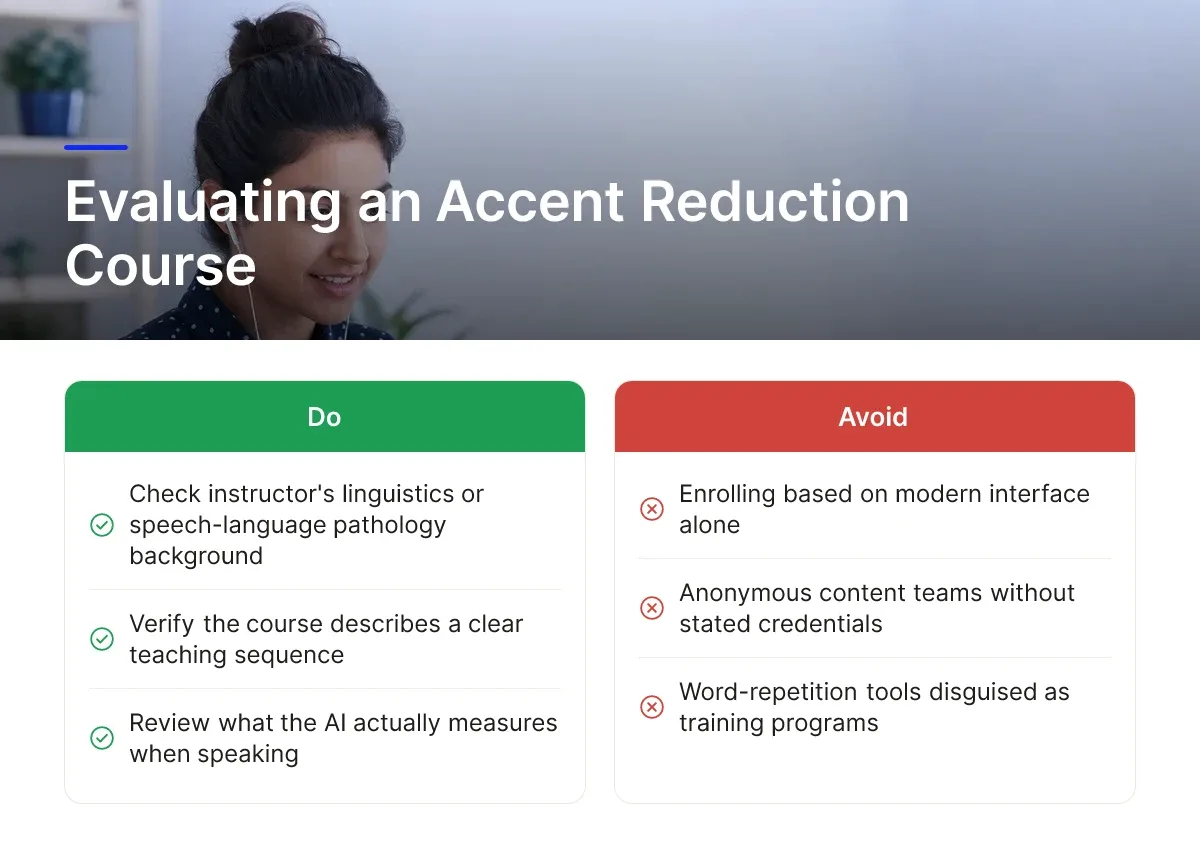
Before enrolling in any online accent reduction course, check three things: who designed it, what sequence it teaches, and what the AI actually measures when you speak.
Many apps promote a modern interface but say little about the instructional thinking behind it. A short checklist filters out word-repetition tools disguised as training programs.
- Instructor credentials. Look for a named instructor with a background in linguistics, speech-language pathology, or professional accent coaching, not just an anonymous content team.
- A stated teaching sequence. The course should describe a path: which sounds come first, how they build into phrases and sentences, and how intonation and rhythm get introduced. “Practice daily” is not a method.
- Transparency about AI evaluation. The provider should explain exactly what the AI scores: isolated words, full sentences, intonation, rhythm, or all of these together.
Why Does It Matter That an AI Coach Was Trained by a Professional Linguist?
An AI coach trained by a working accent coach reflects that coach’s judgment about what to correct first and how to explain it, not just a generic accuracy score.
InPronunci’s AI Accent Coach was trained by Prof. Alex, Ph.D. Accent Coach, Doctor of Education, and professional linguist, to evaluate speech the way he does in 1-on-1 sessions. That matters because an algorithm built without input from someone who teaches pronunciation for a living tends to flag surface errors without understanding why a Spanish speaker reduces final consonants or why a Mandarin speaker flattens sentence stress. Each InPronunci lesson also includes Pronunci Instructions, step-by-step guidance that tells the student what to pay attention to before they attempt the sound, so they are not left guessing what “practice more” actually means.
How Should Real-Time Feedback on Intonation and Rhythm Differ From Single-Word Scoring?
Feedback should score how sounds, stress, and rhythm work together across a full sentence, not just whether one isolated word was pronounced correctly.
Single-word scoring tells a learner whether “think” sounded right in isolation. It says nothing about whether their stress fell on the right syllable in a sentence, whether they linked words naturally, or whether their intonation signaled a question instead of a statement. InPronunci’s Evaluation Mode addresses this directly: the AI Accent Coach evaluates pronunciation, intonation, melody, rhythm, connected speech, and sentence flow as a person speaks, and Feedback & Analysis then breaks that speech into sentences, words, and sounds to show where the pattern broke down. Research on second-language pronunciation instruction has found that explicit, structured teaching produces measurable gains over unguided exposure alone [2]. A reasonable step before trusting any AI coach’s output is to review its published evaluation guidelines, available for InPronunci at inpronunci.com/ai-accent-coach, so you know what the score is actually measuring.
How Long It Takes to See Progress in an Online Accent Reduction Course
Progress follows a sequence, not a calendar: isolated sound accuracy comes first, automatic use comes next, and control under real speech pressure comes last. No online accent reduction course can tell you a fixed week count because that sequence depends on how much you practice and how often you apply it outside the app.
Early progress looks like producing a single American sound correctly in isolation, for example getting the tongue tip to the right spot on the ridge behind your upper teeth for a clear American R, without the sound sliding back into a native-language pattern. Mid-stage progress means that same sound holds steady inside phonetic exercises, sound combinations, and reductions, without you consciously thinking about tongue or jaw position each time. Later progress means the sound survives full sentences and paragraphs spoken at normal conversational speed, under the kind of pressure a real meeting or interview creates. Each stage builds on the one before it; skipping ahead to sentence practice before a sound is stable usually means the old pattern reappears the moment you stop paying attention.
What Improvement Looks Like at the Intermediate Level vs. the Advanced Level
Intermediate-level goals and advanced-level goals are different finish lines, not the same race at different speeds. At the intermediate level, the goal is clearer, more confident, independent speech: listeners stop asking you to repeat yourself, and you speak without hesitating over sounds that used to trip you up. At the advanced level, the goal is speech closer to native-like American pronunciation, evaluated against a stricter standard. This distinction mirrors the two AI Accent Coach evaluation levels in InPronunci: Intermediate evaluation supports clear, confident, independent speakers, while Advanced evaluation measures full speech performance against native American English and is recommended alongside the Premium Plan, where Prof. Alex, Ph.D. Accent Coach, Doctor of Education, and professional linguist, personalizes feedback session by session.
How Does Consistent Practice Compare to Sporadic Practice With Random Exercises?
Short, consistent sessions build automatic speech habits more reliably than occasional long ones, because phonetic exercises are designed to make a sound steady and controlled before it ever reaches sentence practice. A sound practiced for ten focused minutes most days gets repeated in enough varied contexts, consonant clusters, reductions, assimilations, to become stable. The same sound practiced for two hours once a week gets exposed to fewer contexts overall and fades faster between sessions. Thomson and Derwing’s 2015 review of pronunciation instruction research supports a measured view of what any course can realistically achieve: structured instruction improves intelligibility and comfort, but it is not a shortcut to effortless, native-like speech for every learner [2].
No course, including InPronunci, can guarantee a native-like accent. Results depend on regular practice and on using the new pronunciation in daily conversation, not only inside the app.
Choosing the Right Online Accent Reduction Course for Your Goals and Budget
The right online accent reduction course depends on how independently you learn, how fast you want feedback, and whether you want a coach reviewing your progress by name.
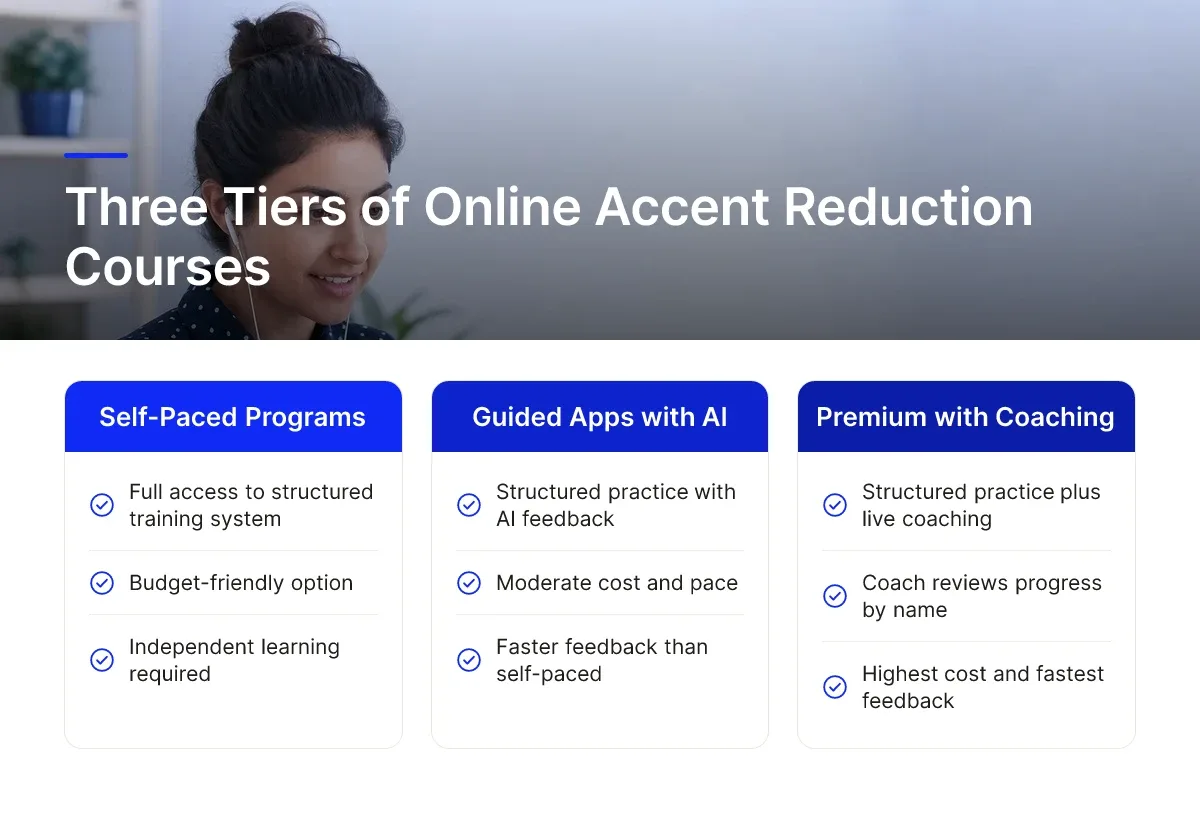
Course formats generally fall into three tiers: budget-friendly self-paced programs, guided apps with AI feedback, and premium plans that pair structured practice with live coaching. Matching the tier to your working style matters more than chasing the longest feature list.
What’s the Difference Between a Self-Guided Plan and a Premium Plan With Monthly 1-on-1 Sessions?
A self-guided plan gives you full access to a structured training system, while a premium plan adds a human coach on top of that same system. InPronunci’s Basic Plan enables the complete training program, all four chapters, and the student group chat, which suits learners who are comfortable practicing on their own schedule with Pronunci Instructions and AI Accent Coach feedback guiding each session.
InPronunci’s Premium Plan adds one 1-hour live session per month with Prof. Alex, Ph.D. Accent Coach, Doctor of Education, and professional linguist, plus a personal chat between sessions, feedback on submitted practice, and homework. This tier works for professionals who want someone checking their articulation, rhythm, and intonation directly, not just an app score. Pricing on the Premium Plan may vary slightly depending on whether you subscribe through the web or through the Apple App Store or Google Play, reflecting those platforms’ fees.
Independent learners can make real progress with self-guided structured practice and AI feedback alone. Professionals aiming for native-like speech, or those who want accountability from a named coach, typically get more from a plan that pairs live coaching with AI evaluation of full sentences and paragraphs, not isolated words.
How Do Free Introductory Chapters Help You Decide if a Course Fits Your Learning Style?
A free introductory chapter lets you test the teaching approach, lesson pacing, and feedback style before spending anything. InPronunci’s Free Chapter 1, Speech Organs Education, walks you through how the tongue, lips, jaw, and airflow coordinate for American sounds, the same foundation used throughout the paid chapters.
This removes most of the guesswork from picking an online accent reduction course. You can see whether Pronunci Instructions match how you like to learn before deciding between the Basic Plan and Premium Plan.
Before enrolling in Premium, InPronunci schedules a consultation so Prof. Alex can recommend the right AI Accent Coach level, Intermediate or Advanced, based on your goals and first-language influence. Other course types, including video-based apps and general speaking-practice platforms, vary in structure and depth, so compare the teaching approach, not just the price tag, before committing.
Real student result: before and after training
Tian, a Mandarin speaker, trained in the InPronunci Premium Plan, which combines Interactive 1-on-1 American Accent Training with Prof. Alex and daily practice in InPronunci. Prof. Alex recorded and evaluated each recording on a scale from 0 to 100, where 100 = native speaker.
Student testimonial

“Prof. Alex is an excellent accent coach, and he puts a lot of practice into you. As a non-native English speaker, I wanted to reduce my foreign accent, and training my American accent with him has been a great experience.”
Full evaluation of Tian on MyAccentWay
8monthsof hard work and dedication
Listen to the starting point0:00
Listen to the result0:00
Pronunciation estimates generated by ChatGPT
100 represents a reference benchmark for General American English pronunciation. Scores are supplementary AI estimates, not standardized or independently validated measurements.
Professional phonetic evaluationRead Prof. Alex’s Full Sound-by-Sound Phonetic Evaluation →
InPronunci pronunciation training incorporates educational conditions developed and experimentally investigated in Prof. Alex’s doctoral research. The following before-and-after recordings document individual students’ pronunciation development through personalized instruction based on these research-informed principles.
This before-and-after comparison documents Tian’s individual pronunciation development in InPronunci’s research-based pronunciation training, which incorporates educational conditions developed and investigated in Prof. Alex’s doctoral research. It is an individual student case, not part of the original experiment.
Questions & Answers
Frequently Asked Questions
01Can an online accent reduction course fully eliminate an accent?
No course or coach can honestly guarantee that, and InPronunci doesn’t claim it either. The realistic goal is to reduce the influence of your native language on pronunciation, rhythm, and intonation so you communicate clearly and confidently. Some speakers get close to native-like American English with consistent practice, but every accent reflects a speaker’s background, and the aim is clarity and confidence, not erasing identity.
02Do I need to already speak English well to benefit from a structured accent course?
Most structured accent courses, including InPronunci, work best for intermediate and advanced speakers who already communicate in English but want clearer pronunciation. If you’re still building vocabulary and grammar, general English study should come first. Once your speech is understandable, sound-by-sound accent training produces more noticeable improvement.
03How is an accent reduction course different from working with a speech-language pathologist?
A speech-language pathologist diagnoses and treats speech, language, and voice disorders, while an accent course like InPronunci trains pronunciation for non-native speakers who have no disorder. If you experience articulation difficulty, stuttering, or voice problems that go beyond accent, consult a licensed speech-language pathologist. InPronunci is supportive practice, not therapy or medical treatment.
04Can native English speakers use an accent training course to sound more neutral?
Yes, native speakers with regional or family-language influence sometimes use structured training to adopt a more neutral General American sound. This applies to speakers of British, Australian, or regional US accents, or people raised in the US with speech patterns from a parent’s first language. The same sound-by-sound approach applies regardless of starting point.
05How much daily practice does an online accent reduction course usually require?
Most learners see steadier results from short, focused sessions, often around ten to twenty minutes most days, rather than infrequent long sessions. Consistency matters more than duration because new tongue and jaw positions need repeated exposure across varied contexts to become automatic. A structured course with staged lessons makes it easier to fit practice into a daily routine without guessing what to work on next.
Conclusion
Clear American English comes from training sounds in order: articulation first, then phonetic exercises, then sentences with stress and intonation, then paragraphs and presentation-style speech. Skipping straight to conversation practice, as many apps encourage, leaves the underlying sound system untouched. If you want feedback on full speech rather than isolated words, and step-by-step guidance instead of guesswork, that structure matters more than any single feature. Start with InPronunci’s Free Chapter 1 on the web, the App Store, or Google Play, and see how speech-organ training feels before committing to a plan.
Sources & References
Recommended Articles
A Practical Guide to Finding the Right BoldVoice Alternative
Looking for a boldvoice alternative? Compare training approaches, feedback depth, and coaching styles to find the app that fits your accent goals. Discover.

accent reduction for healthcare professionals
Healthcare professionals reduce their accent most effectively by training American English sound by sound, then building that accuracy into phonetic...

A Complete Guide to Choosing the Best ELSA Speak Alternative
Looking for an ELSA Speak alternative? Learn what to look for in apps built for structured, sound-by-sound American accent training instead.