


Understanding accent reduction for healthcare professionals is essential. Healthcare professionals reduce their accent most effectively by training American English sound by sound, then building that accuracy into phonetic exercises, sentences with correct stress and intonation, and paragraph-length clinical speech. Clear pronunciation matters in healthcare because specific sounds (vowel length, consonant endings, word stress) cause patients and colleagues to mishear medication names, instructions, and symptoms. Structured, sound-by-sound training with speech-organ work and guided feedback builds the clarity and confidence needed for patient conversations, handoffs, and team communication, without asking anyone to erase their accent or identity.

Why Clear Pronunciation Matters in Clinical Communication
A handful of sound patterns, not a general “accent,” account for most mishearing between international clinicians and their patients or colleagues. Fixing those specific patterns, rather than trying to sound like someone else, is what accent reduction for healthcare professionals is actually about.
Which Sounds and Patterns Most Often Cause Misunderstandings
Vowel length confusions are common and consequential: “ship” versus “sheep,” or “live” versus “leave,” can change a sentence’s meaning entirely when a patient is describing symptoms or a nurse is confirming an instruction. Dropped or unclear final consonants cause similar problems with dosage numbers (“fifteen” heard as “fifty”) and drug names that end in sounds not present in the speaker’s first language.
Word stress errors change perceived meaning too. English uses stress to distinguish words that look identical on paper, the kind of pattern seen in pairs like DESert and deSERT, and medical terminology is full of multisyllabic words where misplaced stress can momentarily confuse a listener trying to match a sound to a known term. None of this reflects a deficiency in clinical knowledge. It reflects how the sound and stress system of a first language gets carried into English, a pattern every learner experiences regardless of how advanced their English is.
How Pronunciation Affects Patient Trust and Communication Outcomes
Intonation carries meaning on its own. A rising tone at the end of a sentence usually signals a question in English, while a falling tone signals a statement, so flattened or uniform intonation can make an urgent symptom report sound like routine small talk, or turn a confirmed diagnosis into something that sounds uncertain. In handoffs and other time-pressured exchanges, that mismatch matters.
When a patient or colleague asks “can you repeat that?” once, it costs a few seconds. When it happens repeatedly during a shift, it adds real cognitive load for both sides and can quietly erode a clinician’s confidence exactly when clear, fast communication matters most, during handoffs, emergency calls, or family conversations. Research on second-language speech supports a specific response to this: Thomson and Derwing’s 2015 review found that focused pronunciation instruction improves comprehensibility, the ease with which a listener understands a speaker, even when the speaker’s accent remains audible [1]. The goal is intelligibility and confidence, not sounding identical to a native speaker. Every accent is welcome in this work; what changes is how reliably the message lands.
Accent Reduction for Healthcare Professionals: A Sound-by-Sound Path to Confident Speech
Accent reduction for healthcare professionals works best as a progression: train the sound, automate the sound, speak it in sentences, then deliver it in full clinical explanations. Skipping stages is why many clinicians can pronounce a sound correctly in isolation but lose it the moment they talk to a patient.
What Structured Accent Training Looks Like Beyond Single Sounds
The path has four stages: sound articulation, phonetic exercises, sentence practice with stress and intonation, and paragraph-level delivery [2]. Sound articulation means training the exact tongue, lip, and jaw position for a specific American sound. Phonetic exercises repeat that sound in different combinations until it stops requiring conscious effort. Sentence practice adds stress and intonation, because American English marks meaning by which word gets emphasis, not just by vowel accuracy [1]. Paragraph-level work applies all of it to real clinical speech: explaining a diagnosis, walking a patient through discharge instructions, or presenting a case during rounds.
Inside the InPronunci App
Train American Sounds with Interactive Visual 2D Sound Simulators
Learning American pronunciation involves more than listening to sounds and repeating them.
InPronunci’s Interactive Visual 2D Sound Simulators, developed by Prof. Alex using 2D Sound Motion Technology, guide students through the tongue, lip, and jaw movements involved in producing American consonants and vowels.
Students actively coordinate their speech movements with the simulator, practice each sound aloud, and develop greater awareness of how American sounds are produced.
You don’t just listen to an American sound. You actively train how to produce it.
This lesson demonstrates active training of the American voiceless consonant /t/. Prof. Alex’s Pronunci Instructions guide students before they practice the tongue-tip and airflow-release movements using the Interactive Visual 2D Sound Simulator.
Three Benefits of InPronunci’s Interactive Visual 2D Sound Simulators
- Active ArticulationTrain tongue, lip, and jaw movements while producing American sounds aloud.
- Guided Sound TrainingFollow Prof. Alex’s Pronunci Instructions to understand what to focus on and how to practice.
- Greater Sound ControlDevelop awareness and coordination for clearer, more consistent American pronunciation.
Take the American R in a word like “arterial” or “emergency.” The tongue curls back and up without touching the roof of the mouth, and the tip stays loose rather than tense. Spanish speakers often tap the tongue against the ridge behind the upper teeth instead, producing a flapped or trilled R. Japanese speakers often substitute a sound closer to a flap, since Japanese doesn’t distinguish R and L the way English does. Neither mistake is a flaw in effort; it’s the native sound system carrying over into English [1].
The flap T shows up constantly in clinical speech: “patient data,” “better,” “vital signs.” Instead of a full, released T, the tongue tip taps quickly against the ridge behind the upper teeth, closer to a fast D. Say “patient” slowly and most non-native speakers release a hard T; say it at normal speed and native speakers flap it. Missing this pattern can make speech sound overly formal or oddly segmented to American ears.
How Speech-Organ Training and Phonetic Exercises Build Automatic Speech
Isolated sound drills teach the position but not the habit. A sound only becomes reliable once it survives the speed and unpredictability of real conversation with patients, nurses, and physicians who talk fast and interrupt. That’s why phonetic exercises, sentence drills, and paragraph practice matter as much as the sound itself.
InPronunci: American Accent Training App builds this exact progression. The Interactive Visual 2D Sound Simulators train the tongue, lips, and jaw for sounds like the American R and the flap T, Pronunci Instructions from Prof. Alex, Ph.D. Accent Coach, Doctor of Education, and professional linguist guide each step, and the AI Accent Coach evaluates full sentences and paragraphs, not just single words.
Try this today: pick one sound, the American R or the flap T. Say it alone, then in three words (“arterial,” “better,” “patient”), then in one clinical sentence (“The patient’s vital signs are stable”). Record yourself, compare it against a native model, and repeat. For more on tongue and jaw positioning, see the guide to tongue placement in English sounds.

Comparing Training Formats: Apps, Group Classes, and One-on-One Coaching
Accent reduction for healthcare professionals generally takes one of three forms: self-paced apps, group classes, or one-on-one coaching, and each fits a different schedule and budget.
Self-paced apps let a nurse or physician practice between patients, during a commute, or after a night shift ends, on a budget-friendly tier compared to live coaching. Group classes offer a set weekly time, peer practice, and shared feedback, but less attention to any one speaker’s native-language patterns. One-on-one coaching gives the most individualized correction, at a premium tier, with a coach adjusting the plan to a specific accent, specialty vocabulary, and goals.
For clinicians working rotating shifts, the format question often comes down to time, not just cost. A fixed weekly class is hard to keep when a schedule changes every two weeks.
What Features to Look for in an Accent Training App or Program
Look for feedback on full sentences and paragraphs, not just isolated words, since clinical speech happens in phrases like “take this twice daily” and “your blood pressure is slightly improved.”
Four features separate a structured program from a repetition drill:
- Full-speech feedback. Evaluation of connected sentences, not a single word scored in isolation.
- Sound-by-sound progression. A sequence that builds consonants and vowels before moving to rhythm and intonation.
- Clear guidance on what to practice and why. Instructions that explain the specific correction, not just a score.
- A path from sounds to sentences to paragraphs. Practice that scales up to presentation-style delivery, close to a patient handoff or a case presentation.
InPronunci: American Accent Training App builds around these four points directly: 2D Sound Motion Technology trains sound articulation through Interactive Visual 2D Sound Simulators, Pronunci Instructions guide each lesson, and the four chapters move from individual sounds through phonetic exercises to sentence practice and paragraph delivery.
How AI Evaluation and Personalized Instruction Compare
AI evaluation and human coaching serve different purposes, and the strongest programs combine both rather than relying on just one.
InPronunci’s AI Accent Coach evaluates pronunciation, intonation, melody, rhythm, connected speech, and sentence flow as someone speaks, rather than scoring single words, and Feedback & Analysis then breaks that speech into sentences, words, and sounds. Pronunci Instructions from Prof. Alex, Ph.D. Accent Coach, Doctor of Education, and professional linguist, accompany every lesson, so a learner always knows what to adjust. Other apps take different approaches: ELSA Speak offers AI-powered practice with instant personalized feedback, role-plays, and broad communication practice, while BoldVoice pairs guided video practice and coach videos with AI speech evaluation. None of these replace a licensed speech-language pathologist for a diagnosed speech or voice disorder [4].
What to Expect: Timeline, Practice, and Realistic Progress
Progress depends on how often you practice and whether you apply new pronunciation outside the app, in real conversations with patients and colleagues, not on a fixed number of weeks. Accent reduction for healthcare professionals works the same way any motor and cognitive skill works: consistent, deliberate repetition builds automatic habits, while occasional practice without real-world use builds knowledge that stays stuck in the practice room.
What Measurable Improvements Look Like in Clarity and Confidence
Instead of chasing a date on a calendar, track qualitative signs that your speech is landing more clearly. Notice whether patients or colleagues ask you to repeat yourself less often during handoffs, phone calls, or bedside conversations. Pay attention to whether you feel more at ease leading a case presentation or walking a patient through discharge instructions without rehearsing every sentence in your head first.
Recording yourself at intervals gives you something concrete to compare, rather than relying on how a conversation felt in the moment. Save a short recording of a typical patient explanation or team update every few weeks, then listen back to earlier ones. You will often notice changes in rhythm and clarity before you consciously feel them.
How Consistent Practice Leads to Lasting Change
A pronunciation comparison tool makes this kind of self-monitoring structured instead of guesswork. InPronunci’s Your Coach vs. My Pronunci Pronunciation Comparison Tool lets you record a sentence, place it next to a native-speaker model, and consciously notice where your vowel length, word stress, or intonation differs. That noticing is the skill itself: once you can hear the gap, you can start closing it on your own, in conversations the app never scripted.
Cognitive Accent Training
Cognitive Accent Training: Learn to Recognize and Correct Your Own Pronunciation
Have you ever listened to yourself speaking English and noticed that your pronunciation sounds different from an American speaker’s, but weren’t sure why?
InPronunci incorporates Cognitive Accent Training to help students recognize their existing pronunciation habits and become more aware of how they speak.
Through Your Coach vs. My Pronunci, students listen to their own recordings, compare them with an American pronunciation model, and actively identify differences in sounds, stress, rhythm, and intonation.
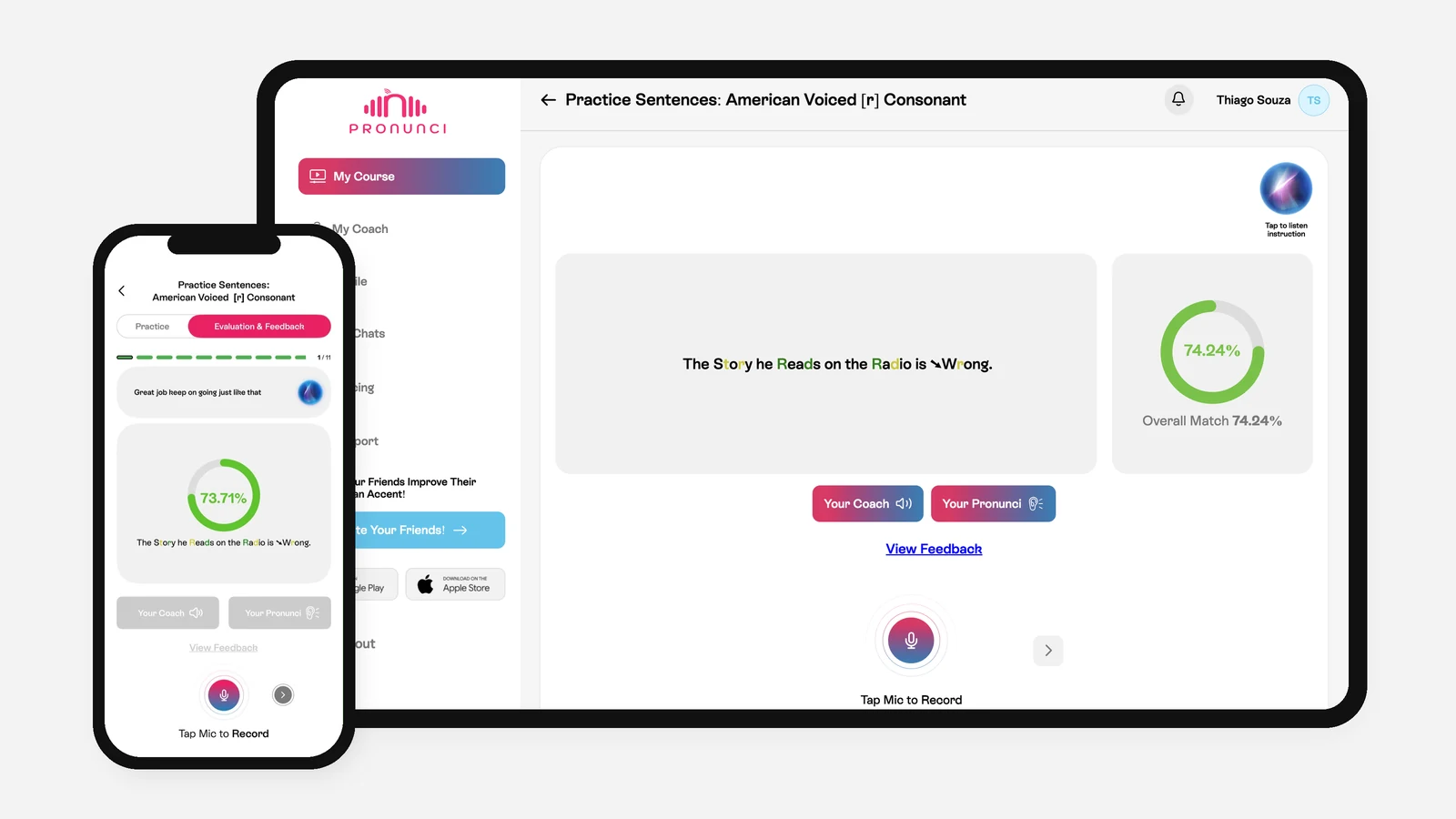
Prof. Alex’s Pronunci Instructions then guide students in understanding how to approach those corrections, while Interactive Visual 2D Sound Simulators support active articulation practice.
The process is simple:
Listen → Compare → Recognize → Understand → Practice → Correct → Recheck
Instead of relying entirely on an AI pronunciation score, students learn to participate actively in evaluating and improving their own speech.
The goal is to help students become increasingly capable of recognizing their pronunciation differences and correcting them independently.
- Hear the American ModelThe model American pronunciation of each practice sentence.
- Recognize Your DifferencesCompare your recorded speech with the American pronunciation model to identify differences in sounds, stress, rhythm, and intonation.
- Practice Your CorrectionsUse Pronunci Instructions and AI feedback to understand which pronunciation differences need attention, practice corrections, and compare your speech again.
This approach has research behind it. Saito (2012) found that explicit pronunciation instruction, where learners consciously study and practice specific sounds and patterns, produced measurable gains in second-language pronunciation compared to instruction that left pronunciation unaddressed [5]. That supports a structured, sound-by-sound approach over casual exposure alone.
Accent training is supportive practice, not therapy. If you suspect an underlying speech or hearing difficulty rather than first-language influence on your pronunciation, consult a licensed speech-language pathologist for assessment and care.
How to Choose an Accent Training Program That Fits a Healthcare Schedule and Budget
The right choice depends on three things: the instructor’s linguistic background, a curriculum built around sound-by-sound progress rather than word lists, and a format that fits shift work. Accent reduction for healthcare professionals works best when all three line up with how a clinician actually practices, not just what a program advertises.
What Background and Experience an Accent Coach Should Have
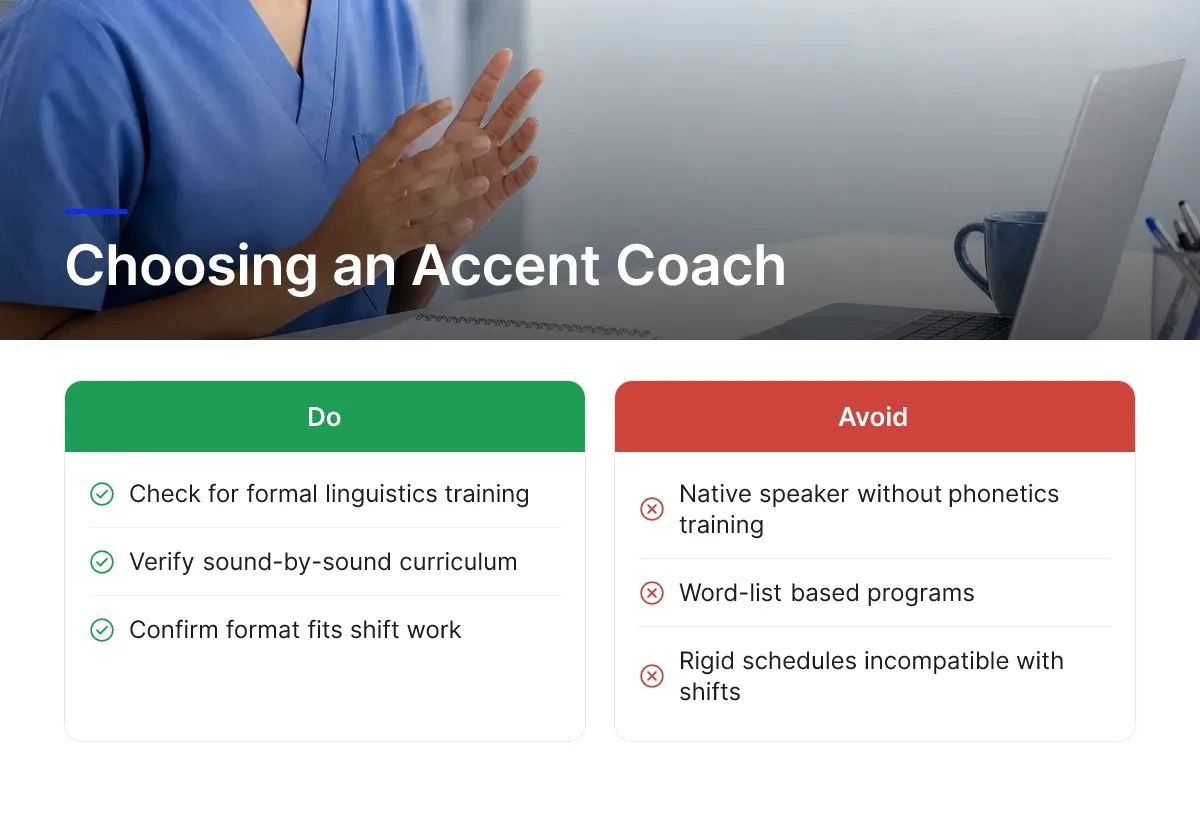
Check whether the coach has formal training in linguistics or phonetics, not just native fluency. A native speaker can model a sound, but explaining tongue, lip, and jaw position for a specific mispronunciation takes training in how speech organs actually work.
Ask whether the program has experience with professional or clinical speakers specifically. Medication names, dosage numbers, and patient handoffs carry a different error cost than casual conversation, and a coach who has worked with doctors, nurses, or pharmacists will know which sounds tend to cause the misunderstandings that matter most in a clinical setting [5].
Also look for a structured curriculum: sounds, then phonetic exercises, then sentences with stress and intonation, then paragraph-length speech. Programs built around isolated word repetition skip the stage where a sound becomes automatic in connected speech, which is where most real misunderstandings happen in fast clinical conversation [2].
Which Pricing Model and Format Fit a Busy Clinical Schedule
Shift workers rarely have a fixed hour free at the same time every week. A self-guided app that allows short, daily sessions, ten minutes between patients or before a shift, fits that reality better than a program that requires a scheduled weekly call. Professionals who want fixed accountability, on the other hand, may prefer live sessions on the calendar.
InPronunci: American Accent Training App offers both, structured across budget-friendly and premium tiers. Free Chapter 1 covers speech-organ education and costs nothing, a useful way to confirm the teaching style fits before paying for anything. The Basic Plan ($35/month) gives self-guided access to the full four-stage course, the Interactive Visual 2D Sound Simulators, and Pronunci Instructions in every lesson, built for someone training independently around a clinical schedule. The Premium Plan ($200/month on the web) adds one live 1-hour 1-on-1 session per month with Prof. Alex, Ph.D. Accent Coach, Doctor of Education, and professional linguist, plus personal chat support between sessions, for professionals who want a coach checking their progress directly.
Every tier includes the InPronunci group chat, which matters for clinicians who want peer encouragement alongside solo practice. Starting with Free Chapter 1 or a consultation before committing to a paid plan is a reasonable way to test fit, something worth doing with any program before paying for a full course, not just this one. For more on the full course structure, see the American accent training course overview.
Real student result: before and after training
Abishek, a Tamil and Indian English speaker, trained in the InPronunci Premium Plan, which combines Interactive 1-on-1 American Accent Training with Prof. Alex and daily practice in InPronunci. Prof. Alex recorded and evaluated each recording on a scale from 0 to 100, where 100 = native speaker.
Student testimonial

“In my opinion, InPronunci is the best app for American accent training because it works exactly like Prof. Alex conducts his classes. It gives clear guidance, structured practice, and focused pronunciation training.”
Full evaluation of Abishek on MyAccentWay
9monthsof hard work and dedication
Listen to the starting point0:00
Listen to the result0:00
Independent phonetic evaluation
Jane Timokhin, Ph.D. in Applied Linguistics
Independent evaluator Jane Timokhin, Ph.D. in Applied Linguistics, assessed Abishek’s before and after audio recordings and documented measurable improvements in American English pronunciation after nine months of training at MyAccentWay.
Interactive American Accent Training, informed by Prof. Alex’s doctoral research. At MyAccentWay, he applies these interactive teaching principles through 2D Sound Motion Technology, active pronunciation practice, and personalized feedback, so students understand, train, and refine American English speech sounds instead of only listening and repeating. Learn more about Prof. Alex’s doctoral research.
Questions & Answers
Frequently Asked Questions
01Can accent reduction training help with medical terminology specifically, or only everyday speech?
Structured accent training covers both, and clinical vocabulary needs direct attention because it combines unfamiliar sounds with heavy stress patterns. Words like “ibuprofen,” “laceration,” or “subcutaneous” carry multisyllabic stress that often falls on the wrong syllable for non-native speakers. A sound-by-sound approach trains the vowels and consonants first, then applies them to practice sentences built from real clinical phrases, dosage numbers, and patient instructions.
02Do healthcare employers ever require or support accent training for staff?
Some hospitals and clinics do support it, though requirements vary widely by institution and are not standardized nationally. Communication clarity affects patient safety and satisfaction scores, which motivates some employers to fund training. Clinicians should check with their department or human resources about tuition support or professional development funds before enrolling.
03Will reducing my accent change how I sound to patients from my own community?
Training improves clarity without erasing your identity or your connection to patients who share your background. The goal is natural American English that is easy to understand, not a loss of who you are. Many bilingual clinicians code-switch naturally, speaking with more General American clarity in clinical settings while retaining their native accent in community or family contexts.
04Is online accent training as effective as in-person coaching for busy clinicians?
Online, structured training can fit a clinician’s schedule better than in-person sessions, since practice happens between shifts rather than at fixed appointment times. What matters most is structure: sound-by-sound articulation work, phonetic drilling, and feedback on full sentences and paragraphs, not the delivery format. A platform with guided instructions and speech evaluation can match the structure of in-person coaching.
Conclusion
Clear communication in clinical settings comes from training specific sounds, word stress, and sentence rhythm, not from vague practice. Start with the sounds that cause the most patient confusion, such as final consonants in dosage numbers or vowel length in symptom descriptions, then move that accuracy into real sentences and paragraphs. Clinicians who treat this as structured, sound-by-sound work make faster, more lasting progress than those relying on scattered tips.
A practical next step: try Free Chapter 1 of InPronunci on the web, the App Store, or Google Play, and build from there with the sounds your patients hear most.
Sources & References
- Accent Reduction Classes & Training Online | Prof. Alex, Ph.D.
- What is American Accent Training? – Accent Advisor
- Accent Modification
- Accent Reduction for Doctors, Nurses & Pharmacists | MyAccentWay
Recommended Articles

A Complete Guide to Choosing the Best ELSA Speak Alternative
Looking for an ELSA Speak alternative? Learn what to look for in apps built for structured, sound-by-sound American accent training instead.

Why US-Raised People Still Have a Heritage Speaker Accent
People raised in the US who grew up speaking a language other than English at home often keep subtle pronunciation patterns from that first language, even...
5 Pronunciation Assessment Tools to Track Your Progress
Discover the pronunciation assessment tools and features that matter most for tracking progress toward clear, native-like American English speech.