


A structured English accent coach online works by combining expert-designed training with technology that evaluates your full speech as you talk, not just isolated words. Intermediate and advanced speakers use it to retrain sound articulation, rhythm, and intonation patterns borrowed from their native language, then apply those patterns in real sentences and paragraphs. The result is clearer, more natural American English and the confidence to communicate independently, without needing a live session for every correction.

What Does an English Accent Coach Online Actually Train?
An English accent coach online trains the specific sounds, stress patterns, and intonation habits a speaker carries from their first language, not general English ability. A speaker can have a large vocabulary and near-perfect grammar and still get asked to repeat themselves, because the gap is in articulation and rhythm, not comprehension or word choice.
This is a narrower, more technical job than most learners expect. It means identifying that a Spanish speaker may shorten the vowel contrast in “ship” and “sheep,” that a Hindi speaker may tap a retroflex /t/ where American English uses a flap T in “water,” or that a Mandarin speaker may drop final consonants in words like “need” or “last.” Accent training addresses these patterns directly, sound by sound, rather than treating pronunciation as a byproduct of speaking more English.
Structured American Accent Training Course
From Speech Organs Education to American Intonation
The InPronunci course is built step by step: every chapter prepares the next one, and by the end of the course students receive a certificate.
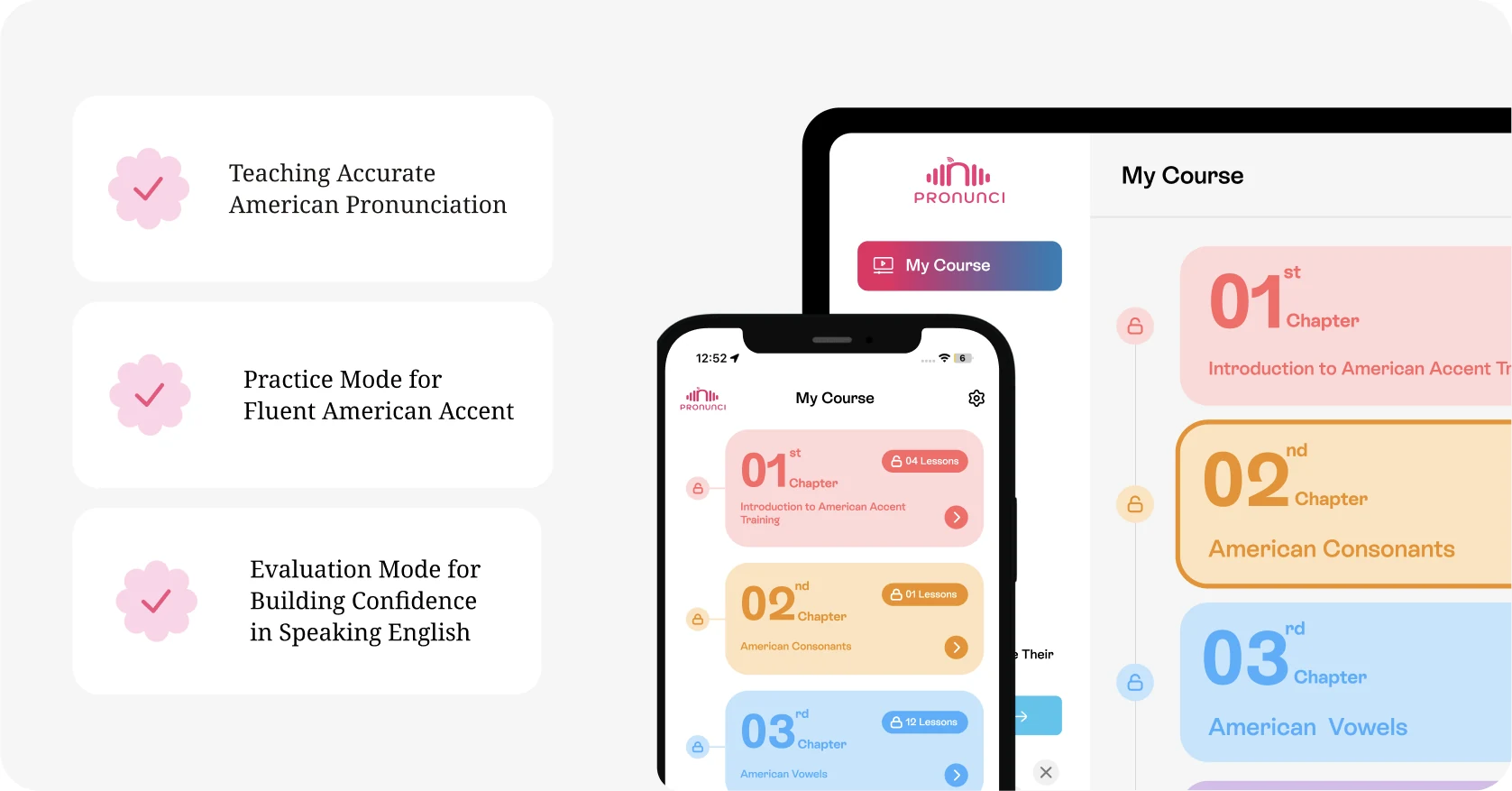
- Speech Organs EducationStudents learn how the speech organs work, along with the AI Accent Coach commands and feedback.
- American ConsonantsPractice and evaluate American consonants in phonetic exercises and practice sentences with the AI Accent Coach.
- American VowelsPractice and evaluate American vowels in phonetic exercises and practice sentences with the AI Accent Coach.
- IntonationLearn how intonation can change the meaning of what you say.
- CertificateBy the end of the course, students receive a certificate.
Why Intermediate and Advanced Speakers Still Need Accent Training
Intermediate and advanced speakers are the main audience for this kind of training precisely because they already communicate successfully in English. Their goal is not to become understandable. It is to be understood the first time, without repeating themselves in a client call, and to sound more natural in a meeting, interview, or presentation. These are the professionals and students described across InPronunci’s target audience: engineers, healthcare workers, call center agents, international students, and TOEFL or IELTS candidates who have passed the fluency bar and now want precision.
How Structured Training Differs From Tips, Games, and Scoring Apps
A tips article or a game that scores a single repeated word gives a learner a number, but no teaching sequence. It does not explain why the sound was wrong, what the tongue or jaw should do differently, or how that correction carries into a full sentence. Structured training works through stages: train the sound itself, make it automatic through phonetic exercises, apply it in sentences with stress and intonation, then use it in paragraph-length, presentation-style speech. InPronunci: American Accent Training App follows this exact sequence, the same one Prof. Alex, Ph.D. Accent Coach, Doctor of Education, and professional linguist, uses in his 1-on-1 training.
Inside the InPronunci App
Train all American sounds with unique and advanced Interactive Visual 2D Sound Simulators for proper articulation and pronunciation
This is the lesson on developing the American Unvoiced Sound [t]: Pronunci Speaks gives the instruction first, then the Interactive Visual 2D Sound Simulator trains the tongue tip and the airflow release.
- EffectiveMost apps offer visual learning. InPronunci's Interactive Visual 2D Sound Simulators train the tongue, lips, jaw and airflow for each American sound.
- ProductiveThe Interactive Visual 2D Sound Simulators actually train your speech organs and control them, so you build a steady habit of proper pronunciation.
- ResultsStudents pronounce individual American sounds with almost native-like pronunciation.
Shifting delivery to an app does not remove the coaching judgment behind it. Pronunci Instructions carry Prof. Alex’s step-by-step guidance into every lesson, so the structure a learner follows reflects two decades of accent-teaching decisions, not an automated guess.
How Does App-Based Accent Training Actually Change Speech Patterns?
Structured training changes speech patterns by moving a sound through four stages in a fixed order: physical articulation, automatic repetition, sentence-level intonation, and finally paragraph delivery. Skip a stage and the new sound rarely survives in real conversation.
The Four Stages of Accent Training and Why the Order Matters
A sound has to be produced correctly in isolation before it can be trusted anywhere else. That is why sound articulation training comes first: the tongue, lips, jaw, and airflow need to learn a new physical position before the brain can attach that position to words, sentences, and spontaneous talk.
Take the American R. Many Spanish and Portuguese speakers tap or trill it because that is the R their native language uses. Producing the American R correctly requires curling the tongue tip back without touching the roof of the mouth, tensing the sides of the tongue against the upper back teeth, and keeping the lips slightly rounded. The TH sound presents a different problem: speakers of Mandarin, German, and French often substitute /s/, /z/, /d/, or /t/ because their languages have no equivalent, so the fix starts with placing the tongue tip lightly between the teeth and pushing air through before any attempt to use the sound in a sentence.
Once that physical habit is built, phonetic exercises make it automatic. Sentence practice then adds stress, rhythm, and melody, and paragraph practice tests the sound under the pressure of real, continuous speech. Any English accent coach online working through fewer than these four stages is asking a student to use a sound the mouth has not yet learned to produce reliably.
How Phonetic Exercises Turn a Corrected Sound Into a Habit
Phonetic exercises make a corrected sound automatic by drilling it inside sound combinations, reductions, and assimilations, the patterns that show up constantly in fast natural speech. A sound a student can produce slowly and deliberately often breaks down the moment it meets connected speech, where sounds link, shorten, and blend into neighboring words.
InPronunci’s 2D Sound Motion Technology addresses the first stage directly. Its Interactive Visual 2D Sound Simulators train the tongue, lips, jaw, teeth, airflow, and voice to produce each American vowel and consonant, with Pronunci Instructions from Prof. Alex, Ph.D. Accent Coach, Doctor of Education, and professional linguist, guiding each step so students know exactly what to adjust.
Whether a corrected sound actually transfers into real communication can only be confirmed by evaluating full speech, not single words. Saito 2012 found that explicit pronunciation instruction produced measurable gains in learners’ spoken production over time [3], which is the logic behind evaluating connected sentences and paragraphs rather than isolated sounds. InPronunci’s AI Accent Coach and Feedback & Analysis apply that same principle, scoring pronunciation, intonation, rhythm, and sentence flow together, then breaking paragraphs into sentences, words, and sounds so students see exactly where the pattern holds and where it still drops out.

What Should You Look for in an Accent Training App?
The strongest selection criteria are the coach’s linguistic credentials, the depth of speech evaluation, and whether the system trains sound production rather than just scoring attempts. Price matters less than whether the training actually changes how you produce sounds.
What Qualifications Should Be Behind an Accent Training App?
Check who designed the curriculum, not just who markets the app. A linguist or accent coach with formal training in phonetics builds lessons around how sounds are physically produced, not just lists of words to repeat.
This distinction shows up in the content itself. An app built by someone without linguistic training tends to default to vocabulary drills and word repetition, because that’s easier to build than a curriculum based on speech-organ articulation. An app built around phonetics addresses tongue position, lip rounding, jaw movement, and airflow for each sound, because that’s what actually changes pronunciation.
When researching an English accent coach online, look for a named instructor with a verifiable background, not an anonymous “team of experts.” InPronunci, for example, is created and led by Prof. Alex, Ph.D. Accent Coach, Doctor of Education, and professional linguist, and the curriculum reflects that background: four chapters moving from Speech Organs Education through consonants, vowels, and intonation.
Why Full-Sentence AI Evaluation Differs From Single-Word Scoring
Apps that score single words or isolated sounds measure something narrower than how people actually speak. Real communication happens in connected sentences, where stress, rhythm, and intonation carry as much meaning as individual sounds.
A system that evaluates pronunciation, intonation, melody, rhythm, connected speech, and sentence flow together gives a more complete picture of how understandable you are. This matters especially for intermediate and advanced speakers, whose remaining gaps are often in rhythm and melody rather than in individual sounds they can already produce in isolation.
InPronunci’s Evaluation Mode works this way. The AI Accent Coach evaluates full speech as students talk, not one word at a time, and Feedback & Analysis then breaks paragraphs into sentences, sentences into words, and words into sounds for targeted review. It offers two evaluation levels: Intermediate, for speakers building clear and confident communication, and Advanced, for those working toward speech closer to a native model. This is one approach among several worth comparing, not the only valid one.
A complete system, regardless of which app you choose, should include sound-specific training tied to speech-organ movement, step-by-step guidance in every lesson, practice drills that make sounds automatic, a way to compare your speech against a native-speaker model, and evaluation across full sentences rather than isolated words. Also check whether the app connects sound training to connected speech and real sentence practice, since sounds trained in isolation often break down once they appear in fast, linked speech.
Can You Sound Like a Native Speaker, and How Long Does It Realistically Take?
Structured training can reduce a foreign accent and build clear, controlled speech, but no program erases an accent or guarantees a fixed timeline.
Reducing an Accent Versus Eliminating It
The honest goal of any accent program is reduction, not elimination. Pronunciation research supports this framing directly: Thomson and Derwing’s 2015 review concludes that pronunciation instruction can meaningfully improve comprehensibility and intelligibility, but it does not describe instruction as erasing a learner’s first-language influence entirely [2]. That distinction matters because it sets expectations correctly from day one.
An accent carries identity. Reducing it means fewer repeated questions, more comfortable meetings, and speech that listeners process without effort. It does not mean sounding like a different person. Any English accent coach online that promises full elimination or a specific number of weeks to “sound 100% American” is overselling what the research actually supports.
What drives real progress is consistent practice across all four stages of training, not isolated sound drills repeated in a vacuum. Lee, Jang, and Plonsky’s 2015 meta-analysis found that pronunciation instruction produces a measurable overall effect on learners’ pronunciation, with outcomes varying by instruction type and how it’s delivered [1]. Sound articulation alone rarely moves the needle the way sound training combined with phonetic repetition, sentence-level intonation, and paragraph delivery does.
Setting Different Goals as an Intermediate or Advanced Learner
Not every learner is training toward the same outcome, and a serious course should treat that as a real distinction, not a marketing tier. Some learners want to become independent, confident speakers with clear articulation that any American listener understands without strain. Others, often advanced professionals preparing for leadership roles, client-facing work, or on-camera presentations, aim to sound closer to a native speaker for specific career reasons.
InPronunci reflects this split directly in its Evaluation Mode. The AI Accent Coach offers an Intermediate level for speakers focused on clarity and confident, independent communication, and an Advanced level for those working toward native-like speech, evaluated against full native American English performance and recommended alongside the Premium Plan’s monthly 1-on-1 sessions with Prof. Alex, Ph.D. Accent Coach, Doctor of Education, and professional linguist. Both paths use the same four-stage structure described in InPronunci’s course overview, just with different endpoints in mind.
Choosing the right goal first makes the practice routine more useful. A call center agent prioritizing clarity trains differently, in emphasis, than a professional preparing for executive presentations who wants rhythm and melody closer to a native model.
Self-Paced Accent Training or One-on-One Coaching: Which Fits Your Goals?
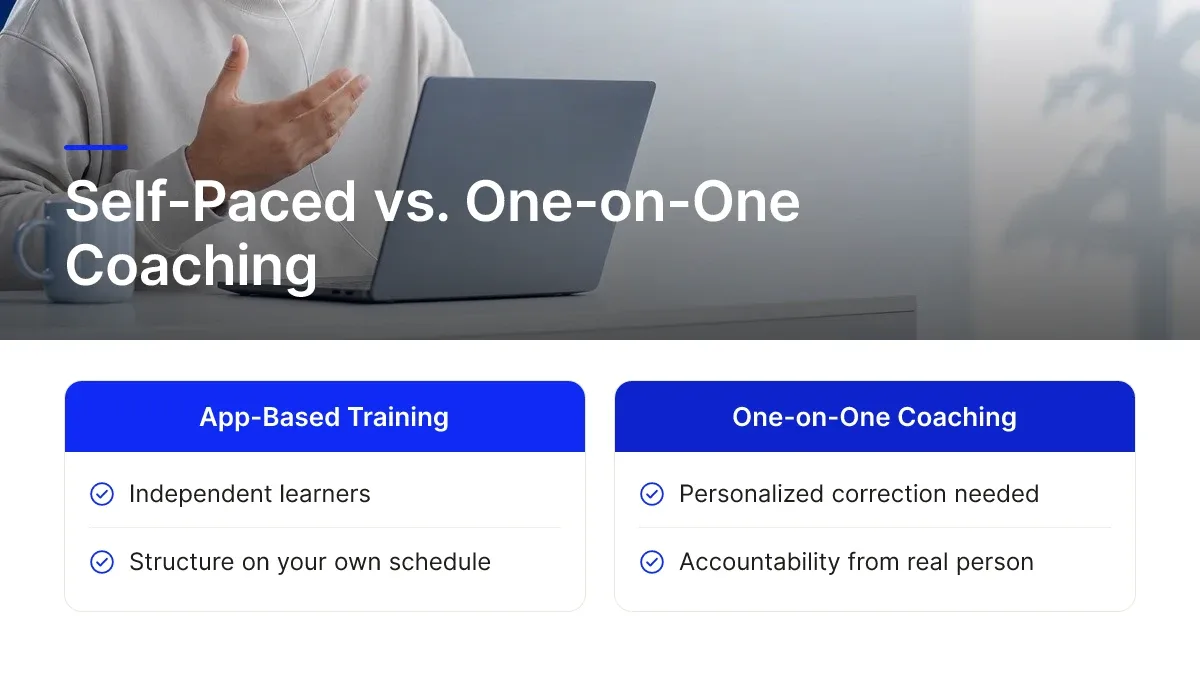
Self-paced training fits independent learners who want structure on their own schedule, while one-on-one coaching fits those who need personalized correction and accountability from a real person.
The choice isn’t binary. Many learners start with structured self-guided practice and add live coaching once they know exactly what their speech needs. Understanding what each format actually provides helps you decide where to start, and whether an English accent coach online should be part of your plan from day one or something you add later.
When to Choose App-Based Training Over Live Coaching
App-based training works when you’re motivated enough to practice consistently without someone checking on you. A structured program gives full access to a curriculum, phonetic drills, and feedback on your pronunciation as you speak, available whenever you have time to train.
InPronunci’s Basic Plan follows this model: self-guided access to the full training program, including the Interactive Visual 2D Sound Simulators, Pronunci Instructions in every lesson, and AI Accent Coach feedback on sound accuracy, intonation, rhythm, and connected speech. It also includes the student group chat, which gives some peer context without a coach present. This setup fits learners who want to work through sounds, phonetic exercises, sentences, and paragraphs at their own pace.
Live coaching adds something self-paced training can’t: a human who hears your specific first-language patterns and corrects them in real time. A coach notices, for example, that a Spanish speaker’s short vowels keep lengthening, or that a Hindi speaker’s word stress stays flat across a sentence, and adjusts the next lesson accordingly. That kind of individualized diagnosis is harder to replace with self-study alone, though Lee, Jang & Plonsky’s 2015 meta-analysis found that explicit pronunciation instruction produces measurable gains regardless of format [1], which suggests structured self-guided practice is not a lesser path, just a different one.
What Structured Accent Training Costs at Each Level
Cost generally scales with how much personal attention you receive, not just the content itself. Self-guided plans sit at a budget-friendly tier because they give full curriculum access without live instructor time. Personalized coaching sits at a premium tier because it includes a real coach’s recurring attention.
InPronunci reflects both tiers under one system. The Basic Plan covers self-guided training at $35/month. The Premium Plan, at $200/month, adds one 1-hour live session per month with Prof. Alex, personal chat between sessions, feedback on submitted practice, and homework, on top of full app access. Combining both approaches, practicing independently between live sessions, lets a coach’s corrections stick rather than fade before the next conversation.
More than mechanics: InPronunci doesn’t teach only the mechanics of sounds. It teaches students how to become confident, fluent English speakers through a step-by-step system. Training may begin with how each American sound is made. Then it moves into sound combinations, sound contractions, phonetic exercises, practice sentences, and paragraphs in real rapid speech, so students start speaking English fluently and comfortably.
Questions & Answers
Frequently Asked Questions
01Is accent training only useful for beginners learning English?
No, accent training is often more valuable for intermediate and advanced speakers than for beginners. Beginners are still building vocabulary and grammar, while advanced speakers have the language skills to focus fully on pronunciation, rhythm, and intonation. Professionals who already communicate well in English but want to sound clearer or more natural are InPronunci’s main audience.
02Do I need special equipment to train my accent with an app?
No special equipment is required beyond a phone, tablet, or computer with a microphone. InPronunci works on the web at learn.inpronunci.com, on iOS, and on Android, so you can train the Interactive Visual 2D Sound Simulators and record practice sentences with devices you already own.
03Can accent training help with a specific first-language influence, like Spanish or Hindi?
Yes, structured training can target the specific sounds and rhythm patterns a learner’s first language tends to carry into English. Spanish speakers often work on the short vs. long vowel distinction (ship/sheep) and final consonants, while Hindi speakers often work on the /v/-/w/ difference and the American flap T. A coach or structured course identifies these patterns and builds targeted practice around them, rather than treating all accents the same way.
04Should I see a speech-language pathologist instead of using an accent training app?
If you have a diagnosed speech or hearing disorder, a licensed speech-language pathologist is the right professional to consult, not an app. Accent training apps like InPronunci offer supportive practice for pronunciation and communication goals, but they are not therapy or diagnosis for underlying speech conditions.
05Can native English speakers use accent training apps too?
Yes, native speakers of British, Australian, or regional American accents sometimes use these apps to train a clearer General American accent. The same speech-organ and articulation training that helps non-native speakers also helps native speakers sharpen clarity for broadcasting, sales, or public speaking.
Conclusion
Clear American English comes from training the sounds, rhythm, and intonation your native language left out, not from repeating isolated words. Start with the speech organs, make the sounds automatic through phonetic exercises, then apply them in sentences and paragraphs. A structured course paired with coach guidance and full-speech evaluation gets you further than scattered tips or one-word scoring ever will.
Start with Free Chapter 1, Speech Organs Education, on the App Store, Google Play, or at learn.inpronunci.com, and see how the first stage of training feels before choosing a plan.
Sources & References
- InPronunci: Accent Training App – App Store
- Top American Accent Coaching Experts for 2026 | MyAccentWay
- Accent Reduction Classes Online | American English Coaching
Recommended Articles
Why Is English Pronunciation So Difficult to Master?
Explore why is English pronunciation difficult for non-native speakers, focusing on speech-organs coordination and training techniques.
How an Accent Training App Can Help You Sound More Natural
An accent training app works best when it trains speech organs sound by sound, then builds phonetic drills, sentence stress, and paragraph-level speech.
7 English Articulation Exercises for Crisper Speech
English articulation exercises train the tongue, lips, jaw, and airflow to produce accurate American vowel and consonant sounds, building the foundation...
Plans
What InPronunci costs
InPronunci Basic
$35 per month
Chapter 1 is free after signup.
InPronunci Premium
$200 per month
Includes a coach:
Why InPronunci is worth the price
- Interactive Visual 2D Sound Simulators, built on 2D Sound Motion Technology developed by Prof. Alex, train your speech organs for each American sound.
- Prof. Alex's guided instructions in every lesson, like working with a real coach.
- The Advanced AI Accent Coach evaluates sounds, intonation, rhythm, stress, and connected speech against native American English speech (100 = native speaker).