


You train accurate American English pronunciation by working your speech organs (tongue, lips, jaw, and airflow) through a structured sequence: isolate each sound with correct articulation, drill it until automatic with phonetic exercises, then apply it in sentences with natural stress and intonation, and finally in connected paragraphs. This sound-by-sound, speech-organ-first approach builds lasting change instead of temporary imitation. Research on explicit pronunciation instruction (Saito, 2012; Thomson & Derwing, 2015) supports structured, targeted practice over passive listening. Consistency across all four stages, not any single trick, is what makes new pronunciation patterns stick.
Inside the InPronunci App
Train American Sounds with Interactive Visual 2D Sound Simulators
Learning American pronunciation involves more than listening to sounds and repeating them.
InPronunci’s Interactive Visual 2D Sound Simulators, developed by Prof. Alex using 2D Sound Motion Technology, guide students through the tongue, lip, and jaw movements involved in producing American consonants and vowels.
Students actively coordinate their speech movements with the simulator, practice each sound aloud, and develop greater awareness of how American sounds are produced.
You don’t just listen to an American sound. You actively train how to produce it.
This lesson demonstrates active training of the American voiceless consonant /t/. Prof. Alex’s Pronunci Instructions guide students before they practice the tongue-tip and airflow-release movements using the Interactive Visual 2D Sound Simulator.
Three Benefits of InPronunci’s Interactive Visual 2D Sound Simulators
- Active ArticulationTrain tongue, lip, and jaw movements while producing American sounds aloud.
- Guided Sound TrainingFollow Prof. Alex’s Pronunci Instructions to understand what to focus on and how to practice.
- Greater Sound ControlDevelop awareness and coordination for clearer, more consistent American pronunciation.
How Do You Train Your Speech Organs for American English Pronunciation?
You train your speech organs by setting the tongue, lips, and jaw into the exact position each American sound requires, then repeating that position until it holds steady on its own. This is the foundation stage of american english pronunciation training, and it comes before any sentence or paragraph work.
What Is the Correct Tongue, Lip, and Jaw Position for American Vowels and Consonants?
Three sounds cause the most trouble for non-native speakers, and each has a specific, teachable position:
- American R: the tongue tip curls back and up without touching the roof of the mouth, while the sides of the tongue press against the upper back teeth.
- TH sounds (as in “think” and “this”): the tongue tip sits lightly between the front teeth or just behind them, letting air flow over it.
- Flap T in words like “water” and “better”: the tongue tip taps the ridge behind the upper front teeth quickly, producing a sound closer to a fast /d/ than a sharp /t/.
Oxford’s American English pronunciation guide confirms these as standard General American consonant and vowel values [3], and Cambridge Dictionary’s guide on how to pronounce American English reflects the same target sounds learners are aiming to reproduce [4].
Native-language transfer explains why these three sounds resist casual correction. Spanish speakers often substitute a tapped or trilled R learned from their first language. Mandarin speakers tend to soften or drop final consonants, since Mandarin syllables rarely end in consonant clusters. Hindi speakers frequently produce T and D with a retroflex tongue position, curling the tongue further back than American English requires. None of these patterns are errors in the speaker’s native language, they are simply the wrong tool carried into a new sound system.
How Do Articulation Exercises Help You Develop Clear American Pronunciation?
Isolating a sound before using it in sentences stops learners from practicing an inaccurate version at speed, which is harder to undo later than getting it right from the start. If you drill “better” with a mispronounced flap T a hundred times, you have reinforced the error a hundred times, not corrected it.
This is where speech-organ training matters most. InPronunci’s Interactive Visual 2D Sound Simulators train the tongue, lips, jaw, and airflow for each American sound, with Pronunci Instructions from Prof. Alex, Ph.D. Accent Coach, Doctor of Education, and professional linguist, directing attention to specific movement details in every lesson, such as where the tongue tip stops or how much air releases.
Try this today: pick one problem sound, isolate it in five words (for example “red,” “run,” “right,” “around,” “very” for the American R), record yourself saying each word, and compare your recording to a native model. Note exactly where your tongue, lips, or jaw differ before moving to full sentences.
How Does American English Pronunciation Differ From Other English Varieties?
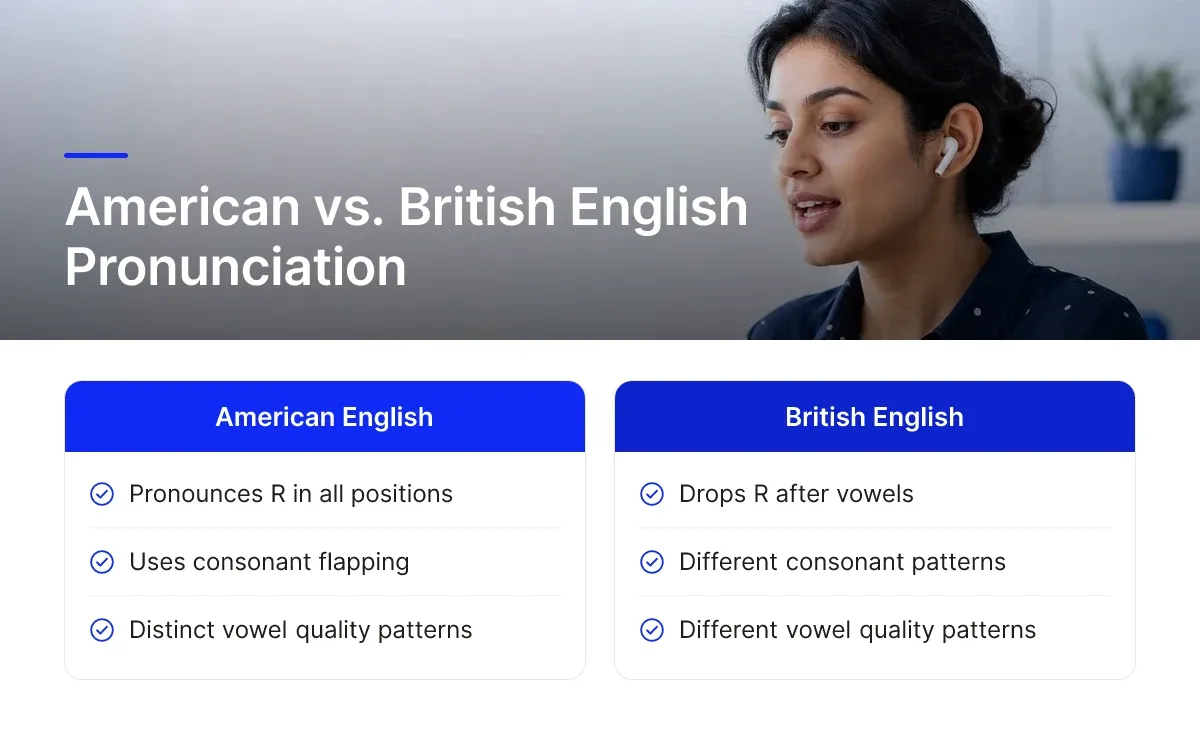
General American differs from British, Australian, and Canadian English mainly in three mechanisms: rhoticity, consonant flapping, and vowel quality, not in correctness.
These are systematic, rule-governed differences. Each variety follows its own consistent pattern; none is a deviation from the other.
How Do British, Australian, and Canadian English Differ From American English Pronunciation?
The clearest marker is rhoticity. General American pronounces the R sound in every position, including after vowels in words like “car,” “hard,” and “teacher.” Most British accents, along with many Australian accents, drop the R unless it is followed by a vowel, so “car” becomes closer to “cah.” Canadian English is rhotic like American English, which is one reason the two are often grouped together in pronunciation training.
The second mechanism is the flap T. In American English, the T between two vowels, as in “better,” “water,” or “city,” turns into a quick tap of the tongue against the ridge behind the upper teeth, producing a sound close to a fast D. British English typically keeps a fuller T release in the same words, with more contact and a sharper burst of air. This single difference accounts for a large share of what listeners perceive as a British versus American accent.
Vowel quality also shifts across varieties. The vowel in “bath” is longer and farther back in most British accents, while General American keeps it short and front, closer to the vowel in “cat” [3]. The “o” in “hot” is rounded in British English but typically unrounded and more open in American English [3]. These are documented contrasts in standard pronunciation references, not signs that one system is more advanced.
Why Does American English Pronunciation Matter for Your Career and Communication?
No variety of English is linguistically more correct. The case for training General American pronunciation is practical: it is the model used in most US workplaces, many standardized exams, and everyday interactions with American colleagues, clients, and patients. If your daily communication happens with American teams or in American academic and professional settings, matching that sound system reduces misunderstandings and repeated requests to repeat yourself.
This is a goal-based decision, not a judgment about which accent sounds better. A speaker aiming for UK business contexts has equally valid reasons to target British pronunciation instead.
How Do You Practice American English Pronunciation Until It Becomes Automatic?
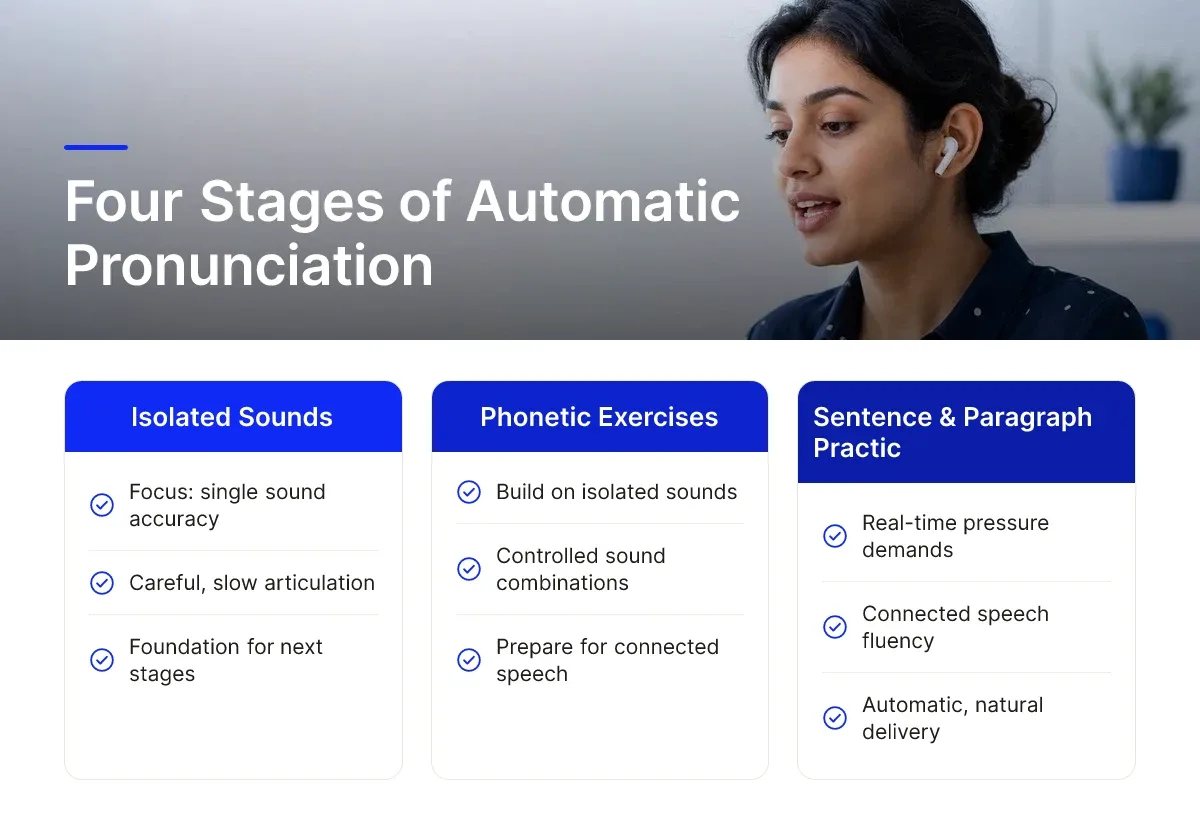
Automatic american english pronunciation comes from four stages in sequence, each building on the last:
- Isolated sounds: correct tongue, lip, and jaw position for a single sound, practiced in isolation.
- Phonetic exercises: controlled repetition of the sound across word pairs and short phrases until it becomes steady.
- Sentence practice: the sound applied with natural stress, rhythm, and intonation.
- Paragraph-level speech: the sound held under natural speaking pressure, alongside linking and connected speech patterns.
Skipping stages is the most common reason accent training stalls. A learner can produce an accurate American R in isolation and still drop it in a fast sentence, because speaking under real-time pressure recruits different control than careful, slow articulation.
What Is the Difference Between Practicing Individual Sounds and Practicing Connected Speech?
Isolated sound accuracy and connected speech fluency are two separate skills, and training one does not automatically train the other. When you say “think” slowly and watch your tongue tip reach your upper teeth, you are building accuracy. But American speakers rarely say words in isolation. They link, reduce, and blend sounds across word boundaries at a pace that leaves no time for careful placement.
This is why sound combinations, reductions, and assimilations matter as a bridge. “Going to” becomes “gonna” in casual speech. The T in “not yet” can shift toward a “ch” sound next to the Y. Final consonants link into the next word’s vowel, so “turn it off” sounds closer to “ter-ni-toff.” These are not sloppy speech. They are regular patterns of General American pronunciation that every fluent speaker uses. Readers who want a fuller treatment of linking, reductions, and blending can see our guide to connected speech.
How Do Phonetic Exercises and Sentence Drills Build Fluent, Habitual American Pronunciation?
Phonetic exercises sit between isolated sounds and full sentences, giving the new sound controlled repetition before stress and intonation get added. A learner might drill the flap T across a set of word pairs, then short phrases, building speed gradually rather than jumping straight from a single sound to a conversation. This staged repetition is what makes a sound steady and habitual instead of something the speaker has to think about consciously.
Sentence practice then layers in stress, rhythm, and melody, the features that carry meaning in American English alongside the sounds themselves. Paragraph-level and presentation-style practice comes last because it forces the learner to hold the new sounds, linking patterns, and intonation together under natural speaking pressure, the same pressure that exists in a meeting or interview. This is the structure InPronunci follows across its four training stages: sound articulation with the Interactive Visual 2D Sound Simulators, phonetic exercises, sentence practice with intonation training, and paragraph practice with presentation-style delivery, the same progression Prof. Alex, Ph.D. Accent Coach, Doctor of Education, and professional linguist, uses in 1-on-1 training.
What Pronunciation Mistakes Do Non-Native Speakers Make, and How Do You Fix Them?
Most pronunciation mistakes follow patterns tied to the sounds and rhythm of the speaker’s first language, not random error. Fixing them starts with naming the exact pattern, then retraining it sound by sound.
What Are the Most Common Pronunciation Errors for Spanish Speakers, Mandarin Speakers, and Other Language Groups?
- Spanish and Portuguese speakers often shorten the vowel difference between “ship” and “sheep,” since their native vowel systems don’t rely on length the way American English pronunciation does. Many also merge /b/ and /v/, saying “berry” for “very,” because Spanish treats these as variants of one sound.
- Hindi, Tamil, and Telugu speakers frequently swap /v/ and /w/, so “vet” and “wet” sound alike. Sentence intonation can also come out flatter than General American patterns, since stress and pitch work differently across Indian languages.
- Mandarin and Cantonese speakers tend to drop or soften final consonants, turning “cat” into something closer to “ca,” because Chinese syllables rarely end in consonant clusters. The /l/-/r/ distinction and the “th” sounds also cause trouble, since none of these exist in the same form in Mandarin.
These are common tendencies observed across large groups of learners, not rules that apply to every individual speaker. First-language influence shapes probability, not destiny.
How Do You Identify and Correct Your Own Pronunciation Mistakes?
Record a sentence, play it back next to a native-speaker model, and listen for one specific difference: a vowel length, a missing final consonant, a flat stress pattern. Isolate that single item and drill it alone before moving to the next one.
Most learners cannot hear their own mistakes without a reference to compare against, the ear adapts to what the mouth already does, so errors sound normal from the inside. This is why a single overall score rarely helps; it tells you something is off without telling you what. Sound-by-sound feedback, tied to the specific vowel or consonant involved, is what lets a learner correct the actual pattern instead of guessing.
This compare-and-adjust process is built into InPronunci’s Your Coach vs. My Pronunci Pronunciation Comparison Tool, where students record their own speech, compare it against the native-speaker model, and consciously adjust the specific sound or stress pattern that differs. Paired with the AI Accent Coach, which evaluates pronunciation, intonation, rhythm, and connected speech as students speak, this turns a vague sense of “something sounds off” into a precise, fixable target. For a closer look at how that evaluation works, see the AI Accent Coach guidelines.
Cognitive Accent Training
Cognitive Accent Training: Learn to Recognize and Correct Your Own Pronunciation
Have you ever listened to yourself speaking English and noticed that your pronunciation sounds different from an American speaker’s, but weren’t sure why?
InPronunci incorporates Cognitive Accent Training to help students recognize their existing pronunciation habits and become more aware of how they speak.
Through Your Coach vs. My Pronunci, students listen to their own recordings, compare them with an American pronunciation model, and actively identify differences in sounds, stress, rhythm, and intonation.
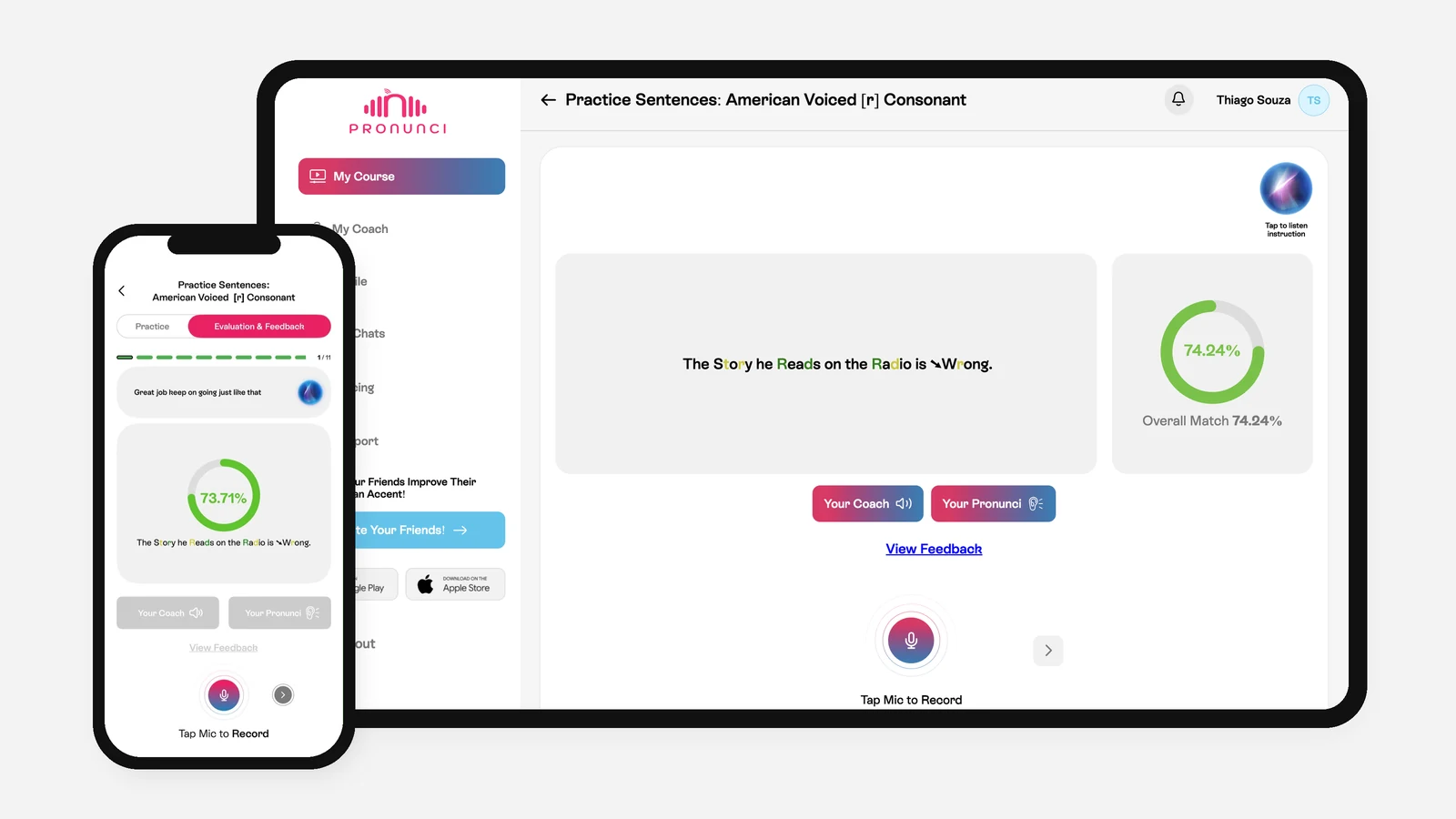
Prof. Alex’s Pronunci Instructions then guide students in understanding how to approach those corrections, while Interactive Visual 2D Sound Simulators support active articulation practice.
The process is simple:
Listen → Compare → Recognize → Understand → Practice → Correct → Recheck
Instead of relying entirely on an AI pronunciation score, students learn to participate actively in evaluating and improving their own speech.
The goal is to help students become increasingly capable of recognizing their pronunciation differences and correcting them independently.
- Hear the American ModelThe model American pronunciation of each practice sentence.
- Recognize Your DifferencesCompare your recorded speech with the American pronunciation model to identify differences in sounds, stress, rhythm, and intonation.
- Practice Your CorrectionsUse Pronunci Instructions and AI feedback to understand which pronunciation differences need attention, practice corrections, and compare your speech again.
What Tools Give You Real-Time Feedback on Your American English Pronunciation?
Meaningful feedback on American English pronunciation has to evaluate full sentences, not isolated words, because intonation, rhythm, and connected speech errors only show up when sounds run together in real speech.
A tool that scores a single word in isolation can tell you whether your “th” sound was close to a native target. It cannot tell you whether your pitch rose or fell in the wrong place, whether you stressed the wrong word in a sentence, or whether you dropped the linking that native speakers use between “want to” and “wanna.” Those patterns only appear in connected speech, and they matter as much to how clear you sound as any single consonant.
How Does AI-Powered Accent Coaching Evaluate Your Full Speech, Not Just Individual Words?
InPronunci’s Evaluation Mode addresses this through two connected parts: the AI Accent Coach and Feedback & Analysis. The AI Accent Coach listens as students speak full sentences and paragraphs, and evaluates sound accuracy, intonation, melody, rhythm, connected speech, and overall sentence flow together, rather than grading one word or sound at a time. It offers two evaluation levels. The Intermediate level suits speakers working toward clear, confident, independent communication. The Advanced level, recommended with the Premium Plan, measures full speech performance against a native American English model for speakers who want to sound native or closer to native. Students should review the AI Accent Coach Guidelines before their first evaluation to understand how scoring works and what each score means (100 = native speaker). See the AI Accent Coach guidelines for details.
What Structured Resources and Guides Help You Track Your Pronunciation Progress?
Feedback & Analysis takes the evaluation a step further by breaking a paragraph into sentences, each sentence into words, and each word into individual sounds. For every sound, students get articulation detail delivered through an Interactive Visual 2D Sound Simulator, along with audio for the sentence or sentence segment. This lets a student trace a recurring error, like a flattened intonation pattern or a missed reduction, back to the specific sound or word causing it.
None of this works as a cold scoring tool. Every lesson includes Pronunci Instructions, step-by-step guidance from Prof. Alex, Ph.D. Accent Coach, Doctor of Education, and professional linguist, that tells students what to listen for and how to adjust before they even reach the evaluation stage. This human guidance layer, paired with AI evaluation, is what separates structured coaching from a feedback widget bolted onto a repeat-after-me exercise.
Other accent apps also give learners feedback worth acknowledging. An AI-powered app can offer instant personalized feedback and conversational role-plays across broader English communication practice, while an app built around guided video lessons from coaches pairs coach-led instruction with AI speech evaluation. Both approaches have real value. InPronunci’s distinction is evaluating full speech as part of a four-stage path, from sound articulation to phonetic exercises, sentence and intonation practice, and paragraph delivery, with a closer comparison available here.
For a deeper look at how connected speech errors form and why they resist single-word correction, see our guide on connected speech in natural American English.

Questions & Answers
Frequently Asked Questions
01Can adults change their American English pronunciation?
Yes, adults can change how they produce American English sounds, stress, and rhythm with structured, explicit practice. Saito 2012 found that explicit pronunciation instruction led to measurable gains in second-language speech production [3]. The speech organs (tongue, lips, jaw) are muscles that respond to deliberate training, the same way they did when the learner first acquired their native language’s sound system.
02How long does it take to notice a change in your pronunciation?
There is no fixed timeline, and it depends on practice consistency, the sounds involved, and the learner’s starting point. Some sound corrections, like adjusting tongue position for a single vowel, can feel noticeable in a single focused session, while rhythm and intonation changes typically need sustained practice across sentences and paragraphs.
03Do you need to eliminate your accent to be understood clearly?
No, clear communication does not require eliminating an accent entirely. Thomson and Derwing’s review of pronunciation research found that intelligibility and comprehensibility matter more for communication than sounding identical to a native speaker [2]. The goal is reducing the patterns that cause misunderstanding, not erasing one’s speech identity.
04What is the difference between an accent and a pronunciation mistake?
An accent is the overall sound pattern a speaker carries from their native language, while a pronunciation mistake is a specific error that can cause confusion, like substituting “sheep” for “ship.” Every speaker has an accent, including native speakers of different regions. Training targets the specific sounds, stress patterns, or intonation habits that reduce clarity, not the accent as a whole.
05Should you focus on sounds, stress, or intonation first?
Sound articulation typically comes first, because stress and intonation are built on top of accurate vowels and consonants. Lee, Jang, and Plonsky’s meta-analysis of pronunciation instruction found that instruction produces measurable gains across different target features [1], which supports working through sounds, then phonetic patterns, then sentence-level stress and melody in sequence rather than in isolation.
Conclusion
Clear American English pronunciation comes from training the speech organs on specific sounds, then making those sounds automatic through phonetic practice, and finally applying them to sentence stress, rhythm, and intonation. Skipping straight to conversation practice without this sequence leaves old speech patterns in place. Start by identifying one sound your native language doesn’t share with American English, and practice its tongue, lip, and jaw position daily for a week. If you want a structured path through this sequence, Free Chapter 1 of InPronunci on the web platform covers speech-organ education and is open to everyone.
Sources & References
- American Pronunciation Training: 2D Sound Motion Technology
- InPronunci: Accent Training App – App Store
- Pronunciation guide for American Dictionary at OxfordLearnersDictionaries.com
- How to pronounce American English in English
Recommended Articles

Top 5 Accent Coach Apps to Master American English 2026
Find the best accent coach app for perfect American English. Compare InPronunci, SpeechPerfect, AccentMaster, LinguaLift, QuickTalk and see why InPronunci leads.

Guide to Choosing the Right Online Accent Reduction Course
Learn what makes an online accent reduction course effective, from speech-organ training to AI feedback, and how to choose the right fit for your goals.
A Practical Guide to Finding the Right BoldVoice Alternative
Looking for a boldvoice alternative? Compare training approaches, feedback depth, and coaching styles to find the app that fits your accent goals. Discover.