


The most effective accent reduction app for Arabic speakers is one that trains the specific sounds Arabic does not share with English, such as /p/-/b/, /f/-/v/, short vowel contrasts, and consonant clusters, rather than offering generic pronunciation drills. InPronunci addresses these through sound-by-sound speech-organ training with Interactive Visual 2D Sound Simulators, step-by-step Pronunci Instructions from Prof. Alex, and an AI Accent Coach that evaluates full sentences, not single words. Arabic speakers also benefit from explicit work on American stress-timed rhythm, since Arabic’s syllable patterns differ from English intonation. Results depend on regular, structured practice, not a single feature.
What Makes an Accent Reduction App Work for Arabic Speakers
An accent reduction app for Arabic speakers works only if it targets the exact sounds and rhythms Arabic and English handle differently, not generic drills. Arabic and English organize consonants, vowels, and stress in different ways, and each gap creates a predictable, named pattern of mispronunciation rather than a vague “accent.”
Arabic does not treat /p/ and /b/ as separate sounds, so pairs like “pack” and “back,” or “cap” and “cab,” often merge into one word for the listener. The difference is voicing plus lip closure: /p/ is voiceless with a small burst of air released as the lips open, while /b/ is voiced, with the vocal cords vibrating during the closure. Arabic also lacks a clear /v/, which is why “van” frequently comes out as “fan.” Producing /v/ requires light contact between the top teeth and bottom lip while the vocal cords stay active, a different articulation from the voiceless, breathier /f/.
Inside the InPronunci App
Train American Sounds with Interactive Visual 2D Sound Simulators
Learning American pronunciation involves more than listening to sounds and repeating them.
InPronunci’s Interactive Visual 2D Sound Simulators, developed by Prof. Alex using 2D Sound Motion Technology, guide students through the tongue, lip, and jaw movements involved in producing American consonants and vowels.
Students actively coordinate their speech movements with the simulator, practice each sound aloud, and develop greater awareness of how American sounds are produced.
You don’t just listen to an American sound. You actively train how to produce it.
This lesson demonstrates active training of the American voiceless consonant /t/. Prof. Alex’s Pronunci Instructions guide students before they practice the tongue-tip and airflow-release movements using the Interactive Visual 2D Sound Simulator.
Three Benefits of InPronunci’s Interactive Visual 2D Sound Simulators
- Active ArticulationTrain tongue, lip, and jaw movements while producing American sounds aloud.
- Guided Sound TrainingFollow Prof. Alex’s Pronunci Instructions to understand what to focus on and how to practice.
- Greater Sound ControlDevelop awareness and coordination for clearer, more consistent American pronunciation.
Which American Consonants and Vowels Are Hardest for Arabic Speakers
Vowels cause as much trouble as consonants. Arabic has three short vowels and three long vowels, a far smaller set than English, which makes close pairs like “ship” versus “sheep” or “bit” versus “beat” hard to hear and even harder to produce consistently [1]. Without direct ear training on vowel length and tongue height, speakers tend to collapse these contrasts into one sound, which changes meaning in ways listeners notice immediately.
Consonant clusters add another layer. English allows clusters that Arabic syllable structure does not permit in the same positions, so speakers often insert a short vowel to break them up, turning “students” into something closer to “estudents” or softening the cluster in “sixth.” This is a structural, rule-based habit carried over from Arabic, not a random error, which is why it shows up consistently across different speakers.
How Arabic Stress Patterns and Intonation Differ From American English
Rhythm is the piece most apps skip. American English is stress-timed: stressed syllables carry more weight, and unstressed vowels reduce toward a neutral schwa sound, which shapes the rhythm of entire sentences. Arabic stress follows different patterns tied to syllable weight, so Arabic speakers often give unstressed English syllables too much clarity and energy, which makes their speech sound evenly paced but less natural to American ears.
These five gaps, voicing in /p/-/b/, lip-teeth contact for /v/, vowel length contrasts, consonant cluster handling, and sentence-level stress, are specific and teachable. InPronunci trains each one directly: the Interactive Visual 2D Sound Simulators work the tongue, lips, jaw, and airflow for sounds like /v/ and short-vowel pairs, while Pronunci Instructions from Prof. Alex, Ph.D. Accent Coach, Doctor of Education, and professional linguist, guide students through stress and rhythm pattern by pattern. You can see how tongue and lip position shape these sounds in more depth on the tongue placement guide.
How an Accent Reduction App Helps Arabic Speakers Build American English Pronunciation
An accent reduction app for Arabic speakers works by replacing a single habit at a time: it retrains the tongue, lips, and jaw to produce an American sound correctly, then repeats that movement until it becomes automatic. Hearing the correct sound once does not change how a speaker produces it.
Can an App Retrain Speech Habits From Arabic and Build New Patterns
Retraining a sound takes repeated, guided movement, not a single correct model to imitate. Arabic does not distinguish /p/ from /b/ or /v/ from /f/, so many Arabic speakers produce “park” as “bark” or “van” as “fan” without noticing the substitution. Fixing that requires the speaker to feel the difference between the lips fully closing for /p/ and barely touching for /b/, then practice that distinction across many words until it holds up in connected speech.
This is where speech-organ training matters more than listening practice alone. An app that only plays a model word and asks the learner to repeat it gives no information about tongue height, lip rounding, or jaw position, so the learner keeps guessing. InPronunci: American Accent Training App addresses this directly: its Interactive Visual 2D Sound Simulators train the tongue, lips, jaw, and airflow for each American sound, including the voicing distinctions that Arabic speakers often merge.
The Difference Between a Scoring App and a Structured Training System
A scoring app rates a single word and stops there; a structured training system trains the sound, drills it in phonetic exercises, then applies it in sentences and paragraphs. Scoring alone tells a learner that a word was wrong without explaining what the tongue or lips did incorrectly, or how to fix it on the next attempt.
Automatic speech habits form in stages: first the sound is trained in isolation, then it gets repeated through phonetic exercises that build control, then it moves into sentence-level stress and intonation, and finally into paragraph delivery close to real conversation. Research on second language pronunciation supports this staged, explicit approach. Thomson and Derwing’s 2015 review found that instructional approaches focused on how sounds are produced tend to support gains in intelligibility more than passive exposure alone [1]. Saito’s 2012 study similarly found that explicit pronunciation instruction produced measurable improvement in learners’ production of difficult sounds [2]. This is the same structure InPronunci follows across its four training stages, moving from sound articulation to phonetic exercises to sentence and paragraph practice.
Key Features of an Accent Reduction App for Arabic Speakers
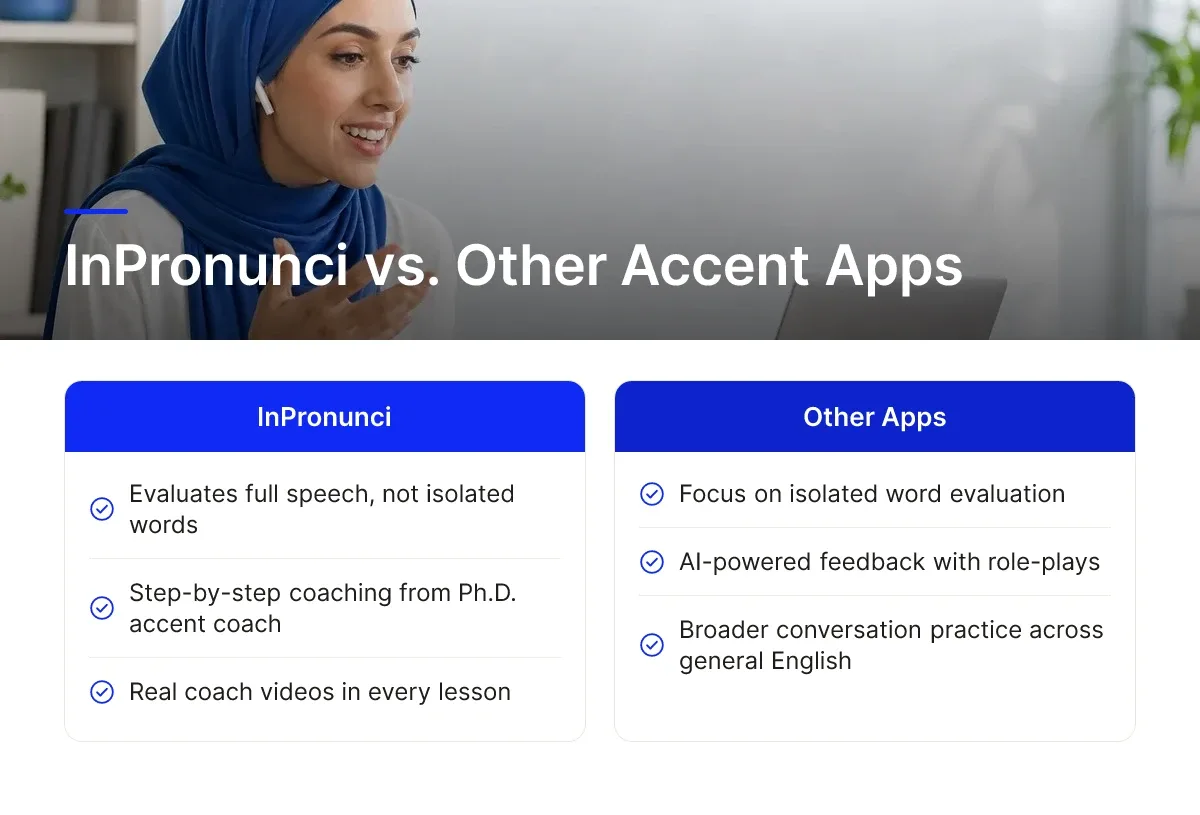
An effective accent reduction app for Arabic speakers needs three things working together: speech-organ training for sounds that don’t exist in Arabic, full-sentence feedback, and clear coaching on what to fix.
Scoring tools that just grade a word as right or wrong skip the step that actually changes pronunciation: training the tongue, lips, and jaw to produce a sound the speaker has never made before. Arabic speakers often know exactly which word they mispronounced but have no idea what to do with their mouth to fix it. That gap is where most apps fail, and it’s where the features below matter most.
Why Speech-Organ Training Through Interactive Simulators Matters for Arabic Speakers
Sounds like /p/ and /v/ are not variations of sounds Arabic speakers already know, they are entirely new articulations that require the speech organs to move in ways Arabic never trained them to move. Standard Arabic has no /p/, which is why “pie” and “by” often come out alike [1], and it has no /v/, which pulls words like “very” toward “ferry.” Reading a rule about lip closure or a static mouth diagram doesn’t teach a speaker how it feels to produce that closure on command.
This is why InPronunci, part of MyAccentWay: American Accent Training, built the Interactive Visual 2D Sound Simulators around speech-organ training rather than description. For /p/, the simulator trains both lips to close fully and release with a small burst of air, something Arabic speakers typically substitute with a softer /b/ closure. For /v/, it trains the lower lip against the upper teeth with continuous airflow and voicing, distinct from the /f/ substitution common for Arabic speakers. Students follow the simulator and repeat the movement until the new position becomes their default, not an exception they have to think about. The tongue placement pillar guide covers this same principle for consonants that depend on precise tongue contact.
Pronunci Instructions add the coaching layer on top of that: step-by-step direction from Prof. Alex, Ph.D. Accent Coach, Doctor of Education, and professional linguist, on where the tongue tip sits, how far the jaw drops, and when the lips should be rounded or spread. Students are never left guessing which part of a sound went wrong.
Why Full-Sentence and Connected Speech Evaluation Matters More Than Single-Word Scoring
Arabic speakers frequently produce a sound correctly in isolation but lose it once speech speeds up, because fast English relies on linking, reductions, and stress patterns that Arabic’s own rhythm doesn’t prepare them for. A short vowel that’s clear in a single word can disappear in a sentence; a final consonant pronounced carefully alone can get dropped when the next word starts with a vowel. Scoring one word at a time never catches this.
InPronunci’s Evaluation Mode addresses this directly. The AI Accent Coach evaluates pronunciation, intonation, melody, rhythm, connected speech, and sentence flow as students speak full sentences, not isolated sounds. Feedback & Analysis then breaks that sentence down into words and sounds, so students see exactly where clarity broke down during connected speech. The connected speech guide explains linking and reduction patterns in more depth.
Practice Mode and the Your Coach vs. My Pronunci Pronunciation Comparison Tool close the loop: students record a sentence, compare it against the native-speaker model, and consciously notice where their rhythm or sound placement diverged. That conscious comparison, repeated across phonetic exercises and paragraphs, is what turns an isolated correct sound into a habit that survives real conversation.
Cognitive Accent Training
Cognitive Accent Training: Learn to Recognize and Correct Your Own Pronunciation
Have you ever listened to yourself speaking English and noticed that your pronunciation sounds different from an American speaker’s, but weren’t sure why?
InPronunci incorporates Cognitive Accent Training to help students recognize their existing pronunciation habits and become more aware of how they speak.
Through Your Coach vs. My Pronunci, students listen to their own recordings, compare them with an American pronunciation model, and actively identify differences in sounds, stress, rhythm, and intonation.
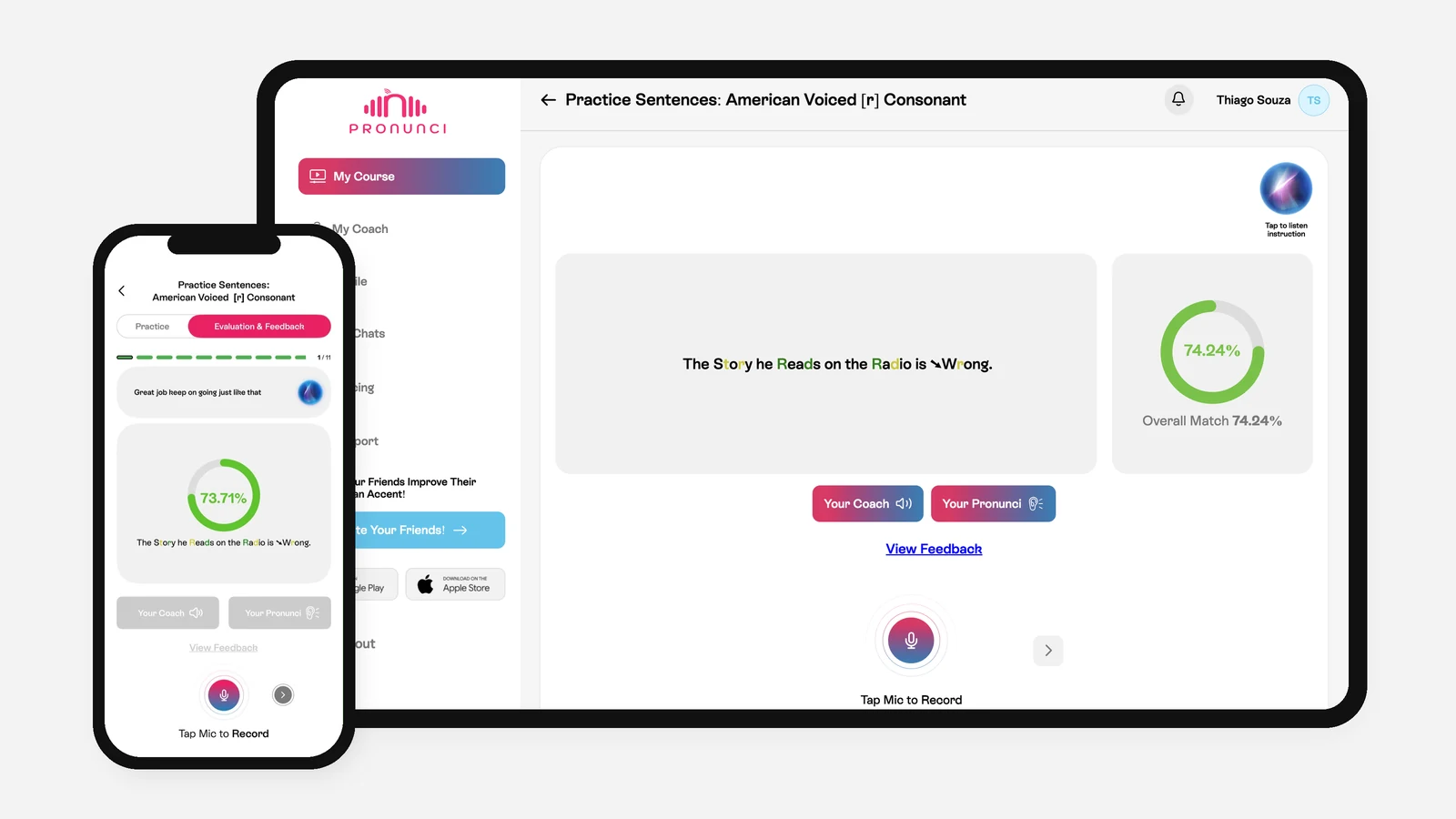
Prof. Alex’s Pronunci Instructions then guide students in understanding how to approach those corrections, while Interactive Visual 2D Sound Simulators support active articulation practice.
The process is simple:
Listen → Compare → Recognize → Understand → Practice → Correct → Recheck
Instead of relying entirely on an AI pronunciation score, students learn to participate actively in evaluating and improving their own speech.
The goal is to help students become increasingly capable of recognizing their pronunciation differences and correcting them independently.
- Hear the American ModelThe model American pronunciation of each practice sentence.
- Recognize Your DifferencesCompare your recorded speech with the American pronunciation model to identify differences in sounds, stress, rhythm, and intonation.
- Practice Your CorrectionsUse Pronunci Instructions and AI feedback to understand which pronunciation differences need attention, practice corrections, and compare your speech again.
How InPronunci Compares to Other Accent Training Apps for Arabic Speakers
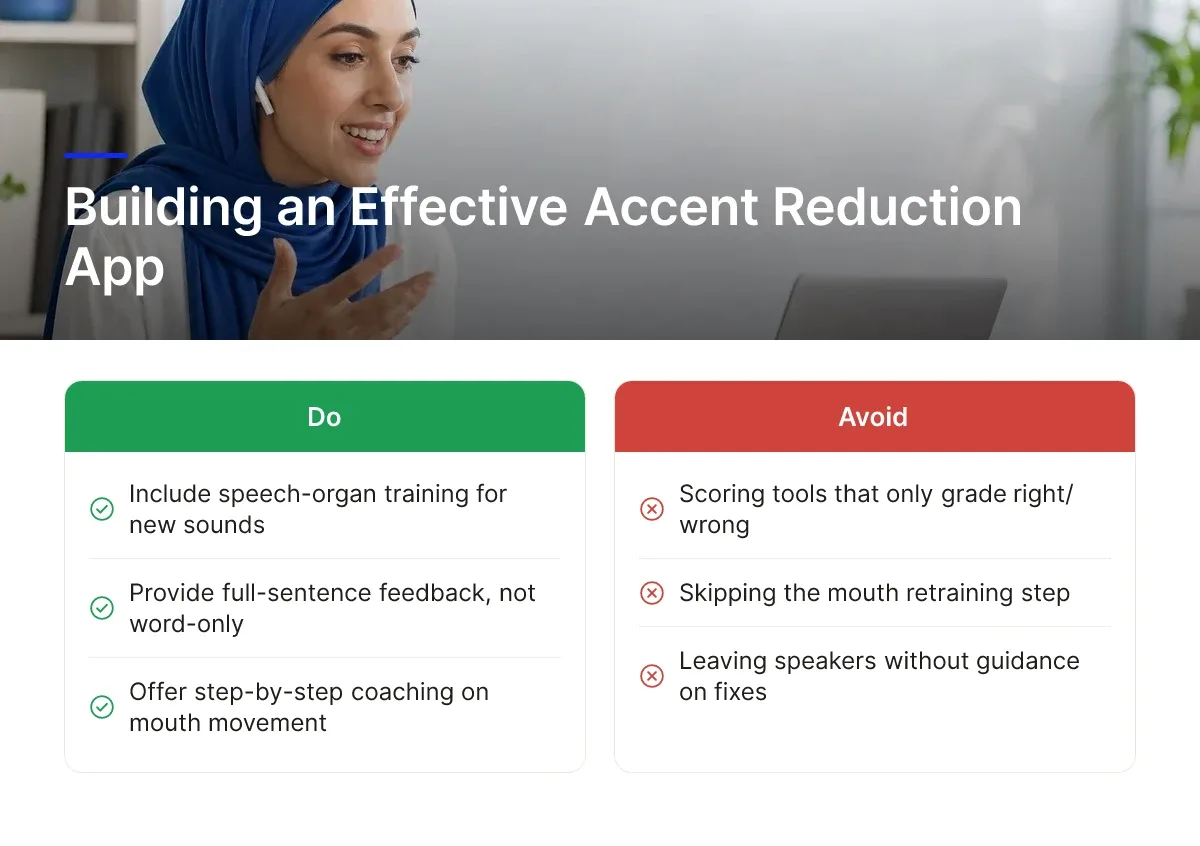
InPronunci differs from other accent apps mainly in two ways: it evaluates full speech, not isolated words, and it gives step-by-step coaching from a real Ph.D. accent coach in every lesson. Arabic speakers researching an accent reduction app for Arabic speakers will find these differences shape how training actually feels day to day.
What Makes InPronunci Different From Other Accent Training Apps
Some accent apps in this category offer guided video practice built around coach videos paired with AI speech evaluation. Others focus on AI-powered feedback with role-plays and broader conversation practice across general English skills. Both approaches have value, but neither combines full-speech evaluation with lesson-by-lesson human guidance the way InPronunci does.
The AI Accent Coach inside InPronunci evaluates pronunciation, intonation, melody, rhythm, connected speech, and sentence flow as a student speaks, rather than scoring one word or sound at a time. For an Arabic speaker working through /p/-/b/ confusion or consonant cluster breakdown, that matters: a mistake rarely lives in a single sound. It shows up across a sentence, in how stress shifts, where pauses fall, and whether sounds link smoothly. Alongside this, Pronunci Instructions from Prof. Alex, Ph.D. Accent Coach, Doctor of Education, and professional linguist, appear in every lesson, giving students the same step-by-step direction he uses in 1-on-1 training.
InPronunci also adds structured speech-organ training through 2D Sound Motion Technology, where the Interactive Visual 2D Sound Simulators train the tongue, lips, jaw, and airflow for each American sound. This sits inside a four-chapter, 400-lesson curriculum with 150 phonetic exercises, moving from sound articulation to phonetic drills, sentence-level intonation, and paragraph practice. It functions as one connected system rather than a set of standalone drills. For a full side-by-side, see the InPronunci vs. ELSA Speak comparison.
Does InPronunci Offer Live Coaching or Only App-Based Training
InPronunci offers both: self-guided app training on the Basic Plan, and human-plus-AI training on the Premium Plan with monthly live sessions with Prof. Alex. The Basic Plan gives full access to the structured curriculum, the simulators, and AI Accent Coach feedback for students who prefer to train independently. The Premium Plan adds a monthly 1-hour live session with Prof. Alex, personal chat between sessions, and feedback on submitted phonetic exercises, sentences, and paragraphs, so Arabic-speaking professionals preparing for client calls or interviews can get direct, personalized correction alongside the app’s daily practice.
How Long It Takes to Reduce an Accent and the Best Way to Practice Daily
Accent change has no fixed finish line. It depends on how regularly you practice and how much you use new sounds in real conversation, not on a set number of weeks or months.
Arabic speakers often ask for a timeline because they want a clear goal to work toward. The honest answer is that pronunciation improvement is a gradual skill-building process, closer to learning an instrument than memorizing vocabulary. Progress comes from repeated, targeted practice of specific sounds until they become automatic, then applying them in longer stretches of speech. Any accent reduction app for Arabic speakers that promises results by a specific date is making a claim it cannot back up.
Should Arabic Speakers Focus on Individual Sounds First or Start With Conversation
Start with individual sounds, then move into sentences and conversation once those sounds feel stable. Arabic does not distinguish /p/ from /b/ or /f/ from /v/ the way English does, and Arabic vowels do not carry the same length contrasts as English vowels like the short “i” in “ship” versus the long “ee” in “sheep”. Jumping straight into conversation without fixing these contrasts means practicing the same substitutions repeatedly, which makes them harder to unlearn later.
Build the sound system first: train /p/-/b/ and /f/-/v/ until the distinction is consistent, then work on vowel length. Once those are steady, layer in sentence stress, word linking, and connected speech, the patterns that make English sound natural rather than just correct. This sequence mirrors the structure InPronunci: American Accent Training App uses, moving from sound articulation to phonetic exercises to sentence-level intonation and finally paragraph practice.
A Daily Practice Routine for Building Automatic American English Speech Habits
A 30-minute daily session, done consistently, builds habits faster than occasional long sessions. Here is a routine to start today:
- 10 minutes: Train two target sounds with the Interactive Visual 2D Sound Simulator and Pronunci Instructions, focusing on tongue, lip, and jaw position for each one.
- 10 minutes: Run phonetic exercises on those same sounds in combination with others, since sounds behave differently next to different neighbors in real words.
- 10 minutes: Read practice sentences aloud, paying attention to sentence stress and linking between words rather than individual sound accuracy.
To track progress without guessing, the AI Accent Coach offers two evaluation levels. The Intermediate level is built for speakers aiming for clear, confident communication. The Advanced level is for those working toward a closer-to-native accent and evaluates full speech performance against native American English. Both report on a 0-100 scale where 100 equals a native speaker, giving a concrete reference point rather than vague praise or criticism.
No app or coach, including InPronunci, can honestly guarantee a native-like accent. Research on pronunciation instruction supports structured, explicit practice over unguided exposure [2], but the outcome still depends on how consistently a learner applies it. For a deeper look at how sound-by-sound training connects to natural speech, see our guide on connected speech in American English.

Real student result: before and after training
Abishek, a Tamil and Indian English speaker, trained in the InPronunci Premium Plan, which combines Interactive 1-on-1 American Accent Training with Prof. Alex and daily practice in InPronunci. Prof. Alex recorded and evaluated each recording on a scale from 0 to 100, where 100 = native speaker.
Student testimonial

“In my opinion, InPronunci is the best app for American accent training because it works exactly like Prof. Alex conducts his classes. It gives clear guidance, structured practice, and focused pronunciation training.”
Full evaluation of Abishek on MyAccentWay
9monthsof hard work and dedication
Listen to the starting point0:00
Listen to the result0:00
Independent phonetic evaluation
Jane Timokhin, Ph.D. in Applied Linguistics
Independent evaluator Jane Timokhin, Ph.D. in Applied Linguistics, assessed Abishek’s before and after audio recordings and documented measurable improvements in American English pronunciation after nine months of training at MyAccentWay.
Interactive American Accent Training, informed by Prof. Alex’s doctoral research. At MyAccentWay, he applies these interactive teaching principles through 2D Sound Motion Technology, active pronunciation practice, and personalized feedback, so students understand, train, and refine American English speech sounds instead of only listening and repeating. Learn more about Prof. Alex’s doctoral research.
Questions & Answers
Frequently Asked Questions
01Why do Arabic speakers often confuse /p/ and /b/ in English?
Standard Arabic has no /p/ sound, so many Arabic speakers substitute /b/ for it, turning “pack” into “back” or “park” into “bark” [1]. The jaw, lips, and vocal cords move almost identically for both sounds; the only difference is that /p/ is voiceless (no vocal cord vibration) and /b/ is voiced. Training the voiceless release of /p/ as a separate habit, rather than relying on how it feels, is usually the fastest fix.
02Is it harder for Arabic speakers to learn American English pronunciation than other accents?
Not harder, just different: Arabic speakers face a distinct set of sounds, including /p/-/b/ and /f/-/v/ confusion, short vowel reduction, and consonant clusters [2]. Every native language brings its own transfer patterns into English. Progress depends on structured, sound-by-sound practice, not on which first language a learner started with.
03Can an accent reduction app help with Arabic speakers’ guttural sound habits carrying into English?
Yes, if the app trains speech-organ position and airflow, not just word repetition. Arabic includes sounds produced deeper in the throat than most English sounds, and that tension can carry into English vowels and consonants, making speech sound tighter than General American requires. InPronunci’s Interactive Visual 2D Sound Simulators train the tongue, lips, jaw, and airflow for each American sound, which helps learners build a lighter, more forward articulation pattern instead of just hearing feedback on isolated words.
04Do I need a live coach, or can an app alone reduce my Arabic accent in English?
Either can work, depending on the structure behind it; a self-guided app with a clear path from sounds to sentences is often enough for motivated learners. InPronunci’s Basic Plan gives full access to speech-organ training, phonetic exercises, and AI Accent Coach feedback on full speech. Learners who want personalized correction and accountability can add the Premium Plan, which includes a monthly live session with Prof. Alex and feedback on submitted practice.
Conclusion
Reducing an Arabic accent in American English comes down to three things: isolating the specific sounds Arabic doesn’t share with English (like /p/, /v/, and short vowels), training those sounds at the speech-organ level, and then carrying them into real sentences with American stress and rhythm. Word-repetition apps rarely cover all three. A structured path, sound training, phonetic drilling, sentence-level intonation, and full-speech evaluation, builds habits that hold up in meetings and calls, not just in app exercises. Start with Free Chapter 1 on the InPronunci web platform, the App Store, or Google Play, and work through the Speech Organs Education chapter before moving into consonant and vowel training.
Sources & References
- English for Arabic Speakers: Pronunciation and Accent Help | San Diego Voice and Accent
- Conversations with ChatGPT about Teaching English Pronunciation
Recommended Articles
Guide to Learning an American Accent for Spanish Speakers
Learn how to master an american accent for spanish speakers through structured phonetic exercises and practice with speech patterns.
speak english like a native
Speaking English like a native speaker means retraining your speech organs, not just learning tips, so your tongue, lips, jaw, and airflow produce American...

How to Structure American Accent Practice the Right Way
Learn how to structure American accent practice step by step, from sound training to rhythm, intonation, and feedback, for faster, lasting results.