



English pronunciation exercises build natural American speech by training the speech organs to produce accurate sounds, then making those sounds automatic through phonetic drills, and finally applying them in sentences and paragraphs with correct stress, rhythm, and intonation. The exercises work because they follow a progression: isolated sound articulation first, then phonetic patterns until they become habitual, then connected speech in real sentences, and finally paragraph-level delivery for natural conversation. Research on explicit pronunciation instruction (Saito, 2012; Thomson & Derwing, 2015) supports this staged approach over random word repetition. Structured programs such as InPronunci apply this exact sequence, training each American sound with the Interactive Visual 2D Sound Simulators before moving to sentence and paragraph practice.
Inside the InPronunci App
Train American Sounds with Interactive Visual 2D Sound Simulators
Learning American pronunciation involves more than listening to sounds and repeating them.
InPronunci’s Interactive Visual 2D Sound Simulators, developed by Prof. Alex using 2D Sound Motion Technology, guide students through the tongue, lip, and jaw movements involved in producing American consonants and vowels.
Students actively coordinate their speech movements with the simulator, practice each sound aloud, and develop greater awareness of how American sounds are produced.
You don’t just listen to an American sound. You actively train how to produce it.
This lesson demonstrates active training of the American voiceless consonant /t/. Prof. Alex’s Pronunci Instructions guide students before they practice the tongue-tip and airflow-release movements using the Interactive Visual 2D Sound Simulator.
Three Benefits of InPronunci’s Interactive Visual 2D Sound Simulators
- Active ArticulationTrain tongue, lip, and jaw movements while producing American sounds aloud.
- Guided Sound TrainingFollow Prof. Alex’s Pronunci Instructions to understand what to focus on and how to practice.
- Greater Sound ControlDevelop awareness and coordination for clearer, more consistent American pronunciation.
How Structured English Pronunciation Exercises Build American Speech Habits
Repeated, guided articulation retrains the coordination between tongue, lips, jaw, and airflow until a new American sound replaces the old first-language pattern automatically. This happens in stages, not all at once, and the order of those stages determines whether the new pronunciation sticks.
What Happens in Your Speech Organs When You Practice American Consonants and Vowels
Every sound in your first language set a default position for your tongue, lips, jaw, and airflow long before you learned English. A Spanish speaker’s tongue taps the alveolar ridge for a trilled R, while the American R pulls the tongue back without touching the roof of the mouth at all. A Japanese speaker’s /r/ and /l/ share a single flap sound, so English separates them into two distinct tongue placements. These are physical habits, built through years of unconscious repetition, and they do not change just because a learner knows the rule. For a closer look at how articulation itself is taught and assessed, see this explainer on teaching articulation, sound features, and similarities.
Changing them requires the same kind of repetition that built them, but directed at the correct position. When a learner repeats an articulation pattern with guidance, the speech organs gradually shift away from the first-language default and settle into the American target. This is why isolated sound training comes first in any serious program: a stable, accurate sound system has to exist before rhythm, stress, or intonation can be layered on top. Trying to fix sentence melody while the underlying consonants and vowels are still inconsistent means building on an unstable foundation.
How Phonetic Exercises Make New Pronunciation Patterns Automatic
A sound a learner can produce correctly in isolation is not yet a sound they can use in real conversation. Phonetic exercises close that gap. Sound combinations, reductions, and assimilations (the way “want to” becomes “wanna” or how a final consonant links into the next word’s vowel) force the new articulation to survive at conversational speed, under the pressure of connected speech. Repetition here shifts the sound from something the learner thinks about to something they produce without thinking.
Saito (2012) found that explicit pronunciation instruction produced measurable gains in second-language pronunciation development, supporting structured practice over unguided exposure to native speech alone [3]. This matters directly for English pronunciation exercises: listening to American English is not the same as training the speech organs to reproduce it. InPronunci applies this staged approach directly. Its Interactive Visual 2D Sound Simulators train the tongue, lips, jaw, and airflow for each American sound as the first stage, with Pronunci Instructions from Prof. Alex, Ph.D. Accent Coach, Doctor of Education, and professional linguist, guiding each step before the learner moves into phonetic exercises and sentence practice. You can read more about how tongue placement affects individual sounds in our guide to tongue placement in English sounds.
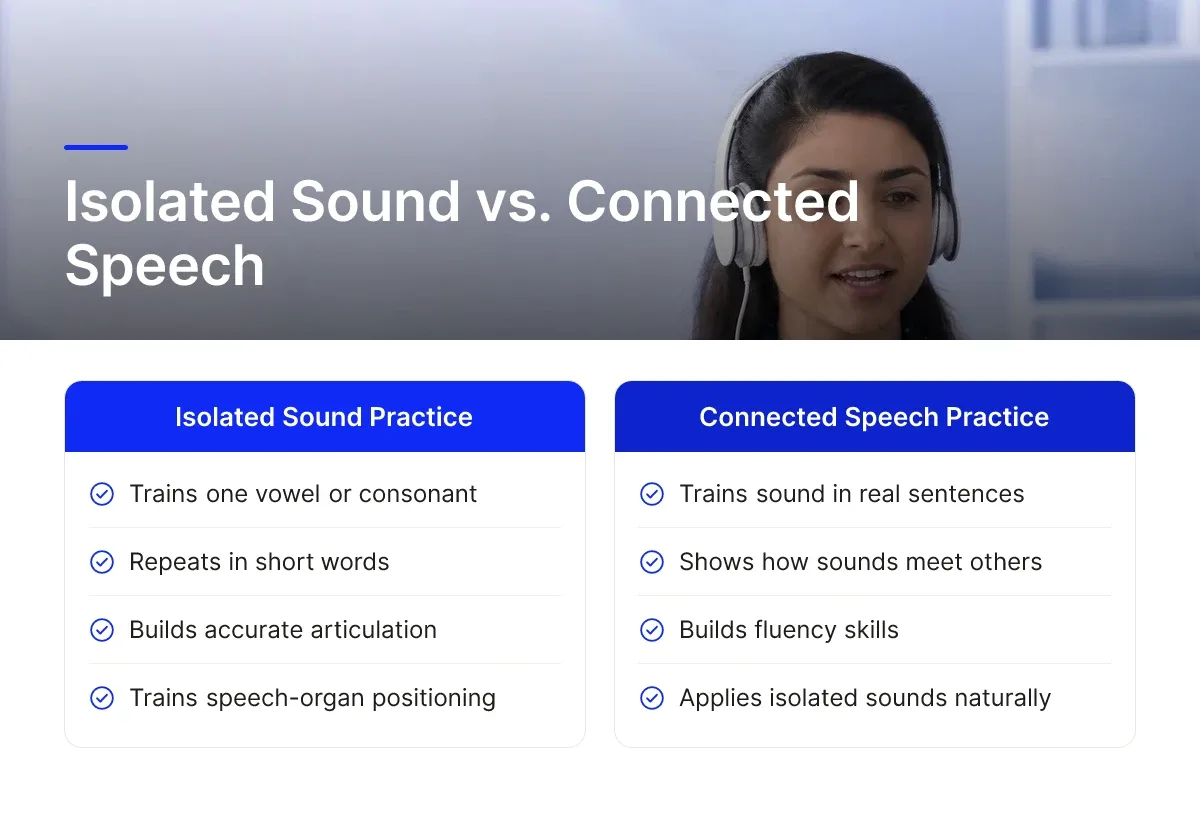
Isolated Sound Practice vs. Connected Speech Exercises
Isolated sound practice trains one vowel or consonant until articulation is accurate and repeatable; connected speech practice trains how that same sound behaves once it meets other sounds in real sentences. Effective English pronunciation exercises need both stages, because they build different skills.
Isolated practice means repeating a single target sound, such as the American R or the TH sound, in short words until the tongue, lips, and jaw consistently find the correct position. This is where speech-organ training with the Interactive Visual 2D Sound Simulators does its work: the simulators train the tongue, lips, jaw, and airflow for one sound at a time, so a learner can feel and correct the exact movement before trying it in context.
Why Exercises Need to Move Beyond Single Words Into Sentences and Paragraphs
A sound learned in isolation often changes shape once it enters a sentence, because stress, linking, and reduction change it. A learner who can produce a clean American R in “red” may still struggle with “red or blue,” where the R links into the next vowel. Isolated drills build the raw articulation; sentence and paragraph practice teaches the speech organs to hold that articulation under the pressure of connected speech.
Connected speech changes follow predictable patterns:
- Consonants link into following vowels, so “turn it off” is produced closer to “turn-it-off” than as three separate words.
- Function words reduce, so “going to” shifts toward a “gonna”-type pattern in casual speech.
- The flap T turns the T in “water” and “better” into a quick tap closer to a D sound.
None of these patterns show up in single-word drills, which is one reason isolated practice alone leaves speech sounding careful but unnatural.
How Stress, Rhythm, and Intonation Change When Sounds Combine in Natural Speech
American English is stress-timed: stressed syllables fall at a fairly even pace while unstressed syllables and function words compress and reduce around them. Many other languages, including Spanish and several Indian languages, are more syllable-timed, giving each syllable closer to equal weight. Carrying that syllable-timed rhythm into English can make speech sound flat or overly deliberate, even when every individual sound is correct.
Training rhythm and intonation at the sentence level is covered in more depth in InPronunci’s guide to connected speech, which breaks down linking, reduction, and stress patterns with example sentences. InPronunci’s phonetic exercises and sentence practice stage build directly on this: once a sound is trained in isolation, students practice it inside phrases where stress and reduction apply, then move to paragraph practice for presentation-style delivery.
How to Identify Which Pronunciation Exercises Target Your Weaknesses
You find the right exercises by identifying the specific sounds and patterns your native language carries into English, then confirming that gap with a recording, not a guess.
First-language influence follows recognizable tendencies, though no two speakers carry them identically:
- Spanish and Portuguese speakers often merge short and long vowels, so “ship” and “sheep” sound the same.
- Hindi, Tamil, and Telugu speakers may substitute /w/ for /v/ and apply a flap T inconsistently in words like “water” or “better.”
- Mandarin and Cantonese speakers frequently drop final consonants and mix up /l/ and /r/.
- Japanese speakers tend to confuse /r/ and /l/ and add a vowel sound after consonants that should end a word, turning “strike” into something closer to “sutoraiku.”
These are common tendencies, not fixed rules, and plenty of speakers from each language group show different patterns entirely.
Guessing which sound needs work wastes practice time. Recording your own speech and placing it next to a native-speaker model shows exactly where pronunciation diverges, whether that is a vowel length issue, a dropped final consonant, or flat intonation across a sentence. This comparison step turns a vague sense of “something sounds off” into a specific, trainable target.
What Role Does Real-Time AI Feedback Play in Choosing the Right Exercises
Real-time feedback narrows the list of exercises by flagging exactly which sounds, stress patterns, or connected-speech habits break down as you speak full sentences. A tool that only scores isolated words cannot tell you whether your intonation flattens in longer speech or whether a sound slips only in certain consonant combinations. Evaluating sound accuracy, intonation, melody, rhythm, and connected speech together, as InPronunci’s AI Accent Coach does, points to the exercises that matter instead of leaving you to practice everything equally.
How to Assess Your Pronunciation Before and After Structured Training
A pronunciation score only means something when it is benchmarked against a clear reference, with 100 representing a native speaker, and used to set direction rather than deliver a verdict. A score of 60 today is not a judgment on your ability. It is a starting point that tells you which chapter of English pronunciation exercises to prioritize and gives you a number to track as you retrain specific sounds.
InPronunci’s Evaluation Mode combines this AI Accent Coach scoring with Feedback & Analysis, which breaks a paragraph into sentences, sentences into words, and words into individual sounds. Each sound gets its own correction detail through an Interactive Visual 2D Sound Simulator, so you see precisely where to adjust tongue, lip, or jaw position rather than re-practicing sounds that are already accurate. Review the AI Accent Coach guidelines before your first evaluation to understand how the scoring works and how to read the feedback.
The Progression From Individual Sounds to Natural Conversation
English pronunciation exercises work best in a fixed order: sound articulation first, then phonetic drills, then sentence stress and intonation, then paragraph-level delivery. Skipping a stage weakens the ones that follow, because each stage trains a skill the next stage assumes is already in place.
The Typical Path From Articulation Training Through Sentence Practice to Paragraph Delivery
Stage one is sound articulation: training the tongue, lips, jaw, and airflow to produce a single American vowel or consonant correctly, in isolation, before it meets any other sound. Stage two takes that sound into phonetic exercises, combinations, reductions, and assimilations that occur when sounds run into each other in real words and phrases. Stage three moves to full sentences, where stress, rhythm, and intonation determine which words carry meaning and which get compressed. Stage four is paragraph practice with presentation-style delivery: sustained speech close to what a meeting, interview, or lecture actually demands.
Each stage depends on the one before it. Phonetic drills on a sound you haven’t yet learned to articulate just repeat the same error faster. Sentence-level intonation training doesn’t sound natural if word stress isn’t already automatic, because a speaker who’s still consciously placing stress on individual words has no attention left over for the sentence’s overall pitch pattern. This is consistent with explicit, staged pronunciation instruction producing measurable gains in later speech accuracy [3].
How Exercises Prepare You for Presentations, Interviews, and Workplace Communication
Paragraph-level practice is the stage closest to what professionals actually need: a project update in a stand-up meeting, an answer in a job interview, a few unscripted minutes after a slide deck ends. None of that looks like isolated sounds or single sentences. It requires holding correct articulation, stress, and rhythm steady over 30 seconds or more, often while thinking about content at the same time. That’s precisely what the earlier three stages build toward.
A short routine to try today: pick one sound you find difficult, such as the American R or the TH sound. Train it in isolation for a minute. Drill it inside three short phonetic patterns, such as “red,” “bread,” “around.” Then read two practice sentences aloud, marking which words carry stress before you speak.
InPronunci structures its course around this same four-stage logic across four chapters: Speech Organs Education, American Consonant Sounds, American Vowel Sounds, and American Intonation and Emphasis. Each session pairs the Interactive Visual 2D Sound Simulators with Pronunci Instructions before moving into phonetic exercises, sentences, and paragraph practice. See the course overview for how the full progression is organized.
What Makes English Pronunciation Exercises Effective for Professional Communication
English pronunciation exercises work for professional communication when they train accuracy under pressure, not just accuracy in a quiet practice session. A client call or a stand-up meeting moves faster than a drill, and sounds that are correct at a slow pace often collapse once speech speeds up.
How Exercises for Business English Differ From General Pronunciation Practice
General pronunciation practice usually isolates a sound at a comfortable pace, while workplace-focused practice adds speed, interruption, and real stakes to the same sounds. A software engineer running a client call needs the same /θ/ or flap T accuracy she trained in isolation, but now while thinking on her feet and responding to questions. Training that only happens at a slow, controlled pace does not automatically transfer to a fast exchange where a wrong word stress can make a technical term unrecognizable to a listener.
This is why business-context practice layers speed and cognitive load onto the same sound work: reading a paragraph aloud while maintaining clear articulation, then answering an unscripted question without losing that clarity. The goal is sustaining accurate articulation when attention is split between what to say and how to say it.
What Pronunciation Skills Matter Most for Meetings, Presentations, and Confident Speaking
Three skills carry the most weight in professional settings. Word stress on key terms helps a healthcare worker make sure “medication” or “diagnosis” lands clearly in a patient conversation. Sentence-level intonation signals confidence, a question, or a transition, which matters in an interview when a rising tone on the wrong word can make a statement sound uncertain. Connected speech, the way words link together in natural phrases, is what separates fluent-sounding speech from a halting, word-by-word delivery during a presentation.
Paragraph-length, presentation-style practice builds the stamina these moments require. A single sentence drilled correctly does not prepare someone for a five-minute interview answer or a client update that runs several minutes without a script. Sustained practice at paragraph length trains the same consistency a professional needs when nerves and pacing pressure build over time.
InPronunci’s Pronunci Instructions guide learners through each lesson step by step, the way Prof. Alex, Ph.D. Accent Coach, Doctor of Education, and professional linguist, would guide a student in a live class. This structure supports the transfer from drilled sounds to confident, independent speech in real meetings and interviews, building on the sentence and paragraph practice described in InPronunci’s structured accent training course.

Questions & Answers
Frequently Asked Questions
01How often should you do English pronunciation exercises to see progress?
Short, daily sessions of 10 to 15 minutes work better than one long weekly session, because speech-organ training depends on repetition. A sound you practice once a week stays unfamiliar to your tongue and jaw. Spreading practice across most days of the week lets correct articulation become your automatic habit rather than something you have to think about mid-sentence.
02Can English pronunciation exercises help reduce a strong accent?
Yes, structured pronunciation exercises can reduce the influence of your first language on your American English, though no app or coach can promise a fully native-like result. Progress depends on consistent practice and on using the new sounds in real conversation, not only in isolated drills. InPronunci describes this as reducing, never eliminating, an accent.
03Do English pronunciation exercises work for exam preparation like IELTS or TOEFL speaking?
Yes, pronunciation exercises directly support IELTS Speaking, TOEFL Speaking, and IELTS Listening because examiners score intelligibility, stress, and intonation, not just vocabulary. Training individual sounds, then sentence stress and rhythm, then full-paragraph delivery mirrors the structure of exam speaking tasks. Listening-focused exercises also sharpen the ear for IELTS Listening passages spoken in natural American or other native-speaker rhythm.
04What’s the difference between pronunciation exercises and general speaking practice?
Pronunciation exercises target specific sounds, stress patterns, or connected-speech features with deliberate repetition, while general speaking practice focuses on fluency and conversation without correcting how sounds are produced. General practice can reinforce an existing error if nobody catches it. Pronunciation exercises isolate the problem, such as a missing American R or flattened word stress, before returning it to full sentences.
05Can adults improve pronunciation as effectively as younger learners?
Yes, adults can make significant pronunciation gains, though the process relies more on deliberate, guided practice than the incidental learning younger children experience. Adult learners typically have stronger awareness of their own speech organs and can use targeted feedback more effectively. Consistent practice with isolated sounds, phonetic drills, and sentence-level work closes most of the gap over time.
Conclusion
Progress comes from training sounds at the speech-organ level first, then locking them in with phonetic exercises, then carrying them into sentence stress, intonation, and paragraph-length speech. Skipping straight to conversation practice, without ever correcting the underlying articulation, is why many learners plateau despite years of speaking English. A structured path, like the one InPronunci builds through Pronunci Instructions and AI Accent Coach feedback on full speech, closes that gap more directly than isolated drills.
Start with Free Chapter 1 on the App Store, Google Play, or the web, and build your practice routine from there.
Sources & References
Recommended Articles
accent reduction app for arabic speakers
The most effective accent reduction app for Arabic speakers is one that trains the specific sounds Arabic does not share with English, such as /p/-/b/...

Guide to Learning an American Accent for Spanish Speakers
Learn how to master an american accent for spanish speakers through structured phonetic exercises and practice with speech patterns.

speak english like a native
Speaking English like a native speaker means retraining your speech organs, not just learning tips, so your tongue, lips, jaw, and airflow produce American...