
TL;DR:
- Repetition is essential for mastering pronunciation by reinforcing speech motor patterns through consistent practice. Structured, feedback-driven repetition transforms sounds from conscious effort to automatic, natural speech. Effective repetition combines visual tools, real-time correction, and progression from sounds to fluent conversation.
Repetition is the core mechanism behind pronunciation mastery. Specifically, it is the process of reinforcing speech motor patterns through consistent, structured practice until correct sounds become automatic. In linguistics and speech pathology, this process is grounded in the Principles of Motor Learning, which confirm that speech motor patterns become automatic only through frequent, supported practice, not passive exposure. The role of repetition in pronunciation mastery goes far beyond simple “repeat after me” drills. When you practice with purpose, feedback, and structure, repetition rewires how your brain produces sound. Inpronunci’s American Accent Training Course is built on exactly this principle.
How does repetition improve pronunciation skills?
Repetition improves pronunciation by building and strengthening neural pathways in the brain. Each time you produce a sound correctly, the neural circuit responsible for that movement becomes more efficient. Over time, what once required conscious effort becomes automatic, fluent speech.

The Principles of Motor Learning explain this process clearly. Speech is a physical skill, just like playing piano or learning to type. Your tongue, lips, and jaw must learn precise movement sequences. Consistent, supported repetition moves those skills from a fragile, conscious state to a stable, automatic one.
Research supports this directly. Guided repetition with teacher vocal modulation produced significant fluency improvements and reduced language anxiety in a quasi-experimental study, with a Cohen’s d of 0.89 over 8 weeks. That effect size is large. It means structured, guided repetition produces real, measurable change in a relatively short time.
Repetition also reduces anxiety. When a sound becomes familiar through practice, your brain stops treating it as a threat or a challenge. You speak with less hesitation, more confidence, and greater clarity.
Key benefits of repetition for pronunciation:
- Strengthens neural pathways for specific sounds and sound combinations
- Builds speech muscle memory for vowels, consonants, stress, and rhythm
- Reduces cognitive load so you can focus on meaning, not mechanics
- Lowers language anxiety through familiarity and predictability
- Transfers correct patterns from controlled practice to real conversation
Pro Tip: Record yourself once a week saying the same sentence. Compare recordings over four weeks. You will hear the change in your own voice, and that evidence keeps you motivated.
What are effective repetition techniques for pronunciation practice?
Not all repetition produces results. Mindless drilling of isolated sounds rarely transfers to real speech. The most effective approach combines structured cycles, varied input, and feedback at every stage.
The NECTAR practice cycle, developed by linguist Viktoria Verde, Ph.D., organizes repetition into six stages: Notice, Ear training, Copy, Target, Articulate, and Repeat. This structure prevents rote parroting by requiring you to understand articulatory mechanics before you repeat. You are not just copying a sound. You are learning how to produce it.
The four most effective repetition techniques are:
- Shadowing. Listen to a native speaker and repeat simultaneously, matching rhythm, stress, and intonation. Shadowing trains connected speech, not just individual sounds. Read more about shadowing for American English to apply it correctly.
- Minimal pair drills. Practice pairs of words that differ by one sound, such as “ship” and “sheep.” This sharpens your ear and your production at the same time.
- Sentence-level repetition. Repeat full sentences, not isolated phonemes. This trains stress, rhythm, and intonation together, which is how American English actually sounds.
- Spaced repetition. Return to the same sounds and patterns across multiple sessions. Spacing practice over days consolidates memory more effectively than one long session.
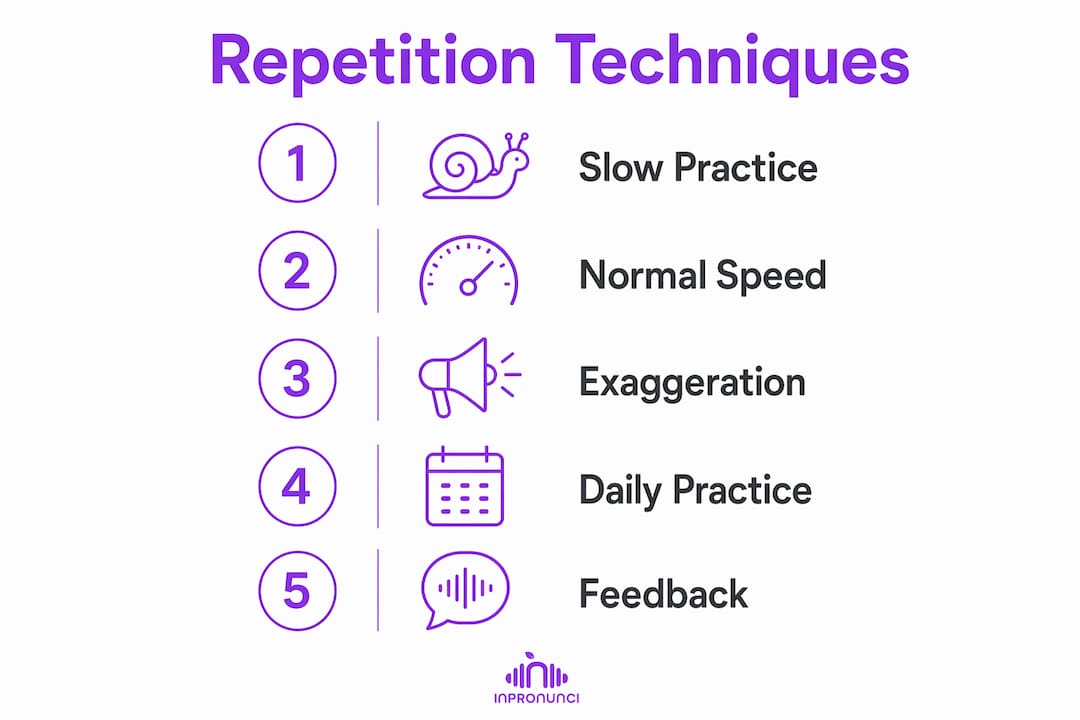
Pro Tip: Practice the same sentence in three ways: slowly for accuracy, at normal speed for fluency, and with exaggerated stress for awareness. This variation prevents your brain from going on autopilot.
Research recommends 25–30 minutes of daily practice combining perception and production. Short, focused sessions outperform longer, unfocused ones for building procedural speech habits. The same principle applies whether you are learning American English or learning Chinese pronunciation. Consistent daily exposure beats occasional marathon sessions.
| Technique | Best for | Session length |
|---|---|---|
| Shadowing | Rhythm, intonation, connected speech | 10–15 minutes |
| Minimal pair drills | Vowel and consonant accuracy | 5–10 minutes |
| Sentence repetition | Stress and natural flow | 5–10 minutes |
| Spaced repetition | Long-term retention | Daily, short cycles |
Common misconceptions about repetition-based practice
The biggest misconception is that more repetition always means faster progress. Volume without quality produces plateaus, not results. Repeating a sound incorrectly 100 times trains the wrong pattern just as effectively as repeating it correctly.
Practicing isolated phonemes without connected speech rhythm, stress, and intonation is a common mistake. American English is a stress-timed language. Its natural rhythm depends on which syllables are stressed and how words link together. Drilling the /æ/ sound in isolation, without ever practicing it inside words and sentences, produces unnatural speech.
Common pitfalls to avoid:
- Repeating without listening critically to your own output
- Skipping intonation and rhythm in favor of individual sounds only
- Practicing for long periods without breaks, which reduces retention
- Relying on one technique and ignoring others
- Practicing without any feedback, which allows errors to solidify
Oral task repetition has shifted in research from a short-term planning tool to a long-term practice tool for skill transfer. This means repetition works best when you treat it as a long-term investment, not a quick fix. Consistency over weeks and months produces the kind of change that transfers to real conversations, meetings, and presentations.
How to use Inpronunci’s tools for accelerated accent mastery
Inpronunci applies the science of repetition through three integrated systems that work together to produce real results.
- 2D Sound Video Simulators. These
interactive mouth-training simulators show exactly how native speakers position their tongue, lips, and jaw for each American sound. You see the movement, then repeat it. This visual feedback removes the guesswork from repetition and makes each practice cycle more accurate.
- AI Accent Coach. As you speak, the AI Accent Coach evaluates your pronunciation, intonation, rhythm, and connected speech in real time. It identifies errors immediately, so you correct them before they become habits. This is intelligent repetition, not blind drilling.
- Human-Guided Instructions. These instructions work like a real accent coach, guiding you through each sound, sentence, and speaking situation. You always know what to practice, how to practice it, and whether you are on the right track.
Inpronunci’s daily practice plan structures your repetition from individual sounds to words, sentences, paragraphs, and real speaking situations. You build accuracy at each level before moving to the next. This progression prevents the common mistake of rushing to conversation before the foundational sounds are stable.
You can start with the Free Chapter 1, “Get to Know Your Speech Organs,” which teaches you how your mouth produces sound before you begin repeating anything. The Basic Plan gives you self-study access with AI and human-guided support. The Premium Plan adds monthly 1-on-1 sessions with Prof. Alex., Ph.D., for personalized guidance. See real learner results from
Andrew,
Thiago, and
InPronunci training structure
How InPronunci trains the American speech system
InPronunci trains the full American speech system: Interactive 2D Sound Video Simulators and phonetic exercises for articulation and American sound development, sentence practice for intonation, melody, rhythm, and connected speech, paragraph practice for spontaneous speech, public speaking, and real communication confidence, and Advanced AI Accent Coach evaluation as you speak.
InPronunci is a newer, advanced, and linguistically structured American accent training platform with more than 1,000 downloads and a growing learner base. It is designed for serious learners who want clearer American pronunciation, stronger intonation, more natural rhythm, better connected speech, and the ability to speak English more confidently in real communication. The program is especially useful for intermediate and advanced English speakers who want to become independent speakers of English with confident communication, stronger speaking control, long-term speech improvement, and great public speaking skills. It is also designed for advanced speakers whose goal is to speak like a native or closer to native-like American speech, including people who were raised in the United States but still have slight accent patterns from the native language they were born with.
Tian.
Key Takeaways
Repetition builds pronunciation mastery only when it is structured, consistent, and combined with accurate feedback at every stage of practice.
| Point | Details |
|---|---|
| Repetition builds neural pathways | Consistent practice moves sounds from conscious effort to automatic speech. |
| NECTAR cycle prevents rote drilling | Notice, Ear training, Copy, Target, Articulate, Repeat produces real articulatory understanding. |
| 25–30 minutes daily is optimal | Short, focused sessions combining perception and production outperform long, unfocused ones. |
| Connected speech must be included | Practicing isolated sounds without rhythm and intonation produces unnatural American English. |
| Feedback is non-negotiable | Repeating without correction solidifies errors rather than eliminating them. |
Why I think most learners misunderstand repetition entirely
Most learners treat repetition as a volume problem. They believe that if they just practice more, their accent will improve. That belief is the single most common reason learners plateau.
What I have seen consistently, working with learners across proficiency levels, is that the quality of each repetition cycle matters far more than the number of cycles. A learner who practices 15 minutes a day with clear visual feedback, immediate error correction, and structured progression will outperform someone drilling for an hour without guidance. The low-pressure, engaging environment is not a luxury. It is a requirement for the brain to consolidate new speech patterns.
The other thing most learners miss is the role of perception. You cannot produce a sound you cannot hear accurately. Ear training must come before production in every repetition cycle. That is why the NECTAR framework starts with noticing and listening before you ever open your mouth to copy. Skipping that step is like trying to paint a room without looking at the color first.
My advice is direct: commit to 25–30 minutes of structured daily practice, use tools that show you exactly how sounds are made, and get feedback every time you speak. That combination is what turns repetition into mastery.
— Prof. Alex., Ph.D. Accent Coach
Inpronunci’s American Accent Training: structured repetition that works
Inpronunci is built for learners who are serious about clear American English. Every lesson applies the principles covered in this article: structured repetition, visual feedback, real-time correction, and progressive skill building from sounds to real speech.
The American Accent Training step-by-step course guides you through vowels, consonants, stress, rhythm, intonation, and connected speech with 2D Sound Video Simulators, an AI Accent Coach, and human-guided instructions. You are never practicing alone or guessing whether you are doing it right. Start with the Free Chapter 1 at learn.inpronunci.com/sign-up, download the app on the App Store or Google Play, or book a free Premium session with Prof. Alex., Ph.D. at calendar.app.google/VATsvVHVb7HdU9Pb9.
FAQ
What is the role of repetition in pronunciation mastery?
Repetition strengthens the neural pathways and speech motor patterns needed for automatic, accurate sound production. Without consistent repetition, pronunciation skills remain fragile and require conscious effort rather than flowing naturally.
How many minutes a day should I practice pronunciation?
Research recommends 25–30 minutes of daily focused practice combining perception and production. Short, consistent sessions build procedural speech habits more effectively than occasional longer ones.
Why does mindless repetition not improve my accent?
Repeating sounds without feedback or structure reinforces errors instead of correcting them. Effective repetition requires noticing mistakes, understanding how sounds are produced, and correcting output in each practice cycle.
Should I practice sounds in isolation or in sentences?
Sentence-level practice is more effective for American English because it trains stress, rhythm, and intonation together. Isolated sound drills are useful for targeting specific errors but must be combined with connected speech practice to transfer to real conversation.
How does Inpronunci support repetition-based pronunciation training?
Inpronunci combines 2D Sound Video Simulators, an AI Accent Coach, and human-guided instructions to make every repetition cycle accurate and corrective. Learners receive real-time feedback as they speak, which prevents errors from becoming habits.