


American accent training step by step is a deliberate, daily process that builds clarity and naturalness through consistent practice of sounds, rhythm, and intonation. The industry term for this work is accent modification, and it covers everything from individual phoneme production to the suprasegmental features that make speech sound fluent and natural. For non-native English professionals, structured training pays off in meetings, presentations, and job interviews where clarity directly affects how you are perceived. Tools like shadowing, self-recording, and apps such as Inpronunci give you a repeatable system to improve American pronunciation without guesswork or wasted time.
Structured American Accent Training Course
From Speech Organs Education to American Intonation
The InPronunci course is built step by step: every chapter prepares the next one, and by the end of the course students receive a certificate.
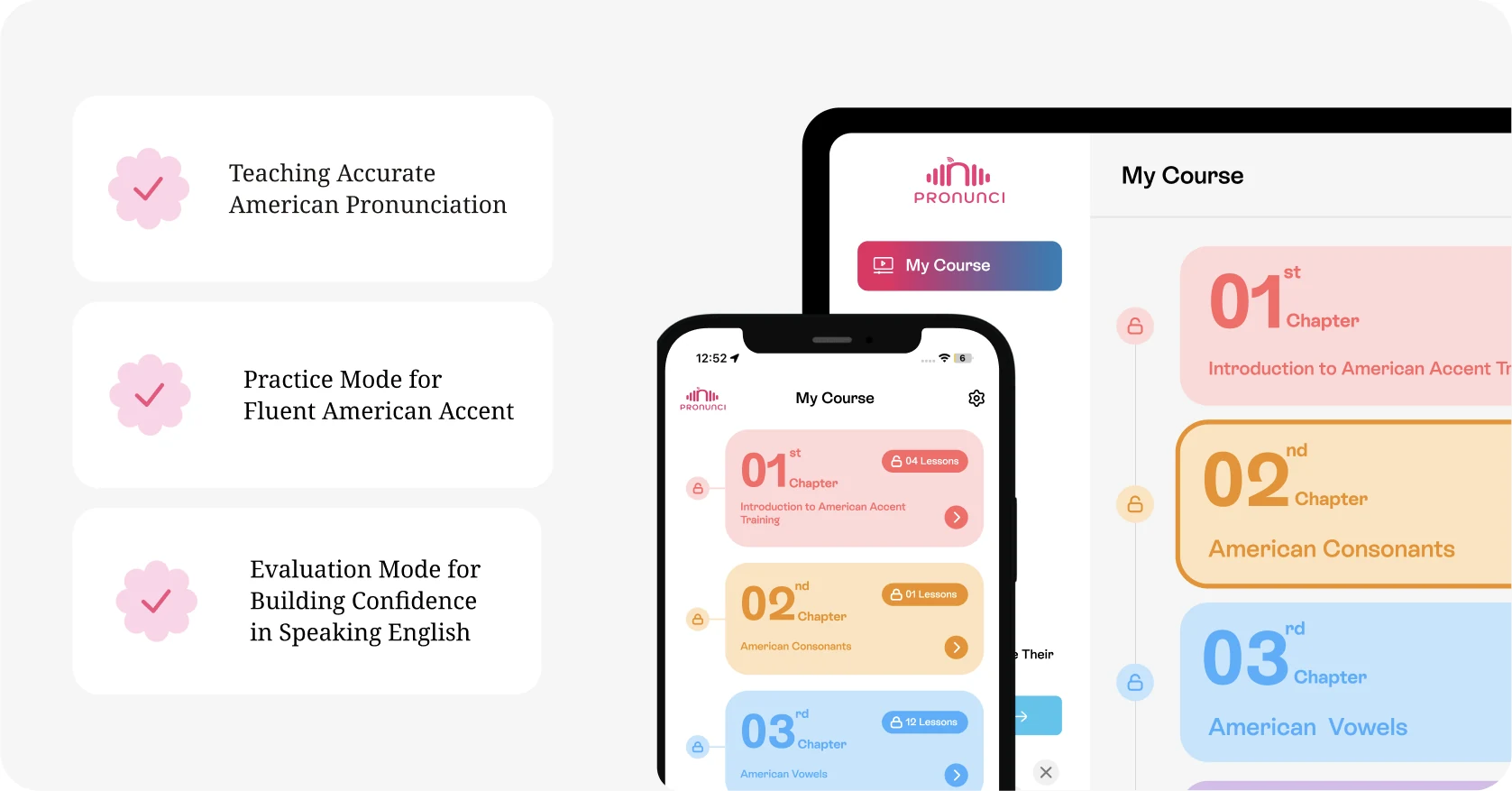
- Speech Organs EducationStudents learn how the speech organs work, along with the AI Accent Coach commands and feedback.
- American ConsonantsPractice and evaluate American consonants in phonetic exercises and practice sentences with the AI Accent Coach.
- American VowelsPractice and evaluate American vowels in phonetic exercises and practice sentences with the AI Accent Coach.
- IntonationLearn how intonation can change the meaning of what you say.
- CertificateBy the end of the course, students receive a certificate.
What do you need before starting American accent training step by step?
The right setup makes training faster and more consistent. Before your first session, gather these tools:
-
Audio clips of American English speakers. Podcasts, TED Talks, and news broadcasts work well. Choose speakers with a General American accent, the standard used in broadcast media and most professional settings.
-
A recording device. Your smartphone is enough. You need to hear yourself back, not just feel how you sound while speaking.
-
An IPA chart or American pronunciation guide. The International Phonetic Alphabet maps every sound to a symbol. You do not need to memorize it, but referencing it helps you identify exactly which sounds need work.
-
A dedicated app. Inpronunci provides structured lessons, AI feedback, and 2D mouth training simulators that show tongue and lip placement for each American sound.
Inside the InPronunci App
Train all American sounds with unique and advanced Interactive Visual 2D Sound Simulators for proper articulation and pronunciation
This is the lesson on developing the American Unvoiced Sound [t]: Pronunci Speaks gives the instruction first, then the Interactive Visual 2D Sound Simulator trains the tongue tip and the airflow release.
- EffectiveMost apps offer visual learning. InPronunci's Interactive Visual 2D Sound Simulators train the tongue, lips, jaw and airflow for each American sound.
- ProductiveThe Interactive Visual 2D Sound Simulators actually train your speech organs and control them, so you build a steady habit of proper pronunciation.
- ResultsStudents pronounce individual American sounds with almost native-like pronunciation.
Start Chapter 1 freeChapter 1 is free in the InPronunci app.
Your mindset matters as much as your tools. Accent modification requires patience and consistency over weeks, not days. Set one specific goal per week, such as mastering the American flap T or the short vowel in “cat.” Specific goals produce measurable progress. Vague goals produce frustration.
Choose your accent model before you start. General American is the best target for most professionals because it is widely understood across regions and industries. Avoid mixing regional accents during training. Consistency in your model speeds up muscle memory formation.

How to do the 10-minute daily routine for American accent training
A structured 10-minute routine covers every layer of American pronunciation without overwhelming a busy schedule. Follow this sequence every day.
The full 10-minute sequence
-
Minutes 1–2: Mouth warm-up. Loosen your articulators before any speaking practice. Stretch your lips wide, round them forward, and move your jaw in slow circles. Hum a scale to activate your vocal cords. This step reduces tension and improves sound accuracy.
-
Minutes 3–4: Shadowing. Play a short American English clip, 20–30 seconds, and repeat it simultaneously or with a slight delay. Focus on rhythm and stress, not perfect pronunciation. Successful shadowing prioritizes mirroring prosody before focusing on clear articulation. Mumbling the rhythm correctly is a real milestone, not a failure.
-
Minutes 5–6: Focused sound practice. Pick one phoneme that challenges you. Common targets for non-native professionals include the American flap T (the sound in “butter” or “water”), the voiced TH (as in “the”), and the short vowel in “bad.” Repeat the target sound in isolation, then in words, then in short phrases.
-
Minutes 7–8: Read aloud with stress marking. Take a paragraph from a business article or script. Mark the stressed syllables with a pencil before reading. Then read aloud, exaggerating the stress contrast between strong and weak syllables. This trains prosody, the rhythm and melody of American speech.
-
Minutes 9–10: Record and review. Record your read-aloud from the previous step. Play it back and compare it to a native speaker recording of the same text. Self-recording after each drill block helps identify subtle errors unseen during speaking, accelerating mastery.
Pro Tip: Resist the urge to skip the warm-up. Cold articulators produce sloppy sounds. Two minutes of warm-up changes the quality of everything that follows.
| Minute | Activity | Focus |
|---|---|---|
| 1–2 | Mouth warm-up | Lip, jaw, and vocal cord activation |
| 3–4 | Shadowing | Rhythm and stress mirroring |
| 5–6 | Sound focus | One target phoneme in context |
| 7–8 | Stress reading | Prosody and sentence rhythm |
| 9–10 | Record and review | Self-correction and feedback |
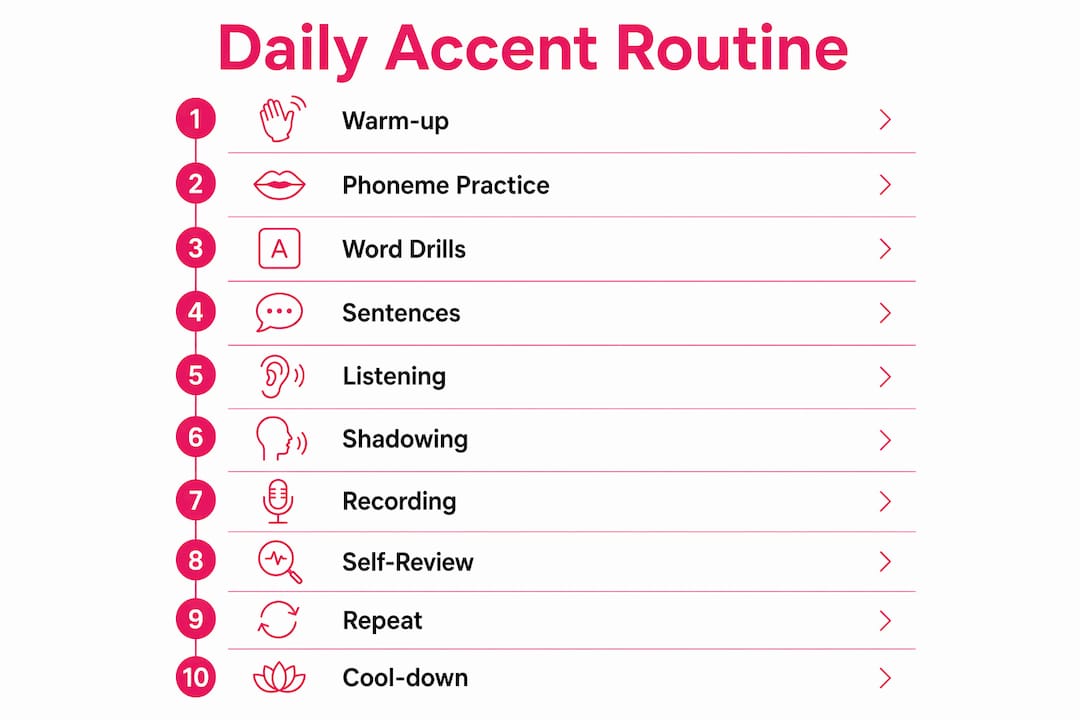
The 10-minute version follows the same principle. Short, daily, and structured beats long and occasional every time.
Why do rhythm, intonation, and stress matter more than perfect sounds?
Suprasegmental training covering stress, rhythm, and intonation impacts perceived communicative ease more than accent deviation alone. That finding changes how you should prioritize your training time.
Here is the practical difference:
| Feature | What it covers | Why it matters |
|---|---|---|
| Word stress | Which syllable gets emphasis | Wrong stress makes words unrecognizable |
| Sentence stress | Which words carry the main idea | Listeners use stress to find meaning |
| Rhythm | Pattern of strong and weak syllables | American English is stress-timed, not syllable-timed |
| Intonation | Rise and fall of pitch across phrases | Signals questions, statements, and emotions |
“Multimodal approaches with music, gamification, and acoustic speech-organ training improve comprehensibility significantly.” — Frontiers in Education, 2026
That research points to a practical method. Use acoustic visualization tools, apps that display your pitch curve or waveform, to see your intonation patterns. Gamified practice keeps you engaged long enough to build real habits. Inpronunci’s AI Accent Coach displays feedback on rhythm and intonation as you speak, giving you a visual and auditory reference at the same time.
The most common mistake professionals make is drilling individual sounds while ignoring prosody. A perfectly produced “R” sound still sounds unnatural if your sentence stress is wrong. Train rhythm and intonation alongside sounds, not after them.
How does technology accelerate your accent mastery?
Recording yourself and comparing your speech to native speaker models is a highly valuable self-study technique available. Most learners skip it because listening to yourself feels uncomfortable. That discomfort is exactly where improvement lives.
Key practices for using technology well:
-
Record every session. Use your phone or a free app. Replay the recording immediately after each drill block, not at the end of the week.
-
Use an AI feedback app. AI feedback apps help learners target challenging American sounds, interpret scores, and maintain motivation through measurable progress. Inpronunci’s AI Accent Coach gives real-time feedback on the flap T, TH sounds, vowels, and connected speech patterns.
-
Use 2D mouth simulators. Inpronunci’s 2D Sound Motion Technology diagnoses tongue placement and articulatory deviation from native models. Seeing exactly where your tongue should sit for a sound removes the guesswork that slows most learners down.
-
Track your scores over time. Progress in accent modification is gradual. Weekly score comparisons show movement even when daily practice feels flat.
Pro Tip: After recording, listen with headphones. Speakers distort your voice. Headphones reveal the actual quality of your sounds, especially vowel clarity and final consonants.
Achieving American sound system mastery requires roughly 3,000 repetitions of a new sound pattern to build automatic speech habit. Technology shortens that timeline by telling you immediately when a repetition is wrong, so you are not reinforcing a bad habit 3,000 times.
What are the most common challenges in step-by-step accent training?
Every professional hits the same walls during accent modification. Knowing them in advance keeps you from quitting at the wrong moment.
-
The rhythm plateau. Early in shadowing, you mumble the rhythm correctly but your words are unclear. This is normal and necessary. Prioritize prosody before precision during shadowing to avoid robotic speech. Skipping this phase produces stilted, unnatural output.
-
Robotic speech. Learners who focus only on individual sounds often produce speech that is technically correct but sounds mechanical. The fix is to return to shadowing and read-aloud practice with exaggerated natural stress.
-
Progress plateaus. After two to three weeks, improvement slows. This is when most people quit. The solution is to change your practice material, not your method. New clips, new texts, and new phoneme targets restart the learning curve.
-
Accuracy versus naturalness. Professional communication requires naturalness, not perfection. A slightly accented speaker with strong rhythm and clear stress is easier to understand than a technically precise speaker with flat intonation.
-
Unrealistic timelines. Accent modification takes months of consistent practice. Set a 90-day goal, not a 2-week goal. Measure progress by recording comparisons, not by how you feel on any given day.
Structured daily practice of sounds, rhythm, and intonation is the fastest path to clearer American English for non-native professionals.
What I have learned from watching professionals train their accents
The biggest mistake I see busy professionals make is treating accent training like vocabulary study. They memorize rules, read about phonetics, and then wonder why their speech does not change. Accent modification is physical training. Your tongue, lips, and jaw need repetition the way a musician’s fingers need scales.
The professionals who improve fastest share one habit: they practice out loud, every day, even for 10 minutes. They do not wait for a perfect block of time. They record themselves in the car, shadow a podcast during a lunch break, and review their recordings before bed. Consistency beats intensity every time.
The second thing I have learned is that prosody is the real unlock. I have worked with professionals who had near-perfect individual sounds but were still hard to follow in meetings. The moment they started training sentence stress and intonation, their colleagues noticed the difference within weeks. Rhythm is what makes speech feel natural to a listener, even when the accent is still present.
If you are a non-native professional, do not wait until your pronunciation feels ready. Start recording yourself in real professional situations, presentations, calls, and meetings, and use that material as your training content. The gap between your practice voice and your professional voice closes faster when you train with real stakes.
— Prof.
Inpronunci: a structured path for professionals
Accent modification works best when your training is organized, progressive, and guided by real feedback. Inpronunci’s American accent training program is built by Ph.D. linguists who train translators and interpreters, and it follows the exact step-by-step sequence described in this article.
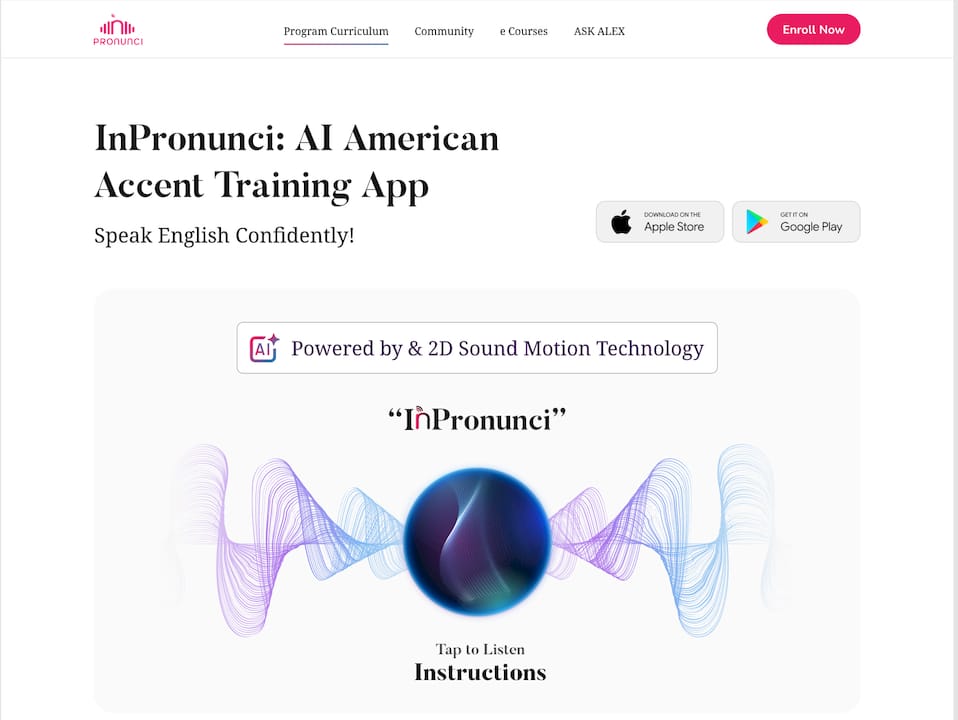
The program moves from speech-organ positioning and individual sounds through words, sentences, and real speaking situations. Inpronunci’s AI Accent Coach gives feedback on your pronunciation, rhythm, and intonation as you speak. The 2D Sound Motion Technology trains you to position your tongue and lips for each American sound. The full curriculum includes a free first chapter so you can assess the method before committing. Premium members get monthly 1-on-1 sessions with a Ph.D. accent coach for personalized guidance.
Questions & Answers
FAQ
01What is American accent training step by step?
American accent training step by step, also called accent modification, is a structured method that builds American pronunciation through daily practice of sounds, rhythm, stress, and intonation in a fixed sequence. The process moves from individual phonemes to connected speech and real speaking situations.
02How long does it take to see results?
Most professionals notice measurable improvement in clarity within 4–8 weeks of consistent daily practice. Full accent modification typically takes several months of structured training.
03Is shadowing the best method for learning an American accent?
Shadowing is one of the best methods because it trains rhythm and prosody simultaneously with sound production. Shadowing stages progress from active listening through mumbling rhythm to blind shadowing with a delay, with AI evaluation at the end.
04What American sounds are hardest for non-native professionals?
The American flap T (as in “water”), the voiced and voiceless TH sounds, the short vowel in “bad,” and the American R are consistently the most difficult for non-native speakers across most language backgrounds.
05Can I train my accent without a teacher?
Yes, with the right tools. Self-recording, AI feedback apps, and structured programs like Inpronunci give you the feedback loop that a teacher would provide. Premium plans with 1-on-1 coaching accelerate progress for professionals with specific goals.
Recommended
American Accent Training for Beginners: Daily Practice Plan
A structured daily practice plan for American accent training — designed by Prof. Alex., Ph.D. Learn the sounds, stress, rhythm, and connected speech patterns that matter
The Strategic Guide to American Accent Training for Professionals in 2026
Unlock your executive potential with our 2026 guide to American accent training. Master clarity with advanced tech and expert coaching to lead with confidence.

Accent Reduction For Professionals: Methods That Work
Master workplace clarity. Discover effective accent reduction for professionals with proven methods for sound retraining, intonation, and daily practice — by Prof. Alex,
Article generated by BabyLoveGrowth
InPronunci training structure
How InPronunci trains the American speech system
InPronunci trains the full American speech system: Interactive Visual 2D Sound Simulators and phonetic exercises for articulation and American sound development, sentence practice for intonation, melody, rhythm, and connected speech, paragraph practice for spontaneous speech, public speaking, and real communication confidence, and Advanced AI Accent Coach evaluation as you speak.
InPronunci is an advanced, linguistically structured American accent training platform with more than 1,000 downloads and a growing learner base. It is designed for serious ESL learners who want American pronunciation, stronger intonation, more natural rhythm, better connected speech, and the ability to speak English more confidently in real communication. The program is especially useful for intermediate and advanced English speakers who want to become independent speakers of English with confident communication, stronger speaking control, long-term speech improvement, and great public speaking skills. It is also designed for advanced speakers whose goal is to speak like a native or closer to native-like American speech, including people who were raised in the United States but still have slight accent patterns from the native language they were born with. It is a complete American accent training course and system created by Prof. Alex, Ph.D. Accent Coach, Doctor of Education, and professional linguist based in Austin, Texas, with Pronunci Instructions from Prof. Alex for each lesson that make self-learning more effective, supported, and clear.
Plans
What InPronunci costs
InPronunci Basic
$35 per month
Chapter 1 is free after signup.
InPronunci Premium
$200 per month
Includes a coach: