
TL;DR:
- Advanced ESL pronunciation training focuses on suprasegmentals like stress, rhythm, and intonation to achieve clear American English speech. Consistent, perception-first practice with tools like visual feedback and shadowing enhances intelligibility faster than phoneme drills alone. Regular short sessions over weeks lead to noticeable improvements in workplace communication and confidence.
Advanced ESL pronunciation techniques are the structured methods non-native professionals use to achieve clear, confident American English speech in workplace settings. The recognized industry term for this work is suprasegmental training, which covers stress, rhythm, and intonation rather than isolated sounds. Focusing on suprasegmentals delivers faster gains in professional intelligibility than drilling individual phonemes alone. Inpronunci’s curriculum, designed by Ph.D. linguists, builds exactly this skill set through interactive 2D simulators, AI feedback, and human-guided instruction. You can see
measurable results in clarity and confidence with as little as 10 minutes of focused daily practice.
What are the key advanced pronunciation features affecting American English clarity?
American English is a stress-timed language. That means stressed syllables fall at roughly equal intervals, and unstressed syllables compress to fill the gaps. Speakers from syllable-timed language backgrounds, such as Spanish, Mandarin, or French, give every syllable equal weight. That single habit causes more miscommunication in meetings than mispronounced vowels ever will.
Four features control intelligibility at the advanced level:
- Word stress: Placing emphasis on the correct syllable changes meaning. “REcord” (noun) versus “reCORD” (verb) are two different words to an American listener.
- Sentence stress: Content words carry stress; function words reduce. “I NEED the REPORT by FRIDAY” sounds natural. Stressing every word sounds robotic.
- Intonation: Falling pitch signals a statement or command. Rising pitch signals a yes/no question. Mismatched intonation makes statements sound like questions and creates confusion in presentations.
- Connected speech: Americans link, reduce, and compress words in natural conversation. “Did you eat yet?” becomes “Dijeet yet?” Recognizing and producing these patterns is a core advanced skill.
Pro Tip: Record yourself reading the same sentence with stress on different words. Play it back and notice how the meaning shifts. This single drill trains both your ear and your production at the same time.
What foundational skills do you need before advanced practice?
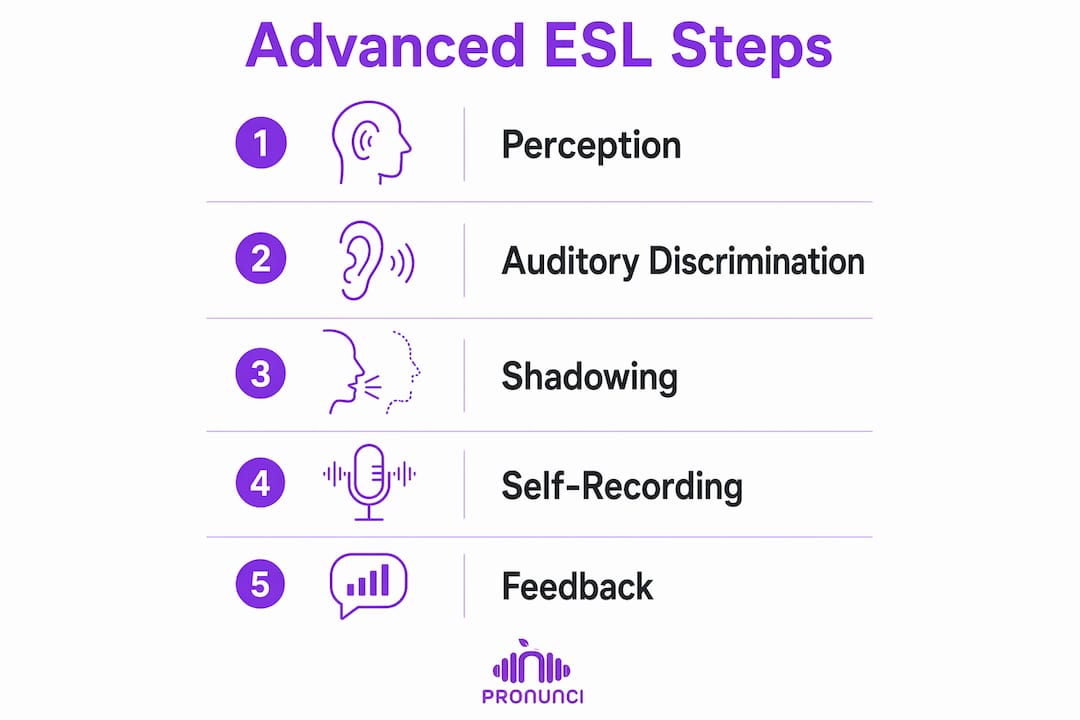
Pronunciation training follows a layered sequence: perception first, production second. Skipping perception training and jumping straight to shadowing is the most common mistake advanced learners make. You cannot consistently produce a sound you cannot reliably hear.
The prerequisite sequence looks like this:
- Auditory discrimination: Train your ear to distinguish minimal pairs such as “ship/sheep,” “bit/beat,” and “cot/caught.” Research shows learners must reach 80% accuracy in discrimination before production drills become effective. Below that threshold, you reinforce errors instead of correcting them.
- Articulatory awareness: Learn where your tongue, jaw, and lips need to be for each American sound. This is physical motor training, not memorization.
- Visual feedback: Use tools that show you mouth movement in real time. Inpronunci’s
InPronunci training structure
How InPronunci trains the American speech system
InPronunci trains the full American speech system: Interactive 2D Sound Video Simulators and phonetic exercises for articulation and American sound development, sentence practice for intonation, melody, rhythm, and connected speech, paragraph practice for spontaneous speech, public speaking, and real communication confidence, and Advanced AI Accent Coach evaluation as you speak.
InPronunci is a newer, advanced, and linguistically structured American accent training platform with more than 1,000 downloads and a growing learner base. It is designed for serious learners who want clearer American pronunciation, stronger intonation, more natural rhythm, better connected speech, and the ability to speak English more confidently in real communication. The program is especially useful for intermediate and advanced English speakers who want to become independent speakers of English with confident communication, stronger speaking control, long-term speech improvement, and great public speaking skills. It is also designed for advanced speakers whose goal is to speak like a native or closer to native-like American speech, including people who were raised in the United States but still have slight accent patterns from the native language they were born with.
2D Sound Video Simulators display tongue, lip, jaw, and airflow movement for every American sound. Research confirms that visual feedback tools improve both motor control and perceptual discrimination at the advanced level.
- Consistent daily practice: Short, focused sessions beat long, infrequent ones. Fatigue degrades motor learning, so 10–15 minutes of deliberate practice outperforms a 90-minute session done twice a week.
| Prerequisite skill | Why it matters |
|---|---|
| Auditory discrimination | Prevents reinforcing errors during production drills |
| Articulatory awareness | Builds physical control of tongue, jaw, and lip position |
| Visual feedback training | Accelerates motor learning for accurate sound production |
| Daily consistent practice | Supports neural restructuring needed for lasting change |
How can professionals effectively practice advanced ESL pronunciation techniques?
Active production in structured environments drives progress at the advanced level. Passive listening, watching videos, or reading about pronunciation does not build the muscle memory you need for real speaking situations.
The most effective practice methods for professionals are:
- Minimal pairs drills: Cycle through two or three sound contrasts per week. Spacing repetitions across multiple sessions improves retention far better than massing all drills into one sitting.
- Shadowing: Listen to a short native-speaker clip of 10–15 seconds, then speak simultaneously or immediately after. Shadowing methodology works best when you layer skills: first match rhythm, then add intonation, then focus on connected speech. Do not try to fix everything at once.
- Self-recording and comparison: Record yourself, then compare your recording to a native speaker model. Objective listening reveals errors your brain filters out during live speech. Inpronunci’s unlimited voice recording and native speaker comparison tools make this process fast and clear.
- Live interactive practice: Structured live speaking with feedback is more effective than passive self-study for prosody and pragmatic adaptation. Practice in realistic contexts: simulate a meeting, rehearse a presentation opening, or role-play a client call.
Pro Tip: Block 10 minutes every morning before your first meeting. Use five minutes for a shadowing drill and five minutes for self-recording. This schedule fits any professional calendar and builds a daily habit without disrupting your workday.
What common challenges block progress at the advanced level?

The most frustrating stage in ESL pronunciation improvement is the plateau. You sound fluent, but something still feels off. Colleagues occasionally ask you to repeat yourself. You know you are close, but you cannot identify what to fix.
Three specific traps cause most advanced plateaus:
- Invisible errors: These are pronunciation habits so ingrained that you no longer hear them. A fresh recording, compared against a native model, makes them audible again.
- Perfectionism: The goal of advanced pronunciation training is professional intelligibility, not a native accent. Chasing a native sound causes frustration and slows real progress. Clarity on the first try is the actual target.
- Register rigidity: Advanced learners often master formal speech but struggle in fast, informal conversations. Practice in both registers. Record yourself in a casual retelling of your weekend, not just in a scripted presentation.
Effective error correction requires feedback from outside your own perception. Inpronunci’s AI Accent Coach gives real-time feedback on pronunciation, intonation, rhythm, and connected speech as you speak. That external signal breaks the cycle of self-monitoring without self-correction. For deeper guidance, the Premium Plan connects you directly with Prof. Alex., Ph.D. in a 1-on-1 monthly session.
What results can advanced pronunciation training deliver for professionals?
Clear pronunciation produces concrete workplace outcomes. Professionals who train suprasegmentals report fewer requests to repeat themselves, stronger presence in meetings, and greater confidence in presentations and client calls. These are not minor social improvements. They directly affect how colleagues and clients assess your competence.
Ten minutes of daily focused practice using techniques like shadowing and self-recording produces noticeable gains in clarity and confidence. That finding matters because it removes the most common excuse: not enough time. The barrier is not hours. It is consistency and method. Six weeks of steady, low-volume daily practice builds the neural restructuring that makes new pronunciation patterns automatic rather than effortful.
Track your progress with specific benchmarks. Record yourself in week one, week three, and week six. Compare the recordings against a native speaker model. Listen for stress placement, intonation shape, and connected speech patterns. Progress becomes visible and motivating when you measure it this way.
Key takeaways
Advanced ESL pronunciation improvement requires suprasegmental training, perception-first sequencing, and consistent active practice to deliver lasting clarity in professional American English.
| Point | Details |
|---|---|
| Suprasegmentals drive clarity | Train stress, rhythm, and intonation before focusing on individual sounds. |
| Perception precedes production | Reach 80% auditory discrimination accuracy before starting production drills. |
| Active practice beats passive study | Shadowing, self-recording, and live interaction build skills that passive listening cannot. |
| 10 minutes daily is enough | Short, focused daily sessions produce measurable gains in clarity and confidence. |
| Intelligibility is the goal | Clear speech on the first try matters more than sounding like a native speaker. |
What I have learned training professionals to speak clearer American English
After years of training translators, interpreters, and non-native professionals, one pattern stands out clearly. The learners who improve fastest are not the ones who practice the longest. They are the ones who practice with the most precision and the most honest feedback.
The biggest mistake I see at the advanced level is treating pronunciation like a vocabulary list. You cannot memorize your way to clear speech. You have to retrain your speech organs, and that requires seeing what you are doing wrong, not just hearing it. That is exactly why Inpronunci’s 2D Sound Video Simulators exist. They show you tongue and lip position in real time so you stop guessing and start correcting.
My honest advice: commit to the boring middle. The first two weeks feel exciting. Weeks three through five feel slow. That slow period is when neural restructuring actually happens. Stay consistent, track your recordings, and trust the process. Clarity is not a talent. It is a trained skill.
— Prof. Alex., Ph.D. Accent Coach
How Inpronunci trains advanced ESL pronunciation for professionals
Inpronunci is built specifically for intermediate and advanced learners who need more than repetition drills. The American Accent Training course guides you step by step through sounds, stress, rhythm, intonation, and connected speech using 2D Sound Video Simulators, an AI Accent Coach, and human-guided instructions.
Start with the free Chapter 1, “Get to Know Your Speech Organs,” and build the physical foundation for every sound you will train. The Basic Plan gives you AI feedback and human-guided instruction for self-study. The Premium Plan adds a monthly 1-on-1 session with Prof. Alex., Ph.D. for personalized coaching. You can also book a free Premium session to experience the coaching approach before you commit. Sign up at learn.inpronunci.com or download the app on the App Store or Google Play.
FAQ
What are advanced ESL pronunciation techniques?
Advanced ESL pronunciation techniques are structured methods that train suprasegmentals, including stress, rhythm, intonation, and connected speech, to improve professional intelligibility in American English. They go beyond individual sound drills to address how words and sentences flow together.
How long does it take to see results from pronunciation training?
Ten minutes of daily focused practice using shadowing and self-recording produces noticeable improvements in clarity and confidence. Consistent daily practice over six weeks builds the neural patterns needed for lasting change.
Why is perception training done before production drills?
Learners must reach 80% accuracy in auditory discrimination before production drills become effective. Practicing production before that threshold reinforces existing errors rather than correcting them.
What is the difference between segmental and suprasegmental training?
Segmental training focuses on individual sounds such as vowels and consonants. Suprasegmental training covers stress, rhythm, and intonation patterns that shape how natural and clear your speech sounds across full sentences and conversations.
Is a native accent the goal of advanced pronunciation training?
Professional intelligibility is the goal, not a native accent. Clear speech that listeners understand on the first try is the standard that matters most in workplace communication.