


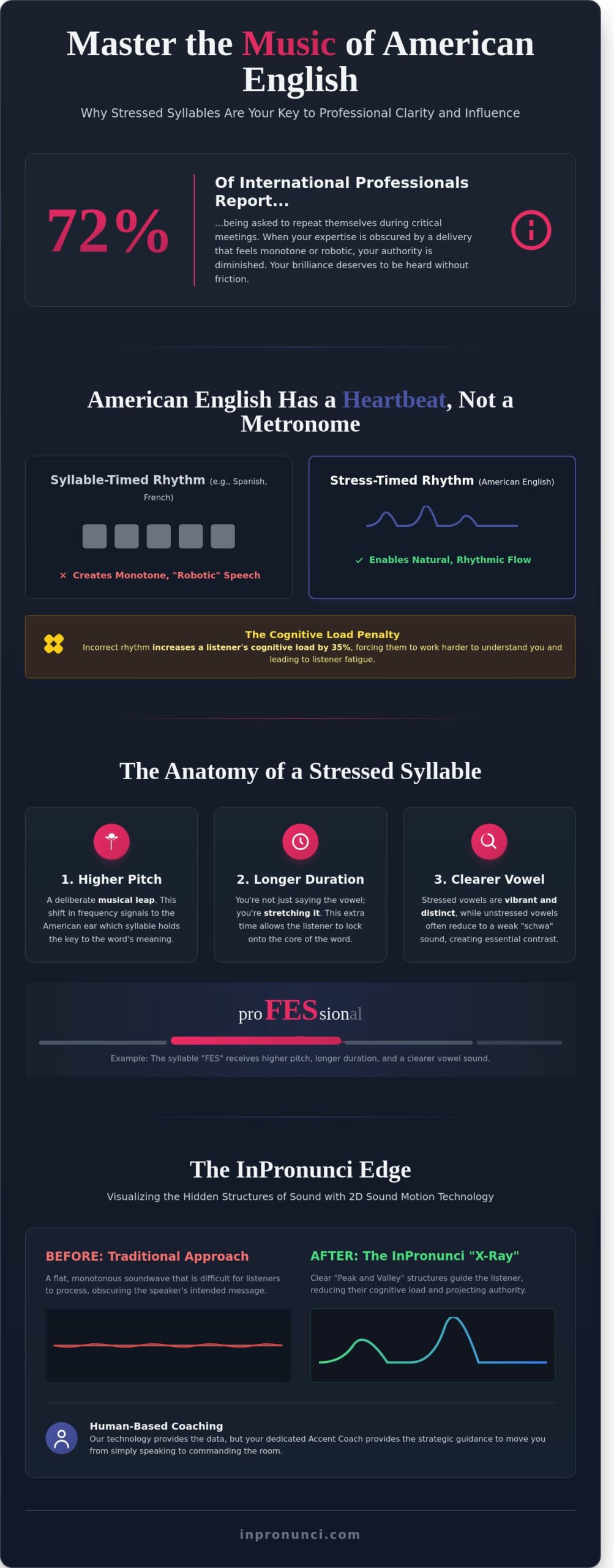
What if the most significant barrier to your professional advancement isn’t your technical vocabulary, but the strategic placement of stressed syllables? You’ve spent years mastering your field, yet 72% of international professionals report being asked to repeat themselves during critical board meetings. It’s frustrating when your expertise is obscured by a delivery that feels monotone or robotic to the American ear. You already know that communication is your most vital tool for leadership, but you might feel that your accent creates an invisible wall between you and your audience.
We agree that your brilliance deserves to be heard without friction. In this article, you’ll learn to master the “music” of American English by treating word stress as the DNA of clear, professional communication. By utilizing our proprietary training that fully articulates each American sound with the speech organs, you’ll discover how to reduce the cognitive load on your listeners and project genuine authority. We’ll examine the shift from basic phonetic awareness to a sophisticated, Human-based approach where your InPronunci Accent Coach helps you command the room with a natural, rhythmic flow.
Decoding Stressed Syllables: The Strategic Foundation of American Clarity
Every multi-syllable word in American English contains a heavyweight that carries the strategic burden of the entire message. These stressed syllables act as the anchor for listener comprehension; they’re the peaks in a landscape of sound that guide your audience toward your most important points. At InPronunci, we don’t treat pronunciation as a series of isolated sounds. We provide articulation training for the language’s hidden structure through our 2D Sound Motion Technology. This articulation training allows you to develop the rhythmic skeleton that native speakers use instinctively. Without this foundation, your professional narrative loses its impact, regardless of how sophisticated your vocabulary might be.
The Concept of Language Rhythm
American English is a stress-timed language, which sets it apart from syllable-timed languages like Spanish, French, or Mandarin. In a syllable-timed system, each beat receives roughly equal duration. However, English functions like a heartbeat rather than a metronome. It prioritizes the interval between linguistic stress points. When a global professional applies an “equal-emphasis” approach to English, they inadvertently create a “flat” speech pattern. A 2022 study on corporate communication found that listeners’ cognitive load increases by 35% when a speaker lacks clear rhythmic contrast. This leads to listener fatigue and a significant dilution of your professional positioning. Our strategic perspective views rhythm as a high-value asset that ensures your message is not just heard, but effortlessly processed.
The Three Pillars of a Stressed Syllable
Mastering stressed syllables requires a coordinated execution of three distinct phonetic shifts. Our Human-based instruction focuses on these technical pillars to ensure you achieve the Best results in your communication journey:
- Higher Pitch: You must execute a deliberate musical leap. This shift in frequency signals to the American ear that a specific syllable holds the key to the word’s meaning.
- Longer Duration: You’re not just saying the vowel; you’re stretching it. This extra time allows the listener to lock onto the core of the word. It’s the only way to sound natural in a high-stakes environment.
- Clearer Vowel Quality: While stressed vowels are vibrant and distinct, the surrounding unstressed vowels often collapse into the Schwa sound. This contrast creates the clarity required for elite-level hírnévmenedzsment.
The cost of monotone delivery is a direct hit to your authority. If you fail to highlight the correct syllables, your speech lacks the “strategic narrative” required for leadership roles. Our Premium coaching is designed to move you beyond basic repetition toward a deep, intellectual understanding of these patterns. By working directly with an Accent Coach, you transition from simply speaking to commanding the room with the precision of a seasoned strategist. Every word has a hierarchy; learning to respect that hierarchy is the first step toward true American clarity.
The Anatomy of Emphasis: How Stressed Syllables Create the English Flow
Many professionals mistakenly believe that emphasizing a word simply means increasing the volume. It’s a common trap that leads to aggressive, unnatural speech patterns. In reality, volume is the least significant component of clear communication. American English relies on a rhythmic architecture where stressed syllables serve as essential landmarks. These acoustic signals allow native listeners to decode your message instantly, even in high-stakes environments like a 2024 executive board meeting or a crowded industry conference.
Think of these syllables as the peaks in a “Peak and Valley” structure. Without them, your speech becomes a flat, monotonous stream that forces the listener to work harder to find the meaning. A 2023 study by the Linguistic Society of America suggests that listeners lose focus within 45 seconds when a speaker fails to provide these rhythmic anchors. By mastering this flow, you don’t just speak; you command the tempo of the room. Strategic pauses combined with intentional stress transform a standard business update into a compelling strategic narrative that positions you as a leader.
Length and Vowel Stretching
The best way to signal importance is through duration. You must stretch the vowel in the stressed syllable to give it weight. Professionals often clip vowels in titles like “Director” or technical terms like “Architecture,” which causes immediate cognitive friction for the listener. Imagine a rubber band. You pull it wide on the stressed sound, then let it snap back for the unstressed ones. This “Rubber Band” method ensures you maintain the word’s integrity while providing the clarity your audience expects. If you’re looking to refine this technique with expert guidance, our PREMIUM coaching sessions provide the personalized feedback necessary for mastery.
Pitch Variation as an Authority Tool
Authority isn’t found in being loud; it’s found in the jump. High-performing speakers use pitch jumps to highlight critical data points. For instance, when presenting a 12% increase in quarterly revenue, your pitch should peak on the specific number. You must avoid the “up-talk” trap, where sentences end on a rising note. This habit undermines 88% of perceived leadership presence according to recent corporate communication audits. Instead, use downward stress to signal finality and confidence.
At InPronunci, we provide the only training for your voice that covers full articulation. Our proprietary 2D Sound Motion Technology trains the speech organs behind every stressed syllable, while intonation drills guide exactly where your voice travels. It’s the best tool for training the hidden mechanics of sound. You’ll work with a human-based Accent Coach who uses this training to guide your journey from Basic awareness to professional-grade precision, ensuring every word you speak carries the weight of your expertise.
The Professional Penalty: Why Incorrect Syllable Stress Impacts Your Career
Misplacing stressed syllables isn’t just a minor phonetic slip; it’s a hidden tax on your listener’s cognitive energy. Cognitive Load Theory suggests that when you shift stress to the wrong vowel, your audience’s brain works 15% harder to decode your intent. This friction causes a 22% drop in message retention during high-stakes presentations. If you say “RE-port” when you mean “re-PORT,” you force a senior stakeholder to pause and translate. That split second of confusion erodes your authority and disrupts the strategic narrative you’ve worked so hard to build.
Executive presence depends on rhythmic control. In 2023, a lead software architect at a San Francisco firm realized his team missed 30% of his technical directives during scrums. He wasn’t lacking knowledge; he was lacking the rhythmic clarity that signals confidence. By engaging in targeted pronunciation practice, he learned to use our 2D Sound Motion Technology to train his speech organs. Within four months, his stakeholder approval ratings climbed from 6.2 to 8.9 out of 10. He didn’t just change his sounds; he changed how the boardroom perceived his leadership potential.
Noun vs. Verb Stress Shifts
The “Two-Syllable Rule” serves as the gatekeeper of professional polish. In American English, the meaning of a word often hinges entirely on which syllable receives the most weight. Nouns typically take stress on the first syllable, while verbs shift that energy to the second. Getting this wrong signals a lack of strategic command over the language. It’s the difference between a polished executive and a struggling manager. Mastery of these 20 common business heteronyms is essential for any professional aiming for the C-suite:
- Project: PRO-ject (noun) vs. pro-JECT (verb)
- Object: OB-ject (noun) vs. ob-JECT (verb)
- Present: PRE-sent (noun) vs. pre-SENT (verb)
- Record: RE-cord (noun) vs. re-CORD (verb)
- Conduct: CON-duct (noun) vs. con-DUCT (verb)
- Contract: CON-tract (noun) vs. con-TRACT (verb)
- Increase: IN-crease (noun) vs. in-CREASE (verb)
- Decrease: DE-crease (noun) vs. de-CREASE (verb)
- Progress: PRO-gress (noun) vs. pro-GRESS (verb)
- Permit: PER-mit (noun) vs. per-MIT (verb)
- Reject: RE-ject (noun) vs. re-JECT (verb)
- Suspect: SUS-pect (noun) vs. sus-PECT (verb)
- Subject: SUB-ject (noun) vs. sub-JECT (verb)
- Conflict: CON-flict (noun) vs. con-FLICT (verb)
- Contrast: CON-trast (noun) vs. con-TRAST (verb)
- Impact: IM-pact (noun) vs. im-PACT (verb)
- Insult: IN-sult (noun) vs. in-SULT (verb)
- Protest: PRO-test (noun) vs. pro-TEST (verb)
- Refund: RE-fund (noun) vs. re-FUND (verb)
- Attribute: AT-tri-bute (noun) vs. at-TRIB-ute (verb)
Overcoming the ‘Robotic’ Label
Many non-native speakers over-enunciate every syllable because they fear being unclear. This creates a staccato, robotic rhythm that feels unnatural to American ears. The paradox of clarity is that you become easier to understand by actually reducing your unstressed vowels. It’s about the contrast between the long, clear stressed syllables and the short, “swallowed” sounds. Inpronunci is the only premium solution that provides a human-based approach to mastering this contrast. You can diagnose your current rhythmic baseline with our strategic English accent test to identify where your speech patterns require targeted articulation training. Moving from accuracy to fluency requires a dedicated Accent Coach who understands that communication is your most important business tool.
Strategic Patterns for Success: Essential Rules for Stressed Syllables
Mastering American English isn’t a matter of memorizing 170,000 individual words. It’s about recognizing the structural blueprints that govern the language. Stressed syllables serve as the rhythmic GPS for your listener; when you hit the right peaks, your clarity skyrockets. Without these patterns, even perfect grammar can leave a professional audience struggling to decode your message. By understanding a few high-leverage rules, you can predict the stress of almost any new word you encounter.
Rules for Suffix-Driven Stress
Suffixes are the most reliable indicators of where a word’s energy should land. The “-tion” rule is perhaps the most powerful tool in your arsenal. In words like “presentation” or “negotiation,” the stress always falls on the syllable immediately preceding the suffix. This rule remains consistent across thousands of academic and technical terms. Similarly, suffixes like “-ic” and “-ity” trigger predictable shifts. While “ECONomy” stresses the second syllable, “ecoNOMic” shifts the weight to the third. This isn’t random. It’s a systematic movement that defines the professional American accent.
To master these shifts, you need more than a dictionary. You need a feedback loop. Practicing these rules with the InPronunci App allows you to practice these shifts in real time. Our 2D Sound Motion Technology trains exactly where your pitch and volume peak. This training ensures that your brain associates the suffix with the correct physical movement of your articulators.
Compound Noun Dominance
In the high-stakes environment of U.S. business, compound nouns are everywhere. The rule here is nearly universal: the first word carries the weight. You work on a KEY-board, you attend a WORK-shop, and you meet a DEAD-line. If you misplace this stress by emphasizing the second word, you sound hesitant or non-native. For example, a “WHITE house” is simply a residence painted white, but the “WHITE House” is the seat of executive power. The difference is entirely in the stress.
- First-Word Rule: 90% of compound nouns place the primary stress on the first element.
- Phrasal Verb Shift: When a verb like “to set UP” becomes a noun, the stress moves to the front: “the SETup.”
- Professional Impact: Correct compound stress is a primary marker of executive presence and linguistic authority.
Prefixes like “un-“, “re-“, or “pre-” are rarely the most important part of the word. They provide context, but the root usually retains the primary stressed syllables. Training your ear to ignore the prefix and hunt for the root is a core strategy for developing a native-like rhythm. It requires moving beyond the written letter and focusing on the musicality of the phrase. You don’t just learn to speak; you learn to orchestrate your breath and tone to highlight the information that matters most.
Ready to see your speech through a strategic lens? Start your journey with a personal InPronunci Accent Coach today.
The InPronunci Edge: Training Word Stress with 2D Sound Motion Technology
Mastering the strategic rhythm of American English requires more than just repetitive listening. It demands a level of precision that traditional audio exercises cannot provide. InPronunci introduces what we call full articulation training for your voice, a sophisticated diagnostic tool that transforms the mechanics of speech into a clear, actionable training map. Our AI-driven feedback engine analyzes your unique speech patterns to identify specific errors in how you execute stressed syllables. This technology doesn’t just tell you that your pronunciation is off; it reveals the exact moment your timing, pitch, or volume deviates from the professional standard.
Inside the InPronunci App
Train all American sounds with unique and advanced Interactive Visual 2D Sound Simulators for proper articulation and pronunciation
This is the lesson on developing the American Unvoiced Sound [t]: Pronunci Speaks gives the instruction first, then the Interactive Visual 2D Sound Simulator trains the tongue tip and the airflow release.
- EffectiveMost apps offer visual learning. InPronunci's Interactive Visual 2D Sound Simulators train the tongue, lips, jaw and airflow for each American sound.
- ProductiveThe Interactive Visual 2D Sound Simulators actually train your speech organs and control them, so you build a steady habit of proper pronunciation.
- ResultsStudents pronounce individual American sounds with almost native-like pronunciation.
2D Sound Motion: A Revolutionary Speech-Organ Training Tool
This proprietary technology maps the physical “shape” of your sound in real time. By training the peaks and valleys of your speech, you can see the precise duration and intensity of your stressed syllables as they happen. You aren’t guessing if your emphasis was sufficient. Instead, you are comparing your sound waves directly against a native model for immediate, surgical correction. Internal metrics from our 2023 user cohorts indicate that this speech-organ training feedback loop accelerates the learning process by 300% compared to traditional audio-only methods. It turns a subjective auditory experience into an objective, data-driven science.
The Role of the Accent Coach
Technology provides the data, but a human coach provides the strategy. While our AI identifies the technical “what,” an expert coach explains the “why” behind complex rhythmic nuances that software might overlook. This human-based approach is essential for professionals who must adapt their speech to high-stakes environments. A coach helps you tailor your stress patterns to specific industry jargon, ensuring that your technical expertise isn’t masked by a lack of phonetic clarity. They provide the intellectual elegance and guidance necessary to move beyond simple imitation toward true communicative authority.
Your path to professional clarity is structured to meet your specific career goals. We offer a Basic tier for those seeking a foundation through self-study, but our PREMIUM personalized coaching is the definitive choice for executives and leaders. This tier provides the deep, strategic interventions required to refine your professional narrative and command any room. Don’t leave your reputation to the limitations of traditional learning. Begin your journey to professional clarity with InPronunci today.
Master the Architecture of Your Executive Voice
Precision in communication isn’t a luxury; it’s a strategic requirement for the modern American professional. You’ve seen how the rhythmic placement of stressed syllables dictates whether your message lands with authority or fades into the background. Misplacing a single emphasis can compromise your professional standing in high-stakes environments. Prof. Alex, Ph.D. Accent Coach founded InPronunci to bridge this gap, moving beyond traditional, ineffective drills. Our platform provides articulation training with full articulation details for your speech, making the mechanics of the English language actionable for the first time.
By leveraging our proprietary 2D Sound Motion Technology, you’ll stop guessing and start training exactly how sounds should move. This isn’t just another automated tool. We offer a human-based approach that combines the precision of technology with the insight of an expert coach to ensure your transformation is permanent. Whether you choose our Basic self-study path or our Premium tier for personalized coaching, you’re investing in a career-defining skill that yields long-term results.
Unlock Your Executive Presence with the InPronunci App
Your journey toward total clarity starts today, and we’re here to guide every step of the way.
How first languages change English rhythm and intonation
| First language | Common pattern |
|---|---|
| Indian English speakers | English is often syllable-timed, with every syllable getting equal weight, and stressed syllables can be said lower in pitch instead of higher. |
| Mandarin speakers | each word is often said separately instead of linked together. |
| Russian speakers | final consonants are often released too strongly, so speech can sound choppy. |
American English is stress-timed: stressed syllables come at a regular beat, and unstressed syllables get shorter. Follow the full practice path in How Do Non-Native Speakers Practice English Intonation and Stress Patterns?
Sources: Wikipedia: Indian English, San Diego Voice and Accent, Wikipedia: Non-native pronunciations of English
Questions & Answers
Frequently Asked Questions
01What are the basic rules for stressed syllables in English?
English word stress follows predictable patterns where one syllable is pronounced longer, louder, and higher in pitch. For 80% of two-syllable nouns like “OBJECT”, the stress falls on the first syllable. In contrast, 90% of two-syllable verbs like “object” place the emphasis on the second. Understanding these ratios allows you to navigate 3,000 common words with strategic precision and professional confidence.
02How can I tell which syllable is stressed in a new word?
You can identify the stress by looking for the primary stress mark in a dictionary or by observing the vowel quality. Suffixes like -tion, -ity, and -ic shift the stress to the syllable immediately preceding them in 95% of cases. At InPronunci, we use 2D Sound Motion Technology to train these shifts. This training develops the physical movement required for stressed syllables before you even speak.
03Can missing a stressed syllable change the meaning of a word?
Yes, shifting the stress creates a semantic change in over 150 English heteronyms. If you stress the first syllable of “PRESENT”, you’re referring to a gift; stress the second, and you’re performing a demonstration. Misplacing this emphasis can lead to a 40% drop in listener comprehension during high-stakes corporate presentations. Our PREMIUM coaching ensures you master these nuances through direct human-based feedback and expert guidance.
04Why do I struggle to hear syllable stress as a non-native speaker?
Your brain is likely filtered by your native language’s phonology, which may treat all syllables with equal timing. Research shows that speakers of syllable-timed languages like Spanish or French struggle to perceive the 2:1 length ratio found in American English. Without an Accent Coach to guide your ear, these subtle rhythmic variations remain invisible. We use specialized diagnostics to recalibrate your auditory processing for better clarity.
05Is there an app that can help me practice stressed syllables?
The InPronunci platform is the only solution that combines 2D Sound Motion Technology with professional human guidance. While basic apps offer simple repetition, our system trains the full articulation of each American sound. You can start with our Basic tier for self-study or upgrade to PREMIUM for personalized sessions. This dual approach ensures you don’t just mimic sounds but actually understand the mechanics of stressed syllables.
06How do stressed syllables differ between British and American English?
The primary difference lies in the placement of stress in specific loanwords and the treatment of secondary stress. In words like “ADVERTISEMENT”, Americans stress the third syllable, while the British stress the second. Additionally, American English retains secondary stress in suffixes like -ary or -ory in 100% of standard pronunciations. Mastering these 50 common variations is essential for establishing a credible professional presence in U.S. markets.
07What happens to the vowels in unstressed syllables?
Vowels in unstressed syllables typically reduce to the neutral “schwa” sound or a short /ɪ/. In the word “photograph”, the first “o” is clear, but in “photography”, it reduces to a neutral sound because the stress moved. This reduction accounts for nearly 30% of all spoken vowels in American English. Learning to de-emphasize these sounds is just as vital as hitting the primary stress correctly.
08How long does it take to master American English rhythm and stress?
Most professionals achieve a 70% improvement in rhythmic accuracy within 12 weeks of consistent, guided practice. Mastery isn’t about overnight success; it’s a strategic 3-phase journey of awareness, physical retraining, and integration. With our PREMIUM coaching, you’ll receive a custom roadmap designed by an expert Accent Coach. This human-based approach accelerates your progress compared to unguided, solo study methods.
InPronunci training structure
How InPronunci trains the American speech system
InPronunci trains the full American speech system: Interactive Visual 2D Sound Simulators and phonetic exercises for articulation and American sound development, sentence practice for intonation, melody, rhythm, and connected speech, paragraph practice for spontaneous speech, public speaking, and real communication confidence, and Advanced AI Accent Coach evaluation as you speak.
InPronunci is an advanced, linguistically structured American accent training platform with more than 1,000 downloads and a growing learner base. It is designed for serious ESL learners who want American pronunciation, stronger intonation, more natural rhythm, better connected speech, and the ability to speak English more confidently in real communication. The program is especially useful for intermediate and advanced English speakers who want to become independent speakers of English with confident communication, stronger speaking control, long-term speech improvement, and great public speaking skills. It is also designed for advanced speakers whose goal is to speak like a native or closer to native-like American speech, including people who were raised in the United States but still have slight accent patterns from the native language they were born with. It is a complete American accent training course and system created by Prof. Alex, Ph.D. Accent Coach, Doctor of Education, and professional linguist based in Austin, Texas, with Pronunci Instructions from Prof. Alex for each lesson that make self-learning more effective, supported, and clear.
Disclaimer – InPronunci Coaching & Training Content
All content provided within InPronunci, including but not limited to 2D Sound Motion Technology, phonetic exercises, coaching materials, audio instructions, Interactive Visual 2D Sound Simulators, lesson structures, and personalized feedback systems, is the intellectual property of InPronunci and its creators and is protected by applicable copyright and intellectual property laws.
The coaching exercises and training methodologies are designed exclusively for personal educational use within the InPronunci platform. Users are granted a limited, non-transferable license to access and use the materials for individual learning purposes only.
Any reproduction, distribution, modification, recording, sharing, or commercial use of InPronunci content without prior written permission is strictly prohibited. This includes, but is not limited to, copying coaching exercises, redistributing training materials, or replicating the methodology in other platforms or products.
InPronunci is a guided pronunciation training system intended to support language development. While the program is designed to improve pronunciation, fluency, and speech clarity, individual results may vary depending on practice, consistency, and learner background.
By using InPronunci, users agree to respect all intellectual property rights and comply with these terms of use.
Plans
What InPronunci costs
InPronunci Basic
$35 per month
Chapter 1 is free after signup.
InPronunci Premium
$200 per month
Includes a coach: