
TL;DR:
- Pronunciation coaching enhances clarity and confidence in English speech through personalized feedback and sound training. Guided lessons outperform self-study by correcting errors in real time and building speech muscle memory. Combining AI tools with human coaching accelerates progress and improves professional communication outcomes.
Pronunciation coaching is a structured form of linguistic training that improves a speaker’s clarity, confidence, and comprehension in English by targeting sound accuracy, rhythm, stress, and intonation. Unlike passive listening or generic language apps, pronunciation coaching delivers personalized, real-time feedback from human instructors or advanced AI tools. The industry term for this work is accent and pronunciation instruction, and it applies directly to professional settings like job interviews, workplace presentations, and daily business communication. Inpronunci’s approach combines Interactive 2D Sound Video Simulators, an AI Accent Coach, and human-guided instructions to make this training accessible and measurable.
What is pronunciation coaching and why does it outperform self-study?
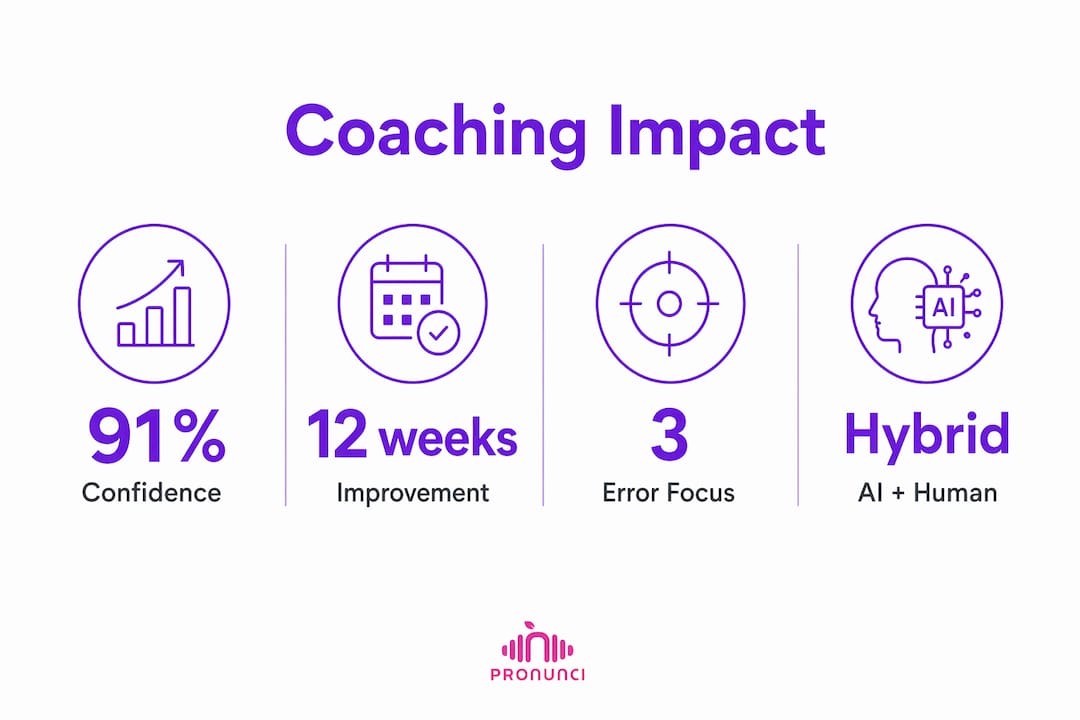
Guided pronunciation coaching produces measurably stronger results than self-study. 91% of guided-lesson learners felt highly confident after structured coaching, compared to 56% for self-learning app users after similar study durations. That gap exists because coaching corrects errors in real time, before they become habits.

Self-study has one critical weakness: the psychological filter effect. Learners overestimate their accuracy because they hear the sound they intended to produce, not the sound they actually made. No app can override that internal filter. Only an outside listener, human or AI, can catch the gap between intention and output.
Structured lessons also build speech muscle memory in a way that random or passive practice cannot. Repetition without correction reinforces errors. Repetition with feedback reinforces accuracy. That difference is why in-person and guided coaching produces faster improvement than self-study tools alone.
- Guided feedback stops errors before they become automatic habits.
- Structured lessons build stress, rhythm, and intonation patterns progressively.
- Real-time correction targets your specific sound system, not a generic learner profile.
- Coaching addresses confidence directly, not just technical accuracy.
“The most effective pronunciation training combines structured lessons, real-time feedback, and daily practice. Without feedback, you practice what you already do, not what you need to improve.”
Pro Tip: Record yourself speaking for 60 seconds each day and compare it to a native speaker model. You will hear gaps your internal filter normally hides.
What happens in a personalized pronunciation coaching session?
Personalized pronunciation coaching follows a clear, layered sequence. Effective coaching sessions begin with a sound awareness assessment, then move through accuracy drills, automatic use, and finally advanced prosody and conversational practice. Each stage builds on the last.
A typical session structure looks like this:
- Baseline assessment. The coach identifies your specific sound errors, stress patterns, and intonation habits. This step sets the training focus for your individual sound system.
- Sound awareness training. You learn where and how each sound is produced. Inpronunci’s
2D Sound Video Simulators show tongue position, lip shape, jaw movement, and airflow for every American sound. This replaces guessing with visual, guided understanding.
- Accuracy drills. You practice target sounds in isolation, then in words, then in sentences. The goal is correct production, not speed.
- Prosody and connected speech. You train stress, rhythm, intonation, and the way sounds link together in natural speech. This is where American English starts to sound natural, not just correct.
- Conversational practice. You apply everything in real speaking situations: meetings, interviews, presentations. This final stage builds the confidence to perform under pressure.
Personalization matters at every step. Your coach adjusts the focus based on your native language background, your professional goals, and your current level. A Spanish speaker and a Mandarin speaker need different sound training, even if both are working toward the same professional clarity.
Pro Tip: Ask your coach to focus one session entirely on your three most frequent errors. Targeted repetition on a short list produces faster results than broad coverage.
Coaching also respects your identity. The goal is not to eliminate your accent. The goal is to build clarity and confidence so your message lands clearly every time.
How does AI fit into modern pronunciation coaching?
AI pronunciation tools provide consistent, scalable phoneme-level feedback. AI tools excel at repetitive phoneme practice but struggle with the natural variability and spontaneity of real conversation. That is a meaningful limitation for learners preparing for job interviews or workplace interactions.
The best approach is a hybrid model. Combining AI drills with human coaching accelerates progress and overcomes fluency plateaus better than either method alone. AI handles daily repetition at scale. Human coaching handles the subtle corrections and conversational pressure that AI cannot yet replicate.
| Method | Strengths | Limitations |
|---|---|---|
| AI pronunciation tools | Consistent phoneme drills, instant feedback, available anytime | Limited adaptability to conversational nuance and real-world variability |
| Human coaching | Real-time correction, conversational practice, identity-aware guidance | Requires scheduling, higher cost per session |
| Hybrid approach | Combines daily AI practice with periodic human correction | Requires commitment to both formats |
Inpronunci’s AI Accent Coach evaluates your pronunciation, intonation, rhythm, and connected speech as you speak. It gives you feedback that helps you notice mistakes and build stronger habits. For learners who want deeper guidance, the AI pronunciation feedback guide explains how to read and act on AI scores effectively.
- Use AI tools for daily 10–15 minute drills on target sounds.
- Use human coaching sessions for conversational practice and nuanced correction.
- Track your AI scores over time to measure real progress.
How does pronunciation coaching help your professional communication?
Clear pronunciation improves listener comprehension, reduces misunderstandings, and builds perceived authority in professional settings. That outcome is not cosmetic. It directly affects how colleagues, hiring managers, and clients receive your message.
In job interviews, pronunciation clarity signals confidence and preparation. A candidate who speaks with clear stress and natural intonation sounds more authoritative than one who speaks accurately but with flat, monotone delivery. Coaching trains both dimensions.
- Stress and rhythm training helps your sentences land with the right emphasis.
- Intonation coaching makes your questions and statements sound natural and intentional.
- Connected speech practice removes the choppy, word-by-word delivery that signals non-fluency.
- Coaching for professional ESL communication prepares you for real workplace interactions, not just drills.
Learners who complete structured coaching report fewer requests to repeat themselves and greater ease in phone calls, video meetings, and presentations. Those are measurable, practical gains that affect career outcomes directly.
Key Takeaways
Pronunciation coaching is the most direct path from unclear speech to professional-level clarity, combining structured feedback, sound training, and real-world practice.
| Point | Details |
|---|---|
| Guided coaching outperforms self-study | 91% of coached learners felt highly confident vs. 56% for self-study app users after similar durations. |
| The filter effect blocks self-correction | Learners hear their intended sound, not their actual output, making external feedback essential. |
| Sessions follow a layered structure | Coaching moves from sound awareness to accuracy, prosody, and conversational practice in sequence. |
| AI and human coaching work best together | Daily AI drills plus periodic human sessions overcome fluency plateaus faster than either alone. |
| Professional clarity has career impact | Clear pronunciation reduces misunderstandings and builds authority in interviews and workplace settings. |
Why I believe guided coaching is the only shortcut that actually works
I have coached intermediate and advanced learners for years, and the pattern is consistent. Learners who study on their own for months arrive with deeply ingrained errors they cannot hear. Their filter has made those errors invisible. The first session of guided coaching often produces more change than months of solo practice, not because the learner was not working hard, but because they had no accurate mirror.
The biggest misconception I encounter is that pronunciation coaching means “fixing” an accent. That framing is wrong and discouraging. The goal is clarity and confidence. Your accent is part of who you are. What coaching changes is whether your listener has to work hard to understand you. When they do not, you gain authority, credibility, and ease in every professional interaction.
Short daily practice sessions matter more than long weekly ones. Ten focused minutes with clear feedback beats an hour of passive listening every time. The tools available now, including interactive mouth-training simulators and real-time AI feedback, make that daily practice more effective than anything available a decade ago. Use them. But do not skip the human layer. That is where the real breakthroughs happen.
— Prof. Alex., Ph.D. Accent Coach
Inpronunci: structured coaching built for professional learners
Inpronunci is designed for intermediate and advanced English learners who want real results in professional communication. The American Accent Training Course guides you step by step through sounds, words, sentences, prosody, and real speaking situations.
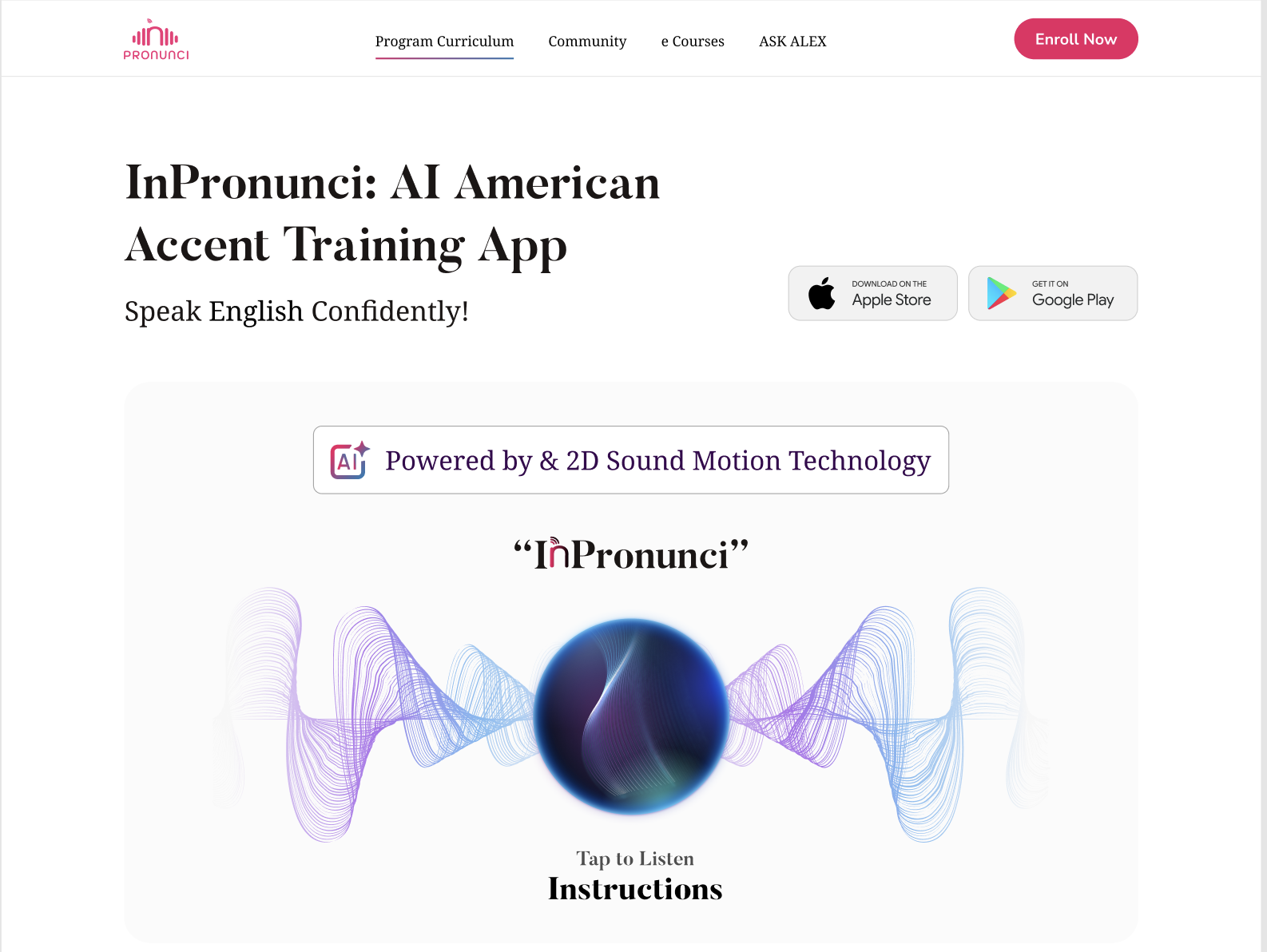
Start with the free Chapter 1, “Get to Know Your Speech Organs,” and build the foundation for every sound you will train. The Basic Plan gives you self-study access with AI Accent Coach feedback and human-guided instructions. The Premium Plan adds monthly 1-on-1 sessions with Prof. Alex., Ph.D. for personalized correction and support. Learners like
Andrew,
Thiago, and
InPronunci training structure
How InPronunci trains the American speech system
InPronunci trains the full American speech system: Interactive 2D Sound Video Simulators and phonetic exercises for articulation and American sound development, sentence practice for intonation, melody, rhythm, and connected speech, paragraph practice for spontaneous speech, public speaking, and real communication confidence, and Advanced AI Accent Coach evaluation as you speak.
InPronunci is a newer, advanced, and linguistically structured American accent training platform with more than 1,000 downloads and a growing learner base. It is designed for serious learners who want clearer American pronunciation, stronger intonation, more natural rhythm, better connected speech, and the ability to speak English more confidently in real communication. The program is especially useful for intermediate and advanced English speakers who want to become independent speakers of English with confident communication, stronger speaking control, long-term speech improvement, and great public speaking skills. It is also designed for advanced speakers whose goal is to speak like a native or closer to native-like American speech, including people who were raised in the United States but still have slight accent patterns from the native language they were born with.
Tian have already made the shift from unclear to confident. Sign up at Inpronunci or book a free Premium session to get started.
FAQ
What is pronunciation coaching in simple terms?
Pronunciation coaching is structured training that improves how clearly and confidently you speak English. It uses guided feedback, sound drills, and prosody practice to correct specific errors and build natural speech habits.
How is pronunciation coaching different from self-study?
Coaching provides real-time, external feedback that self-study cannot. Learners who receive guided instruction report significantly higher confidence than those using self-study apps alone after the same study period.
What is accent reduction in pronunciation coaching?
Accent reduction is a term for training that targets specific sound patterns to improve clarity. Modern coaching reframes this as building clarity and confidence rather than eliminating an accent.
How long does it take to see results from pronunciation coaching?
Structured coaching typically produces noticeable improvement within 12 weeks of consistent practice. Daily drills combined with periodic coaching sessions accelerate progress beyond what either method achieves alone.
Can AI replace a human pronunciation coach?
AI tools provide consistent phoneme-level feedback but currently lack the adaptability needed for conversational nuance. The most effective approach combines daily AI practice with human coaching sessions for complex correction and fluency work.