


Understanding how to improve English pronunciation is essential. You improve English pronunciation by retraining your speech organs and speech patterns in stages: first isolated American vowel and consonant sounds, then automatic phonetic habits, then sentence-level rhythm and intonation, then full paragraph delivery. This works better than random listen-and-repeat practice because each stage builds the physical control the next one needs. Non-native speakers usually carry tongue, lip, and jaw habits from their first language, so progress means retraining muscle movement, not just memorizing rules.
Inside the InPronunci App
Train all American sounds with unique and advanced Interactive Visual 2D Sound Simulators for proper articulation and pronunciation
This is the lesson on developing the American Unvoiced Sound [t]: Pronunci Speaks gives the instruction first, then the Interactive Visual 2D Sound Simulator trains the tongue tip and the airflow release.
- EffectiveMost apps offer visual learning. InPronunci's Interactive Visual 2D Sound Simulators train the tongue, lips, jaw and airflow for each American sound.
- ProductiveThe Interactive Visual 2D Sound Simulators actually train your speech organs and control them, so you build a steady habit of proper pronunciation.
- ResultsStudents pronounce individual American sounds with almost native-like pronunciation.
What You Need Before You Start Retraining Your Pronunciation
Before you can act on any advice about how to improve English pronunciation, you need three things in place: awareness of your speech organs, a way to hear yourself accurately, and acceptance that this happens in stages, not one sitting.
Most pronunciation guidance assumes you already know what your tongue, lips, teeth ridge, soft palate, and airflow are doing when you speak. You don’t, and that’s normal. Non-native speakers typically learned English sounds by ear, copying a general impression of a word rather than the exact placement that produces it. Without knowing where your tongue tip sits for a /θ/ sound in “think,” or how airflow changes between /s/ and /z/, an instruction like “round your lips more” has nothing to attach to.
How is systematic accent retraining different from general English pronunciation tips?
Generic tips target individual words; structured retraining targets the physical habits producing every word wrong in the same way. A tip like “practice the word ‘thirty’ slowly” fixes one word. Learning where your tongue must sit for every /θ/ and /ð/ sound fixes hundreds of words at once, because you’re correcting the cause, not the symptom.
Why do non-native speakers need structured training stages instead of just listening and repeating?
Listen-and-repeat fails quietly, because your ear is calibrated to your native sound system, so a mispronounced vowel can sound correct to you even when a native listener hears it clearly as off [4]. Recording yourself and comparing against a native model closes that gap, since a recording doesn’t share your ear’s bias.
Practically, you need a mirror or phone camera to watch your own mouth, a quiet space free of background noise for clean recordings, and a reliable model of correct sound production to compare against, not just any native speaker, but a consistent one you can return to. This is the same starting point Prof. Alex built into Chapter 1: Speech Organs Education, free inside InPronunci, which walks through tongue, lip, and airflow awareness before any drilling begins. For a deeper look at why tongue position drives so much of this, see our guide on the role of tongue placement in English sounds.
Cognitive Accent Training
Compare Your Coach vs. Your Pronunci
In every practice sentence, students listen to Your Coach, record their own voice, and compare it with Your Pronunci, so they consciously notice and correct each sound.
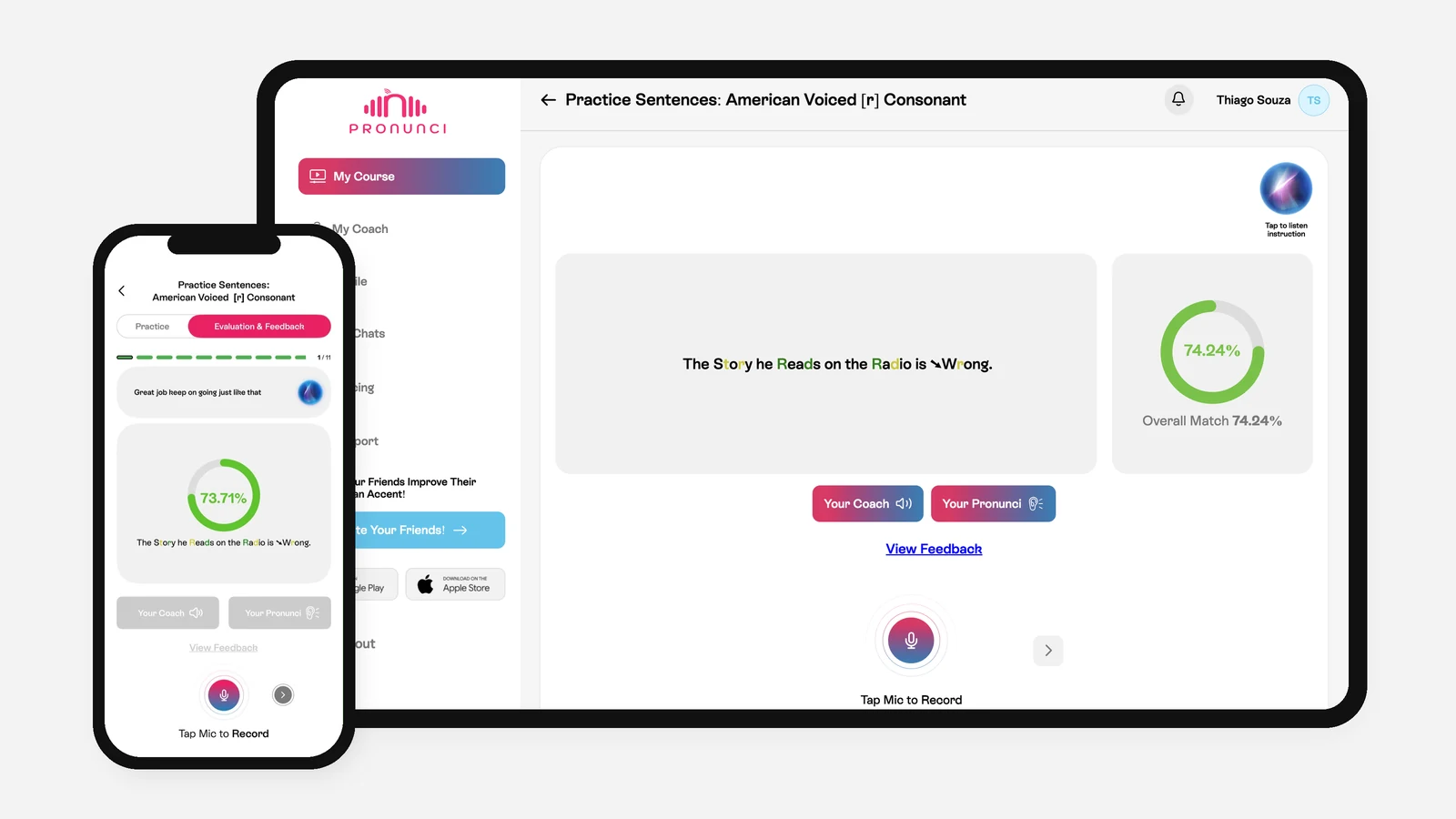
- Listen to Your CoachThe model American pronunciation of each practice sentence.
- Compare with Your PronunciYour own recorded pronunciation, side by side with the coach.
- Correct with feedbackThe match score and color-coded letters guide each correction.
How to Improve English Pronunciation by Retraining Your Speech Organs
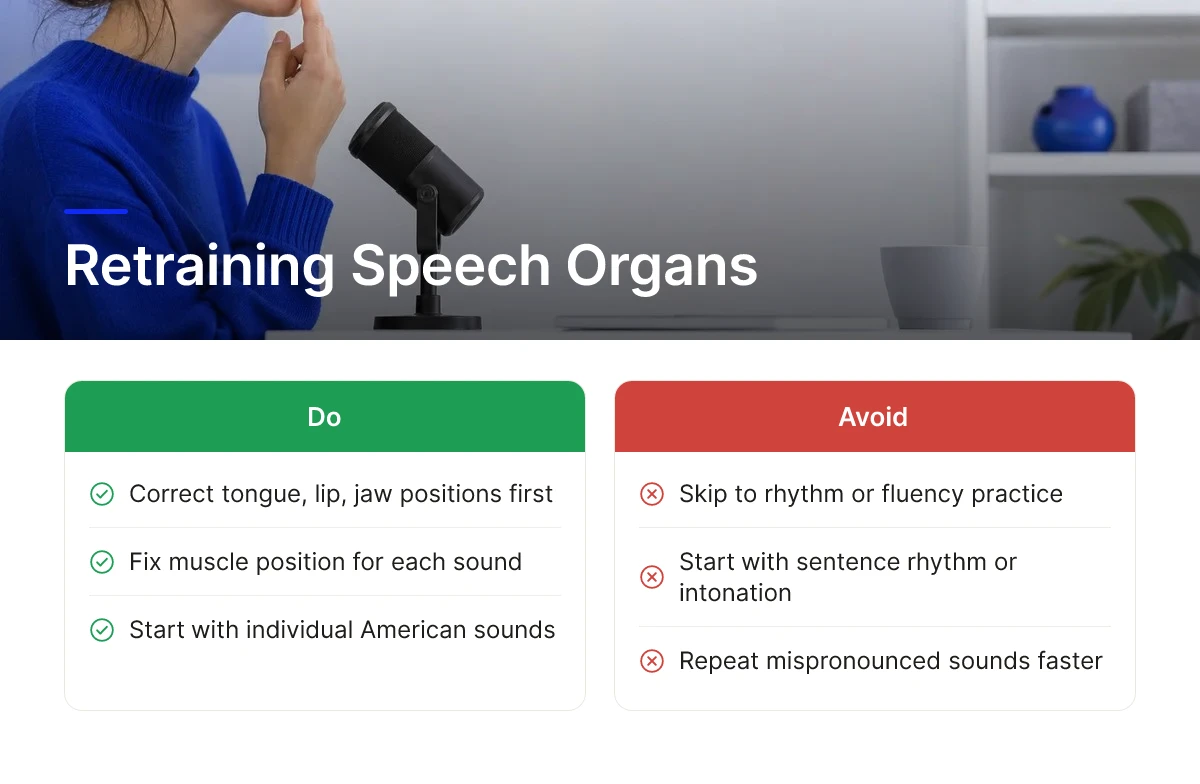
The starting point for how to improve English pronunciation is not sentence rhythm or intonation, it’s correcting the tongue, lip, and jaw positions for individual American sounds first.
Every sound you mispronounce traces back to a specific muscle position your native language never trained. Fix the position, and the sound follows. Skip this step, and rhythm or fluency practice just repeats the same errors faster.
What specific tongue, lip, and jaw positions do you need for American vowels and consonants?
Each American consonant and vowel has a fixed, describable position for the tongue, lips, and jaw. For /t/ and /d/, the tongue tip presses the ridge just behind the upper front teeth, then releases quickly. For /θ/ in “think,” the tongue tip goes between the upper and lower teeth, not behind them, a common substitution error for speakers whose languages lack this sound.
Lip shape matters just as much. /w/ requires rounded, pushed-forward lips, almost like whistling, while /iː/ in “see” needs spread, tense lips with the tongue high and forward. Confusing these two shapes is why “wheel” and “we’ll” or similar pairs blur together for many learners.
The American /r/ causes particular trouble. It requires the tongue pulled back and slightly curled, with no contact against the roof of the mouth or teeth ridge. Speakers of rhotic languages like Hindi or Spanish often substitute a tapped or trilled /r/ made with tongue-tip contact, while speakers of non-rhotic varieties may drop the sound almost entirely. Both substitutions are audible to American listeners immediately, even when every other sound is correct.
How do pronunciation training apps with speech-organ training compare to traditional methods?
A coach describing tongue position verbally, or a textbook diagram freezing one static frame, cannot show you how the tongue moves from one position to the next. Speech is motion, not a series of snapshots. That’s the gap Interactive Visual 2D Sound Simulators inside InPronunci: American Accent Training App are built to close, they train the tongue, lips, jaw, and airflow through full video movement for every American vowel and consonant, so students follow the motion pattern rather than guess at a fixed shape. For background on how the underlying tongue mechanics work, see InPronunci’s guide on tongue placement in English sounds.
A short practice routine you can run today: pick three sounds you regularly get corrected on, such as /θ/, /r/, and the /w/–/iː/ contrast. Train the movement pattern for each one, produce it slowly and exaggerated, then at normal speaking speed, then inside a minimal-pair word like “think/sink,” “right/light,” or “wheel/we’ll.”
This articulation stage needs to feel stable, accurate on demand, not just occasionally, before moving to phonetic exercises, sentence rhythm, or intonation work. Building rhythm on top of unstable sounds just cements the wrong habits deeper.
Turn Isolated Sounds into Automatic Speech Habits
Knowing a rule and producing it under pressure are two different skills, and the gap between them is exactly where most self-study plans stall. You can know that /θ/ requires the tongue between the teeth and still say “tink” instead of “think” the moment you’re mid-sentence in a live meeting.
This is the core mechanism behind how to improve English pronunciation in a way that survives real conversation, not just quiet practice. Rule knowledge lives in the thinking brain; automatic pronunciation lives in muscle memory, built through repetition of the correct movement until it fires without conscious effort.
How do phonetic exercises and sound combinations turn isolated sounds into fluent, natural speech?
Phonetic exercises bridge that gap by moving a sound through stages: isolation, then combination with neighboring sounds, then full sentences at conversational speed. English speakers routinely reduce and merge sounds across word boundaries, “did you” becomes “didja,” “want to” becomes “wanna”, and a learner who only practices words in isolation never encounters these patterns until a native speaker uses one in conversation and the meaning is lost [4]. Structured exercises drill these reductions and assimilations directly, so the ear and the mouth learn the pattern together instead of the mouth learning one version and the ear expecting another.
What pronunciation mistakes do speakers of particular native languages commonly make in American English?
Native-language habits shape these errors in predictable ways. Spanish speakers often insert a short vowel before initial /s/ clusters, saying “espeak” instead of “speak,” because Spanish phonology doesn’t allow words to start with /s/ plus a consonant. Mandarin speakers frequently drop final consonants or flatten sentence stress, since Mandarin syllables rarely end in consonant clusters and rely on tone rather than stress for emphasis. Neither error is a lack of effort, it’s the old sound system filling in gaps the new one hasn’t yet built.
Unstructured repetition doesn’t fix this. Saying a word wrong 50 times just reinforces the wrong tongue and jaw movement; the habit gets stronger, not more correct. That’s why exercises need to move in sequence, sound, then combination, then sentence, with feedback at each stage confirming the movement itself, which is the structure behind InPronunci’s phonetic exercises and its AI Accent Coach evaluation of sounds as they appear in connected speech, not just in isolation.
A workable daily drill: pick one recurring mistake, isolate the sound, drill it in 5 minimal word pairs (think/tink, speak/espeak), then apply it in 2 full sentences at normal speed. Ten minutes, done consistently, retrains the habit faster than an hour of unfocused talking. For more on how these sound-level patterns connect into full sentences, see our guide on connected speech in natural American English.
Build American Rhythm, Stress, and Intonation in Connected Speech
Sentences carry meaning through timing and pitch, not just accurate sounds, so how to improve English pronunciation at the sentence level means training rhythm and melody, not just individual words.
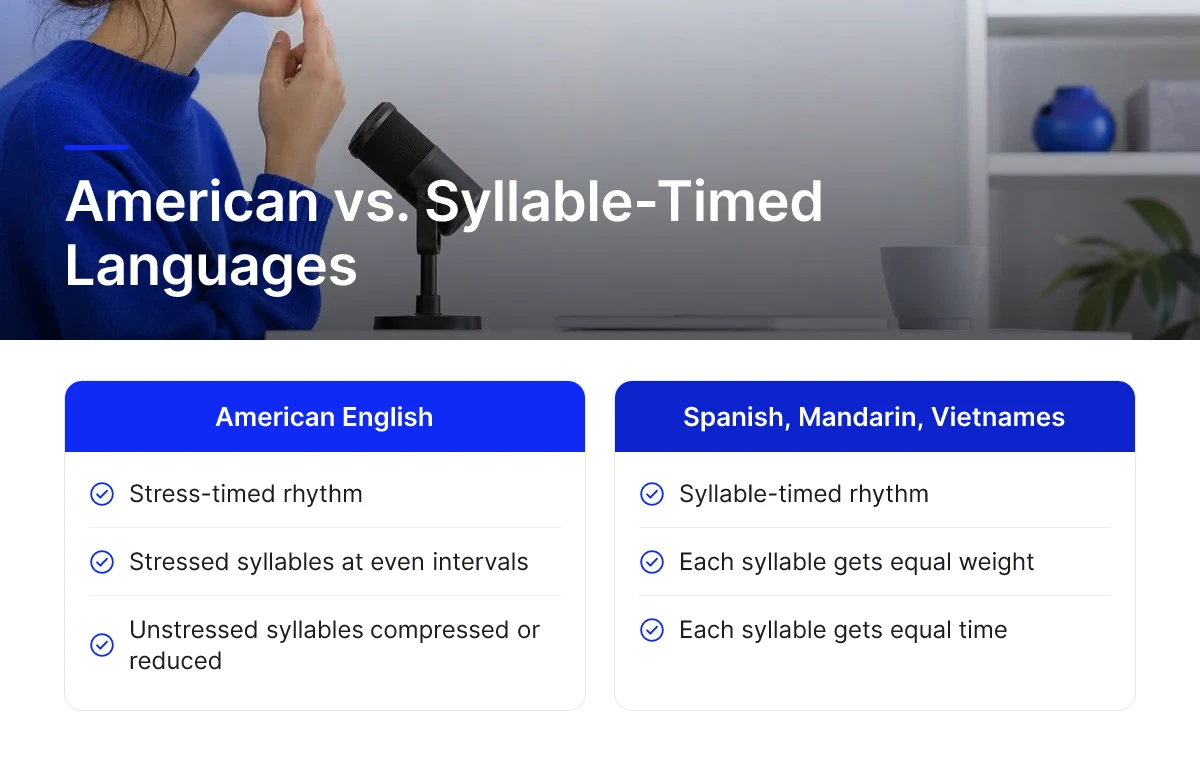
American English is stress-timed, not syllable-timed. That means stressed syllables land at roughly even intervals, and everything between them gets compressed, shortened, or reduced to fit that beat. Languages like Spanish, Mandarin, or Vietnamese give each syllable close to equal weight and time. That mismatch explains why a learner can pronounce every sound in a sentence correctly and still sound foreign, the words are right, but the timing pattern belongs to a different rhythm system entirely.
How does sentence-level intonation training prepare you differently than word-by-word practice?
Word-by-word drilling teaches you to say each sound clearly in isolation. Sentence-level training teaches you where pitch rises, where it falls, and which word carries the emphasis that changes meaning. Yes/no questions like “Are you coming?” rise at the end. Statements and information questions, “Where did you park?”, fall. And within any sentence, the word carrying new or contrasting information gets a pitch peak: “I said Tuesday” versus “I said Tuesday” shift meaning depending on which word gets the emphasis. Drilling single words never teaches this, because stress and pitch only exist in relation to a full thought. Both stages matter, but the order matters too, students who jump straight to full sentences without first stabilizing individual sounds tend to blur the very contrasts that stress and intonation depend on.
What role does connected speech and sound reduction play in sounding like a native American English speaker?
Native speakers habitually link, reduce, and blend words together, and skipping these patterns is what makes careful, word-perfect speech sound stiff or overly formal. Linking joins a final consonant to the next vowel, so “turn it off” becomes “turn-i-toff.” Reduction shrinks unstressed function words, “going to” becomes “gonna,” “want to” becomes “wanna.” Assimilation changes a sound to match its neighbor, so “did you” often comes out closer to “didja.” None of this is sloppy speech; it’s the predictable, rule-governed pattern that keeps stress-timed rhythm intact [1].
A short daily routine builds this skill without a coach in the room:
- Write out a sentence and mark the two or three words carrying the main stress.
- Say it aloud, exaggerating those stressed words and stretching the pauses between them.
- Repeat the same sentence at natural conversational speed, letting the unstressed words compress and blend the way they would in real speech.
This is the same progression InPronunci’s sentence and paragraph practice builds on: after sound-level training, the AI Accent Coach evaluates stress placement, pitch movement, and connected speech across full sentences, not just isolated words. For a deeper look at how that evaluation works, see the AI Accent Coach guidelines, and for the mechanics of linking and reduction, the connected speech guide breaks down each pattern in more detail.
Apply Your Pronunciation Training to Professional Speaking
Professional speaking situations demand paragraph-level control, steady pacing, deliberate pauses for emphasis, and the ability to recover smoothly after a misspoken word without losing your listener. That’s a different skill from producing one clear sentence in isolation, and it’s the last piece of how to improve English pronunciation for real business use.
A client call, a job interview, or a presentation to leadership all share the same demand: your listener needs to track your meaning across several sentences, not just decode individual words. If your rhythm collapses under pressure or you rush through a stumble, the listener loses the thread even when each sound was technically correct. This is why paragraph practice, not just sentence drills, belongs in any serious training plan.
How should your pronunciation practice differ when preparing for business meetings, interviews, or presentations versus casual conversation?
Casual conversation tolerates dropped sounds, filler words, and an uneven pace because both speakers are filling in gaps together. Business communication doesn’t offer that cushion. A client on a conference call, or an interviewer hearing you for the first time, needs deliberate pausing before key points, clear stress on the terms that carry your message, and a controlled pace even when nerves push you to speed up.
Practicing for this context means rehearsing full paragraphs the way you’d deliver a project update or an interview answer, reading aloud, marking where to pause, and noticing which words in the sentence should carry the most stress. That’s a different rehearsal habit than free-flowing chat practice, and it’s worth building deliberately before a high-stakes meeting rather than during one.
How long does it typically take to see noticeable improvement in your American English pronunciation with structured training?
Individual sounds respond fastest. Focused daily practice on a specific vowel or consonant, say, the American /r/ or the “th” sounds, often produces a noticeable change within a few weeks of consistent repetition. Natural-sounding rhythm and confident paragraph delivery take longer, because they depend on all four training stages working together: accurate sounds, automatic phonetic patterns, sentence-level intonation, and finally extended speech under real conditions. There’s no single universal timeline here, and claims of overnight fluency should be treated with caution.
Broad conversational-practice apps such as ELSA Speak build general speaking confidence through role-plays and everyday scenarios, which suits learners focused on day-to-day fluency. InPronunci takes a different approach at the paragraph stage: the Advanced AI Accent Coach evaluates full sentence flow, melody, stress, and connected speech together rather than scoring single words, and Pronunci Instructions from Prof. Alex guide each paragraph-practice session the way a live coach would in a real lesson. For a deeper feature-by-feature look, see the AI Accent Coach guidelines and the InPronunci vs. ELSA Speak comparison.

Questions & Answers
Frequently Asked Questions
01Can adults change their pronunciation, or is it only easy for children?
Adults can retrain pronunciation at any age, though it takes deliberate practice rather than passive exposure. Children absorb sounds without effort, but adults have an advantage children lack: they can consciously study tongue placement, airflow, and stress patterns, then correct themselves systematically. Structured, repeated practice with feedback matters more than age.
02Do I need to lose my accent completely to be understood clearly in American English?
No, the goal is clarity and confidence, not erasing every trace of your native language. Accent modification means adjusting the sounds, rhythm, and intonation patterns that actually cause misunderstandings [2], while keeping your voice and identity intact. Many professionals speak with a light accent and communicate perfectly clearly.
03What’s the fastest way to identify which sounds I personally struggle with?
Record yourself reading a short paragraph aloud, then compare it against a native-speaker model sound by sound. Preply’s guide recommends recording and comparing your speech directly against native pronunciation to spot gaps [4]. Tools like InPronunci’s Your Coach vs. My Pronunci comparison isolate exactly which vowels, consonants, or stress patterns need work.
04Should I focus on American, British, or another English accent when I train?
Pick one accent model and train consistently toward it, rather than mixing input from multiple accents. Switching between American and British reference audio slows progress because the vowel systems and intonation patterns differ. If your goal is workplace communication in the US, General American gives you one stable target, which is the model InPronunci’s curriculum and 2D Sound Motion Technology are built around.
05Can I improve pronunciation without moving to the US or talking to native speakers daily?
Yes, structured practice with recorded feedback can substitute for daily immersion. What matters is consistent, corrected repetition of target sounds and sentence patterns, not geographic proximity to native speakers. Apps with real-time evaluation and speech-organ training let you practice this daily from anywhere.
Conclusion
Clear American pronunciation comes from training your speech organs and speech patterns in order: individual sounds first, then phonetic habits, then sentence rhythm and intonation, then full paragraphs delivered naturally. Skipping straight to conversation practice without fixing the underlying sounds is why many learners plateau. Start today by recording one paragraph, comparing it against a native model, and identifying two or three sounds to target this week. If you want that comparison and structured progression built into one system, InPronunci’s free Chapter 1 is a practical place to begin.
Sources & References
- Maintaining Your American Accent Long Term | MyAccentWay
- 15 Proven Tips to Improve Your English Accent Online | Anywhere Speech & Language | Online Speech Therapy Across the US
- How to Improve English Pronunciation & Lose Your Accent
Recommended Articles

How to Speak With an American Accent in Everyday Life
You develop an American accent by retraining the physical mechanics of speech — mouth shape, tongue placement, and rhythm — not by memorizing rules. The...

TOEFL Speaking and Listening: How the American Sound System Helps International Students (Plus IELTS, FCE and CAE)
TOEFL speaking and listening for students who want to study in the USA: train the whole American sound system to understand fast English and speak clearly.

InPronunci for ESL Teachers: A Structured Way of Teaching Pronunciation to ESL Students Worldwide
A pronunciation app for ESL teachers and departments worldwide: sound-by-sound lessons, ESL pronunciation activities, AI feedback, free Chapter 1.
Plans
What InPronunci costs
InPronunci Basic
$35 per month
Chapter 1 is free after signup.
InPronunci Premium
$200 per month
Includes a coach: