



ESL teachers can give every student a structured way of teaching pronunciation between classes with InPronunci, a pronunciation app and American Accent Training App created by Prof. Alex, Ph.D. Accent Coach, Doctor of Education, and professional linguist. It trains each American sound step by step, then builds it into sentences, paragraphs and real communication, for ESL, EFL and ESOL programs worldwide.
What InPronunci is
InPronunci is a linguistically structured American Accent Training App: a complete American accent training course developed by Prof. Alex, Ph.D. Accent Coach, Doctor of Education, and professional linguist, based in Austin, Texas. Prof. Alex has more than 20 years of teaching experience and teaches adult ESOL at Austin Community College.
InPronunci is not a pronunciation scoring app. It is a training program. Students learn American sounds step by step, sound by sound, and then use them in real speech: sentences, paragraphs, presentations and conversation. The goal is for students to become independent and confident English speakers.
Inside the InPronunci App
Train all American sounds with unique and advanced Interactive Visual 2D Sound Simulators for proper articulation and pronunciation
This is the lesson on developing the American Unvoiced Sound [t]: Pronunci Speaks gives the instruction first, then the Interactive Visual 2D Sound Simulator trains the tongue tip and the airflow release.
- EffectiveMost apps offer visual learning. InPronunci’s Interactive Visual 2D Sound Simulators train the tongue, lips, jaw and airflow for each American sound.
- ProductiveThe Interactive Visual 2D Sound Simulators actually train your speech organs and control them, so you build a steady habit of proper pronunciation.
- ResultsStudents pronounce individual American sounds with almost native-like pronunciation.
Teaching pronunciation in ESL programs: why a structured path matters
ESL teachers know the problem well. A class has grammar, reading, writing, listening and speaking to cover, and pronunciation usually gets the time that is left. When it is taught, it is often taught as “listen and repeat”: the teacher models a word, and the class repeats it. This is especially hard in ESL lessons for adults, where ESL pronunciation habits from the first language are already strong.
Listen-and-repeat has a limit. A student can repeat a sound correctly in class and still go back to the native-language sound the moment they speak freely. The reason is simple: the speech organs (tongue, lips, jaw, teeth, airflow and voice) have not been trained to produce the new sound on their own. Repeating a model is not the same as building the movement.
A structured pronunciation path solves two problems for ESL teachers and departments:
- Time. Students practice the sound system outside class, so class time can go to communication.
- Consistency. Every student follows the same sound-by-sound sequence, no matter which instructor teaches the course.
What to look for in an accent training app for ESL teachers
The best accent training app for ESL teachers is one that teaches pronunciation the way a teacher would: one sound at a time, in a clear order, with instructions before practice and feedback after it. ESL teachers can check any pronunciation app against five questions:
- Does it train how each sound is made? Students need to train the tongue, lips, jaw, airflow and voice, not only listen to a model.
- Does it follow a sequence? A sound-by-sound path from speech organs to consonants, vowels and intonation is easier to assign than random words.
- Does it give instructions before the score? Students should know what to change before they are evaluated.
- Does it move from sounds to real speech? Phonetic exercises, sentences and paragraphs connect pronunciation to communication.
- Can students start for free? A free first chapter lets a whole class try it before a department decides.
InPronunci was built to answer all five. It is an English pronunciation app created by Prof. Alex, who teaches adult ESOL himself.
For ESL, EFL, ESOL and ELL teachers worldwide
InPronunci is used online, so it works for teachers in any country and any program: teaching English as a second language (ESL) in the United States, Canada, the UK and Australia; teaching English as a foreign language (EFL) in Asia, the Middle East, Latin America, Europe and Africa; adult ESOL programs; ELL teachers in schools; language centers; and university English departments.
Students can use it on iPhone, Android or a computer, so it fits classrooms, computer labs and homework. The training is in American English, and the instructions are written for intermediate and advanced learners from any first language.
Why an ESL teacher’s own pronunciation matters
For ESL students, the teacher’s voice is the main model of spoken English. Students hear it every class, for months or years. Whatever that voice does, students learn to do: the sounds, the rhythm, the stress and the intonation.
Prof. Alex has traveled widely and observed many ESL teachers in different countries and classrooms. Many of them are excellent teachers of grammar, vocabulary and communication, but they speak English with a strong accent from their own first language. In his 1-on-1 practice, he sees the result again and again: when a new student starts accent training with him, the student’s pronunciation often reflects the pronunciation of their former English teacher. The same vowel substitutions, the same consonant habits, the same flat or first-language intonation.
This is not the student’s fault, and it is not a criticism of the teacher. Students learn what they hear. A teacher who models a sound incorrectly for years teaches that sound to every class. And an accent that was learned from a teacher is harder to change later, because the student has practiced it for a long time and believes it is correct.
That is why Prof. Alex believes that ESL teachers who want their students to speak clear, natural English should first work on their own pronunciation. A teacher who speaks American English clearly, without a strong first-language accent, gives students:
- A correct model of each sound, every class.
- Natural rhythm and intonation to listen to and absorb.
- Confidence in feedback, because the teacher can hear and correct a sound they can produce themselves.
- Fewer habits to undo later, if the student continues to advanced accent training.
InPronunci was designed for ESL teachers as well as for students. A teacher can train each American sound with the same structured program, at their own pace, before or while using it with their classes. Every English language teacher, whether an ESL teacher or an English as a foreign language teacher, can use it this way. Language centers and ESL departments can also add InPronunci to ESOL teacher training, so new instructors train the same sound system they will teach. Teachers who want personal guidance can also choose the Premium Plan for 1-on-1 Interactive American Accent Training with Prof. Alex.
The research behind the method
The InPronunci teaching method is grounded in Prof. Alex’s doctoral research on interactive foreign-language instruction. In a pedagogical experiment with an experimental group and a control group, students taught through interactive methods scored significantly higher on the English progress test than students taught through traditional, teacher-centered methods (Mann–Whitney test). The research is published in Procedia – Social and Behavioral Sciences: https://doi.org/10.1016/j.sbspro.2015.10.047.
Prof. Alex adapted this interactive approach to pronunciation teaching. InPronunci places the student in a student-centered, active role: instead of passively listening and repeating, students train each American sound with the Interactive Visual 2D Sound Simulators, follow Pronunci Instructions, practice, compare, adjust and practice again.
For ESL teachers, this is a familiar principle. Communicative, student-centered teaching is already the standard in most ESL programs. InPronunci applies the same principle to pronunciation, the one skill that is still often taught in a teacher-centered way.
Read more: The Research Behind InPronunci: Why Active and Interactive Learning Works.
How the program is structured
InPronunci contains 25 core sound-training sessions. Each session has 2 parts, and each part has 8 lessons, for 400 structured lessons in total.
| Program content | Volume |
|---|---|
| Sound-training sessions | 25 |
| Session parts | 50 |
| Structured lessons | 400 |
| Phonetic exercises | 150 |
| Speaking sentences | 392+ |
| Paragraph practices | 25 |
The curriculum has four chapters:
Chapter 1: Speech Organs Education (free). Students learn how the tongue, lips, teeth ridge, soft palate, hard palate, airflow and speech-organ coordination affect pronunciation. This gives every student a shared vocabulary for the rest of the course, which also helps teachers when they give feedback in class.
Chapter 2: American consonant sounds. 13 consonant sessions, 78 phonetic exercises, 200+ practice sentences and 13 paragraph practices. Students follow the sessions in order: Session 2 is the American R and Session 3 is the TH sounds. The chapter includes the sounds ESL students usually find hardest: the American R, the TH sounds, the American T (including the flap T and the glottal stop), V and W, and L.
Chapter 3: American vowel sounds. 12 vowel sessions, 72 phonetic exercises, 192 speaking sentences and 12 paragraph practices, including the contrasts students often confuse, such as ship vs. sheep and full vs. fool.
Chapter 4: American intonation and emphasis. Pitch movement, sentence stress, word stress, rhythm, pauses and emphasis, so students stop sounding flat or unclear even when their individual sounds are correct.
Structured American Accent Training Course
From Speech Organs Education to American Intonation
The InPronunci course is built step by step: every chapter prepares the next one, and by the end of the course students receive a certificate.
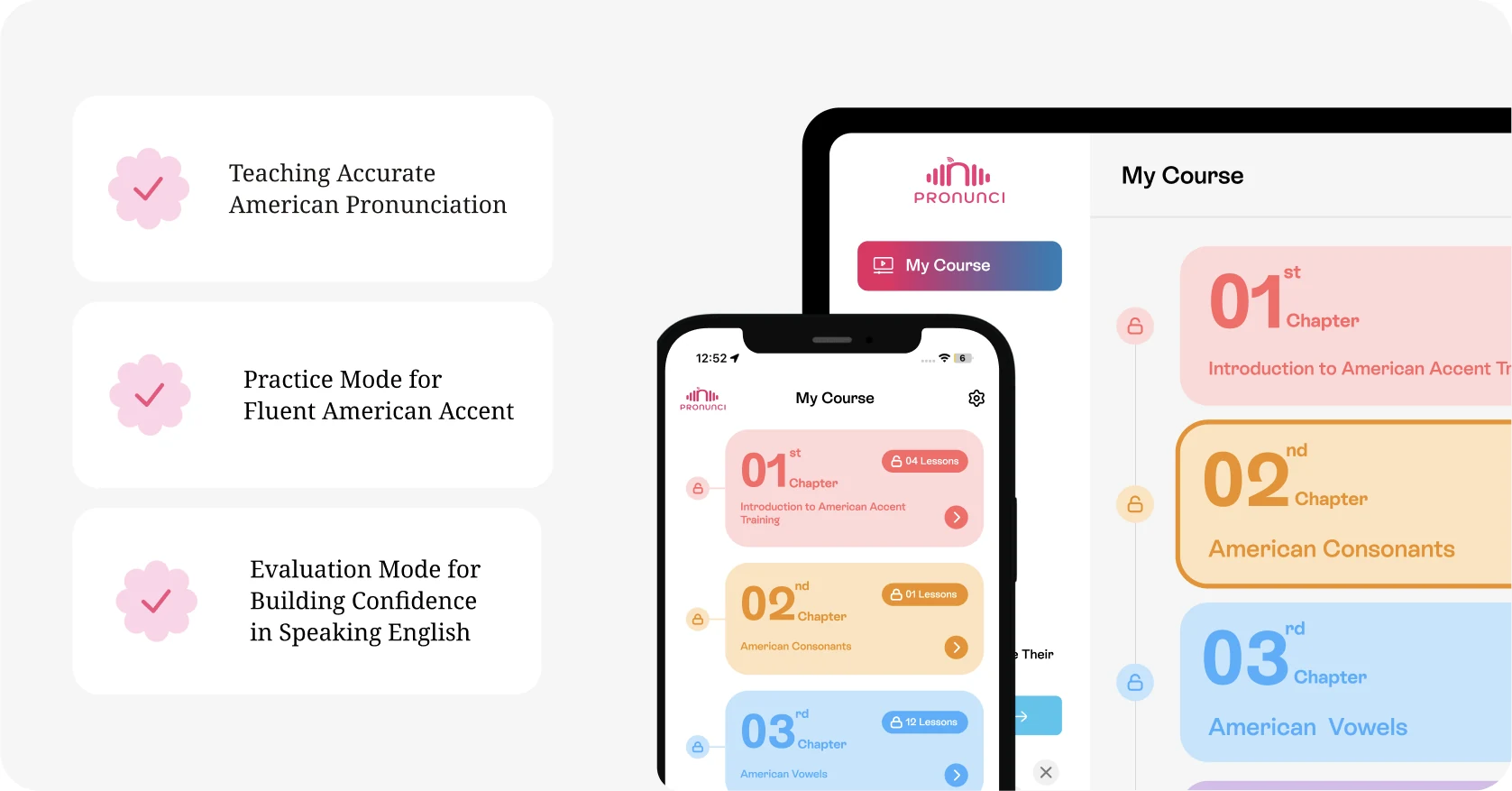
- Speech Organs EducationStudents learn how the speech organs work, along with the AI Accent Coach commands and feedback.
- American ConsonantsPractice and evaluate American consonants in phonetic exercises and practice sentences with the AI Accent Coach.
- American VowelsPractice and evaluate American vowels in phonetic exercises and practice sentences with the AI Accent Coach.
- IntonationLearn how intonation can change the meaning of what you say.
- CertificateBy the end of the course, students receive a certificate.
InPronunci Method: Prof. Alex’s Interactive Accent Training Path to Fluency
The InPronunci Method is Prof. Alex’s structured interactive American accent training program inside InPronunci, the linguistically structured American Accent Training App he developed. It follows his sound-by-sound path to fluency: every American sound in the course goes through the same steps, from sound development with the Interactive Visual 2D Sound Simulators to phonetic exercises, practice sentences and paragraph practice, including American intonation, emphasis, melody and rhythm.
Students develop and train each sound first, and the evaluation comes after. InPronunci places the student in a student-centered, active role at every step. Because every sound follows the same path, the program is easy for ESL teachers to assign and easy to check.
Develop Each American Sound Before Your Speech Practice
Start with 2D Sound Development to understand how the sound is produced.
At this stage, the student doesn’t just get information.
The student develops the sound with the Interactive Visual 2D Sound Simulators, which train the tongue, lips and jaw to produce it.
This is interactive learning: InPronunci places the student in a student-centered, active role.
Scoring first and then giving information is that traditional approach in digital form.
Practice the Sound in Phonetic Exercises
Use phonetic exercises to build steady sound control.
In Practice mode, the student trains the sound and sound combinations with phonetic exercises, guided by Pronunci Instructions at every step.
At this stage, InPronunci uses the shadowing technique: the student speaks along with the model, so the sound becomes natural in the student’s own speech and fluent pronunciation develops.
Evaluate Each Sound Before Full Sentences
One sound at a time, learners record the target American sound and receive AI Accent Coach feedback before moving into full sentence practice.
After Practice mode is done, Evaluation mode opens. The AI Accent Coach evaluates the student’s pronunciation of the sound at the phoneme level, to help the student retain the sound system.
The sound is its main task, but it also evaluates intonation, rhythm, melody and word stress, so students receive an accurate score, not just a game-style result.
Beyond the score, the AI Accent Coach and Pronunci Instructions work together to support the student all the way, explaining what went wrong and how to fix it.
Then InPronunci places the student in cognitive accent training: the student listens to My Coach vs My Pronunci and compares the two speech samples. This helps the student start applying critical thinking and improve their speech.
Practice the Sound, Intonation and Melody in Sentences
Practice the sound and American Intonation inside real sentence structure.
Training continues with practice sentences.
In Practice mode, InPronunci puts the student back in the shadowing technique, now at the sentence level.
This builds the student’s sound pronunciation, intonation, melody and rhythm together, the way they work in real speech.
Evaluate Your Intonation & Connected Speech
Now the AI Accent Coach listens to the full sentence — not just the sound
InPronunci then puts the student in Evaluation mode for the practice sentences, to evaluate their progress. The AI Accent Coach’s main task is the sound of the session. It also evaluates intonation, rhythm, melody and word stress, so students receive an accurate score, not just a game-style result.
The feedback breaks each sentence into words, and each word into sounds and complex sound combinations. The AI Accent Coach highlights all the mistakes in the sentences on one page. For every sound that needs work, Pronunci provides the Interactive Visual 2D Sound Simulator to train it again.
Then InPronunci places the student in cognitive accent training again: the student listens to My Coach vs My Pronunci for each sentence and compares the two speech samples, applying critical thinking to improve their speech.
Practice Your Speech in Paragraphs
Train longer speech, storytelling, and connected speech.
After practice sentences, the student moves on to more serious work: paragraph practice. InPronunci puts the student into the shadowing technique again.
At this stage, the student practices the sounds they learned and the intonation they developed in sentence practice, and starts building public speaking skills.
After the paragraph practice, students review their paragraph evaluation word by word and sound by sound, then move to the next sound and follow the same path again. That is the core of the method: sound-by-sound training.
This path follows the same connected training stages Prof. Alex uses in his 1-on-1 Interactive American Accent Training.
Student results with Prof. Alex's Interactive American Accent Training
As the research section above explains, Prof. Alex's doctoral research found interactive, student-centered teaching more effective than traditional, teacher-centered teaching. That is why his Interactive American Accent Training is more effective than traditional "listen and repeat" teaching for learning to speak with proper American pronunciation.
Results we see with students of Prof. Alex's 1-on-1 Interactive American Accent Training, shown on MyAccentWay, Prof. Alex's coaching brand (100 = native speaker):
- Abishek, Tamil and Indian English speaker: 62 → 84 in 9 months
- Tian, Mandarin speaker: 58 → 85 in 8 months
- Vlad, Russian speaker: 60 → 83 in 5 months
- Andrew, Russian speaker: 52 → 76 in 5 months
- Alain, Nigerian English speaker: 57 → 72 in 8 months
Prof. Alex evaluated both recordings of each student sound by sound. ChatGPT's comparison of the same recordings gave similar scores. These are live results and reviews, not research subjects.
The training tools, explained for teachers
Interactive Visual 2D Sound Simulators
There is one simulator for each American consonant and vowel sound. The simulators are not diagrams or pictures. They are training tools: students articulate together with the 2D mouth movement, say the sound out loud, repeat the movement, and train their speech organs until the articulation is correct. A mouth diagram shows a sound; an InPronunci simulator trains it. Learn more about 2D Sound Motion Technology.
Pronunci Instructions
Prof. Alex explains every session and lesson with voice-guided instructions, the same way he guides students in class. Students always know how to practice and what to focus on, so self-study does not become random repetition.
Practice Mode
Audio and video lessons with phonetic exercises, sentences and paragraphs recorded by a professional linguist. Students practice at their own pace and can return to any simulator at any time.
Evaluation Mode: AI Accent Coach and Feedback & Analysis
The AI Accent Coach evaluates each sound, sentence and paragraph, as shown in the steps above, and Feedback & Analysis tells students exactly what to practice next. There are two levels:
- Intermediate: for students who have never worked on their accent before. This level fits most ESL classes.
- Advanced: for students with high fluency who want to fine-tune their speech. It is recommended together with the Premium Plan.
Before using it, students should read the AI Accent Coach Guidelines.
My Coach vs My Pronunci
Students listen to the coach's model (My Coach), record themselves (My Pronunci), and compare. This trains the listening awareness ESL students need to notice their own errors.
Pronunciation activities for ESL classes: six ways to use InPronunci
InPronunci works as ready-made ESL resources for teachers: structured ESL teaching materials for pronunciation, from speech-organ lessons and phonetic exercises to practice sentences and paragraphs. Here are six ways to use them.
1. Homework between classes. Assign one session part per week. Students arrive in class with the sound already trained, and class time goes to using it in communication.
2. A pronunciation lab. In a computer lab or on phones, students work through the same session while the teacher moves around the room and gives individual feedback.
3. Mixed-level classes. Students work at their own pace, so a stronger student can move ahead while a student who needs more time can repeat a lesson as many times as needed.
4. Exam speaking preparation. Clearer pronunciation, stress and intonation support the speaking sections of TOEFL, IELTS, FCE, CAE and other English exams, and university presentations.
5. Shared terminology for the department. Because Chapter 1 teaches every student the same speech-organ vocabulary, all instructors can give feedback in the same terms ("tongue tip on the teeth ridge," "lips rounded").
6. The teacher's own pronunciation. As explained above, students learn the pronunciation they hear from their teacher. Teachers can train their own American pronunciation with the same program, so every class hears a clear model. InPronunci was designed for professional linguists, translators, interpreters and ESL teachers as well as for students.
Accessibility note
InPronunci may also help students with speech or hearing disabilities who need stronger articulation support and structured practice. InPronunci is not a diagnostic, medical or treatment tool. Students with speech or hearing disabilities should consult a licensed speech-language pathologist.
Questions & Answers
Frequently Asked Questions
01
Can ESL teachers use InPronunci with a whole class?
Yes. Each student follows the same structured sessions at their own pace, so the teacher can assign the same session to the whole class and use class time for communication practice.
02
What level of English do students need?
InPronunci is designed for intermediate and advanced English speakers. The Intermediate level of the AI Accent Coach is the right starting point for most ESL students.
03
Does InPronunci replace pronunciation teaching in class?
No. It gives students a structured way to train the sound system outside class. The teacher still gives feedback, builds communication activities, and helps students use the new sounds in real speech.
04
How is InPronunci different from listen-and-repeat practice?
In listen-and-repeat practice, the student copies a model. In InPronunci, the student takes an active role: they train each sound's articulation with the Interactive Visual 2D Sound Simulators, compare their speech with the model, adjust, and apply the sound in sentences and paragraphs.
05
Is the method research-based?
Yes. It applies the interactive, student-centered approach that Prof. Alex's doctoral research found more effective than traditional, teacher-centered instruction.
06
Why should ESL teachers work on their own accent?
Because students learn the pronunciation they hear in class. In Prof. Alex's 1-on-1 practice, new students' pronunciation often reflects the pronunciation of their former English teacher. A teacher who speaks clear American English gives students a correct model of every sound, rhythm and intonation pattern.
07
What is the best accent training app for ESL teachers?
Look for an app that trains one sound at a time, explains how each sound is made before practice, moves from sounds to sentences and paragraphs, and lets students start for free. InPronunci follows this structure in four chapters, and Chapter 1 is free for every student.
08
How do you teach pronunciation to ESL students?
Here is how to teach pronunciation to ESL students: teach one sound at a time, first how the sound is made, then phonetic exercises, then sentences with stress and intonation, then longer speech. InPronunci gives students this path outside class, so class time can go to communication practice.
09
Can ESL teachers outside the United States use InPronunci?
Yes. InPronunci works online on iPhone, Android and computers, so ESL and EFL teachers in any country can use it with their students.
10
Can students try it for free?
Yes. Chapter 1: Speech Organs Education is free for every student.
Plans
What InPronunci costs
InPronunci Basic
$35 per month
Chapter 1 is free after signup.
InPronunci Premium
$200 per month
Includes a coach: