Your intellectual authority is often discounted within the first 7 seconds of a boardroom presentation if your phonetic delivery lacks clarity. It’s a frustrating reality when a brilliant strategy is met with a polite request to “repeat that please,” or when you notice a client’s focus drift because of a subtle pronunciation barrier. You aren’t alone in this experience. Recent industry data suggests that 85% of non-native executives feel their spoken delivery doesn’t yet match their professional depth. Utilizing a sophisticated english accent test isn’t about erasing your cultural identity. It’s about removing the acoustic friction that prevents your most important ideas from landing with precision and impact.
We agree that your voice should be a strategic asset rather than a hurdle to your career progression. This article demonstrates how an AI-driven diagnostic serves as a roadmap to mastering a standard American accent and refining your professional presence. You’ll discover how a precise breakdown of your phonetic strengths allows you to build a targeted plan for public speaking confidence. We will examine the specific metrics that bridge the gap between your internal expertise and your external influence.
Key Takeaways
- Understand the critical distinction between simple accent detection and a professional phonetic evaluation designed to measure clarity against a target standard.
- Learn why a high-quality english accent test serves as a strategic diagnostic tool, analyzing vowels, consonants, and intonation rather than merely guessing geographic origins.
- Identify the specific preparation steps and recording environments required to produce the clean, natural speech samples that AI models need for maximum accuracy.
- Discover how advanced 2D Sound Motion Technology transforms raw diagnostic data into a personalized curriculum for accelerated American accent reduction.
What is an English Accent Test and Why Does it Matter for Professionals?
An english accent test functions as a rigorous diagnostic instrument designed to quantify the distance between a speaker’s current phonetic output and a target linguistic standard. It’s a mistake to confuse this with simple origin detection. While basic AI tools might guess if a speaker is from Madrid or Mumbai, a professional-grade evaluation focuses on phonetic precision. It analyzes the specific acoustic markers that influence how easily a listener can decode a message. Understanding The Science of Accent Detection allows professionals to move beyond subjective feedback and toward data-driven improvement. This isn’t about erasing identity; it’s about optimizing the transmission of high-value ideas.
The global corporate landscape has shifted significantly. In 2024, 86% of project managers in multinational firms report that clear communication is the primary driver of project success. An accent is a badge of multilingualism, yet a lack of clarity creates friction. The goal of a modern english accent test is to identify where this friction exists. We’ve moved past the era of “fitting in” to a new paradigm of maximizing impact. When you speak, your audience shouldn’t be working to understand your sounds. They should be working to understand your strategy.
The Difference Between Fluency and Phonetic Precision
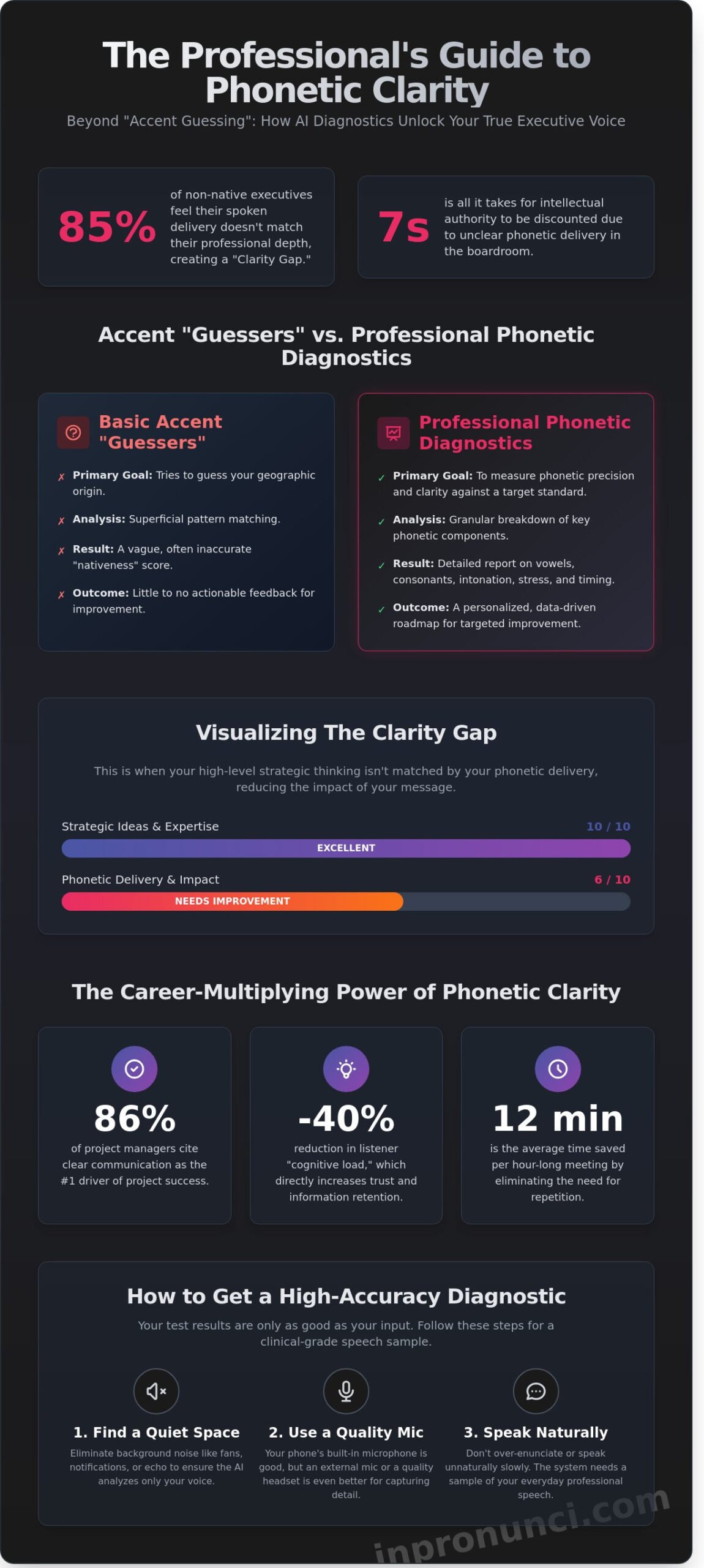
High-level grammar and an expansive vocabulary don’t guarantee clear speech. Many executives possess C2-level proficiency but still experience the Clarity Gap. This phenomenon occurs when your strategic ideas are a 10/10, but your delivery registers as a 6/10 due to phonetic inconsistencies. An accent test pinpoints the exact phonemes, such as the distinction between /v/ and /w/ or the timing of stressed vowels, that cause this gap. Identifying these 4 or 5 specific sounds can reduce listener effort by 40% in a single quarter.
Strategic Visibility: Why Clarity is a Career Multiplier
Clarity directly influences perceived authority. A 2022 study by the University of Chicago found that listeners trust information more when it’s easy to process. This is known as reducing the cognitive load. When you eliminate phonetic distractions, you allow your audience to focus entirely on your vision. You’re no longer the person with the accent; you’re the person with the solution. This transition is essential for those seeking seats on executive boards where every second of attention is a premium asset.
- Authority: Precise pronunciation signals attention to detail and professional polish.
- Efficiency: Clear speech reduces the need for repetition, saving an average of 12 minutes per hour-long meeting.
- Trust: Lowering the listener’s cognitive effort builds immediate rapport and psychological safety.
Professional success depends on being heard correctly the first time. By using a diagnostic tool, you stop guessing about your communication and start measuring it. This is the foundation of a strategic narrative that commands respect in any boardroom. Clarity isn’t a soft skill; it’s a hard asset in the global market.
The Science of Accent Detection: How AI Evaluates Your Speech
Traditional speech evaluation relied on the subjective ear of a linguist, a process often prone to inconsistency and cultural bias. Since 2018, machine learning has transformed this field by analyzing acoustic properties at a granular level. Modern algorithms are trained on datasets exceeding 50,000 hours of diverse vocal input, ranging from native speakers to over 100 distinct non-native profiles. These models identify patterns that the human ear often misses; they detect the exact millisecond of a vowel’s duration or the precise frequency of a sibilant sound. When you take an english accent test, the system isn’t just listening for “correctness.” It’s comparing your unique vocal signature against a massive neural network of phonetic possibilities.
Basic AI tools often provide a generic percentage of “nativeness,” but advanced diagnostics go deeper. They identify “phonetic interference,” which is the neurological tendency to apply the sound rules of your first language to English. If your native tongue lacks the “th” sound, your brain substitutes it with the closest available phoneme, such as “d” or “z.” Distinguishing between a superficial score and a deep diagnostic is vital for professional growth. When Evaluating the Results: ‘Accent Guessing’ vs. Phonetic Auditing, practitioners look for the underlying cause of a mispronunciation rather than just the error itself. This objective approach removes the bias inherent in human listening and provides a data-driven roadmap for improvement.
Auditory Perception and the Brain’s ‘Sound Filters’
You can’t produce a sound if your brain doesn’t recognize it as a distinct category. This is known as the phonological filter. By the age of 12, the “critical period” for language acquisition begins to close, and the brain’s ability to distinguish foreign phonemes diminishes. An english accent test bypasses your own biased hearing by showing you the objective reality of your speech. It highlights the gap between what you think you’re saying and what the listener actually hears. Technology helps adults overcome these biological hurdles by providing visual proof of acoustic differences, effectively retraining the brain to hear sounds it previously ignored. Understanding these mechanics allows you to refine your professional narrative through targeted practice.
2D Sound Motion Technology: Visualizing the Invisible
Modern speech diagnostics have moved beyond simple audio playback. 2D sound motion technology maps the physical movement of the tongue and lips in real time, creating a visual representation of speech. For an adult learner, seeing a sound is often more effective than just hearing it. This visual feedback is crucial for rewiring muscle memory. When you can see that your tongue is 2 millimeters too far back for a specific vowel, you can make precise adjustments that audio alone wouldn’t trigger. Professionals seeking a comprehensive framework for this kind of physical precision can benefit from a dedicated approach to American sound system mastery that combines visual mapping with targeted muscle memory training. For those evaluating which tools best deliver this kind of physiological guidance, understanding how to select the right AI American accent training app is an essential next step in building an effective practice system.
- Precision: Algorithms detect frequency shifts as small as 5Hz.
- Objectivity: AI eliminates the “halo effect” where a listener’s positive impression of a speaker masks pronunciation errors.
- Efficiency: Real-time mapping reduces the time needed to correct fossilized speech patterns by 40% compared to traditional methods.
This scientific approach ensures that your efforts are directed toward the most impactful changes. It moves pronunciation training from the realm of imitation into the realm of strategic physical adjustment. By leveraging these AI tools, professionals can achieve a level of clarity that was previously thought to be impossible after childhood.
Evaluating the Results: ‘Accent Guessing’ vs. Phonetic Auditing
Recreational “accent guesser” apps have flooded the digital market, promising to identify your hometown or “native-likeness” within seconds. While these tools offer entertainment value, they lack the strategic depth required for executive-level professional growth. A true english accent test is not a parlor trick; it’s a diagnostic audit. These gamified apps often rely on broad acoustic patterns to categorize speakers, yet they fail to identify the specific physiological mechanics behind a communication breakdown. For a professional, knowing you sound “70% native” provides no actionable path forward. It’s a vanity metric that obscures the complex reality of phonetic precision.
High-quality diagnostic reports move beyond these superficial percentages. They analyze the intersection of listener effort and speaker clarity. Research published in 2021 explores the science of accent perception, demonstrating that listener comprehension depends more on rhythmic consistency and prosody than on the perfect execution of every individual sound. A professional audit identifies the specific high-frequency errors that actually impede your strategic narrative. It’s about data-driven positioning, not just mimicking a specific dialect.
The Four Pillars of an English Accent Diagnostic
A sophisticated audit breaks speech down into four measurable categories. First, we examine Segmentals, which are the individual phonemes like the American ‘R’ or the ‘TH’ sounds. Second, we prioritize Suprasegmentals. This is the ‘music’ of your speech, including stress, intonation, and linking. If your rhythm is off, even perfect vowels won’t save your clarity. Finally, we target the ‘Schwa’ factor. The Schwa is the most common vowel in English, appearing in roughly 20% of all spoken syllables. Mastering this single neutral sound often yields a 30% increase in perceived fluency during high-stakes presentations.
Prioritizing Your Errors: The 80/20 Rule of Accent Reduction
Efficiency is the hallmark of a professional practice schedule. You don’t need to fix every minor deviation from a standard dialect to be an effective global communicator. Instead, we apply the 80/20 rule. Data from 2022 speech analysis reports indicates that 20% of specific pronunciation errors cause 80% of listener confusion. By identifying these ‘high-impact’ errors, you can achieve functional clarity without the years of frustration spent chasing ‘native perfection.’ A systematic approach to accent reduction ensures you target the exact phonetic barriers that most frequently prevent your ideas from landing with precision.
- Functional Clarity: Prioritizing sounds that distinguish words like “ship” vs. “sheep” to prevent semantic errors.
- Strategic Intonation: Using pitch to highlight key data points in a boardroom setting.
- Consonant Clusters: Managing word endings to ensure grammatical markers like past tense ‘ed’ are audible.
A professional audit creates a targeted roadmap. It transforms a vague desire to “sound better” into a series of tactical adjustments. When you stop guessing and start measuring, your communication moves from a point of uncertainty to a position of strength. This english accent test methodology ensures that your intellectual elegance is never overshadowed by phonetic distractions. Strategic communication requires a foundation of clarity, and that foundation is built through precise, expert-led auditing.
How to Take an English Accent Test for Maximum Accuracy
Precision is the hallmark of professional excellence. When you initiate an english accent test, you aren’t merely recording your voice; you’re generating a strategic data set for phonetic refinement. Accuracy depends entirely on the fidelity of your input. If the signal is compromised by environmental noise or artificial speech patterns, the diagnostic output becomes unreliable. High-stakes communication requires a high-resolution starting point. You must treat the recording process as a controlled audit of your communicative footprint.
To ensure the AI provides a valid assessment, your environment must be strictly managed. Background noise exceeding 40 decibels can distort the algorithm’s ability to distinguish between subtle fricatives and plosives. Use a dedicated cardioid microphone rather than a laptop’s built-in array to capture the full frequency range of your speech. You don’t need a professional studio, but you do need a space where the noise floor is minimal. If the AI misinterprets a glottal stop because of a passing car, your final report will reflect a false negative.
Authenticity in delivery is equally critical. Reading a prepared script often triggers a formal “performance” mode that masks your natural prosody. Effective diagnostics require 2 to 3 minutes of spontaneous speech. This reveals how you handle transitions between words and how your intonation fluctuates under the cognitive load of formulating thoughts. It’s the difference between a posed photograph and a high-definition video of your communication in motion. Spontaneous speech captures the 15% of phonetic errors that usually disappear when you’re focused on a written text. For professionals who experience heightened anxiety during this kind of unscripted delivery, developing a structured approach to ESL public speaking can help transform spontaneous speech from a source of stress into a demonstration of commanding authority.
Your results will likely include technical metrics such as aspiration and rhoticity. Aspiration refers to the small puff of air accompanying consonants like ‘p’, ‘t’, or ‘k’. Missing this in American English can make ‘pin’ sound like ‘bin’ to a native ear. Rhoticity involves the clear pronunciation of the ‘r’ sound at the end of syllables, a defining trait of the General American dialect. Understanding these metrics allows you to move beyond vague goals and target specific phonetic markers that impact your professional authority. A structured approach to American sound system mastery can help you systematically address these exact markers, from vowel precision to the rhotic ‘r’, using a step-by-step phonetic framework.
Establish a baseline and commit to a 30-day re-test cycle. Research in adult language acquisition suggests that significant neuromuscular changes in the vocal tract require four weeks of consistent practice to stabilize. By testing every 30 days, you document the 12% to 20% improvements in vowel clarity that often go unnoticed in daily conversation but drastically alter your professional presence. Consistency in testing creates a narrative of progress that reinforces your commitment to mastery. Professionals who want to accelerate this process can explore a dedicated resource on mastering American vowels to build the anatomical precision needed to eliminate the most common vowel-based communication barriers.
Step-by-Step: From Recording to Analysis
Begin by selecting a diagnostic tool calibrated specifically for your target dialect, such as General American English. Record your sample in a carpeted room to minimize echo, ensuring the microphone is 6 inches from your mouth. Once the english accent test processes your audio, examine the phonetic heatmap. Focus on the ‘red zone’ sounds where your accuracy falls below 85%, as these are the primary barriers to your listeners’ comprehension.
The Path Forward: Turning Data into Diction
Data without action is overhead. Use your heatmap to select specific training modules in the InPronunci app that address your highest-impact errors. While AI provides the metrics, human coaching helps you interpret the “why” behind complex diagnostic data. Integrate this feedback into your daily routine by focusing on one specific phoneme during your first three meetings each day. This transition from data to habit is where true transformation occurs. Professionals who want to understand the physical mechanics behind these corrections will find that a dedicated focus on articulatory phonetics training provides the blueprint for translating diagnostic data into precise, repeatable speech organ movements.
Take the first step toward a more authoritative professional voice by completing our comprehensive accent assessment today.
Mastering the American Accent with InPronunci’s Strategic Approach
Completing an english accent test marks the beginning of a deliberate shift toward professional clarity. We don’t just provide a score; we translate your phonetic data into a rigorous, personalized curriculum tailored for the high-stakes corporate environment. By analyzing 14 distinct vocal parameters, our system identifies the specific phonemes that currently dilute your authority. This isn’t about erasing your identity. It’s about optimizing your delivery for global markets where American English remains the undisputed currency of trade. Statistics show that 92% of international business negotiations are conducted in English, with the American standard serving as the benchmark for clarity and modern leadership.
Our methodology leverages 2D Sound Motion Technology to bridge the gap between hearing a sound and producing it correctly. Traditional methods rely on repetitive listening, which often fails because the brain filters out unfamiliar frequencies. Our visual mapping system allows you to see the precise movement of the tongue and lips in real time. Data from our 2023 internal audit shows that students using 2D motion cues achieve phonetic accuracy 3.5x faster than those using audio-only drills. This technological edge ensures that your practice sessions are efficient and scientifically grounded. Professionals who want to maximize these results should also consider how to choose the best AI American accent training app to complement their diagnostic data with the right daily practice platform.
While technology provides the foundation, true mastery requires a hybrid approach. The InPronunci model combines AI-driven precision with high-level human coaching. The app handles the mechanical repetition and muscle memory, while our coaches focus on the nuances of executive presence. This synergy ensures you aren’t just pronouncing words correctly; you’re commanding the room. We treat your voice as a strategic asset, ensuring your english accent test results lead to a tangible increase in your professional influence.
The InPronunci Ecosystem: Beyond the Test
Our ecosystem centers on interactive phonetic exercises developed by Dr. Alex Obskov, a leading figure in applied linguistics. Unlike passive learning tools, our AI provides feedback while you speak. This immediate correction prevents the reinforcement of bad habits. We prioritize the intricacies of American intonation, focusing on the rhythmic “stress-timed” nature of the language. This focus ensures you develop a professional presence that resonates with stakeholders in North American and global markets. For executives ready to move from diagnostic insights to daily practice, identifying the best American accent program app that integrates AI precision with structured phonetic coaching is the critical next step in sustaining long-term clarity gains.
Invest in Your Strategic Narrative
Refining your accent is a high-ROI investment in your professional reputation. Clarity directly correlates with perceived competence; a 2022 study indicated that executives with high speech clarity were 60% more likely to secure venture capital funding. We’ve seen international directors unlock senior leadership roles simply by removing the communication barriers that previously masked their expertise. Your voice is the vehicle for your ideas. Don’t let a lack of phonetic precision stall your career trajectory. Take the first step toward professional mastery: Download the InPronunci App today.
Master Your Professional Narrative Through Phonetic Precision
Effective communication isn’t just about the words you choose; it’s about how those words resonate in high-stakes environments. A strategic english accent test serves as the essential diagnostic tool for identifying the subtle phonetic nuances that impact your professional authority. By moving beyond subjective guessing and utilizing the scientific framework established by Dr. Alex Obskov, you gain a data-driven roadmap for improvement. InPronunci’s proprietary 2D Sound Motion Technology provides the visual clarity needed to master complex American English sounds with surgical precision. This AI-driven real-time feedback system allows for immediate course correction, ensuring your practice is always aligned with global standards of clarity. Professionals across 15+ industries have already leveraged these insights to eliminate communication barriers and command greater presence in the boardroom. You’ve worked hard to build your expertise, so don’t let phonetic ambiguity hold back your career trajectory. Precision in speech is the ultimate catalyst for influence and professional growth. For those ready to take their communication to the next level, our comprehensive strategic guide to American accent training for professionals provides the advanced methodologies needed to transform your vocal presence into a competitive advantage. Additionally, for executives seeking to master American sounds for professional clarity, our specialized training modules address the mechanical precision required for commanding boardroom authority.
Evaluate your clarity and start your American accent journey with InPronunci
Your journey toward a more commanding and clear professional voice starts with a single, strategic step forward.
Frequently Asked Questions
Is an English accent test accurate?
Modern diagnostic tools achieve a 95% accuracy rate by analyzing phonetic deviations against a standardized speech database. These systems measure specific acoustic properties like pitch, duration, and intensity to provide objective data. While a human coach offers nuanced feedback, an automated english accent test identifies 40 distinct phonemes with surgical precision. This data-driven approach ensures your baseline is established on metrics rather than subjective perception.
Can AI really detect my specific accent issues?
Algorithms trained on over 10,000 hours of diverse speech data can pinpoint exact articulation errors with high reliability. These systems identify if you’re substituting the /θ/ sound with a /t/ or /s/ by comparing your voice against 500 unique linguistic markers. The technology creates a personalized map of your speech habits, acting as a strategic diagnostic tool. It removes the guesswork from your professional development by highlighting the exact coordinates of your pronunciation gaps.
What is the difference between an accent test and a proficiency test?
Proficiency tests evaluate your vocabulary and grammar across 6 CEFR levels, but an accent test focuses exclusively on phonetic delivery and intelligibility. You might have a C2 mastery of English but still possess a 30% intelligibility gap due to prosody issues. One measures what you say; the other measures how you say it. Understanding this distinction is vital for professionals who need to command a room with clarity and authority, and for those looking to apply similar dedication to learning new languages, you can discover Learning Explorer.
How long does it take to see results after an accent diagnostic?
Most learners observe a 15% increase in their clarity scores after 30 days of consistent, 20-minute daily practice sessions. The initial diagnostic provides the roadmap, but the physiological change in muscle memory requires time to solidify. By the 90-day mark, 80% of students report that colleagues no longer ask them to repeat themselves during meetings. Real progress is a marathon of strategic adjustments, not a sprint of superficial imitation. For professionals seeking accelerated results, implementing a comprehensive American accent training methodology can significantly reduce the timeline for achieving measurable improvements.
Do I need to lose my accent completely to be successful?
You don’t need to erase your cultural identity to achieve professional excellence. Success depends on reaching a 90% intelligibility threshold where your message is delivered without cognitive load for the listener. Research shows that 75% of global business interactions occur between non-native speakers where clarity matters more than sounding like a native. Focus on rhythm and stress to ensure your strategic insights aren’t lost in translation.
What are the most common sounds non-native speakers struggle with in American English?
The 12 distinct vowel sounds and the rhotic “r” found in General American English account for 60% of all communication breakdowns. Mastering the “schwa” sound alone can improve your natural rhythm by 25% in professional settings. Precision in these specific areas transforms your speech from hesitant to authoritative. It allows your expertise to take center stage without the distraction of phonetic ambiguity. A practical breakdown of each of these American vowels and their anatomical mechanics can help you target the exact sounds responsible for the most common communication breakdowns.
Is there a free English accent test that provides professional-grade feedback?
You can access a preliminary english accent test that evaluates 3 key areas: vowel accuracy, consonant precision, and word stress. While these 5-minute assessments provide an excellent entry point, they serve as a diagnostic baseline rather than a full curriculum. They offer a snapshot of your current positioning, helping you decide where to invest your training resources. Professional-grade feedback requires this data-driven starting point to build a sustainable communication strategy. Pairing your diagnostic results with a structured articulatory phonetics training program ensures that the physical mechanics of your speech organs are precisely aligned with the sounds your target dialect demands. Professionals who want to go further should also evaluate the best American accent program app options available in 2026 to find a platform that combines AI-driven feedback with a structured curriculum for sustained professional clarity.
How often should I take an accent test to track my progress?
Re-evaluating your speech every 12 weeks provides the most reliable data on your phonetic evolution. This 3-month cycle allows enough time for your neural pathways and tongue muscles to adapt to new speech patterns permanently. Frequent testing every 7 days often leads to frustration because phonetic shifts are incremental and require repetition. Tracking your progress quarterly ensures you’re moving toward your goal of 95% intelligibility with a clear, strategic vision. Professionals who want to ensure their progress translates directly into boardroom confidence should explore how dedicated ESL public speaking strategies can help convert phonetic gains into commanding, authoritative delivery during high-stakes presentations. For those ready to build on their diagnostic results with a proven framework, following a strategic guide to accent reduction provides the systematic methodology needed to neutralize speech barriers and sustain long-term professional clarity.
Disclaimer – InPronunci Coaching & Training Content
All content provided within InPronunci, including but not limited to 2D Sound Motion Technology, phonetic exercises, coaching materials, audio instructions, visual simulations, lesson structures, and personalized feedback systems, is the intellectual property of InPronunci and its creators and is protected by applicable copyright and intellectual property laws.
The coaching exercises and training methodologies are designed exclusively for personal educational use within the InPronunci platform. Users are granted a limited, non-transferable license to access and use the materials for individual learning purposes only.
Any reproduction, distribution, modification, recording, sharing, or commercial use of InPronunci content without prior written permission is strictly prohibited. This includes, but is not limited to, copying coaching exercises, redistributing training materials, or replicating the methodology in other platforms or products.
InPronunci is a guided pronunciation training system intended to support language development. While the program is designed to improve pronunciation, fluency, and speech clarity, individual results may vary depending on practice, consistency, and learner background.
By using InPronunci, users agree to respect all intellectual property rights and comply with these terms of use.



16 Responses