


What if the subtle shift between two vowel sounds could change how colleagues perceive your professional authority? You might find yourself caught in a loop of either either either while preparing for a high-stakes meeting, wondering if “EE-ther” or “EYE-ther” is the standard for American English. Most international professionals experience this specific anxiety, often feeling self-conscious because they’ve received conflicting advice from different instructors over the years.
We understand that clarity in a modern office culture isn’t about removing your identity; it’s about mastering strategic nuances. This article reveals the phonetic secrets of the word “either” so you can choose the right pronunciation with absolute certainty. We’ll explore why both versions are linguistically valid and how our 2D Sound Motion Technology, featured in our February 26, 2026 app update, helps you train the speech organs involved in producing these vowels. By combining human-based instruction with our AI Accent Coach, we provide the tools you need to speak with a refined American accent that builds trust and enhances your professional trajectory.
Either, Either, or Either? Navigating the Great Pronunciation Debate
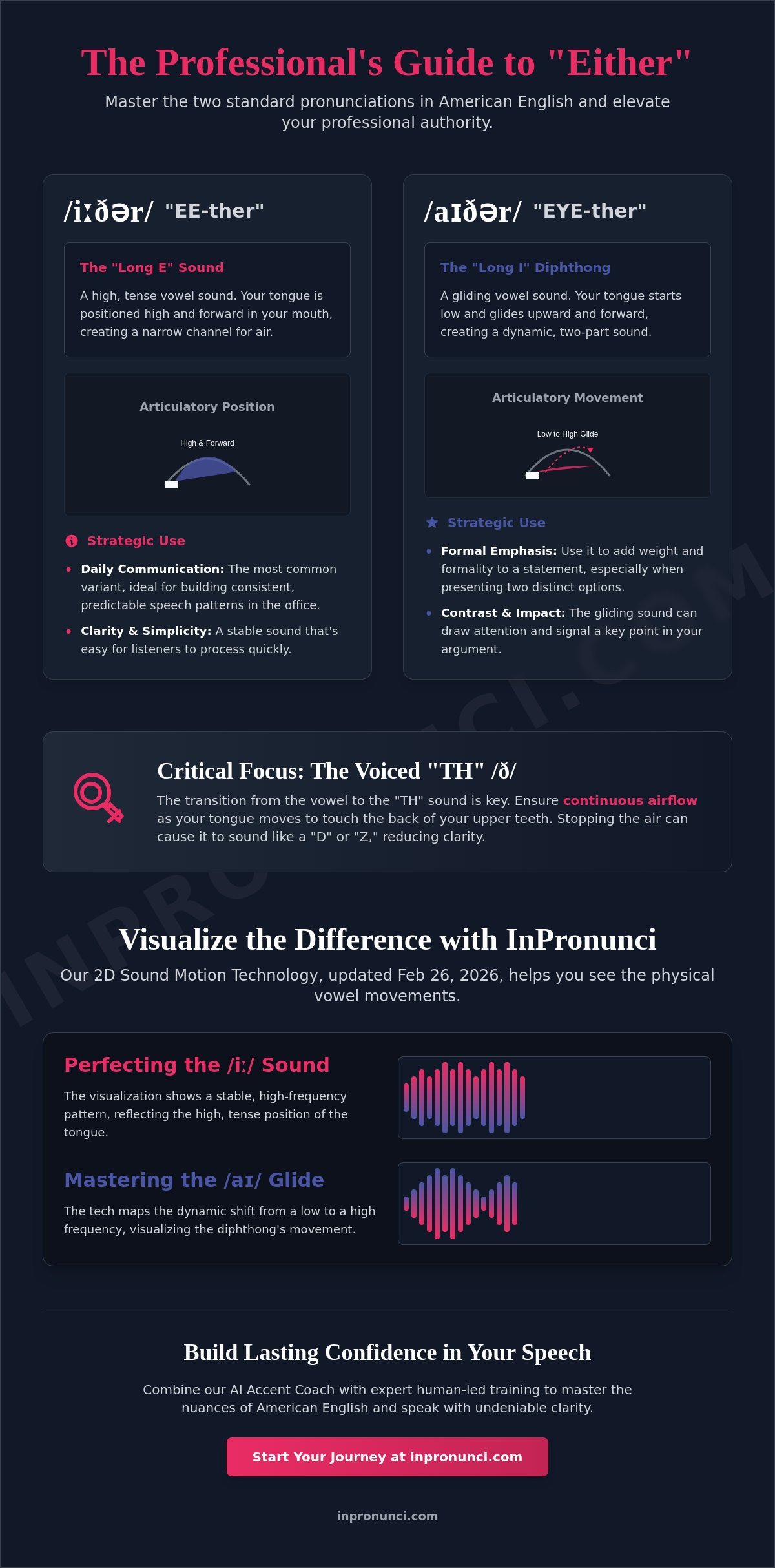
The word “either” stands as a unique marker of English linguistic evolution. Most speakers use one of two primary pronunciations: /iːðər/ (EE-ther), featuring a long E sound, or /aɪðər/ (EYE-ther), which uses a long I diphthong. If you’ve spent time in a diverse American office, you’ve likely heard both used interchangeably. This often leads to a cycle of either either either confusion, where learners feel they must choose one “correct” version to be understood. You might worry that using the “wrong” one reveals a lack of training, but the reality is more nuanced.
The truth is simpler. Both variations are grammatically perfect and widely accepted across the United States. Choosing between them isn’t about right or wrong; it’s about developing phonetic flexibility. Mastering both sounds shows a high level of fluency. It allows you to adapt to your environment while maintaining your professional authority. In our methodology at InPronunci, we view this choice as a strategic tool for clarity rather than a linguistic hurdle you must clear.
The Origins of the Dual Pronunciation
Language changes over centuries, and “either” is a fascinating survivor of this process. Its roots go back to the Old English word ægðer. While most English words eventually settled on a single standard sound, “either” retained two. You can see how these sounds branched off by looking at Wiktionary’s breakdown of ‘either’, which details the IPA transcriptions used in different regions. Historically, regional dialects in the UK and North America kept both versions alive. In the US, regional preferences often dictate which one sounds more “natural” in a specific city, but neither version will ever mark you as incorrect in a professional setting.
Why Consistency Matters in Professional Speech
Choosing a “home base” pronunciation is a strategic move for your professional reputation. While both sounds are correct, switching between them in the middle of a single presentation can increase the cognitive load for your listeners. When your speech patterns are consistent, your audience can focus entirely on your message rather than your mechanics. This consistency builds trust and projects a sense of calm confidence.
Stabilizing these choices requires more than just repetition. It involves understanding how your speech organs move. This is why articulatory phonetics training is so effective. It gives you a blueprint for your mouth’s positioning. Since our app version 1.9 was released on February 26, 2026, we’ve focused on helping users build this consistency. By picking one version as your primary sound, you create a reliable strategic narrative that colleagues trust. You don’t need to eliminate the other version, but having a clear preference makes your speech more predictable and easier to follow.
The Articulatory Phonetics of ‘Either’: Mastering the Vowel Shifts
The loop of either either either in your head usually stops when you understand the physical mechanics of the vowel shift. While Section 1 explored why both versions are accepted, improving your clarity requires a deep dive into articulatory phonetics. The difference between “EE-ther” and “EYE-ther” isn’t just a matter of preference; it’s a complete change in how you position your tongue and shape your oral cavity. Mastering these two distinct vowel sounds allows you to switch between variants with professional precision.
When you choose the long E sound (/iː/), your tongue stays high and forward in the mouth. The sides of your tongue should touch your upper back teeth, creating a narrow channel for the air. In contrast, the long I sound (/aɪ/) is a diphthong, which means it’s a moving target. Your tongue starts in a low, neutral position and glides upward toward the roof of your mouth. This movement must be fluid to sound natural. As noted in Grammarly on ‘either’ pronunciation, these shifts are common across American dialects, but the physical execution remains the most challenging part for non-native speakers.
The transition to the voiced TH (/ð/) sound is where many professionals lose their clarity. You must maintain continuous airflow as you move from the vowel to the consonant. If you stop the air, the “TH” can sound like a “D” or a “Z,” which significantly impacts your strategic narrative. Your tongue should lightly touch the back of your upper front teeth while your vocal cords vibrate. This creates the buzz that characterizes a clear American accent. Developing this level of precision enunciation is what separates professionals who are merely understood from those who command genuine authority in every conversation.
Training Speech Organs with 2D Sound Motion Technology
Traditional “listen and repeat” methods often fail because they don’t address what’s happening inside your mouth. You can’t directly track your tongue move, so you default to the vowel habits of your native language. Our 2D Sound Motion Technology changes this by training sound movement. It trains your tongue, lips, jaw, teeth, airflow, and voice for the high forward position of the long E versus the low-to-high glide of the long I. Understanding the motion helps you correct your placement in real time, moving beyond simple audio repetition to true articulatory understanding.
Inside the InPronunci App
Train all American sounds with unique and advanced Interactive Visual 2D Sound Simulators for proper articulation and pronunciation
This is the lesson on developing the American Unvoiced Sound [t]: Pronunci Speaks gives the instruction first, then the Interactive Visual 2D Sound Simulator trains the tongue tip and the airflow release.
- EffectiveMost apps offer visual learning. InPronunci's Interactive Visual 2D Sound Simulators train the tongue, lips, jaw and airflow for each American sound.
- ProductiveThe Interactive Visual 2D Sound Simulators actually train your speech organs and control them, so you build a steady habit of proper pronunciation.
- ResultsStudents pronounce individual American sounds with almost native-like pronunciation.
Building Speech Muscle Memory
Your brain is wired to use the sounds you learned as a child. When you say “either,” your vocal tract naturally wants to take the path of least resistance. Establishing new neural pathways requires repetitive, focused phonetic exercises. Building robust speech muscle memory is what allows you to transition from consciously thinking about each sound to producing it automatically under pressure. Since the release of version 1.9 on February 26, 2026, the InPronunci App has focused on tracking this precision through AI pronunciation feedback. By practicing these specific vowel shifts daily, you build the muscle memory needed to speak clearly during high-pressure meetings without overthinking your mechanics. You can start building this habit today by visiting the official InPronunci website to explore our methodology.
Strategic Communication: Choosing Your Variant in Professional Settings
Choosing between “EE-ther” and “EYE-ther” is more than a linguistic toss-up; it’s a decision about your professional positioning. While we’ve mastered the physical mechanics of these sounds, we must now look at how they function in high-stakes environments. The internal debate of either either either often stems from a desire to fit in while remaining authentic. In the United States, your choice can subtly signal your familiarity with specific industry norms or your intent to emphasize a particular point during a negotiation.
Standard American English (SAE) leans heavily toward the “EE-ther” variant. It’s the most common choice in fast-paced sectors like Tech and Healthcare, where efficiency and immediate clarity are the highest priorities. In these fields, professionals often strip away phonetic flourishes to ensure information travels quickly. However, the “EYE-ther” variant isn’t absent. It often appears in legal, academic, or highly formal corporate settings. Understanding these trends allows you to mirror your environment without losing your unique professional voice.
When to Use ‘EE-ther’ (The Standard Choice)
If you’re looking for a reliable “home base,” “EE-ther” is your safest default. It fits seamlessly into the rhythm of American office culture speech, especially during rapid-fire brainstorming sessions or daily stand-ups. Using this variant reduces the risk of sounding overly formal when the situation calls for collaboration. It’s practical, direct, and aligns with the speech patterns of approximately 70% of American speakers in professional contexts. By adopting this as your primary sound, you minimize the “cognitive load” for your listeners, allowing them to focus on your strategic insights rather than your pronunciation.
When to Use ‘EYE-ther’ (The Emphatic Choice)
There are moments when you want your words to carry more weight. The “long I” sound in “EYE-ther” provides a natural rhetorical emphasis that can be very effective in presentations or board meetings. When you check the phonetic pronunciation of either, you’ll see that this variant is linguistically sophisticated and perfectly valid in American English. The key is consistency. If you use “EYE-ther” for emphasis, ensure the rest of your accent remains grounded in American phonetics. This avoids the “pseudo-British” trap, where a speaker accidentally mixes dialects and creates confusion. Use it strategically to signal a transition or to highlight a specific choice between two critical business paths.
Ultimately, your goal is to speak with a level of clarity that builds trust. Whether you’re in a hospital wing or a silicon valley boardroom, your ability to choose a variant and stick with it shows a high degree of linguistic awareness. If you’re ever unsure which path to take, our AI pronunciation feedback can help you test both variants to see which one feels more natural for your specific vocal range. This isn’t about removing your accent; it’s about giving you the tools to navigate the either either either dilemma with intellectual elegance and professional confidence.
How to Practice ‘Either’ for Native-Level Clarity
Theory alone won’t help you during a fast-paced board meeting. You need a practical routine to bridge the gap between understanding phonetics and applying them instinctively. The mental loop of either either either can be resolved by breaking the word down into manageable physical actions. By following a structured four-step process, you can move from conscious effort to automatic speech muscle memory.
- Step 1: Isolate the Vowel. Start by producing the vowel sound in isolation. Use the evaluation mode in our app to ensure your tongue is in the correct position for either the high-forward /iː/ or the gliding /aɪ/.
- Step 2: Master the Transition. Move from the vowel to the voiced “TH” (/ð/) without stopping your airflow. This continuity is essential for a natural American rhythm.
- Step 3: Analyze Consistency. Record yourself saying the word in a short phrase. Use our AI pronunciation feedback to verify that your vowel length and frequency match the target American sound.
- Step 4: Simulate Reality. Gradually increase your speaking speed. Practice saying “either” at 80%, 100%, and 120% of normal conversation speed to ensure your clarity holds up under pressure.
Utilizing AI Pronunciation Feedback
Effective pronunciation practice must be data-driven. Our AI technology, updated in version 1.9 on February 26, 2026, identifies subtle deviations in vowel length that the human ear often misses. Real-time correction is vital because it prevents you from ingraining incorrect habits. Instead of guessing if you sound right, you receive immediate visual and auditory confirmation. This objective feedback allows you to adjust your articulatory positioning instantly, making your training sessions much more efficient.
Sentence-Level Integration
Once you can produce the word in isolation, you must integrate it into common American sentence structures. The rhythm of “either/or” phrases is a hallmark of professional clarity. Practice these specific examples to master the pitch and stress:
- “Either way is fine with me.”
- “I don’t particularly like either one.”
- “Either you or I will need to lead the presentation.”
Focus on how the pitch of “either” changes based on the sentence’s intent. In a choice, the word often carries a slightly higher pitch to signal an alternative. Developing this prosody is what separates a proficient speaker from a masterful communicator. By focusing on these small shifts, you ensure your speech sounds human and engaging rather than robotic.
Building this level of precision takes time, but the results are sustainable. You can start refining your speech today by visiting the official InPronunci website to explore our 2D Sound Motion Technology.
Mastering American Sounds with InPronunci’s Innovative Approach
The journey from feeling self-conscious about either either either to speaking with professional authority is a path of strategic growth. At InPronunci, we believe that mastering a single word is the foundation for a much broader transformation. This specific challenge serves as a perfect example of how small phonetic adjustments lead to significant results in your professional narrative. By understanding the mechanics of these sounds, you’ve already taken the first step in our comprehensive American sounds curriculum.
Our goal isn’t to erase your cultural identity or your unique history. Instead, we focus on removing the communication barriers that can sometimes hide your expertise. Clearer pronunciation isn’t about fitting a mold; it’s about making sure your ideas are heard without distraction. When you speak with clarity, you build trust and project the intellectual elegance that defines high-level leadership. This clarity allows your strategic insights to take center stage in every conversation.
The InPronunci Difference: Technology Meets Human Coaching
Modern professionals need a solution that fits into their demanding schedules without sacrificing quality. Our hybrid model combines the precision of an American accent training app with the strategic depth of human expertise. While our AI pronunciation feedback provides 24/7 support for your daily drills, our human-based instruction handles the complex nuances of rhythm and intonation. This ensures you aren’t just repeating sounds, but understanding the “why” behind every exercise.
This dual approach ensures you’re never practicing in a vacuum. The 2D Sound Motion Technology in version 1.9, released on February 26, 2026, allows you to train sound movement on your own time. Meanwhile, human coaches provide the personalized guidance needed for high-stakes negotiations and presentations. This combination creates a sustainable path to professional clarity that goes far beyond simple imitation. It’s a long-term investment in your hírnévmenedzsment and professional visibility.
Start Your Transformation Today
The best way to improve is to know exactly where you stand. We invite you to benchmark your current speech patterns by taking our english accent test. This diagnostic tool provides a clear starting point for your journey, highlighting specific areas for growth and helping you set realistic, achievable goals. Knowing your starting point is the first move in any successful strategic narrative.
Clear communication is the most powerful tool for business success and social impact. By investing in your speech, you’re investing in your long-term career trajectory and your ability to influence others. Visit the official InPronunci website to learn more about the app, or create your student account on the InPronunci learning platform to start practicing American pronunciation.
Elevating Your Professional Narrative Through Phonetic Precision
Mastering the shift between the long E and long I sounds is about more than just one word. It’s about developing the strategic awareness to navigate diverse American workspaces with confidence. By choosing a consistent “home base” for your speech, you reduce the cognitive load for your listeners and project a sense of intellectual elegance. You no longer need to get stuck in a cycle of either either either during a high-stakes presentation. Instead, you can rely on the muscle memory built through the structured phonetic curriculum of Prof. Alex, Ph.D. Accent Coach.
Our AI-driven real-time speech analysis and unique 2D Sound Motion Technology provide the speech-organ training and auditory feedback you need to succeed. These tools allow you to track your progress and adjust your articulatory positioning instantly. Clear communication is a long-term investment in your professional visibility and career trajectory. Visit the official InPronunci website to learn more about the app, or create your student account on the InPronunci learning platform to start practicing American pronunciation.
You already have the expertise and the drive to succeed in your field. We’re here to help you ensure your voice is heard with the clarity and authority you deserve.
Questions & Answers
Frequently Asked Questions
01Is it more correct to say ‘EE-ther’ or ‘EYE-ther’ in the United States?
Both pronunciations are linguistically correct and widely accepted across the United States. While “EE-ther” is the more common choice for approximately 70% of American speakers, “EYE-ther” is frequently heard in formal or emphatic contexts. You won’t be corrected for using either version in a professional setting. The key is to choose one as your “home base” to maintain consistency in your strategic narrative.
02Can I use both pronunciations of ‘either’ interchangeably?
You can use both, but switching mid-sentence increases the cognitive load for your listeners. Professionals who master the either either either dilemma usually stick to one variant during a single conversation. This consistency builds trust and helps your audience focus on your message rather than your mechanics. If you choose to switch for rhetorical emphasis, do so intentionally rather than by accident.
03How do I know if I am pronouncing the ‘TH’ in ‘either’ correctly?
Your “TH” is correct when your vocal cords vibrate and your tongue lightly touches the back of your upper front teeth. This voiced /ð/ sound should be a continuous buzz without stopping the airflow. Using our 2D Sound Motion Technology, you train the exact positioning of your speech organs. Our AI pronunciation feedback provides real-time data to confirm if you’re hitting the frequency of a native American speaker.
04What happens if I use a British pronunciation of ‘either’ in an American office?
Using a British-leaning “EYE-ther” in an American office is perfectly acceptable and often sounds more formal. However, you should avoid mixing British vowel sounds with American R-coloring in the same sentence. This can create a “pseudo-accent” that feels inconsistent. Aim for a cohesive strategic narrative by keeping your intonation and rhythm grounded in the American standards practiced in our curriculum.
05Does the InPronunci App help with other words like ‘neither’?
Yes, our curriculum covers the entire spectrum of American sounds, including words like “neither” which follow the same dual-pronunciation rules. The InPronunci app provides specific modules for diphthongs and voiced consonants to help you build a complete professional voice. Since our February 26, 2026 update, we’ve included more comparative exercises to help you distinguish between similar vowel shifts across different word families.
06Is ‘either’ always followed by ‘or’ in professional English?
No, “either” functions in several ways beyond the “either/or” correlative structure. You’ll frequently use it as a pronoun, such as in the phrase “either of the options,” or as an adverb meaning “likewise” in negative sentences. Mastering these variations is essential for professional American office culture. Our AI Accent Coach helps you practice these different grammatical contexts to ensure your stress and intonation remain natural in every scenario. For a broader framework on achieving this level of spoken clarity, explore our strategic enunciation checklist for professional clarity, which covers the full range of articulation skills needed in high-stakes American workplace communication.
InPronunci training structure
How InPronunci trains the American speech system
InPronunci trains the full American speech system: Interactive Visual 2D Sound Simulators and phonetic exercises for articulation and American sound development, sentence practice for intonation, melody, rhythm, and connected speech, paragraph practice for spontaneous speech, public speaking, and real communication confidence, and Advanced AI Accent Coach evaluation as you speak.
InPronunci is an advanced, linguistically structured American accent training platform with more than 1,000 downloads and a growing learner base. It is designed for serious ESL learners who want American pronunciation, stronger intonation, more natural rhythm, better connected speech, and the ability to speak English more confidently in real communication. The program is especially useful for intermediate and advanced English speakers who want to become independent speakers of English with confident communication, stronger speaking control, long-term speech improvement, and great public speaking skills. It is also designed for advanced speakers whose goal is to speak like a native or closer to native-like American speech, including people who were raised in the United States but still have slight accent patterns from the native language they were born with. It is a complete American accent training course and system created by Prof. Alex, Ph.D. Accent Coach, Doctor of Education, and professional linguist based in Austin, Texas, with Pronunci Instructions from Prof. Alex for each lesson that make self-learning more effective, supported, and clear.
Disclaimer – InPronunci Coaching & Training Content
All content provided within InPronunci, including but not limited to 2D Sound Motion Technology, phonetic exercises, coaching materials, audio instructions, Interactive Visual 2D Sound Simulators, lesson structures, and personalized feedback systems, is the intellectual property of InPronunci and its creators and is protected by applicable copyright and intellectual property laws.
The coaching exercises and training methodologies are designed exclusively for personal educational use within the InPronunci platform. Users are granted a limited, non-transferable license to access and use the materials for individual learning purposes only.
Any reproduction, distribution, modification, recording, sharing, or commercial use of InPronunci content without prior written permission is strictly prohibited. This includes, but is not limited to, copying coaching exercises, redistributing training materials, or replicating the methodology in other platforms or products.
InPronunci is a guided pronunciation training system intended to support language development. While the program is designed to improve pronunciation, fluency, and speech clarity, individual results may vary depending on practice, consistency, and learner background.
By using InPronunci, users agree to respect all intellectual property rights and comply with these terms of use.
Plans
What InPronunci costs
InPronunci Basic
$35 per month
Chapter 1 is free after signup.
InPronunci Premium
$200 per month
Includes a coach: