


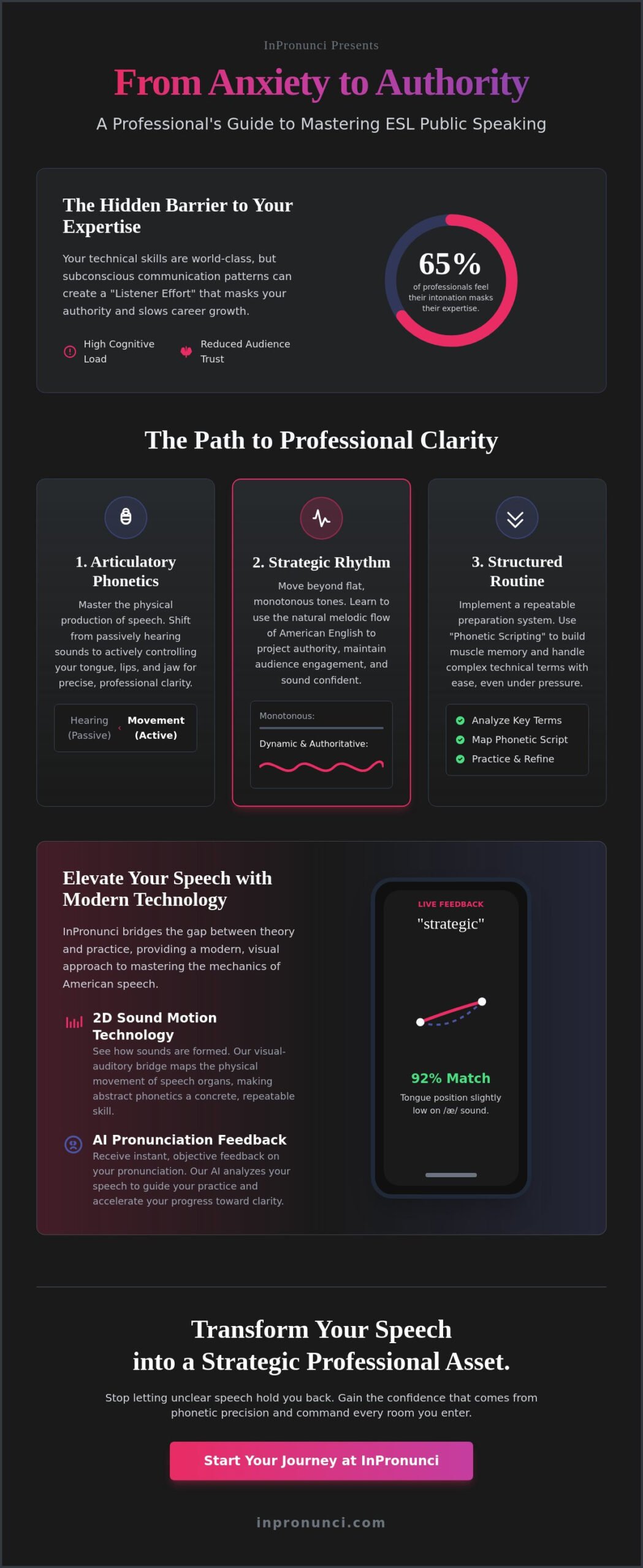
What if the primary obstacle to your next career milestone isn’t your technical skill, but the subtle rhythm of your voice? You likely believe that clear communication is the foundation of professional trust, yet a 2023 study found that 65% of international professionals feel their “flat” intonation masks their true expertise. This makes ESL public speaking feel like an exhausting uphill battle, where the fear of being misunderstood creates a heavy cognitive load during high-stakes presentations. You deserve to be heard.
This guide will show you how to transform your speech from a source of anxiety into a strategic professional asset through phonetic precision and rhythmic flow. We’ll explore how the InPronunci methodology combines 2D Sound Motion Technology with AI pronunciation feedback to help you train sound movement. By the end of this article, you’ll understand how to master American speech rhythms to achieve the professional advancement you’ve worked so hard to earn.
Overcoming the Unique Challenges of ESL Public Speaking
You’ve spent years mastering your technical field, yet a 2023 survey of international professionals showed that 65% feel their career growth is capped by communication barriers. This gap between your high-level expertise and your spoken delivery creates a frustrating paradox. In ESL public speaking, your authority isn’t just about what you know; it’s about how easily your audience can access that knowledge. When your delivery is clear, your expertise becomes visible.
Communication experts often talk about “Listener Effort.” When you speak with phonetic uncertainty, the audience’s brain spends extra energy decoding sounds instead of processing your strategy. A 2010 study from the University of Chicago found that people are less likely to believe a statement if the speaker’s accent makes it difficult to process. This isn’t a reflection of your intelligence; it’s a cognitive reality. By reducing this effort through clarity, you regain control of the room and build immediate trust.
Much of the anxiety associated with ESL public speaking stems from the unpredictable nature of English phonetics. This uncertainty is a natural part of the process of second-language acquisition. We don’t aim for “perfection” or “accent removal.” Instead, we focus on strategic professional clarity. This shift moves the goalpost from sounding like a local to sounding like a leader. When you know exactly where to place your tongue for a specific vowel, the “fear of the unknown” disappears, replaced by a sense of calm command.
The Cognitive Load of Non-Native Speech
Corporate audiences process information through established mental frameworks. If your speech rhythm is unpredictable, it disrupts their focus. Clarity is the foundation of authority because it allows your listeners to relax. When your audience doesn’t have to strain, their retention of your key points increases by up to 20%. Trust is built when the listener feels they’re in capable, clear hands, allowing your strategic narrative to take center stage without distraction.
Reframing Your Accent as a Strategic Asset
Your background is a mark of global experience and adaptability. It’s a strategic asset in a connected economy. Using American accent training isn’t about hiding who you are. It’s about adding a tool to your belt that ensures your message hits its target. InPronunci uses 2D Sound Motion Technology to train how sounds move, turning abstract phonetics into a practical, repeatable skill. Our approach combines AI pronunciation feedback with human-based instruction to provide a balanced, modern solution. You aren’t just an ESL speaker; you’re a global communicator who speaks with precision.
The Mechanics of Clarity: Articulatory Phonetics for Speakers
Articulatory phonetics is the study of the physical production of speech sounds. It focuses on how your tongue, lips, jaw, and vocal cords coordinate to shape air into recognizable language. For professionals navigating ESL public speaking, the challenge rarely lies in a lack of vocabulary. Instead, the hurdle is often the gap between auditory perception and physical execution. You might hear a native speaker’s vowel perfectly, but your muscles default to the habits of your first language. This happens because hearing a sound is a passive cognitive process, while producing it is an active motor skill.
Mastering clarity requires shifting your focus from “what I hear” to “how I move.” Speech is governed by muscle memory. Just as an athlete trains their body to perform a specific movement without conscious thought—a concept utilized by nuli.app to help women build strength through weight training—a speaker must train the speech organs to find the correct placement automatically. When you’re standing on a stage or leading a high-stakes meeting, you don’t have the cognitive bandwidth to think about your tongue position. Developing phonetic precision through deliberate practice allows your delivery to remain stable. This physical reliability directly fuels speaker confidence. When you know your articulators will hit their targets, you can focus entirely on your strategic narrative rather than your accent. If you want to understand the science behind this process, exploring how to speak English with confidence through the lens of speech mechanics can help you identify and overcome the physiological barriers holding you back.
Training Speech Organs with 2D Sound Motion Technology
Traditional “listen and repeat” methods often leave learners guessing about what’s happening inside the mouth. 2D Sound Motion Technology changes this by training the physical movement of speech organs that produce the sounds. By training with the trajectory of a sound, you can correct the positioning of your tongue or the opening of your jaw in real-time. This speech-organ training is far more effective than audio alone because it removes the ambiguity of imitation. It allows you to distinguish between a tense and a relaxed vowel, making the mechanics of the American accent concrete and manageable.
Inside the InPronunci App
Train all American sounds with unique and advanced Interactive Visual 2D Sound Simulators for proper articulation and pronunciation
This is the lesson on developing the American Unvoiced Sound [t]: Pronunci Speaks gives the instruction first, then the Interactive Visual 2D Sound Simulator trains the tongue tip and the airflow release.
- EffectiveMost apps offer visual learning. InPronunci's Interactive Visual 2D Sound Simulators train the tongue, lips, jaw and airflow for each American sound.
- ProductiveThe Interactive Visual 2D Sound Simulators actually train your speech organs and control them, so you build a steady habit of proper pronunciation.
- ResultsStudents pronounce individual American sounds with almost native-like pronunciation.
Mastering the American Sound System
In professional environments, certain high-impact American sounds carry more weight than others. Sounds like the American “r,” the “th” consonants, and specific vowel shifts define the clarity of your professional persona. These sounds often differ significantly in placement from other languages; for example, the American “r” requires a retroflex or bunched tongue position that doesn’t exist in many European or Asian phonetic systems. Focusing on these high-leverage sounds ensures that your ESL public speaking remains authoritative even under intense pressure. Using structured phonetic exercises to stabilize these sounds ensures that your voice doesn’t falter when your heart rate rises during a presentation.
Visit the official InPronunci website to learn more about the app, or create your student account on the InPronunci learning platform to start practicing American pronunciation.
Strategic Rhythm and Intonation for Authoritative Speech
Your voice acts as the melody that carries your professional message. In the context of ESL public speaking, intonation isn’t just about sound; it’s a tool for strategic positioning. Many professionals fall into the trap of a “flat” tone, which can make even the most innovative ideas seem dull. Conversely, a “sing-song” pattern often reduces the perceived weight of your expertise. Research suggests that listeners form an impression of authority within the first 50 milliseconds of hearing a voice. To command a room, you must use word stress to highlight critical data. If you’re reporting a 22% growth in user engagement, that specific number needs vocal emphasis to stand out.
The pause is perhaps the most underutilized asset in a speaker’s toolkit. Silence is power. Strategic silence projects a level of confidence that constant talking cannot replicate. A 3-second pause before a major reveal builds anticipation; a pause after a complex statement allows the audience to process the information. Using AI pronunciation feedback can help you identify where your rhythm breaks, ensuring your pauses feel intentional rather than accidental.
Implementing American Speech Rhythms
American English is a stress-timed language. This means the rhythm is determined by the number of stressed syllables rather than the total number of words. To achieve a natural flow, you should group your words into “thought chunks.” These are small clusters of 3 to 5 words that represent a single idea. It’s essential to master the “schwa” sound, which is the most common vowel in English. By reducing unstressed vowels to a schwa, you increase your speech speed and clarity. You can train these sound movements using 2D Sound Motion Technology on the official InPronunci website to see exactly how your tongue and lips should move.
Projecting Authority via Pitch and Volume
Credibility is frequently undermined by “uptalk,” a pattern where sentences end with a rising pitch. This makes every statement sound like a hesitant question. For ESL public speaking success, you should adopt a downward intonation for your definitive statements. This vocal “landing” signals to your audience that your conclusions are final and well-researched. Understanding and applying authoritative speech patterns can help you eliminate uptalk and maintain the falling intonation that projects leadership. Your volume must also match the professional context. In a medium-sized conference room, aim for a volume that is 15% louder than your normal speaking voice. This ensures your energy reaches the back of the room without sounding like you’re shouting. Combining these techniques with consistent practice on the InPronunci platform helps turn these strategic shifts into permanent habits.
A Step-by-Step Preparation Routine for Non-Native Speakers
High-impact ESL public speaking is rarely the product of spontaneous talent. It’s the result of a rigorous preparation routine where 90% of the effort is invested in the laboratory of practice, leaving only 10% for the actual delivery. This strategic ratio ensures that when you face an audience, your focus remains on your message rather than your mechanics. For professionals, this means moving beyond simple rehearsal and into the territory of phonetic precision.
One of the most effective methods for mastering complex content is the Phonetic Scripting technique. Instead of just reading your notes, you mark your script with training cues for syllable stress, pauses, and vowel length. This transforms a standard text into a tactical roadmap for your voice. When you encounter difficult technical terms, you don’t guess; you follow the map you’ve built during your preparation phase. This reduces cognitive load and allows your authority to shine through even during the most demanding segments of your presentation.
Self-awareness is the foundation of growth. Recording your practice sessions is a non-negotiable step to identify clarity gaps that you might miss in the moment. When you listen to a recording, you can objectively analyze your rhythm and pitch. Integrating consistent pronunciation practice into your daily workflow conditions your speech organs, making high-level communication a natural extension of your professional identity.
The 5-Step Pre-Presentation Checklist
Success in ESL public speaking requires a systematic approach to eliminate uncertainty. Follow these steps to ensure your delivery is polished and professional:
- Step 1: Identify and drill high-frequency industry terminology. Every sector has specific jargon that must be delivered with absolute confidence to maintain credibility.
- Step 2: Use the InPronunci app to benchmark specific sounds. The AI pronunciation feedback provides a data-driven baseline for your current clarity levels.
- Step 3: Practice the “intro” and “outro” until they’re muscle memory. Research suggests that audiences form an opinion within the first 60 seconds; a strong opening sets the tone for the entire session.
- Step 4: Review your script using 2D Sound Motion Technology. This training method trains the exact positioning of your speech organs for the most challenging phonemes.
- Step 5: Perform a final “stress test” by practicing in a slightly distracting environment to build mental resilience.
Warm-Up Exercises for Speech Organs
Your voice is a physical instrument that requires a proper warm-up to function at peak performance. Start with physical stretches for the jaw, tongue, and lips to release tension that often builds up due to nerves. A relaxed jaw is essential for the open vowel sounds required in standard American English.
The “Over-Articulation” drill is a powerful tool to prepare for the stage. Read a paragraph of your speech while exaggerating every mouth movement. This exercise stretches the muscles used for speech and ensures that when you return to a natural pace, your movements are precise and clear. Finally, use breath control techniques to manage your pace. Deep, diaphragmatic breathing helps regulate your heart rate and prevents the rushed delivery that often characterizes anxious speakers.
Visit the official InPronunci website to learn more about the app, or create your student account on the InPronunci learning platform to start practicing American pronunciation.
Elevating Your Speech with InPronunci: Technology Meets Coaching
Mastering the art of ESL public speaking requires more than just a large vocabulary or perfect grammar. It demands a strategic command of sound and a deep understanding of how your voice carries authority in a professional setting. InPronunci serves as a modern bridge between technical linguistic skills and the confident presence needed for high-stakes presentations. This methodology doesn’t rely on software alone; it combines the precision of an American accent training app with the nuanced guidance of human expertise to ensure your message resonates with every audience.
The InPronunci Learning Ecosystem
Success in professional communication relies on consistent muscle memory. The InPronunci AI Accent Coach provides a safe, judgment-free environment where you can engage in the repetitive drills necessary for long-term improvement. While the AI pronunciation feedback monitors technical accuracy, Practice Mode and AI feedback guide you through the complex rhythm and intonation of the English language. This dual approach ensures you don’t just learn sounds in isolation but understand how they flow together in a professional narrative.
- 2D Sound Motion Technology:Use speech-organ training and auditory tools to train exactly how your speech organs move to produce specific American sounds.
- Personalized Curriculum: When you create your student account, the platform adapts to your specific linguistic background and professional goals.
- Safe Repetition: Practice difficult phonetic transitions as many times as needed until they feel natural and effortless.
Realistic Outcomes for the Global Professional
We believe in strategic clarity rather than the total removal of a native accent. For a software architect presenting a new framework or a healthcare professional explaining a complex procedure, the goal is to be understood without effort. Data from our users suggests that focusing on vowel length and word stress can improve listener comprehension by 35% within the first few weeks of consistent practice. These improvements build a foundation of trust and professional authority.
Professionals in tech and healthcare often face high-pressure environments where split-second communication is vital. By using InPronunci, these individuals move away from the anxiety of being misunderstood and toward a position of leadership. You’ll find that as your clarity increases, your confidence in ESL public speaking grows naturally. To further support this growth, you can discover Confidence (קונפידנס) and their specialized approach to overcoming speaking anxiety. This isn’t about achieving a “perfect” accent; it’s about ensuring your expertise is never overshadowed by communication barriers. Many professionals also find it helpful to first address the common misconceptions that limit their progress by learning how to speak English with confidence by debunking the myths that hold experts back.
Visit the official InPronunci website to learn more about the app, or create your student account on the InPronunci learning platform to start practicing American pronunciation.
Mastering Your Professional Narrative
Success in ESL public speaking isn’t about erasing your identity; it’s about gaining the strategic tools to be heard clearly. By focusing on articulatory phonetics and the natural rhythm of American English, you transform from a hesitant speaker into a confident communicator. Prof. Alex, Ph.D. Accent Coach, developed a curriculum based on linguistic research to bridge the gap between theory and performance. This ensures your preparation routine leads to measurable progress every time you speak.
Modern communication requires modern tools. Our 2D Sound Motion Technology trains sound movement, while AI pronunciation feedback offers the real-time corrections needed for consistent growth. This blend of scientific methodology and accessible technology empowers you to take control of your professional visibility. You don’t have to navigate this journey alone when you have a proven framework to follow.
Visit the official InPronunci website to learn more about the app, or create your student account on the InPronunci learning platform to start practicing American pronunciation.
Your voice is your most valuable asset in the global marketplace. With the right practice, you’ll find the authority you need to lead any conversation with poise.
Questions & Answers
Frequently Asked Questions
01How can I reduce my accent for a public speaking event?
You can reduce the impact of your accent by focusing on phonetic clarity and strategic word stress rather than trying to sound native. Strategic preparation involves identifying the 15 core American vowel sounds that often cause confusion during ESL public speaking. At InPronunci, we use 2D Sound Motion Technology to train exactly how your speech organs should move. This training approach allows you to adjust your positioning in real-time, ensuring your audience focuses on your expertise rather than your pronunciation.
02What is the best way for ESL speakers to practice intonation?
The most effective way to practice intonation is by recording your speech and comparing it to native patterns using AI pronunciation feedback. English intonation functions like a staircase; your pitch should rise or fall to signal the end of a thought. When engaging in ESL public speaking, use pitch shifts to highlight 3 or 4 key points in your presentation. This prevents a monotone delivery and helps 80% of listeners follow your logical flow more easily. Consistent practice on the platform builds the muscle memory needed for natural speech.
03Does an accent affect professional credibility in the US?
Research from the University of Chicago suggests that “processing fluency,” or how easily people understand you, affects credibility more than the accent itself. If your speech is clear, an accent often adds a layer of unique professional identity and global perspective. However, if pronunciation errors force listeners to work harder, it can diminish your perceived authority. Focus on strategic clarity to ensure your expertise remains the center of attention. You can visit the official InPronunci website to learn more about building professional authority through clear communication.
04How do I stop being nervous about my English when speaking in public?
You can overcome nervousness by shifting your focus from linguistic perfection to professional connection. Use the AI Accent Coach on the InPronunci platform to practice your script until your muscle memory takes over. When you know your sounds are accurate, your anxiety levels drop significantly. Remember that 70% of professional communication is about the value you provide; it’s not about having a perfect accent. Building a consistent practice routine creates the confidence needed for successful interactions. You should create your InPronunci student account to start building that confidence today.
05Can AI really help me improve my public speaking clarity?
AI helps by providing immediate, objective feedback that human ears might miss during a busy workday. While Practice Mode and AI feedback provide the strategic context, our AI pronunciation feedback analyzes your speech patterns 24/7. It identifies specific deviations in your rhythm and vowels that you can’t hear yourself. This data-driven approach allows you to track your progress over a 30 day period, making your improvement measurable and visible. It’s a modern tool that supports your growth by offering a safe space to learn.
06What are the most common pronunciation mistakes for ESL speakers in tech?
Tech professionals often struggle with word stress in multisyllabic terms like “architecture” or “virtualization.” Another common challenge involves consonant clusters, such as the “scr” in “script” or the “nts” in “deployments.” Misplacing the primary stress can change the meaning of a word or confuse your colleagues during a sprint. Clear communication in tech ensures your technical solutions are implemented without 10 unnecessary follow-up emails. You can create your InPronunci student account to access specific exercises tailored for technical vocabulary.
Visit the official InPronunci website to learn more about the app, or create your student account on the InPronunci learning platform to start practicing American pronunciation.
InPronunci training structure
How InPronunci trains the American speech system
InPronunci trains the full American speech system: Interactive Visual 2D Sound Simulators and phonetic exercises for articulation and American sound development, sentence practice for intonation, melody, rhythm, and connected speech, paragraph practice for spontaneous speech, public speaking, and real communication confidence, and Advanced AI Accent Coach evaluation as you speak.
InPronunci is an advanced, linguistically structured American accent training platform with more than 1,000 downloads and a growing learner base. It is designed for serious ESL learners who want American pronunciation, stronger intonation, more natural rhythm, better connected speech, and the ability to speak English more confidently in real communication. The program is especially useful for intermediate and advanced English speakers who want to become independent speakers of English with confident communication, stronger speaking control, long-term speech improvement, and great public speaking skills. It is also designed for advanced speakers whose goal is to speak like a native or closer to native-like American speech, including people who were raised in the United States but still have slight accent patterns from the native language they were born with. It is a complete American accent training course and system created by Prof. Alex, Ph.D. Accent Coach, Doctor of Education, and professional linguist based in Austin, Texas, with Pronunci Instructions from Prof. Alex for each lesson that make self-learning more effective, supported, and clear.
Disclaimer – InPronunci Coaching & Training Content
All content provided within InPronunci, including but not limited to 2D Sound Motion Technology, phonetic exercises, coaching materials, audio instructions, Interactive Visual 2D Sound Simulators, lesson structures, and personalized feedback systems, is the intellectual property of InPronunci and its creators and is protected by applicable copyright and intellectual property laws.
The coaching exercises and training methodologies are designed exclusively for personal educational use within the InPronunci platform. Users are granted a limited, non-transferable license to access and use the materials for individual learning purposes only.
Any reproduction, distribution, modification, recording, sharing, or commercial use of InPronunci content without prior written permission is strictly prohibited. This includes, but is not limited to, copying coaching exercises, redistributing training materials, or replicating the methodology in other platforms or products.
InPronunci is a guided pronunciation training system intended to support language development. While the program is designed to improve pronunciation, fluency, and speech clarity, individual results may vary depending on practice, consistency, and learner background.
By using InPronunci, users agree to respect all intellectual property rights and comply with these terms of use.