



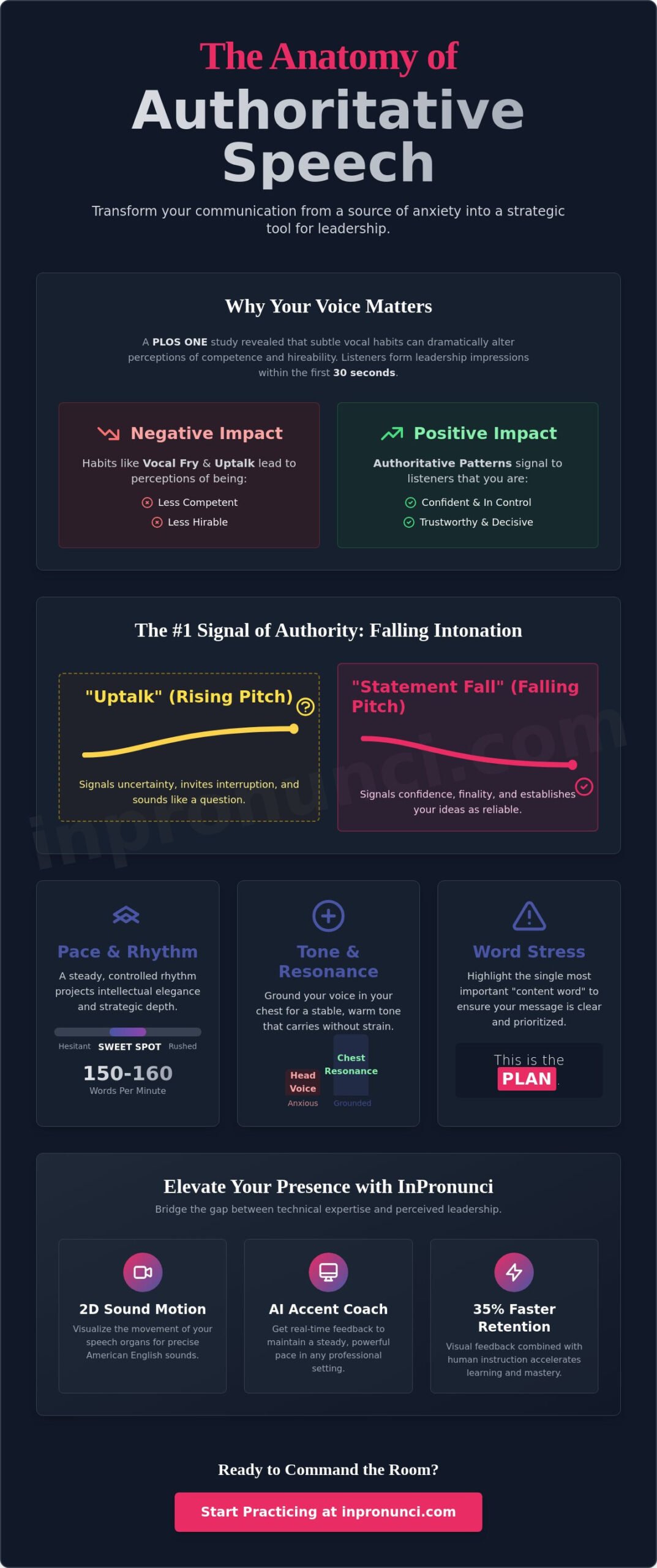
A study published in PLOS ONE revealed that subtle vocal habits, such as vocal fry, can cause listeners to perceive a speaker as less competent and less hirable. You’ve likely experienced the frustration of being interrupted during a presentation or felt that your strategic insights weren’t fully recognized because of how you delivered them. It’s a common hurdle for international professionals who worry their accent might impact their perceived authority. By mastering specific authoritative speech patterns, you can transform your communication from a source of anxiety into a strategic tool for leadership.
We believe that professional authority is not about volume, but about the strategic rhythm and falling intonation of American speech. This article explores how to eliminate “uptalk” and why maintaining a pace of 150 to 160 words per minute is essential for professional clarity. You’ll discover how the combination of human instruction and 2D Sound Motion Technology provides the speech-organ training needed for faster retention. Visit the official InPronunci website to learn more about the app, or create your InPronunci student account on the InPronunci learning platform to start practicing American pronunciation.
What are Authoritative Speech Patterns in American English?
Authoritative speech patterns aren’t about volume. Shouting often signals a loss of control rather than leadership. True authority in an American professional setting emerges from a strategic combination of controlled pitch, steady rhythm, and decisive intonation. It’s the ability to command a room through the weight of your words rather than the decibels of your voice. Research from 2024 indicates that listeners form leadership impressions within the first 30 seconds of hearing a speaker. These patterns signal competence and trustworthiness directly to the listener’s brain, making them essential for any international professional aiming for a seat at the table.
Mastering The Science of Sound: Pitch, Pace, and the Falling Intonation is a critical step for leadership in international teams. This linguistic framework explains how pitch movement conveys meaning and emotional subtext. For those engaged in ESL public speaking, these patterns are the bridge between technical expertise and perceived leadership. When you use a “statement fall” instead of rising intonation, you signal that your ideas are finalized and reliable. This precision eliminates the ambiguity that often leads to being interrupted or overlooked in high-stakes meetings.
The Role of Tone and Resonance
Vocal resonance is the vibration of sound in the body’s cavities. In professional communication, chest resonance creates a sense of stability and warmth that head voice often lacks. High-head tones can sound thin or anxious, whereas low-chest tones project a grounded confidence. This physical grounding allows your voice to carry further without straining your vocal cords. It’s a strategic choice that makes your presence felt before you even finish your first sentence. By shifting your focus to the chest, you ensure your authoritative speech patterns sound natural and resonant.
Why Non-Native Speakers Struggle with Authority
Non-native speakers often face unique challenges when trying to project authority. The intonation of a native language can bleed into English, creating a rhythm that sounds hesitant to American ears. “Translation fatigue” also plays a role. During long meetings, the mental effort of translating can lead to a monotone delivery that listeners mistake for a lack of energy. There’s a strong psychological link between pronunciation and perceived expertise. When a speaker’s rhythm is off, the listener’s brain works harder to process the information, which can unintentionally lower the speaker’s perceived status. Using a modern solution like the official InPronunci website offers resources to help bridge this gap through speech-organ training feedback and rhythm training.
The Science of Sound: Pitch, Pace, and the Falling Intonation
The way you move your breath determines the way people move their attention toward you. Diaphragmatic breathing is the physical foundation for a steady, authoritative voice. When you breathe from your chest, your pitch naturally rises, which can signal anxiety to your listeners. By engaging your core, you provide the consistent air pressure needed for vocal resonance. This physical grounding allows you to maintain authoritative speech patterns even during high pressure negotiations. A University of Missouri dissertation on What are Authoritative Speech Patterns highlights how vocal control directly influences the listener’s perception of power and social status.
Word stress acts as the spotlight of your sentence. In American English, highlighting the most important information through a slightly higher pitch and longer vowel duration ensures your message is clear. If you stress every word equally, you sound robotic or unsure. Instead, pick the one “content word” that carries your primary meaning. This precision shows you’ve prioritized your thoughts before speaking, which projects intellectual elegance and strategic depth.
Mastering the Falling Intonation
The “Statement Fall” is the most important signal of authority in professional English. While a “Question Rise” at the end of a sentence invites feedback, a falling pitch signals that a point is finalized. Try this practical exercise: say the phrase “This is the plan.” On the word “plan,” let your pitch drop significantly. This simple shift builds immense trust in online meeting pronunciation, where training cues are limited and your voice must do all the heavy lifting. You can use the InPronunci app to visualize these pitch drops and ensure your statements don’t sound like questions.
Strategic Pausing and Pacing
Fast talkers are often perceived as nervous or untrustworthy because they don’t leave room for the listener to process information. The ideal speaking pace is between 150 to 160 words per minute. Strategic silence creates “thinking time” and projects power. Use the “three second rule” when you’re asked a difficult question. Instead of filling the air with “um” or “uh,” pause for three seconds. This silence signals that you’re a strategic thinker who provides considered answers rather than reactive ones. Use these pauses to emphasize key metrics or strategic goals, making your most important points stand out through contrast.
Identifying and Fixing Vocal Authority Killers
Even a well-prepared strategic narrative can be undermined by subtle vocal habits that signal hesitation or a lack of conviction. These “authority killers” often operate beneath your conscious awareness but are immediately processed by your listener’s subconscious. To consistently project leadership, you must identify and neutralize these distractions. Maintaining authoritative speech patterns requires a commitment to vocal clarity and the elimination of habits that dilute your professional presence.
Vocal fry and filler words are two of the most common obstacles for international professionals. Vocal fry, that creaky sound produced at the very bottom of your vocal register, was shown in a PLOS ONE study to make speakers appear less competent and less hirable. Similarly, overusing filler words like “um,” “ah,” or “like” creates mental static for your audience. Instead of filling the silence, use a strategic pause to reset your breath. This simple shift allows your next statement to land with more weight and precision. For professionals preparing to raise capital, refining your startup pitch pronunciation is especially critical, as investors form trust impressions within seconds of hearing your delivery.
Eliminating Uptalk and Hesitation
Uptalk is the habit of ending a statement with a rising inflection, which mistakenly turns a declaration into a question. In a high-stakes meeting, this rising tone suggests you’re seeking permission or aren’t fully committed to your own data. It’s a common hurdle during presentations where you want to appear collaborative but end up sounding unsure. To anchor your voice, focus on driving the pitch downward on the final syllable of your sentence. This “statement fall” transforms a hesitant suggestion into a definitive expert opinion.
The Problem with Monotone Speech
Listener disengagement is the inevitable result of monotone speech. When your voice lacks pitch variation, the listener’s brain stops prioritizing your information. You can speak English with confidence by adopting “staircase” intonation, where you step your pitch up or down to highlight key logical points. This dynamic rhythm keeps your audience focused on your strategic goals. Using an American accent training app like InPronunci helps you practice these pitch steps. Through 2D Sound Motion Technology, you can train your speech organs to vary your vocal energy to keep yourauthoritative speech patterns engaging and effective.
Breathless delivery often occurs when you’re anxious or trying to speak too quickly. Running out of air at the end of a sentence makes you sound panicked and loses the resonant power of your chest voice. By respecting the ideal pace of 150 to 160 words per minute, you give yourself the “air time” needed to finish every sentence with strength. This controlled delivery ensures that your final words are just as impactful as your first.
A Step-by-Step Guide to Projecting Confidence
Transforming your vocal habits requires a structured approach that moves beyond theory into physical execution. It’s not enough to understand the mechanics; you must build the muscle memory required to maintain authoritative speech patterns during high-pressure negotiations or technical presentations. By following a deliberate sequence of adjustments, you can shift your delivery from hesitant to commanding in any professional American English setting. Research from 2024 indicated that learners using speech-organ training feedback tools for accent training achieved 35% faster retention, proving that a structured, tech-supported approach yields the most sustainable results.
Follow these five steps to refine your professional presence:
- Step 1: Ground your posture and engage your core. Breath support is the engine of your voice. By standing or sitting tall and engaging your diaphragm, you provide the steady air pressure needed for chest resonance and vocal stability.
- Step 2: Lower your starting pitch. Find your “authority zone” by speaking from the lower end of your natural register. This avoids the thin, anxious sound of a high-pitched head voice.
- Step 3: Practice the “Falling Intonation.” Ensure every declarative sentence ends with a downward pitch. This reinforces the “Statement Fall” we discussed earlier, signaling that your points are final and well-considered.
- Step 4: Record your speech for self-auditing. Use your phone to record a practice presentation. Listen specifically for “authority killers” like vocal fry or filler words that dilute your strategic narrative.
- Step 5: Use speech-organ training feedback tools. Verify your sound movement and rhythm using modern technology. Seeing the physical movement of your speech organs helps bridge the gap between what you hear and what you produce.
If you’re ready to see your voice in action, you can download the American accent training app to track your progress with real-time visual feedback.
Daily Habits for Vocal Authority
Consistency is the differentiator between those who study communication and those who master it. Dedicate five minutes each morning to a vocal warm-up that includes humming to engage resonance and “over-enunciating” a short text to build muscle memory. This deliberate practice ensures your speech organs are primed for clarity before your first meeting. Integrating these habits into ESL public speaking transforms a daunting task into a manageable, strategic process.
Mindset Shifts for the Authoritative Speaker
Technical mastery must be supported by a shift in perspective. You aren’t seeking approval from your audience; you’re providing valuable information that they need to succeed. When you move from a mindset of “asking to be heard” to “delivering expertise,” your intonation naturally becomes more decisive. Confidence is the result of repeated, correct practice. By trusting your preparation and the AI pronunciation feedback provided by modern tools, you can focus entirely on the impact of your message.
Elevating Your Professional Presence with InPronunci
Traditional coaching often relies on subjective listening, which can be inconsistent and difficult to quantify. InPronunci bridges this gap by combining human-based instruction with an advanced American accent training app. This dual approach ensures that while you master the rhythmic nuances of authoritative speech patterns, you also receive the objective data needed for rapid improvement. While human guidance handles the complexities of emotional resonance and phonetic exercises, the AI supports your daily practice by providing the consistency required for long-term habit change.
The role of the AI Accent Coach is to provide real-time AI pronunciation feedback on your intonation and rhythm. This technology allows you to practice in a private, high-frequency environment, which is vital for professionals in tech and healthcare who need to maintain a leadership presence during demanding shifts. By receiving immediate corrections on your pitch and pace, you can adjust your delivery instantly. This prevents the reinforcement of “authority killers” and ensures that every practice session moves you closer to a more commanding professional presence.
Training Success with 2D Sound Motion
One of the biggest challenges for non-native speakers is that they can’t determine where their speech organs should be positioned to create specific American sounds. 2D Sound Motion Technology solves this by training sound movement within the mouth and throat. This technology is particularly effective for correcting “uptalk,” as it trains you to distinguish the physical difference between a rising and falling pitch. By rehearsing the “Statement Fall,” you build the muscle memory required to sound decisive without having to overthink your delivery during a live meeting. This speech-organ training is a primary reason why learners using these tools retain new sounds faster than those in traditional settings.
Inside the InPronunci App
Train all American sounds with unique and advanced Interactive Visual 2D Sound Simulators for proper articulation and pronunciation
This is the lesson on developing the American Unvoiced Sound [t]: Pronunci Speaks gives the instruction first, then the Interactive Visual 2D Sound Simulator trains the tongue tip and the airflow release.
- EffectiveMost apps offer visual learning. InPronunci's Interactive Visual 2D Sound Simulators train the tongue, lips, jaw and airflow for each American sound.
- ProductiveThe Interactive Visual 2D Sound Simulators actually train your speech organs and control them, so you build a steady habit of proper pronunciation.
- ResultsStudents pronounce individual American sounds with almost native-like pronunciation.
Start Your Journey to Authoritative Communication
We don’t believe in “deleting” your accent; your international background is a vital part of your professional identity and strategic value. Instead, our structured curriculum focuses on improving clarity and reducing the accent barriers that lead to being interrupted or misunderstood. The goal is a professional presence where your ideas, not your delivery, are the primary focus. InPronunci supports professionals across all sectors by focusing on the specific phonetic exercises and rhythm that lead to realistic, measurable outcomes in authoritative speech patterns.
Whether you’re a developer explaining a complex architecture or a physician discussing a treatment plan, the ability to project confidence through voice alone is a non-negotiable differentiator. You’ll gain the tools to command the room during presentations, ensuring your strategic narrative is heard and respected by every stakeholder. Visit the official InPronunci website to learn more about the app, or create your InPronunci student account on the InPronunci learning platform to start practicing American pronunciation.
Mastering Your Voice for Strategic Leadership
Mastering authoritative speech patterns is a journey from seeking permission to providing expertise. You’ve learned that leadership is conveyed through the “Statement Fall” and the strategic use of silence. By replacing hesitant “uptalk” with a grounded, resonant tone, you ensure your professional insights are taken seriously in every meeting. These small, deliberate shifts in your vocal delivery create a lasting impression of competence and strategic depth.
The InPronunci platform combines human-based guidance with a structured curriculum designed by Prof. Alex, Ph.D. Accent Coach. By using unique 2D Sound Motion Technology for speech-organ training and real-time AI pronunciation feedback, you can train exactly how to adjust your rhythm and pitch for maximum impact. This modern approach helps you build the muscle memory needed to speak with clarity and confidence in any high-stakes environment. Visit the official InPronunci website to learn more about the app, or create your student account on the InPronunci learning platform to start practicing American pronunciation. Your voice is your most powerful tool; it’s time to use it with purpose.
Structured American Accent Training Course
From Speech Organs Education to American Intonation
The InPronunci course is built step by step: every chapter prepares the next one, and by the end of the course students receive a certificate.
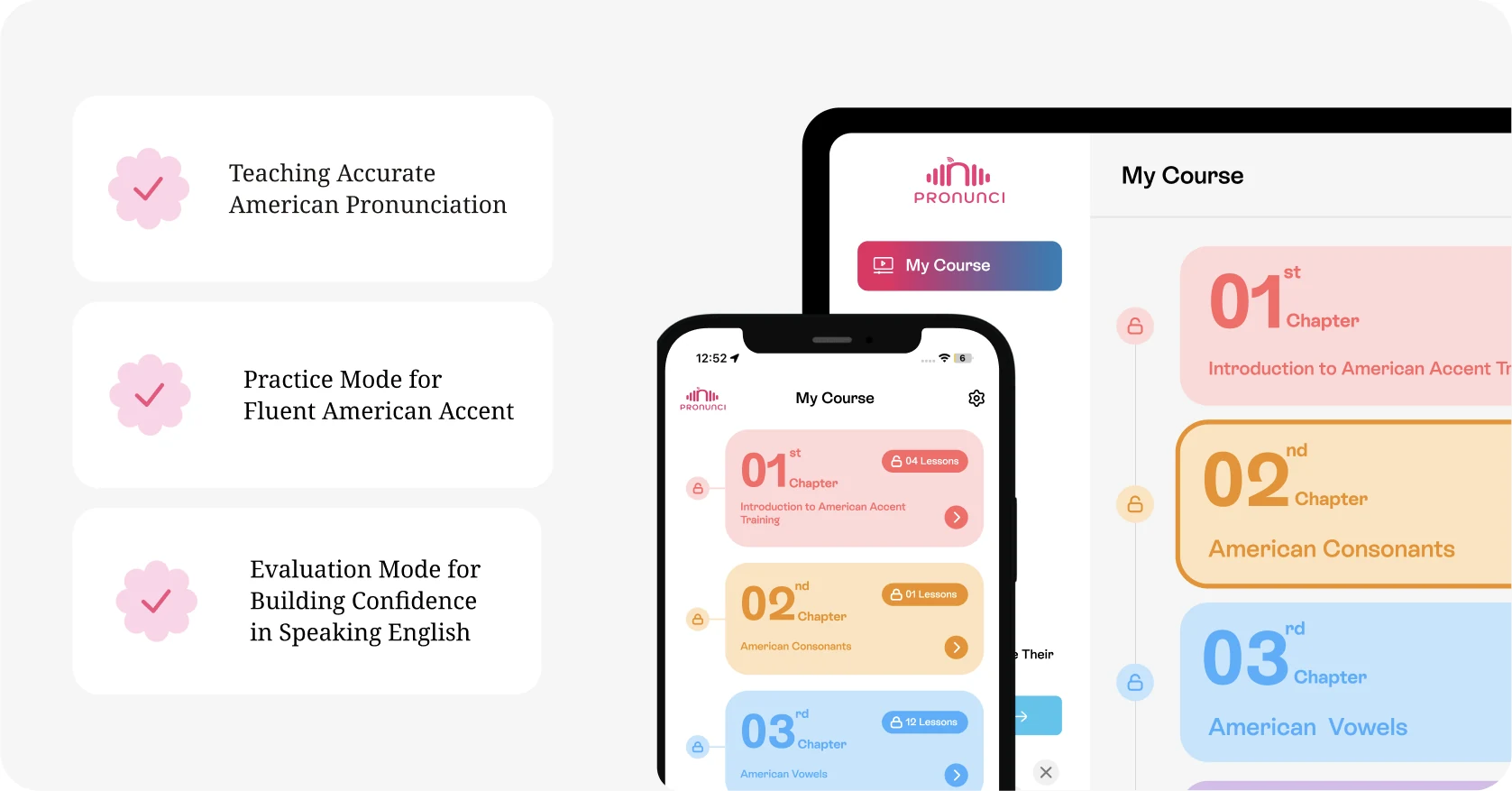
- Speech Organs EducationStudents learn how the speech organs work, along with the AI Accent Coach commands and feedback.
- American ConsonantsPractice and evaluate American consonants in phonetic exercises and practice sentences with the AI Accent Coach.
- American VowelsPractice and evaluate American vowels in phonetic exercises and practice sentences with the AI Accent Coach.
- IntonationLearn how intonation can change the meaning of what you say.
- CertificateBy the end of the course, students receive a certificate.
Questions & Answers
Frequently Asked Questions
01What exactly are authoritative speech patterns?
Authoritative speech patterns are a combination of specific vocal habits, including falling intonation, chest resonance, and a controlled pace of 150 to 160 words per minute. These linguistic markers signal competence and social status to the listener’s brain. Unlike volume, authority is built on precision and the strategic use of silence. By mastering these patterns, you project a strategic narrative that commands respect without needing to raise your voice during high-stakes presentations.
02Can I sound authoritative if I have a strong foreign accent?
You can sound completely authoritative even with a foreign accent because authority is rooted in rhythm and intonation rather than the “removal” of an accent. American professional settings prioritize clarity and the “statement fall” over native-like vowel sounds. A 2024 study showed that leadership impressions are formed by how you structure your delivery and use word stress. Focus on these structural elements to build confidence and ensure your expertise is recognized by your international team.
03How do I stop my voice from rising at the end of sentences (uptalk)?
You stop uptalk by consciously dropping your pitch on the final syllable of every declarative sentence. This “Statement Fall” prevents your statements from sounding like questions, which is a common habit that undermines leadership in meetings. Practicing with visual feedback tools allows you to see the pitch movement, helping you anchor your voice at the end of a thought. This physical adjustment transforms a hesitant suggestion into a definitive expert opinion that projects power and certainty.
04Is there a difference between sounding authoritative and sounding aggressive?
The primary difference between authority and aggression lies in vocal resonance and pacing. Authority relies on low-chest tones and strategic pauses that create “thinking time,” whereas aggression often involves high volume and a rushed, breathless delivery. By maintaining a steady pace and using a falling intonation, you project professional confidence and intellectual elegance. This approach fosters a partnership tone that signals you’re a high-level advisor who understands complex relationships without needing to be loud.
05How long does it take to learn authoritative speech patterns?
You can begin noticing changes in your vocal delivery within 4 to 6 weeks of consistent daily practice. Research from 2024 indicates that learners using speech-organ training feedback tools for accent training achieved 35% faster retention than those in traditional tutoring settings. Sustainable results depend on building muscle memory through deliberate authoritative speech patterns exercises. Using an American accent training app allows for the high-frequency practice necessary to make these professional habits permanent and natural.
06Can an AI app really help me sound more confident in meetings?
An AI app helps you sound more confident by providing objective, real-time feedback on your intonation and rhythm. While human-based instruction handles phonetic exercises, the AI pronunciation feedback ensures you maintain consistency during your daily practice. This modern solution allows you to identify subtle habits like vocal fry or rising pitch before they impact your professional presence. It acts as a consistent coach that supports your growth and ensures you project leadership through voice alone.
07What is the best way to practice authoritative patterns daily?
The best way to practice is a focused 5-minute morning routine that includes over-enunciation and the use of 2D Sound Motion Technology. This speech-organ training method develops correct speech organ positioning for clearer American English sounds. Integrate these patterns by recording yourself and listening for pitch drops on key metrics during practice. Consistent, short bursts of practice are more effective for building long-term authoritative speech patterns than occasional long sessions.
Visit the official InPronunci website to learn more about the app, or create your student account on the InPronunci learning platform to start practicing American pronunciation.
InPronunci training structure
How InPronunci trains the American speech system
InPronunci trains the full American speech system: Interactive Visual 2D Sound Simulators and phonetic exercises for articulation and American sound development, sentence practice for intonation, melody, rhythm, and connected speech, paragraph practice for spontaneous speech, public speaking, and real communication confidence, and Advanced AI Accent Coach evaluation as you speak.
InPronunci is an advanced, linguistically structured American accent training platform with more than 1,000 downloads and a growing learner base. It is designed for serious ESL learners who want American pronunciation, stronger intonation, more natural rhythm, better connected speech, and the ability to speak English more confidently in real communication. The program is especially useful for intermediate and advanced English speakers who want to become independent speakers of English with confident communication, stronger speaking control, long-term speech improvement, and great public speaking skills. It is also designed for advanced speakers whose goal is to speak like a native or closer to native-like American speech, including people who were raised in the United States but still have slight accent patterns from the native language they were born with. It is a complete American accent training course and system created by Prof. Alex, Ph.D. Accent Coach, Doctor of Education, and professional linguist based in Austin, Texas, with Pronunci Instructions from Prof. Alex for each lesson that make self-learning more effective, supported, and clear.
Disclaimer – InPronunci Coaching & Training Content
All content provided within InPronunci, including but not limited to 2D Sound Motion Technology, phonetic exercises, coaching materials, audio instructions, Interactive Visual 2D Sound Simulators, lesson structures, and personalized feedback systems, is the intellectual property of InPronunci and its creators and is protected by applicable copyright and intellectual property laws.
The coaching exercises and training methodologies are designed exclusively for personal educational use within the InPronunci platform. Users are granted a limited, non-transferable license to access and use the materials for individual learning purposes only.
Any reproduction, distribution, modification, recording, sharing, or commercial use of InPronunci content without prior written permission is strictly prohibited. This includes, but is not limited to, copying coaching exercises, redistributing training materials, or replicating the methodology in other platforms or products.
InPronunci is a guided pronunciation training system intended to support language development. While the program is designed to improve pronunciation, fluency, and speech clarity, individual results may vary depending on practice, consistency, and learner background.
By using InPronunci, users agree to respect all intellectual property rights and comply with these terms of use.