


AI powered language learning tools help intermediate and advanced English speakers improve their American accent by combining structured sound training with real-time evaluation of pronunciation, rhythm, and connected speech as they actually talk, not just isolated words. The strongest tools pair this AI feedback with clear human guidance on what to practice and why, so learners move from understanding a sound to using it automatically in sentences and conversation. Below are tools worth trying, organized by what each does best, followed by a framework for choosing the right one for your goals.

1. InPronunci: AI Powered Language Learning Tool for Sound-by-Sound Accent Training
InPronunci is a structured American accent training app that pairs human coaching with AI evaluation to build American English sound by sound, not through generic conversation drills.
Each training session introduces about two new American sounds. As learners move forward, the InPronunci AI Accent Coach evaluates those new sounds together with every sound trained in earlier sessions: Session 3 checks the sounds from Sessions 1 and 2 as well as its own, and this pattern continues through the course. The evaluation scope grows as the learner’s repertoire grows, so earlier sounds stay accountable instead of being left behind once a lesson ends. That cumulative design is something the top accent and pronunciation apps generally don’t offer.
Alongside the AI evaluation, Pronunci Instructions give learners human audio guidance from Prof. Alex, Ph.D. Accent Coach, Doctor of Education, and professional linguist. These instructions tell students what to listen for and pay attention to during practice, while the AI Accent Coach handles the moment-by-moment evaluation and self-correction. Sound training itself happens through 2D Sound Motion Technology: the Interactive Visual 2D Sound Simulators train the tongue, lips, jaw, and airflow to produce each American vowel and consonant correctly.
Inside the InPronunci App
Train American Sounds with Interactive Visual 2D Sound Simulators
Learning American pronunciation involves more than listening to sounds and repeating them.
InPronunci’s Interactive Visual 2D Sound Simulators, developed by Prof. Alex using 2D Sound Motion Technology, guide students through the tongue, lip, and jaw movements involved in producing American consonants and vowels.
Students actively coordinate their speech movements with the simulator, practice each sound aloud, and develop greater awareness of how American sounds are produced.
You don’t just listen to an American sound. You actively train how to produce it.
This lesson demonstrates active training of the American voiceless consonant /t/. Prof. Alex’s Pronunci Instructions guide students before they practice the tongue-tip and airflow-release movements using the Interactive Visual 2D Sound Simulator.
Three Benefits of InPronunci’s Interactive Visual 2D Sound Simulators
- Active ArticulationTrain tongue, lip, and jaw movements while producing American sounds aloud.
- Guided Sound TrainingFollow Prof. Alex’s Pronunci Instructions to understand what to focus on and how to practice.
- Greater Sound ControlDevelop awareness and coordination for clearer, more consistent American pronunciation.
Among AI powered language learning tools built for accent work, InPronunci fits intermediate and advanced speakers who want a structured path from individual sounds to full sentences and paragraphs, rather than an app that only scores isolated words.
2. ChatGPT for Conversational Practice and Explanation
ChatGPT works as a text-based conversation partner and grammar explainer, but it does not listen to or evaluate spoken pronunciation.
It generates practice dialogues on demand, explains why one word choice sounds more natural than another, and answers grammar questions in plain language. A learner preparing for a client call can ask it to draft sample exchanges or clarify the difference between similar phrases. What it cannot do is hear how those sentences actually sound when spoken aloud. It has no access to a learner’s rhythm, intonation, or sound accuracy, so it cannot confirm whether a sentence was pronounced with natural American stress or flat, syllable-by-syllable delivery.
ChatGPT suits learners who want a conversation partner for vocabulary and phrasing as a supplement to dedicated pronunciation work, not a replacement for it. It’s useful for building the sentences and content worth practicing out loud, but the actual speaking evaluation needs a tool built specifically for audio.
3. ElevenLabs for Hearing Target Pronunciation Models
ElevenLabs generates natural-sounding American English audio that learners can use as a listening model before practicing a word or sentence aloud.
The use case is straightforward: type a target word or sentence and generate audio of how it should sound in a clear American voice, then use that as a reference to imitate. It’s a voice generation tool, not a speech evaluation tool, so it has no way to listen to the learner’s own recording or point out what went wrong. It produces a model, nothing more.
This makes ElevenLabs a reasonable listening supplement for learners who want extra reference audio for specific words or phrases alongside a structured accent course. It works best paired with a tool that evaluates the learner’s actual spoken output, since generating a good model and producing that sound correctly are separate challenges.
4. Perplexity for Researching Pronunciation Rules and Patterns
Perplexity helps learners research the reasoning behind pronunciation rules, citing sources as it answers text-based questions.
It handles questions like why a word carries stress on a particular syllable, or how a sound pattern such as a flap T or a reduced vowel behaves in connected speech. It answers in text with citations attached, but it does not listen to speech, evaluate a recording, or give spoken feedback of any kind.
Among AI powered language learning tools, Perplexity suits self-directed learners who want to understand the “why” behind a rule before they start practicing it. That understanding is a useful first step, but reading an explanation and training the speech organs to produce the sound consistently are two different stages of learning.

5. InPronunci AI Accent Coach for Full-Speech Evaluation
The InPronunci AI Accent Coach evaluates pronunciation, intonation, melody, rhythm, connected speech, and sentence flow together as learners speak full sentences, not single words in isolation.
How does AI evaluate full sentences and connected speech, not just individual words?
Instead of scoring one word at a time, the AI Accent Coach listens to complete sentences and paragraphs and checks how sound accuracy interacts with stress, melody, and the way words link together in natural speech. Feedback & Analysis then breaks that speech down into sentences, words, and individual sounds, so learners see exactly where the breakdown happened within the flow of real communication, not a disconnected drill.
There are two evaluation levels. Intermediate is built for learners working toward clearer, more confident communication in everyday and professional settings. Advanced is for learners aiming closer to native-level American speech, and it’s recommended alongside the Premium Plan, where Prof. Alex adds personal, live feedback on top of the AI evaluation.
Why does evaluation scope expand as learners accumulate more trained sounds?
Because the course is cumulative, the AI Accent Coach keeps checking sounds learners trained earlier even as new ones are introduced, so progress on sound five doesn’t come at the cost of sound one slipping back into old habits. Learners also use the Your Coach vs. My Pronunci Pronunciation Comparison Tool to record their own speech, compare it directly against the native-speaker model, and consciously self-correct what they hear. Before starting, it’s worth reading the AI Accent Coach Guidelines to understand how to interpret the feedback.
Cognitive Accent Training
Cognitive Accent Training: Learn to Recognize and Correct Your Own Pronunciation
Have you ever listened to yourself speaking English and noticed that your pronunciation sounds different from an American speaker’s, but weren’t sure why?
InPronunci incorporates Cognitive Accent Training to help students recognize their existing pronunciation habits and become more aware of how they speak.
Through Your Coach vs. My Pronunci, students listen to their own recordings, compare them with an American pronunciation model, and actively identify differences in sounds, stress, rhythm, and intonation.
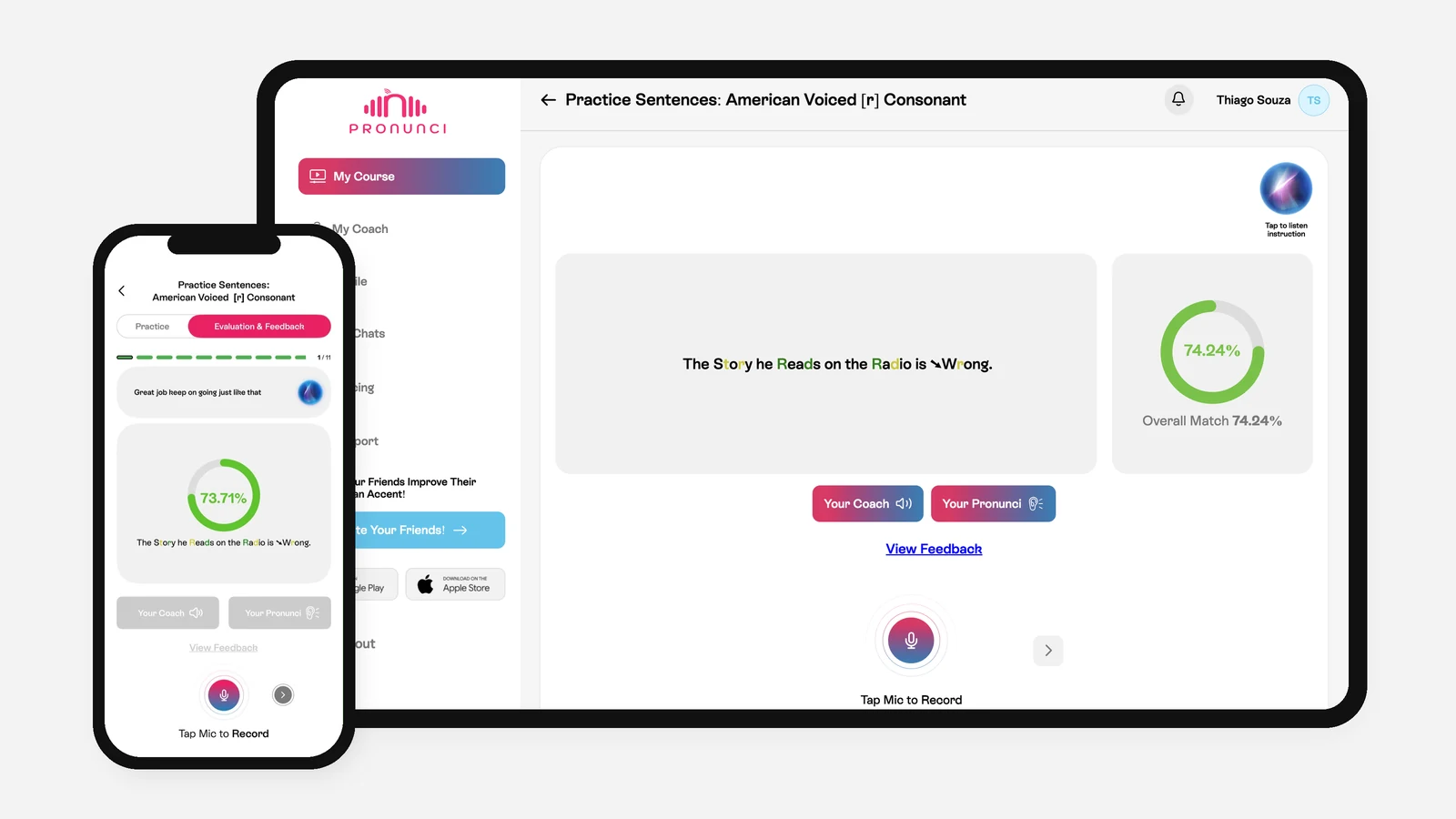
Prof. Alex’s Pronunci Instructions then guide students in understanding how to approach those corrections, while Interactive Visual 2D Sound Simulators support active articulation practice.
The process is simple:
Listen → Compare → Recognize → Understand → Practice → Correct → Recheck
Instead of relying entirely on an AI pronunciation score, students learn to participate actively in evaluating and improving their own speech.
The goal is to help students become increasingly capable of recognizing their pronunciation differences and correcting them independently.
- Hear the American ModelThe model American pronunciation of each practice sentence.
- Recognize Your DifferencesCompare your recorded speech with the American pronunciation model to identify differences in sounds, stress, rhythm, and intonation.
- Practice Your CorrectionsUse Pronunci Instructions and AI feedback to understand which pronunciation differences need attention, practice corrections, and compare your speech again.
This full-speech approach fits learners past the beginner stage who want evaluation that reflects how they actually talk in conversation, not a single-word score disconnected from real speech.
6. InPronunci Premium for Live Coaching Plus AI App Access
InPronunci Premium pairs a live monthly 1-on-1 session with Prof. Alex with full access to the app’s AI-driven training system, combining human correction with structured self-study.
The human teaching comes first: a 1-hour live session with Prof. Alex each month, a personal chat between sessions for questions and quick checks, feedback on submitted phonetic exercises, sentences, and paragraphs, plus homework tailored to the student’s goals. This is not an AI-only subscription with a higher sticker price attached. Prof. Alex, Ph.D. Accent Coach, Doctor of Education, and professional linguist, reviews each student’s first-language influence patterns, articulation, rhythm, stress, intonation, and connected speech, then personalizes the training around them.
Premium sits in a budget-friendly tier for students who want live coaching without committing to Prof. Alex’s separate weekly 1-on-1 program on MyAccentWay, which runs on a different schedule and starts with its own paid evaluation session. Premium works best for professionals and advanced learners who have hit a plateau with self-study and want someone to explain the nuances behind a flagged error, not just a corrected score.
How does live one-on-one coaching with AI app access compare to self-guided AI training?
Self-guided training through the Basic Plan gives a student the full course and the AI Accent Coach’s cumulative evaluation, which is enough for many motivated learners. Premium adds a person who can connect the dots the AI surfaces but can’t always unpack: why a Spanish speaker’s vowel length keeps shifting, or why a Hindi speaker’s flap T attempt isn’t landing. That combination of cumulative AI evaluation and live human explanation is Premium’s specific differentiator among AI powered language learning tools.
7. Phonetic Exercise Generators and Practice Mode Tools
Phonetic exercise tools drill a single trained sound across word positions and combinations until the articulation stops requiring conscious effort.
Once a student can produce a sound correctly in isolation, a phonetic exercise tool repeats that sound at the start, middle, and end of words, and pairs it with neighboring sounds that tend to cause slips, reductions, or assimilations. InPronunci’s Practice Mode works this way: it drills each trained sound until it becomes a steady, controlled, habitual part of speech rather than something the student has to think through. From there, the sound moves into practice sentences, where stress, rhythm, and intonation come into play, and the student has to produce it inside connected speech instead of alone.
How do phonetic exercises and practice sentences build automatic speech habits?
This stage suits learners who already understand how to position the tongue, lips, or jaw for a given sound but still revert to old patterns under normal speaking speed. Repetition across varied word contexts is what turns a correct sound into an automatic one.
Many speaking apps skip from isolated sound drills straight to open conversation practice, leaving a gap between knowing a sound and using it reliably in real speech. Phonetic exercise practice fills that gap before sentence and paragraph work begins.
How to Choose the Right AI Powered Language Learning Tool for Accent Training
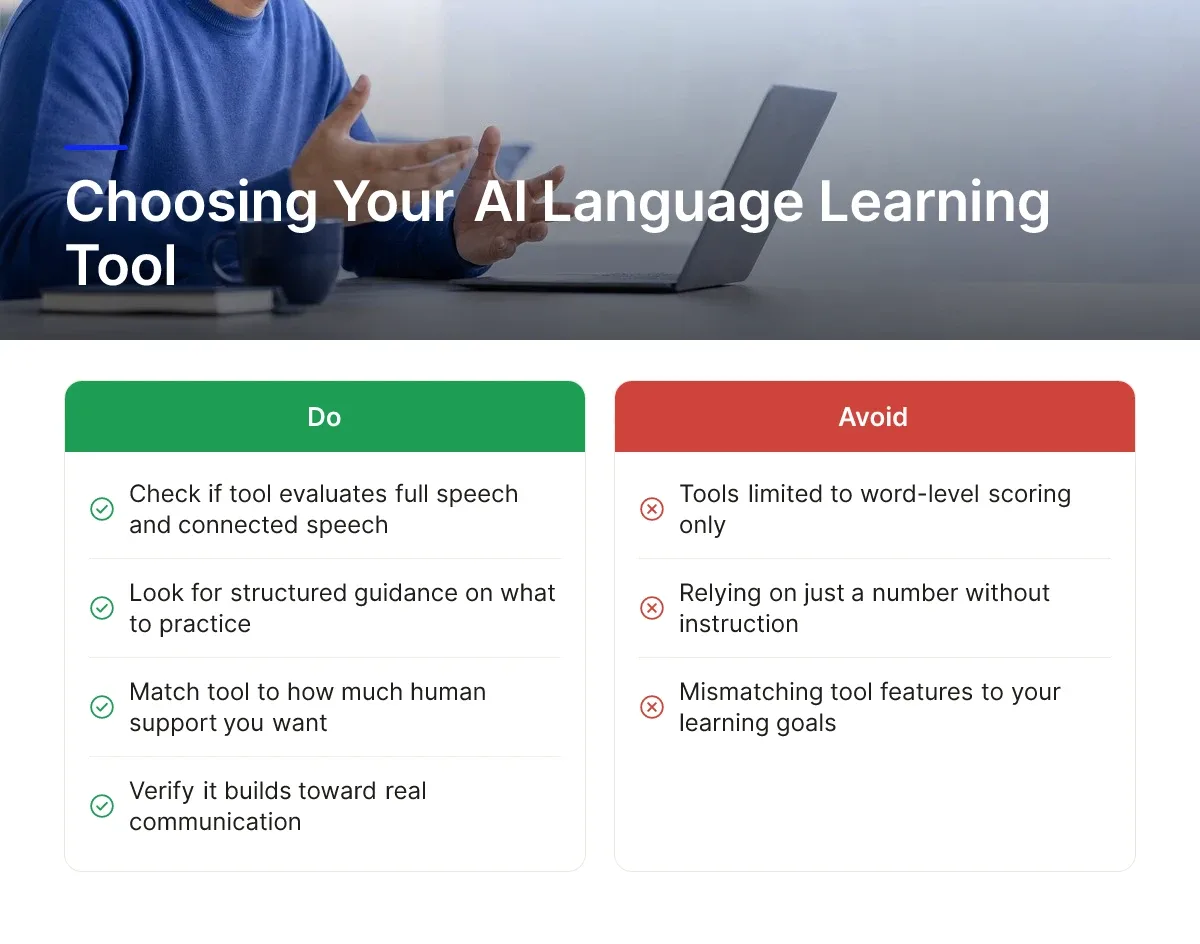
Match the tool to four questions: what it evaluates, how it guides practice, how much human support you want, and whether it builds toward real communication.
First, check whether the tool evaluates full speech, sentences, rhythm, and connected speech, or only scores single words or isolated sounds. A tool limited to word-level scoring won’t catch the rhythm and intonation patterns that often make the biggest difference in how clear someone sounds [1]. Second, look for structured guidance on what to practice and why, not just a number. Step-by-step instruction, like InPronunci’s Pronunci Instructions from Prof. Alex in every lesson, tells a learner what to listen for and adjust, instead of leaving them to guess from a score.
Third, weigh self-guided AI training against live coaching with AI support. Budget-friendly self-study plans suit motivated learners who want to work independently; mid-range or premium live-coaching bundles suit professionals who want personal feedback on first-language influence patterns alongside AI practice. Fourth, ask whether the tool builds toward independent, confident communication in meetings, presentations, and daily conversation, or stops at drill practice with no path forward.
What’s the best AI accent training tool for your budget and learning timeline?
Start with a free first chapter or introductory lesson before paying for anything. Testing the training approach against your own speech patterns tells you more than any feature list.
Which AI accent training approach works best for your learning style and goals?
Learners who want structure and independence do well with self-guided AI powered language learning tools. Those who want someone to explain the nuances an AI coach flags benefit more from a bundle that includes live coaching.
Questions & Answers
Frequently Asked Questions
01Is it possible to improve your American accent through AI-powered practice?
Yes, AI-powered practice can improve pronunciation and speaking confidence when it’s part of structured, consistent training rather than isolated exercises. Research on explicit pronunciation instruction supports targeted, systematic practice over unguided repetition [1]. Tools that evaluate full sentences, not just single words, give learners clearer signals about what to correct and why, which makes the practice more useful over time.
02Do AI accent tools actually fix your mistakes, or just score your pronunciation?
Most AI accent tools score pronunciation; fewer explain how to correct it. A score tells you something is off but not what your tongue, lips, or jaw should do differently. InPronunci’s AI Accent Coach evaluates pronunciation, intonation, rhythm, and connected speech as you speak, and Feedback & Analysis breaks that down sentence by sentence, word by word, and sound by sound so you know exactly what to adjust.
03Is ChatGPT better for language learning than a specialized AI accent coach?
ChatGPT is useful for grammar, vocabulary, and conversation practice, but it was not built to evaluate articulation, intonation, or connected speech the way a dedicated accent coach is. A general chatbot can discuss word choice or explain a grammar rule, but it can’t train your speech organs or give sound-specific correction tied to a structured curriculum. Specialized tools like InPronunci combine AI evaluation of full speech with speech-organ training and human guidance from Prof. Alex, which addresses accent and articulation directly rather than as a side effect of conversation practice.
04Can AI accent training prepare you for real-world speaking in professional settings?
It can, if the training moves beyond single sounds into sentences and paragraph-length speech similar to meetings or presentations. Practicing isolated words rarely transfers to spontaneous speaking under pressure. InPronunci’s paragraph practice stage is built for presentation-style delivery, meetings, interviews, and everyday professional communication, so learners rehearse the same rhythm and flow they’ll need on the job.
05What happens after the AI evaluation gives feedback on your speech?
The feedback becomes the basis for targeted correction, not just a score to note and move past. In InPronunci, Feedback & Analysis breaks your paragraph into sentences, words, and sounds, then points you back to the Interactive Visual 2D Sound Simulator for any sound that needs retraining before you practice again.
Conclusion
Picking an AI-powered language learning tool for accent work comes down to three things: does it evaluate full speech or just isolated words, does it tell you how to fix what’s wrong, and does it move you from sounds into real sentences and paragraphs. Scoring alone won’t change your speech patterns. Correction tied to speech-organ training, delivered through a structured sequence, is what builds lasting change.
Start with Free Chapter 1 on the App Store, Google Play, or the web, and see how sound-by-sound training and AI feedback work together before choosing a plan.
Sources & References
Recommended Articles
Why Speech Organ Training Changes Your Accent at the Source
Speech organ training means practicing the exact tongue, lip, jaw, and airflow positions that produce accurate American English sounds, then repeating those...
A Handy Guide to English Pronunciation Exercises That Work
Learn how English pronunciation exercises train speech organs, build automatic sounds, and improve stress, rhythm, and intonation for natural speech.
accent reduction app for arabic speakers
The most effective accent reduction app for Arabic speakers is one that trains the specific sounds Arabic does not share with English, such as /p/-/b/...