



Understanding speak english like a native is essential. Speaking English like a native speaker means retraining your speech organs, not just learning tips, so your tongue, lips, jaw, and airflow produce American sounds, stress, and rhythm automatically. This comes from structured sound-by-sound training: first each vowel and consonant, then phonetic exercises that make them automatic, then sentence-level stress and intonation, then paragraph-level delivery. No app or coach can honestly guarantee a fully native accent, since outcomes depend on consistent, structured practice, but systematic articulation training moves speakers measurably closer to natural, native-like American English.
Inside the InPronunci App
Train American Sounds with Interactive Visual 2D Sound Simulators
Learning American pronunciation involves more than listening to sounds and repeating them.
InPronunci’s Interactive Visual 2D Sound Simulators, developed by Prof. Alex using 2D Sound Motion Technology, guide students through the tongue, lip, and jaw movements involved in producing American consonants and vowels.
Students actively coordinate their speech movements with the simulator, practice each sound aloud, and develop greater awareness of how American sounds are produced.
You don’t just listen to an American sound. You actively train how to produce it.
This lesson demonstrates active training of the American voiceless consonant /t/. Prof. Alex’s Pronunci Instructions guide students before they practice the tongue-tip and airflow-release movements using the Interactive Visual 2D Sound Simulator.
Three Benefits of InPronunci’s Interactive Visual 2D Sound Simulators
- Active ArticulationTrain tongue, lip, and jaw movements while producing American sounds aloud.
- Guided Sound TrainingFollow Prof. Alex’s Pronunci Instructions to understand what to focus on and how to practice.
- Greater Sound ControlDevelop awareness and coordination for clearer, more consistent American pronunciation.
What Does It Mean to Speak English Like a Native?
Native-like speech is four systems working together: accurate sounds, stress-timed rhythm, connected speech, and pitch movement, not one isolated skill. A learner who nails every consonant but keeps a flat, even rhythm will still sound noticeably foreign, because rhythm and intonation carry as much identity as individual sounds do.
What Specific Speech Patterns and Habits Distinguish Native American English Speakers?
Native speakers stretch stressed syllables and compress unstressed ones, so a sentence speeds up and slows down in a predictable pattern rather than moving at an even pace. They also link words together: “not at all” becomes something closer to “no-ta-tall,” and “did you” collapses into “didja.” Function words like “to,” “for,” and “of” reduce to a quick schwa sound instead of their full vowel. On top of that, pitch rises and falls across a sentence to signal emphasis, questions, and attitude, not just at the end of a statement. None of this is decoration. It’s how fluent English actually moves, and it’s one reason apps built around single-word repetition fall short: a learner can say “water” correctly in isolation and still sound unnatural inside a full sentence.
How Do Non-Native Speakers Typically Differ From Native Speakers in Pronunciation, Rhythm, and Intonation?
Many first languages, including Spanish, French, and Mandarin, are syllable-timed: each syllable gets roughly equal length and weight. English is stress-timed, so speakers compress unstressed syllables and lengthen stressed ones to keep a steady beat regardless of how many syllables fall between stresses. Carrying syllable-timed habits into English produces a rhythm that sounds correct sound-by-sound but still reads as foreign, because the timing pattern itself is the mismatch, not any single vowel or consonant [2].
In practice, the gap often shows up less in individual consonants than in three other places: vowel length (short “ship” versus long “sheep”), word stress placement (DEsert versus deSERT), and sentence-level intonation. A learner can produce every sound correctly and still be misread as a non-native speaker because stress falls on the wrong syllable or the pitch pattern doesn’t match what American listeners expect.
The aim is not to erase an accent or any trace of a first language. It’s to reduce the specific features that interfere with clarity and confidence, while building toward speech that sounds natural and is easy to understand on first listen. That’s the structured path InPronunci follows: sound articulation first with the Interactive Visual 2D Sound Simulators, then phonetic exercises, then sentence-level stress and intonation, then paragraph practice, the same four stages Prof. Alex, Ph.D. Accent Coach, Doctor of Education, and professional linguist, uses in 1-on-1 training. You can see how the speech organs train each sound at 2D Sound Motion Technology.
How to Train Your Speech Organs to Speak English Like a Native
Training the tongue, lips, jaw, and airflow to new positions is what actually changes an accent, not listening practice or vocabulary study alone. Each American sound has a precise articulation target, and the speech organs need repetition to produce it without conscious effort.
Take the American R. Most learners try to make it with the tongue tip, the way they would for a tapped or trilled R in Spanish, Hindi, or Russian. The American R works differently: the tongue body pulls back and bunches in the middle of the mouth, with no contact between the tongue tip and the roof of the mouth. The lips round slightly, almost like preparing for a W. Students who keep tongue-tip contact end up with a flap or trill instead of the smooth American R in words like “car,” “river,” or “world.”
The schwa, the most common vowel sound in English (the “uh” in “about” or the second syllable of “sofa”), depends on a relaxed jaw and neutral lips, not rounded or spread. Short vowels like the one in “bit” or “bed” need a smaller jaw drop than their long counterparts in “beat” or “bait.” Get the jaw position wrong and the whole vowel shifts into a different sound entirely.
What Are the Common Pronunciation Mistakes Non-Native Speakers Make Based on Their Native Language?
Most pronunciation errors follow predictable patterns tied to the sounds and rhythm of a learner’s first language, not random mistakes.
Spanish speakers often substitute long and short vowel pairs because Spanish has five vowel sounds compared to roughly fourteen in American English, so “ship” and “sheep” can come out identical. Hindi, Tamil, and Telugu speakers tend to produce retroflex consonants, curling the tongue tip backward for sounds like T and D, where American English calls for an alveolar position with the tongue tip at the ridge just behind the upper teeth. Mandarin and Cantonese speakers frequently drop final consonants because Mandarin syllables rarely end in consonant sounds other than N or NG, which makes words like “want” or “ask” lose their last sound entirely. None of these are errors of effort. They are the native language’s sound system carrying over into English.
What Role Does Articulation Training and Phonetic Exercises Play in Developing Native-Like Speech?
Isolated sound training builds the correct articulation, but phonetic exercises are what move that sound into real, connected speech. A sound practiced alone in a word rarely survives unchanged inside a full sentence, where it gets reduced, linked, or blended with neighboring sounds through assimilation.
Research on explicit, structured pronunciation instruction supports this layered approach. Saito 2012 found that explicit instruction helped learners improve specific sounds measurably over time [2]. Thomson and Derwing’s 2015 review likewise found that focused, structured pronunciation instruction produces better outcomes than exposure alone [2]. This is why InPronunci’s training moves students through sound articulation with the Interactive Visual 2D Sound Simulators first, then into phonetic exercises covering sound combinations, reductions, and assimilations, before sentences and paragraphs. Skipping the exercise stage is a common reason learners can produce a sound correctly in isolation but still slip back into old habits in conversation.
A practical routine: isolate the target sound and say it alone for a minute, then practice it in minimal pairs (R/L, V/B, short/long vowels), then place it in three or four short sentences. Repeat daily rather than in long, infrequent sessions. This sequence, done consistently, is a realistic way to start training toward sounding like a native speaker rather than just recognizing the difference when you hear it.

Why American English Is the Model for This Kind of Training
General American English is the model here because it is the variety most learners ask for when their goal involves US workplaces, US universities, or US-based exams like TOEFL.
That is a practical choice, not a ranking. British English, Australian English, and General American each developed their own vowel systems, consonant patterns, and intonation norms over time [1]. None is more correct than another; they are different, internally consistent systems. The reason to pick one as a training target is that a learner’s ear, mouth, and habits need a single consistent model to build around.
Why Focus on American English Pronunciation Instead of British or Australian English?
Mixing models mid-training creates conflicting habits, not flexibility. The American R is pronounced with the tongue pulled back and the tip curled slightly, while non-rhotic British varieties drop the R after vowels entirely. American English flattens many vowels that British English keeps more rounded, and stress-timing patterns differ enough that a sentence built for one rhythm sounds off in the other. A learner who drills British intonation on Monday and American stress patterns on Tuesday ends up with neither system solidly in place.
This is why InPronunci trains General American English specifically, not a blend. Someone preparing for a client call with a Chicago-based company, a nursing job in Texas, or a TOEFL exam scored against American norms needs one target they can practice daily until it becomes automatic. Choosing American English as that target reflects the learner’s goals: a US employer, a US client base, a US academic program. It says nothing about the value of a British or Australian accent, both of which serve their speakers well in their own contexts.
People who want to speak English like a native speaker of American English benefit from treating that as a specific, achievable training goal rather than a vague aspiration. The same logic would apply if the target were British RP: pick one system, train it consistently, and let rhythm, vowels, and intonation reinforce each other instead of competing. For background on how these systems diverged in the first place, see the historical overview of accent development in American English [1].
How Long It Takes and How to Know You’re Making Progress
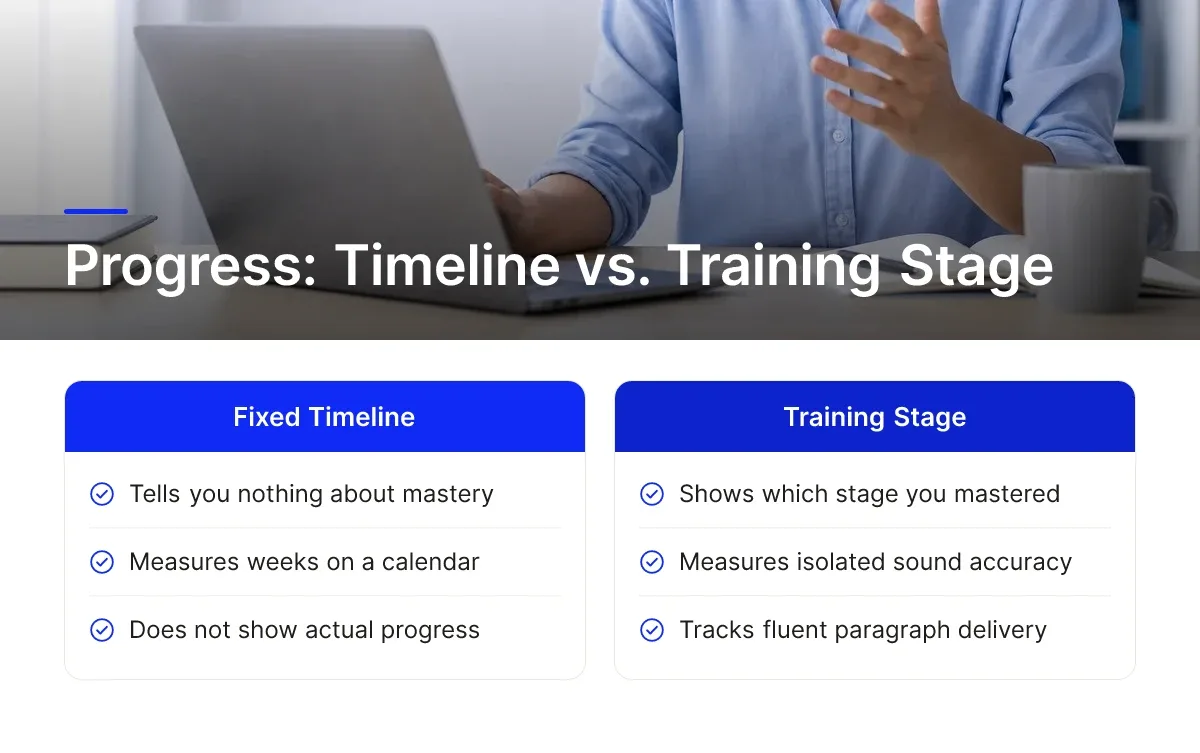
Progress in accent training is better measured by stage completed than by weeks on a calendar: isolated sound accuracy, then automatic sounds in exercises, then natural sentence stress, then fluent paragraph delivery. A fixed timeline tells you nothing about which stage you have actually mastered.
Most learners who want to speak English like a native ask the wrong question first. They ask “how long,” when the more useful question is “what stage am I at.” A sound you can produce correctly in isolation is not yet a sound you produce correctly inside a fast sentence, and a sentence you can say clearly in practice is not yet the same sentence you say clearly under pressure in a meeting. Each of those is a separate skill, and each needs its own evidence of progress.
What Measurable Progress Can You Expect at Each Stage of Accent Training?
At the sound-articulation stage, progress looks like consistent accuracy across different words containing the same sound, not just one rehearsed example. If you can produce the American R correctly in “car” but not in “particular” or “regular,” you are still mid-stage. At the phonetic-exercise stage, progress means fewer self-corrections. You stop pausing to think about tongue or lip position because the movement has become an automatic speech habit rather than a conscious effort.
At the sentence and intonation stage, progress shows up as natural pitch movement: rising and falling tone that matches meaning, not a flat or monotone delivery. At the paragraph stage, progress means sustained fluency over longer speech, including presentations or multi-sentence answers, without the accuracy breaking down as sentences get longer. This is the structure InPronunci’s four chapters follow, moving from Chapter 2’s consonant sounds and Chapter 3’s vowel sounds into Chapter 4’s intonation and emphasis training, so each stage builds on verified accuracy from the one before it.
How Do You Know When Your American English Pronunciation Is Native-Like or Close to Native Level?
Recognizing native-like or near-native progress requires evaluating full speech, not isolated words. Sentence flow, rhythm, and connected speech reveal far more about how natural your English sounds than how cleanly you say a single word in isolation. This is why InPronunci’s AI Accent Coach evaluates pronunciation, intonation, melody, rhythm, connected speech, and sentence flow as students speak, rather than scoring one word at a time, with an Advanced evaluation level built for learners aiming closer to native-level delivery.
No coach or app can honestly guarantee a fully native accent, and InPronunci does not make that promise. Outcomes depend on consistent practice and using the trained patterns in daily conversation, not on the tool alone. Research on pronunciation instruction supports structured, explicit teaching over unguided exposure, which is one reason stage-based training tends to outperform open-ended listening and repeating.
A Structured System to Speak American English Like a Native
A single-word pronunciation score cannot retrain how you produce sounds, link words, and shape intonation across a full sentence. Reaching that goal takes a connected path: sounds, then habits, then sentences, then full speech.
How Does a Four-Stage Training Approach Compare to Isolated Pronunciation Lessons?
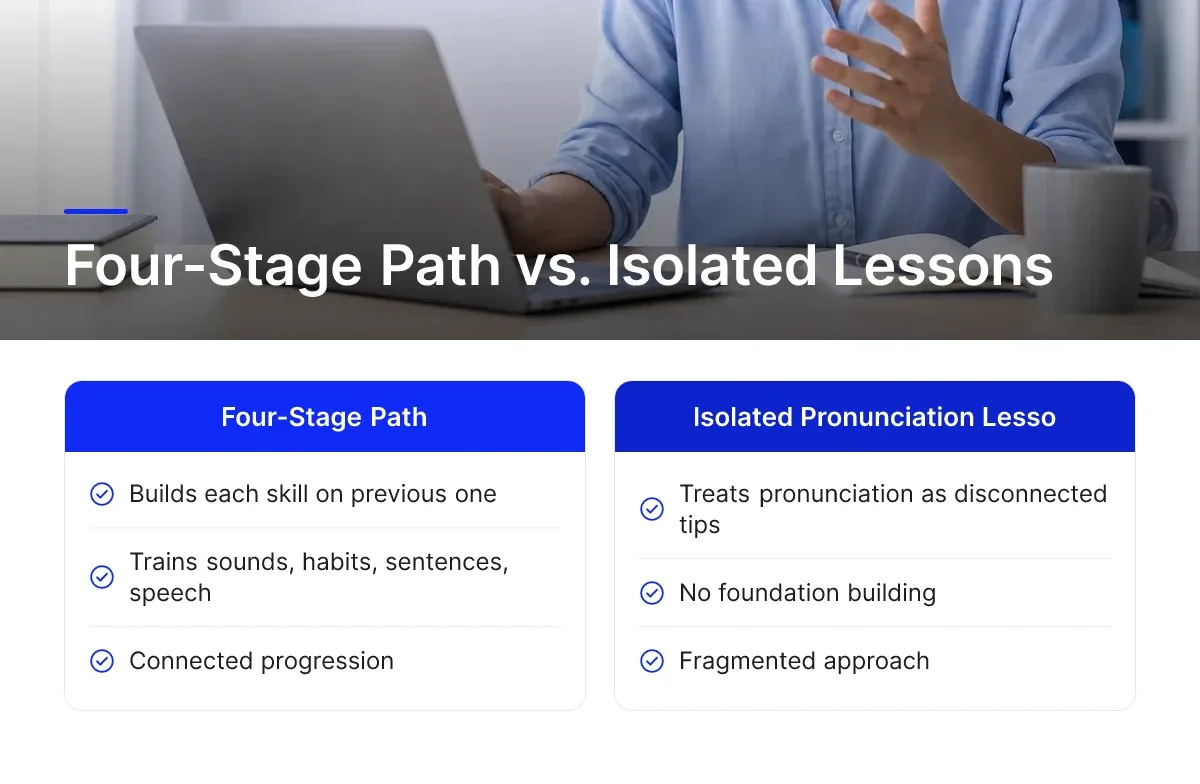
A four-stage path builds each skill on the one before it, instead of treating pronunciation as a list of disconnected tips. The first stage trains individual American sounds: in InPronunci, the Interactive Visual 2D Sound Simulators train the tongue, lips, jaw, teeth, and airflow to produce each vowel and consonant correctly, while Pronunci Instructions from Prof. Alex, Ph.D. Accent Coach, Doctor of Education, and professional linguist, explain exactly what to do in each lesson.
The second stage turns those sounds into automatic habits through phonetic exercises: sound combinations, reductions, and assimilations that show up in real speech, not isolated drills. The third stage moves to sentence-level stress, rhythm, and intonation, the patterns that make English sound connected rather than word-by-word. The fourth stage applies all of it to paragraph-length, presentation-style speech: meetings, interviews, and everyday conversation. Skipping stages, or practicing random words out of context, leaves gaps that resurface the moment a learner has to speak english like a native in an unscripted conversation.
What’s the Difference Between Apps That Score Pronunciation and Systems That Retrain Your Speech Patterns?
Tools that score a single word or sound tell you whether that word was close to a target, but they do not evaluate how your pronunciation, intonation, melody, rhythm, and connected speech hold together across a sentence or paragraph. InPronunci’s Evaluation Mode works differently: the AI Accent Coach assesses full speech as the student talks, and Feedback & Analysis then breaks that speech into sentences, words, and sounds, with articulation detail for each one. The Your Coach vs. My Pronunci Pronunciation Comparison Tool lets students hear their own recording next to the native-speaker model, notice specific differences, and adjust consciously rather than guessing.
Cognitive Accent Training
Cognitive Accent Training: Learn to Recognize and Correct Your Own Pronunciation
Have you ever listened to yourself speaking English and noticed that your pronunciation sounds different from an American speaker’s, but weren’t sure why?
InPronunci incorporates Cognitive Accent Training to help students recognize their existing pronunciation habits and become more aware of how they speak.
Through Your Coach vs. My Pronunci, students listen to their own recordings, compare them with an American pronunciation model, and actively identify differences in sounds, stress, rhythm, and intonation.
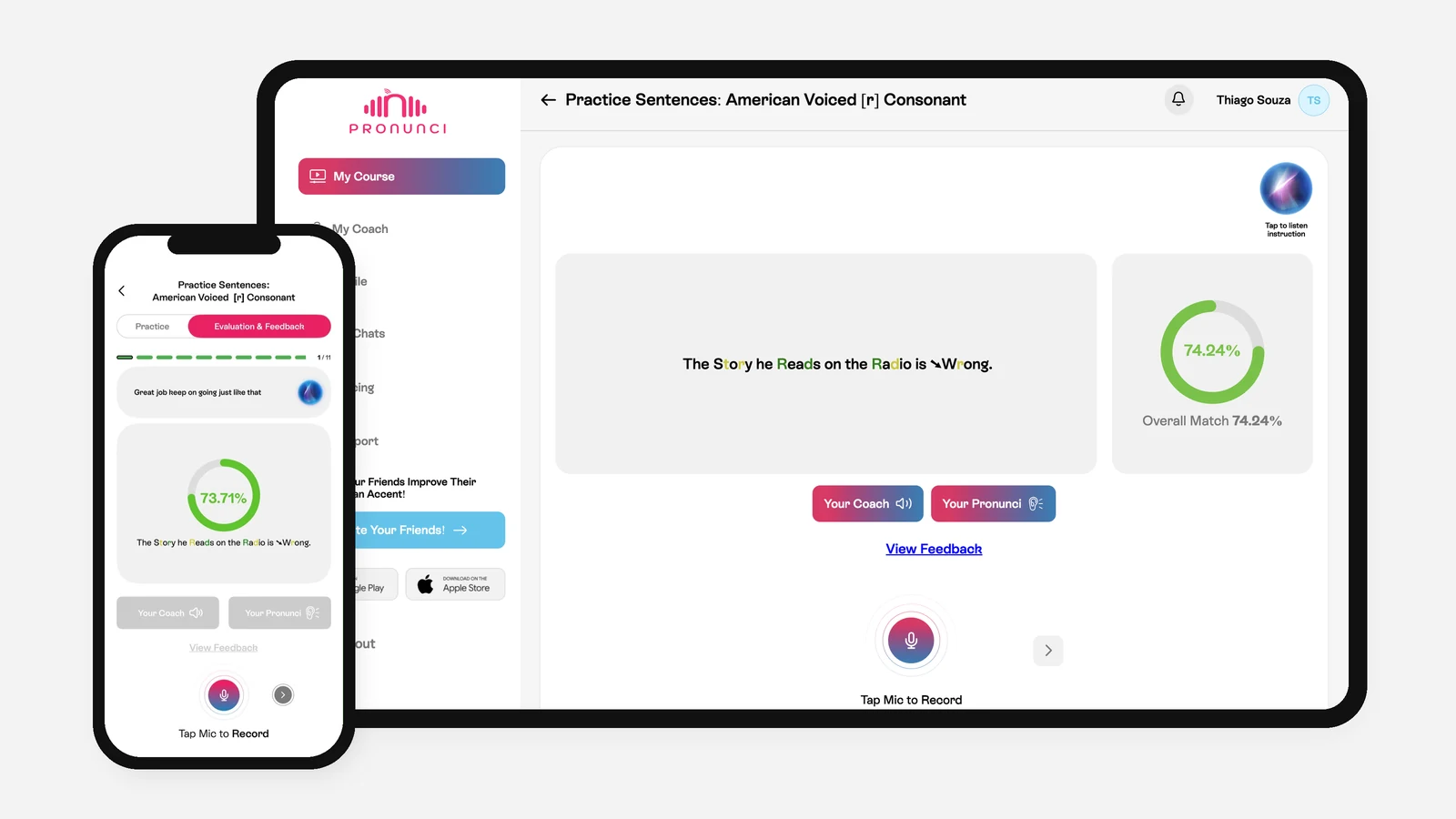
Prof. Alex’s Pronunci Instructions then guide students in understanding how to approach those corrections, while Interactive Visual 2D Sound Simulators support active articulation practice.
The process is simple:
Listen → Compare → Recognize → Understand → Practice → Correct → Recheck
Instead of relying entirely on an AI pronunciation score, students learn to participate actively in evaluating and improving their own speech.
The goal is to help students become increasingly capable of recognizing their pronunciation differences and correcting them independently.
- Hear the American ModelThe model American pronunciation of each practice sentence.
- Recognize Your DifferencesCompare your recorded speech with the American pronunciation model to identify differences in sounds, stress, rhythm, and intonation.
- Practice Your CorrectionsUse Pronunci Instructions and AI feedback to understand which pronunciation differences need attention, practice corrections, and compare your speech again.
This is one connected system, not a set of separate exercises: four chapters, 400 lessons, and 150 phonetic exercises, following the same four-stage path Prof. Alex uses in 1-on-1 training. Students can start with Free Chapter 1, move into the self-guided Basic Plan, or add monthly live sessions with Prof. Alex through the Premium Plan. Other categories of tools in this space lean on guided video coaching or instant single-word scoring; both can be useful, but they approach the problem from a different angle than a full four-stage retraining system. For a closer look at how full-speech evaluation works, see the AI Accent Coach guidelines, and compare approaches directly on the InPronunci vs. ELSA Speak page.
Questions & Answers
Frequently Asked Questions
01Can adults learn to speak English like a native speaker?
Adults can reach a natural, highly intelligible American accent with consistent, structured practice, though no coach or app can guarantee a fully native-like result for every learner. Research on adult pronunciation instruction shows that explicit, structured training produces measurable gains in accuracy, especially for sounds and patterns that differ from the learner’s first language. Progress depends on regular practice, not age alone.
02Do I need to lose my accent completely to be understood?
No. Clear communication, not a fully erased accent, is the real goal. Studies on comprehensibility show listeners can understand speakers clearly even when some first-language influence remains, as long as key sounds, stress, and rhythm patterns are accurate [2]. Reducing an accent is about clarity and confidence, not erasing identity.
03What’s the fastest way to improve American English pronunciation?
Train individual sounds first with correct tongue, lip, and jaw positions, then move into sentences and paragraphs so the new pronunciation becomes automatic. Skipping straight to sentence practice without fixing sound articulation tends to leave old habits in place. Explicit instruction on specific sounds has shown clear benefits over unguided exposure alone [2].
04Should I focus on individual sounds or sentence rhythm first?
Start with individual sounds, since stress, rhythm, and intonation build on accurate articulation. Once the tongue, lips, and jaw can produce American vowels and consonants reliably, phonetic exercises make those sounds automatic in combinations. Only then does sentence-level stress and intonation training stick, which is why structured courses sequence sound work before rhythm work.
Conclusion
Natural American English speech comes from training the speech organs first, then layering phonetic exercises, sentence stress, and paragraph-level delivery on top. Skipping straight to conversation practice without fixing sound articulation leaves old habits intact. Start today by identifying one sound your native language doesn’t use the same way, and practice its tongue, lip, and jaw position for five minutes.
InPronunci: American Accent Training App follows this exact sequence, with Pronunci Instructions from Prof. Alex, Ph.D. Accent Coach, Doctor of Education, and professional linguist, guiding each lesson. Free Chapter 1 is available now on the App Store, Google Play, or the web.
Sources & References
- Improving Accents to Mimic American English: Approaches and Fun Linguistic Facts | American TESOL Institute’s Lexical Press Blog
- Can you learn to speak English like a native speaker?
Recommended Articles

How to Structure American Accent Practice the Right Way
Learn how to structure American accent practice step by step, from sound training to rhythm, intonation, and feedback, for faster, lasting results.

How to Choose the Right Phonetics App for Accent Training
Discover what a true phonetics app should do: train your speech organs, not just score words, with structured sound-by-sound coaching for accent training.

A Guide to Mastering American English Pronunciation
Learn how to train your speech organs for accurate American English pronunciation with a structured, four-stage practice method that builds lasting results.