



American accent practice works best when you train it in a fixed order: individual sounds first, then phonetic exercises that make those sounds automatic, then sentences with stress and intonation, then full paragraphs spoken at a natural pace. Skipping straight to sentence-level practice is why many learners plateau, the underlying vowel and consonant articulation never gets corrected, so old habits resurface under pressure. Each stage trains a different part of speech: speech-organ positioning, muscle control and timing, rhythm and melody, and finally spontaneous delivery.

How to Structure American Accent Practice Sound by Sound
Effective american accent practice starts at the smallest unit of speech, the individual vowel or consonant, and only moves to larger patterns once each sound is accurate on its own.
This order matters because every later stage builds on sound accuracy. Rhythm, stress, and intonation are patterns laid over vowels and consonants; if the vowels and consonants are off, the rhythm is carrying the wrong material. Training sound by sound first gives the rest of the system something solid to work with.
General American vs. Regional American Accents
General American is the neutral, broadcast-style accent most structured training uses as a reference point, distinct from regional varieties like Southern or New York accents. It is not “the only correct way to speak”, it is a stable, widely understood target that gives learners one consistent model instead of several competing ones. Regional accents carry their own vowel shifts, rhythm, and intonation choices that are valid on their own terms, but mixing reference models mid-training makes it hard to know what to aim for. A neutral target lets learners build consistent speech-organ habits before they decide whether to adjust for a regional flavor later.
Training Your Speech Organs for Accurate Vowels and Consonants
Each American sound depends on a specific position of the tongue, lips, jaw, and airflow, and training starts by getting those positions right one sound at a time. The American T and D, for example, need the tongue tip placed firmly behind the upper teeth ridge, not against the teeth themselves as in many Romance and Slavic languages. The American R calls for rounded, tense lips with the tongue pulled back, a shape that feels unfamiliar to speakers whose first language uses a tapped or trilled R. The short vowel in “bit” needs a smaller jaw drop and a more relaxed tongue than the long vowel in “beat,” which is why the two words collapse into one sound for many learners until the jaw and tongue positions are separated deliberately. Clinical resources on articulation and phonology describe this kind of precise, sound-by-sound positioning work as foundational to clear speech production.
Skipping this stage and jumping into sentence practice means practicing fluency on top of inaccurate sounds, which tends to lock in the wrong articulation rather than correct it. InPronunci, the American accent training course led by Prof. Alex, Ph.D. Accent Coach, Doctor of Education, and professional linguist, places this work first for that reason. Its 2D Sound Motion Technology and Interactive Visual 2D Sound Simulators train the tongue, lips, jaw, and airflow for every American vowel and consonant, forming the first of four connected stages before phonetic exercises, sentence intonation, and paragraph delivery. For a closer look at how tongue position shapes individual sounds, see the tongue placement guide.
Inside the InPronunci App
Train American Sounds with Interactive Visual 2D Sound Simulators
Learning American pronunciation involves more than listening to sounds and repeating them.
InPronunci’s Interactive Visual 2D Sound Simulators, developed by Prof. Alex using 2D Sound Motion Technology, guide students through the tongue, lip, and jaw movements involved in producing American consonants and vowels.
Students actively coordinate their speech movements with the simulator, practice each sound aloud, and develop greater awareness of how American sounds are produced.
You don’t just listen to an American sound. You actively train how to produce it.
This lesson demonstrates active training of the American voiceless consonant /t/. Prof. Alex’s Pronunci Instructions guide students before they practice the tongue-tip and airflow-release movements using the Interactive Visual 2D Sound Simulator.
Three Benefits of InPronunci’s Interactive Visual 2D Sound Simulators
- Active ArticulationTrain tongue, lip, and jaw movements while producing American sounds aloud.
- Guided Sound TrainingFollow Prof. Alex’s Pronunci Instructions to understand what to focus on and how to practice.
- Greater Sound ControlDevelop awareness and coordination for clearer, more consistent American pronunciation.
Common Mistakes Non-Native Speakers Make in Accent Practice
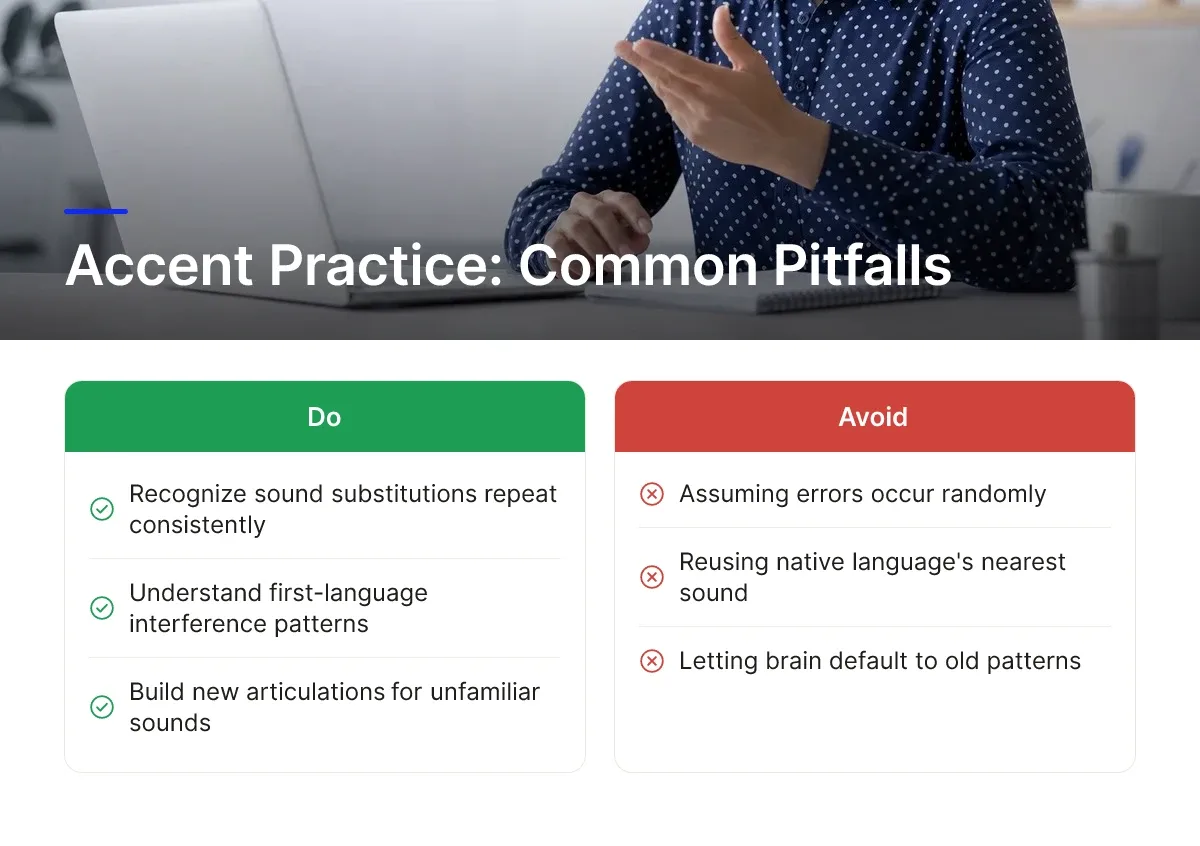
Most errors in American accent practice are not random. They come from mapping unfamiliar American sounds onto the closest sound a learner’s native language already has, producing substitutions that repeat the same way every time.
How Native Language Patterns Interfere With American Sounds
This substitution pattern is called first-language interference, or negative transfer, and it explains why accent errors cluster by language background rather than occurring at random [1]. The brain treats an unfamiliar sound as a variation of the nearest sound it already knows, so it reuses an old articulation instead of building a new one.
Common interference patterns tend to follow a speaker’s native sound inventory:
- Spanish speakers often merge the short vowel in “ship” with the long vowel in “sheep,” since Spanish has five vowel sounds compared to roughly fourteen in American English.
- Hindi speakers frequently confuse /v/ and /w/, since Hindi does not separate them the way English does.
- Mandarin speakers tend to drop final consonants, since Mandarin syllables rarely end in consonant sounds.
- Mandarin speakers may also merge /l/ and /r/, since Mandarin has no sound matching the American /r/.
These are common tendencies tied to each language’s sound inventory, not rules that apply to every speaker, and correcting them works best when it targets the specific sound rather than the learner’s accent as a whole.
Phonetic Exercises That Correct Common Articulation Errors
A second common mistake is practicing isolated word lists and assuming the sound will carry over into real speech. Word lists train a sound in a single, controlled context, but American English constantly changes sounds through reductions, assimilations, and linking across words, patterns that only show up in phonetic exercises built around sound combinations rather than single words.
Repeating a sound alone, without feedback, carries its own risk: if the articulation is slightly off, repetition reinforces the wrong tongue or jaw position instead of correcting it. Research on pronunciation instruction points to this gap, finding that explicit, structured feedback on specific sounds leads to more durable gains than unguided repetition [3].
Structured american accent practice addresses both problems at once: it trains each sound with the speech organs first, then moves it into phonetic exercises with reductions and assimilations, then into sentences and paragraphs, so the new articulation becomes automatic in connected speech rather than isolated drills. InPronunci follows this exact sequence, and its AI Accent Coach evaluates full sentences and paragraphs, not single words, so substitution patterns like these get caught in context. For a closer look at how sound placement affects clarity, see the role of tongue placement in English sounds.
Moving From Isolated Sounds to Natural American Accent Practice
Natural american accent practice depends on connected speech, where individual sounds link, shorten, and blend together instead of staying separate and fully pronounced.
How Connected Speech and Sound Reductions Work
In running speech, American English constantly changes sounds at word boundaries and inside common phrases. “Turn it off” becomes “turni toff,” with the final consonant of “turn” dropped into the vowel of “it” and the /t/ sound sliding into “off” without a pause between words. The /t/ between two vowels, as in “water” or “better,” turns into a quick flap that sounds closer to a fast /d/ than a crisp /t/.
Function words contract further in casual and even professional speech, and these reductions are not sloppy shortcuts, they are patterns native speakers use automatically:
- “going to” becomes “gonna”
- “want to” becomes “wanna”
- “have to” becomes “hafta”
These patterns appear in interviews, meetings, and lectures just as often as in casual conversation.
Isolated Sound Practice vs. Sentence Practice
Training a sound in isolation means producing it slowly, with exaggerated articulation, to lock in the correct tongue, lip, and jaw position. This step matters: it builds the muscle control needed for accuracy. But isolated drilling alone creates a problem. Speakers who only practice sounds one at a time tend to pronounce every consonant fully and evenly in real sentences, which makes their speech sound overly precise, almost robotic, compared to the reduced, blended rhythm of natural American speech.
Sentence-level practice works differently. The same sound now has to adjust its shape depending on what comes before and after it, move faster, and often lose some of its individual clarity in favor of the sentence’s overall flow.
Phonetic exercises exist to bridge that gap. Before jumping to full sentences, drilling specific sound combinations and reductions, linking a final consonant to the next vowel, practicing the flap T in common words, repeating contractions until they feel automatic, trains the ear and the speech organs together. This matches what research on second language pronunciation instruction has found: explicit, structured practice of specific sound features supports measurable gains in production [3].
InPronunci’s Practice Mode is built around this exact transition. After a sound is trained with the Interactive Visual 2D Sound Simulators and Pronunci Instructions, the 150 phonetic exercises across the course drill reductions, linking, and sound combinations before students move into full practice sentences and paragraphs. For more on how sound position affects this process, see the guide on tongue placement in English sounds and the detailed walkthrough of connected speech in American English.
Why Intonation and Rhythm Shape American Accent Practice
Sound accuracy alone does not make speech sound American; rhythm and pitch movement carry as much of the accent as individual vowels and consonants do.
How Stress Patterns and Melody Affect How American You Sound
American English is stress-timed: stressed syllables fall at a roughly even beat, and everything between them compresses or stretches to fit [1]. Many other languages, including Spanish, French, and Mandarin, are syllable-timed or tonal, giving each syllable closer to equal length and weight. Carrying that timing into English produces speech that sounds clipped and even, rather than the rise-and-fall pattern native listeners expect.
The clearest place to hear this is the difference between content words and function words. Nouns, main verbs, adjectives, and adverbs (the words that carry meaning) get full vowels, more volume, and a pitch change. Articles, prepositions, auxiliary verbs, and pronouns (the grammatical glue) reduce to short, flat sounds, often collapsing into a schwa. In the sentence “I want to go to the store,” “want,” “go,” and “store” stand out; “to,” “to,” and “the” almost disappear. A speaker who gives every word equal stress is producing accurate sounds in a rhythm that does not match American speech.
This is why flat or even intonation is a common pattern among speakers of tonal and syllable-timed first languages, even after their sounds improve. Mandarin and Vietnamese speakers may carry level tone contours into English sentences; Hindi and other Indian-language speakers often produce an even stress pattern across syllables. The words are correct, the consonants and vowels may be precise, but the melody still marks the speech as foreign. This is one reason american accent practice has to include stress and pitch work, not sound drills alone.
Practicing Rhythm for Public Speaking and Professional Communication
In meetings, interviews, and presentations, rhythm and pitch do real communicative work: pausing before a key point signals that it matters, slowing down on a number or a name helps it land, and a rising pitch at the end of a question distinguishes it from a statement. Pacing that never varies, with no pauses and no pitch movement, reads as monotone even when every word is understood.
InPronunci’s third training stage addresses this directly, with sentence practice and intonation training that covers stress, rhythm, emphasis, melody, and connected speech. The fourth stage extends it to paragraph practice with presentation-style delivery, so stress and pitch patterns that work in a single sentence carry into longer, spontaneous speech, the kind required in real meetings and interviews.
Tracking Progress With Feedback-Based American Accent Practice
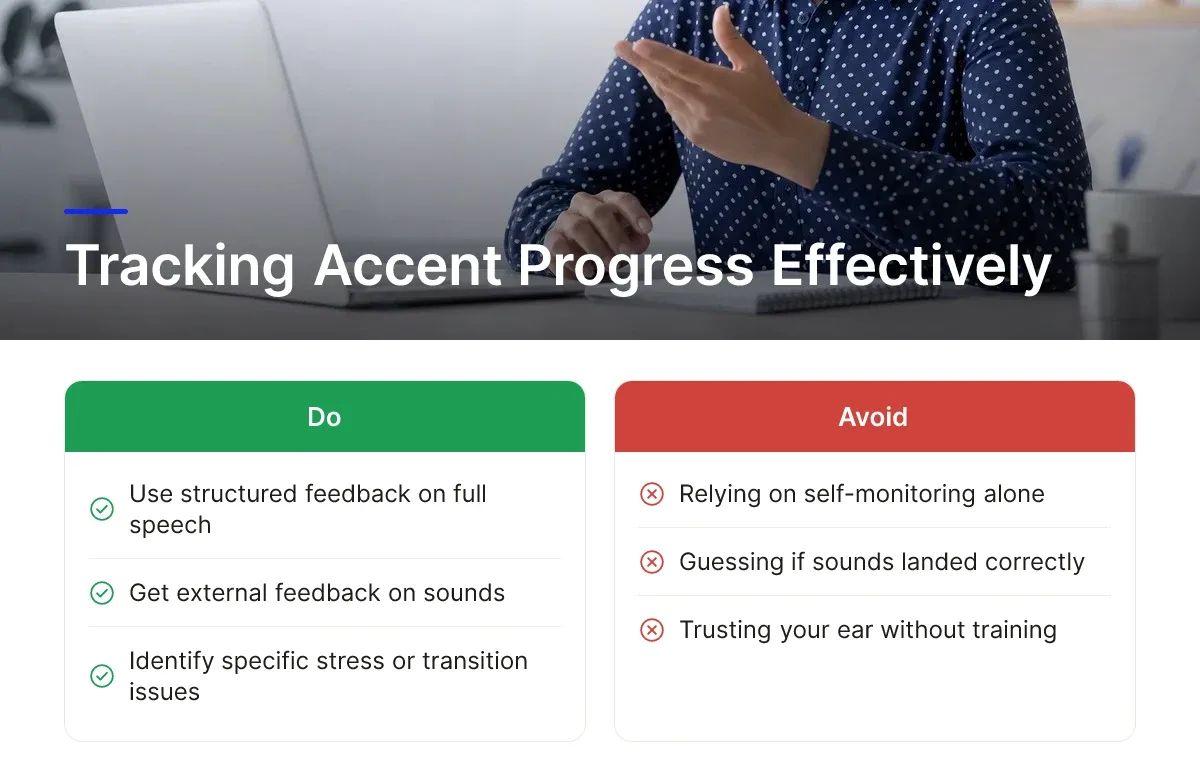
Reliable progress comes from structured feedback on your full speech, not from guessing whether a sound landed correctly while you talk. Self-monitoring alone is not a dependable tool, and effective american accent practice depends on knowing exactly which sounds, stress patterns, or transitions need work.
Your ear is trained by your native phoneme system, and that system filters what you hear from your own mouth. If your first language doesn’t distinguish the short /ɪ/ in “ship” from the long /i/ in “sheep,” your brain may register both as the same sound when you say them, even when a listener hears a clear difference. The same thing happens with substitutions like /v/ for /w/ or /t/ for the flap T in “water”: the error sounds correct to you because it matches a category your native language already has. This is why learners can repeat a sound for years without noticing the mismatch, and why outside feedback matters more than repetition alone.
What Full-Speech Evaluation Should Include
Useful feedback covers sound accuracy, intonation, melody, rhythm, connected speech, and sentence flow together, not a single word scored in isolation.
A sound can be correct on its own and still sound foreign in a sentence if the stress falls on the wrong syllable or the rhythm doesn’t reduce unstressed words the way American English does. InPronunci’s Evaluation Mode addresses this with two connected parts: the AI Accent Coach evaluates pronunciation, intonation, melody, rhythm, connected speech, and sentence flow as you speak full sentences and paragraphs, and Feedback & Analysis then breaks that speech into sentences, words, and sounds so you can see exactly where to adjust. Every lesson also includes Pronunci Instructions, step-by-step guidance from Prof. Alex, Ph.D. Accent Coach, Doctor of Education, and professional linguist, so you know what to listen for before you even reach the evaluation step.
What Realistically Affects How Fast Your Accent Changes
Change depends on consistent, structured practice across all four training stages and on using new patterns in daily conversation, not on a fixed number of weeks.
Sound articulation has to become automatic through phonetic exercises before it holds up in spontaneous sentences and paragraphs. Skipping stages, or practicing sounds without ever applying them in real conversation, tends to slow progress regardless of how many minutes you log.
A short daily routine works better than occasional long sessions: spend a few minutes on one targeted sound drill, run a phonetic exercise set that combines that sound with others, then read a short paragraph aloud focusing on stress and rhythm. Record yourself during the paragraph read and compare it against a native model. For a deeper look at how automatic feedback works, see the AI Accent Coach guidelines, and for the full training path, visit the InPronunci course overview.
Cognitive Accent Training
Cognitive Accent Training: Learn to Recognize and Correct Your Own Pronunciation
Have you ever listened to yourself speaking English and noticed that your pronunciation sounds different from an American speaker’s, but weren’t sure why?
InPronunci incorporates Cognitive Accent Training to help students recognize their existing pronunciation habits and become more aware of how they speak.
Through Your Coach vs. My Pronunci, students listen to their own recordings, compare them with an American pronunciation model, and actively identify differences in sounds, stress, rhythm, and intonation.
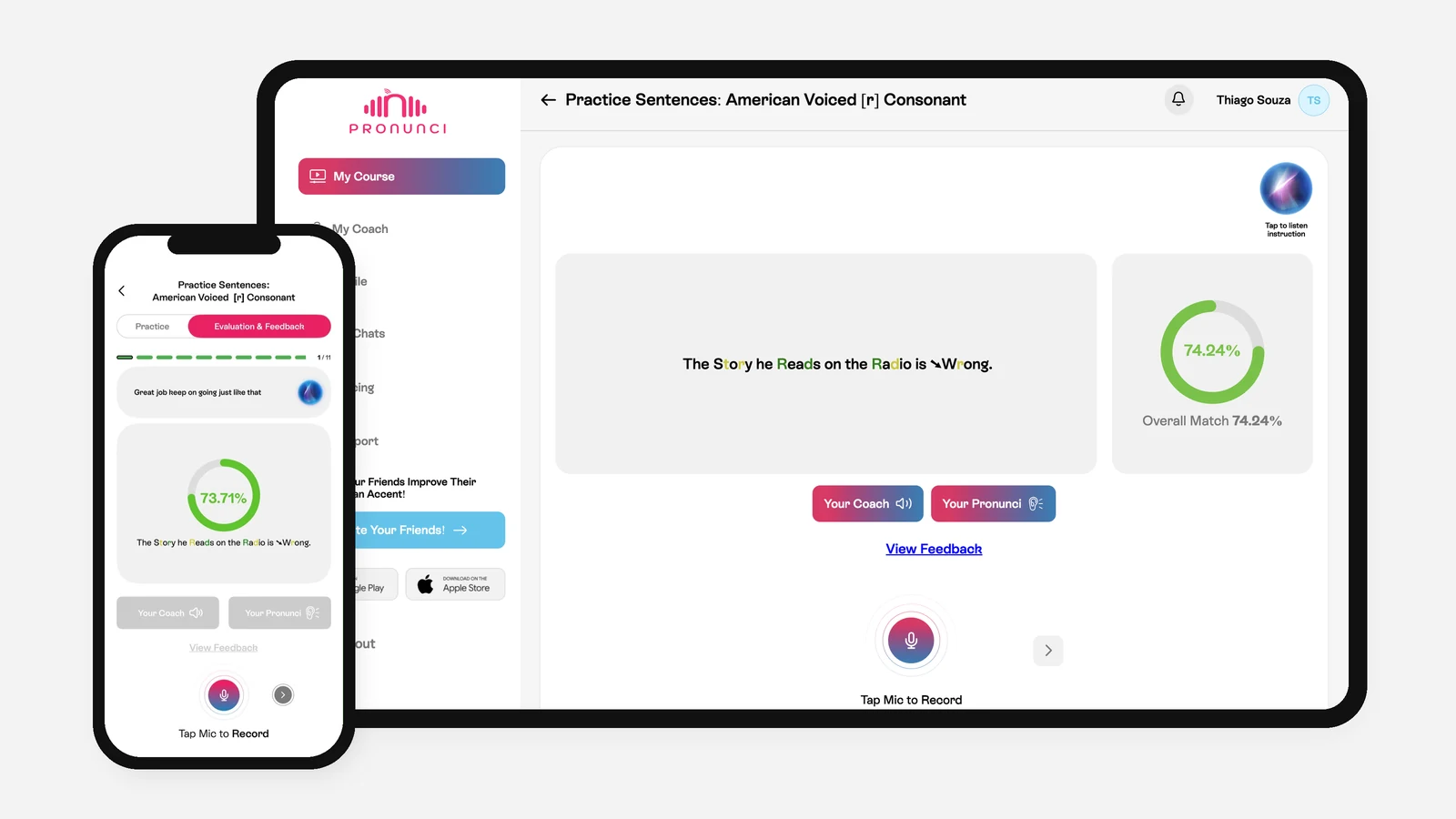
Prof. Alex’s Pronunci Instructions then guide students in understanding how to approach those corrections, while Interactive Visual 2D Sound Simulators support active articulation practice.
The process is simple:
Listen → Compare → Recognize → Understand → Practice → Correct → Recheck
Instead of relying entirely on an AI pronunciation score, students learn to participate actively in evaluating and improving their own speech.
The goal is to help students become increasingly capable of recognizing their pronunciation differences and correcting them independently.
- Hear the American ModelThe model American pronunciation of each practice sentence.
- Recognize Your DifferencesCompare your recorded speech with the American pronunciation model to identify differences in sounds, stress, rhythm, and intonation.
- Practice Your CorrectionsUse Pronunci Instructions and AI feedback to understand which pronunciation differences need attention, practice corrections, and compare your speech again.
Questions & Answers
Frequently Asked Questions
01Is it better to practice American accent sounds alone or in sentences?
Both, but in sequence, not instead of each other. Isolated sound work builds the tongue, lip, and jaw positions you need, while sentence practice trains stress, rhythm, and connected speech, which change how a sound behaves next to other words. A structured course that moves from sound articulation to phonetic exercises to sentences, the approach InPronunci uses, keeps the two connected rather than treating them as separate skills.
02Can adults change deeply ingrained pronunciation habits?
Yes, with explicit, structured instruction rather than passive exposure. Saito’s 2012 study found that explicit pronunciation instruction helped adult learners improve specific sounds over time [3]. Progress depends on regular, targeted practice rather than general conversation alone, and results vary by learner, first language, and the sounds involved.
03Do I need to lose my native accent to sound clear in American English?
No. The goal is clarity and confidence, not erasing your identity or native accent entirely. Most learners aim to reduce specific sounds, stress patterns, or rhythm habits that cause misunderstandings, while keeping their voice recognizably their own. InPronunci’s training supports this goal without promising a fully native-like outcome for every speaker.
04What should I do if I have a speech or hearing difficulty affecting pronunciation?
Consult a licensed speech-language pathologist or appropriate medical professional first. Structured articulation training, including apps like InPronunci, can offer supportive practice once a professional confirms it is appropriate, but it is not a substitute for diagnosis or therapy. The ASHA practice portal on articulation and phonology is a useful starting point for understanding when professional evaluation is appropriate.
05How long should a daily American accent practice session last?
A short, focused session tends to work better than an occasional long one. A practical routine includes a few minutes on one targeted sound, a short set of phonetic exercises combining that sound with others, and a brief paragraph read aloud for stress and rhythm. Consistency across days matters more than the total length of any single session.
Conclusion
Clear American English pronunciation comes from training the speech organs on individual sounds, then carrying those sounds into phonetic exercises, sentences, and full paragraphs where stress and rhythm live. Skipping straight to conversation practice, without first building accurate articulation, is why many learners plateau. Start with one sound you know causes confusion, train it explicitly, then apply it in short practice sentences before moving to longer speech.
A practical next step: open Free Chapter 1 of InPronunci on the web, App Store, or Google Play, and work through the speech-organs lesson before your next meeting or call.
Sources & References
Recommended Articles

How to Choose the Right Phonetics App for Accent Training
Discover what a true phonetics app should do: train your speech organs, not just score words, with structured sound-by-sound coaching for accent training.

A Guide to Mastering American English Pronunciation
Learn how to train your speech organs for accurate American English pronunciation with a structured, four-stage practice method that builds lasting results.

How InPronunci’s Accent Coach App Trains Natural US Speech
Discover how the InPronunci accent coach app trains speech organs, builds sounds into sentences, and gives full-speech AI feedback for natural American English.