


Understanding pronunciation assessment tools is essential. The pronunciation assessment features that matter most for tracking progress toward native-like American English are full-sentence AI evaluation, sound-by-sound articulation feedback, a native-speaker comparison tool, and step-by-step coaching that tells you what to fix, not just a score. A single number (like 72/100) tells you little on its own; real progress comes from pronunciation assessment tools that break speech into sounds, rhythm, and intonation, then connect that feedback to targeted practice. InPronunci’s Evaluation Mode, for example, combines an AI Accent Coach that scores full speech as you talk with Feedback & Analysis that isolates each sound, sentence, and stress pattern for correction.
Before comparing individual features, it helps to know what the best pronunciation assessment tools generally offer:
- Full-sentence AI evaluation that scores connected speech, not just isolated words
- Sound-by-sound articulation feedback that pinpoints the exact error
- Native-speaker comparison for direct, audible reference
- Articulation training linked back to the assessment itself
- Guided instruction that explains how to fix what was flagged
- Progress tracking across a structured curriculum
- Paragraph and presentation-level assessment for real-world speech
1. Full-Speech AI Evaluation (Not Just Single-Word Scoring)
The most useful pronunciation assessment tools score full sentences, not isolated words, because clarity depends on how sounds connect, not just how each one is produced alone. Single-word scoring misses stress timing, the way words link together, and the rise and fall of pitch across a sentence, all of which only show up once speech is connected.
InPronunci’s AI Accent Coach evaluates sound accuracy, intonation, melody, rhythm, connected speech, and sentence flow as students speak, rather than grading one word or one isolated sound. This matters most for intermediate-to-advanced speakers who already produce individual American sounds fairly well but still lose clarity once those sounds move into real sentences and conversation.
Why does sentence-level assessment matter more for natural American English?
American English relies on stress-timed rhythm: some syllables stretch out while others compress, and meaning often rides on which word in a sentence gets the emphasis. A tool that only checks word-level accuracy can’t detect whether a learner is placing that stress correctly or flattening it, which is often the real reason a fluent speaker still sounds foreign.
How do stress patterns and melody change the accuracy of pronunciation feedback?
Feedback that ignores melody can tell a learner their vowels are correct while missing that their sentence intonation makes a statement sound like a question, or a request sound flat and abrupt. InPronunci offers two evaluation levels, Intermediate and Advanced, so learners choose the depth of feedback that matches their goal instead of receiving one fixed score type. Every score reported states “100 = native speaker,” so learners always know what the number actually represents.
2. Sound-by-Sound Feedback & Analysis
Effective pronunciation assessment tools don’t stop at a single score; they break speech into sentences, words, and individual sounds to show exactly where an error occurs. InPronunci’s Feedback & Analysis takes a paragraph, splits it into sentences, splits those into words, and then isolates the specific sounds inside each word, giving articulation detail for each one.
Audio playback for each sentence or sentence part lets a learner isolate the exact moment something went wrong instead of guessing from a general number. This benefits learners who receive a low score but have no idea which sound or word actually caused it, a common frustration with tools that only output a single percentage.
The differentiator here is the loop back to correction: each flagged sound links to an Interactive Visual 2D Sound Simulator, so the learner can retrain that exact articulation right away instead of reading a diagnosis with no path to fix it. A mispronounced flap T or a weak TH, for example, gets flagged and then immediately retrained at the sound level.
Readers who want the underlying science behind why tongue position changes a sound’s accuracy can go deeper in the role of tongue placement in English sounds guide.
Inside the InPronunci App
Train American Sounds with Interactive Visual 2D Sound Simulators
Learning American pronunciation involves more than listening to sounds and repeating them.
InPronunci’s Interactive Visual 2D Sound Simulators, developed by Prof. Alex using 2D Sound Motion Technology, guide students through the tongue, lip, and jaw movements involved in producing American consonants and vowels.
Students actively coordinate their speech movements with the simulator, practice each sound aloud, and develop greater awareness of how American sounds are produced.
You don’t just listen to an American sound. You actively train how to produce it.
This lesson demonstrates active training of the American voiceless consonant /t/. Prof. Alex’s Pronunci Instructions guide students before they practice the tongue-tip and airflow-release movements using the Interactive Visual 2D Sound Simulator.
Three Benefits of InPronunci’s Interactive Visual 2D Sound Simulators
- Active ArticulationTrain tongue, lip, and jaw movements while producing American sounds aloud.
- Guided Sound TrainingFollow Prof. Alex’s Pronunci Instructions to understand what to focus on and how to practice.
- Greater Sound ControlDevelop awareness and coordination for clearer, more consistent American pronunciation.
3. Native-Speaker Comparison Tools
Comparison tools let learners hear their own recording directly against a native-speaker model, which builds awareness that a score alone can’t provide. InPronunci’s Your Coach vs. My Pronunci Pronunciation Comparison Tool plays the learner’s speech side by side with the native model, so specific gaps in sound, rhythm, or intonation become audible rather than abstract.
Cognitive Accent Training
Cognitive Accent Training: Learn to Recognize and Correct Your Own Pronunciation
Have you ever listened to yourself speaking English and noticed that your pronunciation sounds different from an American speaker’s, but weren’t sure why?
InPronunci incorporates Cognitive Accent Training to help students recognize their existing pronunciation habits and become more aware of how they speak.
Through Your Coach vs. My Pronunci, students listen to their own recordings, compare them with an American pronunciation model, and actively identify differences in sounds, stress, rhythm, and intonation.
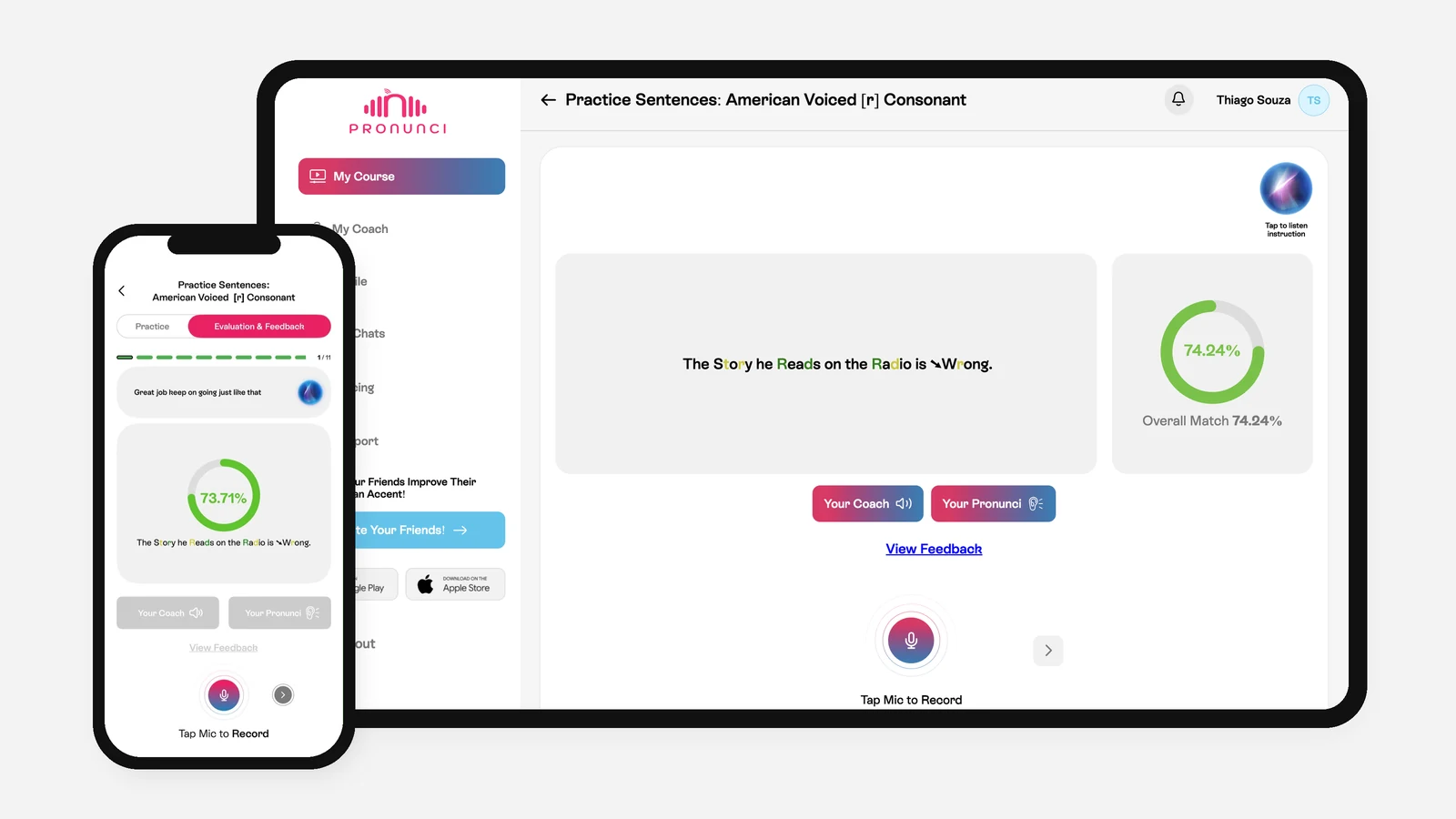
Prof. Alex’s Pronunci Instructions then guide students in understanding how to approach those corrections, while Interactive Visual 2D Sound Simulators support active articulation practice.
The process is simple:
Listen → Compare → Recognize → Understand → Practice → Correct → Recheck
Instead of relying entirely on an AI pronunciation score, students learn to participate actively in evaluating and improving their own speech.
The goal is to help students become increasingly capable of recognizing their pronunciation differences and correcting them independently.
- Hear the American ModelThe model American pronunciation of each practice sentence.
- Recognize Your DifferencesCompare your recorded speech with the American pronunciation model to identify differences in sounds, stress, rhythm, and intonation.
- Practice Your CorrectionsUse Pronunci Instructions and AI feedback to understand which pronunciation differences need attention, practice corrections, and compare your speech again.
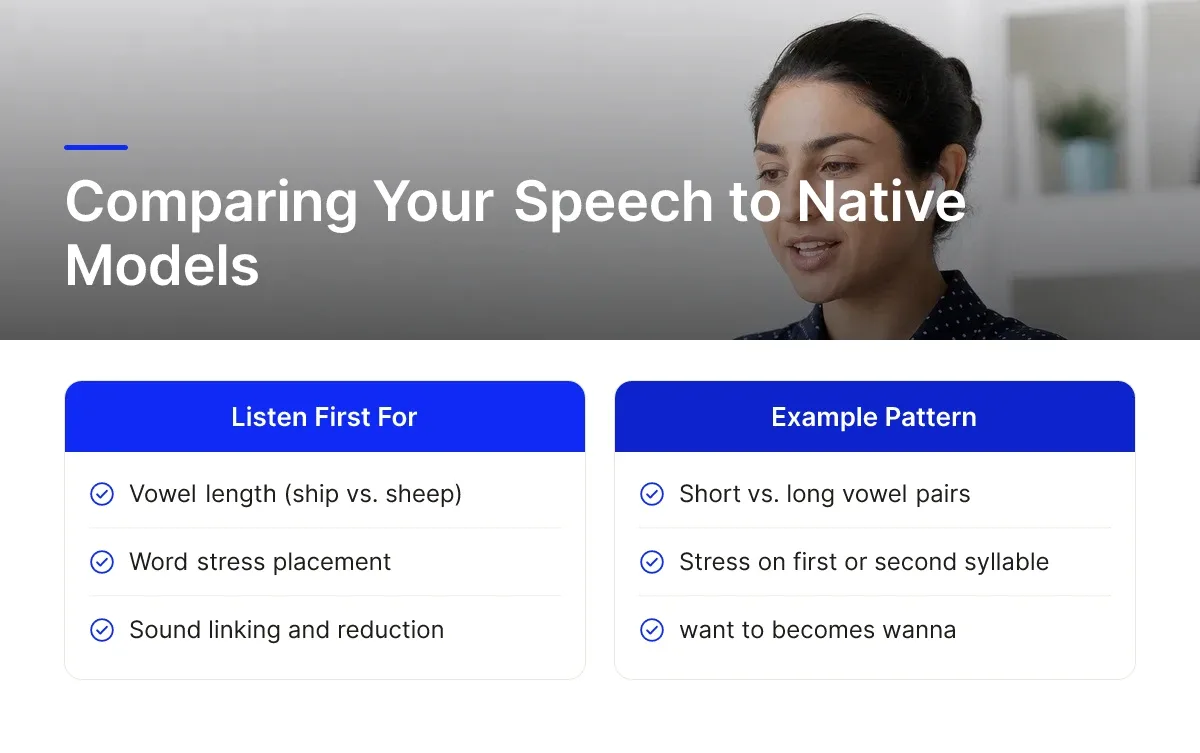
How do you listen for differences between your speech and a native model?
Focus on vowel length first (compare “ship” versus “sheep”), then word stress placement, then where the native speaker links or reduces sounds between words, such as “want to” becoming “wanna” in casual speech. These are the details that separate technically correct words from natural-sounding sentences.
What should you notice when comparing your intonation to a native speaker?
Listen for how pitch rises and falls across the sentence rather than staying flat, and where the native speaker places emphasis to signal the most important word. This approach reflects a cognitive accent-training method: the learner trains their own ear to notice differences, rather than simply receiving a pass-or-fail verdict.
Comparison alone has a limit worth naming: noticing a gap between your speech and a model doesn’t automatically teach you how to close it. Structured sound training should come first, so the comparison step reinforces a skill the learner is already building rather than leaving them aware of a problem with no technique to solve it.
4. Articulation Training Built Into the Assessment Loop
A pronunciation assessment tool is only as useful as its ability to correct what it measures, not just flag that a sound was wrong. A tool that scores a mispronounced sound but offers no way to retrain the tongue, lips, or jaw leaves the learner with a diagnosis and no treatment.
What’s the connection between articulation training and assessment accuracy?
Assessment only becomes actionable when it connects back to how the sound is physically produced. 2D Sound Motion Technology’s Interactive Visual 2D Sound Simulators train the speech organs for the exact sound flagged in evaluation, closing the gap between being told a sound is wrong and knowing how to fix it.
How do interactive simulators support assessment and correction?
Once the AI Accent Coach or Feedback & Analysis flags a specific sound, the learner trains that sound directly with the simulator instead of practicing in the dark. This benefits learners whose errors trace back to first-language influence on particular sounds, such as the flap T, the TH sounds, or the V/W distinction common among Hindi and German speakers.
Most pronunciation assessment tools stop at the score. A connected system routes the learner straight back to retraining the sound that caused the error, which is the difference between measuring a problem and solving it. The full mechanism is covered on the 2D Sound Motion Technology page.

5. Guided Instruction Alongside Automated Feedback
Automated scoring tells a learner what’s wrong; guided instruction tells them how to practice and what to pay attention to before they even attempt the sound again. Pronunci Instructions from Prof. Alex, Ph.D. Accent Coach, Doctor of Education, and professional linguist, appear in every InPronunci lesson, so learners are never left guessing at the next step after a score comes back.
Can an AI coach give you the same feedback as a human accent coach?
Prof. Alex has 20 years of accent and pronunciation teaching experience and trained the AI Accent Coach to evaluate speech the way he does in 1-on-1 training, which is why the automated feedback and the written coaching instructions follow the same logic rather than operating as two disconnected systems. This matters for learners who have tried scoring apps before and plateaued, because a number alone rarely changes technique.
What should feedback tell you about intonation, rhythm, and connected speech?
Useful feedback names the specific pattern that needs work, whether that’s falling intonation at the end of a statement, stress on the wrong syllable, or a missed linking sound between two words, and then directs the learner to a specific practice step. The differentiator is combining AI Accent Coach evaluation with human-written coaching instructions inside the same lesson flow, instead of offering automated scoring as a standalone product with no instructional layer underneath it.
6. Progress Tracking Across a Structured Curriculum
Progress tracking only means something when it follows a fixed sequence: sounds, then phonetic exercises, then sentences and intonation, then paragraphs. Checking a score after one practice session tells you almost nothing about whether that gain holds up a week later or in a different sentence.
What’s the right order: learn sounds, practice, then assess?
Tracking progress against a defined stage order shows whether a gain at one stage actually transfers to the next, instead of measuring isolated moments of careful speech. A learner who corrects the American R in a word list still needs to prove that correction survives in a full sentence, then in a paragraph. That’s the structure that makes pronunciation assessment tools useful for more than a single snapshot.
How do phonetic exercises make a trained sound automatic before it’s tested in sentence-level assessment?
Phonetic exercises drill sound combinations, reductions, and assimilations until a new sound becomes habitual rather than something the learner consciously produces once. Thomson and Derwing’s 2015 review of pronunciation instruction research found that explicit, structured teaching supports more durable improvement than incidental exposure alone [3]. This matters for learners who want to measure real progress across a full course, not just isolated practice sessions.
InPronunci reflects this structure directly: four chapters move from Speech Organs Education through consonants, vowels, and intonation, each with sessions, phonetic exercises, and paragraph practice. That gives assessment a fixed reference structure instead of ad hoc topics or conversation prompts.
7. Paragraph and Presentation-Level Assessment
Paragraph and presentation-level assessment checks whether trained sounds and intonation hold up over longer, less controlled speech, not just in a single rehearsed sentence.
Short sentence assessment can miss problems that only appear over a longer passage: fatigue effects on articulation, breath grouping in the wrong places, or pacing that speeds up under pressure. A learner might nail the flap T in an isolated sentence and still lose it three minutes into a presentation when attention shifts to content instead of sound. Paragraph practice with presentation-style delivery tests whether a sound or stress pattern is truly automatic or only works under careful, slow conditions.
This stage matters most for professionals preparing for meetings, interviews, client presentations, or exam speaking tasks like TOEFL or IELTS, where speech has to hold together for minutes at a time, not seconds. InPronunci’s Evaluation Mode scales from single sound to full paragraph inside one connected system, so learners aren’t switching between a sound app, a sentence app, and a separate recording tool to check different stages. The goal of that evaluation is independent, confident communication, not a passing score on one task.
How to Choose the Right Pronunciation Assessment Features for Your Goals
Match assessment features to your goal: clearer everyday speech, a closer-to-native accent, or personal accountability from a coach, each points to a different setup. The right combination of pronunciation assessment tools depends less on which app you pick and more on how closely its features map to what you’re trying to achieve.
Three goal profiles cover most learners:
- Everyday clarity: someone who wants to be understood the first time and speak with more confidence fits the Intermediate evaluation level with self-guided practice
- Near-native accent: someone preparing for a role where accent is closely scrutinized, or who simply wants to sound closer to native, fits the Advanced evaluation level
- Accountability: a learner who wants someone checking their work and holding them accountable needs live coaching on top of either level
When should you get personalized feedback from a human coach?
Self-guided AI assessment works well once a learner can act on feedback independently. But patterns shaped by a first language, like flat intonation from Hindi or Russian speakers, or dropped final consonants common among Mandarin and Vietnamese speakers, are often hard to self-diagnose from a score alone. A human accent coach can hear the specific substitution and explain the speech-organ adjustment needed, something pronunciation assessment tools alone can flag but not always fully correct.
How can AI assessment and live coaching complement each other?
InPronunci’s Basic Plan gives self-guided learners full access to the training system, the AI Accent Coach, and Feedback & Analysis, at a budget-friendly tier. The Premium Plan adds a monthly live 1-on-1 session and personal chat with Prof. Alex, Ph.D. Accent Coach, Doctor of Education, and professional linguist, at a premium tier for learners who want personalized correction alongside AI evaluation.
Start with Free Chapter 1 to learn speech-organ basics before leaning on any assessment score; understanding tongue, lip, and jaw position makes feedback easier to interpret. No tool, including InPronunci, can guarantee a native-like accent. Results depend on consistent practice and carrying corrected sounds into daily conversation, not on the score itself. Explore the full course structure on the American accent training course overview or learn more about how feedback works on the AI Accent Coach page.

Questions & Answers
Frequently Asked Questions
01What’s the difference between a pronunciation score and actionable feedback?
A score tells you how far off you are; actionable feedback tells you what to fix and how. A number like 72 (100 = native speaker) shows a gap, but it won’t tell you whether your tongue placement, stress pattern, or airflow caused it. InPronunci’s Feedback & Analysis breaks speech into sentences, words, and sounds so you know the exact correction to practice next.
02Should assessment tools focus on individual sounds, sentences, or both?
Both, because sound accuracy and connected speech affect clarity differently. A single sound assessed in isolation won’t reveal problems with rhythm, linking, or intonation that only appear in full sentences. InPronunci’s AI Accent Coach evaluates sound accuracy alongside intonation, rhythm, and sentence flow, not just one word at a time.
03What does overall clarity mean in pronunciation feedback?
Overall clarity measures how easily a listener understands you, combining sound accuracy, stress, rhythm, and connected speech into one picture. It moves beyond native-likeness and closer to the idea of intelligibility that recent pronunciation scoring research emphasizes [2]. A clear speaker isn’t necessarily accent-free, just consistently understood.
04What’s the difference between a scoring app and a full training system?
A scoring app tells you a number; a training system teaches you how to change the sound, then practice it until it’s automatic. Scoring alone doesn’t build the speech-organ control needed for lasting change. InPronunci pairs AI Accent Coach evaluation with Pronunci Instructions and Interactive Visual 2D Sound Simulators, so assessment connects directly to correction, not just measurement.
05How does paragraph practice build on sentence-level assessment?
Paragraph practice tests whether sentence-level gains hold up in longer, less controlled speech, closer to real meetings or presentations. Sentence assessment confirms you can produce a pattern correctly once; paragraph practice and presentation-style delivery confirm you can sustain it under natural speaking pressure.
Conclusion
Good pronunciation assessment does three things: it scores your speech against a clear benchmark (100 = native speaker), it explains the specific sound, stress, or rhythm pattern behind that score, and it connects the finding to a correction you can practice immediately. The best pronunciation assessment tools combine all three rather than stopping at a single score. A number alone won’t change your speech; sound-by-sound feedback tied to a structured practice routine will. If you want to see this in practice, start with Free Chapter 1 on the web, the App Store, or Google Play, and try the AI Accent Coach on a few sentences to see exactly what it flags.
Sources & References
- New research in Language Learning: A pronunciation scoring model built around intelligibility, not imitation
- English Pronunciation Milestones… | Learn English Sounds
Recommended Articles

What an English Accent Coach Online Can Really Do for You
A structured English accent coach online works by combining expert-designed training with technology that evaluates your full speech as you talk, not just...
Why Is English Pronunciation So Difficult to Master?
Explore why is English pronunciation difficult for non-native speakers, focusing on speech-organs coordination and training techniques.
How an Accent Training App Can Help You Sound More Natural
An accent training app works best when it trains speech organs sound by sound, then builds phonetic drills, sentence stress, and paragraph-level speech.