


Understanding can adults learn native accent is essential. Yes, adults can learn a native-like American accent, though results vary with first language, training method, and consistency of practice. Research on adult pronunciation learning shows explicit, structured instruction that targets individual sounds, stress, and intonation produces measurable, lasting improvement well into adulthood. The realistic path is not casual exposure or passive listening but deliberate training of the speech organs, followed by practice at the sentence and paragraph level. Adults who want native-like clarity get there through sound-by-sound work, not shortcuts.
Structured American Accent Training Course
From Speech Organs Education to American Intonation
The InPronunci course is built step by step: every chapter prepares the next one, and by the end of the course students receive a certificate.
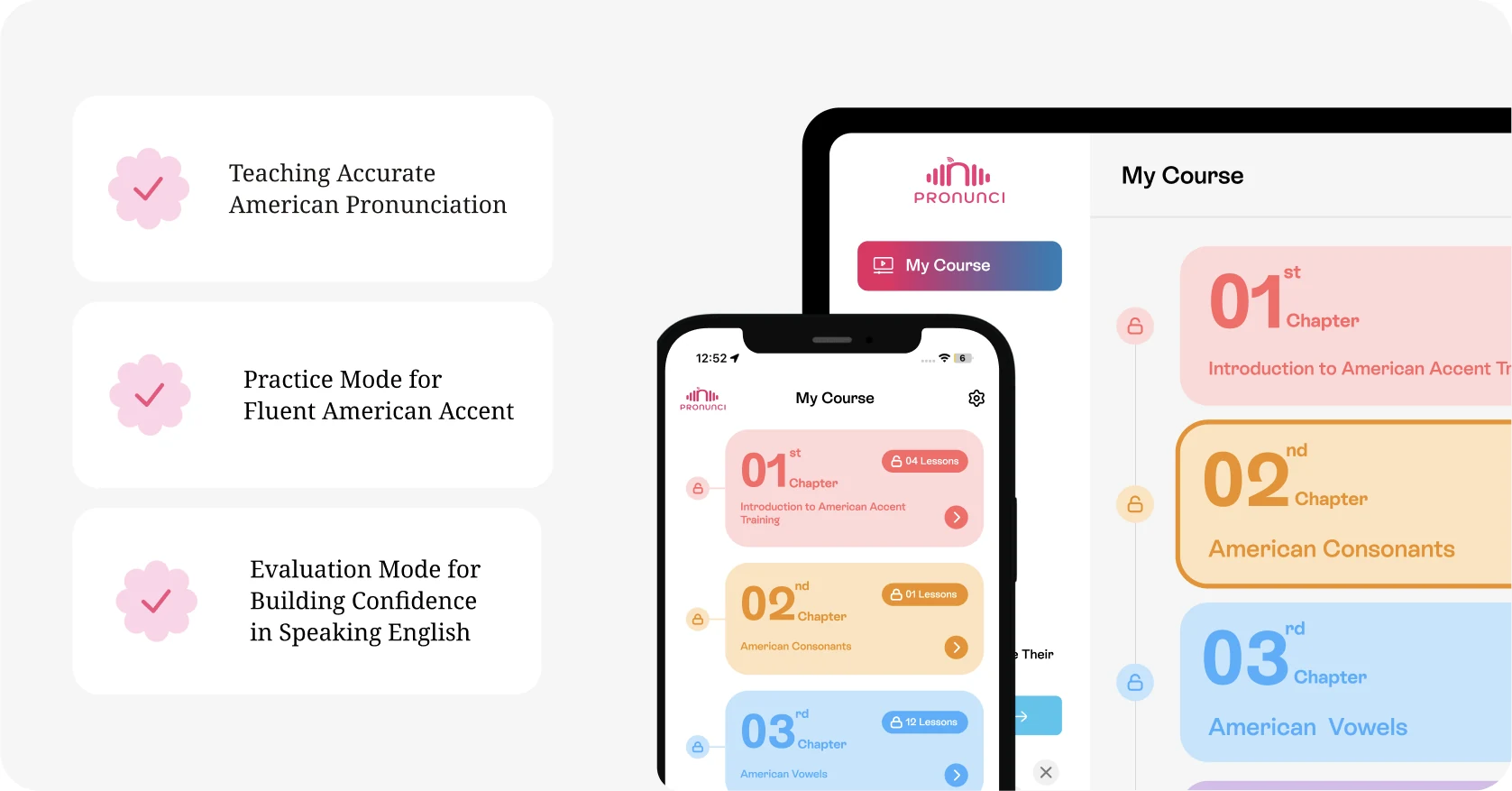
- Speech Organs EducationStudents learn how the speech organs work, along with the AI Accent Coach commands and feedback.
- American ConsonantsPractice and evaluate American consonants in phonetic exercises and practice sentences with the AI Accent Coach.
- American VowelsPractice and evaluate American vowels in phonetic exercises and practice sentences with the AI Accent Coach.
- IntonationLearn how intonation can change the meaning of what you say.
- CertificateBy the end of the course, students receive a certificate.

How to reduce a foreign accent as an adult
Adults reduce a foreign accent by training it consciously: learn how each sound is made, practice the sounds your first language does not have, then move to words, sentences, and intonation, with regular feedback. Research shows pronunciation training works best when it lasts longer and includes feedback. InPronunci: Accent Training follows this path as a structured American accent course created by Prof. Alex, Ph.D. Accent Coach, Doctor of Education, and professional linguist: Interactive Visual 2D Sound Simulators train articulation, Pronunci Speaks gives instructions before every exercise, and the AI Accent Coach gives feedback on each recording.
Can Adults Realistically Learn a Native-Like American Accent?
Adults can reach native-like or near-native American pronunciation, but the outcome depends far more on training method than on age alone. A meta-analysis by Lee, Jang, and Plonsky (2015) reviewed dozens of pronunciation instruction studies and found that explicit teaching produces measurable, durable improvement in adult learners’ pronunciation, not just temporary gains that fade once practice stops [1]. That finding matters because it cuts against the assumption that adult speech patterns are fixed once learned.
What Does the Research Say About Adult Accent Acquisition and Neuroplasticity?
Saito (2012) tested this directly, comparing learners who received explicit instruction on specific sounds against those who only practiced through communication tasks. The explicit-instruction group showed significantly stronger gains in pronunciation accuracy over time, showing that conscious, targeted training changes how adults produce sounds, not simply how they perceive them [2]. This is the mechanism behind every serious accent program: you are not waiting for the brain to absorb a sound through exposure, you are training the tongue, lips, jaw, and airflow to produce it correctly, on purpose, until it becomes automatic.
Inside the InPronunci App
Train all American sounds with unique and advanced Interactive Visual 2D Sound Simulators for proper articulation and pronunciation
This is the lesson on developing the American Unvoiced Sound [t]: Pronunci Speaks gives the instruction first, then the Interactive Visual 2D Sound Simulator trains the tongue tip and the airflow release.
- EffectiveMost apps offer visual learning. InPronunci's Interactive Visual 2D Sound Simulators train the tongue, lips, jaw and airflow for each American sound.
- ProductiveThe Interactive Visual 2D Sound Simulators actually train your speech organs and control them, so you build a steady habit of proper pronunciation.
- ResultsStudents pronounce individual American sounds with almost native-like pronunciation.
This is also where the common question “can adults learn native accent” gets a clearer answer. The honest response is not a flat yes or no. It is: adults can learn a native accent when the training targets the speech organs directly and continues long enough to become habitual, the same structured path InPronunci uses across its four training stages, from sound articulation to paragraph-level delivery.
How Does Age Affect the Ability to Learn Native-Like American Pronunciation?
Age changes the ease of acquisition, not the ceiling on what is possible. Children often pick up native sounds incidentally, through sheer volume of exposure, without any conscious effort. Adults generally cannot rely on that same incidental process, since their speech organs have already set habits from their first language. But adults have an advantage children don’t: they can consciously analyze a sound, isolate the tongue or lip position that produces it, and drill that position until it sticks.
Thomson and Derwing (2015) reviewed decades of pronunciation research and concluded that comprehensibility gains are driven by the quality and focus of instruction, not by the learner’s age at onset [1]. In other words, whether someone can learn a native accent as an adult depends on whether their training addresses actual articulation, rhythm, and intonation, or just asks them to repeat words and hope the accent fades on its own.
What Makes American Accent Training Different From General Pronunciation Apps?
Most pronunciation apps score what a learner already said; structured accent training changes how the tongue, lips, and jaw move to produce the sound correctly the next time. That mechanism gap explains why some learners plateau after months of app use while others keep improving.
How Does InPronunci’s Approach Differ From Scoring-Based Pronunciation Apps?
A scoring-based app records a word, compares it to a reference model, and returns a percentage or a red-yellow-green mark. That tells the learner a sound missed the target, but it does not show them where their tongue was, where it needed to be, or how to move between the two. The feedback loop ends at diagnosis.
InPronunci: American Accent Training App builds the correction step into the lesson itself. Its 2D Sound Motion Technology uses Interactive Visual 2D Sound Simulators to train the tongue, lips, jaw, teeth, airflow, and voice for each American vowel and consonant. A learner trying to fix the American R, for example, follows the simulator through the tongue-pull-back motion and repeats it with Pronunci Instructions guiding each attempt, step by step, the way Prof. Alex, Ph.D. Accent Coach, Doctor of Education, and professional linguist, walks students through the same movement in 1-on-1 sessions.
Why Does Speech-Organ Training Go Further Than Feedback Alone?
Feedback tells a learner what happened. Speech-organ training changes what happens next time, which is the actual question behind whether adults can learn native accent patterns instead of just recognizing their own mistakes.
ELSA Speak offers AI-powered feedback, role-plays, and broad English communication practice across many speaking scenarios. BoldVoice offers guided video practice with coach videos and AI speech evaluation focused on American accent improvement. Both are structured differently from InPronunci, not inferior to it, they emphasize feedback and modeling, while InPronunci adds direct articulation training as the first stage before any sentence or paragraph work begins.
InPronunci also evaluates differently once a learner starts producing full sentences. The AI Accent Coach reads pronunciation, intonation, melody, rhythm, connected speech, and sentence flow together, not a single isolated word, and Pronunci Instructions appear in every lesson so learners always know what to adjust before they try again. Readers who want the full side-by-side can see InPronunci vs. ELSA Speak for a fair comparison of both approaches.

How Long Does It Take to Reduce an Accent and Sound More Native?
No fixed timeline applies to every learner: progress depends on first-language influence, starting pronunciation level, and how consistently someone practices, not on a calendar.
Two speakers who start the same course can progress at different rates for reasons that have nothing to do with effort. A Spanish speaker working on vowel length and a Mandarin speaker working on final consonants are retraining different muscle patterns, so comparing their timelines directly does not make sense. What does transfer across learners is the structure of the practice itself, which is why the question “can adults learn native accent” is better answered by looking at training design than at weeks on a calendar.
What Realistic Expectations Should Intermediate and Advanced Speakers Have?
Expect gradual, stage-based improvement rather than a sudden shift, with sound accuracy stabilizing before rhythm and intonation catch up. Progress typically follows this sequence:
- A sound becomes accurate in isolation first, through deliberate articulation practice.
- It becomes automatic in phonetic exercises, where it appears in combinations and reductions.
- It transfers into full sentences with correct stress and intonation.
- It finally stabilizes in paragraph-length, connected speech.
Skipping ahead to sentence practice before a sound is stable in isolation tends to produce inconsistent results, because the old motor pattern resurfaces under the pressure of connected speech.
Advanced learners aiming for native-like intonation and connected speech should expect the sentence and paragraph stages to take more sustained work than the isolated-sound stage. A single sound correction is a narrower motor task than learning to match pitch movement, sentence stress, and linking patterns across a full conversation. This is consistent with findings that explicit pronunciation instruction produces measurable gains in both controlled and spontaneous speech, with spontaneous, connected speech typically requiring more sustained instruction to show the same level of improvement.
What Kind of Practice Produces Noticeable Improvement?
Short daily sessions that isolate one sound at a time build motor memory faster than occasional long sessions, because muscle retraining depends on frequent, focused repetition rather than volume in a single sitting. This mirrors how targeted accent reduction training works: identifying specific sound patterns and drilling them in short, repeated intervals rather than general, unfocused speaking practice [1]. InPronunci structures its four training stages around this principle, moving from the Interactive Visual 2D Sound Simulators to phonetic exercises, sentences, and paragraphs so that each stage locks in before the next begins.
What Is the Best Method for Training American Sounds and Intonation?
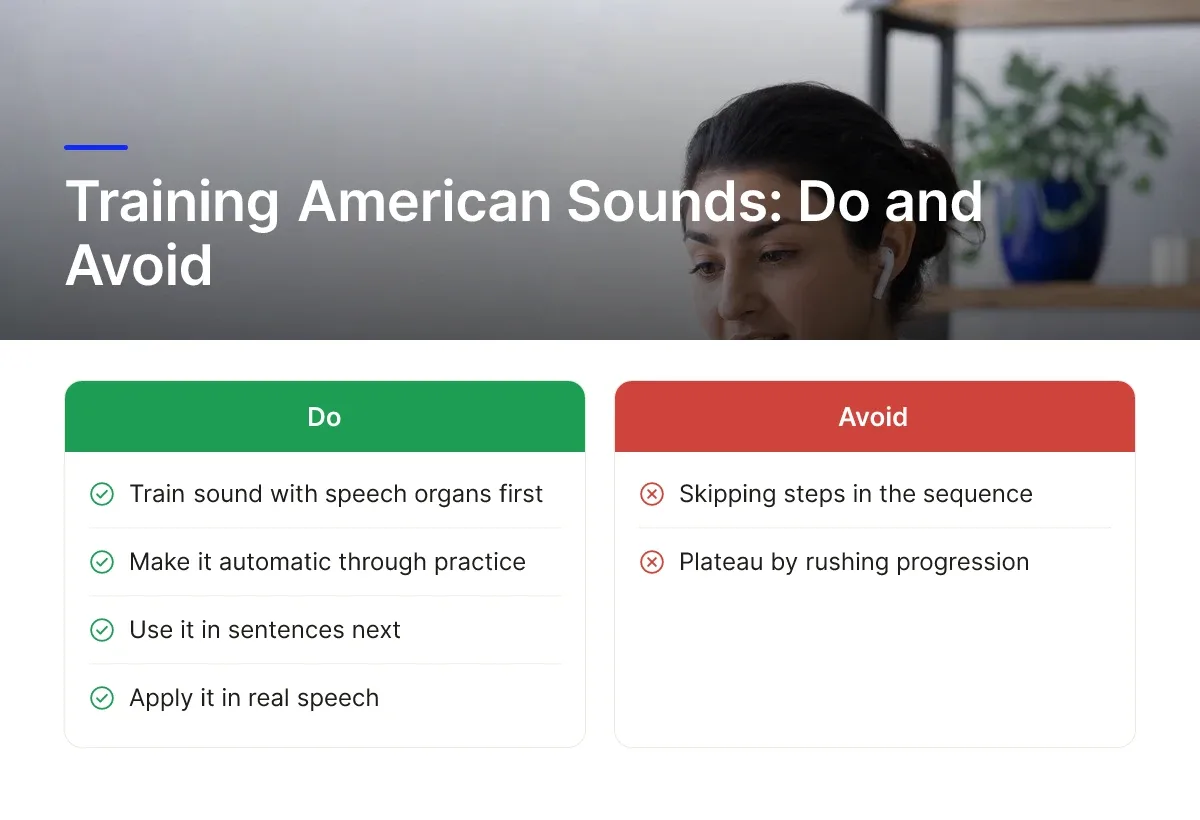
The method that works moves in one direction only: train the sound with the speech organs first, then make it automatic, then use it in sentences, then use it in real speech. Skipping steps is the main reason adults who ask whether can adults learn native accent change for themselves often plateau after initial progress.
What Are the Four Connected Training Stages?
InPronunci structures training in four connected stages, the same sequence Prof. Alex, Ph.D. Accent Coach, Doctor of Education, and professional linguist, uses in his 1-on-1 training:
- Sound articulation training builds accurate American vowels and consonants using the Interactive Visual 2D Sound Simulators, which train the tongue, lips, jaw, teeth, airflow, and voice for each sound.
- Phonetic exercises take that sound and make it fluent and habitual, not something the speaker has to think about.
- Sentence practice adds American rhythm, stress, intonation, and connected speech, so the sound survives inside real phrasing.
- Paragraph practice applies all of it to longer speech: presentations, meetings, interviews, and everyday conversation.
Each stage depends on the one before it. Intonation and rhythm training assumes the speaker can already produce the underlying sounds with consistent tongue, lip, and jaw positioning. Without that motor control, intonation patterns have nothing stable to attach to, and pronunciation tends to drift back to old habits under pressure, in a job interview, a client call, or a live presentation.
How Do Phonetic Exercises and Sentence Practice Work Together?
Take the American R. The tongue stays pulled back and slightly curled, away from the roof of the mouth, with no contact at the tongue tip anywhere, unlike the tapped or trilled R many languages use. A speaker first trains that tongue position in isolation with the simulator, then drills it in phonetic exercises, words like “car,” “early,” and “report,” before ever placing it in a sentence. Only after the position is stable does it move into full sentences like “The marketing director reported strong results.”
Phonetic exercises are not isolated drills disconnected from real talk. They include reductions (“going to” becoming “gonna” in casual speech), assimilations (where one sound shifts to match its neighbor), and sound combinations that occur constantly in connected speech. This is the link between connected speech patterns and the isolated sound work most apps skip. Research on explicit pronunciation instruction has found that structured, focused training produces measurable gains in both accuracy and comprehensibility compared to unguided exposure [1].
A short routine to try today: pick one target sound, train its articulation deliberately with attention to tongue and lip position, repeat it in a few minimal pairs (ship/sheep, bet/bat), then say it out loud in three full sentences. Five minutes of this, done with the correct speech-organ position from the start, builds habits that a lifetime of casual repetition won’t.
Should Adults Aim for a Native Accent or Focus on Intelligibility?
Both are legitimate goals, and the right answer depends on the speaker’s profession, audience, and personal preference, not on a single correct outcome for everyone.
What Is the Difference Between Reducing an Accent and Sounding Native?
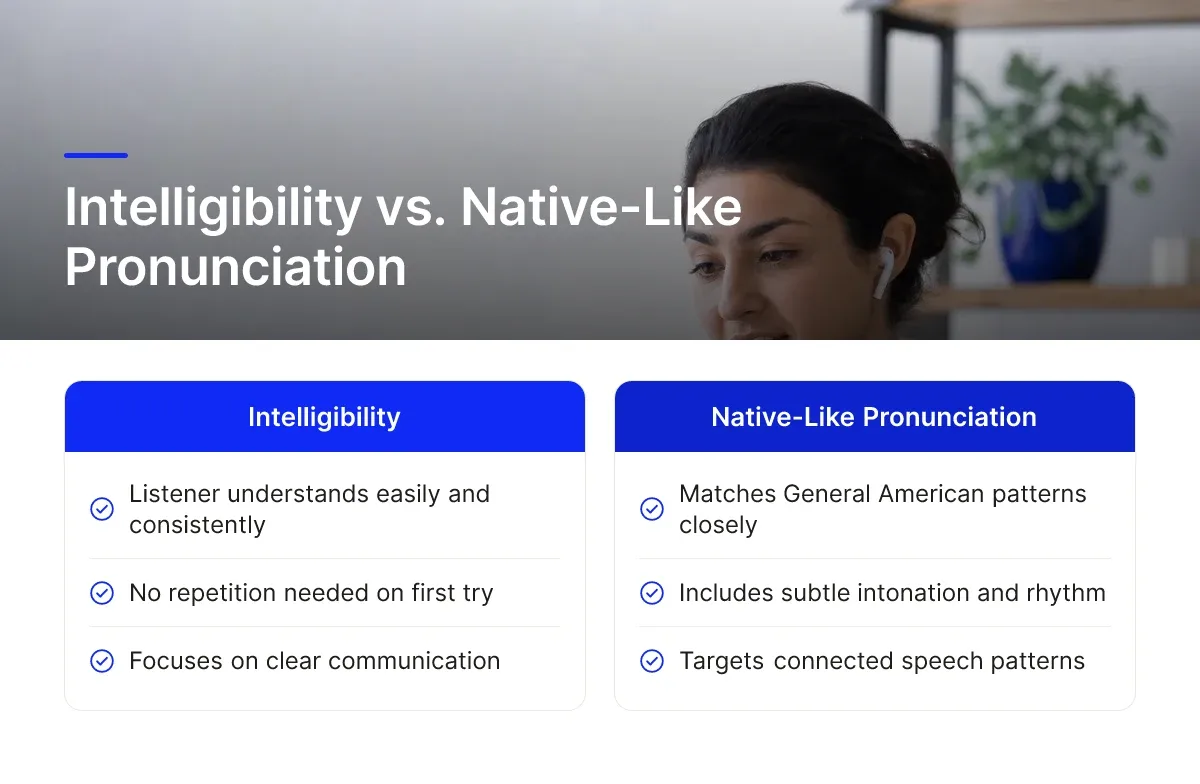
Intelligibility means a listener understands the speaker easily and consistently, on the first try, without asking for repetition. Native-like pronunciation goes further: it targets matching General American patterns closely, including the subtler layers of intonation, rhythm, and connected speech that most listeners notice only subconsciously.
A call center agent who wants American customers to understand every word has a different target than a professor preparing international conference talks who wants to sound indistinguishable from a US colleague. Both are training the same speech organs; they are simply choosing different finish lines.
Thomson & Derwing’s 2015 review makes a point that matters here: comprehensibility and accentedness are separate dimensions of speech, not two points on the same scale [1]. A speaker can become easier to understand while still sounding identifiably non-native, and that outcome is not a failure. It means reducing an accent does not require erasing the identity it carries.
How Does Native-Like Pronunciation Affect Confidence at Work and in Interviews?
For many professional contexts, strong intelligibility is enough. A software engineer running a stand-up, a nurse explaining discharge instructions, or a sales rep closing a call all need to be understood clearly and confidently, and that goal is well within reach for most intermediate and advanced speakers.
Some learners have legitimate reasons to go further. Advanced professionals negotiating executive roles, job candidates in highly competitive interview pools, and English teachers or interpreters who are themselves a pronunciation model often want speech that matches native patterns as closely as possible, including the intonation shifts that signal confidence or hesitation in American English. Whether can adults learn native accent outcomes depends largely on how structured and sound-specific the training is, not on talent alone.
InPronunci builds for both tracks. The AI Accent Coach’s Intermediate level evaluates pronunciation, rhythm, and flow for speakers who want to communicate clearly and independently. The Advanced level, recommended with the Premium Plan, evaluates full speech performance against native American English for learners specifically targeting native-like delivery, alongside monthly 1-on-1 sessions with Prof. Alex, Ph.D. Accent Coach, Doctor of Education, and professional linguist. For more on how adults learn native accent through structured practice rather than guesswork, see InPronunci’s AI Accent Coach page.
Whichever path a learner chooses, the brand stance stays constant: the goal is to reduce an accent, never to eliminate it, and every accent deserves respect.
Related guide: How to Reduce a Foreign Accent as an Adult
Questions & Answers
Frequently Asked Questions
01Can an adult reduce a foreign accent without a teacher?
Yes, with a structured course and feedback on each recording. A coach helps when you get stuck, which is why InPronunci Premium includes monthly 1-on-1 sessions with Prof. Alex.
02Is it too late for an adult to change their accent?
No, it is not too late. Adult speakers can change how specific sounds, stress, and intonation patterns work in their speech through targeted, repeated practice [1]. Progress depends more on consistent, structured training than on age alone. What changes is the method: adults need explicit instruction on tongue, lip, and jaw position rather than passive exposure.
03Does first language affect how hard it is to sound American?
Yes, the first language shapes which sounds and patterns are hardest to adjust. Spanish and Portuguese speakers often work on short versus long vowels and final consonants, Hindi and Tamil speakers often focus on the flap T and word stress, and Mandarin speakers often target final consonants and the “th” sounds. These are common tendencies, not fixed rules, and training should target the individual speaker’s patterns.
04Can listening and watching American shows alone reduce an accent?
Listening alone rarely changes production because recognizing a sound is different from training the muscles that produce it. Exposure builds awareness of rhythm and melody, which helps, but speech organs still need direct practice through articulation drills and feedback. Passive listening works best alongside, not instead of, structured sound training.
05What should I train first: individual sounds or intonation?
Start with individual sounds before moving to intonation. A stable sound system gives the tongue, lips, and jaw consistent habits, which makes stress and melody patterns easier to layer on top in sentences and paragraphs.
06Is there a single best way to measure whether an adult can learn a native accent?
There is no single test, but consistent progress across sound accuracy, sentence stress, and connected speech is the clearest sign. The most reliable way to answer whether can adults learn native accent goals are realistic for a specific learner is to track measurable change at each training stage rather than judging progress by how natural speech feels in casual conversation alone.
Conclusion
Adults can change how they sound in English, but the sounds-first, structure-second order matters more than age. Train individual vowels and consonants with correct tongue, lip, and jaw positions before layering in stress and intonation, then apply both in full sentences and paragraphs. Progress comes from explicit, repeated practice and feedback on complete speech, not passive listening or isolated word drills [1] [2].
Start with Free Chapter 1 of InPronunci’s Speech Organs Education on the App Store, Google Play, or the web, and build your sound foundation before moving to sentence-level work.
Sources & References
- Do Accent Reduction Classes Work? | ALTA Language Services
- Why can’t grown-ups learn a language without an accent? | Antimoon Forum
Recommended Articles
How to Speak English More Clearly and Be Understood
You speak English more clearly by training the individual sounds, stress, and intonation patterns of American English with deliberate, structured.

Guide to Choosing the Best Pronunciation App Free Option
Explore the best pronunciation app free options for American accent training, what free tiers include, and when a paid plan is worth it. Discover essential.

What to Expect From American Accent Training Online
American accent training online works by combining structured, sound-by-sound instruction with guided practice and feedback, typically moving through four...
Plans
What InPronunci costs
InPronunci Basic
$35 per month
Chapter 1 is free after signup.
InPronunci Premium
$200 per month
Includes a coach: