

Understanding pronunciation app free is essential. A handful of free or freemium pronunciation apps let intermediate and advanced English speakers start training American accent patterns before committing to a paid plan, but most free tiers only cover single-word scoring, not full speech training. Free chapters or trial tiers typically teach speech-organ awareness and basic sound practice, while sentence-level intonation, connected speech, and full-speech AI feedback are usually reserved for paid plans. The practical approach is to use free resources to learn the mechanics of individual sounds, then move to structured paid training once you need rhythm, stress, and connected speech work.
What Free or Freemium Pronunciation App Options Exist for American Accent Training?
Free options fall into two different categories, and confusing them leads to wasted practice time: ad-supported scoring apps versus structured courses with one genuine free chapter. This is particularly relevant for pronunciation app free.
The first category is the pronunciation app free download you find on an app store, often supported by ads or limited to a handful of daily practice turns. These apps typically listen to one word at a time and return a score. Pronuncian, for example, teaches the 43 sounds of American English through listen-and-repeat practice and works even offline [2]. BoldVoice offers a free tier with in-app purchases, built around short daily sessions and AI-powered feedback on recorded speech [1]. The second category is a structured accent training course that enables one full chapter at no cost as an on-ramp to a paid plan. InPronunci’s Free Chapter 1, Speech Organs Education, is built this way: it is a complete lesson on how the tongue, lips, teeth ridge, and airflow work together to shape American sounds, not a locked preview of a paid feature.
Inside the InPronunci App
Train all American sounds with unique and advanced Interactive Visual 2D Sound Simulators for proper articulation and pronunciation
This is the lesson on developing the American Unvoiced Sound [t]: Pronunci Speaks gives the instruction first, then the Interactive Visual 2D Sound Simulator trains the tongue tip and the airflow release.
- EffectiveMost apps offer visual learning. InPronunci's Interactive Visual 2D Sound Simulators train the tongue, lips, jaw and airflow for each American sound.
- ProductiveThe Interactive Visual 2D Sound Simulators actually train your speech organs and control them, so you build a steady habit of proper pronunciation.
- ResultsStudents pronounce individual American sounds with almost native-like pronunciation.
What does a freemium model look like in pronunciation training apps, and what features stay free?
A typical freemium pronunciation app gives away word-level checks, a capped number of daily exercises, or a single introductory lesson, while the full curriculum stays behind a subscription. What usually stays free: basic pronunciation scoring on isolated words, a limited practice session count, or an orientation lesson explaining how the app works. What usually requires payment: sentence-level practice, connected speech training, detailed feedback breakdowns, and progress tracking across a full course. This split exists because word-scoring is cheap to deliver at scale, while sentence-level and intonation feedback requires more training content and more detailed evaluation. If you’re searching for a pronunciation app free of hidden costs, it helps to confirm exactly which of these features sits behind the paywall before you start.
How do free trial chapters in accent training apps compare to fully free apps?
A free trial chapter inside a structured course usually teaches a complete skill, while a fully free scoring app usually teaches a repeating loop of word checks. Intermediate and advanced speakers often outgrow pure scoring apps within a short number of sessions because their remaining pronunciation issues live in connected speech, sentence stress, and intonation, areas a single-word score cannot diagnose or correct. InPronunci’s Free Chapter 1 is built as a genuine first step: it gives speech-organ awareness learners can carry into every later session, whether they continue with the Basic Plan or move to Premium with 1-on-1 coaching. When evaluating any free tier, judge it by what it teaches you to do differently with your tongue, lips, and airflow, not by the score it displays on screen.
Structured American Accent Training Course
From Speech Organs Education to American Intonation
The InPronunci course is built step by step: every chapter prepares the next one, and by the end of the course students receive a certificate.
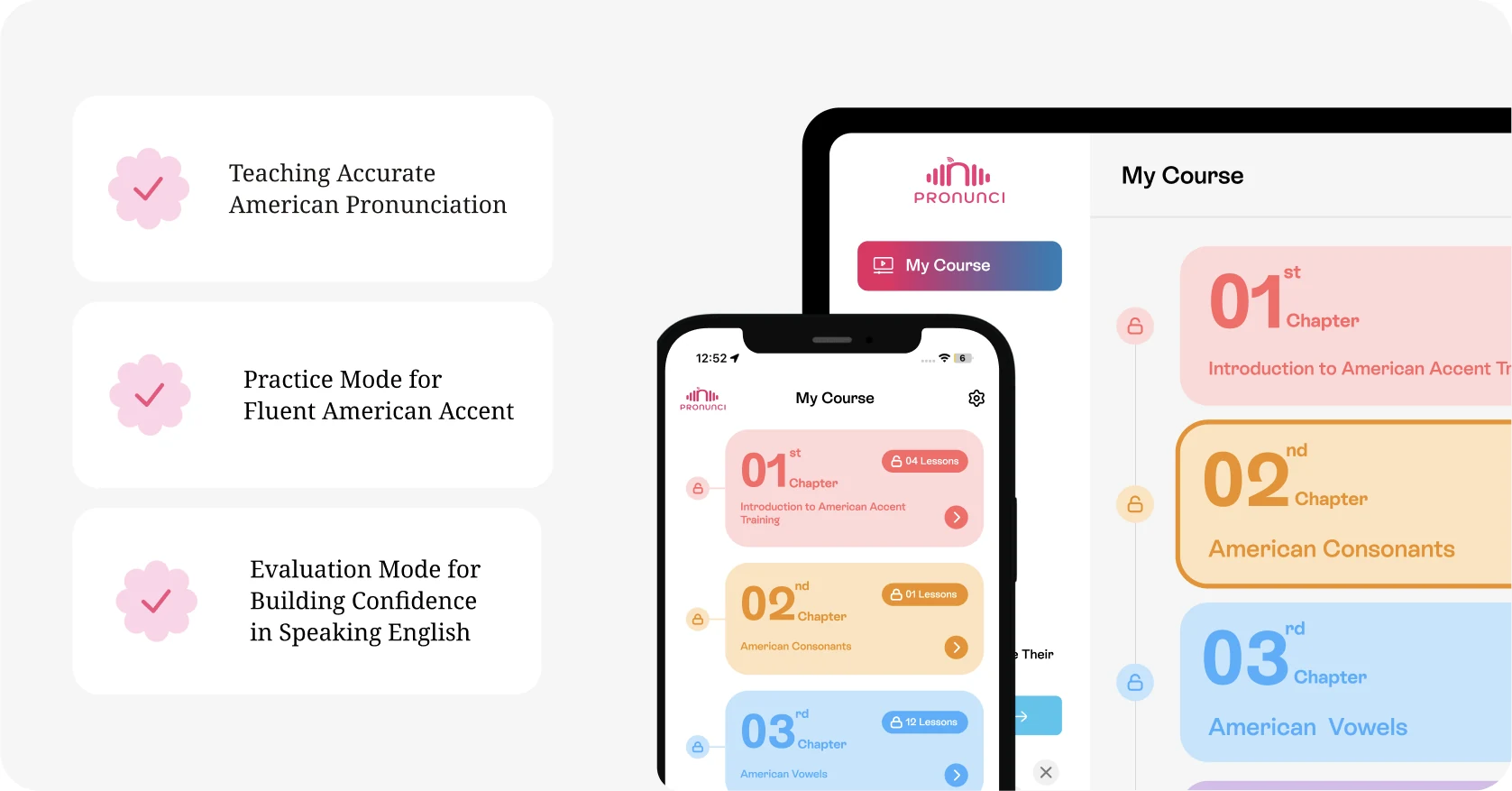
- Speech Organs EducationStudents learn how the speech organs work, along with the AI Accent Coach commands and feedback.
- American ConsonantsPractice and evaluate American consonants in phonetic exercises and practice sentences with the AI Accent Coach.
- American VowelsPractice and evaluate American vowels in phonetic exercises and practice sentences with the AI Accent Coach.
- IntonationLearn how intonation can change the meaning of what you say.
- CertificateBy the end of the course, students receive a certificate.
How Do Free Pronunciation Apps Compare to Paid Options for Accent Training?
A free pronunciation app usually scores single words or isolated sounds well, but it rarely trains the sentence-level rhythm and intonation that make speech sound natural. The gap is not a quality flaw. It is a difference in what each tool is built to measure.
Scoring one word against a reference pronunciation is a contained computational problem. The app records a sound, compares it to a stored model, and returns a match score. Evaluating a full sentence, where stress shifts, syllables link together, and pitch rises and falls to signal meaning, requires modeling far more variables at once. That is why a free pronunciation app typically stops at word or phoneme-level feedback: it is the layer that is simplest to score reliably, not the layer that matters most for sounding natural.
What accent training features are missing from free pronunciation apps that intermediate and advanced speakers need?
Most free tiers skip three things intermediate and advanced speakers actually need: structured speech-organ training, sentence-level stress and intonation coaching, and connected speech patterns. When considering pronunciation app free, this point stands out.
- Speech-organ training. Correcting a sound like the American R or the TH sounds requires guidance on tongue, lip, and jaw position, not just a pass/fail score after the fact.
- Sentence-level stress and intonation. American English relies on stress-timed rhythm, where some words compress and others carry pitch and emphasis. A free pronunciation app that only checks word accuracy will not flag a flat or evenly-stressed sentence.
- Connected speech. Linking, reductions, and assimilations (like “going to” becoming “gonna” in casual speech) change how words sound together. Our connected speech guide covers why this layer trips up advanced speakers even after they master individual sounds.
How do free apps handle speech organ training, intonation feedback, and connected speech evaluation?
Largely, they don’t, which is why structured paid courses sequence training differently: sound articulation first, then phonetic exercises to make sounds automatic, then sentence practice with intonation, then paragraph-level delivery. Skipping straight to open conversation practice, which many free apps emphasize, can leave gaps in articulation and rhythm that resurface under pressure, in interviews or presentations.
InPronunci’s AI Accent Coach illustrates the contrast: it evaluates pronunciation, intonation, melody, rhythm, connected speech, and sentence flow as a student speaks, rather than scoring a single word or sound in isolation. It is one example of full-speech evaluation among several approaches in the category, applied within InPronunci’s four-stage structure from the American accent training course.

What Is the Difference Between Pronunciation Scoring Apps and Structured Accent Training Courses?
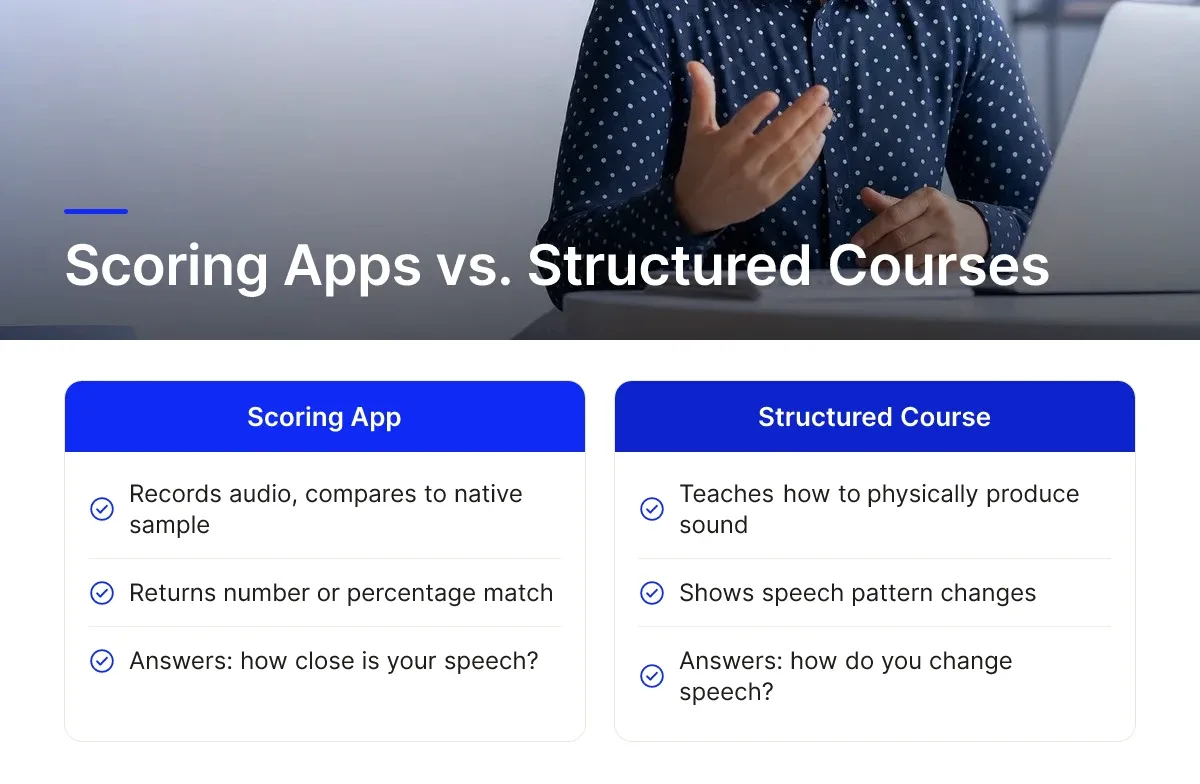
A scoring app tells you how close your speech sounds to a target; a structured course teaches you how to physically produce that sound yourself. That distinction matters more than most learners realize when they search for a pronunciation app free of charge, because the two tools solve different problems.
Why do some apps just score your pronunciation while others teach you how to change your speech patterns?
A scoring tool records your audio, runs it through a speech recognition model, and returns a number or a percentage match against a native-speaker sample. That feedback answers one question: how close are you? It does not answer the question that actually matters for improvement, which is what to change about your tongue, lips, or jaw to close the gap.
This is where many intermediate and advanced speakers plateau. They know a sound is off because an app flagged it, but knowing a score is low does not teach the physical adjustment needed to fix it. A structured course instead starts with the mechanics: where the tongue sits, how the lips round, whether air flows through the nose or mouth, and how the jaw moves. Scoring measures the outcome; articulation training builds the skill that produces the outcome. For those exploring pronunciation app free, this matters.
How does sound-by-sound articulation training differ from general English speaking practice apps?
General practice apps usually mix vocabulary drills, conversation scenarios, and pronunciation checks into one broad activity. Sound-by-sound training isolates a single vowel or consonant and builds it from the ground up before moving to sentences.
InPronunci follows this sequence across four connected training stages. First, students work with the Interactive Visual 2D Sound Simulators and Pronunci Instructions from Prof. Alex, Ph.D. Accent Coach, Doctor of Education, and professional linguist, to train the tongue, lips, jaw, and airflow for each American sound. Second, phonetic exercises make that sound automatic through repetition, reductions, and sound combinations. Third, sentence practice adds stress, rhythm, and intonation so the sound survives in connected speech. Fourth, paragraph practice applies it to presentation-style delivery for meetings, interviews, and everyday conversation.
The American R shows why this matters. Producing it correctly requires retracting the tongue body and keeping the tongue tip away from the roof of the mouth, a position most scoring apps never explain. A score might tell a learner their R sounds “off,” but only articulation training shows the tongue where to go and lets the learner rebuild the sound from the correct position. Research on explicit pronunciation instruction supports this approach: Saito 2012 found that teaching pronunciation rules and articulatory detail explicitly produced pronunciation gains that passive exposure or feedback-only approaches did not reliably produce.
For a non-native English professional preparing for client calls or interviews, this difference is the reason a pronunciation app free trial alone rarely moves the needle past a certain point. Structured, sound-by-sound work does what scoring cannot: it teaches the physical change, not just measures the distance from it. For more on how tongue position shapes individual sounds, see our guide to tongue placement in English sounds.
How Can You Combine Free Resources and Paid Training Into a Pronunciation Practice Routine?
The most efficient path uses free tools to diagnose your trouble sounds, then moves to structured paid training once you know what rhythm and stress patterns need work. Searching for a pronunciation app free of charge is a reasonable first move, it just shouldn’t be the last one.
What should you practice for free before investing in a premium accent training plan?
Start by identifying which sounds your native language doesn’t share with American English, since that’s where most mispronunciations come from. Hindi speakers often confuse /v/ and /w/ and need work on the flap T in words like “water” and “better.” Spanish and Portuguese speakers frequently struggle with short versus long vowel pairs, such as “ship” versus “sheep.” Mandarin speakers often drop final consonants or mix up /l/ and /r/. A free chapter or app that teaches the speech organs, tongue, lips, jaw, airflow, gives you the vocabulary to name what’s happening in your mouth, not just that something sounds “off.” This directly impacts pronunciation app free outcomes.
Once you know your target sounds, a short daily routine builds the muscle memory needed to make them automatic:
- Warm up (3-4 minutes). Pick 2-3 target sounds and run through mouth-position drills for each, focusing on where your tongue and lips should land.
- Record (2-3 minutes). Say a sentence containing those sounds out loud and record it on your phone.
- Compare (3-4 minutes). Listen back against a native-speaker model of the same sentence and note exactly where your version diverges.
- Repeat with adjustment (3-4 minutes). Say the sentence again, consciously correcting the specific difference you heard.
Fifteen minutes a day, done consistently, is enough to work through a handful of target sounds without a paid subscription, and much of it can be done using nothing more than a pronunciation app free download and a notebook.
How do free chapters or trial periods help you decide if a paid accent training course is right for you?
Free chapters show you how a program teaches, not just what it covers, which matters more once you’ve moved past isolated sounds. A listen-and-repeat free app can tell you how all 43 sounds of American English are supposed to sound [2], but it can’t tell you why your /θ/ keeps coming out as /t/ or correct the tongue position causing it. That’s the point where free practice stops being enough: when your errors shift from a single sound to rhythm, word stress, or getting misunderstood across full sentences. No free tool evaluates connected speech or sentence-level flow the way a structured course does.
InPronunci’s Free Chapter 1, Speech Organs Education, is built for exactly this diagnostic stage, it teaches tongue, lip, and airflow coordination so you can follow more advanced instruction with real awareness. From there, self-motivated learners typically move to the Basic Plan for full access to the four-stage training system, phonetic exercises, and AI Accent Coach feedback on full speech, not just single words. Professionals aiming for native-like delivery, or who want personal correction, can add the Premium Plan after a consultation with Prof. Alex, Ph.D. Accent Coach, Doctor of Education, and professional linguist.
Research on pronunciation instruction supports patience with this process: explicit teaching can measurably improve specific aspects of pronunciation, but comprehensibility gains are gradual and uneven across learners, not an overnight shift [1]. Keep practicing daily, track one sound at a time, and treat free and paid tools as different stages of the same path rather than competitors. This is particularly relevant for pronunciation app free.
Which Pronunciation App Features Actually Improve American Accent and Connected Speech?
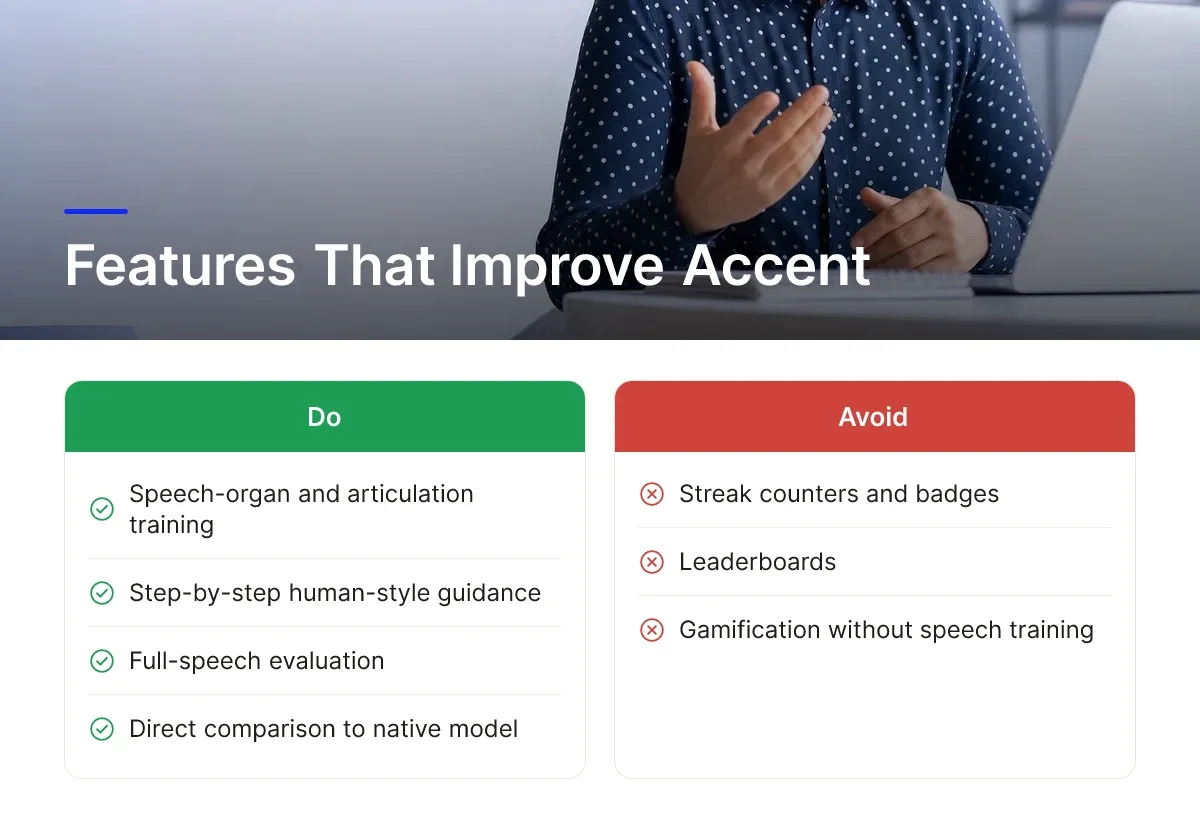
Four feature categories correlate with real accent change: speech-organ training, step-by-step human-style guidance, full-speech evaluation, and a direct comparison against a native model. Streak counters, badges, and leaderboards do not belong on that list. They keep you opening the app, but they do not train your tongue, jaw, or sentence rhythm.
When you evaluate a pronunciation app free of charge or on a paid plan, check for these four things specifically. Everything else is secondary.
- Speech-organ and articulation training. The app should show you where your tongue, lips, and jaw go for each sound, not just play a model and ask you to repeat it.
- Step-by-step human-style instruction. Guidance that tells you what to notice and how to correct it, lesson by lesson, rather than a single automated score with no explanation.
- Full-speech evaluation. Feedback on intonation, rhythm, and connected speech across sentences and paragraphs, not just accuracy on isolated words.
- A native-model comparison tool. A way to hear your own recording next to a native speaker’s version of the same sentence, so you can hear the gap yourself.
What does real-time AI feedback on intonation, rhythm, and sentence flow look like in pronunciation apps?
It means the app scores how your stress, pitch, and timing move across a full sentence, not just whether you said one word correctly. American English is stress-timed: stressed syllables fall at roughly even intervals, and unstressed syllables and function words compress or reduce to fit that rhythm. Get the sounds right but misplace the stress, and listeners still struggle to follow you. A sentence like “I didn’t say he stole the money” changes meaning depending on which word carries the stress, regardless of how clean each sound is.
This is why word-level or sound-level scoring alone misses the bigger issue. An app that only checks individual phonemes can tell you your /θ/ in “think” is accurate while missing that your sentence stress pattern makes the whole utterance hard to parse. Evaluation that covers connected speech, linking, reductions, and stress placement across a sentence, gets closer to what actually determines whether a listener understands you the first time. Research on pronunciation teaching has found that explicit instruction targeting these broader features supports measurable gains in how comprehensible learners sound to listeners [2].
How important is step-by-step instruction from a professional accent coach compared to automated feedback alone?
Instruction from a trained coach tells you why a mistake happens and what to do next; automated feedback alone usually only tells you that something is wrong. InPronunci builds this into every lesson through Pronunci Instructions, step-by-step guidance from Prof. Alex, Ph.D. Accent Coach, Doctor of Education, and professional linguist, so you know exactly what to pay attention to before you practice, not just after you fail a score. When considering pronunciation app free, this point stands out.
InPronunci pairs that human guidance with the AI Accent Coach, which evaluates pronunciation, intonation, melody, rhythm, connected speech, and sentence flow as you speak. The Your Coach vs. My Pronunci Pronunciation Comparison Tool lets you hear your recording against the native-speaker model directly, building the kind of conscious self-correction that scoring alone does not teach. ELSA Speak offers AI-powered feedback with role-plays and broad communication practice, and BoldVoice offers guided video practice with coach videos and AI speech evaluation. Both are reasonable options in this category; the difference is whether the app trains your speech organs for each sound and walks you through full-speech correction lesson by lesson, which is what InPronunci’s structured path is built to do.
Cognitive Accent Training
Compare Your Coach vs. Your Pronunci
In every practice sentence, students listen to Your Coach, record their own voice, and compare it with Your Pronunci, so they consciously notice and correct each sound.
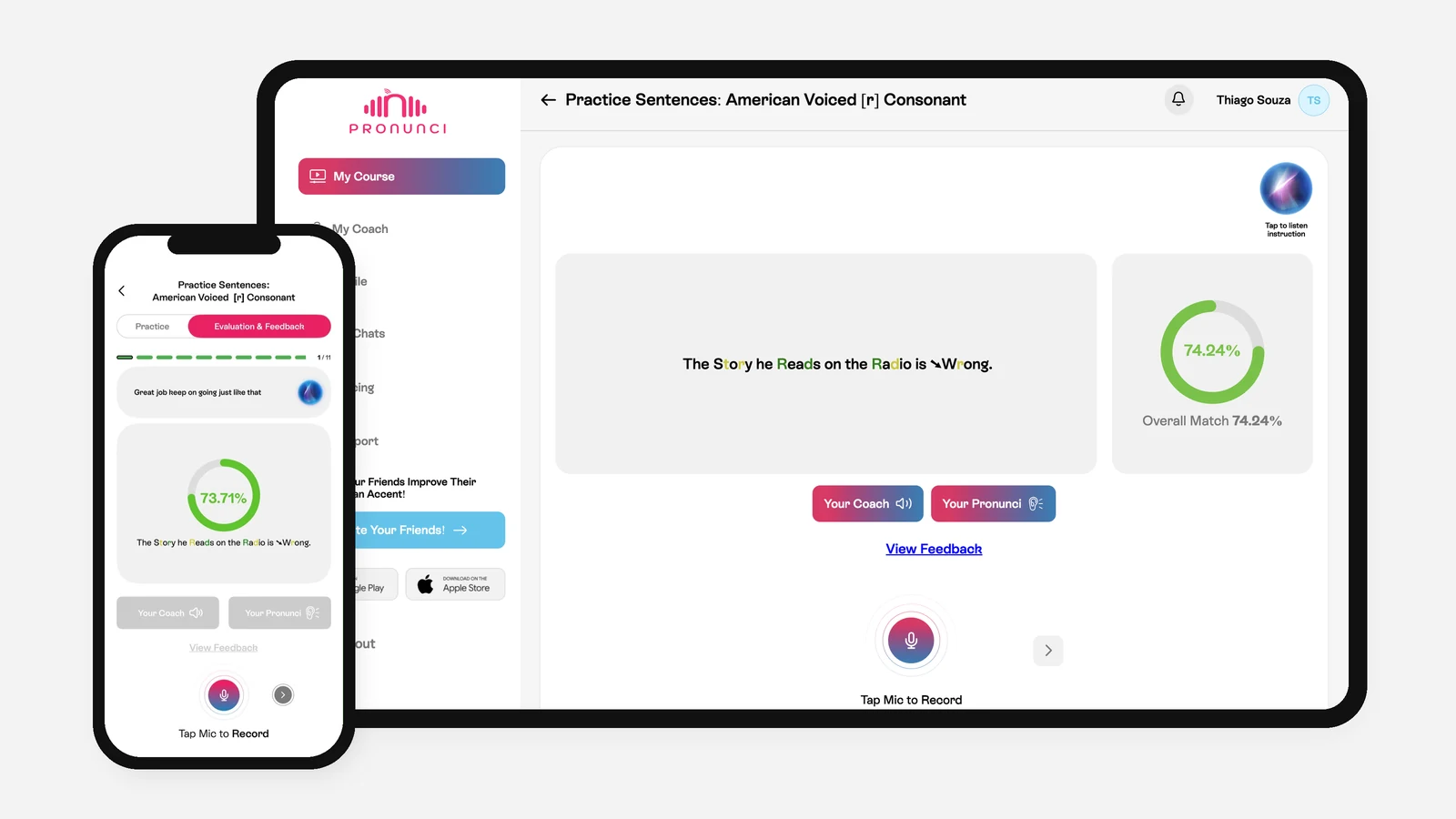
- Listen to Your CoachThe model American pronunciation of each practice sentence.
- Compare with Your PronunciYour own recorded pronunciation, side by side with the coach.
- Correct with feedbackThe match score and color-coded letters guide each correction.
Questions & Answers
Frequently Asked Questions
01Can a free pronunciation app alone reduce an accent?
A free pronunciation app can build awareness of sounds, but reducing an accent usually takes structured, ongoing practice beyond a free tier. Research on explicit pronunciation instruction shows that targeted, sustained training produces measurable gains, which is hard to get from a single free chapter or a limited free plan. Free access works best as a starting point, not the whole path.
02Do free pronunciation apps teach intonation and sentence stress?
Most free app tiers focus on individual sounds or word-level repetition, not intonation or sentence stress. Rhythm, stress, and melody usually require sentence- and paragraph-level practice, which tends to sit behind a paid plan. If intonation is your main goal, check whether an app’s free content goes beyond isolated words before relying on it.
03Is it worth starting with a free chapter before paying for accent training?
Yes, a free chapter is a reasonable way to test an app’s teaching method before committing to a paid plan. InPronunci’s Free Chapter 1, Speech Organs Education, teaches how the tongue, lips, and airflow work together, which prepares you to follow deeper sound and intonation training later. It also shows whether a course’s structure and pacing fit your learning style. For those exploring pronunciation app free, this matters.
04What should I do if I have a speech or hearing difficulty, not just an accent?
Consult a licensed speech-language pathologist or medical professional first. Pronunciation apps, including InPronunci, offer supportive practice for articulation and clarity, but they are not therapy or diagnosis, and a licensed professional can assess needs an app cannot address.
05Is a pronunciation app free download safe to rely on for daily practice?
A pronunciation app free download is generally safe for daily sound-awareness practice, as long as you understand its limits. Most free downloads are reliable for isolated word checks and basic repetition drills, but they are not built to catch sentence-level stress or connected speech errors. Use them consistently for early practice, then pair them with structured lessons once your errors move beyond single sounds.
Conclusion
Free pronunciation apps are useful for testing a method or building early sound awareness, but intonation, connected speech, and lasting accent change typically require a structured, paid path. Before choosing one, check whether its free tier teaches actual speech-organ mechanics or just scores word repetition. If you want a serious starting point, try InPronunci’s Free Chapter 1 on the web platform or through the App Store, then compare how its structured, sound-by-sound system fits your goals before deciding on a paid plan.
Sources & References
Recommended Articles

What to Expect From American Accent Training Online
American accent training online works by combining structured, sound-by-sound instruction with guided practice and feedback, typically moving through four...
What Is Accent Reduction and How Does It Really Work?
Accent reduction works by retraining how your speech organs produce American English sounds, stress, and intonation through structured, repeated practice...
Why Do I Have an Accent and What Causes It in English?
You keep your native accent in English because your speech organs learned to produce sounds, rhythm, and intonation for your first language first, and those...
Plans
What InPronunci costs
InPronunci Basic
$35 per month
Chapter 1 is free after signup.
InPronunci Premium
$200 per month
Includes a coach: