


You speak English more clearly by training the individual sounds, stress, and intonation patterns of American English with deliberate, structured practice, not by speaking faster or memorizing more vocabulary. Clarity comes from how precisely your tongue, lips, and jaw shape each vowel and consonant, how you stress key words in a sentence, and how smoothly you link sounds between words. Research on second-language pronunciation (Thomson & Derwing, 2015) shows that explicit, focused instruction on these mechanics improves intelligibility more reliably than general speaking practice alone.
Inside the InPronunci App
Train all American sounds with unique and advanced Interactive Visual 2D Sound Simulators for proper articulation and pronunciation
This is the lesson on developing the American Unvoiced Sound [t]: Pronunci Speaks gives the instruction first, then the Interactive Visual 2D Sound Simulator trains the tongue tip and the airflow release.
- EffectiveMost apps offer visual learning. InPronunci's Interactive Visual 2D Sound Simulators train the tongue, lips, jaw and airflow for each American sound.
- ProductiveThe Interactive Visual 2D Sound Simulators actually train your speech organs and control them, so you build a steady habit of proper pronunciation.
- ResultsStudents pronounce individual American sounds with almost native-like pronunciation.
Identify What Makes American English Sound Clear
Clarity means a listener understands you the first time, without asking you to repeat yourself. It is a separate goal from fluency and from accent, and confusing the three leads learners to practice the wrong thing.
How Clarity Differs From General Fluency
Fluency measures how smoothly you produce language: few pauses, quick word retrieval, natural pacing. Clarity measures something different: whether your sounds, stress, and rhythm land the way a listener expects them to. A speaker can talk fast and confidently and still be hard to understand, if vowels are inaccurate or stress falls on the wrong syllable. The reverse is also true. A slower, more deliberate speaker with precise articulation often sounds clearer than a rapid one.
Accent is a third, separate concept, and it is not the target. Every speaker has an accent, including native speakers of different regional varieties, and accents are a normal part of identity and community, not a disorder or a defect, according to the American Speech-Language-Hearing Association [4]. Learning how to speak English more clearly does not mean erasing where you come from. It means making sure the mechanics of your speech consistently transmit meaning.
Why Vowels, Consonants, Stress, and Intonation All Matter Together
Intelligibility depends on several systems working together, not one skill in isolation. Vowel and consonant accuracy determines whether “ship” sounds different from “sheep,” or whether “van” is distinguishable from “ban.” Word stress tells a listener which syllable carries the meaning, so “PRESent” (the gift) and “preSENT” (to show) stay distinct. Sentence-level intonation signals what matters most in a sentence, what’s a question versus a statement, and where a thought ends.
Connected speech ties these pieces together. Native-like American English links words, reduces unstressed syllables, and blends sounds across word boundaries, so “what are you doing” becomes closer to “whaddaya doin’.” Without this linking, speech sounds choppy and overly segmented, even when each word is pronounced correctly in isolation. Our guide on connected speech in natural American English covers these patterns in detail.
These mechanics are trainable. Saito (2012) found that explicit instruction targeting specific pronunciation features produced measurable gains in learners’ speech, compared to instruction without that focused attention [3]. That’s the premise behind InPronunci: American Accent Training App, which moves learners through sound articulation, phonetic exercises, and intonation training in a fixed sequence rather than leaving clarity to chance.
Train Your Tongue, Lips, and Jaw to Produce Clear American Sounds
Clear American speech starts with small, precise movements of the tongue, lips, and jaw, not with speaking louder or slower. Learning how to speak English more clearly means retraining those movements one sound at a time.
How Tongue, Lip, and Jaw Position Change a Sound
Every vowel and consonant is the product of three variables: how high the tongue sits in the mouth, how much the lips round or spread, and how wide the jaw opens. Change one of these and the sound changes with it, even if everything else stays the same.
Take the difference between “ship” and “sheep.” Both use a tongue position near the front of the mouth, but “ship” (/ɪ/) uses a lower, more relaxed tongue and a shorter jaw opening, while “sheep” (/iː/) pulls the tongue higher and tenses the muscles, with lips slightly spread. Many Spanish, Japanese, and Korean speakers merge these two vowels into one sound, since their native languages don’t distinguish vowel length and tension the same way. The result: “I need a sheet” can come out sounding like “I need a shit,” which is exactly the kind of mix-up that undermines confidence in professional settings.
Consonants work the same way. The flap T in words like “water” and “better” isn’t a true /t/ at all. The tongue tip taps the ridge behind the upper front teeth for a fraction of a second, producing a sound closer to a quick /d/. Speakers who pronounce a hard, released /t/ here (common among Indian English and British-influenced speakers) sound overly formal or foreign to American ears. The American R is just as distinctive: the tongue pulls back and bunches in the middle of the mouth without the tip touching anywhere, unlike the tapped or trilled R common in Spanish, Russian, or Hindi.
For a deeper breakdown of tongue, lip, and jaw mechanics sound by sound, see our guide on tongue placement in English sounds.
What Connected Speech Is and Why It Matters for Clarity
Native English speakers link and reduce sounds between words, and listeners expect that pattern as a signal of fluency, not sloppiness. Two mechanisms matter most for clarity: linking and reduction.
- Linking: a final consonant moves into the next word’s vowel, so “turn it off” becomes “turn-it-off” rather than three separate, choppy words.
- Reduction: function words compress in casual speech, so “going to” becomes “gonna” and “want to” becomes “wanna.”
Speakers who pronounce every word fully and separately often sound stiff or overly careful rather than clear, because they’re working against a pattern native listeners are tuned to expect [1]. Our guide to connected speech walks through more linking and reduction patterns with practice sentences.
Explicit, structured pronunciation instruction has been shown to produce measurable gains in how comprehensible learners’ speech is to listeners [3], which is why isolated tips rarely work as well as a guided system. InPronunci: American Accent Training App builds these speech-organ movements directly through the Interactive Visual 2D Sound Simulators, part of 2D Sound Motion Technology. The simulators train the tongue, lips, jaw, and airflow for each American sound, so instead of guessing at a description, you follow the exact movement pattern until it becomes automatic.
Spot and Correct the Pronunciation Mistakes Holding You Back
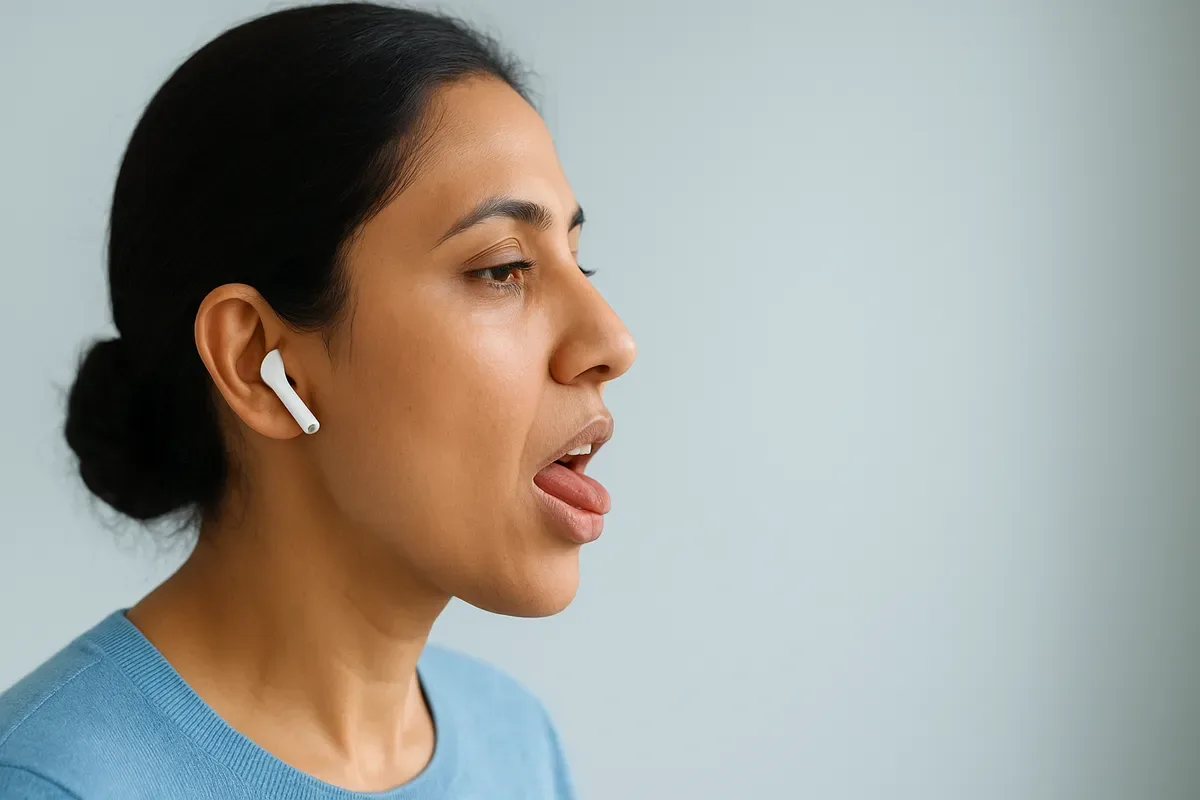
Most unclear speech traces back to a short list of predictable substitutions, not random errors, and each one connects to a specific habit from the speaker’s native language. Identifying which pattern applies to you is the fastest route to learning how to speak English more clearly.
How Native-Language Habits Carry Over Into English Speech
Every language organizes sounds differently, and the brain defaults to those familiar categories when it encounters new ones. English has about 15 vowel sounds, more than many languages distinguish, so speakers tend to merge pairs that sound identical in their first language but carry meaning in English.
Spanish and Portuguese speakers often merge short and long vowel pairs, so “ship” and “sheep” or “live” and “leave” sound the same. The fix starts with jaw and tongue height: the short /ɪ/ in “ship” uses a lower, more relaxed tongue position than the tense, high /i/ in “sheep.” The same speakers frequently blend /v/ and /b/, since Spanish treats them as one sound, so “vote” and “boat” collapse together. Training the /v/ requires the top teeth resting lightly on the bottom lip, with audible friction, not the full lip closure used for /b/.
Hindi, Tamil, and Telugu speakers commonly overlap /v/ and /w/, producing “vine” for “wine” or vice versa, and often substitute retroflex /t/ and /d/ sounds, curling the tongue tip back against the hard palate instead of placing it at the alveolar ridge just behind the upper teeth. Intonation tends to stay flatter and more even across a sentence, which can make statements and questions sound alike to American listeners even when every sound is correct.
Mandarin and Cantonese speakers often drop final consonants, since many Chinese syllables end in vowels or nasals only, so “like” becomes “lie” and “cat” becomes “ca.” The /l/ and /r/ sounds, and sometimes /n/ and /l/, also merge because Mandarin doesn’t contrast them the same way English does.
Treat these as common tendencies tied to how each language organizes sound, not fixed rules every speaker follows. The goal is reducing interference from the first language, never eliminating an accent, since every accent is a legitimate part of spoken English [4]. If a reader suspects an underlying speech or hearing difficulty rather than first-language interference, a licensed speech-language pathologist can assess that separately from accent training.
InPronunci’s Chapter 1, Speech Organs Education, trains readers to recognize their own tongue, lip, and jaw placement before tackling these patterns sound by sound with the Interactive Visual 2D Sound Simulators, following the same approach outlined in our tongue placement guide.
Structured American Accent Training Course
From Speech Organs Education to American Intonation
The InPronunci course is built step by step: every chapter prepares the next one, and by the end of the course students receive a certificate.
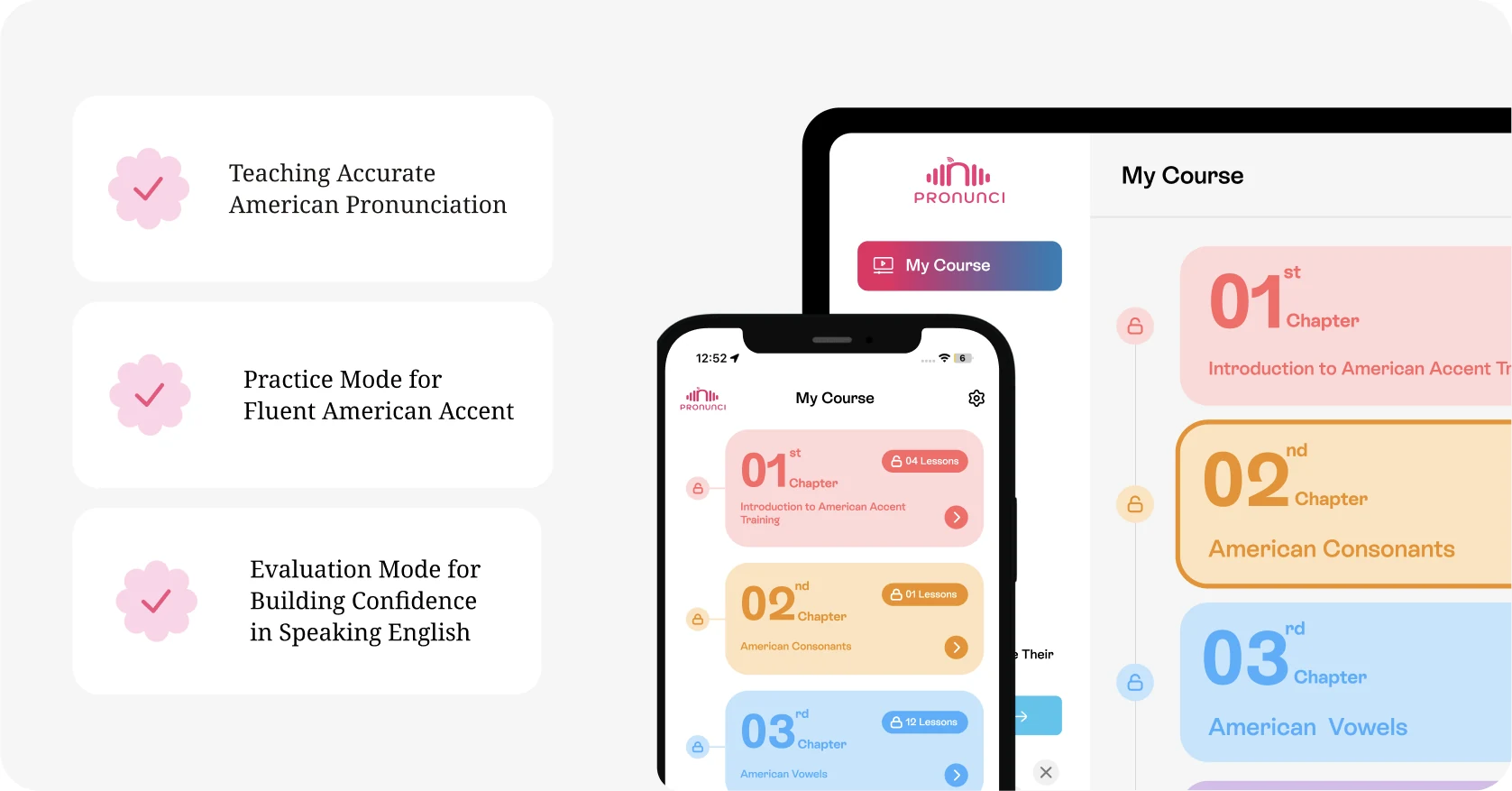
- Speech Organs EducationStudents learn how the speech organs work, along with the AI Accent Coach commands and feedback.
- American ConsonantsPractice and evaluate American consonants in phonetic exercises and practice sentences with the AI Accent Coach.
- American VowelsPractice and evaluate American vowels in phonetic exercises and practice sentences with the AI Accent Coach.
- IntonationLearn how intonation can change the meaning of what you say.
- CertificateBy the end of the course, students receive a certificate.
Build a Daily Practice Routine and Track Your Progress
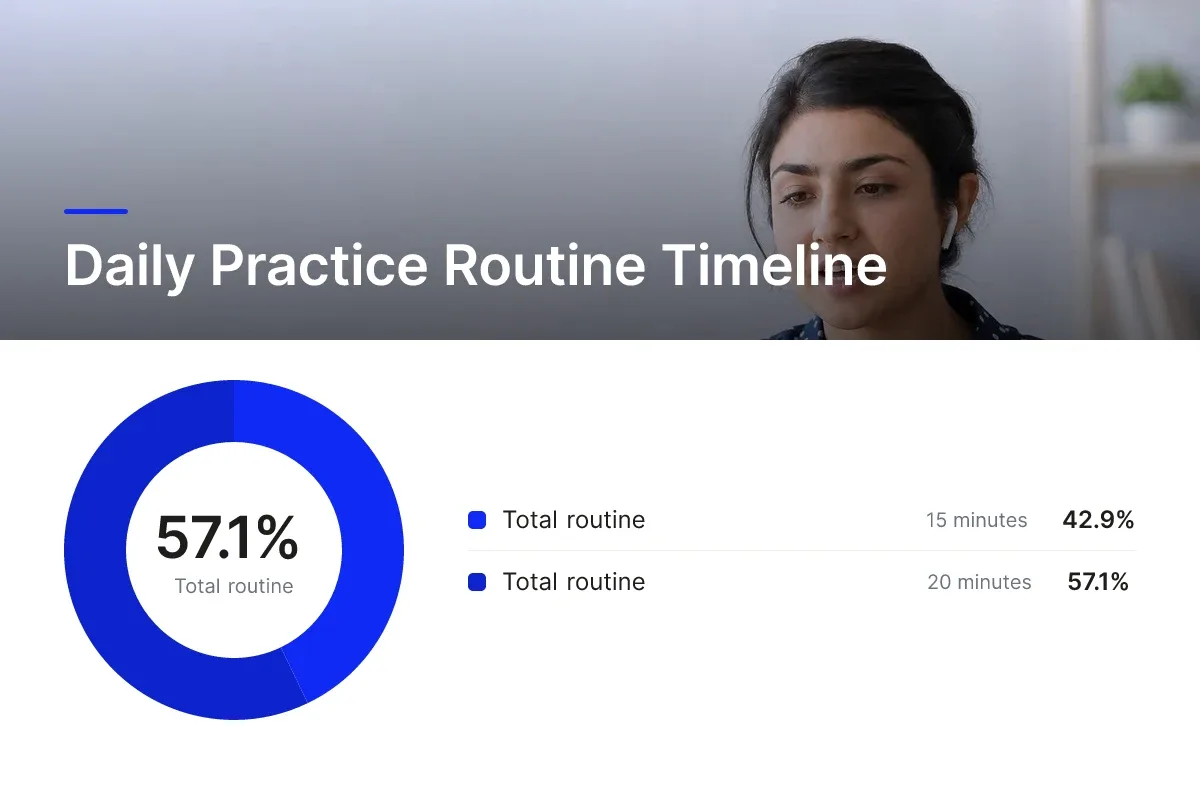
A short, consistent routine that moves from sound to word to sentence to paragraph works better than long, unstructured practice sessions. The order matters more than the length.
Here is a routine you can run in about 15 to 20 minutes:
- Warm up your articulators. Stretch your jaw, round and spread your lips, and move your tongue tip to the teeth ridge a few times. This loosens the muscles you are about to retrain.
- Drill one target sound in isolation. Pick a sound you know is weak, for example the American R or the TH sound, and repeat it alone until the tongue or lip position feels stable.
- Move to words. Say five to ten words containing that sound in different positions: beginning, middle, and end.
- Practice sentences with stress marked. Write out two or three sentences, underline the stressed words, and read them aloud with exaggerated rhythm before smoothing it out.
- Read a short paragraph aloud. Apply the same sound and stress pattern across connected speech, where sounds link and reduce naturally.
How to Structure Practice So Clear Pronunciation Becomes Automatic
Clear pronunciation becomes automatic when practice moves through four stages in order: accuracy, repetition, sentence-level melody, then paragraph delivery.
First comes isolated sound accuracy, where you confirm the tongue, lips, and jaw are in the right position without the pressure of a full sentence. Next comes automaticity, built through repeated drills until the sound no longer requires conscious thought. Only then does sentence-level stress and intonation training make sense, since a sound you cannot yet produce reliably will not hold up once intonation, rhythm, and speed are added. The final stage is paragraph-length delivery, where you apply everything in connected, natural-paced speech, closer to how you actually talk in meetings or interviews. This staged approach reflects explicit pronunciation instruction research, which has found that structured, targeted practice produces measurable gains in both accuracy and comprehensibility [3].
How to Self-Assess Your Clarity Progress
Self-assessment works best when you record your own speech and compare it against a native-speaker model, listening for specific gaps rather than a vague sense that something sounds off.
Instead of asking “did that sound wrong,” ask “was my stress on the second syllable instead of the first,” or “did I drop the final T in ‘about’.” This is a core part of learning how to speak English more clearly: naming the exact sound or pattern that differs from the model, not just noticing discomfort. InPronunci’s AI Accent Coach is built for this kind of full-speech evaluation. Rather than scoring a single word or isolated sound, it evaluates pronunciation, intonation, melody, rhythm, connected speech, and sentence flow as you speak complete sentences, which mirrors how listeners actually judge clarity in real conversation.
The Your Coach vs. My Pronunci Pronunciation Comparison Tool supports the same habit directly: you record your sentence, hear it next to the native-speaker model, and consciously identify where the two diverge. Over repeated sessions, this comparison habit trains your ear as much as your speech organs, which is part of what InPronunci’s structured course builds through its AI Accent Coach and Feedback & Analysis tools.
Cognitive Accent Training
Compare Your Coach vs. Your Pronunci
In every practice sentence, students listen to Your Coach, record their own voice, and compare it with Your Pronunci, so they consciously notice and correct each sound.
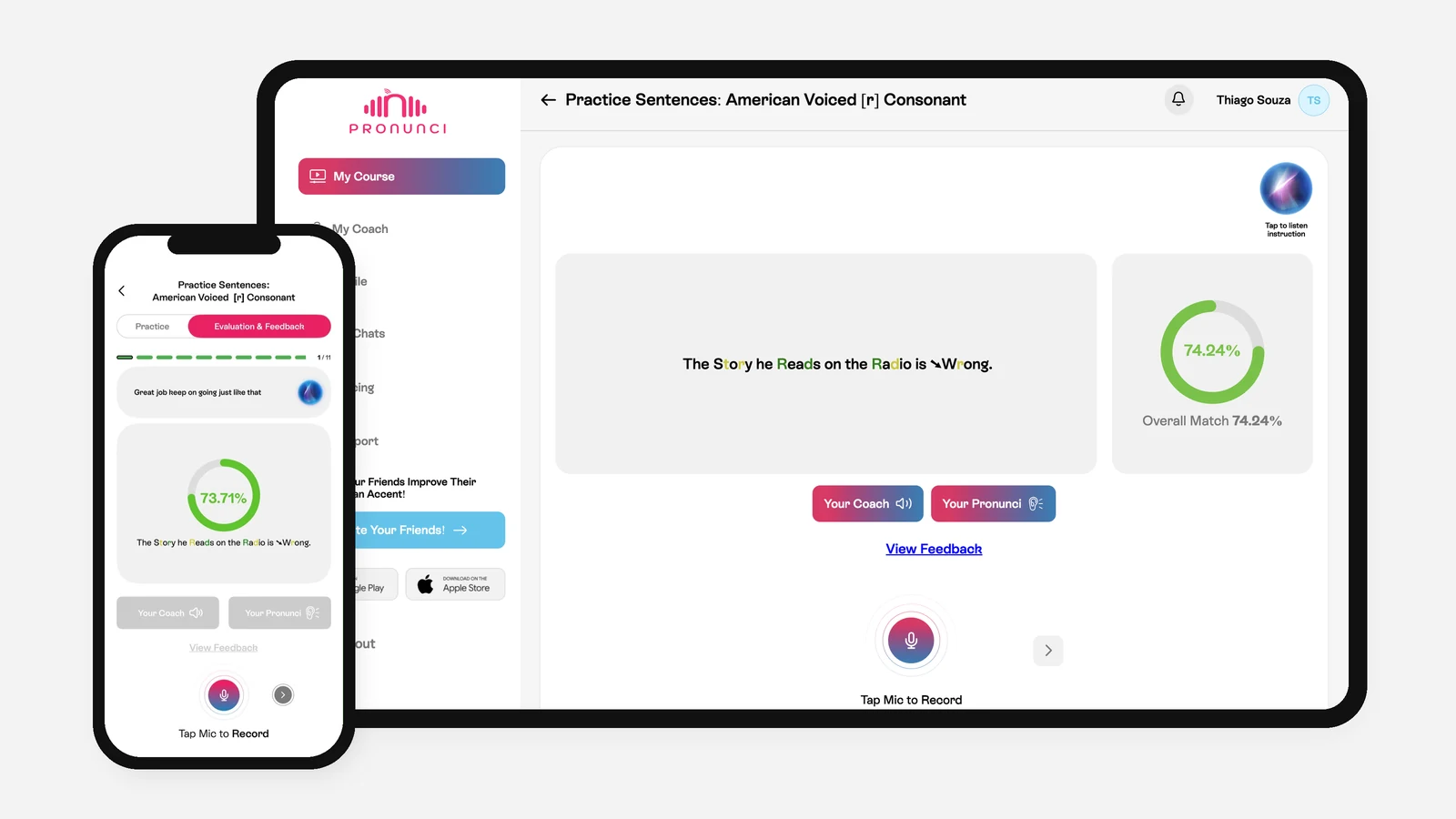
- Listen to Your CoachThe model American pronunciation of each practice sentence.
- Compare with Your PronunciYour own recorded pronunciation, side by side with the coach.
- Correct with feedbackThe match score and color-coded letters guide each correction.
Choose Between Self-Study, Tutoring, and Structured Accent Training
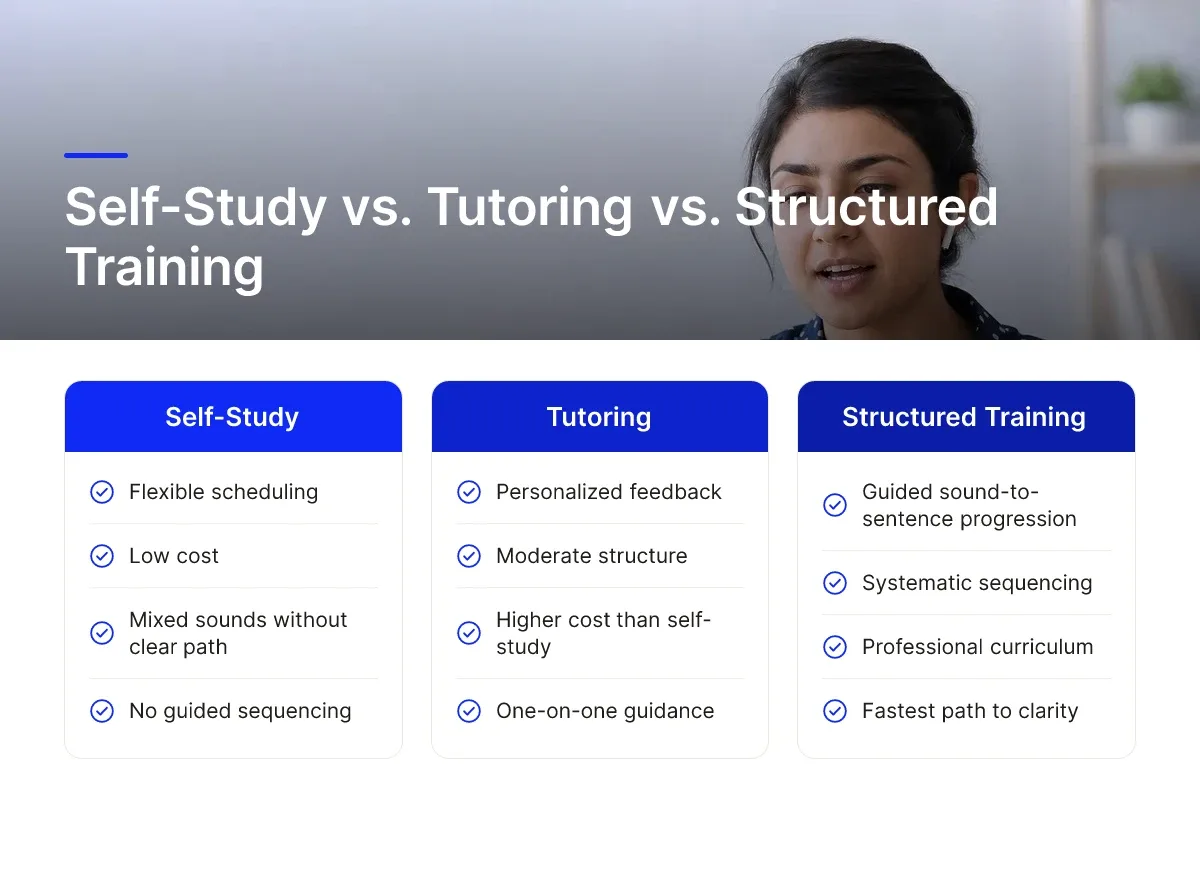
The fastest path to speak English more clearly depends on how much structure, feedback, and guided sequencing you need, not just how much time you can spend practicing.
Self-study covers general apps, YouTube pronunciation videos, and shadowing (repeating audio as you listen). It is flexible and costs little, which makes it a reasonable starting point. The gap shows up in sequencing: most self-study methods mix sounds, vocabulary, and listening practice without connecting them into a path from individual sounds to full sentences to paragraph-length speech. You can drill the American R one day and jump to idioms the next, with no system checking whether the sound transferred into your actual conversation.
One-on-one tutoring fixes the feedback problem. A trained coach hears what’s actually happening in your speech and corrects it in real time, something no app can fully replace. The constraint is frequency. Most tutoring happens in scheduled sessions, often weekly or monthly, which leaves long gaps where you practice alone without correction.
Structured accent training apps close part of that gap. ELSA Speak offers AI-powered speaking practice with instant personalized feedback and role-plays. BoldVoice combines guided video practice, coach videos, and AI speech evaluation. Both pair technology with guided lessons, which gives learners more structure than free-form self-study.
How AI Speech Evaluation Compares to Human Accent Coaching
Most AI tools evaluate pronunciation one word or sound at a time, which helps with isolated accuracy but says little about how your speech sounds in context. InPronunci: American Accent Training App works differently on two points. Pronunci Instructions give step-by-step guidance from Prof. Alex, Ph.D. Accent Coach, Doctor of Education, and professional linguist, in every lesson, so you always know what to adjust and why. The AI Accent Coach then evaluates full speech, pronunciation, intonation, melody, rhythm, and connected speech, rather than scoring single words.
That evaluation sits inside a four-stage structure: train each American sound with the Interactive Visual 2D Sound Simulators, make it automatic through phonetic exercises, apply it in sentences with stress and intonation, then use it in paragraph-length, presentation-style speech. See the full course structure and the fair comparison at InPronunci vs. ELSA Speak.
Questions & Answers
Frequently Asked Questions
01How long does it take to notice clearer pronunciation?
There’s no fixed timeline, since it depends on which sounds need work and how consistently someone practices. Research on explicit pronunciation instruction shows learners improve accuracy when training targets specific sounds and patterns rather than general conversation [3]. Progress tends to show up first in isolated sounds, then in sentences, then in spontaneous speech, since each stage demands more automatic control.
02Can adults change ingrained pronunciation habits?
Yes, adults can retrain pronunciation habits, though it takes deliberate, structured practice rather than passive exposure. Studies on second-language pronunciation instruction report measurable gains in comprehensibility and accentedness after explicit, focused training [3]. The speech organs (tongue, lips, jaw) are muscles that respond to repetition, which is why isolating a sound, practicing its movement, then applying it in sentences works better than general conversation practice alone.
03Is it necessary to lose my accent to be understood clearly?
No, losing an accent isn’t necessary for clear communication. Accents are a normal part of speech, not an error to eliminate. The real goal is intelligibility: training the sounds, stress, and rhythm patterns that most affect whether listeners understand you easily, while keeping your voice and identity intact.
04What’s the fastest way to practice English pronunciation at home?
Work on one sound at a time, in a short daily session, rather than switching topics constantly. Start with the mouth position for a specific sound, repeat it in isolation, then move to words and short sentences that use it in context. Recording yourself and comparing it with a native-speaker model helps you notice gaps you can’t hear in real time. InPronunci’s Your Coach vs. My Pronunci Pronunciation Comparison Tool is built around exactly this kind of side-by-side listening practice.
Conclusion
Clearer English pronunciation comes from training specific sounds, then making them automatic in sentences and paragraphs, not from vague “speak more” advice. Start with the mouth position for the sounds that cause the most confusion for your first language, build phonetic habits through repetition, then carry those patterns into real sentence stress and intonation. If you want a structured place to start, train the speech organs for your first sounds with Free Chapter 1 on the App Store, Google Play, or the web.
Sources & References
- General American Accent: What It Is and How It Sounds
- articulation, Expert Accent Reduction & Public Speaking Tips for Clear Speech, Get Rid of Your Accent | Books, Apps & Courses | BATCS Global
- Accent Modification
Recommended Articles

Guide to Choosing the Best Pronunciation App Free Option
Explore the best pronunciation app free options for American accent training, what free tiers include, and when a paid plan is worth it. Discover essential.

What to Expect From American Accent Training Online
American accent training online works by combining structured, sound-by-sound instruction with guided practice and feedback, typically moving through four...

What Is Accent Reduction and How Does It Really Work?
Accent reduction works by retraining how your speech organs produce American English sounds, stress, and intonation through structured, repeated practice...
Plans
What InPronunci costs
InPronunci Basic
$35 per month
Chapter 1 is free after signup.
InPronunci Premium
$200 per month
Includes a coach: