



Understanding why do I have an accent is essential. You keep your native accent in English because your speech organs learned to produce sounds, rhythm, and intonation for your first language first, and those patterns became automatic long before you started learning English. Your tongue, lips, and jaw developed habitual positions for your native sound system, and your brain learned to hear English sounds through that same filter, which is why certain American vowels, consonants, or stress patterns feel physically unfamiliar. This is a motor and perceptual habit, not a fixed trait, so structured retraining of the speech organs and ear can change it. Reputable second language acquisition research (Saito, 2012; Thomson & Derwing, 2015) confirms that targeted pronunciation instruction produces measurable improvement in how learners produce and are understood in a second language.
Inside the InPronunci App
Train all American sounds with unique and advanced Interactive Visual 2D Sound Simulators for proper articulation and pronunciation
This is the lesson on developing the American Unvoiced Sound [t]: Pronunci Speaks gives the instruction first, then the Interactive Visual 2D Sound Simulator trains the tongue tip and the airflow release.
- EffectiveMost apps offer visual learning. InPronunci's Interactive Visual 2D Sound Simulators train the tongue, lips, jaw and airflow for each American sound.
- ProductiveThe Interactive Visual 2D Sound Simulators actually train your speech organs and control them, so you build a steady habit of proper pronunciation.
- ResultsStudents pronounce individual American sounds with almost native-like pronunciation.
Why Do I Have an Accent When I Speak English?
An accent happens because your first language built sound categories, rhythm, and melody patterns in your brain first, and English speech gets filtered through that system. It is not a measure of how well you know English grammar or vocabulary. Many advanced speakers with large vocabularies and near-perfect writing still ask why do I have an accent, and the answer sits in the speech organs and the auditory system, not in language knowledge.
What Happens in Your Brain and Mouth That Makes Accents Persist?
Your brain organizes the sounds of your native language into a set of categories early in life, and it uses that same set to interpret every new sound it hears afterward. When you hear an English vowel or consonant that does not exist in your first language, your brain does not create a new category for it automatically. Instead, it maps the unfamiliar sound onto the closest native category you already have.
A Spanish speaker, for example, often maps the short vowel in “ship” and the long vowel in “sheep” onto one native vowel, because Spanish does not distinguish vowel length the same way. A Korean or Japanese speaker may map English /r/ and /l/ onto a single native category, since neither language separates them the way English does. This is not a hearing problem. It is a learned filter, and it explains why certain American sounds feel physically unfamiliar even after years of English use.
Does Your Age or How Long You’ve Spoken English Affect Whether You Can Change Your Accent?
Years of repetition make native speech patterns more automatic, but they do not make those patterns permanent. The tongue, lips, and jaw rehearse native-language movements thousands of times before a learner ever studies English, so those motor habits become the default setting the speech organs return to under pressure, in fast speech, or in stressful situations like interviews or client calls.
Research on pronunciation instruction supports the view that this default can shift with the right training, regardless of a learner’s starting level. A research synthesis by Lee, Jang, and Plonsky (2015) found that pronunciation instruction produces measurable gains across learner levels, including intermediate and advanced speakers [1]. Age and years of exposure affect how entrenched the habits are, not whether change is possible.
This process is universal. Every learner pairing, whether Mandarin-to-English, Arabic-to-English, or French-to-English, goes through the same mapping of a new sound system onto an old one. It is a predictable outcome of how the brain and speech organs learn language, not a flaw tied to one native language or one learner. Understanding this mechanism is the starting point for change: InPronunci’s training addresses accent at the source, retraining the speech organs and the ear together instead of asking learners to repeat words and hope the pattern corrects itself.
How Do Your Speech Organs Lock In Accent Patterns From Your First Language?
Your tongue, lips, and jaw learned a fixed set of positions for your first language, and those positions become the default setting your mouth returns to in English. This is the physical answer to why do I have an accent: your speech organs are doing exactly what they were trained to do, just not for the sounds you’re now trying to produce.
What Specific Mouth and Tongue Positions Does Your Native Language Teach You?
Every language trains a specific map of tongue, lip, and jaw movements, and the brain treats that map as complete once it’s learned [3]. English has sounds that fall outside many of these maps entirely. The dental “th” in “think” or “this” requires the tongue tip to touch the back of the upper front teeth, a position many languages never use. Spanish, Russian, French, and German speakers commonly substitute /t/, /d/, /s/, or /z/ instead, turning “think” into “tink” or “sink,” and “this” into “dis” or “zis.” The substitution isn’t carelessness. It’s the nearest sound the native-language tongue map already has on file.
Why Do Spanish Speakers, Mandarin Speakers, and Other Language Groups Struggle With Different English Sounds?
Each native language trains a different, predictable set of mouth habits, which is why accent patterns look so consistent within a language group. Spanish has a smaller vowel inventory than English, so Spanish speakers often merge short and long vowel pairs like “ship” and “sheep,” hearing and producing both with a similar tongue height. Hindi and several other Indian languages use retroflex tongue positions, curling the tongue tip further back than English requires, which affects /t/ and /d/ and makes the American flap T in words like “water” and “better” (the quick tap that replaces /t/ between vowels) harder to locate. Mandarin and Cantonese speakers often drop final consonants, since their native syllable structures rarely end in consonant clusters, and may merge /l/ and /r/, sounds that don’t contrast the same way in those languages.
Rhythm compounds all of this. Spanish and French are syllable-timed, giving each syllable roughly equal length. American English is stress-timed, stretching stressed syllables and compressing unstressed ones into quick, reduced sounds like schwa. A Spanish speaker who gives every syllable equal weight in “comfortable” will sound clipped and overly precise rather than natural. For the mechanics behind tongue height, vowel length, and jaw position, see our guides on tongue placement in English sounds and vowel sounds and mouth position.
Can You Actually Reduce Your Accent, and How Does Structured Training Work?
Yes. You can reduce an accent through repeated, structured practice that retrains your speech organs and your ear together, though the goal is clarity, not erasing where you come from.
Once you understand why do I have an accent in the first place, the fix follows a logical path: the muscles that move your tongue, lips, and jaw learned one set of habits for your first language, and they need new, deliberate instructions to produce American sounds consistently. This isn’t about willpower or “trying harder” when you speak. It’s about training specific movements until they become automatic, the same way an athlete rebuilds a swing or a stroke one rep at a time.
What’s the Best Way to Retrain Your Speech Organs for American English Sounds?
The best approach trains sounds in a fixed order: isolated articulation first, then automaticity, then sentence rhythm, then full paragraphs. This mirrors how InPronunci structures its four connected training stages.
- Stage 1: Isolated sound articulation. Before a sound can appear correctly in conversation, your tongue, lips, and jaw need to learn its exact position. A Spanish speaker producing the English “sheep” instead of “ship” often hasn’t yet built a distinct short /ɪ/ position, so the vowel defaults to the long /i/ that exists in Spanish.
- Stage 2: Phonetic exercises. Once the organs know the position, the sound needs repetition across sound combinations, reductions, and assimilations until it stops requiring conscious effort.
- Stage 3: Sentence-level stress and intonation. A correct sound in a single word still needs to survive inside connected speech, where stress, rhythm, and melody change how sounds behave.
- Stage 4: Paragraph-level delivery. Longer speech, like a presentation or interview answer, tests whether the new pattern holds up under cognitive load, when you’re thinking about content, not pronunciation.
This is also why isolated “tips,” like a single video explaining the American R, rarely produce lasting change. A sound corrected in one word needs practice across many contexts before it becomes habitual. Research on second language pronunciation instruction supports this: explicit, sustained instruction produces measurably better outcomes than incidental exposure alone [1]. Listening to English for years without structured practice trains comprehension, not production.
How Long Does It Take to See Real Progress in Reducing Your Accent?
Progress depends on how consistently you practice and how different your native sound system is from American English, not on a fixed calendar.
A Japanese speaker working on the /r/-/l/ distinction is retraining a contrast that doesn’t exist as two separate categories in their first language, which takes different work than a German speaker adjusting vowel length. Consistency matters more than intensity: short, focused sessions that isolate one sound, then build it into exercises and sentences, tend to compound. Sporadic practice without a stage-based structure tends to plateau, because the speech organs never fully consolidate the new position before moving to the next challenge.
InPronunci trains the physical movement directly with the Interactive Visual 2D Sound Simulators, which train the tongue, lips, jaw, teeth, airflow, and voice for each American vowel and consonant, paired with 2D Sound Motion Technology and Pronunci Instructions, Prof. Alex’s step-by-step guidance in every lesson. Instead of guessing what to adjust, students follow a specific, sequenced correction at the articulation stage before moving into phonetic exercises and sentence practice.
What’s the Difference Between Accent Coaching and Other Pronunciation Apps?
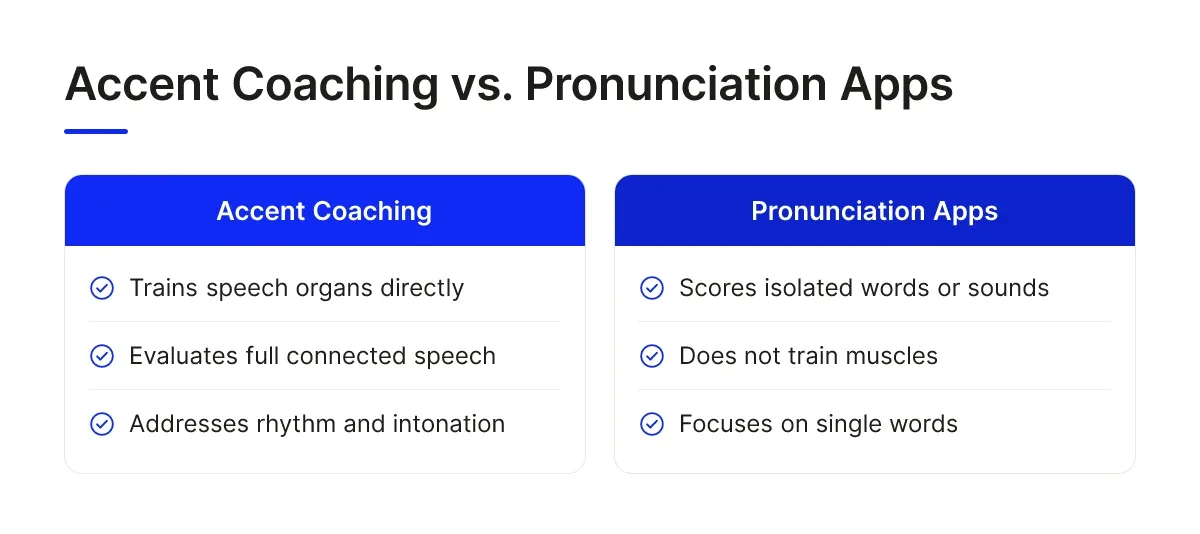
Accent coaching trains the speech organs and evaluates full connected speech, while many pronunciation apps score isolated words or sounds without touching the muscles that produce them. That distinction matters once you start asking why do I have an accent in meetings or calls despite years of English practice: the answer usually involves rhythm, intonation, and sound patterns working together, not a single mispronounced word.
How Does Training Your Speech Organs Directly Compare to Scoring Apps or General English Practice?
A tool that scores a single word tells you whether that word matched a reference recording. It does not tell you what your tongue, lips, or jaw need to do differently, and it rarely captures how that sound behaves once it’s surrounded by other words in a real sentence.
InPronunci: American Accent Training App takes a different approach with 2D Sound Motion Technology. The Interactive Visual 2D Sound Simulators train the tongue, lips, jaw, teeth, airflow, and voice to produce each American vowel and consonant, so the correction happens at the level of movement, not just sound matching. This structural difference separates accent coaching from apps that rely only on audio feedback without training the physical movements behind each sound.
What Makes Real Accent Coaching Different From Tips or Feedback-Only Apps?
Real accent coaching evaluates pronunciation, intonation, melody, rhythm, and sentence flow together, as one connected performance, rather than isolated words or sounds in sequence. This is where InPronunci’s two main differences come in. The AI Accent Coach evaluates a student’s full speech as they talk, scoring sound accuracy alongside stress, rhythm, and connected speech rather than grading a single word in isolation. Alongside it, Pronunci Instructions give step-by-step guidance in every lesson from Prof. Alex, Ph.D. Accent Coach, Doctor of Education, and professional linguist, so students always know what to adjust and why, much like working with a coach in person.
General pronunciation practice apps serve real purposes and deserve a fair description. Some offer AI-powered feedback with role-plays and broad conversation practice, and some pair guided video lessons with coach videos and AI speech evaluation. These are legitimate approaches to broader English communication, not the “natural speech” alternative to a “mechanical” accent app. The practical difference is scope and structure: whether the training targets full connected speech and speech-organ movement, or works mainly from audio feedback on shorter segments.
For a full side-by-side look at one of these approaches, see the InPronunci vs. ELSA Speak comparison, which compares training approach, structure, and evaluation depth using verified facts about each product.
How Do You Start Retraining Your American English Pronunciation?
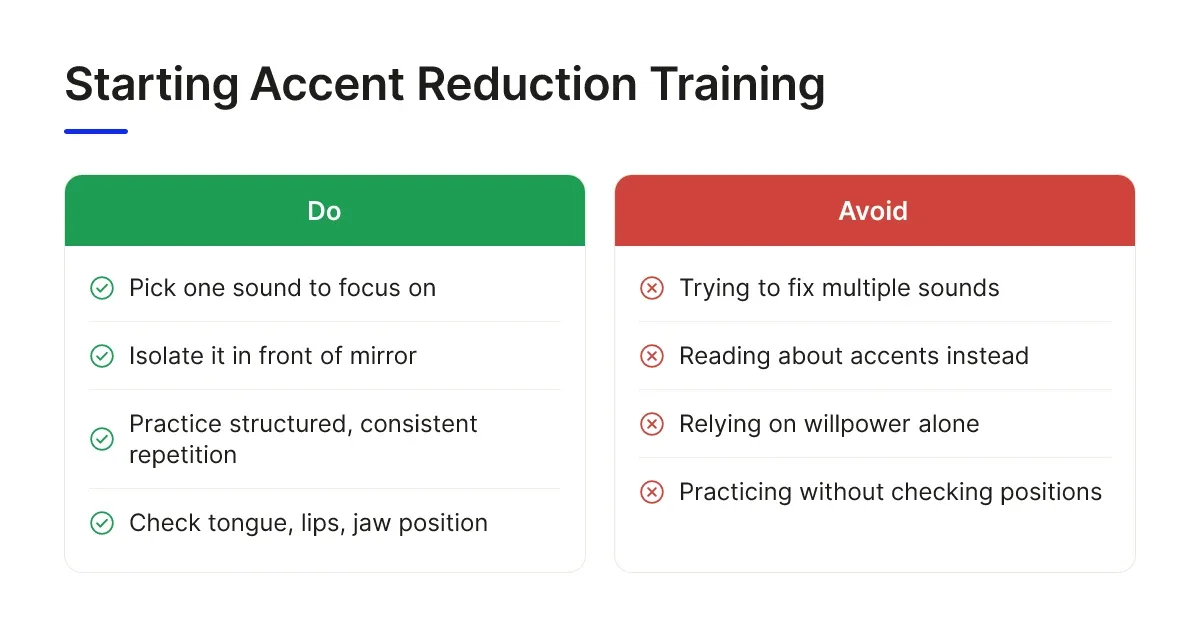
Start with one sound, isolate it, and practice it out loud today, structured, consistent repetition is what changes a speech pattern, not reading about why do I have an accent in the first place.
What’s the First Step if You Want to Reduce Your Accent and Speak Clearer American English?
Pick one sound that regularly causes confusion. For many speakers that’s the American R, the TH sound in “think” or “this,” or the short vs. long vowel pair in “ship” and “sheep.” Isolate it in front of a mirror so you can check your tongue, lips, and jaw position before you try it in words.
Next, practice it in five minimal pairs: for TH, try “think/sink,” “thin/fin,” “though/dough,” “bath/bass,” and “mouth/mouse.” Say each pair slowly, watching your tongue tip touch the bottom edge of your upper front teeth for the TH sound rather than pulling back to an /s/ or /f/. Then move to three full sentences: “I think this is the third thing,” “Three thin threads,” “That’s the truth.” Say each one twice, once slowly and deliberately, once at normal speaking speed.
This routine takes a few minutes and you can repeat it daily with a different sound each week. The goal isn’t to erase where you’re from, it’s to add clear, flexible control over the sounds that cause the most repeated misunderstandings.
Should You Work With a Coach, Use an App, or Do Both?
Both paths work, but they solve different problems. A self-guided structured app works well for motivated learners who can follow a clear sequence and practice independently. A 1-on-1 coach adds something an app alone can’t: personalized correction for the specific patterns your first language carries into English, including articulation habits, sentence rhythm, and connected speech.
If you have an underlying speech or hearing difficulty, pronunciation training should run alongside, not instead of, guidance from a licensed speech-language pathologist. InPronunci is structured practice, not therapy or diagnosis.
InPronunci combines both. New students start free with Chapter 1, Speech Organs Education, which covers how the tongue, lips, teeth ridge, and airflow work together before any sound drills begin. From there, the course path moves into phonetic exercises and sentence practice with intonation, guided by Pronunci Instructions from Prof. Alex, Ph.D. Accent Coach, Doctor of Education, and professional linguist, in every lesson. Self-motivated learners typically do well on the Basic Plan; professionals who want personalized coaching and feedback on their own speech can book a consultation for the Premium Plan, which includes a monthly live session with Prof. Alex.
Start with Free Chapter 1 on the App Store, Google Play, or the web.
Questions & Answers
Frequently Asked Questions
01Is it possible to completely get rid of an accent?
No, and that is not the right goal. Accent reduction is realistic; accent elimination is not, because speech patterns built over years of speaking a native language stay partly embedded in how your speech organs move. Structured training can reduce an accent substantially and make your speech clearer and more natural, which is why InPronunci frames its work as reducing, not erasing, an accent.
02Does having an accent affect how clearly people understand you?
An accent itself does not block understanding, but specific sound substitutions and rhythm differences can. If a listener hears one sound where they expect another, or stress falls on the wrong syllable, comprehension drops even when grammar and vocabulary are correct. This is why sound-level and intonation training, not just vocabulary study, directly improves how clearly you come across in meetings, calls, and interviews.
03Can adults retrain their pronunciation, or is this only easier for children?
Adults can retrain their pronunciation through deliberate, explicit practice, even though early childhood learning works differently. Research on pronunciation instruction, including Saito 2012 [1] and Lee, Jang & Plonsky 2015’s review of pronunciation teaching outcomes [1], supports measurable gains in adult learners from focused articulation work. Progress depends on structured practice of the speech organs, not age alone.
04Do some native languages make certain English sounds harder than others?
Yes, specific first languages create predictable challenges with specific English sounds, though these are tendencies, not fixed rules. Spanish speakers often merge short and long vowels, Mandarin speakers may drop final consonants, and Hindi speakers often substitute a retroflex consonant for the American R or T. Identifying your own pattern is the first step to correcting it.
Conclusion
An accent comes from real, identifiable causes: speech organs trained for one language’s sounds, native-language rhythm carried into English, and limited exposure to explicit correction. None of these are fixed. Start by identifying which sounds and stress patterns your native language affects most, then retrain those speech organs directly rather than relying on general listening practice.
InPronunci’s four-stage course, built by Prof. Alex, Ph.D. Accent Coach, Doctor of Education, and professional linguist, works through this process: sound articulation, phonetic exercises, sentence intonation, and paragraph delivery, with AI Accent Coach feedback on full speech. Begin with Free Chapter 1 on the App Store, Google Play, or the web to identify your own sound patterns before building a full practice routine.
Sources & References
- Position Statement on Students Who Are Non-Native Speakers of Standard American English | Department of Speech, Language and Hearing Sciences
- Accent (sociolinguistics) – Wikipedia
Recommended Articles
What Cognitive Accent Training Is and How It Rewires Speech
Cognitive accent training retrains your speech organs and listening habits together: you train the tongue, lips, jaw, and airflow to produce accurate...
Why Connected Speech in American English Matters for Fluency
How to practice connected speech in American English: linking, flap T, reductions and dropped sounds, one pattern at a time.
Why Pronunciation Coaching for Adults Actually Works
Pronunciation coaching for adults works by retraining speech muscles, not just correcting words. Learn the method behind lasting accent improvement.
Plans
What InPronunci costs
InPronunci Basic
$35 per month
Chapter 1 is free after signup.
InPronunci Premium
$200 per month
Includes a coach: