


Cognitive accent training retrains your speech organs and listening habits together: you train the tongue, lips, jaw, and airflow to produce accurate American sounds, then drill those sounds until they become automatic, then apply them in sentences with natural stress and rhythm, and finally use them in paragraphs and real speech. This is the four-stage sequence InPronunci’s course follows, moving from sound articulation to phonetic exercises to sentence-level intonation to presentation-style delivery, so correct pronunciation becomes a habit rather than something you consciously monitor every time you speak.
How Does Cognitive Accent Training Retrain Your Speech Organs to Produce American English Sounds?
Cognitive accent training works by isolating one sound at a time, training the tongue, lips, jaw, and airflow to produce it correctly before any word, sentence, or rhythm pattern gets added.
Cognitive Accent Training
Compare Your Coach vs. Your Pronunci
In every practice sentence, students listen to Your Coach, record their own voice, and compare it with Your Pronunci, so they consciously notice and correct each sound.
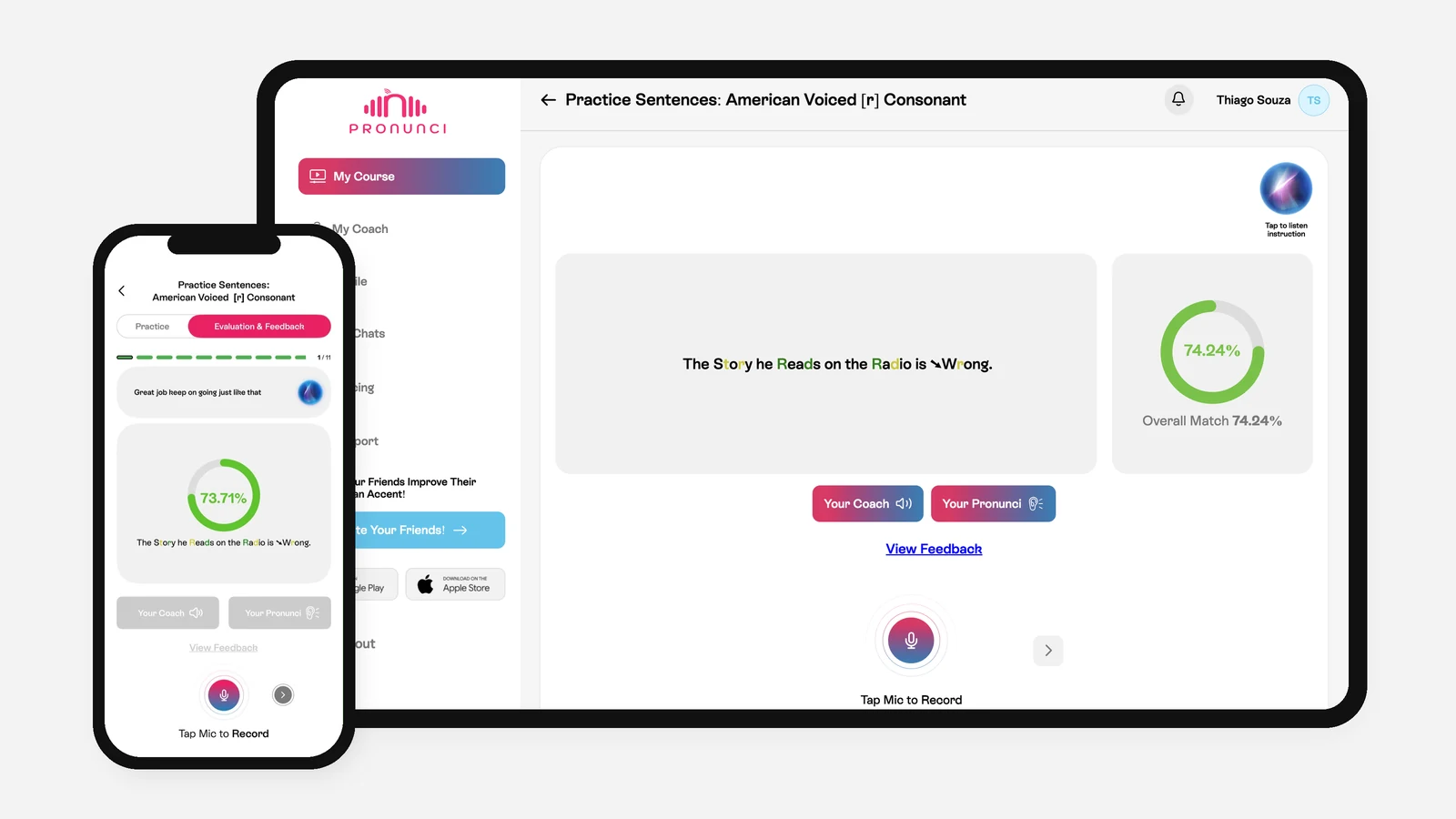
- Listen to Your CoachThe model American pronunciation of each practice sentence.
- Compare with Your PronunciYour own recorded pronunciation, side by side with the coach.
- Correct with feedbackThe match score and color-coded letters guide each correction.
Word lists skip this step. A learner repeats “red,” “river,” and “rabbit” without ever correcting the tongue position behind the sound, so the same substitution gets practiced a hundred times. Isolated sound work fixes the articulation first, so every word built on that sound afterward is correct by default rather than by accident. This is why InPronunci’s course starts with sound articulation training before phonetic exercises, sentence practice, or paragraph delivery even begin, rhythm and intonation layered on top of an unstable sound just make the error harder to hear and harder to unlearn later.
What role does tongue placement and jaw position play in American sound articulation?
Tongue placement determines whether a sound is recognizable as American English or reads as a transfer from the speaker’s first language. The American R is a clear case: the tongue curls back and up, approaching the roof of the mouth without touching it, while the sides of the tongue press against the upper back teeth. Spanish and Italian use a tapped or trilled R, where the tongue tip strikes the ridge behind the teeth. French uses a uvular R, produced in the back of the throat. None of these transfer directly, so a speaker who has never isolated the American R tends to default to the version their first language trained decades earlier.
The same logic applies to TH, as in “think” or “this.” The tongue tip sits lightly between the upper and lower teeth with steady, continuous airflow. Many learners substitute T, D, S, or Z because those sounds exist in their native inventory and TH does not. The Interactive Visual 2D Sound Simulators train this tongue-between-teeth position along with jaw opening and airflow control, so the student feels the difference between a stopped sound (T, D) and a continuous one (TH) rather than just hearing it.
How do phonetic exercises make American sounds automatic and habitual?
Repetition under guidance turns a corrected sound into an automatic one, which is what phonetic exercises are built to do. Each InPronunci lesson pairs the simulator with Pronunci Instructions, step-by-step cues from Prof. Alex that tell the student exactly where to place the tongue, how open the jaw should be, and what to listen for. Saito 2012 found that explicit pronunciation instruction produces measurable gains in second-language sound development compared to exposure alone [5], which is the reasoning behind training sounds explicitly before moving to sentence-level intonation, covered in InPronunci’s connected speech guide.
What’s the Difference Between Cognitive Accent Training and Traditional Accent Training Methods?
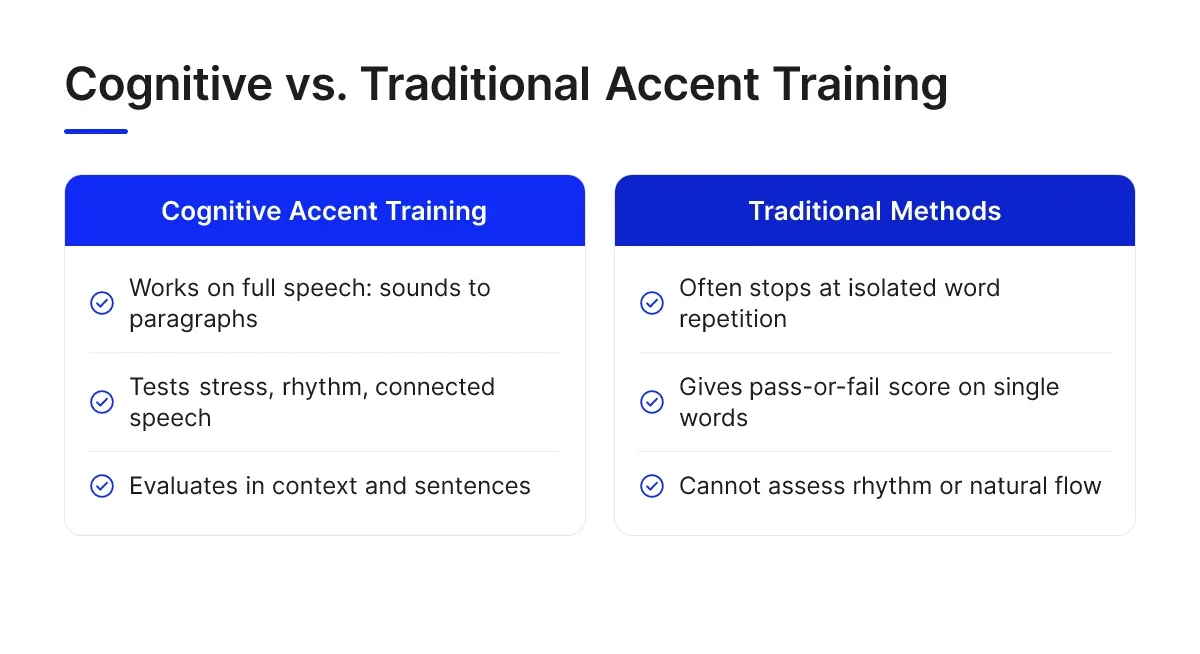
Cognitive accent training works on full speech, from single sounds to paragraphs, while traditional methods often stop at isolated word repetition and a pass-or-fail score.
Repeating a word in front of an app can confirm whether you produced one sound correctly. It cannot tell you whether your stress falls on the right syllable in a sentence, whether you link words the way American speakers do, or whether your rhythm sounds mechanical or natural. Stress, rhythm, and connected speech only show up when a person speaks in context, not when they say “coffee” or “schedule” in isolation. A learner can master every vowel in a word list and still sound choppy in a meeting because sentence-level patterns were never trained.
How does InPronunci’s structured four-stage approach compare to scoring-based pronunciation apps?
Scoring-based apps typically grade a single word or short phrase against a reference pronunciation and return a percentage. InPronunci moves students through four connected stages instead: sound articulation, phonetic exercises, sentence practice with intonation, and paragraph practice with presentation-style delivery. Each stage builds on the one before it, so a sound trained in isolation gets practiced again inside words, then sentences, then extended speech. This sequence reflects how speech actually develops: accurate articulation first, then automatic habits, then natural delivery under the pressure of a full sentence or a real conversation.
Why does real-time evaluation of intonation, rhythm, and connected speech matter more than single-word feedback?
A score on one word says nothing about how that word behaves next to the words around it. The AI Accent Coach inside InPronunci evaluates pronunciation, intonation, melody, rhythm, connected speech, and sentence flow as a student speaks, not just the accuracy of one sound. Pronunci Instructions from Prof. Alex, Ph.D. Accent Coach, Doctor of Education, and professional linguist, accompany every lesson, so students know exactly what to listen for and adjust before they even reach the evaluation step. The Your Coach vs. My Pronunci Pronunciation Comparison Tool adds another layer: students record themselves, compare it against a native-speaker model, and consciously notice where their speech diverges in rhythm or melody rather than guessing from a single score.
Other tools in this category take different approaches worth naming fairly. ELSA Speak offers instant personalized feedback and role-plays for broader English speaking practice. BoldVoice centers guided video practice and coach videos alongside AI speech evaluation. Both are built around real training goals. InPronunci’s distinction is evaluating full speech as it happens, paired with lesson-by-lesson human guidance from a credentialed coach, inside a structured course that moves all the way from sound to paragraph.
Can You Train Yourself to Speak With an American Accent, and How Long Does It Take?
Yes. An accent is a set of learned motor habits for your speech organs, not a fixed trait, and adult learners can change those habits with deliberate, structured practice.
Are accents learned or innate, and what does that mean for your ability to improve?
Your first accent formed because your tongue, lips, and jaw practiced one language’s sound patterns thousands of times before you ever studied another language. Those movements became automatic, the way a tennis swing becomes automatic after enough repetition. Adult learners sometimes assume this automaticity is permanent, as if accents were hardwired at birth. They are not. A review by Thomson and Derwing found that pronunciation instruction produces measurable gains in adult L2 learners, countering the idea that accent is fixed past early childhood [2]. A separate research synthesis by Lee, Jang, and Plonsky examined the overall effect of pronunciation instruction across multiple studies and found a positive effect on learners’ pronunciation outcomes [4]. The practical point: the same brain mechanisms that built your native-language habits can build new ones, with the right kind of practice.
This is the logic behind cognitive accent training: you are not fighting your brain, you are retraining speech organs that already know how to learn new movement patterns. The tongue placement for a sound like the American R or the flap T is a skill, not a fixed trait, and skills respond to practice. Our guide on tongue placement in English sounds walks through how small positioning changes affect clarity. For more information, see Medical Training.
What measurable progress can you expect from structured accent training?
Progress depends on consistency across all four stages, not on any single exercise or trick. Sound articulation training alone will not fix stress patterns, and intonation work will not fix a mispronounced vowel. Each stage, sound articulation, phonetic exercises, sentence practice with intonation, and paragraph-level delivery, builds on the one before it. Skipping stages, or practicing only sounds in isolation, tends to produce shaky progress that does not transfer to real conversation.
The goal is also worth stating clearly: reduce an accent for clarity and confidence, not eliminate it. Every accent is part of someone’s identity, and the aim of structured practice is to be understood easily and speak with less effort, not to sound like someone else. InPronunci applies this through its four connected training stages, the same ones Prof. Alex, Ph.D. Accent Coach, Doctor of Education, and professional linguist, uses in 1-on-1 coaching, with Pronunci Instructions guiding each lesson and the AI Accent Coach evaluating full speech as students practice.
How Does Cognitive Accent Training Prepare You for Professional Communication and Public Speaking?
It moves practice beyond isolated sounds into sustained, spontaneous speech, so clear pronunciation holds up in real meetings, interviews, and client calls.
The first two stages of training build accurate sounds and make them automatic. The second two stages, sentence practice with intonation and paragraph practice with presentation-style delivery, are where that accuracy gets tested under realistic conditions: longer turns, less predictable wording, and the pressure of a live conversation. This is the stage where cognitive accent training stops being a drill and starts resembling actual professional speech.
How does paragraph practice and presentation-style delivery build confidence for meetings, interviews, and public speaking?
Paragraph practice trains a speaker to hold correct stress, rhythm, and sound accuracy across several sentences in a row, not just in a single rehearsed phrase. Short-phrase practice can mask problems that only appear once a speaker has to think on their feet: stress patterns drift, sentence-final intonation flattens, and sounds trained in isolation lose precision under cognitive load. Presentation-style delivery closes that gap by requiring a speaker to maintain clarity while also organizing ideas, which mirrors what happens in a client call, a job interview, or a conference presentation.
For an IT professional walking a client through a project update, or a job candidate answering an open-ended interview question, the challenge is rarely a single difficult sound. It is sustaining clear articulation and natural sentence stress for two or three minutes without losing control of either.
Which professionals benefit most from systematic accent training?
Sentence-level stress and intonation determine whether a listener understands a sentence the first time it’s spoken, because English relies on stress and pitch, not just individual sounds, to signal meaning and emphasis. A flat or misplaced stress pattern can make a correctly pronounced sentence hard to follow, which is a common source of “can you repeat that” moments in meetings and interviews.
Call center agents handling American customers, healthcare professionals speaking with patients and colleagues, and foreign-born professionals in US companies leading stand-up meetings all depend on this layered skill: accurate sounds, natural rhythm, and intonation that carries meaning clearly across a full exchange, not just a rehearsed line.
Inside InPronunci, Evaluation Mode’s Advanced level is built for speakers preparing for these higher-stakes settings. It evaluates full speech performance against native American English and is recommended with the Premium Plan, where Prof. Alex, Ph.D. Accent Coach, Doctor of Education, and professional linguist, works directly with students on the rhythm, stress, and delivery patterns their profession demands. Readers who want the full progression from sound to presentation can review the course structure or the AI Accent Coach guidelines before starting.
What Tools and Features Make Cognitive Accent Training Effective?
Five connected tools carry a student from first sound to full conversation: speech-organ training, coaching instructions, guided practice, self-comparison, and AI evaluation. No single tool works well in isolation, which is the point of cognitive accent training as a system rather than a collection of exercises.
InPronunci’s four-stage course applies these tools in a fixed order. First, students train a sound with 2D Sound Motion Technology. Then they follow Pronunci Instructions to know exactly what to do with that sound. Next, Practice Mode turns the sound into phonetic exercises, sentences, and paragraphs. Students then use Your Coach vs. My Pronunci to compare their own recording against a native-speaker model. Finally, Evaluation Mode checks the result across full sentences and paragraphs, not just a single word.
How do Interactive Visual 2D Sound Simulators train your speech organs differently than other apps?
They train the tongue, lips, jaw, teeth, airflow, and voice through a 2D video simulation of the movement itself, not a static picture of where the mouth should land.
Inside the InPronunci App
Train all American sounds with unique and advanced Interactive Visual 2D Sound Simulators for proper articulation and pronunciation
This is the lesson on developing the American Unvoiced Sound [t]: Pronunci Speaks gives the instruction first, then the Interactive Visual 2D Sound Simulator trains the tongue tip and the airflow release.
- EffectiveMost apps offer visual learning. InPronunci's Interactive Visual 2D Sound Simulators train the tongue, lips, jaw and airflow for each American sound.
- ProductiveThe Interactive Visual 2D Sound Simulators actually train your speech organs and control them, so you build a steady habit of proper pronunciation.
- ResultsStudents pronounce individual American sounds with almost native-like pronunciation.
Most apps offer visual learning. InPronunci goes further: its Interactive Visual 2D Sound Simulators train the speech organs (tongue, lips, jaw, and airflow) to produce each American sound correctly. A student working on the American R, for example, follows the simulator’s instruction on tongue curling and airflow, then repeats the movement until it becomes consistent. This matters because accent patterns are partly motor habits built over years of speaking a first language, and retraining them takes repeated, guided movement rather than a one-time explanation.
What role does step-by-step coaching instruction play in accent improvement?
Pronunci Instructions remove the guesswork by telling students exactly how to practice and what to listen for in every lesson.
Research on explicit pronunciation instruction supports this approach: directed attention to specific sound targets, rather than open-ended exposure, is linked to measurable gains in second-language pronunciation [3][5]. Each lesson in InPronunci carries this guidance from Prof. Alex, Ph.D. Accent Coach, Doctor of Education, and professional linguist, so students are never left comparing their speech to a model without knowing what to fix.
Evaluation Mode closes the loop. Feedback & Analysis breaks a paragraph into sentences, each sentence into words, and each word into sounds, giving articulation detail at every level. The AI Accent Coach itself offers two evaluation depths: an Intermediate level for speakers building clearer, more confident everyday communication, and an Advanced level, recommended with the Premium Plan, for professionals working toward a native-like American accent.
Students can see the simulator training approach directly in this video:
Interactive Visual 2D Sound Simulator demonstration
The lowest-friction way to test the system is Free Chapter 1, Speech Organs Education, available at learn.inpronunci.com or through the full course overview.
Questions & Answers
Frequently Asked Questions
01Is cognitive accent training the same as speech therapy?
No, cognitive accent training is structured pronunciation practice, not speech therapy or a medical treatment. It retrains the speech organs and listening habits for a non-native speaker who already communicates in English but wants clearer, more natural American pronunciation. InPronunci is supportive practice, not diagnosis or treatment. Anyone with a speech, language, or hearing disorder should consult a licensed speech-language pathologist.
02Which first-language speakers tend to face the biggest adjustments in American sound training?
Adjustments depend on how different a learner’s native sound system is from American English, not on one group facing more work overall. Spanish and Portuguese speakers often work on short versus long vowels and final consonants. Hindi, Tamil, and Telugu speakers often adjust the flap T and the /v/-/w/ distinction. Mandarin speakers often focus on final consonants and the “th” sounds. These are common tendencies, not fixed rules for every speaker.
03Do you need to practice every day to retrain your speech patterns?
Consistency matters more than duration, so short daily sessions tend to build automatic habits better than occasional long ones. New articulation patterns become habitual through repeated, focused practice rather than one-time exposure. A brief routine covering sound drills, sentences, and listening comparison is more useful than skipping days and cramming.
04Can native English speakers use this kind of training too?
Yes, native speakers use this same sound-by-sound approach to adjust a regional accent or sharpen articulation. A British, Australian, or regional American speaker aiming for a more neutral General American sound trains the same way: speech organs first, then sentences and rhythm.
Conclusion
Retraining an accent works the same way retraining any motor skill does: through deliberate, structured repetition, not passive listening or isolated word drills [3][5]. The practical path runs in order, train the sound with the speech organs, drill it until automatic, apply it in sentences with stress and intonation, then carry it into paragraphs and real conversation. Explicit instruction on articulation, paired with feedback on full speech rather than single words, is what moves practice into lasting habit [5].
Start with Free Chapter 1, Speech Organs Education, on the web, App Store, or Google Play, and build from there.
Sources & References
- InPronunci: Accent Training – Apps on Google Play
- How easy is it to change your accent?
- Your Brain on Bilingual: How Learning English Rewires Your Thinking
- The Science in Accent Reduction: How to Train Your Brain
Recommended Articles
Why Connected Speech in American English Matters for Fluency
How to practice connected speech in American English: linking, flap T, reductions and dropped sounds, one pattern at a time.
Why Pronunciation Coaching for Adults Actually Works
Pronunciation coaching for adults works by retraining speech muscles, not just correcting words. Learn the method behind lasting accent improvement.

The 8 Best Pronunciation Learning Apps for Adult Learners
Discover the best pronunciation learning apps combining structured sound training with real-time AI feedback for intermediate and advanced English speakers.
Plans
What InPronunci costs
InPronunci Basic
$35 per month
Chapter 1 is free after signup.
InPronunci Premium
$200 per month
Includes a coach: