American Accent
Training for Beginners:
Your Daily Practice Plan
Starting American accent training can feel overwhelming. Dozens of sounds, stress rules, rhythm patterns — and the constant question: where do I actually begin?
The answer is more straightforward than most people expect. You begin with a clear daily practice plan — a repeatable structure that moves you from individual sounds to real speaking situations, one step at a time. Not random repetition. Not passive listening. Targeted, daily training on the specific areas where non-native speakers make the most consistent mistakes.
I designed this guide around the same structured approach used at InPronunci — where AI pronunciation feedback, evidence-based training principles, and Ph.D.-designed curriculum work together to retrain pronunciation from the ground up.
A note on levels: InPronunci is designed for intermediate and advanced learners — speakers who already have a foundation in English and are ready to retrain specific phonetic patterns. If you are brand new to English, use this guide to build your foundation, then bring it into InPronunci when you are ready to refine.
What to Learn First
Before you build a daily routine, you need to know what to put in it. American accent training works best when you start with the building blocks that shape how American English sounds: vowels, consonants, stress, rhythm, and connected speech. These five areas are where non-native speakers make the most consistent, repeating mistakes — and also where focused training produces the fastest results.
Trying to work on everything at once spreads your attention too thin. The learners who improve fastest pick a small number of high-frequency targets and drill them until they are automatic before moving on.
Starting with the right building blocks saves you from reinforcing habits that will take twice as long to undo later.
The Sounds That Define American English
American English has vowel sounds that do not exist in most other languages. The short æ in cat and bad, the rhotic “r” that colors vowels in bird and turn, the reduced schwa in unstressed syllables — these are what make speech sound distinctly American. Most learners skip or underestimate these sounds because they look simple on paper. They are exactly what creates a foreign-sounding accent when mispronounced.
Your first job is to identify which sounds differ from your native language and start there. Understand how each sound is physically produced — where the tongue sits, how the lips move, how air flows. Here are the three priority categories:
Also prioritize these commonly confused consonant pairs: v vs. b, w vs. v, and the ɪ vs. iː distinction (as in bit vs. beat).
Stress and Rhythm: the Patterns That Shape Meaning
American English is a stress-timed language. Some syllables are long and strong; others are short and reduced. This rhythmic pattern is one of the most noticeable markers of a non-native accent when it is missing — even when individual sounds are correct.
Word stress and sentence stress both affect whether listeners understand you. You also need to understand connected speech — the way words blend together in natural conversation. Native speakers do not say each word in isolation. They link, reduce, and modify sounds constantly.
Getting stress and rhythm right has more impact on how natural you sound than perfecting any single vowel or consonant.

Step 1 — Build Your 20-Minute Daily Routine
Twenty minutes a day is enough to make real progress — as long as those minutes are structured. The problem with most practice sessions is that they are unstructured. A fixed daily schedule removes the guesswork and trains your brain to expect consistent input, which accelerates how quickly new speech patterns consolidate.
Consistency matters more than session length. Twenty focused minutes every day will outperform two hours of unfocused practice once a week.
Use this three-block structure for every session. Stick with the same target sounds for at least two weeks before switching:
| Block | Time | Activity |
|---|---|---|
| Sounds | ~7 min | Practice 2–3 target sounds with minimal pairs (e.g., cat vs. cut, ship vs. sheep) |
| Stress & Rhythm | ~7 min | Drill word stress and sentence rhythm with short phrases |
| Connected Speech | ~6 min | Practice linking, reduction, and flapping with real sentences |
Record yourself at the start and end of each week. That feedback loop keeps your training honest and gives you real evidence of improvement — not just a feeling.
Step 2 — Train Core Sounds Without Guessing
Random sound practice leads to random results. The most common mistake in the early stages of accent training is practicing sounds you already produce correctly while skipping the ones that actually need work. Systematic sound training means you know exactly which sounds to target, how they are physically produced, and how to tell when you have gotten it right.
If you cannot hear the difference between two sounds, you cannot reliably produce that difference either. Train your ear and your mouth together.
Start with the sounds your native language does not have. Every language has a different sound system, and the American English sounds that cause the most difficulty are those with no direct equivalent in your first language.
Record and compare every session
Your ear alone is not a reliable judge of your own pronunciation — especially early in training. Recording yourself and comparing to a native speaker model removes the guesswork entirely. Play it back. Identify exactly where your sound differs. Adjust on the next repetition.
At the intermediate and advanced stage, this is exactly where InPronunci’s AI pronunciation feedback engine becomes your most valuable tool — giving you real-time correction on actual speech output, not just a listening model to imitate.
Step 3 — Stress, Rhythm & Connected Speech
Once you can produce individual sounds accurately, you need to train how those sounds fit together in real American speech. This layer is often skipped too early — which is why many learners plateau after initial progress.
Work through this weekly stress drill:
| Day | Focus | Example |
|---|---|---|
| Mon | Two-syllable nouns (stress first syllable) | TA-ble, DOC-tor, MU-sic |
| Tue | Two-syllable verbs (stress second syllable) | be-GIN, re-PEAT, de-CIDE |
| Wed | Content vs. function words in sentences | I WANT to GO to the STORE |
| Thu | Contrastive stress for emphasis | I said THIS one, not THAT one |
| Fri | Full sentences with natural characteristic rhythm | Mixed drill from the week |
Train these three connected speech patterns daily:
- Linking — consonant-to-vowel linking between words: pick it up → pick-it-up
- Reduction — unstressed words like to, for, and reduced to schwa: gonna, wanna, kinda
- Flapping — /t/ and /d/ between vowels become a quick flap sound: water, ladder, butter
Step 4 — Track Progress and Fix What Sticks
Progress in accent training is easy to miss when you only rely on how you feel during practice. Objective tracking gives you real evidence of improvement — and shows you which mistakes keep returning so you can address them systematically.
Use this weekly log every Friday:
| Week | Target Sound / Pattern | What Improved | Still Needs Work |
|---|---|---|---|
| 1 | |||
| 2 | |||
| 3 |
The mistakes that keep showing up week after week are the ones worth slowing down and drilling in isolation before putting them back into sentences.
When the same error appears two weeks in a row, treat it as a priority drill. Return to isolated sound work and practice with minimal pairs — bad vs. bed, man vs. men — before returning to sentence-level practice.
Where InPronunci Fits In
This four-step plan gives you the structure. What it cannot give you is real-time feedback on your actual speech output — the honest, sound-level correction that tells you exactly which part of your articulation is off and why.
That is what InPronunci is built for. The platform is designed for intermediate and advanced learners — speakers who already have a foundation in English and are ready to retrain specific phonetic patterns with precision. If you have been working through this plan and you are ready to move from solo drilling to AI-guided refinement, InPronunci is the next step.
The curriculum combines AI pronunciation feedback, 2D Sound Motion Video Simulators, and Ph.D.-designed structured lessons across consonants, vowels, stress, intonation, and connected speech. Every session gives you correction on your actual output — not a model to passively imitate.

Structured American Accent Training Course
From Speech Organs Education to American Intonation
The InPronunci course is built step by step: every chapter prepares the next one, and by the end of the course students receive a certificate.
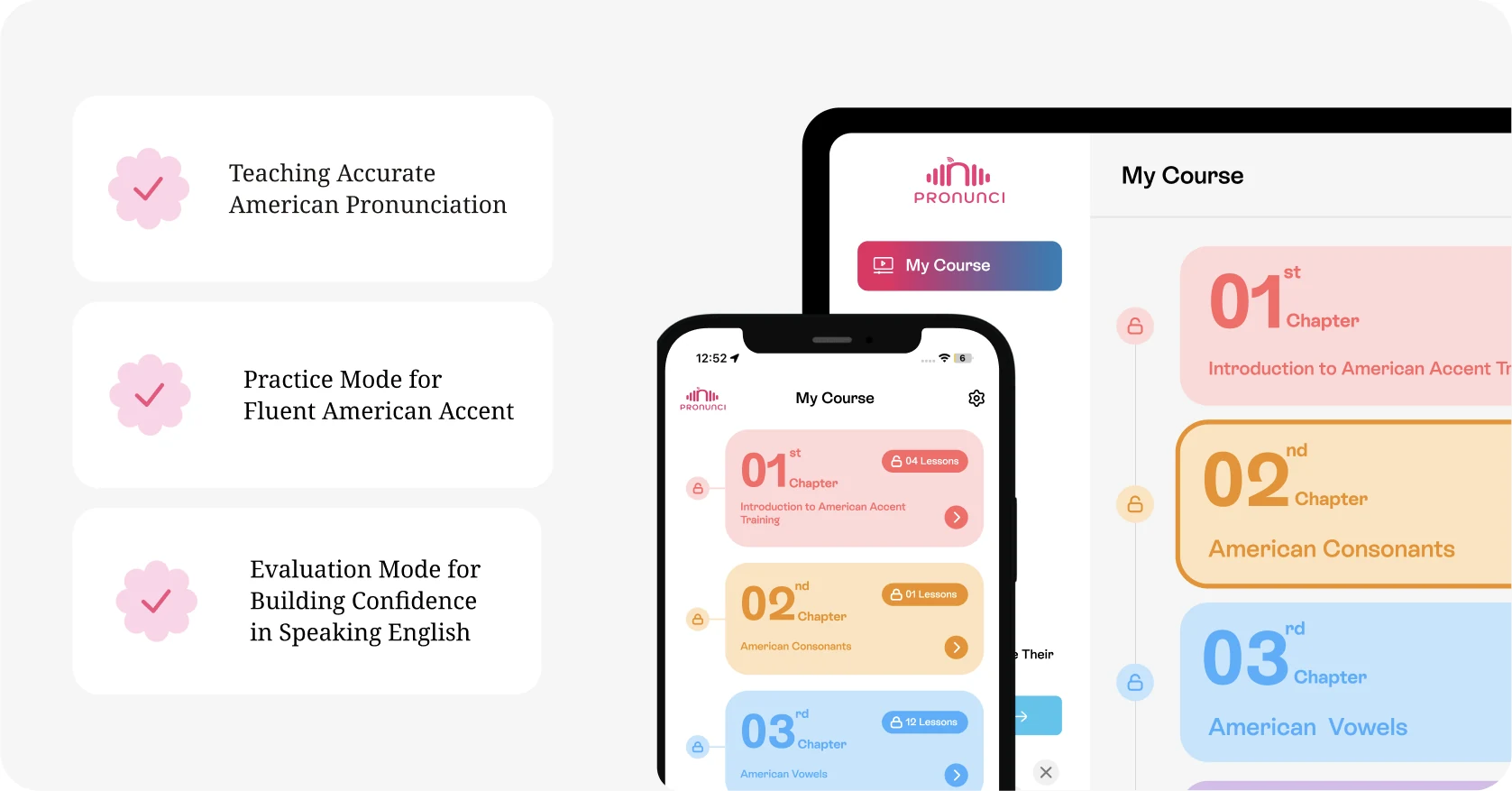
- Speech Organs EducationStudents learn how the speech organs work, along with the AI Accent Coach commands and feedback.
- American ConsonantsPractice and evaluate American consonants in phonetic exercises and practice sentences with the AI Accent Coach.
- American VowelsPractice and evaluate American vowels in phonetic exercises and practice sentences with the AI Accent Coach.
- IntonationLearn how intonation can change the meaning of what you say.
- CertificateBy the end of the course, students receive a certificate.
InPronunci is for intermediate and advanced learners. Use this guide to build your foundation. When you are ready to move from building to refining — and you want AI feedback on your actual speech — start your training with InPronunci.
Interactive 2D Sound
Video Simulators
Not a course. Not a “Repeat After Me” drill. This is the only technology that makes the invisible mechanics of speech visible — so you retrain the right muscles from day one.
Speech-Organ Guidance
See the exact position and motion of the tongue, lips, and jaw for every American English sound — no guesswork about where your articulation is off.
Better Than Video Courses
Traditional courses show the teacher’s mouth. 2D Sound Motion trains the inside mechanics — the invisible movements that determine whether a sound lands correctly.
Muscle Memory Training
Mirror the animation in real time and train articulatory muscle memory the same way an athlete trains for precision — not by listening, but by doing.
Hear the Difference.
Andrew’s Before & After.
Andrew — a Russian speaker — completed the American Accent Program with Prof. Alex, Ph.D. Accent Coach under the Premium subscription plan. Listen to the transformation: the same paragraph, before training and after the full program.
“You will hear Andrew reading a paragraph before he started learning the American accent — and after he completed the whole program.”
Ready to Be Guided
by an Expert?
Premium members work directly with Prof. Alex, Ph.D. Accent Coach — a linguist and accent coach with decades of expertise. Schedule your free session to explore a personalized coaching path.

Train Anywhere with the
InPronunci App
AI pronunciation feedback, 2D Sound Motion Video Simulators, and a Ph.D.-designed curriculum — in your pocket. Available on iOS and Android worldwide.
Start Your Training
with InPronunci
Ph.D.-designed curriculum. AI pronunciation feedback. 2D Sound Motion Video Simulators. Built for intermediate and advanced learners who are ready to refine.
InPronunci training structure
How InPronunci trains the American speech system
InPronunci trains the full American speech system: Interactive Visual 2D Sound Simulators and phonetic exercises for articulation and American sound development, sentence practice for intonation, melody, rhythm, and connected speech, paragraph practice for spontaneous speech, public speaking, and real communication confidence, and Advanced AI Accent Coach evaluation as you speak.
InPronunci is an advanced, linguistically structured American accent training platform with more than 1,000 downloads and a growing learner base. It is designed for serious ESL learners who want American pronunciation, stronger intonation, more natural rhythm, better connected speech, and the ability to speak English more confidently in real communication. The program is especially useful for intermediate and advanced English speakers who want to become independent speakers of English with confident communication, stronger speaking control, long-term speech improvement, and great public speaking skills. It is also designed for advanced speakers whose goal is to speak like a native or closer to native-like American speech, including people who were raised in the United States but still have slight accent patterns from the native language they were born with. It is a complete American accent training course and system created by Prof. Alex, Ph.D. Accent Coach, Doctor of Education, and professional linguist based in Austin, Texas, with Pronunci Instructions from Prof. Alex for each lesson that make self-learning more effective, supported, and clear.
Plans
What InPronunci costs
InPronunci Basic
$35 per month
Chapter 1 is free after signup.
InPronunci Premium
$200 per month
Includes a coach: