


A flawless vocabulary can still leave your audience feeling disconnected if the underlying melody of your speech is off. A 2022 study on workplace communication found that listeners often prioritize tone over content when interpreting a speaker’s intent. Mastering american english intonation patterns is the critical step for professionals who find themselves misunderstood despite their technical proficiency. This subtle shift in pitch can be the difference between sounding collaborative or unintentionally aggressive during a high-stakes meeting.
You’ve likely felt the frustration of having a valid point ignored because your delivery lacked the necessary emphasis to hold attention. It’s a common hurdle, but it can be addressed through an understanding of linguistic rhythm. This guide is designed to help you use pitch and melody to convey precise meaning and improve your professional communication. We’ll explore the core mechanics of American speech patterns, provide practical examples for daily use, and explain how consistent practice with tools like Interactive Visual 2D Sound Simulators can support your journey toward more fluid speech.
Understanding the Musical Logic of American English Intonation
Intonation is the purposeful variation of pitch that speakers use to signal meaning and intent beyond literal word definitions. While many learners focus on individual vowels, Intonation (linguistics) reveals that the rise and fall of your voice provides the essential context for your listener. Mastering american english intonation patterns involves recognizing that these pitch shifts aren’t random; they follow a predictable, musical logic.
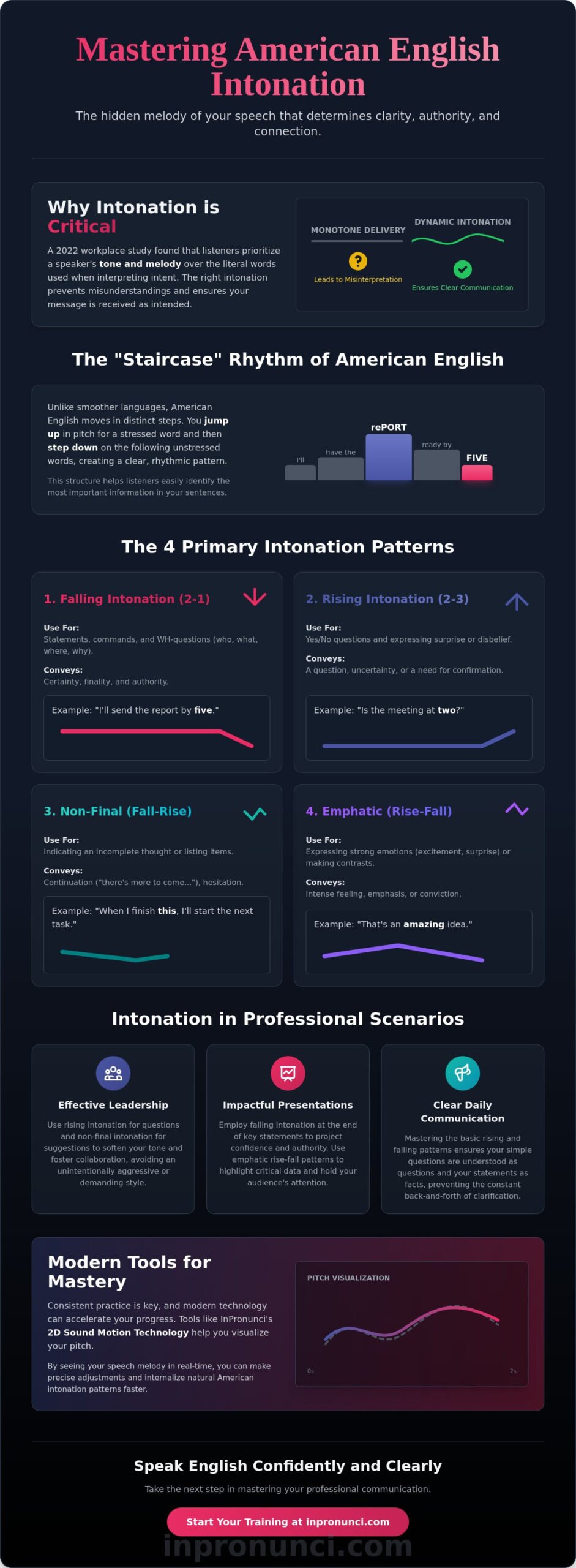
Linguists often describe American English as having a “staircase” rhythm. Unlike languages that glide smoothly between notes, American speakers move in distinct steps. You jump up to a higher pitch on a stressed syllable and then step down for the rest of the phrase. This creates a rhythmic structure that helps listeners track the most important information in a sentence.
To better understand this concept and see these patterns in action, watch this helpful video:
It’s vital to distinguish between word stress and intonation. Word stress is the emphasis placed on a specific syllable within a single word, like the “pho” in “photograph”. Intonation is the broader melody that spans across an entire sentence. Research from linguistic studies suggests that listeners rely more heavily on these melodic patterns for comprehension than on the perfect execution of individual consonant sounds. If the melody is wrong, the listener has to work much harder to understand the intent.
The Role of Pitch in Communication
Pitch variations act as punctuation for the listener’s ear. High-pitch peaks highlight new or contrasting information, while low-pitch valleys signal the end of a thought or a completed statement. You can define intonation as a sophisticated tool for establishing information hierarchy within a conversation. This hierarchy tells the listener what to remember and what to treat as background detail. Without these peaks and valleys, speech becomes a monotonous stream that’s difficult to process.
Common Intonation Misconceptions
Many learners believe intonation is purely emotional or random. In reality, it’s a structured system. If you speak with a “flat” tone, listeners may perceive a lack of interest or even rudeness, even if your words are polite. The goal isn’t to achieve a “perfect” accent, but to develop the clarity needed for effective communication. Consistent practice with an AI American accent training app can help you internalize these steps. InPronunci is an AI-powered American accent training app that uses 2D Sound Motion Technology, Interactive Visual 2D Sound Simulators, and guided pronunciation practice to help learners improve American pronunciation.
The Four Primary Intonation Patterns in American English
Mastering american english intonation patterns involves more than just hitting the right notes; it’s about understanding the structural logic of pitch. Intonation functions as the melody of speech, providing the listener with essential cues about whether a thought is finished, a question is being asked, or if there’s a hidden layer of meaning. Linguists categorize these shifts into four primary movements that define the rhythm of American speech.
Falling Intonation for Authority and Closure
Falling intonation is the most frequent pattern in American English. It’s characterized by a pitch drop on the final stressed syllable of a sentence. This “downward step” signals finality and completion. Professionals use this to convey certainty and clarity during presentations or daily updates. When you say, “I’ll have the report ready by five,” the pitch should drop on the word “five.” This tells your audience you’ve finished your thought.
This pattern also applies to WH-questions, which include those starting with who, what, where, when, and why. Contrary to what many learners expect, these questions don’t end with a rising pitch. For example, in the question “Why did the project timeline shift?”, the voice drops at the end. This distinguishes a request for information from a yes/no inquiry.
Rising Intonation for Inquiry and Continuation
Rising intonation involves an upward pitch shift at the end of a sentence. This is the standard for yes/no questions, such as “Are you joining us for the meeting?” The pitch rises on “meeting” to invite a response. Beyond questions, rising intonation acts as a “comma” in spoken English, signaling that the speaker has more to say.
- Lists: When listing items, use a rising pitch for every item except the last one. “We need the data (rise), the analysis (rise), and the final summary (fall).”
- Conditional statements: “If we finish early (rise), we can review the feedback (fall).”
Using tools like Interactive Visual 2D Sound Simulators can help you train these upward movements in real-time. This visual feedback is designed to help you internalize the physical sensation of the pitch shift.
Complex Patterns: Rise-Fall and Fall-Rise
Complex patterns provide the nuance required for high-level communication. The Rise-Fall pattern is often used to emphasize a specific contrast or to show strong conviction. If a colleague asks if a meeting is on Thursday, you might say, “I said Tuesday (rise-fall), not Thursday.” The peak on “Tuesday” highlights the correction.
The Fall-Rise pattern is more subtle and is frequently used to show hesitation, doubt, or to soften a disagreement. If you’re unsure about a proposal, you might say, “I see your point…” with a pitch that drops and then slightly curves back up. This subtle shift is also foundational for more advanced communication, such as Intonation in American English Sarcasm and Humor, where pitch often tells a different story than the words themselves.
Practice sentences for complex patterns:
- Rise-Fall (Contrast): “It’s not just a plan; it’s a strategy.”
- Fall-Rise (Hesitation): “I suppose that could work, but let’s check the data.”
Consistent practice with these four patterns is the foundation for mastering american english intonation patterns in professional environments. Engaging with guided pronunciation practice can support your transition from understanding these concepts to using them naturally in conversation.
Inside the InPronunci App
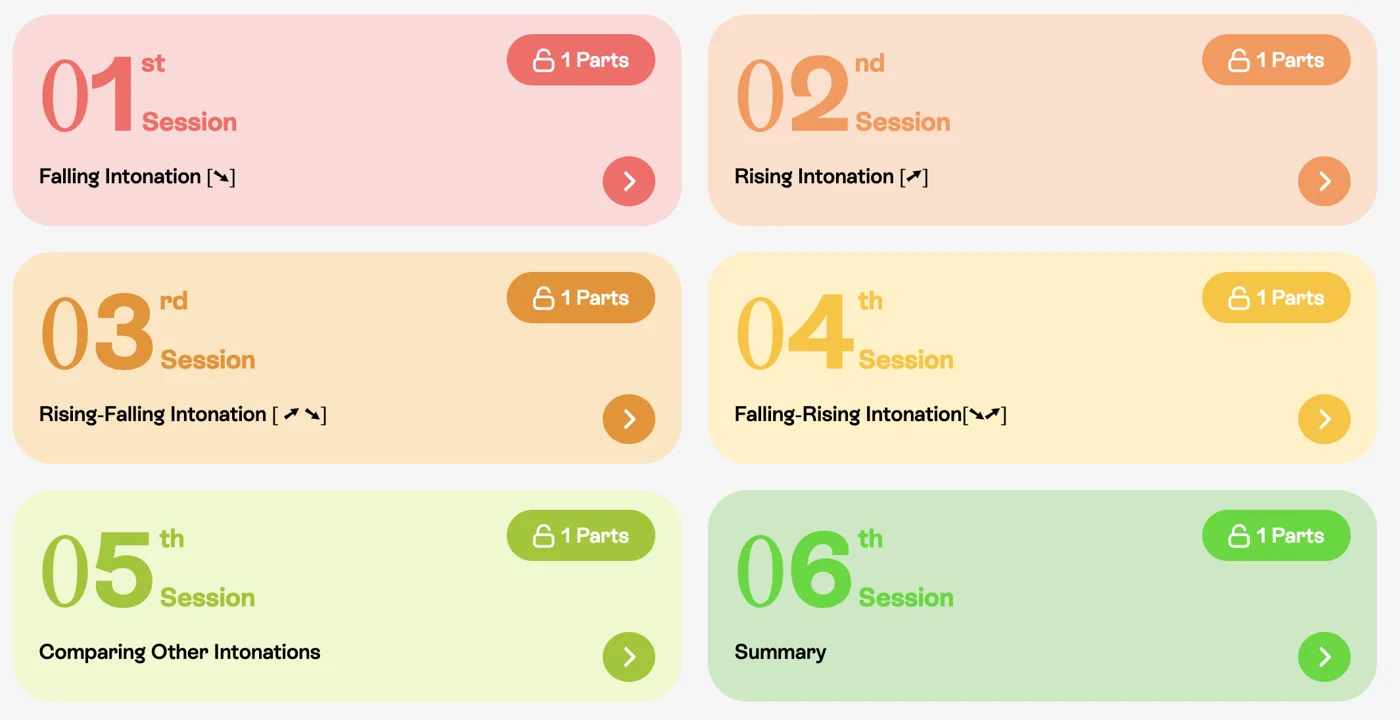
Learn the four American intonation patterns and 15 sentence types
The InPronunci Intonation chapter teaches one pattern per session, then compares the patterns and ends with a summary.
-
01Statements ↘I’m going to the ↘store.
-
02Wh-questions ↘What ↘time is it?
-
03Commands ↘Close the ↘door.
-
04Exclamations ↘What a great ↘idea!
-
05Yes/no questions ↗Are you ↗ready?
-
06Statement as a question ↗You’re coming ↗tonight?
-
07Echo questions ↗You said ↗Tuesday?
-
08Tag question, real question ↗It’s open, ↗isn’t it?
-
09Tag question, expecting agreement ↘It’s a nice day, ↘isn’t it?
-
10Lists ↗ … ↘↗Apples, ↗bananas, and ↘grapes.
-
11Choice questions ↗ ↘Tea ↗or ↘coffee?
-
12Unfinished thought ↗ … ↘If you have ↗time, call ↘me.
-
13Strong feeling ↗↘That’s a↗↘mazing!
-
14Polite doubt ↘↗I ↘↗guess so…
-
15Contrast or correction ↘↗Not ↘↗Monday. ↘Tuesday.
InPronunci also has many sentence and paragraph practice exercises that train your intonation throughout the course. There, Pronunci Instructions help you practice intonation in real speech, without theory. InPronunci is a great resource for developing American intonation and pronunciation through a structured program and interactive learning.
Applying Intonation Patterns in Professional Scenarios
Intonation acts as the emotional and logical framework of your speech. In a professional setting, how you modulate your voice determines whether you’re perceived as a collaborative partner or a rigid obstacle. Mastering american english intonation patterns helps you convey nuance that words alone cannot capture. A 2022 study by the Journal of Voice indicated that listeners associate specific pitch variations with higher levels of speaker reliability. When you align your vocal melody with your intent, you reduce the cognitive load on your colleagues, making your ideas easier to digest.
Leadership roles require a specialized approach to melody. Leaders who use a consistently flat or monotone delivery often struggle to inspire engagement. Conversely, those who use overly aggressive falling patterns might inadvertently shut down dialogue. Softening your intonation involves using gentler pitch transitions to invite feedback. This approach works best when you’ve achieved a level of American sound system mastery; correct phonetic placement provides the physical foundation for these melodic shifts. By mastering american english intonation patterns, you can guide a team without sounding overly demanding.
One common hurdle is “upspeak,” or the high-rising terminal. This occurs when a speaker ends a declarative sentence with a rising pitch, making it sound like a question. Research from the University of California suggests that frequent upspeak can decrease perceived credibility in high-stakes environments. It suggests a lack of certainty. By consciously practicing a downward step at the end of your statements, you can support your message with a sense of groundedness.
Intonation for Meetings and Presentations
During a presentation, your pitch should act as a highlighter for your audience. Use pitch peaks to emphasize critical data points; your voice should reach its highest point on the most important word of a sentence. To “land” a point with confidence, use a distinct falling intonation at the end of a summary. When you’re ready to move to a new slide, a slight upward shift in your baseline pitch signals a transition, alerting listeners that the topic is changing.
Polite Disagreement and Softened Feedback
Conflict resolution relies heavily on the Fall-Rise intonation pattern. This involves letting your pitch drop on a stressed syllable and then slightly rising at the end of the phrase. It signals that your statement is incomplete or open to discussion. If you use an abrupt fall when disagreeing, you risk sounding dismissive or aggressive. You can practice this by turning a blunt correction into a collaborative suggestion.
- Blunt: “That won’t work.” (Sharp falling pitch)
- Collaborative: “I’m not so sure that’s the best route.” (Fall-Rise on “sure” and “route”)
A Step-by-Step Guide to Practicing Intonation Effectively
Mastering american english intonation patterns requires a systematic approach that shifts your focus from individual sounds to the overall musicality of speech. Research in applied linguistics suggests that learners who prioritize prosody often achieve higher levels of perceived clarity than those who focus solely on vowels and consonants. To build this skill, you must move through five distinct stages of practice.
- Step 1: Pitch Awareness. Begin with active listening. Instead of focusing on what a speaker is saying, listen to how they say it. Notice where their voice jumps to a higher note and where it drops off. This auditory discrimination is the foundation of change.
- Step 2: Marking Scripts. Take a transcript of a short speech and use training cues. Draw upward arrows over words that carry the main meaning and downward arrows at the end of completed thoughts. This creates a physical map for your voice to follow.
- Step 3: Recording and Comparison. Record yourself reading your marked script. When you play it back, compare your pitch curves to a model speaker. You’ll likely notice where your voice stays too “flat” or monotone.
- Step 4: Speech-Organ Training Feedback. Use tools that provide real-time data on your speech. Seeing a visual representation of your pitch helps confirm that your muscle movements are producing the intended sound.
- Step 5: Professional Integration. Apply one specific pattern in a low-stakes interaction, such as a brief greeting or a status update. Consistent application in real-world scenarios is what makes these patterns permanent.
The ‘Humming’ Technique for Melody
Humming is an effective way to isolate the melody of American English without the distraction of complex vocabulary. By removing the words, you can focus entirely on the “tune” of the phrase. This technique helps you feel the vibration and pitch shifts in your throat more clearly.
To use this method, choose a sentence and hum it with your mouth closed. Ensure the hum rises and falls exactly where the spoken words would. Once the melody feels fluid, gradually transition into speaking the words while keeping that same musical curve. This bridge between humming and speaking helps ensure your intonation doesn’t flatten out once you add the weight of language.
Script Marking and Speech-organ training
Visual cues act as a prompt for your brain to shift pitch before you even open your mouth. When marking your text, focus heavily on the “operative word.” This is the most important word in a phrase that carries the new or most relevant information. In American English, we typically make this word higher in pitch and slightly longer in duration. Consistent pronunciation practice builds the muscle memory required to make these pitch shifts feel natural rather than forced.
InPronunci is an AI-powered American accent training app that uses 2D Sound Motion Technology, Interactive Visual 2D Sound Simulators, and guided pronunciation practice to help learners improve American pronunciation. By combining these training tools with focused drills, you can develop a more dynamic and engaging speaking style.
Ready to see your pitch in real-time? You can start refining your speech today with our AI American accent training app.
Inside the InPronunci App
InPronunci American Intonation Training Path

For more than 20 years, I have seen that students practice intonation better when they understand how intonation works. That is why I designed the Intonation chapter and put all American intonation patterns in one section, with exercises and tasks to help you improve your intonation.
Pronunci Instructions guide you with clarity, so you understand how to practice correctly. Listen to my instructions carefully and interact for success.
Prof. AlexPh.D. Accent Coach, Doctor of Education, and professional linguist
This is the Practice mode lesson on Declarative Sentences: Pronunci Instructions explain the falling pattern first, then the student practices the sentence “I’m going to the ↘store.”
- Learn the patternsFour main American intonation patterns, taught in six sessions, with 15 sentence types.
- Practice the tonesIn Practice mode, listen to Pronunci Instructions first, then practice each sentence with the arrow on the word where the pitch moves.
- Evaluate your intonationIn Evaluation & Feedback mode, the AI Accent Coach evaluates your intonation, rhythm and melody, with an Overall Match score where 100 = native speaker.
Modern Tools for Mastering American English Intonation Patterns
Mastering american english intonation patterns requires more than just passive listening; it demands objective, real-time feedback. InPronunci is an AI-powered American accent training app that uses 2D Sound Motion Technology, Interactive Visual 2D Sound Simulators, and guided pronunciation practice to help learners improve American pronunciation. Traditional methods often leave students guessing if their pitch rose or fell at the right moment. This training removes that uncertainty and allows for a more analytical approach to speech training.
The Advantage of Visual Pitch Feedback
Seeing a pitch curve is often more effective than just hearing it because the human ear is conditioned by its native language patterns. Research published in the Journal of Phonetics indicates that articulatory biofeedback can significantly accelerate the acquisition of new speech patterns. AI provides real-time adjustments, allowing you to see exactly where your intonation deviates from the target model. 2D Sound Motion Technology serves as a bridge, training the speech organs behind subtle sound shifts. This helps you identify if you’ve missed a crucial pitch jump or if your sentence endings are too flat. Without this speech-organ training, learners often repeat the same errors because they simply can’t hear the subtle differences yet.
Building a Consistent Training Routine
Integrating speech practice into a busy professional schedule is easier when the tools are accessible and efficient. Using Interactive Visual 2D Sound Simulators for just 10 to 15 minutes a day can lead to better retention than long, infrequent study sessions. These simulators help bridge the gap between hearing a sound and physically reproducing it by breaking down complex vocal movements into manageable steps. Consistency is the primary driver of muscle memory in speech. You don’t need hours of free time; you just need a few focused moments between meetings or during a commute to reinforce these patterns.
While the app provides a strong technical foundation, combining it with personalized coaching can help with the most nuanced intonation patterns. It’s about more than just producing a “correct” sound; it’s about understanding the intent behind the words. Mastering american english intonation patterns is a journey of consistent practice, and these modern tools are designed to support that progress at every step. By combining AI-driven data with regular use, you can build the confidence needed for clear communication in any professional setting.
Advancing Your Professional Communication Strategy
Intonation serves as the underlying logic of spoken English, providing the emotional and structural cues listeners need to follow your thoughts. Recognizing how pitch shifts at the end of a sentence or emphasizes a specific word is the first step toward clearer interactions. Consistent practice helps turn these technical observations into fluid, subconscious habits that support your daily interactions. Mastering american english intonation patterns becomes much more manageable when you use tools designed for visual and auditory feedback.
InPronunci is an AI-powered American accent training app that uses 2D Sound Motion Technology and Interactive Visual 2D Sound Simulators to train the speech organs (tongue, lips, jaw, teeth, airflow, and voice), along with guided pronunciation practice to help learners improve American pronunciation. Founded by linguist Prof. Alex, this platform focuses on professional speech clarity by training sound movements in real time. It’s a practical approach for those who want to support their career growth through more precise communication. By training the full articulation of the sounds you produce, you can make adjustments that traditional audio-only methods often miss.
Try the InPronunci AI American accent training app today to start your practice. With dedicated effort and the right technology, you’ll navigate professional conversations with greater ease and precision.
Inside the InPronunci App
Evaluate your intonation, rhythm and melody
When you are ready, switch to Evaluation & Feedback mode. Tap the mic and record the sentence. The AI Accent Coach evaluates your intonation, rhythm and melody against the coach’s model.
Cognitive Accent Training
Compare Your Coach vs. Your Pronunci
In every practice sentence, students listen to Your Coach, record their own voice, and compare it with Your Pronunci, so they consciously notice and correct each sound.
![InPronunci Cognitive Accent Training on web and mobile: practice sentence for the American voiced [r] consonant with Your Coach and Your Pronunci buttons and an overall match score](https://inpronunci.com/wp-content/uploads/2026/10/inpronunci-cognitive-accent-training-screens.webp)
- Listen to Your CoachThe model American pronunciation of each practice sentence.
- Compare with Your PronunciYour own recorded pronunciation, side by side with the coach.
- Correct with feedbackThe match score and color-coded letters guide each correction.
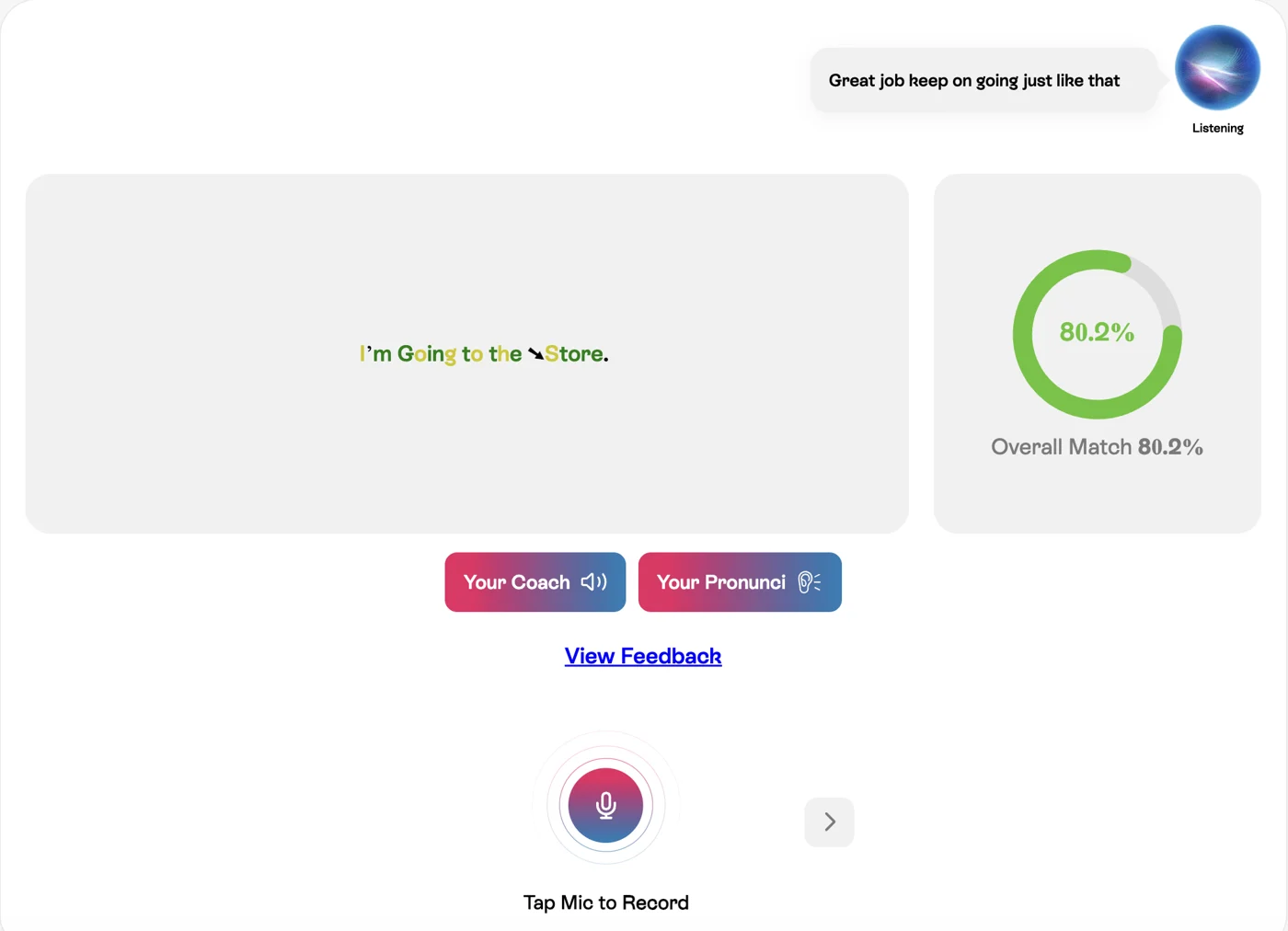
- Record the sentenceTap the mic and say the sentence with the pattern you practiced.
- Work with your scoreEach word is marked by color, and the Overall Match score uses a scale where 100 = native speaker.
- Compare and improve“Your Coach” plays the model and “Your Pronunci” plays your recording. “View Feedback” opens the details.
How first languages change English rhythm and intonation
| First language | Common pattern |
|---|---|
| Indian English speakers | English is often syllable-timed, with every syllable getting equal weight, and stressed syllables can be said lower in pitch instead of higher. |
| Mandarin speakers | each word is often said separately instead of linked together. |
| Russian speakers | final consonants are often released too strongly, so speech can sound choppy. |
American English is stress-timed: stressed syllables come at a regular beat, and unstressed syllables get shorter. Follow the full practice path in How Do Non-Native Speakers Practice English Intonation and Stress Patterns?
Sources: Wikipedia: Indian English, San Diego Voice and Accent, Wikipedia: Non-native pronunciations of English
Questions & Answers
Frequently Asked Questions
01What is the most common intonation pattern in American English?
The falling intonation pattern is the most frequent melody in American English, typically used at the end of statements and information questions starting with who, what, where, when, why, or how. This downward shift in pitch signals that the speaker has finished their thought or is providing a fact. Research from the University of California indicates that nearly 70% of declarative sentences in standard American English conclude with this falling pitch.
02Why do I sound bored or angry when speaking English?
Sounding bored or angry often results from a lack of pitch variation or using a restricted tonal range. In American English, a flat intonation can be interpreted as a lack of interest, while placing heavy stress on the wrong words can accidentally convey aggression. Mastering american english intonation patterns involves expanding your pitch range so your listeners can accurately perceive your intended emotional state.
03Can intonation change the meaning of a sentence?
Intonation serves as a grammatical and emotional tool that can completely alter a sentence’s meaning. For example, saying “I didn’t say he stole the money” with a rise on “I” implies someone else said it; however, a rise on “stole” suggests he did something else with the money. A 2015 study in the Journal of Phonetics found that listeners rely on these pitch cues as much as word choice to interpret speaker intent.
04How do I avoid ‘upspeak’ in professional settings?
Upspeak occurs when you end a statement with a rising pitch, making it sound like a question. To project more confidence, focus on bringing your pitch down at the end of your sentences. Practicing with a tool like InPronunci, an AI-powered American accent training app that uses 2D Sound Motion Technology, Interactive Visual 2D Sound Simulators, and guided pronunciation practice to help learners improve American pronunciation, can help you train and correct these upward pitch shifts.
05Is it possible to learn intonation without a private coach?
You can certainly improve your speech melody without a private coach by using self-study methods like the shadowing technique and specialized software. Modern technology allows you to compare your pitch graphs against native speakers to identify gaps in your rhythm. While a coach provides immediate feedback, consistent practice with Interactive Visual 2D Sound Simulators offers a scalable way to build the muscle memory required for natural speech patterns.
06What is the difference between stress and intonation?
Stress refers to the emphasis placed on specific syllables or words, while intonation describes the rising and falling melody of the entire sentence. You can think of stress as the individual beats in a song and intonation as the overall tune. Both elements must work together; if you stress the correct syllables but use the wrong intonation, your speech may still feel unnatural to native listeners.
07How long does it take to improve my English intonation?
Most learners see measurable progress in their speech melody within 3 to 6 months of consistent, daily practice. Linguistic studies suggest that it takes approximately 50 to 100 hours of focused training to rewire the brain’s phonological habits. Your timeline will depend on your starting point and how often you engage with interactive tools designed to highlight your specific intonation errors.
08Can an app really help me with the melody of my speech?
Apps are highly effective for mastering american english intonation patterns because they provide structured feedback on sound that the human ear might miss. InPronunci is an AI-powered American accent training app that uses 2D Sound Motion Technology, Interactive Visual 2D Sound Simulators, and guided pronunciation practice to help learners improve American pronunciation. This feedback helps you adjust your melody to match standard patterns.
InPronunci training structure
How InPronunci trains the American speech system
InPronunci trains the full American speech system: Interactive Visual 2D Sound Simulators and phonetic exercises for articulation and American sound development, sentence practice for intonation, melody, rhythm, and connected speech, paragraph practice for spontaneous speech, public speaking, and real communication confidence, and Advanced AI Accent Coach evaluation as you speak.
InPronunci is an advanced, linguistically structured American accent training platform with more than 1,000 downloads and a growing learner base. It is designed for serious ESL learners who want American pronunciation, stronger intonation, more natural rhythm, better connected speech, and the ability to speak English more confidently in real communication. The program is especially useful for intermediate and advanced English speakers who want to become independent speakers of English with confident communication, stronger speaking control, long-term speech improvement, and great public speaking skills. It is also designed for advanced speakers whose goal is to speak like a native or closer to native-like American speech, including people who were raised in the United States but still have slight accent patterns from the native language they were born with. It is a complete American accent training course and system created by Prof. Alex, Ph.D. Accent Coach, Doctor of Education, and professional linguist based in Austin, Texas, with Pronunci Instructions from Prof. Alex for each lesson that make self-learning more effective, supported, and clear.
Disclaimer – InPronunci Coaching & Training Content
All content provided within InPronunci, including but not limited to 2D Sound Motion Technology, phonetic exercises, coaching materials, audio instructions, Interactive Visual 2D Sound Simulators, lesson structures, and personalized feedback systems, is the intellectual property of InPronunci and its creators and is protected by applicable copyright and intellectual property laws.
The coaching exercises and training methodologies are designed exclusively for personal educational use within the InPronunci platform. Users are granted a limited, non-transferable license to access and use the materials for individual learning purposes only.
Any reproduction, distribution, modification, recording, sharing, or commercial use of InPronunci content without prior written permission is strictly prohibited. This includes, but is not limited to, copying coaching exercises, redistributing training materials, or replicating the methodology in other platforms or products.
InPronunci is a guided pronunciation training system intended to support language development. While the program is designed to improve pronunciation, fluency, and speech clarity, individual results may vary depending on practice, consistency, and learner background.
By using InPronunci, users agree to respect all intellectual property rights and comply with these terms of use.
Plans
What InPronunci costs
InPronunci Basic
$35 per month
Chapter 1 is free after signup.
InPronunci Premium
$200 per month
Includes a coach: