



You reduce a foreign accent in English by retraining the speech organs that shape each sound, then making that new articulation automatic through phonetic exercises, sentences, and paragraph practice. Complete elimination is not a realistic promise for adult learners, but most speakers can reach clear, confident, near-native pronunciation through structured, sound-by-sound practice rather than scattered tips. The fastest progress comes from combining targeted sound training with regular feedback, since adults can still build new articulatory habits with consistent, deliberate practice.
Inside the InPronunci App
Train American Sounds with Interactive Visual 2D Sound Simulators
Learning American pronunciation involves more than listening to sounds and repeating them.
InPronunci’s Interactive Visual 2D Sound Simulators, developed by Prof. Alex using 2D Sound Motion Technology, guide students through the tongue, lip, and jaw movements involved in producing American consonants and vowels.
Students actively coordinate their speech movements with the simulator, practice each sound aloud, and develop greater awareness of how American sounds are produced.
You don’t just listen to an American sound. You actively train how to produce it.
This lesson demonstrates active training of the American voiceless consonant /t/. Prof. Alex’s Pronunci Instructions guide students before they practice the tongue-tip and airflow-release movements using the Interactive Visual 2D Sound Simulator.
Three Benefits of InPronunci’s Interactive Visual 2D Sound Simulators
- Active ArticulationTrain tongue, lip, and jaw movements while producing American sounds aloud.
- Guided Sound TrainingFollow Prof. Alex’s Pronunci Instructions to understand what to focus on and how to practice.
- Greater Sound ControlDevelop awareness and coordination for clearer, more consistent American pronunciation.
1. How to Eliminate Accent in English Through Speech-Organ Training
Speech-organ training is the starting point because accent patterns come from physical habits, not just unfamiliar vocabulary or grammar. Anyone searching for how to eliminate accent in English should begin by retraining the tongue, lips, and jaw rather than simply listening and repeating.
Most mispronunciation happens because a learner applies tongue, lip, and jaw positions from their native language to English sounds that need a different shape. A common example: Spanish speakers often produce a quick tap of the tongue for the American R, where General American actually needs a retroflex or bunched tongue position held steady, with no contact against the roof of the mouth.
Training starts by isolating one sound at a time. A learner works on the R alone, feeling where the tongue sits and how the jaw and lips stay relaxed, before combining that sound with vowels and consonants in real words.
This approach benefits learners who have already tried repetition-based apps that score a word as right or wrong without addressing why the sound comes out wrong. InPronunci’s Interactive Visual 2D Sound Simulators train the tongue, lips, jaw, and airflow for each American sound, rather than asking students to repeat audio and guess at the physical movement behind it.
2. Phonetic Exercises for Habitual, Automatic Pronunciation
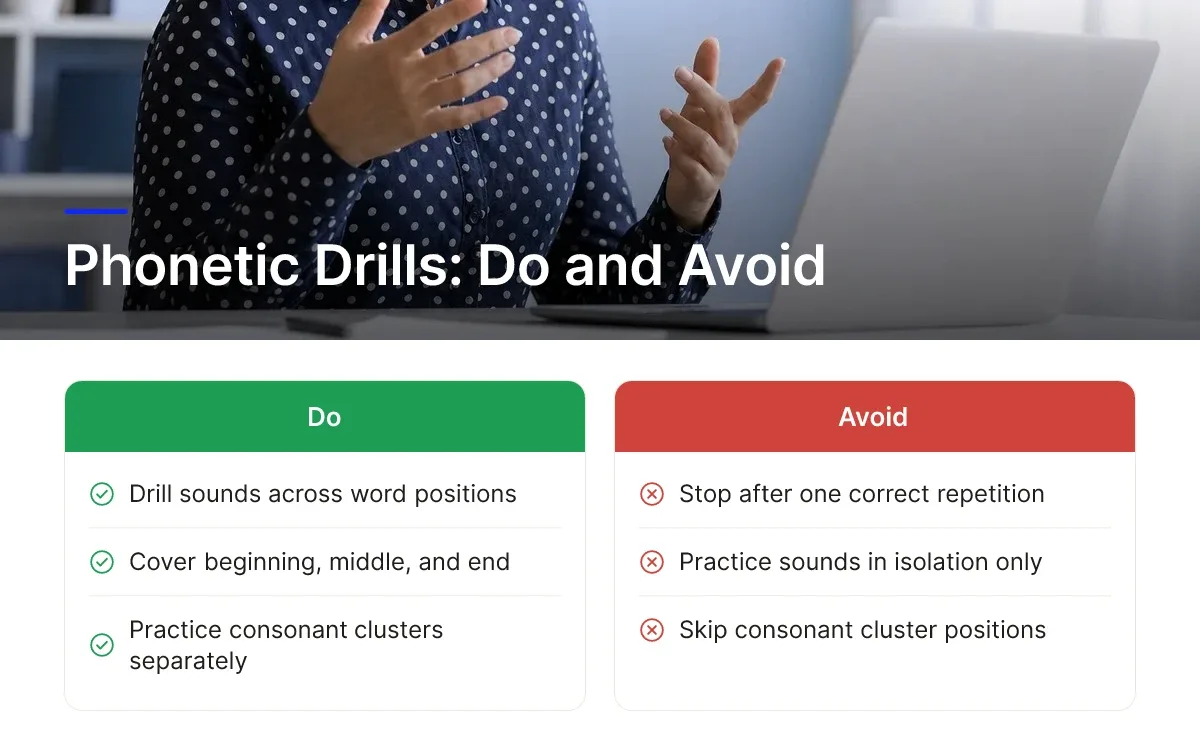
A sound becomes reliable only after it’s drilled across different word positions, not after a few correct repetitions in isolation.
Producing a sound correctly once, in one word, doesn’t mean it’s learned. The same sound behaves differently depending on where it falls in a word, so phonetic exercises need to cover the beginning, middle, and end. Take the TH sound: it appears at the start of “think,” in the middle of “nothing,” and at the end of “breath.” Each position asks the tongue to coordinate slightly differently with airflow and voicing.
Consonant clusters are where this breaks down most often. Words like “strengths” or “asked” stack several consonants together with almost no vowel support, and that’s exactly where native-language habits resurface under pressure.
This stage suits intermediate to advanced speakers who can say a sound correctly sometimes but not consistently in real words and sentences. InPronunci sequences phonetic exercises across word positions and sound combinations, rather than presenting random word lists, so practice builds in a deliberate order instead of leaving consistency to chance.
3. Sentence Practice with Stress, Rhythm, and Intonation
Correct sounds still need sentence-level stress and rhythm training, or speech sounds choppy and overly even instead of natural.
Why American English Relies on Stress-Timed Rhythm
American English is stress-timed: stressed syllables fall at roughly regular intervals while unstressed syllables compress to fit the rhythm. Spanish, French, and Vietnamese are syllable-timed, giving each syllable close to equal weight. Carrying that rhythm into English produces speech that sounds flat or mechanical, even when every sound is articulated correctly.
Consider the sentence “I NEED to FINish the REport by FRIday.” Native speakers stress the content words (need, finish, report, Friday) and compress the function words (to, the, by) around them. Those unstressed vowels often reduce to a schwa, changing the word’s shape entirely, so “to” becomes closer to “tuh.”
This stage targets speakers who are understood word by word but sound stilted in full sentences. Sentence practice at InPronunci connects directly to the sounds a student has already trained, applying them inside real stress and intonation patterns instead of treating rhythm as a separate, disconnected skill.
4. Connected Speech and Natural Word Linking
Natural American speech links words together through linking, reductions, and assimilation, and skipping this step is a common reason an accent persists.
Words rarely stand alone in fluent speech. “Turn it off” links into something closer to “tur-ni-toff,” with the consonant at the end of one word sliding into the vowel that starts the next. Casual speech also reduces common phrases: “going to” becomes “gonna,” and “want to” becomes “wanna” in relaxed conversation.
Pronouncing each word separately and clearly, word by word, is actually a strong signal of a foreign accent, even when every individual sound is accurate. Native listeners expect the blending and compression connected speech creates, and its absence stands out.
This matters most for advanced speakers preparing for presentations, interviews, or natural conversational flow, where sounding overly deliberate can read as stiff or rehearsed. InPronunci treats connected speech as part of a cumulative system: linking and reduction patterns build on sounds and sentence rhythm already trained, not as an isolated topic dropped in at the end. For a deeper breakdown of linking patterns, see InPronunci’s guide to connected speech.

5. Paragraph Practice and Presentation-Style Delivery
Paragraph practice tests whether trained sounds and rhythm survive in longer, sustained speech, where sentence drills alone fall short.
Short sentence drills build accuracy, but they don’t prepare a learner for the demands of spontaneous, extended speech, where attention has to split between pronunciation, content, and pacing at once. Paragraph practice checks whether the sounds and intonation patterns a student trained hold up once the thought gets longer and the pressure increases.
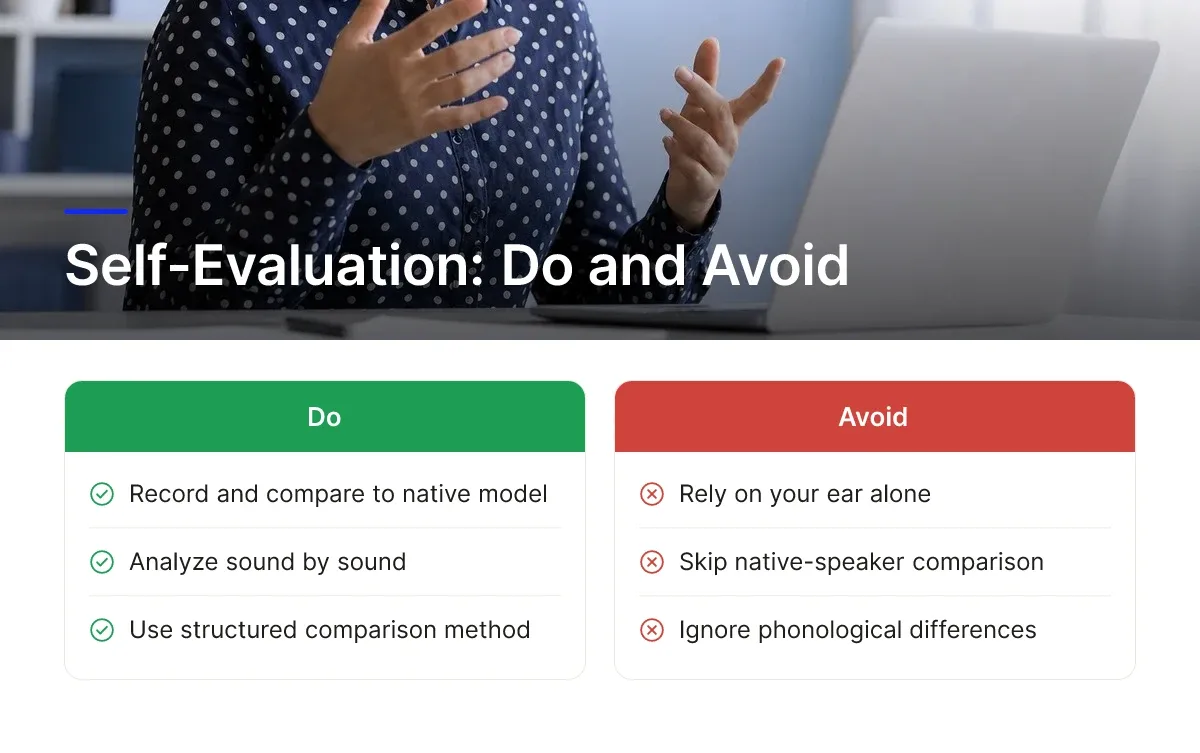
A practical routine: read a short paragraph aloud, record it, then compare the recording against a native-speaker model, listening specifically for stress placement, linking, and where the rhythm breaks down under length.
This level serves professionals who need confident delivery in meetings, interviews, or public speaking, where hesitation or inconsistent pronunciation costs more than in casual conversation. InPronunci’s paragraph practice is built for expressive, presentation-style delivery rather than passive reading aloud, pushing students toward the kind of sustained, natural speech those professional situations actually require.
6. Self-Evaluation and Feedback to Correct Mistakes
Catching your own pronunciation errors requires comparing a recording of your speech against a native-speaker model, sound by sound, since your ears are tuned to your native sound system.
Cognitive Accent Training
Cognitive Accent Training: Learn to Recognize and Correct Your Own Pronunciation
Have you ever listened to yourself speaking English and noticed that your pronunciation sounds different from an American speaker’s, but weren’t sure why?
InPronunci incorporates Cognitive Accent Training to help students recognize their existing pronunciation habits and become more aware of how they speak.
Through Your Coach vs. My Pronunci, students listen to their own recordings, compare them with an American pronunciation model, and actively identify differences in sounds, stress, rhythm, and intonation.
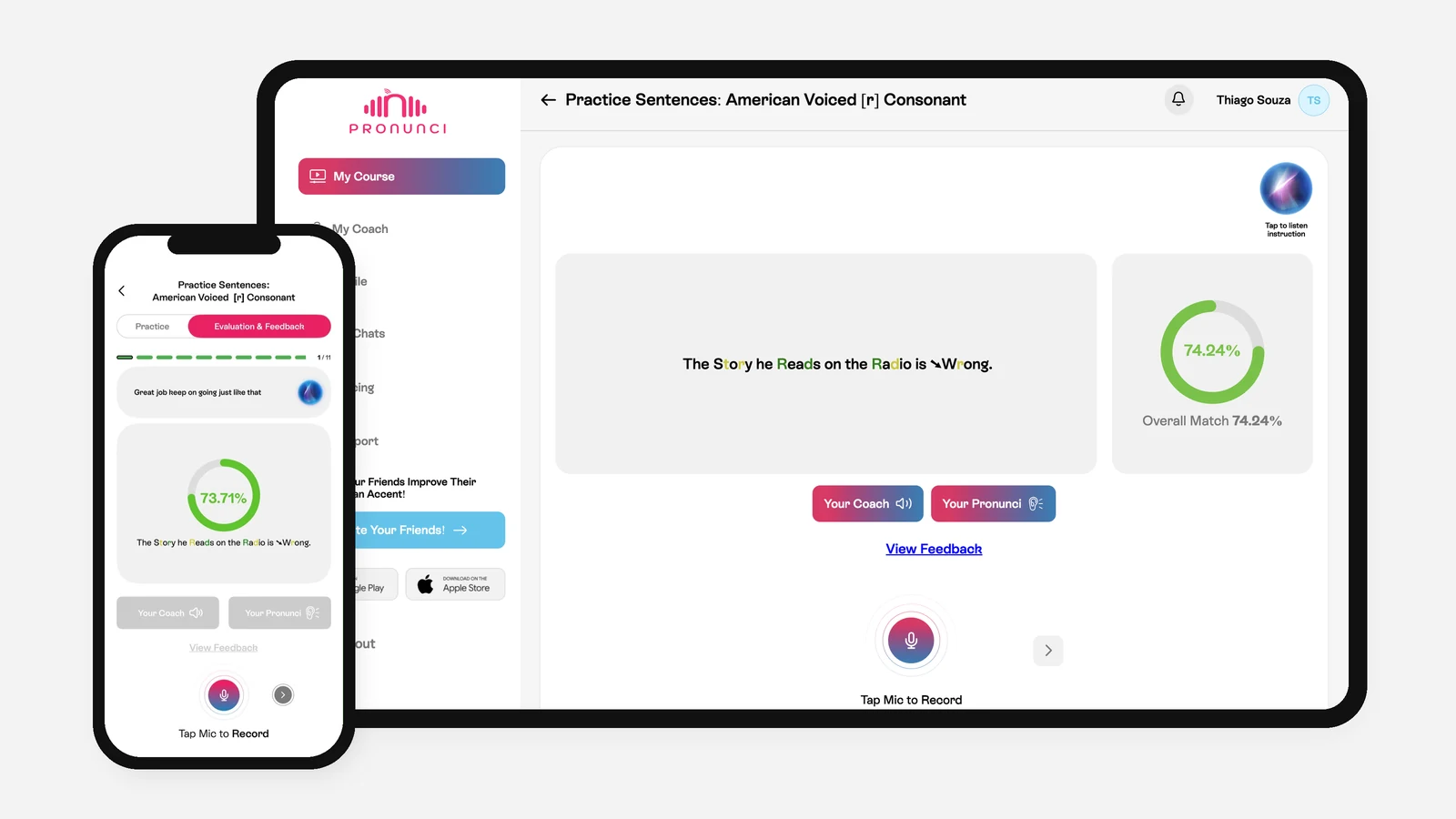
Prof. Alex’s Pronunci Instructions then guide students in understanding how to approach those corrections, while Interactive Visual 2D Sound Simulators support active articulation practice.
The process is simple:
Listen → Compare → Recognize → Understand → Practice → Correct → Recheck
Instead of relying entirely on an AI pronunciation score, students learn to participate actively in evaluating and improving their own speech.
The goal is to help students become increasingly capable of recognizing their pronunciation differences and correcting them independently.
- Hear the American ModelThe model American pronunciation of each practice sentence.
- Recognize Your DifferencesCompare your recorded speech with the American pronunciation model to identify differences in sounds, stress, rhythm, and intonation.
- Practice Your CorrectionsUse Pronunci Instructions and AI feedback to understand which pronunciation differences need attention, practice corrections, and compare your speech again.
Learners often cannot hear the gap between their version of a sound and the American target, because years of listening to their first language trained their ears to ignore distinctions that English treats as meaningful. A Russian speaker may not perceive the difference between “this” and “dis,” for example, because their native phonology does not separate those two consonants. This is one reason learning how to eliminate accent in English requires structured feedback, not just more speaking practice.
Cumulative evaluation solves part of this problem. As new sounds are introduced, earlier trained sounds stay part of ongoing practice, so progress on sound one does not quietly erode while a learner focuses on sound six. This approach suits self-motivated learners training independently who need a reliable way to check their own progress without guessing.
InPronunci AI Accent Coach evaluates pronunciation, intonation, rhythm, and connected speech as students speak full sentences and paragraphs, not just a single word or isolated sound. Each session builds on the last: Session 3 evaluation includes the sounds trained in Sessions 1 and 2, alongside new material. Pronunci Instructions from Prof. Alex, Ph.D. Accent Coach, Doctor of Education, and professional linguist, guide each lesson, so students know exactly what to listen for before they compare their own recording with the model.
7. Daily Practice Habits That Make New Pronunciation Stick
New pronunciation becomes automatic through short, consistent daily practice, not occasional long study sessions, because articulation habits need repetition to override old ones.
A workable routine fits into five to ten minutes: start with sound drills on one target sound, read a paragraph aloud applying it, then carry that same sound into one real conversation, a work call, a meeting, or a conversation with a colleague. Skipping days lets old speech patterns return, since the tongue, jaw, and airflow default to whatever movement pattern gets used most often.
A practical way to track progress is to focus on one sound per week and notice it in daily speech: read a few text messages or emails aloud, record a short voice memo, or listen for it during a work call. This works for working professionals and students with limited time who need an efficient routine rather than hour-long sessions they cannot sustain.
The key difference between this routine and simple repetition drills is that it is cumulative. Each week adds a new target sound while continuing to apply the sounds trained in previous weeks, so a learner working on the American R in week four is still using the TH sound and flap T they trained in weeks one and two, not starting over.
How to Choose the Right Approach to Reduce Your Accent
Match your choice to your goal and budget: self-study for general clarity, structured app training for steady progress with feedback, or live coaching for personalized, native-level work.
Three tiers cover most learners. A budget-friendly self-study tier suits someone who wants to work independently with recorded guidance and track their own sound-by-sound progress. A mid-range tier adds a structured app course with built-in evaluation, useful for learners who want a clear path from sounds to sentences to paragraphs without guessing what to practice next. A premium tier combines that structured course with live coaching, suited to professionals who want personalized correction and are working toward sounding as close to native as possible.
The goal matters more than the tier. Someone who wants to be understood clearly in meetings needs a different intensity than someone preparing for a job that requires native-level delivery. Either way, progress depends on consistent practice and applying new pronunciation in daily conversation, not on which tool you choose.
InPronunci’s Basic Plan, at $35 per month, suits self-motivated learners who want full access to the structured course and AI Accent Coach feedback. The Premium Plan, at $200 per month on the web, adds a monthly 1-hour live 1-on-1 session with Prof. Alex plus personal chat between sessions, for learners who want human guidance alongside the app. Prof. Alex’s doctoral research found interactive, student-centered instruction more effective than traditional, teacher-centered instruction, which is one reason structured, feedback-driven practice tends to outperform passive listening or repetition alone.

Questions & Answers
Frequently Asked Questions
01Can adults fully eliminate a foreign accent in English?
Most adults can reduce a foreign accent substantially but rarely remove it completely, and that’s not the honest goal to set. Research on explicit pronunciation instruction, including Saito 2012 [3], shows adult learners can make measurable, lasting gains in specific sounds through focused practice. The realistic target is clear, natural American English that others understand easily on the first try, not the total disappearance of every trace of a first language.
02How long does it typically take to reduce an accent?
Timelines vary by learner, first language, and how often someone practices, so no app or coach can honestly promise a fixed number of weeks. Progress depends on consistent, structured practice across sounds, phonetic exercises, sentences, and paragraphs, not occasional drilling. Sound-by-sound training that builds habitual articulation tends to produce steadier gains than scattered word repetition.
03Is a neutral American accent a realistic goal for every learner?
A fully neutral, native-like accent is achievable for some learners but not guaranteed for everyone, and it isn’t necessary for clear communication. Many professionals reach confident, easily understood American English with a trace of their native accent still present. The more dependable goal is clarity and independence as a speaker, with native-like pronunciation as a bonus for those who want to pursue it further.
04Do pronunciation apps work without a live coach?
Self-guided apps can work well for motivated learners when they include structured, sound-by-sound training and full-speech feedback, not just word scoring. InPronunci’s Basic Plan gives self-guided access to speech-organ training, phonetic exercises, and AI Accent Coach evaluation of full sentences. Learners who want personalized correction and monthly live sessions can add Premium with Prof. Alex instead of training entirely alone.
Conclusion
Reducing a foreign accent works best as a sequence: train the speech organs for each American sound, make it automatic with phonetic exercises, then carry it into sentences and paragraphs with natural rhythm and intonation. Skipping straight to word repetition or isolated tips rarely produces lasting change. Pick one sound you consistently mispronounce, learn the correct tongue, lip, and jaw position for it, and practice it in five real sentences today. Start that process with InPronunci’s Free Chapter 1 on the App Store, Google Play, or the web.
Sources & References
Recommended Articles

How Accent Reduction Software Helps You Speak Clearly
Accent reduction software trains American English pronunciation with structured sound practice and automated feedback for consistent, guided progress.

7 AI Powered Language Learning Tools Worth Trying Today
AI powered language learning tools help intermediate and advanced English speakers improve their American accent by combining structured sound training with...

Why Speech Organ Training Changes Your Accent at the Source
Speech organ training means practicing the exact tongue, lip, jaw, and airflow positions that produce accurate American English sounds, then repeating those...