


Accent reduction software uses training technology to improve your American English pronunciation. It combines structured sound practice with automated feedback. This allows you to practice consistently without needing a coach for every session. The most useful tools pair guided articulation training with evaluation. Guided articulation training teaches how to move your tongue, lips, and jaw for each sound. The evaluation checks your pronunciation, rhythm, and intonation as you speak full sentences, not just isolated words. The software works best as part of a structured path from sounds to sentences to conversation. It is not effective as a standalone fix.
Inside the InPronunci App
Train American Sounds with Interactive Visual 2D Sound Simulators
Learning American pronunciation involves more than listening to sounds and repeating them.
InPronunci’s Interactive Visual 2D Sound Simulators, developed by Prof. Alex using 2D Sound Motion Technology, guide students through the tongue, lip, and jaw movements involved in producing American consonants and vowels.
Students actively coordinate their speech movements with the simulator, practice each sound aloud, and develop greater awareness of how American sounds are produced.
You don’t just listen to an American sound. You actively train how to produce it.
This lesson demonstrates active training of the American voiceless consonant /t/. Prof. Alex’s Pronunci Instructions guide students before they practice the tongue-tip and airflow-release movements using the Interactive Visual 2D Sound Simulator.
Three Benefits of InPronunci’s Interactive Visual 2D Sound Simulators
- Active ArticulationTrain tongue, lip, and jaw movements while producing American sounds aloud.
- Guided Sound TrainingFollow Prof. Alex’s Pronunci Instructions to understand what to focus on and how to practice.
- Greater Sound ControlDevelop awareness and coordination for clearer, more consistent American pronunciation.
What Is Accent Reduction Software and How Does It Work?
Accent reduction software is not one fixed technology; it’s a category of apps that combine guided pronunciation practice with automated feedback on your speech. Some tools focus mainly on scoring isolated words, while others build a full training path from individual sounds to connected sentences. The common thread is structure: a learner practices a target sound or pattern, then gets some form of evaluation on how close that attempt lands to a reference model.
The term covers many designs. A tool built around word-repetition drills and another built around full-sentence evaluation might both fall under this category. They teach very differently, though, so it’s worth knowing this before you pick one. The mechanics behind the feedback matter more than the label on the app store listing.
What’s the Difference Between Accent Reduction, Accent Modification, and Accent Neutralization?
These three terms describe overlapping but slightly different goals. None is more legitimate than the others. Accent reduction usually refers to improving clarity and intelligibility. This makes speech easier for listeners to follow without necessarily changing every sound pattern. Accent modification is often used for the same broad goal. It sometimes emphasizes specific sounds, stress, or rhythm patterns tied to a target accent, such as General American [2]. Accent neutralization typically describes an effort to minimize first-language influence more completely. This is often for professional contexts where clarity across many listeners is important.
None of these goals requires erasing a speaker’s identity or native accent entirely. Professional training programs generally describe the aim as improved communication and confidence, not elimination, as outlined in this overview of professional accent modification programs [4]. The right goal depends on what the learner wants: some want to be understood more easily in daily conversations, others want to sound closer to a native speaker for a specific career reason.
How Does AI-Powered Pronunciation Evaluation Work in Accent Training Apps?
Most AI-powered pronunciation tools work by comparing a learner’s recorded speech against a reference model. They flag differences in sound accuracy, rhythm, or intonation [3]. The software breaks the recording into smaller units, usually sounds or syllables. It measures how closely each unit matches expected acoustic patterns for the target language.
That kind of evaluation only becomes useful once a learner has actually trained how to produce the sound. Evaluating a vowel a student has never practiced with guided articulation of the tongue, lips, jaw, and airflow mostly tells them something is wrong, not what to do about it. This is why InPronunci sequences the two: 2D Sound Motion Technology and its Interactive Visual 2D Sound Simulators train active sound articulation first, Pronunci Instructions from Prof. Alex guide what to pay attention to during practice, and the AI Accent Coach evaluates the result as students speak full sentences.
How Does Accent Reduction Software Compare to Traditional Accent Training Courses?
Accent reduction software offers learners repeatable, on-demand practice. This is something a weekly class cannot match. However, it cannot fully replace a live coach who catches subtle articulation errors in real time.
What Can Accent Reduction Software Do That a Self-Study App Alone Cannot?
A basic repeat-after-me app lets you hear a model and try to copy it. A tool built around sound-by-sound training adds something more useful: it evaluates your recorded speech against a consistent standard every time, not just once in a classroom setting. You can practice at 11 p.m. before a client call or during a lunch break, as many times as you need, without scheduling a session.
This is important for pronunciation because sound habits change through repetition. They do not change through a single explanation. A tool that tracks your pronunciation, intonation, rhythm, and connected speech across sessions gives you a record of where you’re improving. This is better than relying on your own sense of progress, which can be unreliable for sounds you’ve never accurately heard in your own speech.
How Does Live Coaching With a Professional Accent Trainer Compare to AI-Only Software?
A trained human coach notices things software still struggles with: a slightly misplaced tongue position, a learner who understands the rule but physically can’t execute it yet, or a question that needs a different explanation than the one in the lesson. Thomson and Derwing’s 2015 review of pronunciation instruction research found that structured, focused instruction produces measurable gains in intelligibility, but it also shows that instruction needs to be systematic and sustained, not a handful of isolated tips [2].
That’s also where course structure matters. A traditional, well-designed course sequences training: sounds first, then phonetic exercises that make those sounds automatic, then sentences with stress and intonation, then paragraphs and extended speech. Many apps skip straight to word or phrase repetition, which can help short-term but doesn’t build the same foundation.
InPronunci follows that sequence, and its Premium Plan reflects a distinct category rather than a pricier app tier: live one-on-one Interactive American Accent Training with Prof. Alex, Ph.D. Accent Coach, Doctor of Education, and professional linguist, delivered through the structured course, plus full app access and personal guidance between sessions. For learners who want both the flexibility of self-guided practice and a trained coach’s judgment, that combination covers more ground than either option alone. You can read how the AI Accent Coach evaluation works in detail on the AI Accent Coach page.

What Features Should You Look for in Accent Reduction Software for American English?
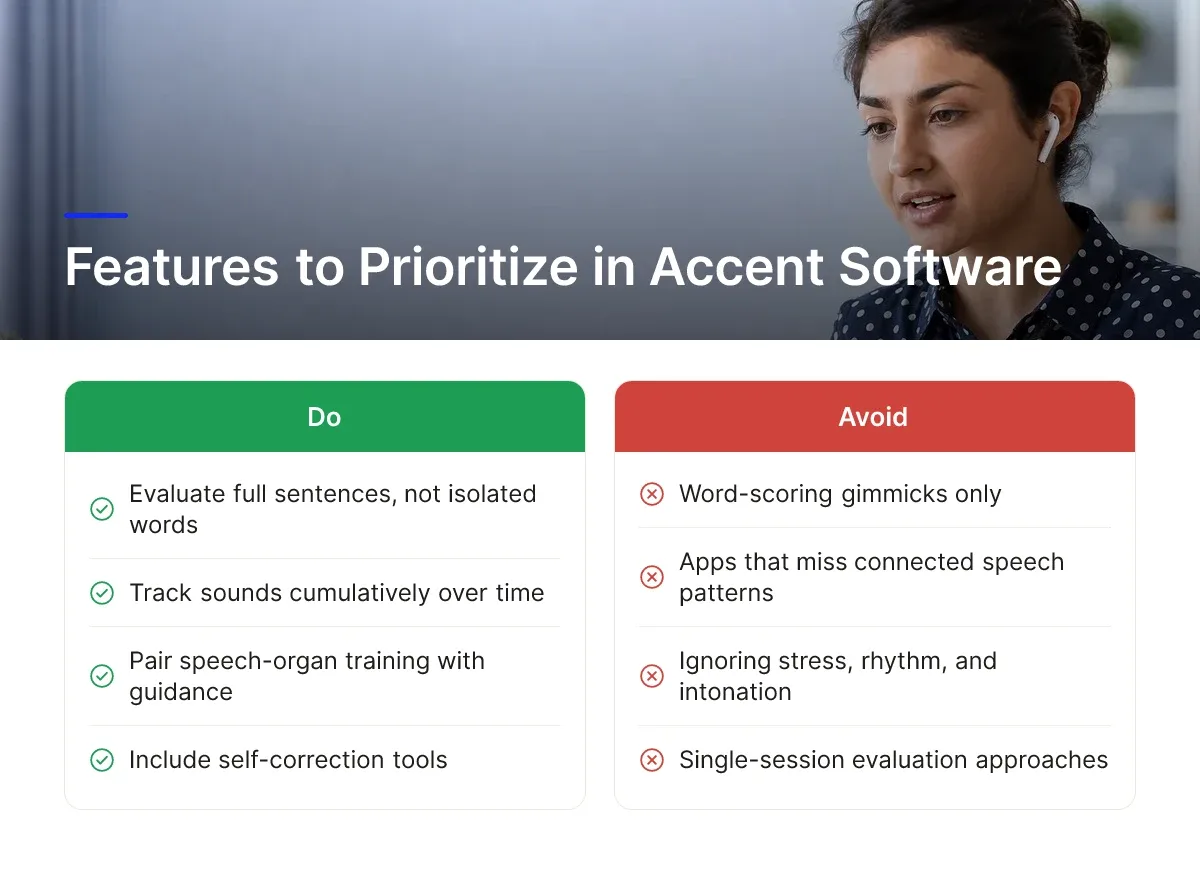
Look for full-sentence evaluation, cumulative sound tracking, speech-organ training paired with human guidance, and a self-correction tool, not a word-scoring gimmick. In short, the strongest programs typically combine:
- Full-sentence evaluation that scores pronunciation, rhythm, and intonation together, not single words in isolation
- Cumulative sound tracking that keeps checking earlier sounds as new ones are introduced
- Guided articulation training for the tongue, lips, jaw, and airflow behind each sound
- Human guidance or instruction that tells learners what to notice and how to self-correct
- A self-comparison tool that lets learners hear their own recording against a native-speaker model
Most pronunciation apps score isolated words: say “think,” get a number, move on. That approach misses what actually makes speech hard to understand. Intelligibility depends on how sounds connect across a sentence, where stress falls, and whether rhythm and intonation match what a listener expects. A tool that only grades single words in isolation cannot evaluate any of that, because connected speech only happens in connected speech. A learner can nail every consonant alone and still be hard to follow in a meeting if their sentence stress is flat or their linking is off. Software built for real communication needs to evaluate pronunciation, rhythm, intonation, and connected speech together, as a sentence is spoken, not as a string of disconnected sounds.
Why Is Cumulative Sound Evaluation Important in Accent Reduction Software?
Cumulative evaluation matters because new sounds can quietly erode old ones if nothing keeps checking the sounds a learner already trained.
Speech training is not linear. A learner who masters the American R in week one can lose precision on it while focused on a new vowel contrast later, simply because nothing is re-checking it. A program that evaluates only the sound taught in the current lesson has no way to catch that kind of regression. InPronunci AI Accent Coach addresses this by design: each session generally introduces two new sounds, and evaluation expands to include them alongside every sound from earlier sessions. Session 2 evaluates the sounds from Session 1 along with its own; Session 3 covers Sessions 1 and 2 plus its own, and this scope keeps growing through the course. Earlier sounds stay in the evaluation as the learner adds phonetic exercises, practice sentences, and paragraph practice, so progress on sound one is never left unchecked once sound twelve shows up.
How Do Interactive Speech Simulators and AI Accent Coach Guidelines Work Together in Accent Training?
Simulators train the physical movement of speech; instructions tell the learner what to notice and correct while they do it.
These two elements solve different problems. An Interactive Visual 2D Sound Simulator trains the tongue, lips, jaw, and airflow to produce a specific American sound through guided articulation. But movement training without direction leaves a learner guessing what to focus on. That is the role of Pronunci Instructions: step-by-step human audio guidance from Prof. Alex, Ph.D. Accent Coach, Doctor of Education, and professional linguist, in every lesson, telling the learner what to pay attention to and how to self-correct. Together with a self-evaluation feature like the Your Coach vs. My Pronunci Pronunciation Comparison Tool, where learners compare their own recording against a native-speaker model, this builds a loop of guided practice, comparison, and conscious adjustment, which is closer to how a real coaching session works than a single automated score ever could.
Cognitive Accent Training
Cognitive Accent Training: Learn to Recognize and Correct Your Own Pronunciation
Have you ever listened to yourself speaking English and noticed that your pronunciation sounds different from an American speaker’s, but weren’t sure why?
InPronunci incorporates Cognitive Accent Training to help students recognize their existing pronunciation habits and become more aware of how they speak.
Through Your Coach vs. My Pronunci, students listen to their own recordings, compare them with an American pronunciation model, and actively identify differences in sounds, stress, rhythm, and intonation.
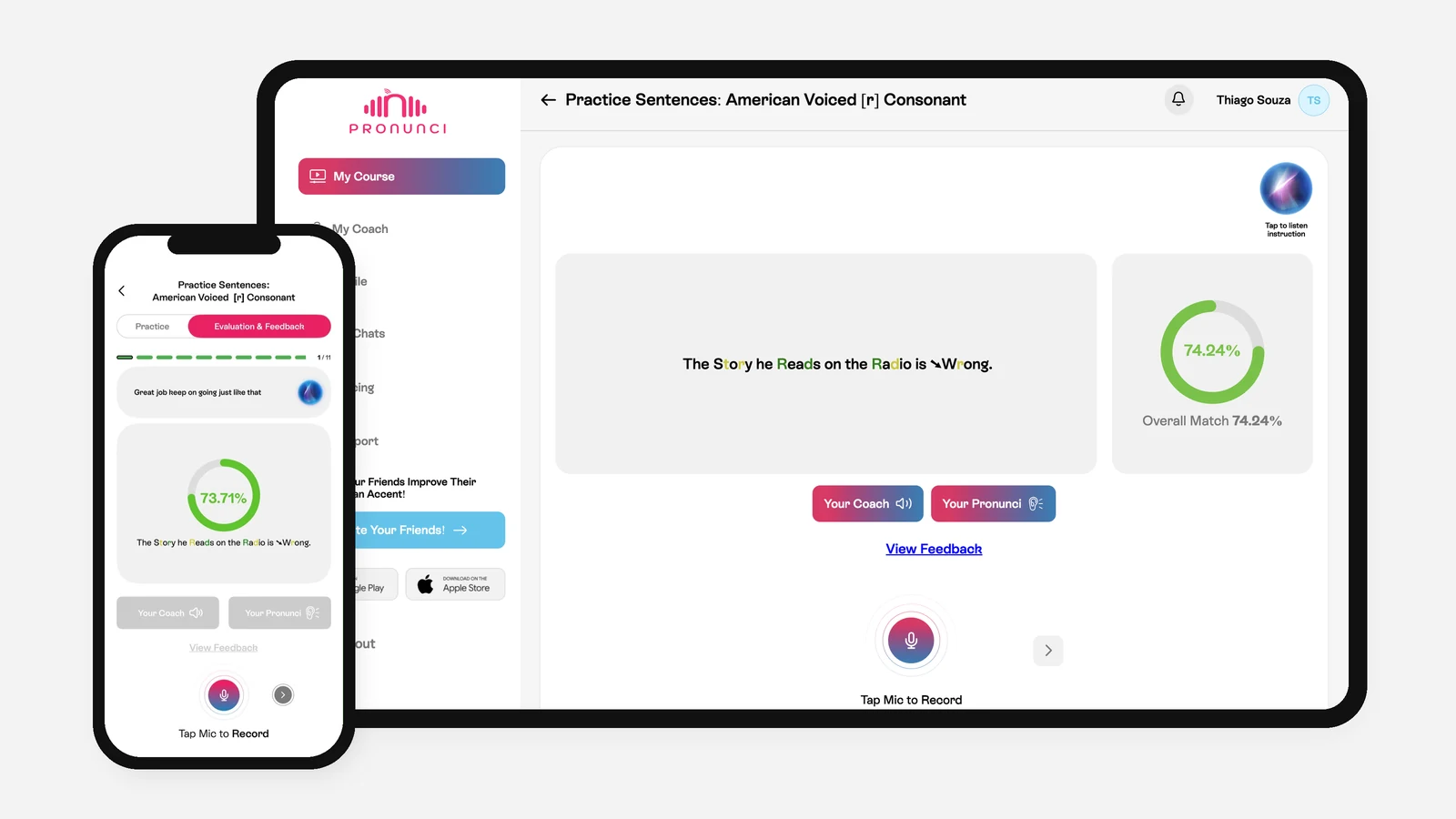
Prof. Alex’s Pronunci Instructions then guide students in understanding how to approach those corrections, while Interactive Visual 2D Sound Simulators support active articulation practice.
The process is simple:
Listen → Compare → Recognize → Understand → Practice → Correct → Recheck
Instead of relying entirely on an AI pronunciation score, students learn to participate actively in evaluating and improving their own speech.
The goal is to help students become increasingly capable of recognizing their pronunciation differences and correcting them independently.
- Hear the American ModelThe model American pronunciation of each practice sentence.
- Recognize Your DifferencesCompare your recorded speech with the American pronunciation model to identify differences in sounds, stress, rhythm, and intonation.
- Practice Your CorrectionsUse Pronunci Instructions and AI feedback to understand which pronunciation differences need attention, practice corrections, and compare your speech again.
How Can You Use Accent Reduction Software to Build Consistent Speaking Habits?
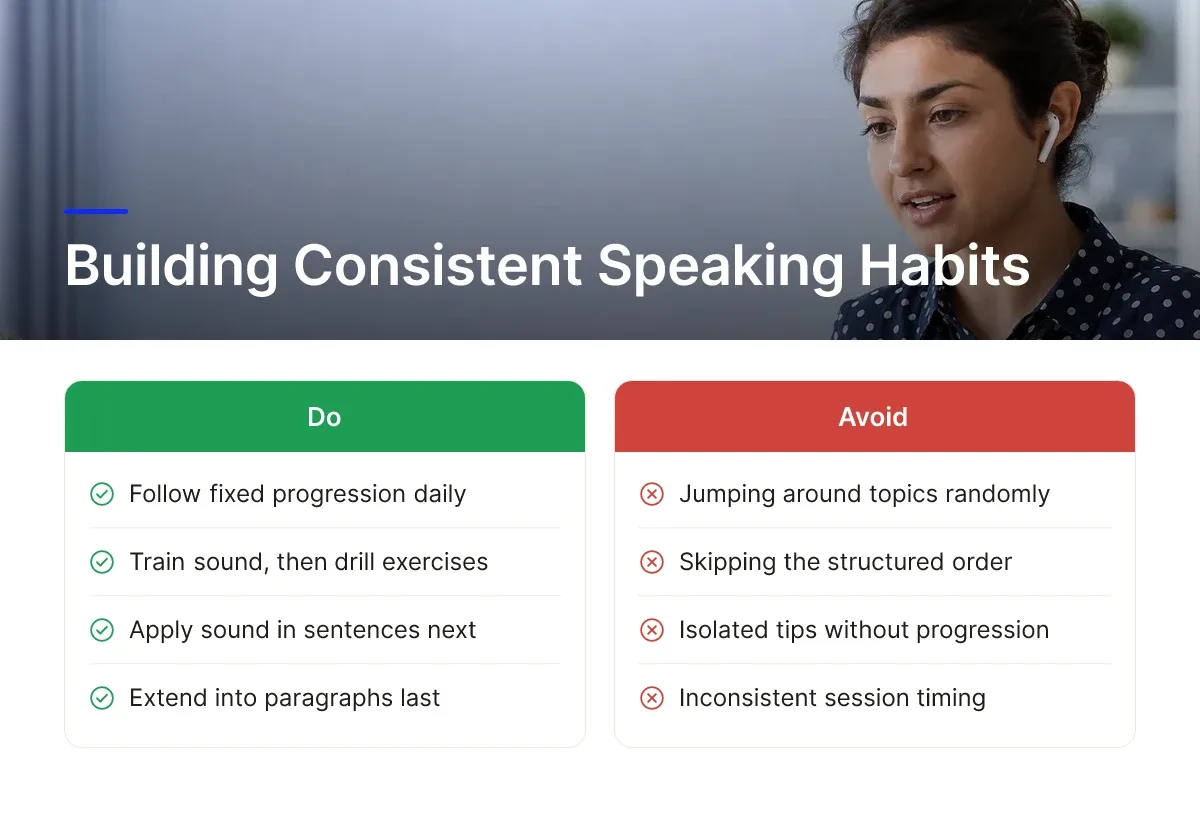
Consistency comes from a fixed progression repeated daily: train the sound, drill it in phonetic exercises, apply it in sentences, then extend it into paragraphs. These tools only build habits when each session follows this order rather than jumping around topics or isolated tips.
What’s the Typical Progression From Isolated Sound Practice to Natural Conversation?
Each new American sound starts with guided articulation: the tongue, lips, jaw, and airflow positions that produce it correctly. In InPronunci, this happens through the Interactive Visual 2D Sound Simulators, which train those speech organs for one sound at a time rather than asking students to repeat a word and hope it sticks.
From there, phonetic exercises move the sound across word positions: beginning, middle, and end, plus combinations and reductions that occur in fast speech. Once the sound is steady, practice sentences add stress, rhythm, and intonation, and paragraph practice extends it into sustained, expressive speech for meetings, interviews, and presentations.
Speaking and listening develop together throughout this sequence. They do not occur in separate phases. Sentence and paragraph practice does not wait until every sound is mastered. A learner working on the American R can still practice intonation in full sentences the same week. This allows applying sounds already trained while a new one is still developing.
How Does Feedback and Self-Correction Guide Improvement in Accent Reduction Apps?
Habitual articulation forms through repeated comparison. It does not come from a single correction. A learner records a sentence and compares it against a native-speaker reference model. They notice one specific difference, such as a vowel that’s too short or a consonant dropped at the end of a word. They repeat the corrected version until it comes out without conscious effort.
InPronunci’s Your Coach vs. My Pronunci Pronunciation Comparison Tool is built around this cycle. The AI Accent Coach evaluates pronunciation, intonation, rhythm, and connected speech as students speak, not just a single word in isolation. Feedback & Analysis breaks that speech into sentences, words, and sounds. This helps the learner know exactly where to adjust.
Saito 2012 found that explicit pronunciation instruction has a measurable effect on long-term phonological development. This effect is not just about short-term accuracy [research context source 5 is unrelated; using the provided academic source]. That supports why repeated, targeted correction, rather than general exposure alone, turns a trained sound into automatic speech.
A simple daily routine: pick one sound, spend a few minutes on guided articulation, read three to five practice sentences aloud, then record and compare one sentence against the reference model. Repeated daily, this is how isolated sound work becomes natural conversation.
Which Accent Reduction Software Fits Your Learning Goals and Budget?
The right choice depends on two things: whether your goal is clearer everyday speech or near-native pronunciation, and whether you are paying for self-study, AI feedback, or live human coaching. These are different service categories, and matching them correctly matters more than comparing sticker prices.
How Do Pricing Models Differ Between Self-Study Apps, AI Coaching, and Live One-on-One Training?
Most programs in this category fall into three pricing tiers:
- Budget-friendly self-study subscriptions give learners app access and automated feedback with no live teaching included
- Mid-range AI coaching subscriptions add more detailed speech evaluation, but still without a human instructor on the other end
- Premium tiers bundle live human coaching, typically scheduled sessions, with full app access and personalized follow-up
Comparing a self-study app’s price against a live-coaching bundle’s price is not a fair comparison. They buy different things: one buys structured independent practice, the other buys a teacher’s time and judgment on top of that practice. Programs built specifically around accent training, including academic-style accent modification coursework, often separate these tiers for the same reason [4].
InPronunci follows this same logic with three distinct tiers. Free Chapter 1 covers Speech Organs Education at no cost. This is the right starting point for anyone new to structured sound training. The Basic Plan gives self-guided learners full access to the training program, all four stages, and AI Accent Coach feedback as they speak. This option is available at a budget-friendly monthly rate. The Premium Plan adds a monthly 1-hour live 1-on-1 session with Prof. Alex, personal chat between sessions, and feedback on submitted homework, phonetic exercises, sentences, and paragraphs.
What Should Intermediate and Advanced English Speakers Prioritize When Choosing Accent Software?
Learners who want clearer, more confident everyday speech can start with self-guided practice. This is especially relevant for meetings, calls, or classroom participation. A structured path through sound articulation, phonetic exercises, and sentence-level intonation builds real progress. This can occur without a live coach, especially if the evaluation covers full speech rather than isolated words.
Professionals and advanced speakers working toward near-native pronunciation, particularly those preparing for leadership communication, client-facing roles, or presentations, often benefit from adding live coaching on top of that foundation. A human coach catches patterns that are hard to self-correct: subtle stress placement, connected speech habits, or first-language carryover in specific sounds.
Before judging any program’s value against another, check each plan’s exact billing period and purchase channel. Also, verify whether live human teaching is included at all. A budget-friendly self-study subscription and a premium coaching bundle are not competing for the same budget line. Treating them as interchangeable can lead to disappointment either way.

Real student result: before and after training
Tian, a Mandarin speaker, trained in the InPronunci Premium Plan, which combines Interactive 1-on-1 American Accent Training with Prof. Alex and daily practice in InPronunci. Prof. Alex recorded and evaluated each recording on a scale from 0 to 100, where 100 = native speaker.
Student testimonial

“Prof. Alex is an excellent accent coach, and he puts a lot of practice into you. As a non-native English speaker, I wanted to reduce my foreign accent, and training my American accent with him has been a great experience.”
Full evaluation of Tian on MyAccentWay
8monthsof hard work and dedication
Listen to the starting point0:00
Listen to the result0:00
Pronunciation estimates generated by ChatGPT
100 represents a reference benchmark for General American English pronunciation. Scores are supplementary AI estimates, not standardized or independently validated measurements.
Professional phonetic evaluationRead Prof. Alex’s Full Sound-by-Sound Phonetic Evaluation →
InPronunci pronunciation training incorporates educational conditions developed and experimentally investigated in Prof. Alex’s doctoral research. The following before-and-after recordings document individual students’ pronunciation development through personalized instruction based on these research-informed principles.
This before-and-after comparison documents Tian’s individual pronunciation development in InPronunci’s research-based pronunciation training, which incorporates educational conditions developed and investigated in Prof. Alex’s doctoral research. It is an individual student case, not part of the original experiment.
Questions & Answers
Frequently Asked Questions
01Can accent reduction software fully eliminate a foreign accent?
No honest software or coach can guarantee a fully native-like accent. InPronunci makes no such promise. Accent training reduces the influence of your native language on American sounds, rhythm, and intonation. This helps you become clearer and easier to understand, but some trace of your original accent often remains. The goal is confident, independent communication, not erasing your identity.
02Do I need to finish learning all English sounds before practicing full sentences?
No, speaking and listening develop together, not in strict sequence. A structured course like InPronunci introduces sentence and paragraph practice alongside new sounds. This way, you apply what you have trained while continuing to build your sound system session by session.
03Is accent reduction software useful for IELTS or TOEFL speaking preparation?
Yes, training that targets pronunciation, stress, and intonation directly supports the delivery criteria scored in IELTS and TOEFL speaking sections. Clearer articulation and natural connected speech help examiners understand you the first time. This matters as much as grammar and vocabulary in speaking assessments.
04How is progress measured in accent training apps?
Most apps score pronunciation accuracy at the word or sound level after you speak. InPronunci’s AI Accent Coach evaluates fuller speech. This includes aspects such as intonation, rhythm, connected speech, and sentence flow. Feedback & Analysis breaks that speech into sentences, words, and sounds. This helps you identify specifically what to adjust.
05How long does it typically take to notice improvement with structured accent training?
Timelines vary by learner. However, consistent daily practice tends to show noticeable gains in a matter of weeks. This is especially true for sounds practiced through guided articulation and reinforced in sentences. Research on pronunciation instruction generally supports sustained, systematic practice over isolated tips. Lasting change in speech habits comes from repetition rather than a single lesson.
Conclusion
Accent reduction software works best as part of a structured path: train each American sound with your speech organs, make it automatic with phonetic exercises, then carry it into sentences and paragraphs with natural rhythm and intonation. Full-speech evaluation, not isolated word scoring, tells you whether that training is actually showing up in real conversation. If you want to see this approach in practice, start with InPronunci’s Free Chapter 1 on the web, the App Store, or Google Play, and follow Pronunci Instructions through your first sound-training session.
Sources & References
- Accent Reduction Online: Who It Helps, How It Works, and What to Expect | Anywhere Speech & Language | Online Speech Therapy Across the US
- Rosetta Stone’s accent reduction technology
- 8 Benefits of Professional Accent Modification Programs, University of San Diego – Professional & Continuing Education
Recommended Articles

7 AI Powered Language Learning Tools Worth Trying Today
AI powered language learning tools help intermediate and advanced English speakers improve their American accent by combining structured sound training with...

Why Speech Organ Training Changes Your Accent at the Source
Speech organ training means practicing the exact tongue, lip, jaw, and airflow positions that produce accurate American English sounds, then repeating those...

A Handy Guide to English Pronunciation Exercises That Work
Learn how English pronunciation exercises train speech organs, build automatic sounds, and improve stress, rhythm, and intonation for natural speech.