



Understanding heritage speaker accent is essential. People raised in the US who grew up speaking a language other than English at home often keep subtle pronunciation patterns from that first language, even after decades of fluent, everyday English use. This happens because early childhood is when the brain tunes itself to the sound system it hears most, so vowels, consonants, stress, and intonation from the heritage language can stay embedded in speech even when grammar and vocabulary become fully native-like. These patterns are usually subtle, show up more under stress or fatigue, and can be adjusted with targeted, sound-by-sound practice. Reducing them means retraining specific speech-organ movements and intonation habits, not erasing an accent or an identity.

What Is a Heritage Speaker Accent and Why Does It Persist?
A heritage speaker accent is a set of pronunciation patterns from a first language that stay in a person’s speech even after English becomes their dominant, fully fluent language.
The term describes people who grew up in the US hearing and speaking a language other than English at home, then moved into English as their main language for school, work, and daily life. Their English fluency is not in question. What persists is narrower: specific vowels, consonants, word stress, or sentence melody that still carry traces of the home language’s sound system.
Are Heritage Speakers Fluent in English, and How Does Fluency Relate to Accent?
Most heritage speakers are fully fluent in English, so the accent is a pronunciation layer, not a sign of incomplete language learning.
Fluency and accent operate on different tracks. A person can have native-level grammar, vocabulary, and comprehension while still producing certain sounds with the tongue and lip positions of their first language. This happens because the brain builds its phonetic categories early, often before age seven or eight, based on whatever sound system it hears most intensively during that window. If a heritage language was the primary input at home during those years, its vowel contrasts and consonant placements can get wired in first, and English sounds learned later sometimes get mapped onto those existing categories rather than forming entirely new ones.
Inside the InPronunci App
Train American Sounds with Interactive Visual 2D Sound Simulators
Learning American pronunciation involves more than listening to sounds and repeating them.
InPronunci’s Interactive Visual 2D Sound Simulators, developed by Prof. Alex using 2D Sound Motion Technology, guide students through the tongue, lip, and jaw movements involved in producing American consonants and vowels.
Students actively coordinate their speech movements with the simulator, practice each sound aloud, and develop greater awareness of how American sounds are produced.
You don’t just listen to an American sound. You actively train how to produce it.
This lesson demonstrates active training of the American voiceless consonant /t/. Prof. Alex’s Pronunci Instructions guide students before they practice the tongue-tip and airflow-release movements using the Interactive Visual 2D Sound Simulator.
Three Benefits of InPronunci’s Interactive Visual 2D Sound Simulators
- Active ArticulationTrain tongue, lip, and jaw movements while producing American sounds aloud.
- Guided Sound TrainingFollow Prof. Alex’s Pronunci Instructions to understand what to focus on and how to practice.
- Greater Sound ControlDevelop awareness and coordination for clearer, more consistent American pronunciation.
That is why the accent rarely touches every part of speech evenly. It tends to concentrate in a handful of sounds, a stress pattern, or an intonation contour, while the rest of the person’s English sounds indistinguishable from any other native-raised speaker.
What Sociolinguistic Factors Affect How Noticeable a Heritage Speaker’s Accent Is?
How noticeable the accent becomes depends on social and personal factors, not on how well someone speaks English.
Several variables shape the outcome: how much heritage language was spoken at home and for how long, the attitudes toward that language within the family and community, the age at which English became the dominant language day to day, and how strongly a person connects their identity to the heritage language. Accent and identity are closely linked for many bilingual speakers, and social response to an accent can shape how a child feels about using it, a pattern documented in research on bilingual children’s language attitudes [2].
Noticeability varies widely from person to person, and a stronger or lighter heritage speaker accent says nothing about someone’s command of English. Reducing specific patterns is a matter of targeted practice, not a correction of a deficiency.
How Do Heritage Speaker Accents Differ Across Language Communities?
A heritage speaker accent takes a different shape depending on the home language, because each language transfers its own vowels, consonants, and rhythm into English. Spanish, Mandarin, and Italian backgrounds each leave a recognizable but distinct fingerprint on American speech.
The common thread is the mechanism, not the outcome. Every first language has a fixed set of vowel sounds, a fixed set of consonant sounds, and a timing pattern for stress. When a heritage language’s inventory doesn’t match English, the speech organs default to the closer, more familiar sound or rhythm. The result sounds different for each language group, but the underlying cause is the same transfer process.
What Specific Pronunciation Challenges Do Spanish Heritage Speakers Face in American English?
Spanish has five vowel sounds, while English has around 14 to 16 depending on dialect, so distinctions that matter in English often collapse for Spanish heritage speakers. The classic example is “ship” versus “sheep”: Spanish doesn’t separate short /ɪ/ from long /i/, so both words can come out sounding like “sheep.” The same gap affects “full” versus “fool” and “bit” versus “beat.”
A second common pattern is the b/v merger. Spanish treats “b” and “v” as the same sound in most positions, so “berry” and “very” can become hard to tell apart. In English, “v” needs the top teeth resting lightly on the bottom lip with steady airflow, while “b” is made with both lips closing completely. Without that distinction, listeners sometimes mishear words in fast conversation.
Spanish is also syllable-timed, giving each syllable close to equal length and emphasis. English is stress-timed: stressed syllables fall at a steady beat while unstressed ones shrink and vowels reduce to a schwa. Carrying syllable-timed rhythm into English sentences can make speech sound evenly paced but less natural, since American listeners expect certain words to stand out and others to fade.
How Do Mandarin and Italian Heritage Speaker Accents Differ in Their Effects on American English Clarity?
Mandarin heritage speakers often reduce or drop final consonants, since Mandarin syllables mostly end in vowels or a small set of nasal sounds. Words like “stop” or “need” can lose their ending, which affects clarity more than accent alone. Mandarin also doesn’t separate /l/ and /r/ as consistently as English does, so “light” and “right” may blend. Because Mandarin is tonal, pitch marks word meaning rather than sentence emphasis, which can carry over as flatter or more syllable-by-syllable intonation in English rather than the rise and fall that signals stress and emotion.
Italian heritage speakers tend to show a different pattern: adding a short vowel after final consonants, so “dog” becomes closer to “dog-a.” Italian also uses meaningful double consonants, such as the difference between “sono” and “sonno,” which can shift timing on English consonant clusters. Word stress placement sometimes differs too, landing on a different syllable than General American English expects.
None of these are fixed rules. A heritage speaker accent reflects individual exposure: how much English was spoken at home, at what age, and in what settings. Two people from the same language background can sound different depending on that history.

Can Heritage Speakers Reduce Their Accent to Speak Clearer American English?
Yes. Pronunciation patterns learned in childhood are not fixed for life; adults can adjust them with explicit, targeted practice, though results depend on consistent, regular work rather than passive exposure.
Speech organs form habits early, but those habits are physical movements, not permanent settings. A heritage speaker who retains certain vowel shifts or stress patterns from a home language can retrain the tongue, lips, and jaw to produce General American sounds with deliberate repetition. The process looks similar to what any adult learner goes through: isolate the sound, practice it in controlled contexts, then carry it into real sentences and conversation.
What Does Accent Reduction Mean for Heritage Speakers, and Is It the Same as Eliminating an Accent?
Accent reduction means speaking with more clarity and less listener effort, not erasing every trace of a heritage speaker accent or the identity it carries.
No training program, including InPronunci, can honestly promise a fully native-like outcome for every learner, and no coach should claim to erase an accent entirely. The realistic goal is a shift in degree: fewer moments where a listener has to ask “sorry, what?”, smoother delivery in meetings or interviews, and more control over how a speaker sounds when it matters. A heritage speaker’s accent often reflects family history and bilingual upbringing, and reduction work can respect that background while still sharpening specific sounds that cause friction in everyday communication.
How Does Listener Comprehension Change When Heritage Speakers Adjust Their Pronunciation?
Listeners decode speech faster when a small number of high-frequency sounds or stress patterns are corrected, even if an accent remains clearly audible.
Comprehension is not all-or-nothing. A listener’s brain works harder when it hits repeated mismatches, like a consistently devoiced final consonant or a stress pattern that falls on the wrong syllable. Fix those specific, recurring patterns, and the listener spends less effort reconstructing meaning, which speeds up and smooths out the exchange. Thomson and Derwing’s 2015 review of pronunciation research describes this as a central finding: targeted instruction can raise intelligibility meaningfully even when it does not produce native-like speech, and the gains tend to concentrate around the sounds and patterns that carry the most communicative weight [1].
Saito’s 2012 study on explicit pronunciation instruction found that focused, sound-specific teaching produced stronger improvement in second-language pronunciation than general listening and speaking exposure alone [1]. That distinction matters for heritage speakers specifically, because years of hearing English at school or work has not, by itself, corrected the patterns carried over from the home language. Explicit, structured practice on the exact sounds involved is what moves the needle.
What Practical Strategies Help Heritage Speakers Adjust Their Pronunciation?
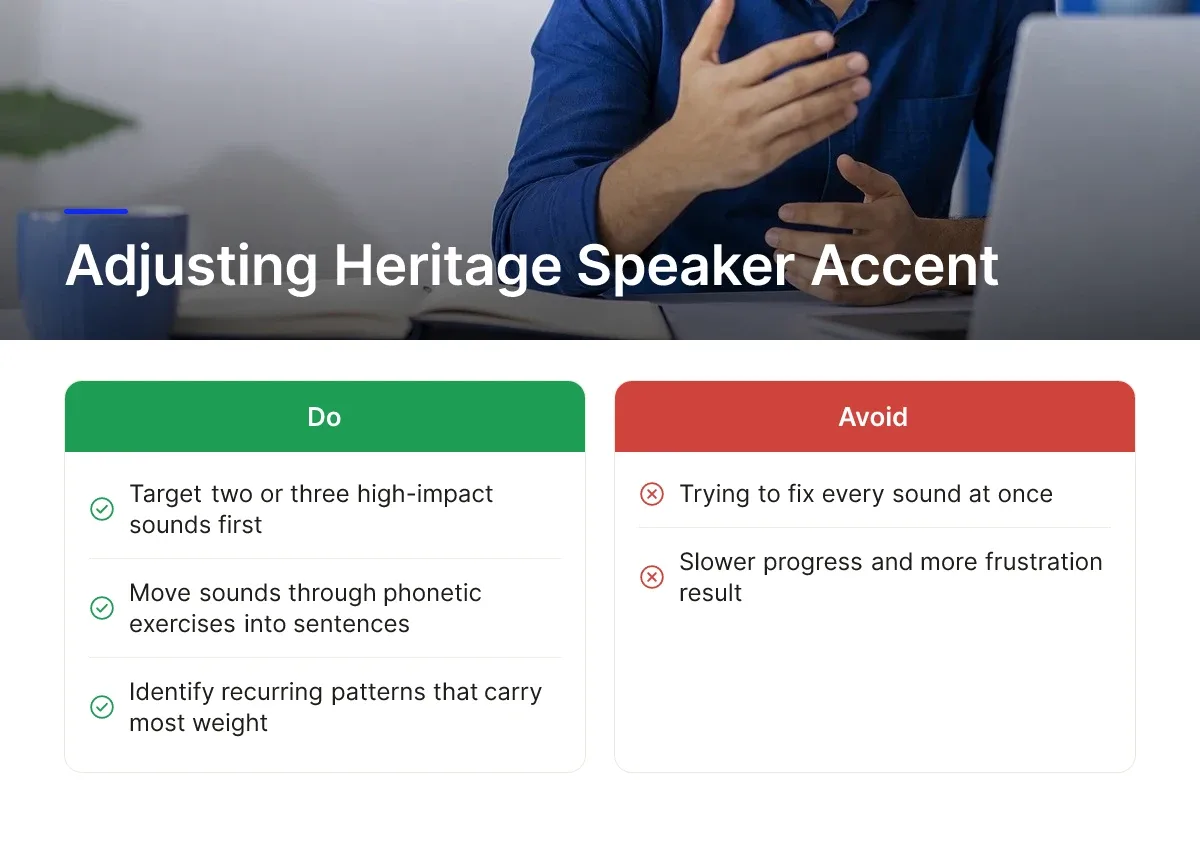
The most effective approach targets two or three high-impact sounds first, then moves them through phonetic exercises into full sentences with American stress and intonation. Trying to fix every sound at once usually leads to slower progress and more frustration than picking a small, specific target.
A heritage speaker accent is rarely one error. It’s usually a handful of recurring patterns: a vowel that merges two English sounds into one, a consonant pronounced with the tongue position of the heritage language, or a rhythm that stays even instead of stress-timed. Identifying which two or three patterns carry the most weight in intelligibility, often a vowel contrast and a consonant like /θ/, /r/, or a reduced final consonant, gives the practice a clear starting point instead of a vague goal like “sound more American.”
How Can Heritage Speakers Practice Individual American Sounds and Phonetic Exercises?
Start by isolating the sound: where the tongue touches, how wide the lips open, whether the vocal cords vibrate. For a sound like the American /r/, that means pulling the tongue back without touching the roof of the mouth, a position that feels unfamiliar for speakers whose heritage language uses a tapped or trilled r.
Once the isolated sound is consistent, phonetic exercises carry it into connected speech: sound combinations (“str” in “street”), reductions (“want to” becoming “wanna”), and assimilations where one sound shifts to match its neighbor. This is where InPronunci’s course moves students after sound articulation training, using phonetic exercises designed to make a corrected sound automatic rather than something the speaker has to consciously control mid-sentence. The Interactive Visual 2D Sound Simulators train the tongue, lips, jaw, and airflow for each target sound before the phonetic drills begin, so students start the exercises with an accurate articulation pattern already in place.
What Role Does Sentence-Level Practice and Intonation Training Play in Accent Adjustment?
Sentence-level practice matters because American English relies on stress-timed rhythm, where stressed syllables fall at roughly even intervals and unstressed syllables compress or reduce. A speaker who nails every vowel in isolation but keeps each syllable equal length will still sound non-native, because the rhythm pattern itself signals a different first-language background.
A short routine for today: pick one vowel or consonant, drill it in minimal pairs (ship/sheep, van/ban), then place it inside three or four full sentences. Record yourself saying those sentences, then compare the recording against a native-speaker model, listening specifically for where stress falls and which words reduce. This mirrors the comparison step built into InPronunci‘s Your Coach vs. My Pronunci tool, where students notice gaps and adjust consciously rather than guessing.
Cognitive Accent Training
Cognitive Accent Training: Learn to Recognize and Correct Your Own Pronunciation
Have you ever listened to yourself speaking English and noticed that your pronunciation sounds different from an American speaker’s, but weren’t sure why?
InPronunci incorporates Cognitive Accent Training to help students recognize their existing pronunciation habits and become more aware of how they speak.
Through Your Coach vs. My Pronunci, students listen to their own recordings, compare them with an American pronunciation model, and actively identify differences in sounds, stress, rhythm, and intonation.
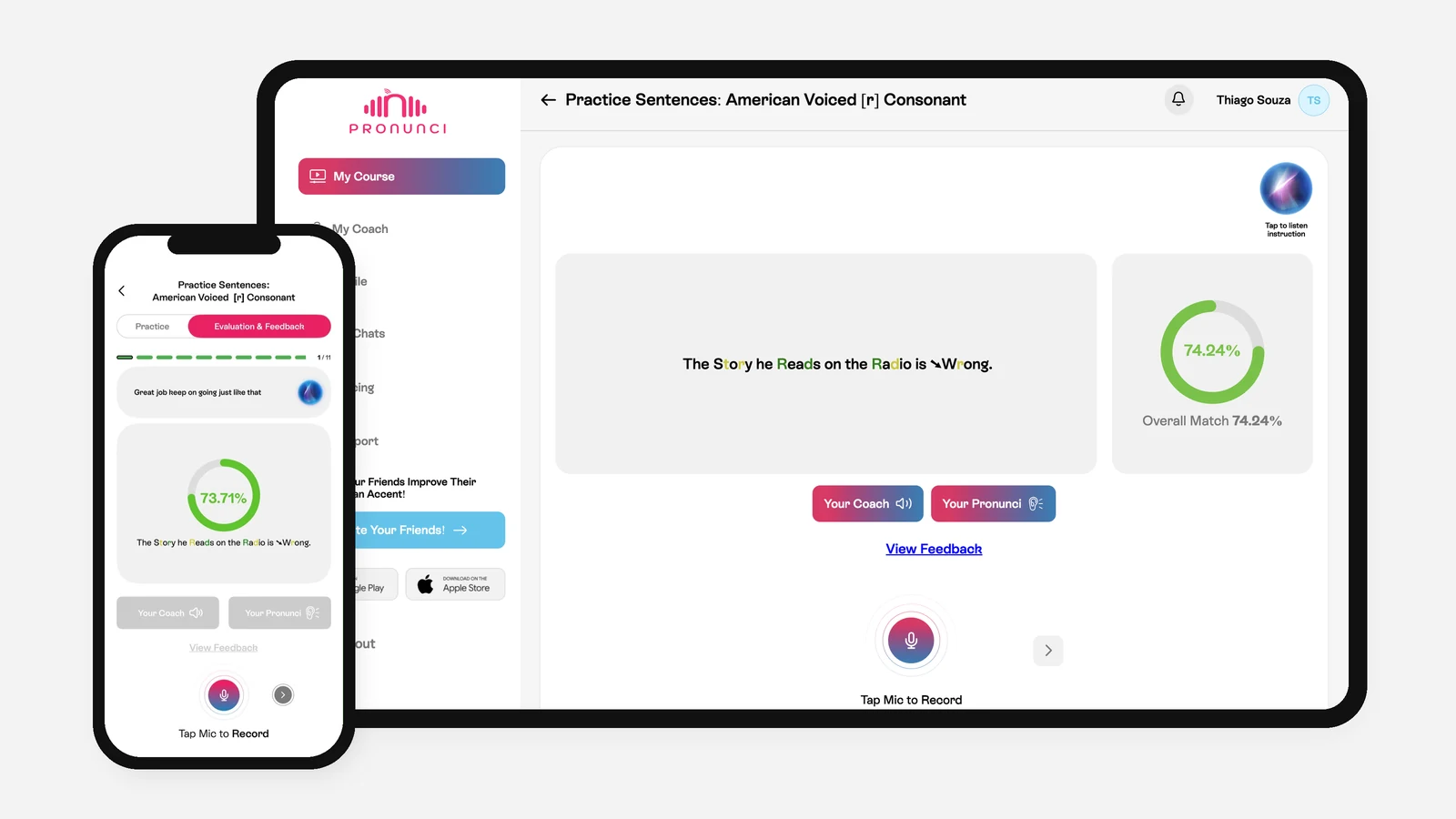
Prof. Alex’s Pronunci Instructions then guide students in understanding how to approach those corrections, while Interactive Visual 2D Sound Simulators support active articulation practice.
The process is simple:
Listen → Compare → Recognize → Understand → Practice → Correct → Recheck
Instead of relying entirely on an AI pronunciation score, students learn to participate actively in evaluating and improving their own speech.
The goal is to help students become increasingly capable of recognizing their pronunciation differences and correcting them independently.
- Hear the American ModelThe model American pronunciation of each practice sentence.
- Recognize Your DifferencesCompare your recorded speech with the American pronunciation model to identify differences in sounds, stress, rhythm, and intonation.
- Practice Your CorrectionsUse Pronunci Instructions and AI feedback to understand which pronunciation differences need attention, practice corrections, and compare your speech again.
For readers who want to go deeper on how sounds link and reduce across word boundaries, the connected speech guide covers the linking and reduction patterns that sentence-level drills depend on, and the tongue placement guide breaks down articulation for individual sounds in more detail.
How Can Heritage Speakers Train Their Speech Organs for Accurate American Sounds?
Heritage speakers train speech organs by isolating the exact tongue, lip, and jaw position for each sound, then rebuilding it through phonetic exercises, sentences, and full paragraphs.
A heritage speaker accent usually traces back to a handful of recurring substitutions rather than a general difficulty with English. Correcting it starts with precise articulation, not repetition of whole words.
What Is the Best Way to Train Tongue, Lips, and Jaw Placement for American Consonants and Vowels?
Take the American R, one of the sounds heritage speakers most often inherit a substitute for from a home language. The tongue tip curls back slightly without touching the roof of the mouth, the back of the tongue tenses, and the lips round just a little, as in “car” or “report.” Speakers whose heritage language uses a tapped or trilled R (common in Spanish, Portuguese, and several South Asian languages) often tap the tongue against the gum ridge instead, producing a short flap rather than the sustained American R.
The same pattern shows up with vowels. A heritage speaker accent shaped by a language with fewer vowel distinctions may flatten “ship” and “sheep” into the same sound, because the home language never required a jaw and tongue-height difference that English does. The fix is physical: lower the jaw slightly more for “sheep,” tense the tongue, and hold the vowel longer. These are speech-organ adjustments, not vocabulary problems, and they respond to targeted practice rather than general conversation practice.
How Do Heritage Speakers Move From Sound Articulation to Natural, Automatic American Speech?
Accurate articulation only becomes natural speech when it moves through four stages: isolated sound training, phonetic exercises, sentence-level practice with stress and intonation, and paragraph-level delivery. Skipping straight to conversation practice is why many heritage speakers plateau. The correct R or vowel shows up when they think about it, then disappears under the pressure of real speech.
InPronunci: American Accent Training App follows this exact four-stage path, the same one Prof. Alex, Ph.D. Accent Coach, Doctor of Education, and professional linguist, uses in 1-on-1 training. Students start with the Interactive Visual 2D Sound Simulators, which train the tongue, lips, jaw, and airflow for each American vowel and consonant, guided by Pronunci Instructions in every lesson. From there, phonetic exercises make the sound automatic, sentence practice adds stress and intonation, and paragraph practice builds presentation-style delivery for meetings, interviews, and everyday conversation.
Evaluation Mode, including the AI Accent Coach, tracks pronunciation, intonation, rhythm, and connected speech across full sentences and paragraphs, not just a single word or sound, so progress is visible at the level where accents actually show up. For a closer look at how that evaluation works, see the AI Accent Coach guidelines, and for the full articulation framework, see the pillar guide on tongue placement in English sounds.
If speech sounds are difficult to control for reasons beyond typical first-language influence, such as a history of hearing loss or a diagnosed speech disorder, consult a licensed speech-language pathologist. InPronunci is structured practice, not therapy or diagnosis.

Questions & Answers
Frequently Asked Questions
01Is having a heritage speaker accent a sign of weaker English skills?
No, a heritage speaker accent has nothing to do with English proficiency. Many heritage speakers have strong vocabulary, grammar, and fluency, but their pronunciation still carries subtle sound, stress, or intonation patterns from the language spoken at home growing up. Accent and competence are separate skills, and clear pronunciation can be trained independently of vocabulary or grammar.
02At what age do heritage speaker accent patterns usually become fixed?
There is no fixed age; pronunciation habits can shift at any stage with targeted practice. Patterns formed in early childhood tend to feel more automatic by adulthood, which is why they persist even after years of fluent, grammatically accurate English. Age affects how automatic the habits feel, not whether they can be retrained.
03Can heritage speakers sound completely native if they practice enough?
No app or coach can honestly guarantee a fully native-like accent, and that outcome varies by speaker. Consistent, structured practice on individual sounds, stress, and connected speech can bring pronunciation much closer to General American patterns. Results depend on regular practice and using the new pronunciation habits in daily conversation, not on a fixed timeline.
04Should parents worry that bilingual exposure will cause a permanent accent in their children’s English?
No, bilingual exposure does not cause a permanent accent, and it should not be treated as a problem to avoid. Growing up with two languages brings cognitive and social benefits, and pronunciation patterns can be addressed later through structured practice if a child or adult chooses. Bilingualism is an asset, not an error to correct early.
Conclusion
A heritage speaker accent comes from real bilingual history, not from a gap in English ability. Reducing it starts with isolating the specific sounds, stress patterns, or intonation habits carried over from the home language, then retraining them sound by sound before moving into sentences and full conversation. Progress depends on consistent, structured practice, not on waiting for the accent to fade on its own.
A practical next step: train Chapter 1 (Speech Organs Education) free on InPronunci’s web platform, the App Store, or Google Play, and see which specific sounds need the most work before committing to a full plan.
Sources & References
- Do Accent Reduction Classes Work? | ALTA Language Services
- Bilingual children’s social preferences hinge on accent – PMC
Recommended Articles

5 Pronunciation Assessment Tools to Track Your Progress
Discover the pronunciation assessment tools and features that matter most for tracking progress toward clear, native-like American English speech.

What an English Accent Coach Online Can Really Do for You
A structured English accent coach online works by combining expert-designed training with technology that evaluates your full speech as you talk, not just...

Why Is English Pronunciation So Difficult to Master?
Explore why is English pronunciation difficult for non-native speakers, focusing on speech-organs coordination and training techniques.